INTRODUCTION
Ontogenetic changes in habitat use and diet of intertidal invertebrates and fish have been amply reported (e.g. Steger, Reference Steger1987; Cancino & Castilla, Reference Cancino and Castilla1988; Moreno et al., Reference Moreno, Asencio and Ibañez1993; Muñoz & Ojeda, Reference Muñoz and Ojeda2000; Moksnes, Reference Moksnes2002; Hiddink, Reference Hiddink2003; Erlandson et al., Reference Erlandson, Porri and McQuaid2008). These changes arise through spatial variation in size- or age-dependent selective pressures, and can be critical for juvenile survival and the species' ecology. In the case of top predators, variation in diet between recruits and adults can be essential to understand the dynamics and persistence of the predator–prey system across biogeographic scales, as well as the consequences for local food webs (Steger, Reference Steger1987; Woodward et al., Reference Woodward, Speirs and Hildrew2005; Wieters et al., Reference Wieters, Gaines, Navarrete, Blanchette and Menge2008). As early life stages are usually more vulnerable to biotic and abiotic factors (Gosselin & Quian, Reference Gosselin and Quian1997), poor knowledge about the ecology of early life stages may lead to important limitations in our understanding of community and ecosystem-level processes (Barker, Reference Barker1979; Rumrill, Reference Rumrill1989; Himmelman & Dutil, Reference Himmelman and Dutil1991).
Asteroid predators are both conspicuous and functionally important components of marine benthic ecosystems (Menge, Reference Menge, Jangoux and Lawrence1982). Many of these species play important ecological roles controlling the abundance of prey and overall community structure (Paine, Reference Paine1966; Navarrete & Castilla, Reference Navarrete and Castilla2003; Menge et al., Reference Menge, Blanchette, Raimondi, Freidenburg, Gaines, Lubchenco, Lohse, Hudson, Foley and Pamplin2004). Ease of observation and manipulation has facilitated the development of studies documenting their foraging, reproductive and general ecology (Feder, Reference Feder1959; Menge, Reference Menge1972; Paine, Reference Paine1976; Dayton et al., Reference Dayton, Rosenthal, Mahen and Antezana1977; Keough & Butler, Reference Keough and Butler1979; Tokeshi, Reference Tokeshi1989a; Menge et al., Reference Menge, Berlow, Blanchette, Navarrete and Yamada1994; Lawrence & Vásquez, Reference Lawrence and Vásquez1995; Robles et al., Reference Robles, Sherwood-Stephens and Alvarado1995; Navarrete et al., Reference Navarrete, Menge and Daley2000; Harley et al., Reference Harley, Pankey, Wares, Grosberg and Wonham2006; Sanford & Menge, Reference Sanford and Menge2007). However, the great majority of these studies have focused on juvenile and adult stages and much less is known about recruitment and the ecology of early life stages of many of the most common species (but see Barker, Reference Barker1977; Sewell & Watson, Reference Sewell and Watson1993; Balch & Scheibling, Reference Balch and Scheibling2000; Carlson & Pfister, Reference Carlson and Pfister1999; Witman et al., Reference Witman, Genovese, Bruno, McLaughlin and Pavlin2003).
The South American sun star, Heliaster helianthus (Lamarck) is the most common and ecologically important intertidal sea-star along the south-eastern Pacific coast down to about 34°S (Castilla & Paine, Reference Castilla and Paine1987; Tokeshi, Reference Tokeshi1989b). Individuals are found from the mid-upper intertidal zone down to shallow (<10 m deep) subtidal areas (Viviani, Reference Viviani1978; Gaymer & Himmelman, Reference Gaymer and Himmelman2008). Studies on this species have focused on diet analyses, foraging patterns, its community-wide effects on wave-exposed rocky platforms (Castilla, Reference Castilla1981; Paine et al., Reference Paine, Castilla and Cancino1985; Castilla & Paine, Reference Castilla and Paine1987; Tokeshi, Reference Tokeshi1989a, Reference Tokeshib; Navarrete & Castilla, Reference Navarrete and Castilla2003; Navarrete & Manzur, Reference Navarrete and Manzur2008), movement patterns (Barahona & Navarrete, in review), and growth (autotomy) responses to sub-lethal predation by other sea-star predators in shallow subtidal habitats (Gaymer & Himmelman, Reference Gaymer and Himmelman2008; Barrios et al., Reference Barrios, Gaymer, Vásquez and Brokordt2008).
Despite the major ecological role that Heliaster plays in intertidal communities (Paine et al., Reference Paine, Castilla and Cancino1985; Navarrete & Castilla, Reference Navarrete and Castilla2003), remarkably little is known about early developmental stages. Studies by Wieters et al. (Reference Wieters, Gaines, Navarrete, Blanchette and Menge2008) and Navarrete & Manzur (Reference Navarrete and Manzur2008) showed that density and biomass of sun stars are not well correlated to variation in recruitment of mussel or barnacle prey across sites in central Chile, lending support to a predator–prey model with open population structure. Weak spatial correlations between adult predator abundance and productivity of the main prey might be reinforced when predator recruits exploit a food source different than adults. Early life stages of Heliaster are nearly absent in the habitat occupied by late juvenile and adults in intertidal or subtidal habitats (Castilla, Reference Castilla1981; Gaymer & Himmelman, Reference Gaymer and Himmelman2008; Navarrete & Manzur, Reference Navarrete and Manzur2008), suggesting that recruitment is either very sporadic and/or takes place in a different habitat than the one occupied by the adult population (see also Tokeshi, Reference Tokeshi1989b). Taken together, there is a need to identify the location and general ecology of Heliaster young in order to understand the effects of this keystone species on intertidal communities. Here we describe the results of surveys designed to fill this gap, quantify the abundance of recruits of the sun star across central Chile, and determine whether this species undergoes an ontogenetic change in habitat use and diet.
MATERIALS AND METHODS
Study sites and field surveys
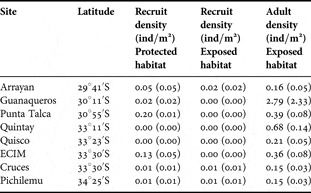
Field surveys conducted between 1998 and 2005 at 16 sites spread over 900 km in central-northern Chile (between 28 and 34°S) showed that Heliaster helianthus populations at wave-exposed habitats are truncated at small body sizes (see Navarrete & Manzur, Reference Navarrete and Manzur2008). Studies conducted in biogenic habitats such as mussel beds, algal turfs and kelp holdfasts have not reported the presence of Heliaster recruits (Cancino & Santelices, Reference Cancino and Santelices1984; Navarrete & Castilla, Reference Navarrete and Castilla1990; Prado & Castilla, Reference Prado and Castilla2006). Moreover, the small fraction of the population that extends into shallow subtidal (~3 m) is composed of only adult individuals (Gaymer & Himmelman, Reference Gaymer and Himmelman2008). Therefore, during 2004 we expanded surveys to include other intertidal microhabitats, including protected platforms, rock crevices, vertical walls, and boulder fields. Based on these initial surveys, we defined recruits, juveniles and adults as individuals with maximum diameters smaller than 35 mm, between 35 and 65 mm and larger than 65 mm, respectively. In summer 2008 we focused our surveys at eight sites in which small-sized individuals had been observed (Figure 1). The number of individuals smaller than 35 mm found in sweep transects parallel to the shoreline for a time period of 15 minutes was recorded in each of the different microhabitats mentioned above. Two to three replicate transects were conducted in each site and the total area of each transect was then measured. Data were expressed as number of individuals per unit area (Table 1). For comparison, we also present the density of recruits in sweep transects in wave exposed platforms conducted at the same sites (see Navarrete & Manzur, Reference Navarrete and Manzur2008 for details of methods).
Map of the study region along the coast of north-central Chile indicating the location of study sites included in field surveys (white circles) and the two permanent study sites (black circles).

Average density (SE) of Heliaster helianthus recruits (<35 mm diameter) and adults (>65 mm) at eight different sites between 29 and 34°S, at protected boulders and crevices and at exposed platforms of each sampled site.

ECIM, Estación Costera de Investigaciones Marinas.
Size structure, density and diet
Only two sites, Las Cruces and Punta Talca (Figure 1), presented abundances of recruits and juveniles high enough to characterize the distribution and feeding habits of young Heliaster (see under Density in Results). It must be noted that attempts to use artificial collectors to quantify Heliaster recruitment, between 2000 and 2005, including scrubbing pads, PVC cylinders, plastic mesh, and Astroturf never rendered good results. At Las Cruces the sampling site was located inside the marine protected area of the Estación Costera de Investigaciones Marinas (ECIM). This site is a small, relatively wave protected boulder beach, located at the southern biogeographic end point reported in the literature for Heliaster, but we have observed persistent populations about 300 km to the south (Broitman et al., Reference Broitman, Navarrete, Smith and Gaines2001; Navarrete & Manzur, Reference Navarrete and Manzur2008). The other site, Punta Talca, is 378 km north of the ECIM, and corresponds to a semi-vertical rock wall moderately exposed to wave action and with abundant crevices. At ECIM, individuals were found under boulders of different sizes while at Punta Talca, individuals were found hidden in crevices. Further description of sites and patterns of community structure can be found in Broitman et al. (Reference Broitman, Navarrete, Smith and Gaines2001), Navarrete et al. (Reference Navarrete, Broitman, Finke, Sotomayor, Venegas and Wieters2002, Reference Navarrete, Wieters, Broitman and Castilla2005).
Monitoring every 3–6 months began in 2004 at ECIM, and in 2005 at Punta Talca, and extended until February 2008. During April 2006, we shifted the monitoring area at Punta Talca to a section that had similar size–frequency distributions but higher density of recruits and juveniles than the initial sampling area, to allow for better descriptions of diet and temporal density fluctuations. Therefore, temporal analyses at Punta Talca did not consider sampling conducted in 2005.
At each site the entire study area was vertically divided in three tidal levels (high, mid and low) following the characteristic vertical zonation of the Chilean rocky coast (Santelices et al., Reference Santelices, Cancino, Montalva, Pinto and Gonzalez1977; Castilla, Reference Castilla1981). At both sites plots between 9 and 23 m2 were permanently marked at each tidal height ensuring that the sampled area was constant between surveys. All individuals found within plots were counted and measured (distance between the two largest ray tips) to the nearest mm with Vernier calipers. Changes in mean and modal sizes through time and tidal levels and estimated growth rates at each site by length–frequency analyses with the freeware FISAT II were examined (http://www.fao.org/fi/statist/fisoft/fisat/index.htm). Length–frequency analyses were performed through modal progression with Bhattacharya's method, ‘linking’ of cohort means, and estimation of growth parameters with a von Bertalanffy growth function (Gayanilo et al., Reference Gayanilo, Sparre and Pauly2006).
To characterize the diet of the different size-classes of Heliaster (i.e. recruits, juveniles and adults), all individuals measured within the permanent plots were inspected and considered to be eating when prey were found in its oral region. If eating, all prey were removed with forceps, placed in labelled bags, and taken to the laboratory where they were identified to the lowest taxon (generally to species) and measured. Individual sun stars were returned to their original position in the field.
Inspection of rarefaction curves (Gotelli & Colwell, Reference Gotelli and Colwell2001) indicated that 15 to 20 individuals were necessary to represent diet diversity of each size-class. Hence, our sample size (N ≥ 20) should provide an adequate estimation of Heliaster diet diversity. Diet diversity was quantified using Shannon–Wiener diversity index (Log e).
Statistical analysis
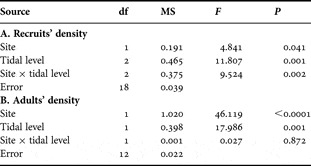
Differences in recruit density across tidal heights and between monitoring sites were assessed by a two-way analysis of variance (ANOVA), with site and tidal height as fixed factors. Assuming statistical independence between density data for recruits and adults, a separate two-way ANOVA was used to contrast adult density between sites and tidal levels (considered as fixed factors), but eliminating the high intertidal zone because no individuals were found at this level at Punta Talca. No statistical comparisons were conducted for juveniles.
The size segregation pattern at each site was analysed by a Welch one-way ANOVA for heterogeneous variances comparing sizes (log-transformed data) among tidal levels and pooling all years for simplicity. A posteriori comparisons were performed by a Tukey multiple comparison test (Quinn & Keough, Reference Quinn and Keough2002).
Both among site differences in Heliaster diet and differences in diversity of consumed prey with increasing body size were assessed by a Welch one-way ANOVA for heterogeneous variances. Separate one-way Welch ANOVAs were conducted for each site.
RESULTS
Density
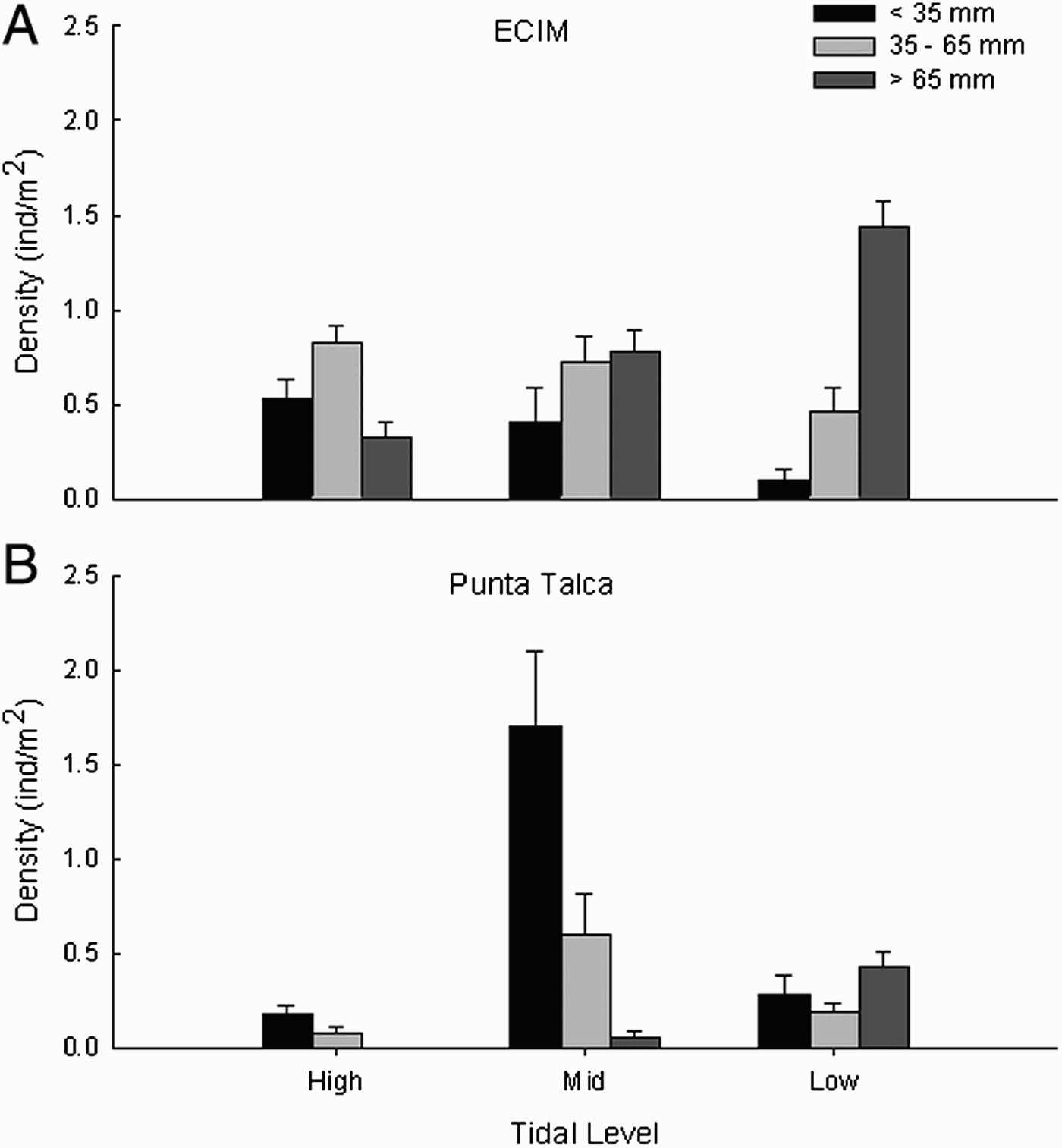
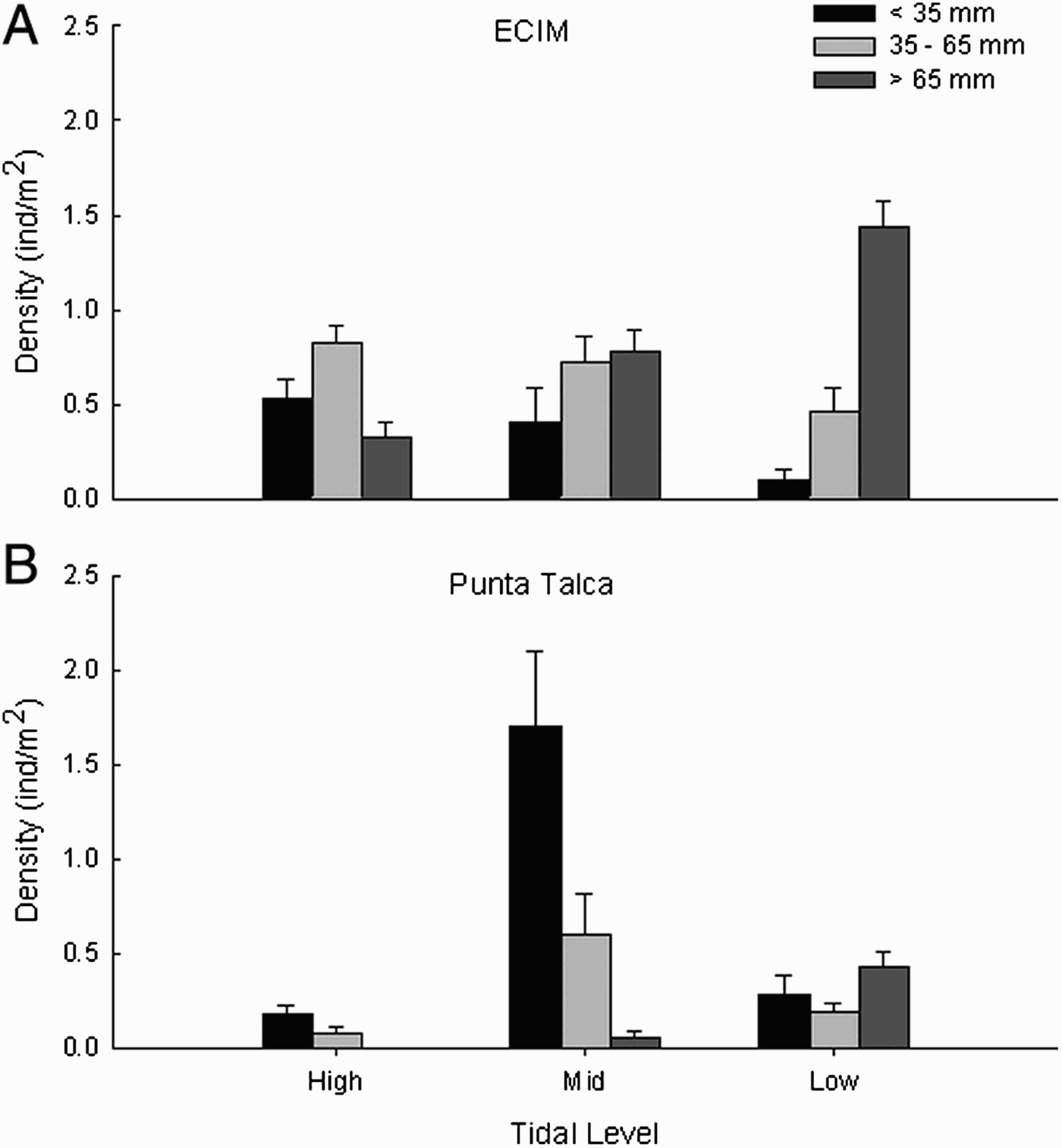
Surveys conducted at eight sites confirmed previous observations of the near absence of Heliaster helianthus recruits from wave exposed platforms where adults are common. Higher densities of recruits were observed at most sites in more wave-protected boulders and crevices than in the exposed platforms (Table 1). The highest densities of sun star recruits were observed at ECIM, Punta Talca and to a lesser extent Arrayan (Table 1). At the two regular monitoring sites, long-term average density of recruits was higher in the high or mid intertidal zones of ECIM and Punta Talca, respectively, than in the low zone (Figure 2). Recruit density across tidal heights was significantly different between monitoring sites, because peak density was reached in the high zone of ECIM but in the mid zone of Punta Talca (Table 2, significant site × tidal level interaction). In contrast to recruits, a clear trend to increasing density of adults from high to low levels was observed at both monitoring sites (Figure 2). Adult sun star density was higher in low intertidal zones at both sites even though it reached higher values at ECIM than at Punta Talca (Table 2). Thus a pattern of size segregation by tidal level was apparent for both sites, but with some differences between them.
Mean density (±SE) of Heliaster helianthus by size-class and tidal level at (A) Estación Costera de Investigaciones Marinas (ECIM) and (B) Punta Talca.
Results of two-way ANOVA with site and tidal level as fixed factors. Separate analyses were performed for (A) recruits' density and (B) adults' density of Heliaster helianthus (see text for details).

At ECIM, recruit density showed a sharp temporal decrease from the beginning of the study in August 2004 until May of 2006 when it reached a steady level at a density of 0.14 (ind/m2) (Figure 3A). Signs of recovery were observed only in March of 2008 when density reached over 0.2 ind/m2. Densities of juveniles were variable but also decreased over time, while density of adults increased over time (Figure 3A). Markedly different density fluctuations were observed at Punta Talca (Figure 3B). Between April and July 2006, recruit density decreased, then increased rapidly to reach over 1.1 ind/m2 by October of the same year and decreased sharply to less than 0.1 ind/m2 by July 2007, when density increased rapidly again. Juvenile and adult density fluctuated through time but did not show a clear temporal trend through the study period as seen in ECIM.
Density of Heliaster helianthus by size-class at (A) Estación Costera de Investigaciones Marinas and (B) Punta Talca on different survey dates. In panel (B) the break at 2005 indicates the change of monitoring site at Punta Talca (see text for details).

Temporal and tidal patterns of size structure
Examination of size–frequency distributions revealed marked size segregation across tidal levels at both sites, as well as evidence for recruitment events and individual growth. At both sites, unimodal frequency distributions, with high representation of recruits and the near absence of adult individuals, were observed in high intertidal zones. Mid tidal elevations were biased to larger sizes due to the presence of juveniles and a few adults and, a flat or multimodal size distribution was found at low tidal elevations where adults were common (Figures 4 & 5). At ECIM a clear increase in average and modal sizes of individuals was observed from high to mid and low intertidal zones on all sampling years (Figure 4; F = 134.94; df = 2, 606.18; P = 0.0001).
Size structure of Heliaster helianthus by intertidal level and year, between 2004 and 2008 at Estación Costera de Investigaciones Marinas. The mean and modal sizes are indicated, except for the low tidal level where there are multimodal distributions.

Size structure of Heliaster helianthus by intertidal level and year, between 2005 and 2008 at Punta Talca. Plots for the high and low tidal levels were omitted in 2008 due to the scarcity of individuals.

At Punta Talca, no clear changes in mean and modal sizes were observed between high and mid intertidal zones, but there was a clear increase in size between mid and low intertidal zones (Figure 5; F = 20.16; df = 2, 159.23; P = 0.0001).
Within tidal levels, temporal changes in average and modal sizes were apparent, particularly in the high and mid intertidal zones of ECIM. In the high intertidal zone, a modal size of 30 mm in 2004 gradually moved to larger sizes over successive years and reached 82 mm in 2007. In 2008 the modal size had decreased while mean size increased slightly, suggesting the arrival of new recruits. At the mid intertidal zone, a similar modal displacement through years was observed, although in 2007 a second mode was observed. In the low zone, a bimodal or multimodal size distribution was evident, which could be due to an overlap of different cohorts, but low sample size does not allow more detailed analyses of modal separation. It is worth noticing a decrease of small individuals from 2004 through to 2008 at this tidal level. At Punta Talca, the modal size remained fairly constant over the years, with no clear increase in average body size through time within tidal level, suggesting that influx of new individuals was more persistent at this site.
Growth rates, estimated using the software FISAT II, fluctuated between 20.1 and 26.0 mm y−1, depending on whether individual sampling dates or pooled yearly data were analysed, with no apparent differences between the two study sites. These growth estimates should be considered as preliminary due to low sample sizes for length–frequency based analyses at both sites.
Diet
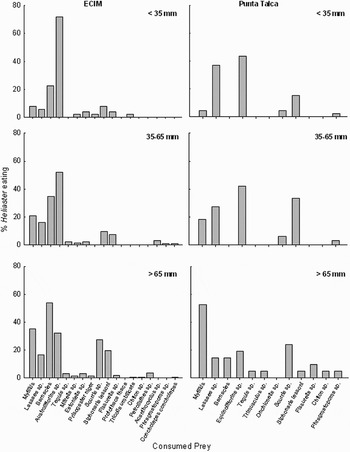
The frequency of individuals found feeding varied between 18.8 and 56.7% at Las Cruces and between 12.5 and 46.2% at Punta Talca, with no differences between sites or between seasons (winter = 35.5 ±3.1%, summer = 30.6 ±4.3%). Sample size to characterize Heliaster diet varied between 21 and 168 individuals per size-class depending on natural variation in density, particularly at Punta Talca. The diet changed in composition with increasing body size. At ECIM Heliaster recruits fed mostly on the periwinkle Austrolittorina araucana (Orbigny; Figure 6). Juvenile individuals also fed on A. araucana and incorporated mussels and barnacles. In contrast, adults preyed mainly on barnacles and mussels and, to a lesser extent, on limpets Scurria spp. and the pulmonate Siphonaria lessoni (Blainv.; Figure 6). At Punta Talca a similar ontogenetic change in Heliaster diet composition was observed. Recruits were mostly found preying on A. araucana, while juveniles consumed mussels and several species of Scurria spp. In turn, adult individuals primarily consumed mussels and to a lesser extent Scurria spp.
Percentage of prey consumed by recruits (<35 mm), juveniles (35–65 mm) and adults (>65 mm) of Heliaster helianthus at the two study sites.

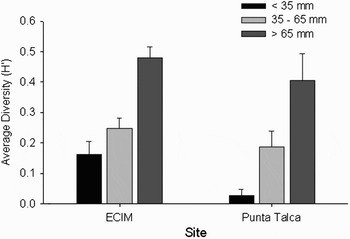
Across all size-classes, diet diversity of Heliaster was significantly higher at ECIM than at Punta Talca (Figure 7, F = 20.90; df = 1, 186.85; P < 0.0001). At both sites, a clear increase in diversity of consumed prey was observed with increasing body size (Figure 7, ECIM: F = 19.76; df = 2, 151.98; P = 0.0001; Punta Talca: F = 11.46; df = 2, 34.09; P = 0.0002). In general, diet diversity of an adult individual doubled the diversity of prey consumed by recruits.
Diet diversity (H′ ±SE) for recruits (<35 mm), juveniles (35–65 mm) and adults (>65 mm) of Heliaster helianthus at the two study sites.

DISCUSSION
Our results support the existence of an ontogenetic change in habitat use patterns and diet composition and breath of the predatory sun star Heliaster helianthus along the coast of central Chile. Recruits occupied boulder fields and crevices in the high or mid-high intertidal zones of wave-protected habitats and appear to move down towards lower tidal levels as they grow. Adults are characteristically found in low intertidal zones of wave exposed and semi-exposed habitats. These changes in habitat use are accompanied by changes in diet composition, which are reflected in the proportion of different prey items and a clear increase of prey diversity.
In general, small and juvenile sea-stars have been found in places or habitats different from those occupied by the adult population (Barker, Reference Barker1979; Scheibling, Reference Scheibling1980; Chia et al., Reference Chia, Young and McEuen1984; Himmelman & Dutil, Reference Himmelman and Dutil1991; Verling et al., Reference Verling, Crook, David, Barnes and Simon2003). For instance, Scheilbling (1980) reports the paucity of juveniles of Oreaster reticulatus (Linnaeus) in shallow-water seagrass habitats (beds of Halodule wrightii (Asch)) where the adults are found. He suggests that settlement and early post-metamorphic development may occur in nursery areas, such as dense beds of Thalassia testudinum (Banks & Soland), and that recruitment to adult habitat may occur at a late juvenile stage. In Heliaster, the size segregation occurs between comparatively wave-protected cryptic habitats (boulder fields and deep crevices) and platforms usually more exposed to wave action, as well as across tidal levels.
Ontogenetic changes in diet composition have also been reported for other asteroids (Menge & Menge, Reference Menge and Menge1974; Barker, Reference Barker1979; Barker & Nichols, Reference Barker and Nichols1983; Himmelman & Dutil, Reference Himmelman and Dutil1991; Verling et al., Reference Verling, Crook, David, Barnes and Simon2003). In some species, dramatic changes from herbivory to carnivory have been reported, like the sea-star Stichaster australis (Verrill) which changes from eating coralline algae to mussels (Barker, Reference Barker1979). In other species size-related diet variation involves changes in the proportions of food items or the diversity of prey species consumed, such as in Pisaster ochraceus (Brandt; Menge & Menge, Reference Menge and Menge1974). In the case of Heliaster, individuals are generalist carnivore predators throughout their benthic life history (Figure 6). Differences in diet breath between size-classes (Figure 7) may be due to morphometric/mechanical restrictions of small individuals and not to actual preferences for different prey. The ontogenetic shift in this predator highlights the need for studies to determine the ecological role of recruits and early juveniles on prey assemblages found in their cryptic microhabitats. A recent study showed that the large individuals of Heliaster found in the shallow subtidal do not appear to play a keystone role in that habitat because they face high predation risks by the larger subtidal sea-star Meyenaster gelatinosus (Gaymer & Himmelman, Reference Gaymer and Himmelman2008). Whether other predators also control the feeding activity of Heliaster recruits in the upper intertidal zone must be investigated.
The ecological processes maintaining size segregation patterns in Heliaster are not well understood. A commonly proposed explanation is changes in feeding preferences and sometimes feeding physiology associated with body size (Sloan, Reference Sloan1980; Himmelman & Dutil; 1991, Verling et al., Reference Verling, Crook, David, Barnes and Simon2003). In the case of Heliaster, small individuals consume a small subset of the prey consumed by adults (at different proportions), suggesting no major physiological changes associated with diet changes. While changes in prey preferences between recruits and adults should be investigated, the observed diet changes seem to reflect changes in prey availability between microhabitats and sites. Thus we speculate that differences in diet are only a consequence of differences in habitat use and are not causing the spatial segregation. Microhabitat selection by settling larva may also play a major role. We suggest that settlement of Heliaster occurs mostly at the high intertidal zone of protected habitats and that post-settlement survival may be higher there than in the low intertidal zone or the shallow subtidal. This pattern is opposite to that observed in other intertidal sea-star species such as Pisaster ochraceus or Stichaster australis, where settlers are found in the low intertidal zone or even in the shallow subtidal, below the adult distribution (Barker, Reference Barker1979; Sewell & Watson, Reference Sewell and Watson1993). Nevertheless, it is comparable, for instance, to the pattern observed for the snail Tegula funebralis, which settles in the high zone and then migrates into the low zone later in life (Paine, Reference Paine1969). Paine suggests that Tegula juveniles attain higher growth rates and avoid predators at the high intertidal zone, which could also explain size-segregation in Heliaster. In the intertidal zone, the conspicuous adult Heliaster are virtually immune to most predators except for occasional consumption by seagulls (Castilla, Reference Castilla1981), while in the shallow subtidal the predatory sea-star Meyenaster gelatinosus appears to have a strong impact on Heliaster adults (Dayton et al., Reference Dayton, Rosenthal, Mahen and Antezana1977; Gaymer & Himmelman, Reference Gaymer and Himmelman2008). The often sub-lethal predation by Meyenaster on adult Heliaster could be lethal for juveniles (Barrios et al., Reference Barrios, Gaymer, Vásquez and Brokordt2008; Gaymer & Himmelman, Reference Gaymer and Himmelman2008), restricting the distribution of small individuals (6–8 cm in radius) to the intertidal zone. Additionally, Viviani (Reference Viviani1978) reported cannibalism by large Heliaster individuals on smaller ones, which could further segregate recruits to the upper intertidal zone, although we have rarely seen cannibalistic interactions in the field. Thus the greater susceptibility to predators suggests that risks of predation can be an important determinant of the spatial distribution for Heliaster's early life stages. This is the case reported for the sea-star Marthasterias glacialis (Linnaeus), in which the juveniles behave cryptically in a structurally complex boulder environment apparently to avoid predation by large crustaceans and seagulls (Verling et al., Reference Verling, Crook, David, Barnes and Simon2003).
Our exhaustive visual inspection of different microhabitats at more than 16 sites on the central coast of Chile over several years confirmed previous reports on the absence of recruits and juveniles of Heliaster from the wave-exposed and semi-exposed low intertidal platforms and walls occupied by large juveniles and adults of this species (Castilla, Reference Castilla1981; Paine et al., Reference Paine, Castilla and Cancino1985; Navarrete & Manzur, Reference Navarrete and Manzur2008). Large temporal fluctuations are expected in the arrival of new individuals and recruitment events could be missed in snapshot surveys (Rumrill, Reference Rumrill1989; see also Menge et al., Reference Menge, Blanchette, Raimondi, Freidenburg, Gaines, Lubchenco, Lohse, Hudson, Foley and Pamplin2004). However, since all these sites were visited on a monthly basis (Navarrete et al., Reference Navarrete, Broitman and Menge2008) and have quantified patterns of community structure and predator abundances over multiple years (Broitman et al., Reference Broitman, Navarrete, Smith and Gaines2001; Navarrete & Manzur, Reference Navarrete and Manzur2008), we believe our surveys captured a persistent pattern of habitat size segregation.
During the four years of study, recruitment patterns inferred from size–frequency distributions varied between sites. Punta Talca showed two, possibly three recruitment events during 2005–2008 while one event (early 2004) was recorded at ECIM (Figure 3). In all cases, marked and rapid decreases in recruit density followed what appeared to be recruitment events. Decreases in density of recruits can be partly explained by growth, but may also indicate high mortality of recruits. High mortality rates (i.e. up to 97%) have been reported for Pisaster ochraceus (Sewell & Watson, Reference Sewell and Watson1993) and deserve investigation in Heliaster. The relatively slow growth rates (20–26 mm y−1) estimated from length–frequency analyses, are in general agreement with growth rates of small individuals of Heliaster fed ad libitum under laboratory conditions (Acosta, Reference Acosta1988), although they are much higher than those measured in laboratory experiments for juveniles by Barrios et al. (Reference Barrios, Gaymer, Vásquez and Brokordt2008). Our estimates of growth rates are also comparable to those reported for other sea-star species, such as Acanthaster plancii (Linnaeus) reared under laboratory conditions (26.4 mm y−1, Yamaguchi, Reference Yamaguchi1974) and one year old individuals of Pisaster ochraceus in the field (22–34 mm, Sewell & Watson, Reference Sewell and Watson1993). Growth estimates were similar for Punta Talca and ECIM, suggesting that differences in diet composition do not translate into large differences in growth rates. However, growth rates inferred from length–frequency data should be taken with caution. Preliminary laboratory studies with small adults (~60–100 mm) fed ad libitum suggest that juvenile Heliaster grow less than 2 mm per year (S.A. Navarrete, unpublished data), which suggests a marked decrease in growth rate as they grow past the most vulnerable stage. Preliminary results indicate that adult population density of Heliaster at the study sites exhibit remarkably little fluctuations over time (J.C. Castilla, unpublished manuscript, authors' personal observations). The effects of low and variable recruitment may be concealed in the adult population because of long temporal delays before recruits reach adult sizes, as has also been suggested for Pisaster ochraceus (Menge et al., Reference Menge, Blanchette, Raimondi, Freidenburg, Gaines, Lubchenco, Lohse, Hudson, Foley and Pamplin2004). Certainly the presence of adult populations at places where no recruits have been found, supports the idea that recruitment is sporadic and in cryptic habitats. Longer term studies considering all life stages are necessary to evaluate the effect of recruitment variability and post-settlement mortality on population dynamics. Since Heliaster seems to be a slow growing and long-lived species, better understanding of the ecology of early life stages and the drivers of ontogenetic changes in habitat use and individual requirements are critical to understand the community-level consequences of this important predatory species.
ACKNOWLEDGEMENTS
We are indebted to Maurin Murua, Alfredo Astorga, Elliott Ramos and Fredy Véliz for assistance in the field. The authors wish to thank J.M. Rojas and B.R. Broitman for valuable comments on earlier versions of this manuscript. The study was supported by Fondecyt grant nos. 1040787 and 1070335 to S.A.N. Titiana Manzur and M.B. acknowledge the Andrew Mellon Foundation for support. Additional funding was provided by a Fondap-Fondecyt grant 15001-001 to the Center for Advanced Studies in Ecology and Biodiversity, which allowed us to maintain long-term monitoring programmes in central Chile.