Implications
Early attainment of puberty predicts anticipation of the heifers’ productive life. This manuscript shows that by using semen from sires with favorable genetic merit for age at first calving and adequate nutrition, a significant percentage of heifers can attain puberty by the first breeding season. On the other hand, heifers born from sires with unfavorable genetic merit for age at first calving had delayed reproductive life even under adequate nutritional conditions. These results clearly show the importance of choosing the sire and its impact on production indexes.
Introduction
Puberty is defined as a sequence of events that results in the first ovulation and subsequently corpus luteum formation, allowing the first pregnancy of heifers (Moran et al., Reference Moran, Quirke and Roche1989). Therefore, puberty may be defined as the beginning of the female’s productive life, which was demonstrated by Brumatti et al. (Reference Brumatti, Ferraz, Eler and Formigonni2011) who observed that puberty onset was an important economic index in beef cattle. Reducing age at first calving from 3 to 2 years increased profitability of the cow-calf operations due to a 138 kg increase of calf produced per cow during a 12-year productive life period (Nunez-Dominguez et al., Reference Nunez-Dominguez, Cundiff, Dickerson, Gregory and Koch1991). In the same line, Terakado et al. (Reference Terakado, Pereira, Yokoo and Albuquerque2015) found that Nelore heifers exposed to an early breeding season (<17 months of age) increased the calves’ weights at weaning, and the odds for precocious heifers to remain in the herd until 5 or 6 years of age.
Nelore is the major breed beef cattle in Brazil and the heifers usually reach puberty from 2 to 3 years of age, weighing ~300 kg (Gunski et al., Reference Gunski, Garnero, Bezerra, Corrado and Lôbo2001; Sereno et al., Reference Sereno, Pellegrin, Lara, Abreu, Sereno and Chalita2001; Nepomuceno et al., Reference Nepomuceno, Pires, Ferraz, Biehl, Gonçalves, Moreira and Day2017). According to the Brazilian Association of Zebu Breeders, the average age at first calving in Nelore is 38±5 months (ABCZ, 2016). Nonetheless, the beginning of heifers’ reproductive life at 14 months of age occurs in a few production systems, when nutritional (Nepomuceno et al., Reference Nepomuceno, Pires, Ferraz, Biehl, Gonçalves, Moreira and Day2017) and genetic (Eler et al., Reference Eler, Silva, Ferraz, Dias, Oliveira, Evans and Golden2002) strategies are explored. Firstly, we hypothesized that high average daily gain (ADG; HG; 0.7 kg/day) in heifers born from sires with low expected progeny difference (EPD) for age at first calving (L) would contribute to reach puberty by 18 months of age, whereas HG by itself would not be sufficient to induce puberty in heifers born from sires with high EPD to age at first calving (H). Our second hypothesis was that heifers submitted to low ADG (LG; 0.3 kg/day) would reach puberty at the same age, regardless whether they were born from L or H sires. Thus, this study aimed to determine the effect of sires’ EPD for age at first calving and ADG on puberty in Nelore heifers.
Material and methods
This experiment was carried out at the Laboratory of Animal Nutrition and Reproduction, Department of Animal Sciences, College of Agriculture Luiz de Queiroz-ESALQ/USP, Piracicaba, SP, Brazil. The Animal Care and Use Committee from the University of São Paulo approved all the procedures with animals (#7595290414).
Animal procedure and nutritional models
A total of 58 Nelore heifers born from four sires (two sires (n=12 and 13, for sire 1 and 2, respectively) with low (EPD of sire 1 within the 10% percentile, and sire 2 within the 20% percentile) EPD for age at first calving and 2 sires (n=11 and 22, for sires 3 and 4, respectively) with high (EPD of both sires within the 90% percentile) EPD for age at first calving, according to the ABCZ (2013) and GENSYS (2013) catalogs), were ranked by initial BW (174±6 kg) and age (9±1 months), then allocated to 28 pens. Nutritional strategies on the present study were either high ADG (HG; 0.7 kg) or low ADG (LG; 0.3 kg). The resulting treatments are hereafter designated as: heifers born from L sires submitted to HG (LHG; n=17) or LG (LLG; n=16), and heifers born from H sires submitted to HG (HHG; n=12) or LG (HLG; n=13). Heifers were also distributed among treatments according to dam because they were generated by in vitro embryo production. The dam (n=20 donors) was not included in the statistical model due to high variability of daughters’ number per dam (1 to 14), but heifers were equally distributed among treatments.
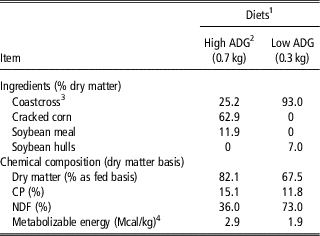
The high and low ADG were obtained by offering different diets and feed amounts. Heifers submitted to LG were fed a grass-based diet, whereas heifers in the HG were fed a grain-based diet. The amount of diet was supplied to obtain an ADG of 0.7 kg and 0.3 kg for HG and LG, respectively. The nutritional profile of both diets is presented in Table 1. Heifers in each treatment were allocated in drylot pens (n=2 or 3 heifers/pen; 3×5 m) containing feed bunks with adequate space for heifers to eat (total space=3 m; 1.0 to 1.5 m per heifer). In addition, heifers had ad libitum access to a mineral supplement (BellNutri 80; Trow nutrition, Cuiabá, MT, Brazil) and water throughout the experimental period.
Ingredients and chemical composition of experimental diets

1 Mineral mix was supplied in mineral boxes ad libitum.
2 Diet from high average daily gain (ADG) contained 30 ppm of sodic monensin (Rumensin 100, Elanco Brazil, São Paulo, SP, Brazil).
3 Haylage.
4 Estimative from NRC (1996).
Heifers were weighed every week following 16-h-fast, and dry matter intake (DMI) was adjusted to the proposed ADG within each treatment. After each BW measurement and individual ADG analysis, heifers within treatments were regrouped if the ADG difference in the same pen was higher than 0.1 kg. The coastcross haylage and concentrate were weighed (Marte; AC 10k, São Paulo, Brazil) separately on a digital scale accurate to 0.1 g and fed once a day. Once a week, the orts were collected, weighed for DMI calculation, and sampled for further analyses. The DMI was evaluated on a daily basis until puberty onset, or at 36 months of age for the eight non-pubertal heifers from the HLG treatment.
Samples of the offered feed and orts were ground in a Wiley mill (Marconi, Piracicaba, Brazil) with a 1.0 mm sieve. Dry matter content was determined by drying the samples at 105°C for 24 h. Total N was determined using the Leco FP528 instrument (Leco Corporation, St. Joseph, MI, USA) according to AOAC (2006), whereas the NDF content was determined according to the procedures described by Van Soest et al. (Reference Van Soest, Robertson and Lewis1991), using α-amylase and sodium sulfite in a 2000-Ankom system (Ankom Tech. Corp., Fairport, NY, USA).
On a weekly basis, corpus luteum presence was evaluated using a transrectal ultrasound machine (DP-2200 VET; Mindray, Shenzhen, China) with a 7.5 MHz linear-array transducer. Moreover, blood samples were collected from the coccygeal vein or artery in plain tubes for progesterone quantification to confirm pubertal status. Puberty onset was defined when a corpus luteum was detected by ultrasonography and confirmed by serum progesterone concentration higher than 1.5 ng/ml (Cooke and Arthington, Reference Cooke and Arthington2009).
Hormone assays
Blood samples collected at 9, 14, 18, 24 and 28 months of age were analyzed for IGF1 and leptin concentrations. Blood samples were centrifuged for 15 min at 1800×g and the harvested serum was frozen at −20°C until further analysis. Total IGF1 concentration was measured by a chemiluminescent assay using commercial IMMULITE 1000 kits (Siemens Healthcare Diagnostics, Deerfield, IL, USA) and the intra-assay CV was 2.7% and 3.4% for the low and high adjuster, respectively, and the sensitivity of the assay was 20 ng/ml. Progesterone concentrations were also measured by a chemiluminescent assay using commercial IMMULITE 1000 kits (Siemens Healthcare Diagnostics). The intra-assay CV was 3.4% and 5.7% for the low and high adjuster, respectively, and the sensitivity of the assay was 0.20 ng/ml. Leptin concentrations were evaluated by a commercial RIA kit (Multi-Species Leptin; Millipore-XL-85K, Bedford, MA, USA), as reported previously (Ren et al., Reference Ren, Wegner, Bellmann, Brockmann, Schneider, Teuscher and Ender2002). The intra-assay CV was between 2.1% and 2.6%, whereas the inter-assay CV was between 2.4% and 9.0%, and the sensitivity of the assay was 1.0 ng/ml.
Statistical analyses
Due to lameness problems, one heifer from the HHG treatment was removed from the experiment, and not included in the statistical analysis. Heifers were used as experimental units to evaluate the effects of the treatments on BW, age at puberty and ADG until puberty because the ADG was controlled weekly. The pens were used as the experimental units to evaluate the effect of the treatments on DMI. The continuous variables were analyzed for normality (Shapiro–Wilk) and homogeneity of variance (Welch test) before analysis with the MIXED procedure of SAS (version 9.3; SAS Institute, Cary, NC, USA), and Satterthwaite approximation was used to determine the denominator degrees of freedom for the treatments effect. The MIXED procedure also evaluated the effect of treatments on IGF1 and leptin concentration using repeated measures over time, which were included on covariance matrices and tested for ‘compound symmetry, heterogeneous compound symmetry, autoregressive, autoregressive heterogeneous, unstructured, banded, variance components, toeplitz and heterogeneous toeplitz,’ and chosen according to the lowest value obtained for Akaike’s information criterion. The means were obtained by the LSMEANS command and mean comparisons were performed by PDIFF option. The percentage of pubertal heifers according to each treatment at 18, 24 and 36 months of age was analyzed by the GLIMMIX procedure using the binomial option. The cumulative proportion of pubertal heifers was analyzed by logistic regression using LIFETEST procedure, and the difference of curves was assessed by the LOGRANK test.
Results
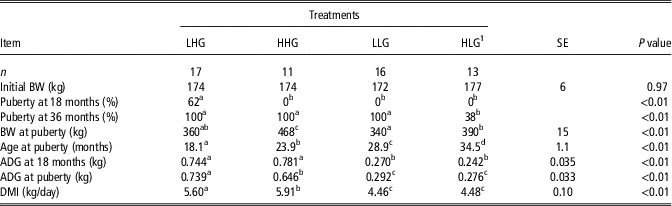
Although heifers from the HHG group were offered a diet to provide a high gain, they remained around 170 days longer in the feedlot compared with LHG cohorts, which increased (P<0.01) BW (108 kg more), and decreased (P<0.01) ADG at puberty (Table 2). However, HHG heifers (0.781±0.03 kg) had a similar ADG as compared with LHG cohorts (0.744±0.03 kg) at 18 months of age. No differences were observed on the ADG between heifers from the LG treatment (P=0.75), whereas HLG heifers were heavier (P<0.01) at puberty when compared with LLG cohorts (390 v. 340 kg for HLG and LLG, respectively; Table 2).
Performance of Nelore heifers according to each treatment until 36 months of age

LHG=heifers born from sires with low expected progeny difference (EPD) for age at first calving submitted to high average daily gain (ADG); LLG=heifers born from sires with low EPD for age at first calving submitted to low ADG; HHG=heifers born from sires with high EPD for age at first calving submitted to high ADG; HLG=heifers born from sires with high EPD for age at first calving submitted to low ADG.
a,bValues within a row with different superscripts differ at P<0.05.
1 Eight heifers from the HLG treatment did not reach puberty by 36 months of age.
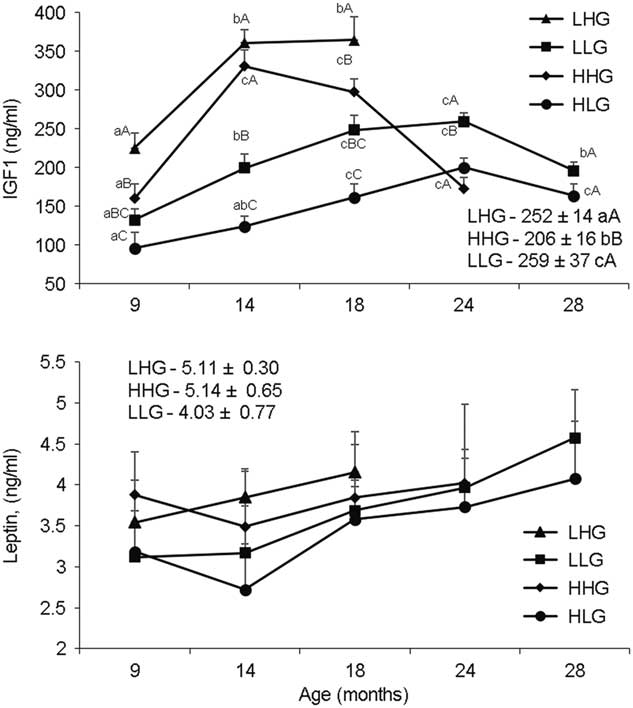
There was no treatment×period interaction (P=0.80) for the circulating leptin concentrations. Regardless of the treatment, leptin concentrations were greater (P<0.01) as heifers became older (Figure 1). Conversely, a treatment×age interaction (P<0.01) was observed on the circulating concentrations of IGF1, in which heifers born from sires with low EPD for age at first calving had greater IGF1 concentrations than heifers born from sires with high EPD for age at first calving in all ages and in the same ADG (sire effect; Figure 1). In addition, heifers submitted to greater ADG had a robust increase in plasma IGF1 concentration from 9 to 14 months of age (P<0.01). In contrast, heifers submitted to the low ADG had a lower increase in IGF1 concentration as age advanced (P<0.01; Figure 1).
Serum concentration of IGF1 and leptin according to treatments at 9, 14, 24 and 28 months of age, and at the week of ovulation. There was no interaction of leptin concentration between treatments and time (P=0.80). Leptin concentration increased (P<0.01) along the age. There was interaction on IGF1 concentration between treatments and time (P<0.01). Treatments: heifers born from sires with low expected progeny difference (EPD) for age at first calving submitted to either high average daily gain (ADG=0.7 kg; LHG; n=17) or low ADG (0.3 kg; LLG; n=16); heifers born from sires with high EPD for age at first calving submitted to either high ADG (HHG; n=11) or low ADG (HLG; n=13). Text box in figure shows IGF1 and leptin concentrations on the week of ovulation, which was not shown in HLG treatment because only five (5/13) heifers attained puberty. A,BCapital letters show statistical difference at P<0.05 within each age. a,bSmall letters show statistical difference at P<0.05 among ages.

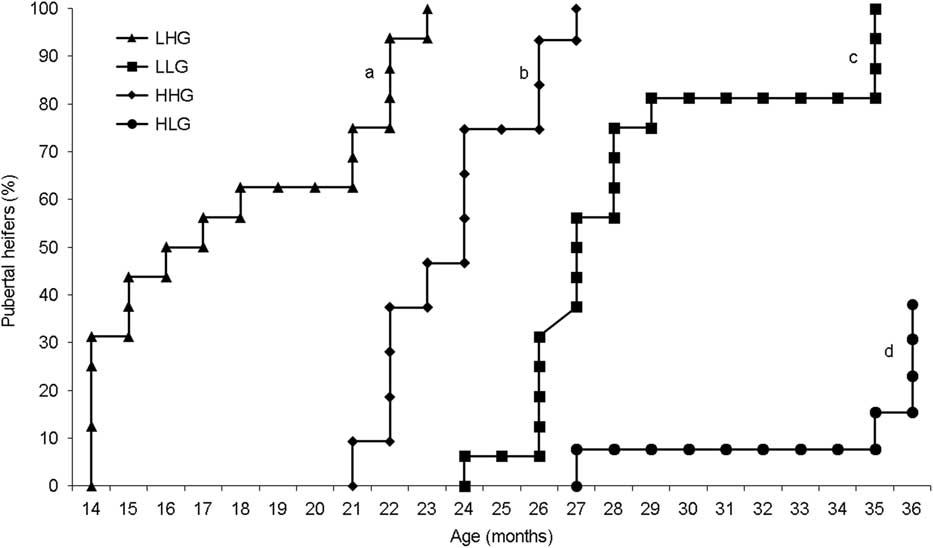
There was a treatment effect (P<0.01) in the percentage of heifers that reached puberty by 18 (62%, 0%, 0% and 0%), 24 (100%, 6%, 54% and 0%), and 36 months of age (100%, 100%, 100% and 38%) for LHG, LLG, HHG and HLG, respectively (Table 2; Figure 2). Only five (5/13) heifers from HLG treatment reached puberty by 36 months of age, and the other 8 non-pubertal heifers weighed 362±6 kg at the end of the study.
Cumulative proportion (%) of Nelore heifers that attained puberty in each treatment. Treatments: heifers born from sires with low expected progeny difference (EPD) for age at first calving submitted to either high average daily gain (ADG=0.7 kg; LHG; n=17) or low ADG (0.3 kg; LLG; n=16); heifers born from sires with high EPD for age at first calving submitted to either high ADG (HHG; n=11) or low ADG (HLG; n=13). a,b,c,d Lines with different superscripts differ at P<0.05.

Heifers from the LHG treatment were younger (P<0.01) at puberty (18±1 months of age) compared with the other treatments. These heifers started reaching puberty at 14 months of age, and all heifers were pubertal by 23 months of age (Table 2; Figure 2). Heifers from all treatments did not reach puberty between June to August, which coincided with the winter solstice in the South hemisphere.
Discussion
The results obtained from the LHG treatment demonstrate that it is possible to decrease the puberty age in Nelore heifers to 18 months, and it is feasible to raise Nelore heifers to ovulate before this time, matching with the end of the breeding season in tropical countries (Nepomuceno et al., Reference Nepomuceno, Pires, Ferraz, Biehl, Gonçalves, Moreira and Day2017). In order to achieve it, sires were selected for precocious age at first calving and heifers had unrestricted growth. These conditions resulted in more than half of heifers reaching puberty before the aforementioned target age of 18 months, since the LHG treatment anticipated puberty in 62% of the heifers. Previous studies with greater number of non-selected Nelore heifers, submitted to either feedlot or pasture systems after weaning, resulted in only 32% and 13% of puberty by 18 months of age, respectively (Nepomuceno et al., Reference Nepomuceno, Pires, Ferraz, Biehl, Gonçalves, Moreira and Day2017).
Several farmers in Brazil aim to begin the heifers’ reproductive life around 26 months of age (Gunski et al., Reference Gunski, Garnero, Bezerra, Corrado and Lôbo2001; ABCZ, 2016). However, it does not occur in the majority of Brazilian cow–calf systems, in which heifers are usually bred only when they are >3 years of age (Gunski et al., Reference Gunski, Garnero, Bezerra, Corrado and Lôbo2001; Sereno et al., Reference Sereno, Pellegrin, Lara, Abreu, Sereno and Chalita2001). Thus, the difference in the percentage of pubertal heifers between LLG and HLG treatments has immediate applicability to the beef cattle industry.
Corroborating our first hypothesis, the high ADG was not sufficient to induce puberty in heifers from sires with high EPD for age at first calving before 18 months of age. Hence, the EPD for age at first calving was essential to determine the timing of puberty onset, delaying around 5 months the age at puberty in high gain condition. Our second hypothesis was not accepted because 100% of the heifers from sires with low EPD for age at first calving reached puberty before 36 months of age, whereas only 38% of heifers from sires with high EPD for age at first calving reached puberty at the same age. Irano et al. (Reference Irano, Camargo, Costa, Terakado, Magalhães, Silva, Dias, Bignardi, Baldi, Carvalheiro, Oliveira and Albuquerque2016) suggested that the genetic control of puberty is susceptible to a pattern of complex polygenic inheritance. Several researchers attempted to identify the physiological processes that lead to this difference, and it seems that puberty onset is controlled by the hypothalamus. Cánovas et al. (Reference Cánovas, Reverter, Deatley, Ashley, Colgrave, Fortes, Islas-Trejo, Lehnert, Porto-Neto, Rincón, Silver, Snelling, Medrano and Thomas2014) analyzed eight tissues of pre- and post-pubertal Brangus heifers by RNA-Seq and found that hypothalamus samples had the greatest increase in the puberty regulatory genes as compared with the other analyzed tissues (pituitary gland, uterus, endometrium, ovary, liver, muscle and adipose tissue). In addition, several studies with Nelore heifers have shown that single nucleotide polymorphisms provide relevant information to help elucidate which genes affect puberty onset (Costa et al., Reference Costa, Camargo, Diaz, Irano, Dias, Carvalheiro, Boligon, Baldi, Oliveira, Tonhati and Albuquerque2015; Regatieri et al., Reference Regatieri, Boligon, Costa, Souza, Baldi, Takada, Venturini, Camargo, Fernandes Júnior, Tonhati, Oliveira and Albuquerque2017).
The common recommendation for Bos taurus taurus beef heifers is to achieve 60% to 65% of their expected mature BW before the first breeding (Patterson et al., Reference Patterson, Perry, Kiracofe, Bellows, Staigmiller and Corah1992; Gasser, Reference Gasser2013), and it is believed the mature BW in Nelore is between 400 and 500 kg (Rosa et al., Reference Rosa, Lôbo, Oliveira and Borjas2000 and Reference Rosa, Lôbo, Oliveira, Bezerra and Borjas2001). Rosa et al. (Reference Rosa, Lôbo, Oliveira, Bezerra and Borjas2001) found that the mature BW of cows was 447 kg after evaluating 34 herds in 11 Brazilian regions. Assuming 450 kg as the mature BW of Nelore cows, the LHG and HHG treatments resulted in BW at puberty of 80% and 107% of this mature BW, respectively. Thus, we observed that Nelore heifers in the HHG and LHG treatments reached 60% to 65% of mature BW at 14 months of age (data not shown), but unlike B. taurus taurus heifers, did not reach puberty at this point.
Heifers from the HHG treatment had lower ADG (0.1 kg) during the experimental period than heifers from the LHG treatment because of a longer feedlot period. This feeding length increase resulted in fatter non-precocious heifers, suggesting that they became less energetically efficient due to sigmoid type growing pattern in ruminants (NRC, 1996), corroborating the similar ADG until 18 months of age in heifers from LHG and HHG treatments. In addition, the longer feedlot period increased the amount of feed provided for heifers from HHG treatment, increasing feed costs.
The age at puberty was also jeopardized when the heifers’ development was restricted by low ADG. In our results, this difference was nearly 1 year, comparing the age at puberty in the same EPD group, showing how important a proper nutrition is. However, it is important to highlight that the probability of pregnancy at 16 months of age is not highly related to the genetic selection for weight at weaning, yearling or maturity (Boligon and Albuquerque, Reference Boligon and Albuquerque2011).
The IGF1 concentration was higher in heifers from sires with low EPD for age at first calving in both ADG, indicating that IGF1 concentration was associated with genetic factors that may have contributed to an earlier puberty onset in precocious heifers. In the same line, authors have observed a correlation between IGF1 after weaning and puberty onset (Yilmaz et al., Reference Yilmaz, Davis and Simmen2006; Johnston et al., Reference Johnston, Corbet, Barwick, Wolcott and Holroyd2014). In addition, Fortes et al. (Reference Fortes, Li, Collis, Zhang and Hawken2013) observed that genes in the IGF1 pathway were associated to puberty age in Brahman heifers. Chronic administration (every 14 days) of recombinant bovine somatotropin, from weaning to the beginning of the breeding season, increased IGF1 concentration and hastened puberty attainment in beef heifers (Cooke et al., Reference Cooke, Bohnert, Francisco, Marques, Mueller and Keisler2013). Besides genetic factors, IGF1 concentration was also influenced by ADG. Heifers with high ADG had a robust increase on IGF1 concentrations from 9 to 14 months of age, influenced by 75% of grain in the diet, coinciding with the growth spurt. Diets with high amount of grain increase insulin concentration, stimulating IGF1 production through an increase in the hepatic expression of growth hormone receptors (GHR-1A; Butler et al., Reference Butler, Marr, Pelton, Radcliff, Lucy and Butler2003). Thus, the high ADG allowed heifers to express their genetic potential. On the other hand, heifers submitted to low ADG had gradual, but slow, increase in IGF1 concentration since their diet contained 93% low-quality forage.
Leptin concentration only increased as heifers became older, demonstrating that it did not trigger puberty onset, agreeing with Maciel et al. (Reference Maciel, Zieba, Amstalden, Keisler, Neves and Williams2004), who demonstrated no effect of chronic administration of recombinant ovine leptin on age at puberty in beef heifers. Nonetheless, leptin concentration has been positively associated with GnRH and gonadotropin synthesis, hence, the leptin does not trigger puberty, but it is a permissive signal for puberty onset (Maciel et al., Reference Maciel, Zieba, Amstalden, Keisler, Neves and Williams2004; Roa et al., Reference Roa, Galiano, Castellano, Pinilla and Tena-Sempere2010).
An interesting observation was that in June, July and August heifers from all treatments did not reach puberty, whereas in September there was a higher proportion of heifers reaching puberty. In the Southern hemisphere, September marks the beginning of the spring and hence, the day length is augmented progressively. We speculate that the lack of pubertal heifers from June to August might be related to a seasonal (photoperiod) effect, since others have already described this effect in cattle (Hansen, Reference Hansen1985; Schillo et al., Reference Schillo, Hall and Hileman1992). However, it is important to highlight that more studies are necessary to elucidate the mechanisms in Nelore females.
In summary, only Nelore heifers with favorable genetic merit for age at first calving were able to attain puberty by 18 months of age. In heifers with unfavorable genetic merit for age at first calving, supplementary feeding to achieve high ADG was unable to shift the age at puberty below 24 months. Moreover, the low EPD for age at first calving was an essential factor for puberty either in high or low ADG.
Acknowledgments
The authors would like to thank Fundação de Amparo à Pesquisa do Estado de São Paulo (FAPESP 2014/14136-4) and Conselho Nacional de Desenvolvimento Científico e Tecnológico (CNPq) for financial support on this project. The authors also thank Experimental Station Hildegard Georgina Von Pritzelwitz (Fundação de Estudos Agrários Luiz de Queiroz) for allowing the use of their heifers during this study.