Introduction
Schizophrenia and autism spectrum disorder (ASD) are both pervasive neurodevelopmental conditions, characterized by considerable impairments in social and non-social cognition and in psychosocial functioning (Lai et al. Reference Lai, Lombardo and Baron-Cohen2014; Owen et al. Reference Owen, Sawa and Mortensen2016). From a historical point of view, autism was initially considered a form of psychotic childhood disorder, but subsequently, it was differentiated from psychoses, gaining a nosographic autonomy in the context of the so-called ‘neurodevelopmental disorders’ (Volkmar & McPartland, Reference Volkmar and McPartland2014). In the current DSM-5, schizophrenia and ASD are described as distinct conditions (American Psychiatric Association, 2013). Schizophrenia is defined as a neuropsychiatric disorder that begins in the late adolescence or early adulthood, characterized by delusions, hallucinations, disorganized speech and behavior, cognitive and negative symptoms (American Psychiatric Association, 2013). ASD is a neurodevelopmental disorder, characterized by persistent deficits in social communication and interaction across multiple contexts and restricted and repetitive patterns of behaviors, interests or activities (American Psychiatric Association, 2013).
Epidemiology of ASD in schizophrenia
In recent years the conception of two clearly separated disorders has been questioned in light of evidences demonstrating spectra of autistic disorders and spectra of schizophrenic disorders, with possible overlapping areas between the two (King & Lord, Reference King and Lord2011; Hallerbäck et al. Reference Hallerbäck, Lugnegård and Gillberg2012; Matsuo et al. Reference Matsuo, Kamio, Takahashi, Ota, Teraishi and Hori2015; Barlati et al. Reference Barlati, Deste, Ariu and Vita2016; Dell'Osso et al. Reference Dell'Osso, Luche, Gesi, Moroni, Carmassi and Maj2016). Regarding available estimates of ASD occurrence in schizophrenia, the literature reports widely heterogeneous results. In particular two recent reviews on this topic identify variable rates of autistic traits in schizophrenia spectrum disorders (SSD) (from 0.78% to 61%), according to the sample characteristics and to the type of assessment employed (Chisholm et al. Reference Chisholm, Lin, Abu-Akel and Wood2015; Kincaid et al. Reference Kincaid, Doris, Shannon and Mulholland2017).
ASD and schizophrenia: overlapping areas
Several studies highlighted the continuity of schizophrenia and ASD symptoms in different clinical populations (Skokauskas & Gallagher, Reference Skokauskas and Gallagher2010). In particular, a growing number of studies exploring the commonalities between schizophrenia and ASD in terms of etiology, language disorders, symptoms, social and non-social cognition and psychosocial functioning, have reinforced the hypothesis of a connection between the two spectra, not only at a clinical, but also at a etiopathogenetic and pathophysiological level (de Lacy & King, Reference de Lacy and King2013; Wilson et al. Reference Wilson, Kline, Reeves, Anthony and Schiffman2014). Regarding clinical features, many studies focused on the presence of autistic traits in patients with schizophrenia (Sheitman et al. Reference Sheitman, Kraus, Bodfish and Carmel2004; Esterberg et al. Reference Esterberg, Trotman, Brasfield, Compton and Walker2008; Kästner et al. Reference Kästner, Begemann, Michel, Everts, Stepniak and Bach2015), while others showed that a significant proportion of children diagnosed with ASD develops schizophrenia later in life (Mouridsen et al. Reference Mouridsen, Rich and Isager2008; King & Lord, Reference King and Lord2011; Larson et al. Reference Larson, Wagner, Jones, Tantam, Lai and Baron-Cohen2017). Thus, it has been emphasized that subjects with a history of ASD could show psychotic symptoms in adolescence and adolescents with a history of childhood or early-onset schizophrenia could manifest typical and persistent autistic traits (Chisholm et al. Reference Chisholm, Lin, Abu-Akel and Wood2015). Furthermore, several studies evidenced that schizophrenia and ASD are both characterized by impairments in social (Abdi & Sharma, Reference Abdi and Sharma2004) and non-social cognition (Schneider & Asarnow, Reference Schneider and Asarnow1987; de Boer et al. Reference de Boer, Spek and Lobbestael2014). In this regard, a recent study underlines similarities in social and non-social cognitive impairment in adults with schizophrenia or ASD, with particularly marked deficits in speed of processing and emotion recognition in both (Eack et al. Reference Eack, Bahorik, McKnight, Hogarty, Greenwald and Newhill2013). Other studies have demonstrated that deficits in Theory of Mind are present not only in ASDbut also in people with schizophrenia (Bora et al. Reference Bora, Yucel and Pantelis2009).
Aim of the study
To our knowledge, only a few studies, with a small sample size, mostly focused on adolescent patients, analyzed the co-occurrence of schizophrenia and ASD, their boundaries, overlaps and differences (Konstantareas & Hewitt, Reference Konstantareas and Hewitt2001; Solomon et al. Reference Solomon, Olsen, Niendam, Ragland, Yoon and Minzenberg2011; Hallerbäck et al. Reference Hallerbäck, Lugnegård and Gillberg2012; Waris et al. Reference Waris, Lindberg, Kettunen and Tani2013). The present study was aimed at investigating the presence of autistic features in a population of adult patients with a well-established diagnosis of schizophrenia. The secondary objective was to identify possible demographic, clinical, cognitive, and functional correlates of schizophrenia patients with and without autistic features. The results could contribute to better characterize patients with schizophrenia and help to disentangle the heterogeneity of the disorder.
Method
Participants
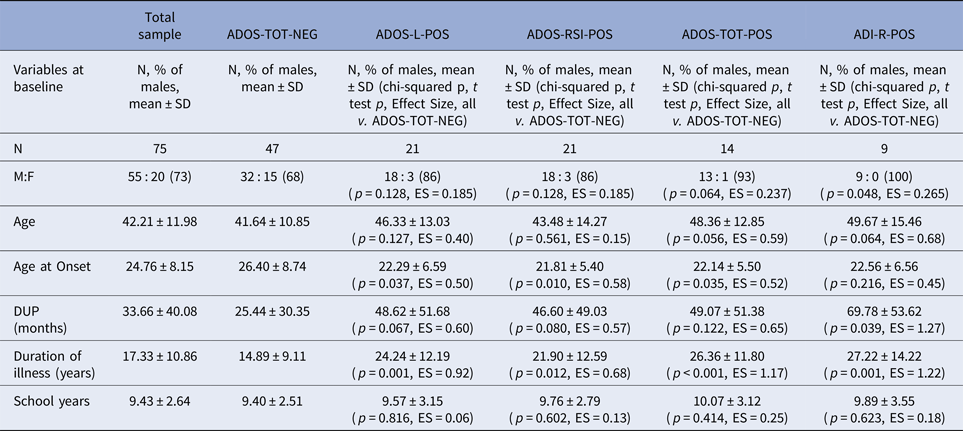
This study included 75 participants with a diagnosis of schizophrenia (DSM-5; American Psychiatric Association, 2013), aged >18 years, recruited from the University Department of Mental Health, Spedali Civili Hospital in Brescia, Italy. Demographic characteristics of the sample are reported in Table 1. All patients were followed naturalistically in the context of a rehabilitative day center and received antipsychotic medication. At baseline 15 patients were on typical, 44 were on atypical antipsychotics, and 16 were on clozapine.
Demographic characteristics of the samplea

ADOS-TOT-NEG, patients negative to all autism scales; ADOS-L-POS, patients positive to the ADOS Language sub-domain; ADOS-RSI-POS, patients positive to the ADOS Reciprocal Social Interaction sub-domain; ADOS-TOT-POS, patients positive to the ADOS Total scale; ADI-R-POS, patients positive to the ADI-R scale; DUP, duration of untreated psychosis; ES, effect size.
a Between-group comparisons of demographic variables. All comparisons (chi-squared p, t test p) performed v. ADOS-TOT-NEG. Effect size measure is Phi for chi-squared tests and Hedge's d for t tests.
Exclusion criteria were: (a) a concomitant diagnosis of substance use disorder; (b) severe positive symptoms or impulsive behavior requiring a higher security setting; (c) significant changes in psychopathologic status (requiring hospitalization or major changes in pharmacologic treatment) in the last 3 months before the study; (d) current or previous diagnosis of delirium, dementia, amnestic disorder or other neurological disorders.
Measures
ASD assessment
Patients enrolled in the study were evaluated with two interviews used for the assessment and diagnosis of ASD: the Autism Diagnostic Observation Schedule (ADOS) (Lord et al. Reference Lord, Rutter, Goode, Heemsbergen, Jordan and Mawhood1989) and the Autism Diagnostic Interview-Revised (ADI-R) (Lord et al. Reference Lord, Rutter and Le Couteur1994).
The ADOS is a semi-structured, standardized assessment of social interaction, communication, play, and imaginative use of materials for individuals suspected of having ASD. It includes a standardized administration of interactive activities introduced by the examiner, designed to elicit social interactions, communication and repetitive behaviors for the purpose of diagnosing an ASD (Lord et al. Reference Lord, Risi, Lambrecht, Cook, Leventhal and DiLavore2000). The observational schedule consists of four 30–45 min modules, each designed to be administered to individuals of different developmental and language levels, ranging from children with no expressive language to older and verbally more capable individuals. Module 4 was developed for adolescents and adults with fluent speech. The ADOS encompasses a diagnostic algorithm using scores from social and communication domains (Lord et al. Reference Lord, Risi, Lambrecht, Cook, Leventhal and DiLavore2000). The ADOS includes three main domains regarding Language/Communication (hereafter referred to as Language), Reciprocal Social Interaction (RSI), and Repetitive and Restricted Behaviors and Interests (RRBIs) (Reisinger et al. Reference Reisinger, Cornish and Fombonne2011). The Total score is compared with two possible cut-off scores, from which the ADOS classification is made (having or not ASD or autistic traits). Scores related to RRBIs do not contribute to the total score and there is no cut-off provided for this sub-domain.
In this study, we used module 4, suitable for verbally fluent and highly functioning adults and adolescents (Bastiaansen et al. Reference Bastiaansen, Meffert, Hein, Huizinga, Ketelaars and Pijnenborg2011). It takes about 45 min to administer and evaluates the following areas: communication, social interactions, play, stereotyped behavior, interests, limited or other abnormal behavior. The Language and RSI sub-domains were considered in this study. The autism assessment did not include RRBIs subscale since it was not required by the diagnostic algorithm of the ADOS to reach a classification of autism or ASD (Lord et al. Reference Lord, Rutter, DiLavore and Risi1999). Positivity to the ADOS total score and to each of the subscales (Language and RSI) were considered as variables to be included in the analyses. Positivity was achieved for patients attaining autism spectrum cut-offs: 2 for Language sub-domain, 4 for RSI sub-domain, 7 for ADOS total score. Patients who resulted positive to the ADOS total score (and therefore to both sub-domains of the ADOS) were subsequently assessed with the ADI-R, to confirm and further validate the results of the ADOS, in order to better discriminate between patients with and without ASD (Le Couteur et al. Reference Le Couteur, Rutter, Lord, Rios, Robertson and Holdgrafer1989).
The ADI-R is a structured interview conducted with parents and/or childhood caregivers (e.g. teachers) of the participant and evaluates the patient's developmental history, starting from the age of 5, as well as current functioning, in areas of development related to autism. It considers three areas on which the ADI-R diagnostic algorithm is based: social reciprocity, communication, and repetitive behaviors. The administration of the ADI-R requires about 90 min and a trained interviewer.
In this study, the ADI-R interview was conducted with parents or siblings. Positivity to the ADI-R was included in the analyses.
Participants were also assessed with clinical, neuropsychological, and psychosocial functioning measures.
Psychopathology
Clinical assessment was performed using the Positive and Negative Syndrome Scale (PANSS) (Kay et al. Reference Kay, Fiszbein and Opler1987). The subscales referring to positive symptoms (PANSS Positive), negative symptoms (PANSS Negative), and to general Psychopathology (PANSS General) were included in the analyses.
Neurocognition
Neurocognitive assessment was performed using the Italian version of the Wechsler Adult Intelligence Scale-Revised (WAIS-R) (Wechsler, Reference Wechsler1981). The WAIS-R consists of different subtests assessing different cognitive domains. A Full-Scale Intelligence Quotient (FSIQ) as well as raw scores for each WAIS-R subtest (Information, Digit Span, Vocabulary, Arithmetic, Comprehension, Similarities, Picture Completion, Stories Arranging, Bock Design, Object Construction, Coding) were obtained and included in the analyses.
Social cognition
Emotion recognition is a sub-domain of social cognition (Green et al. Reference Green, Olivier, Crawley, Penn and Silverstein2005). Emotion recognition performance was measured using the Facial Emotion Identification Test. It consists of a series of pictures of facial expressions, each representative of one of six primary emotions (happiness, sadness, fear, anger, surprise, and disgust) (Kerr & Neale, Reference Kerr and Neale1993). Participants are required to choose the right emotions among those presented. The total percentage of correct responses was included in the analyses.
Real-life functioning
Psychosocial functioning was assessed using the Health of the Nation Outcome Scale (HoNOS) (Wing et al. Reference Wing, Beevor, Curtis, Park, Hadden and Burns1998) and the Global Assessment of Functioning (GAF) scale (American Psychiatric Association, 2000). The HoNOS is a manual-based instrument for the assessment of problems caused by difficulties in behavior, clinical symptoms, cognition, and social and living conditions. The GAF is designed to measure patients’ functioning, considering self-care, social, occupational, and clinical impact on functioning. GAF score and HoNOS total score were included in the analyses.
Autism and clinical assessment, neuropsychological, and functional evaluations were performed during a 2-week period. Autism evaluation was performed by an expert physician (M.G.), trained in the use of the ADOS and the ADI-R interviews. Clinical assessment was performed for each participant by two rehabilitation day center psychiatrists (S.B. and G.D.), whose inter-rater reliability was measured and found to be high (intraclass correlation coefficient >0.9 for PANSS total scores). Neuropsychological tests were administered by an expert psychologist and functional scales were applied by rehabilitation technicians, with team consensus, using different informative sources (clinical records, patient interviews, information obtained from close relatives, and the case manager). Each of the mental health professionals, involved in autism, clinical, neuropsychological, and functional assessment, was unaware of other measures.
Statistical analyses
To study the existence of possible specific characteristics of patients with schizophrenia with autistic traits, demographic, clinical, neurocognitive, and functional variables were compared between patients negative to all autism scales (and sub-domains) and patients positive to the ADOS RSI sub-domain, to the ADOS Language sub-domain, to the ADOS Total scale, and to the ADI-R scale respectively, using independent variables t tests, and chi-squared tests where appropriate. Hedge's g for t tests and Phi for chi-squared tests were calculated and used as Effect Size measures. Subsequently, variables which showed significant differences between groups at t- and chi-squared tests were included in logistic regressions as covariates. Logistic regressions were performed following a backward approach, including positivity to the ADOS RSI sub-domain, to the ADOS Language sub-domain, to the ADOS Total scale, and to the ADI-R scale as dependent variables (each compared with negativity to all autism scales and sub-domains).
Since the ADI-R scale was administered to patients who resulted positive to the ADOS interview, the group of patients positive to the ADI-R included patients who were also positive to the ADOS interview, and thus to each of the two ADOS sub-domains.
Since each variable analyzed has been included in multiple between-group comparisons (n = 4), a correction has been applied following Bonferroni's approach. Conservatively, p values <0.01 were considered statistically significant. All p values were two-tailed. Data were analyzed using SPSS 14.0 software.
Results
The demographic characteristics of the sample are described in Table 1, as long as the demographic characteristics of the groups of patients analyzed (negative to all autism scales, positive to the ADOS RSI sub-domain, positive to the ADOS Language sub-domain, positive to the ADOS Total scale, positive to the ADI-R scale). Of the 75 patients included in the study, 47 were negative to all the autism scales administered (ADOS-TOT-NEG), 21 patients were positive to the ADOS Language sub-domain (ADOS-L-POS), 21 patients were positive to the ADOS RSI sub-domain (ADOS-RSI-POS), 14 patients were positive to the ADOS Total scale (ADOS-TOT-POS), and nine patients were positive to the ADI-R scale (ADI-R-POS). The patients in the ADI-R-POS group were also included in the ADOS-TOT-POS group since the ADI-R scale was administered only to patients positive to the ADOS scale (ADOS total score and sub-domains). Similarly, each of the patients included in the ADOS-TOT-POS group was also included in both the ADOS-L-POS and the ADOS-RSI-POS groups, since positivity to both the ADOS subscales is a necessary condition for positivity to the ADOS scale. Raw scores of the ADOS are available under readers’ request.
Demographic differences between patients positive and negative to autism assessment
A longer duration of illness in ADOS-TOT-POS (t = 3,85; p < 0.001), ADOS-L-POS (t = 3,50; p = 0.001), and ADI-R-POS (t = 3,37; p = 0.001) groups compared with ADOS-TOT-NEG patients emerged. No significant differences emerged in other demographic parameters between patients positive to any autism scale, and patients negative to all autism measures (see Table 1).
Clinical differences between patients positive and negative to autism assessment
No differences in positive symptoms (PANSS Positive subscale) emerged between patients positive to any autism scale and subscale (ADOS-TOT-POS, ADOS-RSI-POS, ADOS-L-POS, and ADI-R-POS) and ADOS-TOT-NEG patients. On the other hand, more severe negative symptoms (PANSS Negative subscale) were observed in ADOS-L-POS (t = 3,25; p = 0.002) and ADI-R-POS (t = 2,75; p = 0.008) groups compared with the ADOS-TOT-NEG group. As for general psychopathology (PANSS General psychopathology subscale), more severe symptoms emerged in ADOS-RSI-POS (t = 3,65; p = 0.001) and ADOS-TOT-POS (t = 2,86; p = 0.006) patients, compared with ADOS-TOT-NEG. No other significant differences in clinical measures between patients positive to any autism scale and patients negative to all autism measures emerged (see Table 2).
Clinical and psychosocial functioning of the sample groupsa

PANSS, Positive and Negative Syndrome Scale; GAF, Global Assessment of Functioning; HoNOS, Health of the Nation Outcome Scale.
a Between-group comparisons of clinical and psychosocial functioning variables; all comparisons (t test p) performed v. ADOS-TOT-NEG.
Psychosocial functioning differences between patients positive and negative to autism assessment
No significant differences in psychosocial functioning between patients positive to any autism measures and patients negative to all autism measures emerged (see Table 2).
Cognitive differences between patients positive and negative to autism assessment
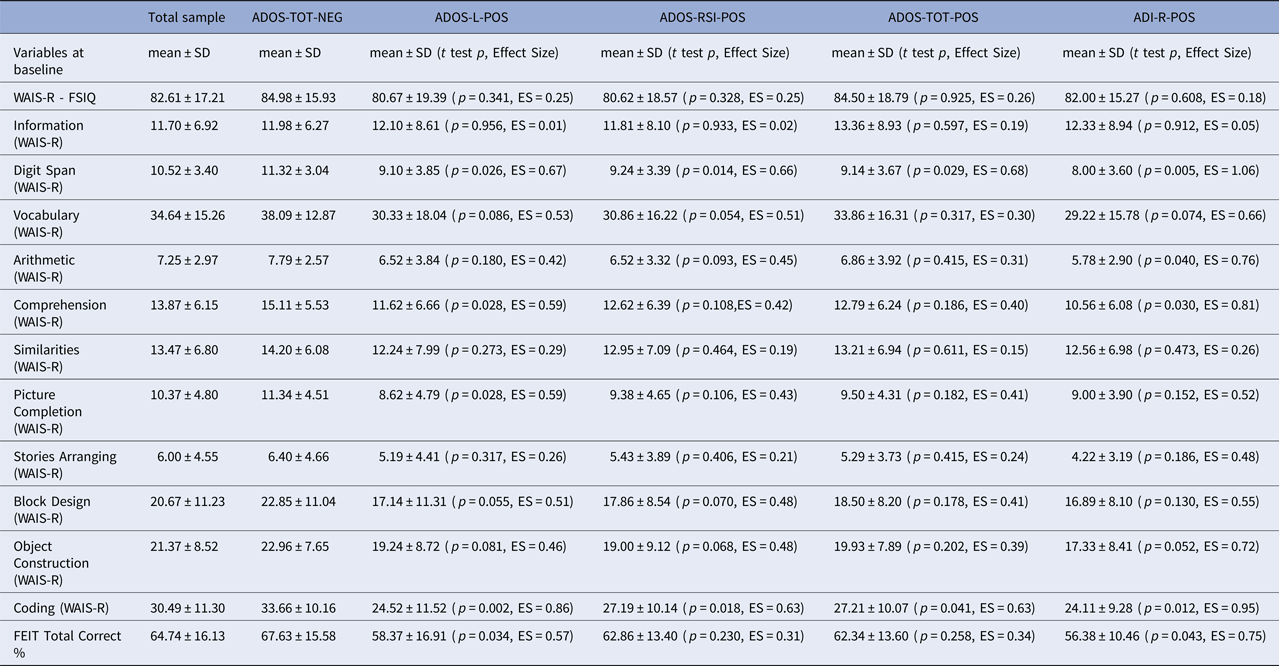
A poorer performance in the WAIS-R Digit Span test was observed in ADI-R-POS patients (t = −2,91; p = 0.005) compared with ADOS-TOT-NEG. Also, a poorer performance in the WAIS-R Coding test emerged in the ADOS-L-POS group (t = −3,28; p = 0.002) compared with ADOS-TOT-NEG.
No significant differences emerged in WAIS-R FSIQ, in other WAIS-R tests, and in recognition of emotional faces between patients positive to any autism measures and patients negative to all autism measures (see Table 3).
Neuropsychological characteristics of the samplea

WAIS-R, Wechsler Adult Intelligence Scale – Revised; FSIQ, Full Scale Intelligence Quotient; FEIT, Facial Emotion Identification Test.
a Between-group comparisons of neuropsychological variables. All comparisons (t test p) performed v. ADOS-TOT-NEG.
Predictors of positivity to autism scales
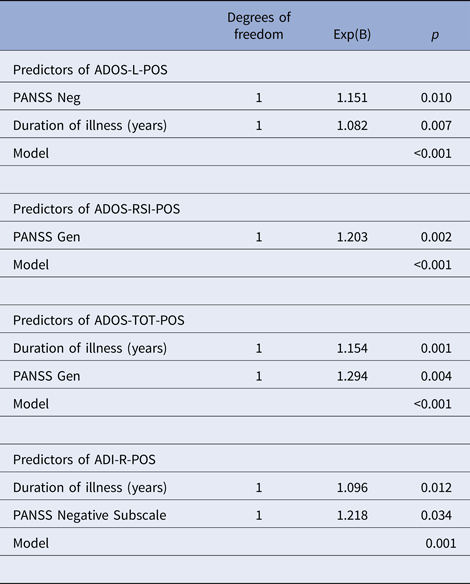
Logistic regression analyses allowed to detect predictors of positivity to autism scales. Individual predictors of positivity to the ADOS scale (ADOS-TOT-POS) were a longer duration of illness and higher PANSS General psychopathology subscale scores. Positivity to ADOS Language sub-domain (ADOS-L-POS) was predicted by higher scores of the PANSS Negative subscale and longer duration of illness. Higher PANSS General psychopathology subscale scores predicted positivity to ADOS RSI sub-domain (ADOS-RSI-POS). Positivity to the ADI-R scale was predicted by longer duration of illness and higher PANSS Negative subscale scores (Table 4).
Predictors of positivity to autism scalesa

a Logistic regression analyses. Individual predictors of ADOS-L-POS, ADOS-RSI-POS, ADOS-TOT-POS, and ADI-R scale.
Discussion
This paper aimed to identify ASD traits in a sample of adult patients with a well-established diagnosis of schizophrenia and to detect demographic, psychopathological, cognitive, and psychosocial characteristics of patients with and without ASD symptoms. In our sample of patients with schizophrenia, we clearly demonstrated the presence of a subgroup with ASD symptoms. In particular, a number of these patients (ADI-R-POS) showed in a more defined way such features, with a rate of 12%, that is included in the range reported in the most recent literature (Chisholm et al. Reference Chisholm, Lin, Abu-Akel and Wood2015; Kincaid et al. Reference Kincaid, Doris, Shannon and Mulholland2017). Moreover, schizophrenic patients with ASD symptoms exhibited specific demographic, psychopathological, and cognitive characteristics. In particular, patients with autistic features had a longer duration of illness compared with schizophrenic patients without ASD characteristics. A longer duration of illness has been associated with a higher severity of the course of the disease and with a poorer long-term outcome in schizophrenia (Rabinowitz et al. Reference Rabinowitz, Levine and Häfner2006; Carbon & Correll, Reference Carbon and Correll2014). These results are in line with those of other studies, in which a subgroup of schizophrenic patients characterized by a more chronic course of illness and high scores on the ADOS scale could be identified (Bastiaansen et al. Reference Bastiaansen, Meffert, Hein, Huizinga, Ketelaars and Pijnenborg2011; Chisholm et al. Reference Chisholm, Lin, Armando, Mazzone and Vitiello2016), suggesting a possible association between schizophrenia and ASD (Konstantareas & Hewitt, Reference Konstantareas and Hewitt2001; Chisholm et al. Reference Chisholm, Lin, Abu-Akel and Wood2015). Our data support the hypothesis of a different course of illness between schizophrenic patients with and without autistic symptoms: it is possible that the subgroup of schizophrenic patients with autistic symptoms may present a different trajectory of the disease, with longer duration of illness, and may be affected by a type of illness sharing some relevant characteristics with ASD (Konstantareas & Hewitt, Reference Konstantareas and Hewitt2001; Chisholm et al. Reference Chisholm, Lin, Armando, Mazzone and Vitiello2016).
The finding of more severe negative symptoms in patients with ASD symptoms is intuitive and well compatible with the prevalence of negative symptoms and limited social interaction in ASD patients (Bastiaansen et al. Reference Bastiaansen, Meffert, Hein, Huizinga, Ketelaars and Pijnenborg2011; Kästner et al. Reference Kästner, Begemann, Michel, Everts, Stepniak and Bach2015; Chisholm et al. Reference Chisholm, Lin, Armando, Mazzone and Vitiello2016). In this regard, schizophrenic patients with marked negative symptoms may show many of the same social deficits as adults with ASD (Frith & Happé, Reference Frith and Happé2005). Furthermore, some patients with schizophrenia may have autistic-like symptoms that covary with negative, but not with positive symptoms (Sheitman et al. Reference Sheitman, Kraus, Bodfish and Carmel2004).
Few studies have compared the domains and magnitude of cognitive impairment between schizophrenia and ASD (Goldstein et al. Reference Goldstein, Minshew, Allen and Seaton2002; Stone & Iguchi, Reference Stone and Iguchi2011; Eack et al. Reference Eack, Bahorik, McKnight, Hogarty, Greenwald and Newhill2013; de Boer et al. Reference de Boer, Spek and Lobbestael2014). In our sample, a distinct cognitive profile emerged in schizophrenic patients with ASD symptoms, who appeared to have a specific impairment in the working memory and processing speed domains (Smith, Reference Smith1982; Banken, Reference Banken1985; Shum et al. Reference Shum, McFarland and Bain1990; Kaplan et al. Reference Kaplan, Fein, Morris and Delis1991). This could be a hint to the existence of a subgroup of patients with schizophrenia, characterized by both specific cognitive dysfunctions and the presence of autistic symptoms, leading to a further characterization of subgroups of patients with different cognitive impairments and autistic profiles (Konstantareas & Hewitt, Reference Konstantareas and Hewitt2001; Spek & Wouters, Reference Spek and Wouters2010). The available scientific literature on this topic is controversial but some authors report that patients with schizophrenia and ASD have similar impairments in their neurocognitive functioning (Schneider & Asarnow, Reference Schneider and Asarnow1987; Goldstein et al. Reference Goldstein, Minshew, Allen and Seaton2002; Sugranyes et al. Reference Sugranyes, Kyriakopoulos, Corrigall, Taylor and Frangou2011; Eack et al. Reference Eack, Bahorik, McKnight, Hogarty, Greenwald and Newhill2013).
No differences in psychosocial functioning between patients with and without ASD symptoms emerged. The scientific literature on psychosocial functioning in schizophrenia with ASD features is sparse and controversial, with some studies suggesting that the co-occurrence of ASD symptoms in schizophrenia may not lead to worse functioning (Raja & Azzoni, Reference Raja and Azzoni2010; Cochran et al. Reference Cochran, Dvir and Frazier2013; Shi et al. Reference Shi, Liu, Shi, Yan, Wang and Wang2017), while others reporting that this co-morbidity may be associated with worse psychosocial functioning (Konstantareas & Hewitt, Reference Konstantareas and Hewitt2001; Bastiaansen et al. Reference Bastiaansen, Meffert, Hein, Huizinga, Ketelaars and Pijnenborg2011; Solomon et al. Reference Solomon, Olsen, Niendam, Ragland, Yoon and Minzenberg2011; Waris et al. Reference Waris, Lindberg, Kettunen and Tani2013; Larson et al. Reference Larson, Wagner, Jones, Tantam, Lai and Baron-Cohen2017). Different hypotheses could be done to explain why in our study no differences in psychosocial functioning between schizophrenia patients with or without ASD symptoms were detected. In particular, the sample recruited in our investigation, i.e. a group of patients highly involved in rehabilitative interventions and followed by psychiatric services for a long time, was characterized by a generalized substantial psychosocial impairment. However, we cannot exclude that a larger sample size and a more comprehensive and sensitive real-life functioning assessment could have allowed to capture some differences between groups.
The correction for multiple comparisons (with a more parsimonious statistical significance threshold) may have masked potentially relevant results. Differences just failing to reach the statistical significance threshold chosen might emerge in studies conducted on larger, statistically more powerful, patient samples. Notably, our finding of an earlier age of onset in patients with ASD features at a trend level is in line with previous evidence (Konstantareas & Hewitt, Reference Konstantareas and Hewitt2001; Cochran et al. Reference Cochran, Dvir and Frazier2013; Maibing et al. Reference Maibing, Pedersen, Benros, Mortensen, Dalsgaard and Nordentoft2015; Jerrell et al. Reference Jerrell, McIntyre and Deroche2017) and warrants further investigation. In general, our results should be considered with caution, since they have been obtained in a relatively small sample. However, the use of logistic regressions allowed us to confirm with a more rigorous method variables predicting the presence of ASD features, i.e. a longer duration of illness and a higher symptom severity.
This study has several limitations: (i) participants of the study may not be fully representative of all patients with schizophrenia, since they had been followed by psychiatric services for a long time and were highly involved in rehabilitative interventions; (ii) the assessment of cognitive functions was limited to the WAIS-R subtests: future research will require the use of more comprehensive neuropsychological batteries, standardized, and validated for patients with schizophrenia; (iii) the assessment of social cognition was limited to measures of facial emotion recognition: future research will need to cover other social cognitive sub-domains; (iv) finally, as previously discussed, the limited sample size, although permitted to demonstrate the existence of a specific group of schizophrenic patients with ASD symptoms, limited the possibility to completely describe their characteristics.
Despite these limitations, the results of this study suggest the existence, in a sample of patients with a diagnosis of schizophrenia, of a distinct group of patients with ASD features, characterized by specific symptomatological and cognitive profile. To our knowledge, only a few other studies mostly focused on adolescent patients, analyzed the co-occurrence of schizophrenia and ASD, their boundaries, overlaps, and differences (Konstantareas & Hewitt, Reference Konstantareas and Hewitt2001; Solomon et al. Reference Solomon, Olsen, Niendam, Ragland, Yoon and Minzenberg2011; Hallerbäck et al. Reference Hallerbäck, Lugnegård and Gillberg2012; Waris et al. Reference Waris, Lindberg, Kettunen and Tani2013). Furthermore, other well-done recent studies mostly explored ASD symptoms in schizotypal personality disorder (Stanfield et al. Reference Stanfield, Philip, Whalley, Romaniuk, Hall and Johnstone2017; Abu-Akel et al. Reference Abu-Akel, Testa, Jones, Ross, Skafidas and Tonge2018). The present study investigated the existence of autistic features in a population of adult patients with a well-established diagnosis of schizophrenia, using rigorous assessment tools for measuring autistic symptoms, and investigated demographic, psychopathological, cognitive and psychosocial functioning overlaps, and differences between patients with or without ASD characteristics.
Schizophrenia and ASD are two distinct behavioral outcomes of aberrant neurodevelopment, and their differentiation is clinically useful also in accordance with current categorical diagnostic systems (Pina-Camacho et al. Reference Pina-Camacho, Parellada and Kyriakopoulos2016). However, the boundaries between them are not always clear and several lines of evidence from neurobiology, epidemiology, neurocognition, and clinic point towards a close relationship between the two disorders (de Lacy & King, Reference de Lacy and King2013; Wilson et al. Reference Wilson, Kline, Reeves, Anthony and Schiffman2014; Chisholm et al. Reference Chisholm, Lin, Abu-Akel and Wood2015; Barlati et al. Reference Barlati, Deste, Ariu and Vita2016). Their overlapping characteristics and potential co-occurrence might pose important diagnostic challenges in clinical practice. Understanding ASD and schizophrenia overlaps, boundaries, and uncertainties may help clinicians to revisit and better understand the relationship between the two disorders and inform more effective management strategies (Wilson et al. Reference Wilson, Kline, Reeves, Anthony and Schiffman2014; Barlati et al. Reference Barlati, Deste, Ariu and Vita2016; Pina-Camacho et al. Reference Pina-Camacho, Parellada and Kyriakopoulos2016). It is becoming increasingly evident that it is necessary to prospectively investigate the co-occurrence of, and commonalities between, schizophrenia and ASD at the trait level using multifactorial data derived from large samples (Stanfield et al. Reference Stanfield, Philip, Whalley, Romaniuk, Hall and Johnstone2017; Abu-Akel et al. Reference Abu-Akel, Testa, Jones, Ross, Skafidas and Tonge2018). Undiagnosed co-occurring disorders may result in individuals not receiving appropriate services, benefits, or treatment, and given the similarities between the disorders, misdiagnosis is well possible (Wing, Reference Wing1981; Davidson et al. Reference Davidson, Greenwood, Stansfield and Wright2014). There is clearly a need for the development of appropriate diagnostic tools to differentiate between schizophrenia and ASD and for research investigating optimal treatment strategies of patients presenting with both disorders. It is important that future research accounts for the heterogeneity of both disorders, examining evidence on multiple levels to identify endophenotypic markers, as well as taking the dimensional nature of the disorders into consideration (Chisholm et al. Reference Chisholm, Lin, Abu-Akel and Wood2015). In this regard, further studies with a longitudinal design should clarify whether we detected former ASD patients who subsequently developed schizophrenia, or a specific subgroup of patients with schizophrenia with ASD symptoms (King & Lord, Reference King and Lord2011; Chisholm et al. Reference Chisholm, Lin, Abu-Akel and Wood2015). Should the latter hypothesis be proven, then further investigation will be needed to understand if ASD symptoms could be considered a specific endophenotype of schizophrenia. Together, these approaches could provide an important conceptual framework for understanding the association between schizophrenia and ASD. In fact, our findings, if confirmed, may allow a better comprehension of the relationships between schizophrenia and ASD, with potential improvement in the diagnosis and treatment of these two severe conditions.
Financial support
Funding for this study was partially provided by the Health Authority of the Lombardia Region (project TR11).
Declaration of interest
None.