

1. Introduction
In the decade since the onset of the financial crisis, the disappointing recovery has sparked renewed concern about the medium-run outlook for advanced economies. Rather than returning to the pre-crisis trend, output has continued to diverge from it. It is difficult to know whether this is a cyclical phenomenon, a slow recovery towards steady state, or a secular change in the nature of steady state growth. As Reference Reinhart and RogoffReinhart and Rogoff (2009) emphasise, major financial crises can have long-lasting effects, and this makes it difficult to distinguish what is cyclical from what is secular. As an indication of the difficulty of separating low frequency signals from high frequency noise, the Great Moderation, the marked reduction in the variance of the US macroeconomy after 1984, was not recognised as a sustained change until the late 1990s.
This was also an issue after the Great Depression. Reference HansenHansen (1939) writing a decade after the Wall Street Crash, now sounds very topical with his concerns about the effects of demographic and technological change, the topics we will be concerned with in this paper. Hansen warned of the danger of secular stagnation driven by declining population growth, which would remove the incentive to invest, though he did not anticipate the offsetting effects of the subsequent war and the baby boom. He also criticised those who regarded the advance of technology as a major cause of unemployment, arguing that there was a need for an acceleration of the rate of progress in science and technology.
Echoing Hansen, after the last financial crisis Reference SummersSummers (2015), in a speech given in 2013, also warned of the dangers of secular stagnation. He noted the long-term decline in real interest rates, and raised the concern that the equilibrium real rate may now have become negative and that a zero nominal rate would then become a chronic and systemic inhibitor of economic activity holding economies back below their potential.
While there may be an important, but transitory, cyclical component in the poor performance of the past decade, we will emphasise the secular forces likely to shape medium run macroeconomic developments. We first review the impact of demographic structure and innovation, then we draw on the empirical and theoretical work reported in Reference Aksoy, Basso, Smith and GraslAksoy, Basso, Smith and Grasl (2015), ABSG, about the impact of changes in demographic structure on macroeconomic outcomes. This suggests that changes in age profile not only have significant implications for savings, investment, real interest rates and growth but also for innovation and that the population ageing predicted for the next decades will tend to reduce output growth and real interest rates across OECD countries.
The age structure of the population can be measured quite precisely and since it is largely predetermined by past fertility it can be forecast rather better than many other economic variables. But for other variables there are important measurement issues. Innovation is inherently difficult to measure and the process by which technological change transmits to productivity can be quite opaque. There is the further concern that the mismeasurement of GDP and productivity is causing us to misinterpret the secular trends. While some like Reference FeldsteinFeldstein (2017) have argued that the real growth in GDP and productivity have been underestimated, the consensus seems to be that mismeasurement is not enough to explain the lower productivity growth and that in the US the break in trend pre-dates the crisis.
2. Demography, innovation and the macroeconomy
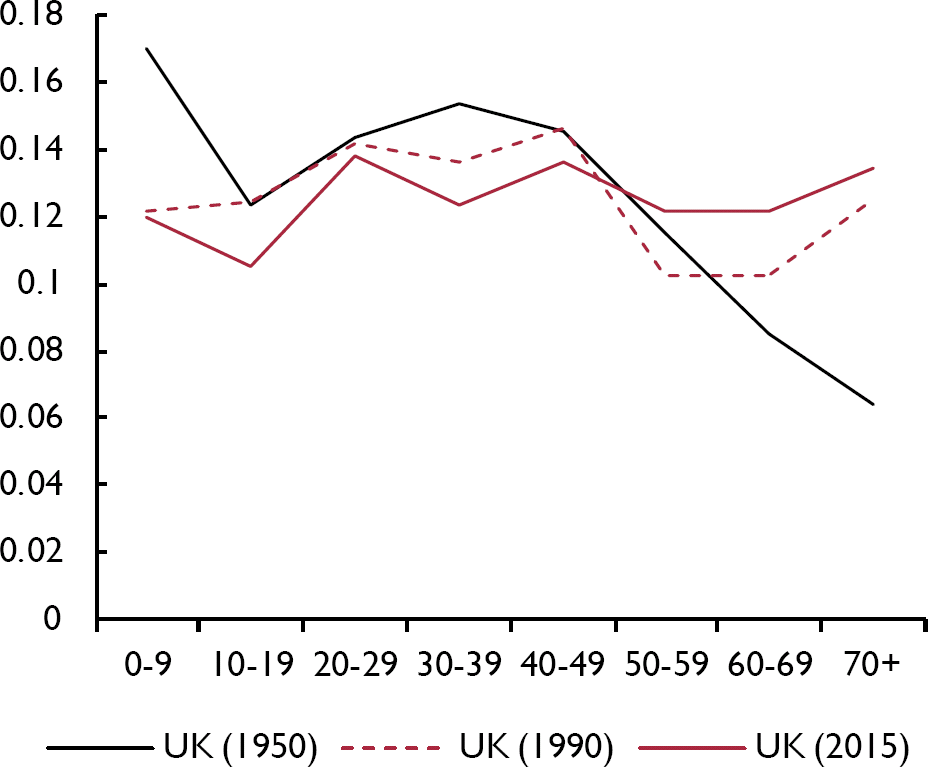
Hansen's demographic concern was falling population growth rates, the current concern is with an ageing population. As is now well known, age profiles in OECD economies are significantly changing. Figure 1 shows the average of UN Population Division estimates of shares of each age group over 21 OECD countries. In this sample, the average proportion of the population aged 60+ increased almost linearly from 16 per cent in 1970 and is projected to reach 29 per cent in 2030, with most of the corresponding decline experienced in the 0–19 age group. Figure 2 shows the shares for the UK. The UN expects an inversion of the ‘population pyramid’ by 2030 with far reaching economic (and potentially social) consequences. The baby-boom generation born between the end of World War II and the late 1960s was very large, reflecting high fertility. They started to enter the labour force between the mid-60s and early 80s. Subsequently fertility rates fell and hence the share of the youngest group (aged 0–9) of the OECD societies fell from almost 20 per cent in the 1970s, to almost 10 per cent predicted for 2030.
Proportion of population in age group, 1970–2030

United Kingdom: proportions in each age group, by year

While fertility declined, longevity increased in response to improved economic conditions, widespread welfare systems and medical advances among other factors. This increase in longevity and the increasing share of the aged in society has implications for expenditure on health and social care, though responsibility for that expenditure differs across countries. While there is an overall ageing trend across the OECD sample, there is substantial cross-country variation. Population ageing in Japan is most pronounced, followed by France, the UK and the US. There is considerable cross-sectional heterogeneity since countries began ageing at different times. In addition to fertility and longevity the other main influence on the age profile is immigration or emigration; migrants tend to be young. In addition the economic effect of the age profile is influenced by participation rates, which differ substantially across countries depending on the prevalence and length of higher education; the incentives and disincentives for women to participate in the labour force; and the factors that influence retirement age and the employment of the old.
As in Hansen's day there is concern both about the speed of technological change and its employment consequences. There is the concern that driverless cars and computers that can defeat Go Champions threaten jobs. With rapid improvements in computer power, it is feared that there will come a point, labelled “The Singularity”, where humans become economically superfluous in the sense that they make no difference to economic performance. Echoing Hansen's scepticism about the negative employment consequences of technological change, Reference NordhausNordhaus (2015) argues that the key question is the substitutability between information and conventional inputs and there is little evidence for a high degree of substitution.
While some fear accelerating technological change leading to the singularity others fear declining rates of innovation and the repeal of Moore's Law which has driven the improvement of electronic components. Reference GordonGordon (2014) argues that technological change may have slowed and a decline in fundamental inventions may reduce growth. As we noted above, measuring the rate of innovation is inherently difficult, and relating it to measured productivity growth even more difficult.
There is a well established link of innovation to demography. Reference KuznetsKuznets (1960) argued “It is the younger groups in the labour force who are most mobile – in space and within the productive system – since unlike older workers they are not committed to family and housing or to established positions. This greater mobility is particularly true of new entrants into the labour force, who naturally veer toward those sectors that are likely to spearhead the country's economic growth and who are oriented toward these sectors even in their training within the educational system.” Similarly, Reference JonesJones (2010) presents microeconomic evidence that there is a link between great ideas and the age of the genius.
He examines the distribution of Nobel-worthy ideas and great inventions and their association with the age profile of their inventors. Reference Irmen and LitinaIrmen and Litina (2016) find a hump-shaped effect of ageing on inventive activity. The increasing part captures the recognition that ageing requires inventive activity to guarantee current and future standards of living. The decreasing part reflects the tendency of ageing societies to lose dynamism and the willingness to take risks.
While most see population ageing as having a negative effect on growth, Reference Acemoglu and RestrepoAcemoglu and Restrepo (2017) argue that, in cross-section, countries where the ratio of old to young workers has increased have grown faster, not slower, than other countries. They argue that this is because technology adjusts to offset the negative effects of ageing, by the substitution of robots and other forms of automation for the workers in short supply. The time-series effects of ageing populations in countries like Japan do not seem so positive, but some have argued that special factors are at work there.
The cause of the secular fall in the real interest rate over the past 35 years, that Summers noted, is a matter of dispute, particularly when the share of profits is tending to increase. Reference Favero, Gozluklu and YangFavero et al. (2016) relate the common persistent component of the US term structure of interest rates to the age composition of the population. One piece of the puzzle is how to interpret the effect of the demographic trends on real interest rates. This is not straightforward. On the demand side, older people tend to dissave, putting upward pressure on the interest rate; while younger people, expecting to live longer, save more, putting downward pressure on interest rates. But on the supply side, the effects are reversed. The innovative tendencies of the young tend to raise the marginal product of capital and the real interest rate. This effect was observed with the entry of the baby-boom generation into the workforce. Correspondingly as the population ages the adoption of new ideas slows and the marginal product of capital declines. If the decline in the real interest rate was driven by demand side effects, one might expect this to cause investment to increase. But investment has not been increasing, consistent with the driving force being a supply side effect causing a fall in the marginal product of capital. If the supply side channel dominates one would expect an ageing population to be associated with declining innovation; a falling marginal product of capital and lower real interest rates, lower investment and lower growth.
In a contrary view, Reference Goodhart, Pradhan and PardeshiGoodhart et al. (2015) argue that the historical combination of the decline in real interest rates, the decline in real wages in the advanced economies and rising inequality have been driven by positive labour supply shocks and that the rising share of the old will cause savings to fall more than investment, thus leading to a rise in real interest rates.
3. Estimates of demographic effects
In this section we summarise the empirical evidence, reported in ABSG, about the impact of changes in demographic structure on macroeconomic outcomes. As Reference KuznetsKuznets (1960) pointed out, the aggregate population of a society serves as producer, saver and consumer, but each age group contributes to the production, saving and consumption processes differently. Thus the demographic structure may affect the long and short-term macroeconomic conditions through several channels. Different age groups (i) have different savings behaviour, according to the life-cycle hypothesis; (ii) have different productivity levels, according to the age profile of wages; (iii) work different amounts, the very young and very old tend not to work, with implications for labour input; (iv) contribute differently to the innovation process, with young and middle age workers contributing the most; and (v) provide different investment opportunities, as firms target their different needs. Thus, changes in demographic structure can be expected to influence savings and investment, hours worked, real interest rates, inflation and real output in the long and short-term either directly or via their effects on expectations on the future course of key variables.
ABSG estimate a panel vector autoregression, VAR, using data for twenty OECD countries, over the period 1970–2007. The estimation period is deliberately ended at 2007 so that the predictions of the demographic effects are not contaminated with the effects of the crisis; the large drop in output occurring at the time the population is ageing. This panel VAR is used to study how much of the variation in key macroeconomic variables can be explained by the evolution of the society's demographic structure, represented by the proportion of various age groups in total population. The six endogenous macroeconomic variables, explained by the model, are the growth rate of the real GDP, git, the share of investment in GDP, I it, the share of personal savings in GDP, Sit, the logarithm of hours worked per capita, H it, the real short-term interest rate, Rit, and the rate of inflation, πit. The exogenous variables, not explained by the model, are population growth, the oil price and the age structure. Population growth is included as a control to distinguish its effects from the age structure effects that are partly caused by population growth.
Demographic variables, like the age structure, change slowly and follow a ‘snake in the tunnel’ pattern as large cohorts, like the baby-boomers, age. This slow smooth pattern of demographic change makes it difficult to separate its effects from other slow moving trends. However, as the demographic structure of the countries in the sample changes at different times, the cross-section variability in the panel data can help to identify the effect of these slow changes. The dynamic nature of the panel vector autoregression, VAR, allows estimation of the long-run effects of the demographic movements, as they are transmitted through the whole system. This allows for the interaction between the six macro variables over time, while controlling for population growth and oil prices. The long-run effect is obtained by assessing how the impact of changes in the age profile reverberate through the macroeconomy, as the six key variables interact. Table 1 reports the long-term demographic effects for three distinct age groups (β1: 0–19 year olds; β2: 20–59 and β3: 60+). ABSG also reports results using a more granular demographic structure using eight age groups. The results are qualitatively similar.

ABSG also estimate a system which includes the number of patent applications and confirm, at the macroeconomic level, the age pattern that Reference JonesJones (2010) identified at the microeconomic level. The demographic structure also affects innovation in a life-cycle pattern, with the proportion of prime-age workers (in particular 40–49 age group) having a strong positive impact on total number of patent applications. The proportion of young dependents and older generations have a negative impact on the number of patent applications per capita.
Table 1 shows that the changing age profile across OECD countries has economically and statistically significant impacts on these key macroeconomic variables and these effects roughly reflect a life-cycle pattern. A larger proportion of the young reduces hours worked and increases inflation. A larger proportion of the working age increases growth, investment and savings, though the effects are not significant, increases hours worked and reduces inflation. A larger proportion of the old reduces growth, investment savings and hours and increases inflation. These are broadly the effects that one would expect. The size of the effects seems plausible. For instance, if in 2015 the UK had the 1970 age structure, it would have added 0.68 percentage points to the long-run annual growth rate.
What is particularly interesting is the demographic effect on the real interest rate, where the demand and supply effects worked in opposite directions. On the demand side older people tend to dissave, putting upward pressure on the interest rate, while young workers expecting to live longer save more, putting downward pressure on interest rates. While on the supply side, innovation by the young workers raises the marginal product of capital and the real interest rate, while the old inhibiting the adoption of new ideas depress the marginal product of capital and the real interest rate. The estimates support a supply side interpretation with the proportion of dependent young and the old depressing real interest rates and the proportion of workers increasing them.
The estimates from the model with eight age groups are used to investigate the impact of the baby-boomers entering the labour market in 1970s and approaching retirement in late 2000s for the individual countries in the sample. For the in-sample period of 2000–7 changes in the age profile contributed to a significant reduction in hours worked, with Japan being the country most significantly affected. Using the United Nations population predictions an out-of-sample exercise is performed to gauge how future demographic changes may impact output growth and real rates until 2030. In most countries the decrease in working-age population and fertility and the increase in the proportion of retirees expected for the next twenty years would result in a strong decrease in trend output growth and significantly lower the real interest rate.
The United Nations (UN) population predictions and the long-run estimates are used to perform country-specific prediction exercises. Since demographic trends are largely predetermined by past birth rates and slowly changing longevity trends, one can predict age structure more precisely than many other variables. Table 2 shows the contribution of demographic changes to output growth for all countries in our sample. It compares the in sample period, the past decade 2000–9 with the current decade 2010–19 (based on population predictions). For all countries in this sample the changes in age profile will lead to a statistically and economically significant drop in trend growth. The average annual real output growth is expected to be reduced by 0.99 percentage points in Japan, 0.92 in the US, and 0.77 in Switzerland and 0.40 in the UK. The table also gives the probability of an increase in the growth rate which is very small.

Similarly over the longer period from 2000 until 2030, using the UN demographic projections, the expected decrease in the proportion of the population of working-age and the increase in the proportion of retirees cause both output growth and the real interest rate to decline. For many countries the predicted real interest rate is negative, supporting Summers concerns.
4. Demographics and innovation, production and medium-run economic performance
ABSG also develop a theoretical model to match the lifecycle characteristics observed empirically and to study the main mechanisms through which demographic changes affect the macroeconomy. The key elements of the model can be summarised as follows. The economic environment incorporates (i) life-cycle properties with three generations of the population (dependant young, workers and retirees) and introduces investment in human capital and (ii) endogenous productivity and medium-term dynamics as in Reference Comin and GertlerComin and Gertler (2006) and thus can study the long-term interaction of demographic changes with savings, investment and innovation decisions. A change in the age profile affects the macroeconomy through three distinct channels. Firstly, changes in fertility and availability of resources of workers affect investment in human capital and the labour supply. Secondly, ageing affects the saving decision of workers. Finally, the share of young workers impacts the innovation process positively and, as a result, a change in the demographic profile that skews the distribution of the population to the right, leads to a decline in innovation activity. The link between demographics and innovation is crucial in matching our empirical findings.
Using calibrated values of the parameters, model simulations show that an increase in the share of young dependants and retirees decreases output growth and investment while an increase in the share of working age does the opposite. In addition, a permanent increase in longevity (an increase in life expectancy) leads to increased growth rates in the short term as the decrease in the marginal propensity to consume of workers leads to lower real interest rate and an increase in innovative activity. However, as the share of young workers decreases, productivity in innovation decreases leading to permanently lower output growth and investment. Finally, the UN population predictions are fed into the theoretical model and the expected changes in population dynamics, for different countries in our samples, match the predictions of the empirical model.
Although the theoretical model only incorporates three age groups (relative to the eight groups in the empirical model) it does well in capturing the estimated impact of changes in demographic structure on output growth and real interest rates for different countries. Increases in average age and reduced fertility are found to be a strong force reducing output growth and real rates across OECD countries.
5. Conclusions
Even after a decade, it is inherently difficult to distinguish cyclical but long-lasting effects of the crisis from secular changes to steady states. This is made more difficult if the steady state is removed by some statistical procedure like the Hodrick-Prescott filter, Reference HamiltonHamilton (2017). Nonetheless, our empirical and theoretical results indicate that one secular trend, the ageing of the population in OECD countries, which is expected to continue in the next decades, may contribute to reduced innovation, reduced output growth and reduced real interest rates across OECD economies. In consequence, the next decades may witness a shift in the focus of economic policy from short-run stabilisation, which has characterised the 1990s and most of 2000s, to medium-run economic performance of economies. We also believe that unless there are drastic changes most OECD countries will need to devise new policies to foster medium-run economic growth in an environment with ageing population, perhaps by increasing investment in human capital.
Of course, demographics are not destiny and our conclusions assume that there will not be major changes in rates of immigration, labour force participation, fertility or longevity. In addition our argument depends on two interesting linkages that deserve further study: the demographic effects on innovation and technological change and the demographic effects on real interest rates.