Introduction
Attention deficit hyperactivity disorder (ADHD) has a complex pathophysiology related to dysfunctions in multiple brain regions (Sonuga-Barke et al. Reference Sonuga-Barke, Bitsakou and Thompson2010a ; Cortese et al. Reference Cortese, Kelly, Chabernaud, Proal, Di Martino, Milham and Castellanos2012; Coghill et al. Reference Coghill, Seth and Matthews2014). Traditional accounts have primarily emphasized the hypoactivation of task-related regions known to mediate effective engagement of attention during goal-directed tasks (Bush et al. Reference Bush, Frazier, Rauch, Seidman, Whalen, Jenike, Rosen and Biederman1999; Ernst, Reference Ernst2003; Aron & Poldrack, Reference Aron and Poldrack2005). However, in recent years, the new focus on the resting brain and the discovery of the default mode network (DMN) has provided a different perspective on deficient attentional engagement during task performance in ADHD (Raichle et al. Reference Raichle, MacLeod, Snyder, Powers, Gusnard and Shulman2001; Paloyelis et al. Reference Paloyelis, Mehta, Kuntsi and Asherson2007; Konrad & Eickhoff, Reference Konrad and Eickhoff2010). The DMN – encompassing anterior and posterior midline brain structures [medial prefrontal cortex (mPFC) and posterior cingulate cortex (PCC)/precuneus] – is active during rest or when individuals are engaged in internally oriented self-referential cognitive processes (Buckner et al. Reference Buckner, Andrews-Hanna and Schacter2008; Spreng & Grady, Reference Spreng and Grady2010; Gerlach et al. Reference Gerlach, Spreng, Gilmore and Schacter2011). DMN activity attenuates following engagement with tasks requiring externally orientated, goal-directed attention. The degree of attenuation (i) varies as a function of cognitive load (Greicius et al. Reference Greicius, Krasnow, Reiss and Menon2003; McKiernan et al. Reference McKiernan, Kaufman, Kucera-Thompson and Binder2003; Greicius & Menon, Reference Greicius and Menon2004; Fransson, Reference Fransson2006; Singh & Fawcett, Reference Singh and Fawcett2008; Pyka et al. Reference Pyka, Beckmann, Schöning, Hauke, Heider, Kugel, Arolt and Konrad2009) and (ii) is predictive of performance deficits linked to residual task-related DMN activity (Weissman et al. Reference Weissman, Roberts, Visscher and Woldorff2006; Li et al. Reference Li, Yan, Bergquist and Sinha2007; Sonuga-Barke & Castellanos, Reference Sonuga-Barke and Castellanos2007). Consistent with the default mode interference hypothesis (Sonuga-Barke & Castellanos, Reference Sonuga-Barke and Castellanos2007) there is evidence of DMN hyperactivation during task performance in individuals with ADHD (Fassbender et al. Reference Fassbender, Zhang, Buzy, Cortes, Mizuiri, Beckett and Schweitzer2009; Peterson et al. Reference Peterson, Potenza, Wang, Zhu, Martin, Marsh, Plessen and Yu2009; Helps et al. Reference Helps, Broyd, James, Karl, Chen and Sonuga-Barke2010; Liddle et al. Reference Liddle, Hollis, Batty, Groom, Totman, Liotti, Scerif and Liddle2011). This is postulated to cause lapses of attention and increased reaction-time variability (Weissman et al. Reference Weissman, Roberts, Visscher and Woldorff2006; Karalunas et al. Reference Karalunas, Geurts, Konrad, Bender and Nigg2014).
The exact mechanism leading to DMN interference during tasks in ADHD is currently unknown. One hypothesis is that it is caused by deficient switching from resting to active goal-directed task states. More specifically, anticipatory preparation for, and implementation of, rest-to-task state switching may be impaired in ADHD, reflecting problems in ‘switching off’ the DMN. However, to date, no study has directly investigated DMN modulation during rest-to-task switching as a potential predisposing factor for excess DMN activity during tasks and its interference with performance.
Consistent with its central role in recent models of between brain network switching, our investigation will also focus on the role of the salience network (SN) specifically its core node – the right anterior insula (rAI).The rAI is a multifunctional region, which gathers and integrates motivationally salient information and fosters effective neural modulation (Dove et al. Reference Dove, Pollmann, Schubert, Wiggins and von Cramon2000; Downar et al. Reference Downar, Crawley, Mikulis and Davis2000, Reference Downar, Crawley, Mikulis and Davis2001, Reference Downar, Crawley, Mikulis and Davis2013; Kurth et al. Reference Kurth, Zilles, Fox, Laird and Eickhoff2010). Being implicated in a wide range of cognitive processes and not only confined to salience processing, rAI has been postulated to play a critical role in state-to-state switching, controlling DMN disengagement and engagement of task-relevant brain networks during rest-to-task transitions (Seeley et al. Reference Seeley, Menon, Schatzberg, Keller, Glover, Kenna, Reiss and Greicius2007; Sridharan et al. Reference Sridharan, Levitin and Menon2008; Menon & Uddin, Reference Menon and Uddin2010; Sidlauskaite et al. Reference Sidlauskaite, Wiersema, Roeyers, Krebs, Vassena, Fias, Brass, Achten and Sonuga-Barke2014). Failures of rest-to-task transitioning in ADHD might therefore be expected to implicate rAI. Indeed, although its role in state-to-state switching in ADHD has not been investigated directly, altered insula structure and function has been demonstrated in the condition in children and adults (Tian et al. Reference Tian, Jiang, Wang, Zang, He, Liang, Sui, Cao, Hu, Peng and Zhuo2006; Valera et al. Reference Valera, Spencer, Zeffiro, Makris, Spencer, Faraone, Biederman and Seidman2010; Spinelli et al. Reference Spinelli, Joel, Nelson, Vasa, Pekar and Mostofsky2011; Lemiere et al. Reference Lemiere, Danckaerts, Van Hecke, Mehta, Peeters, Sunaert and Sonuga-Barke2012; Lopez-Larson et al. Reference Lopez-Larson, King, Terry, McGlade and Yurgelun-Todd2012; Sripada et al. Reference Sripada, Kessler, Fang, Welsh, Prem Kumar and Angstadt2014).
To study rest-to-task switching in ADHD, we used a recently developed task modelled on the classical cued task-switching paradigm (Sidlauskaite et al. Reference Sidlauskaite, Wiersema, Roeyers, Krebs, Vassena, Fias, Brass, Achten and Sonuga-Barke2014). This task includes advance cues signalling upcoming switches between rest and task periods. The use of these cues allows the investigation of anticipatory switch-related neural processes (Brass & Von Cramon, Reference Brass and Von Cramon2002; Meiran et al. Reference Meiran, Hsieh and Dimov2010). Sidlauskaite et al. (Reference Sidlauskaite, Wiersema, Roeyers, Krebs, Vassena, Fias, Brass, Achten and Sonuga-Barke2014) applied this paradigm in healthy adults and found that cues signalling upcoming rest-to-task switches elicited down-regulation of DMN. The opposite occurred upon cues signalling task-to-rest switches – the DMN was up-regulated. The core node of the SN, i.e. rAI, appeared to be implicated when switching to tasks required active cognitive engagement.
For the current study, we predicted attenuated anticipatory down-regulation of DMN in ADHD accompanied by decreased activation of rAI during rest-to-task switching, as a potential basis for excess DMN activity during tasks in ADHD. To examine whether rest-to-task switching impairments may be a specific example of a more general state-to-state switching deficit (e.g. state regulation deficit) (Wiersema et al. Reference Wiersema, van der Meere, Antrop and Roeyers2006; Sonuga-Barke et al. Reference Sonuga-Barke, Bitsakou and Thompson2010a , Reference Sonuga-Barke, Wiersema, van der Meere and Roeyers b ; Metin et al. Reference Metin, Roeyers, Wiersema, van der Meere and Sonuga-Barke2012), we also examined DMN and rAI activation to cues signalling upcoming task-to-rest switches. This allowed us to investigate whether individuals with ADHD also have problems in re-entering the resting state and re-activating the DMN.
Method
Participants
Nineteen individuals with a clinical diagnosis of ADHD (13 combined type, six inattentive type) and 21 typically developing controls (TD) participated in the study [the control sample in the current study highly overlaps (four additional TD participants in the current study) with the subject sample from Sidlauskaite et al. Reference Sidlauskaite, Wiersema, Roeyers, Krebs, Vassena, Fias, Brass, Achten and Sonuga-Barke2014]. Both individuals with and without ADHD diagnosis were recruited via advertising in local magazines, social websites, word of mouth or from the pool of individuals who have participated in earlier experiments and have agreed to be contacted for future research. Individuals with ADHD met the lifespan criteria for the disorder and had both an official clinical diagnosis obtained in a clinical setting and a research diagnosis of ADHD established and confirmed using the DSM-IV-based structured clinical Diagnostic Interview for Adult ADHD (DIVA 2.0; Kooij & Francken, Reference Kooij and Francken2010). Moreover, all participants with ADHD scored above cut-offs on self-report measures of ADHD symptoms retrospectively in childhood [Wender Utah Rating Scale (WURS; mean = 62.84, s.d. = 14.27); childhood ADHD criteria is met when the score is >46; Ward et al. Reference Ward, Wender and Reimherr1993] and in adulthood (Self-report questionnaire on problems of inattention and hyperactivity in adulthood and childhood; following the diagnostic guidelines adults with ADHD were required to exhibit at least four symptoms in the inattentive and/or hyperactive/impulsive domain to meet the adulthood ADHD criteria; Kooij & Buitelaar, Reference Kooij and Buitelaar1997). None of the TD participants scored above the cut-offs on WURS (mean = 26.95, s.d. = 12.70) and/or Self-report questionnaire on problems of inattention and hyperactivity in adulthood and childhood and nor met the criteria for childhood or adulthood ADHD. All participants had a full-range IQ in the normal or above range (>80) derived from a seven subtest version of the Wechsler Adult Intelligent Scale (Ryan & Ward, Reference Ryan and Ward1999). Groups did not differ on IQ (TD: mean = 117.95, s.d. = 11.20; ADHD: mean = 112.05, s.d. = 13.60; p = 0.146), sex ratio (TD: 9 female; ADHD: 10 female) or age (TD: mean = 26.80 years, s.d. = 8.62; ADHD: mean = 29.78 years, s.d. = 9.61; p = 0.308). Nine ADHD group participants were taking psychostimulant medication (eight methylphenidate, one dextroamphetamine) from which they had to refrain for at least 24 h before the experiment. Four individuals with ADHD were also taking antidepressant medication (three selective serotonin reuptake inhibitors, one buproprion chloride) which they could continue using. The overall exclusion criteria were neurological or psychiatric disease and history of brain damage. All participants had normal or corrected to normal vision, four were left-handed (one ADHD).
Task design
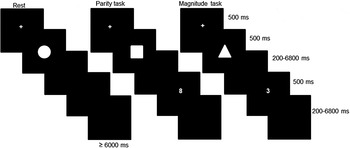
Presentation software package (Neurobehavioural Systems, http://www.neurobs.com) was used to programme the task. It was presented in the scanner and had three trial types consisting of two different task trials, either a magnitude, where participants had to respond to numerical stimuli by deciding whether they were smaller or bigger than 5, or parity judgement, where participants had to respond to numerical stimuli by deciding whether they were odd or even, and rest trials. At the start of each trial a fixation cross appeared on the screen (500 ms) which was followed by a cue (500 ms) signalling the nature of the upcoming trial [i.e. parity judgment task (task 1), magnitude judgment task (task 2) or rest]. All stimuli were presented on a black screen and viewed via a mirror attached to the head-coil. During task trials, participants were instructed to respond as fast and accurate as possible. Depending on task rules, participants had to respond by pressing a button with their right or left index finger. During rest trials (minimum duration 6000 ms), in contrast to task trials, no stimuli followed the cue and participants were instructed to relax and rest. Trial types alternated in a pseudo-random fashion, so that the switch (task-to-rest, rest-to-task, task-to-task) and repeat (task repeat, rest repeat) trial ratios were kept at 1:3 to ensure a robust switch effect. The duration of inter-event intervals (i.e. the duration of cue-target and response-fixation cross intervals) was pseudo-logarithmically jittered ranging from 200 to 6800 ms to reliably separate anticipatory cue-related activity from target-related activity (Fig. 1; also see Sidlauskaite et al. Reference Sidlauskaite, Wiersema, Roeyers, Krebs, Vassena, Fias, Brass, Achten and Sonuga-Barke2014 for further details). All participants undertook four blocks of training before the experiment. The first three blocks were single-cue condition trials for learning the cue-trial associations. The last block mimicked the real task where the cues were intermixed and participants had to alternate between the two tasks and rest trials. There was a total of 300 trials in the experiment. These were divided into three runs (approximate duration of one run was 15 min) performed inside the scanner. At the beginning of each run instructions were displayed to remind the cue-trial associations.
An outline of the cued state-to-state switching task. Each trial starts with a presentation of a fixation cross, followed by one of the three cues. The cue indicates the type of the trial. On task trials, after a jittered cue-target interval, a target appears on the screen and subjects have to respond by pressing a correct response button. The jittering interval ranges from 200 ms to 6800 ms; 50% of the trials has a cue-target interval ranging from 200 ms to 2000 ms. On 30% of the trials the cue-target interval ranges from 2600 ms to 4400 ms. The remaining trials have the cue-target interval in a range from 5000 ms to 6800 ms. The response-fixation cross-interval is jittered in the same fashion. The minimum duration of a rest trial is 6000 ms; no stimuli are presented and subjects are asked to relax and rest until the next fixation cross and trial indicating cue are presented.

Image acquisition and data analysis
Images were acquired using a 3 T Siemens Magnetom Trio MRI system (Siemens Medical Systems, Germany) with a standard 32-channel head-coil. High-resolution 1 mm3 anatomical images were taken with a T1-weighted 3D MPRAGE sequence (duration 6 min). Whole-brain functional images were acquired using T2*-weighted EPI sequence, which is sensitive to blood oxygen level dependent (BOLD) contrast (TR = 2000 ms, TE = 35 ms, acquisition matrix = 64 × 64, FoV = 224 mm, flip angle = 800, slice thickness = 3 mm, voxel size = 3.5 × 3.5 × 3.5 mm3, 30 axial slices). To diminish T1 relaxation artefacts, the first four EPI images of every run were removed. Imaging data were pre-processed and further analysed with Statistical Parametric Mapping software (SPM8; http://www.fil.ion.ucl.ac.uk/spm/software/spm8/). During data pre-processing, first, functional images were slice-time corrected and realigned to the first EPI. Second, functional-to-anatomic co-registration was conducted. Next, images were normalized to the Montreal Neurological Institute (MNI) template and smoothed using isotropic 8 mm full-width half-maximum (FWHM) Gaussian kernel and a high-pass temporal filter with a 128 s cut-off was applied. Event-related single-subject BOLD response was estimated using the general linear model (GLM) in SPM8. The experimental conditions were used to compute event onset vectors. To study cue and switch type-related anticipatory BOLD response, onset-time regressors of interest were formed based on all cue and switch categories. This design enabled us to differentiate the cue-related BOLD response from all other events in the experiment (targets, responses, errors) which were modelled as regressors of no interest. Onset vectors formed the GLM matrix and were convolved with the canonical haemodynamic response function (HRF). Six subject-specific motion parameters were estimated during realignment (three translational and three rotational). All subject-specific motion time-series were visually inspected and the whole data set was excluded from further analyses if motion exceeded 3 mm translationally and/or 3 degrees rotationally. To additionally account for head motion, realignment parameters were included as regressors into the GLM model. Moreover, a two-sample t test analysis of the head motion parameters revealed no significant group differences in neither translational (ADHD: x = 0.173, s.d. = 0.090; y = 0.141, s.d. = 0.059; z = 0.429, s.d. = 0.300; TD: x = 0.183, s.d. = 0.100; y = 0.163, s.d. = 0.070; z = 0.382, s.d. = 0.186; p's respectively: 0.753, 0.296, 0.204), nor rotational (ADHD: roll = 0.0068, s.d. = 0.0044; pitch = 0.0039, s.d. = 0.0019; yaw = 0.0029, s.d. = 0.0012; TD: roll = 0.0054, s.d. = 0.0029; pitch = 0.0034, s.d. = 0.0019; yaw = 0.0026, s.d. = 0.0014; p's respectively: 0.237, 0.414, 0.560) motion.
Whole-brain analyses
Whole-brain analyses were used to define the regions of interest (ROIs) in an independent manner to avoid circularity in the analysis and ‘double dipping’ (Kriegeskorte et al. Reference Kriegeskorte, Simmons, Bellgowan and Baker2009). First, we needed to establish whether rest cues elicited DMN activity as was previously shown by Sidlauskaite et al. Reference Sidlauskaite, Wiersema, Roeyers, Krebs, Vassena, Fias, Brass, Achten and Sonuga-Barke2014), thus the neural activity upon rest cues was compared to the activity elicited by task cues (i.e. rest cue v. task cue contrast. Second, to identify common switch-related activity, we contrasted all switch cues (irrespective of switch type, thus collapsing across state-to-state and task-to-task switches) with repeat cues (irrespective of repeat type, thus collapsing across rest and task repeat conditions). To confirm that the resulting activation maps from rest v. task cue comparisons corresponded to the DMN, we masked it using a standard DMN mask, comprised of bilateral superior medial frontal gyrus and posterior cingulate/precuneus (Buckner et al. Reference Buckner, Andrews-Hanna and Schacter2008; Franco et al. Reference Franco, Pritchard, Calhoun and Mayer2009). To ensure that the switch-related activation from switch v. repeat cues corresponded to the SN, specifically rAI, we masked the activation maps using a standard SN mask comprised of bilateral insula and anterior cingulate cortex (ACC) (Seeley et al. Reference Seeley, Menon, Schatzberg, Keller, Glover, Kenna, Reiss and Greicius2007; Kullmann et al. Reference Kullmann, Pape, Heni, Ketterer, Schick, Häring, Fritsche, Preissl and Veit2013). Both DMN and SN masks were generated using the WFU Pickatlas automated anatomical labelling atlas (Tzourio-Mazoyer et al. Reference Tzourio-Mazoyer, Landeau, Papathanassiou, Crivello, Etard, Delcroix, Mazoyer and Joliot2002). All whole-brain single-subject contrasts were subjected to a second-level random effects analysis. To ensure that both groups of participants shared significant activations (i.e. that activations in both groups overlapped), we treated the single-subject contrasts from the two groups as belonging to one group (i.e. we merged ADHD and control group participants into one group) in the second level analysis and whole-brain activation maps were computed using a one-sample t test to show significant increases in BOLD response. Activations were deemed significant if they survived a family-wise error (FWE) correction at a cluster level (p < 0.05), based on an auxiliary voxel-wise height threshold (p < 0.001 uncorrected).
ROI analyses
The DMN ROIs, derived from rest v. task cue comparisons, included superior medial frontal gyrus (SmFG) (MNI coordinates: 13, 63, 20) and precuneus (MNI coordinates: −12, −49, 41). rAI cluster (MNI coordinates: 34, 28, 6), was derived from the switch collapsed v. repeat collapsed comparison [whole-brain (masked) activation maps for the relevant comparisons are provided in Supplementary Tables S1–S4; Figs S1, S2]. Experimental condition-related parameter estimates (beta values) were extracted from 10-mm radius spheres centred around the respective MNI coordinates for all ROIs. ROI parameter estimates were used as dependent measures in GLM repeated-measures analysis of variance (rmANOVA) using SPSS v. 19 (SPSS Inc., USA), and Bonferroni correction for multiple comparisons was applied (DMN ROI analyses, p < 0.025). Separate rmANOVAs were computed to investigate the attenuation and up-regulation DMN ROIs. To investigate the attenuation of DMN, rmANOVAs for both DMN ROIs including a cue factor with two levels, i.e. rest-to-rest and rest-to-task, as a within-subject factor and group as a between-subject factor were computed. To examine the up-regulation of the DMN, rmANOVAs including a cue factor with two levels, i.e. task-to-task and task-to-rest, as a within-subject factor and group as a between-subject factor were performed.
rAI differential modulation by switch type was examined forming a rmANOVA with cue type (five levels to include all switch/repeat types) as a within-subject factor and group as between subject factor.
Ethical standards
The study was approved by Ghent University Hospital Ethics Committee. Participants gave written informed consent and received a monetary compensation for participation.
The authors assert that all procedures contributing to this work comply with the ethical standards of the relevant national and institutional committees on human experimentation and with the Helsinki Declaration of 1975, as revised in 2008.
Results
Error rate did not differ between groups (controls > 97% correct, s.d. = 0.92; ADHD > 86%, s.d. = 13.70; p = 0.09). The ADHD group had significantly slower responses in all conditions (F 1,38 = 9.57, p = 0.004). Controls, task-switch: mean = 897 ms, s.d. = 0.20; rest-to-task: mean = 826 ms, s.d. = 0.19; task-repeat: mean = 762 ms, s.d. = 0.16. ADHD, task-switch: mean = 1096 ms, s.d. = 0.27; rest-to-task: mean = 1069 ms, s.d. = 0.25; task-repeat: mean = 942 ms, s.d. = 0.21. There was a main effect of switch condition (F 2,76 = 39.29, p < 0.001), with slowest responses for task switch trials. The group × condition interaction was not significant (F 2,76 = 1.91, p = 0.155). The ADHD group had a significantly higher intra-individual response time variability irrespective of switch condition [intra-individual coefficient of variation (ICV) = (s.d. response time)/(mean response time); F 1,38= 5.46, p = 0.025]. There was neither a main effect of condition (F 1.6,60.8 = 1.48, p = 0.234) nor a group × condition interaction (F 1.6,60.8 = 1.68, p = 0.198).
Rest-to-task switches
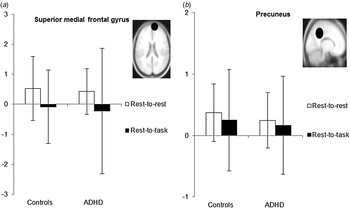
Anterior but not posterior DMN was down-regulated (SmFG: F 1,38 = 5.99, p = 0.019; precuneus: F 1,38 = 0.74, p = 0.393). No main group effect was apparent (SmFG: F 1,38 = 0.11, p = 0.734; precuneus: F 1,38 = 0.352, p = 0.557). The degree of DMN down-regulation did also not differ between groups (group × condition interaction, SmFG: F 1,38 = 0.005, p = 0.942; precuneus: F 1,38 = 0.032, p = 0.859) (Fig. 2).
Default mode network modulation anticipating rest-to-rest and rest-to-task switches in adults with ADHD and controls. The average parameter estimates [beta values ± standard deviation (s.d.)] for the ADHD and control groups extracted from default mode network (DMN) regions. (a) Region of interest (ROI) analysis of the DMN superior medial frontal gyrus during rest-to-rest and rest-to-task cues. (b) ROI analysis of the posterior DMN precuneus during rest-to-rest and rest-to-task cues.

Task-to-rest switches
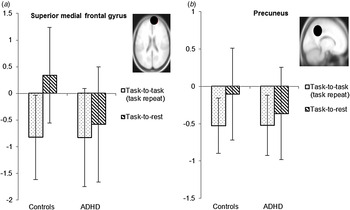
DMN activity was up-regulated to cues signalling task-to-rest switches (SmFG: F 1,38 = 12.97, p = 0.001; precuneus: F 1,38 = 9.89, p = 0.003). A trend toward a group effect was observed in SmFG (F 1,38 = 4.53, p = 0.040) with no group effect in precuneus (F 1,38 = 0.88, p = 0.345; Bonferroni correction p < 0.025). Up-regulation of SmFG was greater in controls than participants with ADHD (group × condition interaction: F 1,38 = 5.42, p = 0.025; task-to-rest: t 38 = 2.93, p = 0.006; task-to-task repeat: t 38= 0.025, p = 0.980), there was no difference between groups in terms of precuneus up-regulation (group × condition interaction; F 1,38 = 2.04, p = 0.161) (Fig. 3).
Default mode network modulation anticipating task-to-task (task repeat) and task-to-rest switches in adults with ADHD and controls. The average parameter estimates (beta values ± s.d.) for the ADHD and control groups extracted from default mode network (DMN) regions. (a) Region of interest (ROI) analysis of the DMN superior medial frontal gyrus during task-to-task (task repeat) and task-to-rest cues. (b) ROI analysis of the posterior DMN precuneus during task-to-task (task repeat) and task-to-rest cues.

rAI
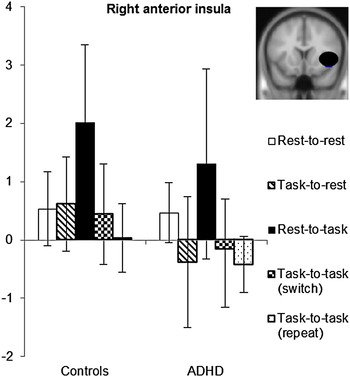
Switch type modulated rAI activation (F 2.84,108.06 = 36.62, p < 0.001), with the strongest rAI response to rest-to-task cues. Groups did not differ with respect to this effect as indicated by the absence of a significant condition × group interaction (F 2.84,108.06 = 2.08, p = 0.110). Instead, the ADHD group showed consistently less rAI activation irrespective of switch type (F 1,38 = 6.73, p = 0.013) (Fig. 4).
Modulation of the right anterior insula (rAI) during different types of switches in adults with ADHD and controls. The average parameter estimates (beta values ± s.d.) for the ADHD and control groups extracted form rAI per switch/repeat condition.

Discussion
The present study is the first to test the hypothesis that anticipatory rest-to-task switching is impaired in ADHD. Against our prediction, anticipatory DMN down-regulation during rest-to-task switching was intact in adults with ADHD. However, we provide the first evidence for ADHD-related difficulties in DMN up-regulation during switching from task-to-rest – as the individual reengages in the resting state. rAI activation was found to be reduced in ADHD, but this was irrespective of switch type.
First, we did not find support for our prediction that excessive DMN activity previously observed during goal directed tasks in ADHD may be due to impaired attenuation of DMN activity during rest-to-task switching. Adults with ADHD down-regulated anterior DMN to the same degree as controls. Posterior DMN precuneus was neither attenuated in controls nor in participants with ADHD. The heterogeneity of the DMN with regard to state switching replicates the findings of Sidlauskaite et al. (Reference Sidlauskaite, Wiersema, Roeyers, Krebs, Vassena, Fias, Brass, Achten and Sonuga-Barke2014) and is in line with the literature implicating precuneus also in visuospatial processing, orientation within and interpretation of surroundings (Gusnard & Raichle, Reference Gusnard and Raichle2001; Hahn et al. Reference Hahn, Ross and Stein2007). If DMN down-regulation during rest-to-task switching is intact in individuals with ADHD, what might then explain DMN hyperactivation during tasks indicated in previous studies (Fassbender et al. Reference Fassbender, Zhang, Buzy, Cortes, Mizuiri, Beckett and Schweitzer2009; Peterson et al. Reference Peterson, Potenza, Wang, Zhu, Martin, Marsh, Plessen and Yu2009; Helps et al. Reference Helps, Broyd, James, Karl, Chen and Sonuga-Barke2010; Liddle et al. Reference Liddle, Hollis, Batty, Groom, Totman, Liotti, Scerif and Liddle2011)? One possibility is that after a successful switch, individuals with ADHD may have difficulties maintaining the required level of effort or motivation to sustain suppression of DMN activity over time, leading to DMN re-emergence during prolonged task intervals (Sonuga-Barke & Castellanos, Reference Sonuga-Barke and Castellanos2007). This increase in DMN activity over time during task performance has previously been shown in patients with traumatic brain injury (Bonnelle et al. Reference Bonnelle, Leech, Kinnunen, Ham, Beckmann, De Boissezon, Greenwood and Sharp2011). However, this hypothesis still requires further investigation in ADHD with tasks incorporating longer trial blocks designed to test for sustained DMN suppression.
While the process of ‘switching off’ the DMN appears intact, the results provide some evidence that adults with ADHD may have a problem ‘switching the DMN back on’ when moving back to rest. Interestingly, for task-to-rest switches we found an attenuated anticipatory up-regulation of the anterior DMN in ADHD and this novel finding of reduced DMN up-regulation has several implications. First, it adds to the previously reported findings of reduced neural engagement during cued response time tasks in ADHD (Cubillo et al. Reference Cubillo, Halari, Smith, Taylor and Rubia2012; Clerkin et al. Reference Clerkin, Schulz, Berwid, Fan, Newcorn, Tang and Halperin2013) and electroencephalographic studies reporting reduced contingent negative variations, reflecting reduced preparatory and anticipatory attentional processes (Brunia & van Boxtel, Reference Brunia and van Boxtel2001; Nagai et al. Reference Nagai, Critchley, Featherstone, Fenwick, Trimble and Dolan2004; Plichta et al. Reference Plichta, Wolf, Hohmann, Baumeister, Boecker, Schwarz, Zangl, Mier, Diener, Meyer, Holz, Ruf, Gerchen, Bernal-Casas, Kolev, Yordanova, Flor, Laucht, Banaschewski, Kirsch, Meyer-Lindenberg and Brandeis2013; Poljac & Yeung, Reference Poljac and Yeung2014) in ADHD (Kenemans et al. Reference Kenemans, Bekker, Lijffijt, Overtoom, Jonkman and Verbaten2005; Linssen et al. Reference Linssen, Sambeth, Riedel and Vuurman2013). However, these studies were confined to cues signalling an upcoming task. Our findings suggest that anticipatory neural disturbances are not confined to task-related processing, but also encompass rest preparation, as reflected in attenuated up-regulation of DMN. Hence, one possibility is that individuals with ADHD may suffer from altered anticipatory mechanism related to task and rest states or even a more generic one and this requires further investigation in future studies. Second, problems engaging DMN and initiating a resting or an idle state are consistent with the clinical idea that individuals with ADHD have problems calming down after a stimulating task and may also relate to commonly reported sleep initiation difficulties (Owens, Reference Owens2006, Reference Owens2009).
rAI was differentially modulated by the anticipation of different switch types and both groups exhibited the strongest rAI response during rest-to-task cues. This finding is in line with the model of rAI as a between large-scale brain network switching hub, controlling transitions disengaging the DMN and employing task-relevant brain regions (Sridharan et al. Reference Sridharan, Levitin and Menon2008; Menon & Uddin, Reference Menon and Uddin2010; Sidlauskaite et al. Reference Sidlauskaite, Wiersema, Roeyers, Krebs, Vassena, Fias, Brass, Achten and Sonuga-Barke2014). rAI activation was found to be reduced in ADHD, however irrespective of switch type. rAI dysfunction is in accord with existing literature on insula function and activity alterations in ADHD, as well as evidence of structural volumetric abnormalities of this region in ADHD (Valera et al. Reference Valera, Spencer, Zeffiro, Makris, Spencer, Faraone, Biederman and Seidman2010; Spinelli et al. Reference Spinelli, Joel, Nelson, Vasa, Pekar and Mostofsky2011; Lemiere et al. Reference Lemiere, Danckaerts, Van Hecke, Mehta, Peeters, Sunaert and Sonuga-Barke2012; Lopez-Larson et al. Reference Lopez-Larson, King, Terry, McGlade and Yurgelun-Todd2012; Sripada et al. Reference Sripada, Kessler, Fang, Welsh, Prem Kumar and Angstadt2014). Since rAI is functionally multifaceted and sophisticated, one cannot strictly dissociate its specialized role in switching from DMN to task states, general saliency processing, and regulation of autonomic bodily functions (Seeley et al. Reference Seeley, Menon, Schatzberg, Keller, Glover, Kenna, Reiss and Greicius2007; Medford & Critchley, Reference Medford and Critchley2010). Because rAI activation to cues appeared unrelated to abnormal switching patterns in ADHD, it may indicate general reduced saliency of cues in ADHD.
Limitations
The current experimental task included rest trials to investigate state-to-state transitions. However, on these trials the cued anticipatory phase could not be completely temporally separated from the actual rest period. While task anticipation and initiation were separated by the appearance of a target, rest was not. Nevertheless, our findings provide clear evidence of impaired early cue-related up-regulation of DMN in ADHD. The temporal resolution of fMRI is inherently limited due to the BOLD haemodynamic response. Combining fMRI and EEG with its excellent temporal resolution in future studies, may increase our understanding about the timing of the processes involved in impaired anticipatory state switching in ADHD.
Conclusion
Anticipatory rest-to-task switching, in terms of cue-related DMN attenuation, seems to be intact in ADHD and cannot explain excess DMN activity observed during tasks. However, individuals with ADHD do exhibit attenuated DMN up-regulation when anticipating switches back to rest, suggesting difficulties in initiating rest or idle states. Reduced rAI activation to cues irrespective of switch type potentially indicates general reduced cue salience in ADHD.
Supplementary material
For supplementary material accompanying this paper visit http://dx.doi.org/10.1017/S0033291715002019.
Acknowledgements
This work is supported by the Fund for Scientific Research – Flanders (project number: 3G084810). Authors declare no conflict of interest. We thank Eric Achten for his help with the imaging protocols, Eliana Vassena for her help with data collection, and Ruth Krebs for her valuable suggestions on data analysis.
Declaration of Interest
None.