1. INTRODUCTION
1.1. Electronic music at the Shanghai Conservatory
Electronic music began to develop in mainland China only in the mid-1980s. Before then, as Marc Battier has written, ‘electroacoustic music was not part of the curriculum’ in China (Battier Reference Battier, Puckette and Hagan2020: 177). Battier and Lin-Ni Liao have observed that over the next several decades, many electronic music centres were established, links with several famous electronic music research institutes were created, and composers who were trained abroad returned to China to teach courses in electronic music (Battier and Liao Reference Battier, Liao and Emmerson2018: 51–6).
Recent research on electronic music in mainland China has included overviews of China as a whole as well as specialised studies of developments in Beijing and Wuhan (Battier Reference Battier, Puckette and Hagan2020; Landy Reference Landy and Emmerson2018; Liu and Yang Reference Stevens2022). In the past 20 years, electronic music has experienced significant and rapid development in Shanghai, and the Shanghai Conservatory of Music has emerged as one of the two ‘front runners in the field of electronic music in China’ (Battier and Liao Reference Battier, Liao and Emmerson2018: 53). Prominent events in the city have included Electronic Music Week (EMW) and meetings of the Electroacoustic Music Studies Network (EMS), the International Computer Music Conference (ICMC) and the IRCAM Forum.
A critical influence on the growth of electronic music in Shanghai has been the ‘Talent Introduction’ programme initiated at the Conservatory by Professor Yang Liqing (杨立青), who became its president in 2000. He invited composers and musicians who studied abroad and who had established careers to return to teach at the Conservatory such as An Chengbi (安承弼), Chen Xiaoyong (陈晓勇), Du Yun (杜韵), Huang Ruo (黄若), Lu Pei (陆培), Qu Xiaosong (瞿小松), Shen Ye (沈葉), Wang Ying (王颖), Wen Deqing (温德青), Xu Shuya (许舒亚), Xu Yi (徐仪) and Zhu Shirui (朱世瑞). Yang’s mission was twofold: first, to build connections and eliminate the gap between young undergraduate students and professors in their fifties and sixties; and second, to allow musicians with international training to bring new ideas into the culture of the conservatory (Battier and Liao Reference Battier, Liao and Emmerson2018: 53). For instance, under the auspices of this programme, An Chengbi founded the Electro-Acoustic Music Center of Shanghai Conservatory (EAMC/EAMCSCM) in 2002, which I currently direct.
In this article, I examine recent works by five composers who participated in this project: Du Yun, Huang Ruo, Shen Ye, Wang Ying and myself (周倩).Footnote 1 Through this analysis, I locate compositional techniques and approaches to sound spatialisation. These works were all composed after 2000 and involve a variety of genres and media, including sound installation (Inscribed), immersive sound (Varying), mixed electronics (Air Glow) and interactive live performance (ROBOTICtack).
The five composers I discuss were all born in China in the 1970s and studied composition at the Shanghai Conservatory; we also pursued additional studies in Europe and the United States and we were brought back as professors or guest professors at the Conservatory with the support of the ‘Talent Introduction’ project.Footnote 2 We all use electronic media and materials in our music. In the analyses that follow, I draw upon manuscripts, unpublished scores, photographs of software design and other sources to document the creative processes and features of a series of representative works. Considered within the broader context of electronic music in China, these works illustrate how Shanghai-based composers have brought new technologies and tools into Chinese practice; these include AudioSculpt, Diphone, Max/MSP and Spat, reflecting their training at institutions such as IRCAM, CNMAT, and CCRMA. I first survey the aesthetic and compositional concepts underlying these works, distinguishing among abstract, mimetic and mixed categories, and I then turn to examine the technical means through which composers have realised these concepts.
1.2. Works studied
Du Yun:
-
Air Glow for five trumpets and two laptops (2006), 15 min, commissioned by the Festival of New Trumpet Music (FONT).
-
An Empty Garlic (空心蒜) for bass flute and playbacks (2014), 16 min, commissioned by Project& (Claire Chase, Worldwide tour of Density 2036, part ii).
Huang Ruo:
-
Inscribed (形中形) for installation (2017), 7 min, commissioned by Manchester International Festival (Factory International, n.d.).
Shen Ye:
-
Prologue of the Moments With You – A Journey of Reconciliation and Love, Music Unlimited XI (合唱无设限 XI:念你如昔之序曲) for choir and electronics (2019), 15 min, commissioned by Taipei Chamber Singers, ‘Music Unlimited, 2019’.
-
Ondulation – Night Music (波动 — 夜乐) for piano and electronics (2014), 8 min, produced by IRCAM.
-
Sword (铸剑) for flute, piano and prepared electronics (2010), 13 min, commissioned by Shanghai Conservatory of Music, Jennifer Hymer and Carin Levine.
Wang Ying:
-
Tun•Tu (吞•吐) for baritone saxophone, electronic sounds and real-time electronics (2012), 10 min, produced by IRCAM.
-
ROBOTICtack for alto, ensemble and electronics (2017), 13 min, commissioned by SWR Experimental Studio.
Zhou Qian:
-
Varying (嬗) for surrounding sounds (Varying for 5.1 version 2010, Varying II for 3D sound version 2019), 10 min, commissioned by Shanghai Conservatory of Music.
-
Qu Shui Ming Yun (曲水鸣韵) for zheng/guqin and electronics (2011 for the zheng version, 2016 for the guqin version), 11 min, commissioned by Electronic Music Week (EMW) Shanghai.
-
Ripples (涟漪) for pipa and electronics (2017), 9 min, produced by the 43rd International Computer Music Conference (ICMC) 2017.
2. MUSICAL IDEAS AND COMPOSITIONAL APPROACHES
In each of these works, the composers strive to transform ideas and emotions into a musical entity – an organised sound world. In some of the works, abstract thoughts, symbolism and philosophical imagery dominate, while in others, concrete events and people, as well as the emotions associated them, prevail. The following subsections provide a discussion of the origins of the musical ideas for these works subdivided into three categories: abstract, emotions, balanced. The compositional approaches used to realise these ideas are then analysed.
2.1. Abstract, symbolic origins of musical ideas, with links to philosophy and nature dominates
In the first category, musical ideas are more often derived from abstract notions, symbolism or reflections related to nature and philosophy.
Wang Ying, for example, composed Tun•Tu (吞吐) during her time studying at IRCAM’s Cursus. She was inspired by Taoist philosophy at that time, so she wrote Tun•Tu to express the connection between human, nature and the universe. The piece musically explains the idea that the universe ‘breathes’ just like humans, that there is convergence and dispersion, invisibility and manifestation. This idea led her to associate the inhaling and exhaling techniques used on the baritone saxophone with Tun吞 (inhale) and Tu吐 (exhale). She has written that ‘Tun and Tu are the Chinese terms for the vast limitlessness of the universe and also for the process of inhaling and exhaling, which is inextricably connected to life on Earth’ (Wang Reference Wang2012).
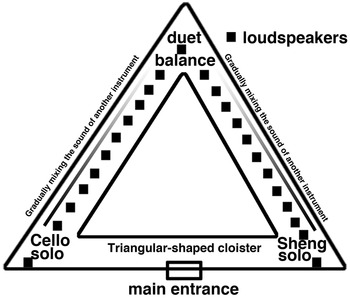
Huang Ruo designed the sound installation Inscribed to reveal a philosophical dilemma with cross-cultural implications, leaving it to the listeners to choose whether to turn left (lulled by the cello) or right (attracted by the sound of the sheng). This sound installation was placed in a triangular building. In this building, Huang set many loudspeakers on two intersecting paths. As the listeners walk on one of the paths, the sounds of the cello or the sheng played by the loudspeakers will change in volume. When the listeners follow the trajectory of the speakers, they can feel the sounds of the two instruments fading, merging and separating, over and over again. The sounds form a cycle or a sound loop. Whether the listeners choose left or right, they might get the impression that Huang superimposes a cycle of sound changes on the triangle of the building’s invariance. This is what the title ‘inscribed’ means. Referring to philosophical reflections on the tangible (triangular form of real architecture) and the intangible (cycle form of virtual sound field), Huang wrote in the programme notes: ‘We often face the choice and dilemma of turning left or turning right. Consciously or unconsciously, what makes us choose one way or the other? Can sound and music play a role in human decisions?’Footnote 3
In this sound installation consisting of a duo, sheng and cello represent the colourful sounds of the East and the West, respectively. Thinking about these cross-cultural implications, Huang has written: ‘Drawing contrasting sonic colors from both the Eastern and Western world, Inscribed offers visitors two different sonic paths.’
Ondulation, completed by Shen Ye while at the IRCAM Cursus, is more abstract and uses the sound made by a particular vibration of a piano string as a metaphor for the primordial universe. Every part of the work, every phrase, chord and rhythm comes from the transient changes, harmonic structures and resonance effects of this piano sound. It is as if every celestial body in the universe today comes from the fundamental laws of the universe at its birth. Shen constructed the soundstage of the concert hall to instil in the listener to the perception of the connections among the various components in the interior of this universe of sound.
My work Varying consists of a set of lively musical variations and an extremely tight musical organisation, both of which unfold from a very small acoustic element: a faint ‘clicking’ sound. Over the years, different composers have pondered using granular time units as sonic material for music composition. As Xenakis wrote in Formalized Music, sound can be regarded as a ‘grain’ (Xenakis Reference Xenakis1992: 43). In Curtis Roads’s Microsound, sound is divided into units of time measured in milliseconds (Roads Reference Roads2001: 3–4). In addition, Concatenative Synthesis, which divides sound into tiny units, is used in Aperghis’s Luna Park (Beller and Aperghis Reference Beller and Aperghis2011). I am interested in these compositional theories and techniques, and Varying is a proof-of-concept of my understanding. The ‘clicking’ sound at the start of Varying transmits its character to every second of change at every level throughout the piece. There is an aesthetic quest for extreme purity in Varying (Zhou Reference Zhou2019). In addition to being inspired by contemporary compositional methods, Varying also drew inspiration from Chinese philosophical concepts of ‘change versus immutability’ and ‘transmutation’.Footnote 4
Similarly, the aesthetic quest for purity is represented in the conceptual source of the work Ripples. ‘Ripple’ is an abstract analogy for a series of miniature physical and psychological fluctuations. I have previously explained this work as: ‘The gleaming wavelets are a refraction of memories and ripples of sound break the silence’ (Zhou Reference Zhou2017).
This idea connects the tangible world with the psychological world and world of abstract sounds. The relationships among all the work’s sounds, regardless whether from the pipa, electronics or among them, are organised through ‘ripples’, which act as a unifying force.
2.2. Origins of musical ideas linked to human emotions and actions dominate
Music falling into the second category was conceived in relation to human emotions and behaviours.
Of the works I have chosen, those obvious in this regard are Du Yun’s Air Glow and An Empty Garlic, and Shen Ye’s Sword and Prologue. For example, the score to Du’s Air Glow states: ‘The heart evokes an air glow/that never goes dark wholly/In an age when despair, desolation, and wretchedness become the norm, so evolves our acquainted aesthetic taste’ (Du Reference Du2006).
At the beginning of An Empty Garlic, Du uses the scraping noise on the tam-tam and percussive sounds from the flute, then the music calms down towards the end, using Sarabande music form to express Du and the flautist’s memories of a mutual friend (Du Reference Du2014).
The idea for Shen’s Sword was inspired by the ancient Chinese spirit of chivalry. This work came from Chinese author Lu Xun’s (鲁迅) novel Casting Swords, a story about an ancient Chinese warrior who takes revenge on a brutal king and both men end up dying together. In Sword’s sound world, the breath of the flute is akin to the wind in the wilderness, the high-pitched chords of the piano chime like the death knell in a distant cemetery, and the fierce rhythmic, metallic crashing electronic sound is associated with the battle depicted in the story (Shen Reference Shen2010).
Finally, Prologue creates a scene: night falls, family and friends gather after work, the sound of the radio programme dances in the air and the story is about to begin. Through this imagery, the work unfolds in a relaxed and casual overall atmosphere. Within the musical structure, the timing of each chorus member’s entrance, their position, the speed and direction of their movements, the substance of their conversations, the distance and amplitude of each voice are all carefully organised. This logical organisation makes the music gradually warm up (Shen Reference Shen2019).
2.3. Abstract notions and human emotions form a balanced origin of musical ideas
With regard to the third category, the musical ideas derive from a balance between abstract ideas and human emotions.
Wang Ying’s ROBOTICtack and my work Qu Shui Ming Yun adopt a balanced origin of musical ideas between concepts and emotions. Wang was constantly thinking about the relationship between intelligent robots and humans in the modern technological era when she composed ROBOTICtack, and viewed it as an adversarial zero-sum game, resulting in the creation of an adversarial acoustic relationship. In addition, from an emotional point of view, the composer was preoccupied with the odds of winning for humans and therefore the music is pervaded by anxiety and tension (Wang Reference Wang2017).
Qu Shui Ming Yun has a double meaning. One meaning is about abstract ideas. ‘Water’ and ‘time’ are the philosophical themes from which the music is conceived, as I noted in the programme notes: ‘Faced with flowing water, we often think of the passing of time. The impressions of water and time are retrieved in memory, and they are layered to form a vast musical space’ (Zhou Reference Zhou2011).
The other meaning is about humanism. I used the musical context of the guqin piece Flowing Water (流水) (Guan Reference Guan1993). This musical quotation reflects my strong attachment to the spirit of humanism, based on the belief that the humanism exhibited in the guqin piece Flowing Water will survive. The new acoustic context of guqin tones and electronic sounds was meant to allow the listener to find a new enthusiasm for listening to ancient Chinese music; to recall the memories about how the humanistic spirit and music complement each other. Lana Norris comments as follows: ‘The piece meandered through microtones and sonic decay without establishing a melodic pathway; Qian’s piece allowed the audience to savor the unfamiliar qin timbre with a sense of unpatterned time’ (Norris Reference Norris2016).
3. MEANS AND TECHNIQUES OF EXPRESSION
For a more varied presentation of musical ideas, different techniques are considered to express different needs. As means of expression, these pieces utilise many electronic music techniques. The composers chose different software tools that they are familiar with based on their different overseas study experiences. At the same time, composers have to think about how to present these pieces with workable techniques. This analysis will summarise the means that are frequently used in these pieces, and focus on three aspects: presets, gestural controllers, and graphical music programming and signal processing.
3.1. Presets
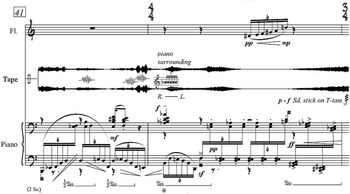
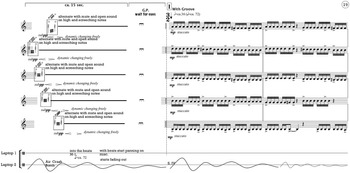
These works utilise a vast variety of electronic music presets. The types of presets (and related equipment or tools) covered in these works are used in a highly individual way. With regard to pre-recorded and processed sound materials, the composers at times use the pre-recorded sounds as an echo of the live instrumental sounds. For example, the pre-recorded piano sounds in Sword serve as a spatial echo to the piano during live performance (Figure 1).
The pre-recorded piano sounds in Sword form a spatial echo for the piano during live performance.

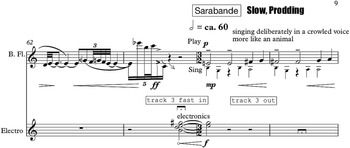
In the example from An Empty Garlic (Figure 2), a pre-recorded chord via electronic playback dovetails with the bass flute part. This chord leads the energetic music to a stately Sarabande part.
In An Empty Garlic, a pre-recorded chord filling the rest in the bass flute part.

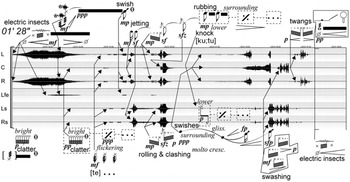
In addition, the pre-recorded sounds are formed into new sound materials by various audio processing techniques such as filtering, compression, time stretch, spectral trimming and resonance. In Varying, the pre-processed audio samples are used as musical ‘bricks’ and are organised logically (Figure 3).
In Varying (5.1 version), the processed audio samples are organised into musical structure.

In Qu Shui Ming Yun, pre-recorded excerpts from the guqin piece Flowing Water form an augmentation canon (as symbol of the dialogue with time in the past) or diminution canon (as sign of the connection with the time coming) with the live-performed instrument. In Tun•Tu, Ondulation, Ripples, and so on, a large amount of sound material is processed in advance to enrich the real-time performance parts. In Inscribed, parameters such as dynamics, volume balance of the duo, and loudspeaker settings are preset. Huang Ruo uses such techniques to create a sound installation that can be exhibited in a public space (Manchester Town Hall) conveniently.
3.2. Using gestural controllers
The audio human–computer interaction (HCI) design is a key to the realisation of the musical ideas behind these works. Composers will consider which gestural controller is best for an interactive musical performance.
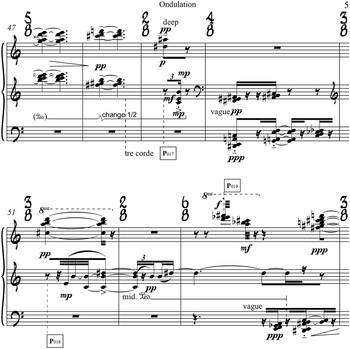
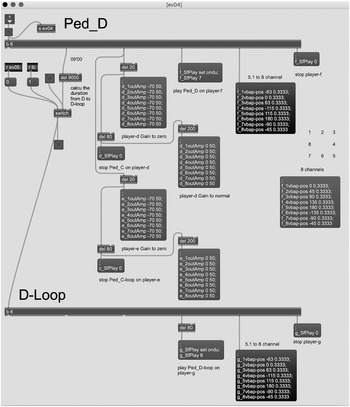
Ondulation requires, for example, that the numerous virtual sound events and the real live performance sound events are matched together with great precision. The acoustic resonance of the piano is essential and the piano lid must be opened so that such resonance is interwoven with the virtual sound field. However, while the use of score-following (Puckette and Lippe Reference Puckette and Lippe1992.) technology would have been the obvious option, in 2014, the Antescofo polyphonic score-following system was prone to interference and loss of control. Therefore, two pianist-triggered MIDI pedals placed to the left and right of the piano pedals became the optimal solution. As a result, Shen Ye arranged up to 70 triggers in Max/MSP, and all the triggers were controlled by the two MIDI pedals. Shen had set up a mechanism within the Max/MSP patches to filter out human errors in triggering. It is a difficult task for a pianist, to play with five pedals that need to be controlled by the feet and also to play five melodic layers that need to be controlled by the hands (Figure 4). After experimenting with several signal control methods, pianist Matthieu Acar made it possible to control live performance and real-time signals perfectly by using MIDI pedals. Acar premiered Ondulation successfully on the stage of Espace de projection (Shen Reference Shen2014).
Complicated pedals and melodic layers change in Ondulation.

To realize a live electronic piece, hand gesture is a considerable method to convert timbre and other sound parameters for real-time control (Puckette and Hagan Reference Puckette and Hagan2020). If a continuous sound change is required, as in ROBOTICtack, Alto and E-guitar use hothand sensors for delay, resonance, modulation, pitch shift, vibrato and other effects (Figure 5). The performers make real-time electronic sounds by shaking the hothand sensors in their hands. Through the gesture controls of the performers, the timbre of live singing or playing can be instantly changed. The robot-like sounds and machine-like sounds are produced to reveal the composer’s worries about the relationship between humans and machines. The performers also have a great deal of freedom by using sensors to handle changes of tempo in the progression of musical emotions.
Using hothand sensors for effects controlling in ROBOTICtack.

3.3. Graphical music programming and signal processing
For real-time or interactive live performance, programming and signal processing are also used in these works. These techniques allow numerous sound materials and complicated signal processes to be easily and flexibly manipulated.
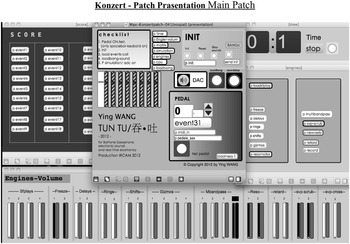
Max/MSP, the most popular graphical ‘music programming environment’ (Ge Reference Ge, Collins and d’ Escriván2017: 66), is used frequently in several pieces. For example, the Max/MSP patch built for Tun•Tu correlates the different technical methods for real-time recording, effects processing (e.g., bandpass, freeze, delay), midi pedal control, and so on, as a whole (Figure 6). When the performer presses the MIDI pedal and activates the Max/MSP settings, the live instrumental sounds and the pre-recorded baritone saxophone sounds are processed by the effects. Then the effected sounds are transmitted to the loudspeakers placed in a surround sound setup.
Max/MSP patch built for Tun•Tu.

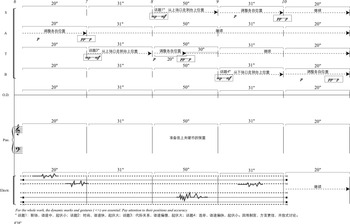
In Air Glow, Du used two laptops to process signals and to integrate the real-time processes with the elements of the performer’s live performance (Figure 7).
Signal inputs in the score of Air Glow.

In my work Ripples, the sound materials are processed in real time by the Max/MSP patches, and the duration can be flexibly varied in response to the pipa played in real time, in order to connect the different textural elements and/or different sections (Figure 8).
Max/MSP setup in Ripples.

4. MUSICAL-SOUND SPATIALISATION
Electronic music compositions achieve their musical ideas not only by synthesising all the sound elements but also by undertaking the construction of musical space. Poème électronique is a remarkable example of musical-sound spatialisation. The music was ‘distributed by 425 loudspeakers’, and ‘Varèse thought of his sounds as objects of different shapes and materials with dynamic properties and tendencies, existing in and moving through a musical space’ (Chadabe Reference Chadabe1997: 61). After Poème électronique, many works were composed with ideas of musical-sound spatialisation. The works I have chosen to analyse present the musical-sound spatialisation in three situations: surround sound, 3D sound spatialisation and special sound fields.
4.1. Surround sound
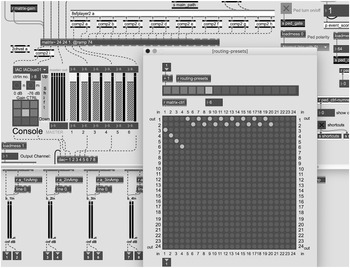
Prologue, Ondulation and Qu Shui Ming Yun all use a vector-based amplitude panning (VBAP) algorithm to handle real and virtual sound source position, panning or movement. Algorithms are also used to create virtual spaces.
These three works may also be differentiated by their respective use of spatial effects. Ondulation is particularly focused on reverberation, as Shen wanted to create an illusion as if the concert hall was transformed into a huge bell. The listeners are inside the bell and they listen to all the music that originates from within and extended outwards for a great distance. To implement this, Shen placed a coin on a piano string at a carefully adjusted position and then played the piano’s key to emit a chime. He passed this chime into the computer for sound analysis and processing via various tools such as AudioSculpt, Open Music, Diphone, GRM-tools and Max/MSP to extract elements – timbral, pitch, time and rhythmic raw materials – to be used in the construction of the piece. He also turned the spectrum of this chime into a resonant effect, which was used to transform the sound emitted by an acoustic piano into that of an electronic source with a chiming reverb. For the live performance at the Espace de projection concert hall at IRCAM, Centre Pompidou, Shen used an IRCAM-designed program to pre-modulate the angle of the wall panel arrays in order to adjust the reflection and absorption coefficients of the concert hall.
Prologue pays particular attention to the movement of sound in space. For this purpose, 10 microphones (suspended from various parts of the stage), 3-track modulated noises, 3-track pre-recorded spliced radio programme voices (Typhoon information for the day, and so on) were sent into the Max/MSP program in the computer with 16 sound tracks in total. Shen used the 2D VBAP algorithm to set up a circular virtual sound field in IRCAM-spat with a radius of 16 metres. Each track of sound had a specific direction and speed change at a specific time. The real-time electronic music section was transmitted through six speakers placed around the concert hall. The entrance of the audience was synchronised with the start of the work, so that the virtual soundstage created an effect as if sounds travelled through the auditorium, connoting an atmosphere of the gathering of a crowd, with the air filled with vibrancy (Figure 9).
Prologue, bb. 6–10.

The audio spatial treatment employed in Qu Shui Ming Yun emphasises the sense of diffusion and envelopment (Figure 10). At the beginning and ending of the piece, I use many long-line sounds in the electronic part. These sounds are projected into the virtual space at specific angles to one another, and both the thick low frequencies with resonances fill the entire concert hall, creating a vast musical space. This immersive acoustic space contrasts with the sound of the zheng/guqin (a traditional Chinese instrument) played live; the reconstructed and disintegrated guqin piece Flowing Water goes against or merges with the electronic sounds. In space and time, past, present and future are united as one.
Multichannel setting for constructing sound spaces in Qu Shui Ming Yun.

4.2. 3D sound spatialisation
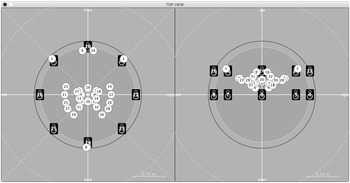
Varying II (3D sound version) was premiered at the 2019 ICMC-NYCEMF, which was designed for a 3D sound field using 16 loudspeakers arrayed in two rings. With this version of the piece, I attempted to use horizontal and vertical sound movement as a fundamental component of the piece. With the ambisonics manipulating the 8+8 two-layer ring-style arrangement of the speakers, the movement of the sounds can create more characteristic three-dimensional figures (Figure 11). I was thus able to establish the construction and varying of sound movement figures in the music.
Sound movement in 3D space of Varying II; the left picture is the front-back graph, and the right picture is the top-down graph. The two graphs show the same moment of music.

4.3. Special sound fields
Huang Ruo’s Inscribed was a sound installation for the Manchester Town Hall composed for a pre-recorded sheng/cello duet (BBC 2017). Manchester Town Hall is a triangular building with the main entrance at the centre of the base (Figure 12). Huang placed a row of speakers on each of the two bottom corners of the triangle leading to the top corner of the promenade. The speakers on the bottom corners on the left and right play the recordings of cello and sheng’s solo, respectively. Upon entering from the base of the triangular performance space, the listener must choose to face either left/cello or right/sheng, and as the listener proceeds to the top corner of the triangular room, the sound of one solo instrument is gradually joined by the sound of the other instrument, and both sounds converge at the top corner. As the listener moves from the top corner towards either of the two sides of the triangular room, the balance of the sounds gradually shifts again to one instrument overtaking the other. This installation exemplifies a special form of sound field, where the inherent architectural design of the building is exploited by the composer. What each person hears will be different from that heard by another, depending on which direction he/she selects, how fast he/she walks and where he/she ultimately stops or continues moving. This myriad of possibilities is an integral part of Huang Ruo’s creative vision.
Manchester Town Hall’s triangular shape put to good use in Inscribed.

5. CONCLUSION
In examining the techniques and technologies used in these works, which include software (GRM Tools, Max/MSP and Spat) and gestural controllers (MIDI pedal and hothand sensors), I have sought to document the distinctive contributions that composers associated with the Shanghai Conservatory have brought into their practice and teaching. These works constitute only a sampling of the many electronic works produced by Shanghai-based composers in recent years. To what extent may we identify techniques and practices that are specific to Shanghai? As several composers were educated at IRCAM, IRCAM tools were brought to create electronic music frequently. New IRCAM software and hardware inventions are quickly utilised in Shanghai. Since the first time Chen Qiangbin (陈强斌) and I visited CCRMA at Stanford University in 2012, the 3D sound spatialisation system High Order Ambisonics (HOA) were already known by people in Shanghai. Since then, 3D sound technology has continued to be studied and ‘Soundscapes – 3D Sound’ concerts were hosted in October 2013. Chen Qiangbin directed the ‘3D holographic sounds’ concerts ‘Esonic3’ (声立方) (Esonic3 concert 2015) by setting 129 loudspeakers based on Wave Field Synthesis (WFS) system in 2015. Shanghai Conservatory performed as the leader in the field of 3D sound research in China.
In the past 20 years, composers who have graduated from Shanghai Conservatory of Music have returned from studies abroad to join the Talent Introduction project. They went back to Shanghai to introduce new electronic tools in courses, perform new electronic works in concerts, and present their compositional techniques and concepts in masterclasses. These composers build not only a bridge between young students and senior scholars in Shanghai, but also a connection between Shanghai Conservatory and the electronic music institutes in the United States and Europe. After 20 years of work, young students of Shanghai Conservatory benefit from the ‘Talent Introduction’ project, they create electronic music with new compositional techniques, sound spatialisation ideas, electronic tools. The year 2022 marks the twentieth anniversary of the Electro-Acoustic Music Center (EAMC). A surround sound/3D sound studio has been established at Shanghai Conservatory of Music. The works created in Shanghai have won several awards in international electronic music competitions. As a part of Chinese electronic music, Shanghai-based electronic music creation become more and more active in a variety of ways. Through this paper, I hope that more research will focus on electronic music creation in Shanghai in the future.