Introduction
Life expectancy is a primary indicator for the assessment of the pace and convergence of mortality decline. Life expectancy at birth reflects the overall mortality level of a population by summarizing mortality patterns that apply to all age groups – children, youths and young and the older adults. However, a dramatic increase in life expectancy across the globe requires greater clarification of the trend and age pattern of lifespan variation. During the course of the demographic transition, a decline in mortality rates results in improved life expectancy levels and a significant reduction in the variability of the distribution of lifespan or ages at death (Engelman et al., Reference Engelman, Caswell and Agree2014). Many studies from developed countries have examined the changes in lifespan variation in response to changing life expectancy (Shkolnikov et al., Reference Shkolnikov, Andreev, Zhang, Oeppen and Vaupel2011; Vaupel et al., Reference Vaupel, Zhang and van Raalte2011). Robine (Reference Robine2001) divided lifespan variability decline into two stages. In the first stage, spanning the late nineteenth and early twentieth centuries, the significant decrease in lifespan variability was associated with the increase in life expectancy. In the second stage, the life expectancy increase was not closely associated with the decrease in lifespan variability. Variability in the lifespan can be measured through various indicators, all of which are highly correlated with each other. In populations with high longevity, life expectancy has increased at all ages, but life disparity has not declined uniformly across all ages (Vaupel et al., Reference Vaupel, Zhang and van Raalte2011). Life disparity has been used to measure lifespan variation in recent decades and is defined as the average number of years lost due to death. Moreover, even at a similar level of life expectancy at birth, life disparity exhibits substantial cross-country differentials. These differentials have been attributed to differences in the age structure and causes of mortality.
The widening of the sex differential in mortality is a well-established characteristic of the mortality decline in the twentieth century. Female life expectancy has increased rapidly (Horiuchi, Reference Horiuchi1999), and men have higher mortality rates at all ages (Oksuzyan et al., Reference Oksuzyan, Crimmins, Saito, O’Rand, Vaupel and Christensen2010) in developed countries. The gap in life expectancy between males and females in the United States has widened rapidly and then stabilized (Edwards & Tuljapurkar, Reference Edwards and Tuljapurkar2005). A similar phenomenon has also been observed in mortality variation measures. The variation measure S 10 among females has been lower than that among males, which represents reduced uncertainty in the lifespan of females (Edwards & Tuljapurkar, Reference Edwards and Tuljapurkar2005). Females in France and the United States have higher life expectancy and a lower estimate for the variation measure of modal length of life (Kannisto, Reference Kannisto2001). Most studies have suggested that the female advantage is evident in both life expectancy and dispersion measures (Shkolnikov et al., Reference Shkolnikov, Andreev, Zhang, Oeppen and Vaupel2011).
South Korea, as one of the two Asian OECD member countries, has been rarely studied, unlike its counterpart, Japan (for example, Shkolnikov et al., Reference Shkolnikov, Andreev, Zhang, Oeppen and Vaupel2011; Vaupel et al., Reference Vaupel, Zhang and van Raalte2011). Life expectancy at birth in South Korea has risen dramatically over the past few decades. The average life expectancy at birth increased from 62.3 years in 1970 to 82.1 years in 2015, which reflects an increase of more than 4 months per year from 1970 to 2015. Life expectancy has increased significantly for both men and women, although women still live much longer than men do. Gender differences in life expectancy varied over time: the gap increased until 1979, reaching a peak of more than 8 years in the 1980s, stagnating from 1979 to 1992, and decreasing steadily thereafter until 2005 (Yang et al., Reference Yang, Khang, Chun, Harper and Lynch2012). The decreased gender gap in life expectancy since the 1990s has come from a greater pace of improvement in mortality for males than for females. Although the reductions in infant and childhood mortality have contributed to both increased life expectancy and a gender gap in life expectancy, their contributions have decreased over recent decades (Yang et al. Reference Yang, Khang, Harper, Davey Smith, Leon and Lynch2010, Reference Yang, Khang, Chun, Harper and Lynch2012).
Decompositions of the male–female life expectancy by Yang et al. (Reference Yang, Khang, Chun, Harper and Lynch2012) between 1970 and 2005 have shown that the mortality differentials between males and females aged 50–69 years explain the maximum difference. The widening gender gap in life expectancy in 1970–1979 came from the rapid decline in mortality among women aged 20–44 years, contributing to 0.9 years (66%). For the stagnating gender gap in 1979–1992, mortality decline among females aged 25–44 years still contributed to a widening of the gap, whereas improvement in mortality among males aged 45–69 years reduced the gap. The narrowing of the gender gap by −1.4 years from 1992 to 2005 has been mainly attributed to the faster decline in mortality of men aged 15–64 years. Cause-specific decomposition of the 1.4-year narrowing of the gender gap in life expectancy from 1992 to 2005 (Yang et al., Reference Yang, Khang, Chun, Harper and Lynch2012) has revealed that liver disease, hypertension-related diseases and transport accidents were mostly responsible for the decline in the sex differentials in life expectancy. Changes in mortality from lung cancer, suicide, chronic lower respiratory diseases and ischaemic heart diseases contributed to the widening of the gap during the same period. These findings have highlighted that smoking-related causes of death have contributed to the widening of the gender gap in South Korea, in contrast to most other industrialized countries (Trovato & Heyen, Reference Trovato and Heyen2006). Lung cancer has contributed negatively to the total change in life expectancy at birth for males in 1983–2005. Furthermore, external causes of death have offset life expectancy more severely for males than females. Mortality from suicide reduced longevity among men between 1983 and 2005 (Yang et al., Reference Yang, Khang, Harper, Davey Smith, Leon and Lynch2010).
With a significant reduction in mortality, there is a high chance of reducing the variation in deaths in South Korea. However, inequalities in life expectancy have attracted more attention than variations in lifespan through examination of how life expectancy differs by gender (Yang et al., Reference Yang, Khang, Chun, Harper and Lynch2012), income (Khang et al., Reference Khang, Bahk, Yi and Yun2016) and education (Son et al., Reference Son, Cho, Oh, Kawachi, Yi and Kwon2012; Jung-Choi et al., Reference Jung-Choi, Khang, Cho and Yun2014). Despite these authors’ assessments of the decline in mortality using life expectancy over the last four decades, the ways in which life disparity has changed during this period remain unexplored. It has been predicted that South Korean women would break the 90-year barrier by 2030 (Kontis et al., Reference Kontis, Bennett, Mathers, Li, Foreman and Ezzati2017). Does life disparity by gender tell the same story with such gains in life expectancy? More specifically, is the lifespan variation in South Korea decreasing along with the increase in life expectancy, as indicated by the observed negative relation between high life expectancy and low life disparity in most countries (Vaupel et al., Reference Vaupel, Zhang and van Raalte2011; Singh & Ladusingh, Reference Singh and Ladusingh2013), or is the life disparity increasing over time, as observed in the United States (Edwards & Tuljapurkar, Reference Edwards and Tuljapurkar2005)? The objective of the present study was to assess the mortality decline from the perspectives of both life disparity and life expectancy. Using life tables from 1970–2015 and cause–elimination life tables from 1983–2015 from the South Korean National Statistics Office, the study analysed the change in sex differentials in life disparity and life expectancy over time in South Korea and decomposed the sex differentials by age and cause of death.
Methods
Complete life tables from 1970 to 2015 from the South Korean National Statistics Office (South Korean National Statistics Office, 2017) were used for the analyses. Annual life expectancy and life disparity at birth were estimated between 1970 and 2015 for males and females. Cause-specific death rates from 1983 to 2015 based on the 10th revision of the International Classification of Diseases also came from South Korean National Statistics Office, which includes cause-specific death rates, and the probability of dying by cause of death, sex and age (5-year intervals).
Life expectancy at birth was defined as the average number of years that new-borns are expected to live if current age-specific mortality rates remain throughout their lives:
 $$e_x^0 = {T_x\over l_x}$$
where T x =the total number of person-years lived after exact age x and l x =number of survivors at age x. Lifespan variation in mortality can be measured using indicators such as S 10 (the standard deviation of life table ages at death above age 10 years) (Edwards & Tuljapurkar, Reference Edwards and Tuljapurkar2005), the interquartile range (Wilmoth & Horiuchi, Reference Wilmoth and Horiuchi1999), the Gini coefficient (Shkolnikov et al., Reference Shkolnikov, Andreev and Begun2003), the Theil index of inequality (Smits & Monden, Reference Smits and Monden2009) and life disparity (Shkolnikov et al., Reference Shkolnikov, Andreev, Zhang, Oeppen and Vaupel2011). These measures differ from each other on some properties and in the degree of their aversion to inequality. Unlike S 10, life disparity covers the entire range of ages, which leads to an important public health interpretation (Shkolnikov et al., Reference Shkolnikov, Andreev, Zhang, Oeppen and Vaupel2011). Life disparity also recognizes the contribution of the age pattern of mortality and the average level of mortality in mortality convergence (Singh & Ladusingh, Reference Singh and Ladusingh2013).
The measure of life disparity (e †) is defined as the average number of years lost due to death or the average remaining life expectancy at the age when death occurs. Life disparity was estimated using the following equation:
 $$e_x^\dag = {1 \over {{l_x}}}\sum\limits_{y = x}^{\omega - 1} {[{d_y}\left( {{e_{y + 1}} + 1 - {a_y}} \right)]} + {1 \over {{l_\omega }}}{d_\omega }\left( {{1 \over 2}{e_\omega }} \right)$$
where l x =number of survivors at age x, d y =expected number of deaths in age interval [y, y + 1), e y+1=average life expectancy at age y + 1, a y =average number of years lived in age interval [y, y + 1) and ω=last open-ended age group (in the case of this study, 100 years and above). The last term in the equation above estimated the average years of life lost for the age group 100 years and above.
In this study, sex differences were defined as female–male differences in mortality indicators (life expectancy/life disparity). The decomposition of sex (female–male) differences in life expectancy at birth was performed using an Excel spreadsheet with the VBA program developed by Shkolnikov and Andreev (Reference Shkolnikov and Andreev2010) to decompose the difference for any life table quantity between two populations by age. This program was based on the general stepwise replacement algorithm developed by Andreev et al. (Reference Andreev, Shkolnikov and Begun2002), which allows for the execution of age decompositions for any type of life-table-based quantity. The method returned components produced by differences in age-specific mortality rates. The decomposition of the female–male difference in life expectancy at birth by age was performed using this spreadsheet. Furthermore, the estimation of cause-specific components for each age was performed using the approach proposed by Andreev (Reference Andreev1982), in which each age-specific component can be further subdivided by cause of death based on the formula:
 $${\bar \eta _{x,i}} = {\rm{ }}\overline {{\eta _x}} {{m_{x,i}^i - {m_{x,i}}} \over {m_x^i - {m_x}}}$$
where
 $\overline{\eta}_{x,i}$
denotes the cause-specific component for cause i at age [x, x + i),
 $\overline{\eta}_x$
denotes the age-specific component for age [x, x + i),
 $m_{x,i}^i$
denotes the death rate at age [x, x + i) from cause i among females and
 $m_{x,i}$
denotes the death rate at age [x, x + i) from cause i for males.
The sex difference in life expectancy at birth was decomposed by eleven major causes of death for all age groups (0, 1–4, 5–9, …, 75–79, 80+ years) for the years 1983 and 2015.
Results
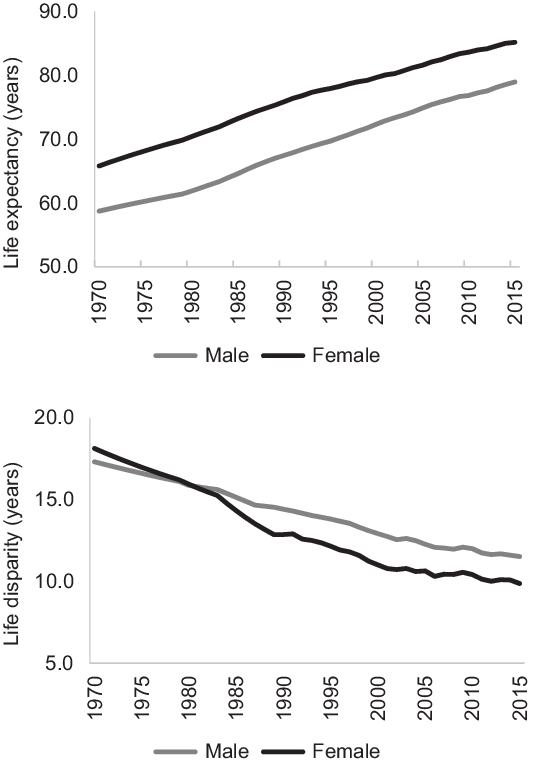
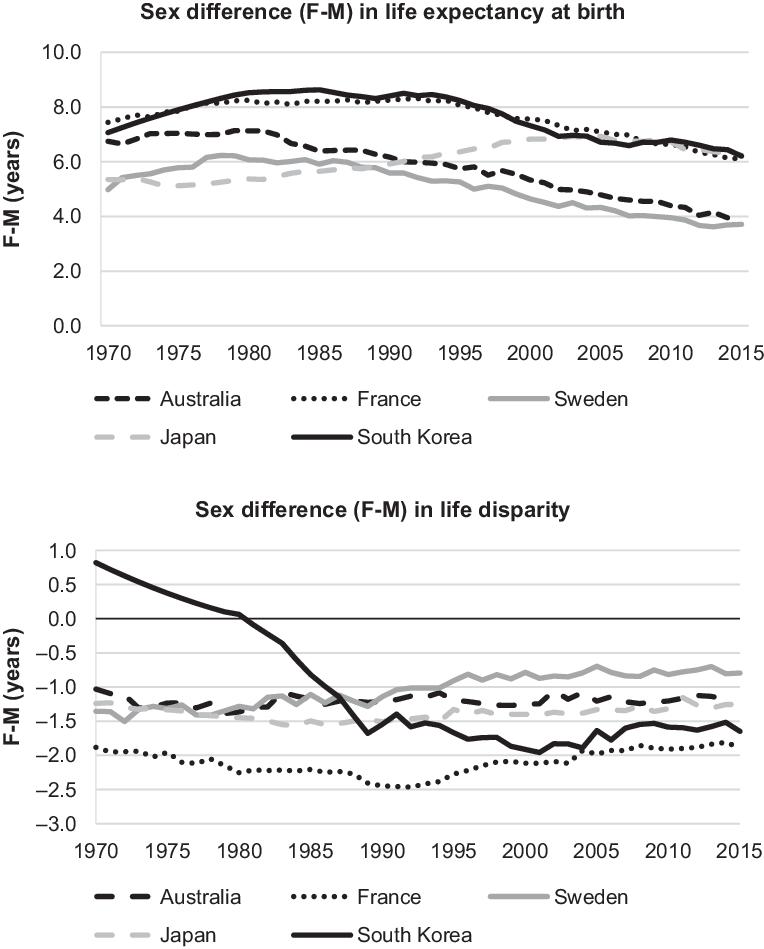
Figure 1 shows that the life expectancy at birth among males increased from 58.7 years in 1970 to 79.0 years in 2015, and for females it increased from 65.8 years to 85.2 years. The sex difference (female–male) in life expectancy increased from 7.1 years in 1970 to a maximum of 8.6 years in 1981. The sex difference in life expectancy at birth declined by 2.4 years from 1981 to 2015. With increasing life expectancy, life disparity reduced over time for both males and females in South Korea. However, females’ life disparity was higher than that of males in the 1970s. The life disparity for females became lower than that for males in 1981. The female–male difference in life disparity was at its maximum (−2.0 years) in 2001. However, this difference did not decrease much from 2001 to 2015. Comparisons of selected OECD countries have shown that South Korea has had the highest sex difference in life expectancy at birth in the last four decades (Fig. 2). However, the sex difference in life disparity was positive in South Korea, while in the other OECD countries it was negative in 1970–1980. This was in contrast to the usual pattern observed in several other countries, which is that any population with higher life expectancy had lower life disparity. However, the sex difference in life disparity changed much more rapidly in South Korea than in the other OECD countries during the 1980s and 1990s. The sex difference in life disparity in South Korea in recent years was only lower than that in France.
Trends in life expectancy at birth and life disparity in South Korea by sex and time.

Comparison of sex differences in life expectancy at birth and life disparity in selected countries, 1970–2015.

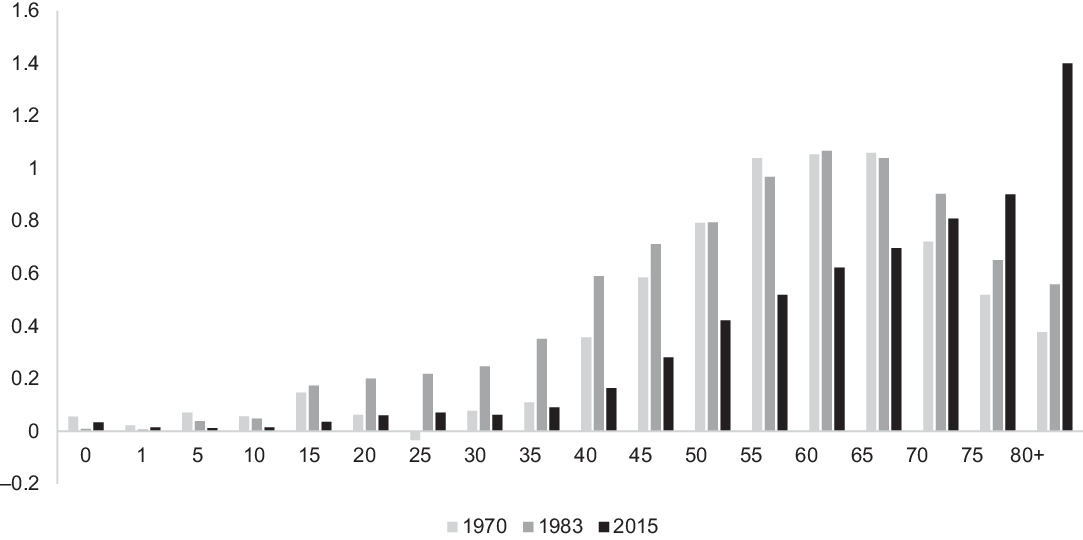
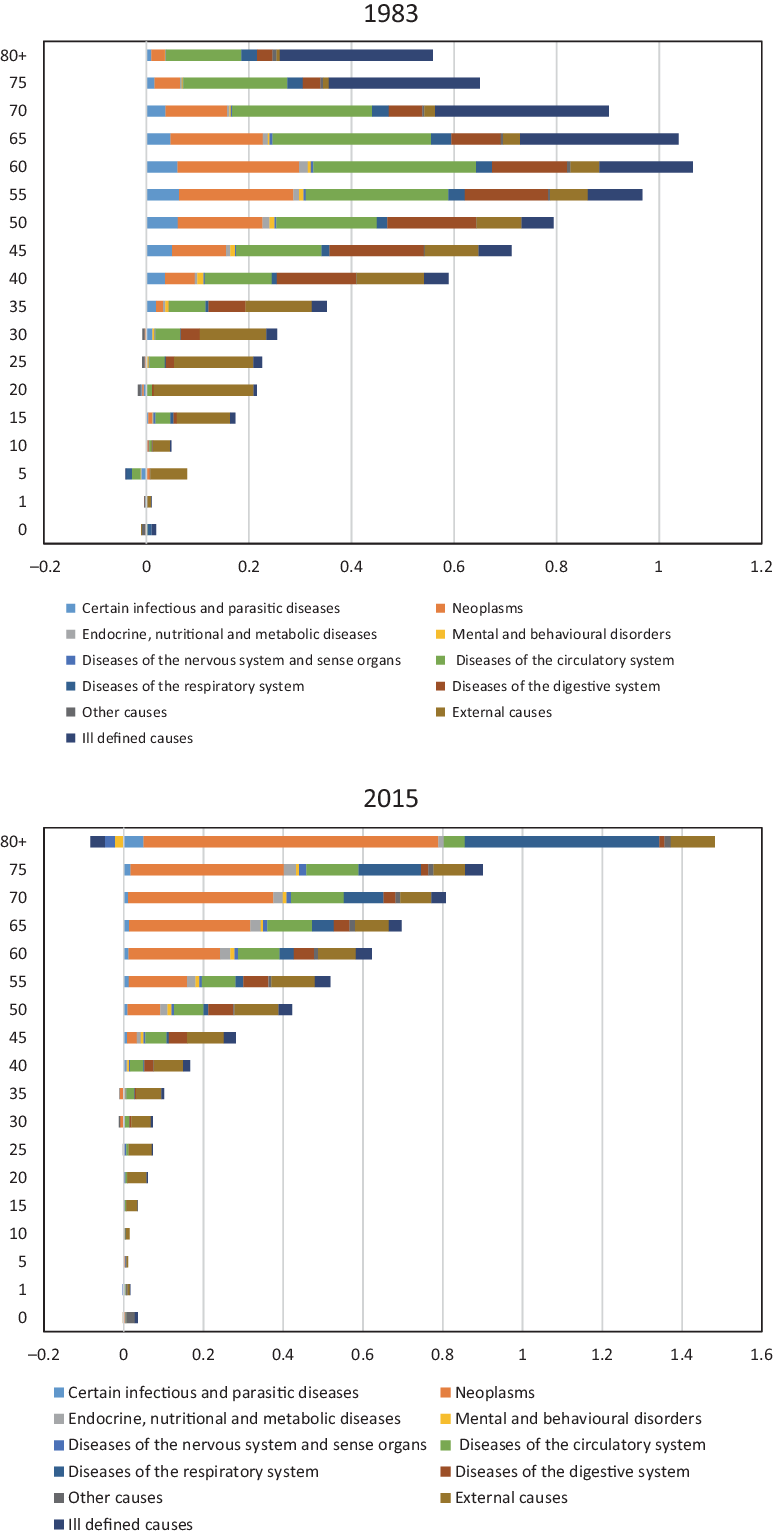
Figures 1 and 2 show that there were large sex differentials in both indicators of mortality in South Korea over the last several decades. Moreover, these differentials were larger than those in other OECD countries. Therefore, it would be interesting to know the contribution of mortality for specific ages and causes. It is evident from Fig. 1 that the gender gap in life expectancy at birth and life disparity in South Korea maintained a similar pattern, except for the time period 1970–1980. However, the next question would be whether the age groups and causes of death that explain this sex difference changed over this period of time. To answer this specific question, decomposition of the sex difference in life expectancy at birth, which is a more widely known indicator of mortality among public health researchers, by both age and cause of death was conducted (Fig. 3). This showed that the female advantage in life expectancy in 1970 was mainly due to the small contribution of the infant and young adult age groups and the large contribution from almost each age group beyond 40 years. There was a shift in the contribution of age groups towards the total sex difference in life expectancy, even though the total sex difference was significant in each time period. The contribution of the older age group (60+) to the sex difference increased from 3.72 years (approximately 53% of the total sex difference) in 1970 to 4.42 years (approximately 70% of the total sex difference) in 2015. The contribution of the adult age group (15–59 years) had reduced from 3.1 years in 1970 to 1.8 years in 2015, and the contribution of the child age group (0–14 years) reduced from 0.20 years in 1970 to 0.07 years in 2015.
Decomposition of sex differences in life expectancy at birth, 1970, 1983 and 2015.

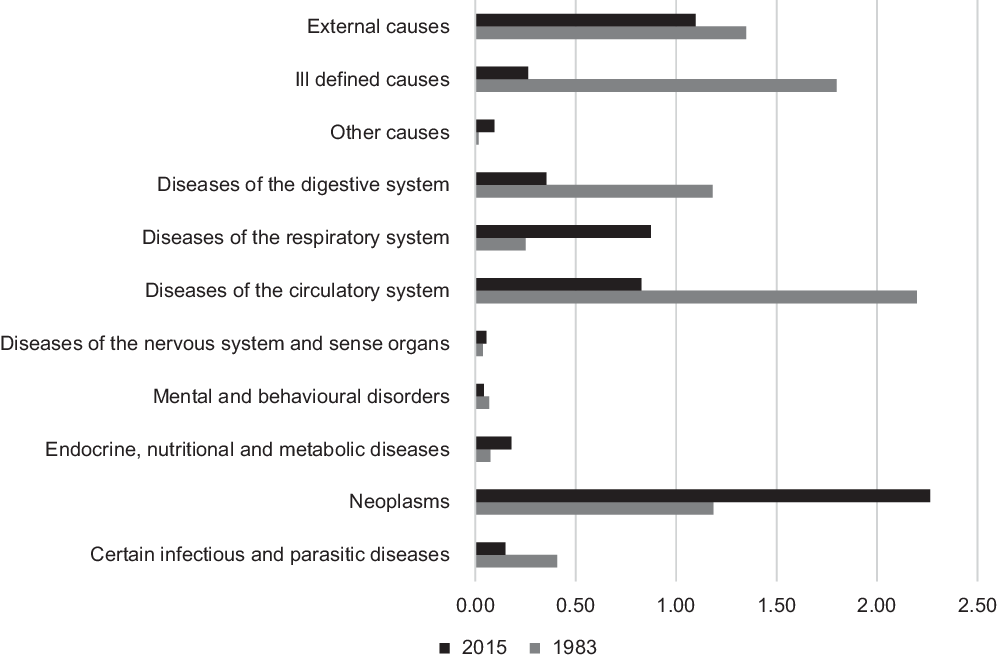
Figures 4 and 5 provide useful insights into the causes of death responsible for the large sex differences in life expectancy at birth in 1983 and 2015. Diseases of the circulatory system (2.2 years) were the most important causes of the sex differences in life expectancy in 1983, followed by external causes (1.3 years), neoplasms and digestive system diseases (1.2 years) (Fig. 4). However, in 2015, neoplasms (2.2 years) and external causes (1.1 years) were the two most important contributors, explaining 50% of the overall sex differences (6.2 years) in life expectancy at birth in 2015. Over this period, there was a significant decline in the contribution of diseases of the circulatory system and digestive system. On the other hand, the contributions of neoplasms and diseases of the respiratory system were on the rise.
Cause-specific components of sex differences in life expectancy at birth in 1983 and 2015.

Age- and cause-specific components of sex differences in life expectancy at birth in 1983 and 2015.

Figure 5 shows the age-specific contribution of each cause-of-death group to sex differences in life expectancy at birth. The contributions of circulatory diseases, neoplasms and digestive diseases mainly came from 50 years and older in 1983 (Fig. 5). There was a significant change in the age-specific pattern of the contribution of neoplasms from 1983 to 2015. In 1983, its contribution increased steadily with age until 60–64 years and decreased thereafter. However, the contribution increased linearly with age in 2015, with the largest contribution from the oldest age group of 80 years and above. The contribution of external causes of death mainly came from middle-aged adults group in 1983. However, in 2015 an apparent linear increase with age was observed, with a large contribution from the elderly aged over 80 years. More than 50% of the contribution of respiratory diseases in 2015 was from the age group 80 years and above.
Discussion
This study analysed the sex differentials in life expectancy at birth and life disparity in South Korea between 1970 and 2015 and demonstrated the changing dynamics of different age groups, the causes of death in each age group and the differences between female and male life expectancy at birth and their variation over time. The study demonstrated that life disparity for both females and males in South Korea had reduced and life expectancy had increased over the four decades from 1970 to 2015. This finding is consistent with the negative relation between life expectancy and life disparity observed in other countries (Vaupel et al., Reference Vaupel, Zhang and van Raalte2011).
South Korean women have always lived longer than South Korean men, but their life disparity has not always been lower than that of men. Despite females’ higher life expectancy in the 1970s, women had higher life disparities than their counterparts. Due to a lack of data on causes of death before 1983, it was not possible to precisely explain the causes of death that led to a higher life disparity for females in 1970 and the large gap in life expectancy. Although the cause-specific components of sex differences in life disparities were not examined for the 1970s, higher life disparities among women could be linked with higher mortality levels among women of reproductive age. For example, a growing number of hospital deliveries and improved maternal care beginning in the 1970s (Lee et al., Reference Lee, Khang, Yun and Jo2005) decreased maternal mortality rates dramatically beginning in the 1980s – from 1516 per 100,000 live births in 1958 to 15 per 100,000 in 2000 (Chun et al., Reference Chun, Doyal, Payne, Cho and Kim2006). High mortality rates of the older age group could also be related to greater life disparities in the 1970s. Although the decline in mortality among elderly females largely contributed to the life expectancy increase in the 1970s, their contribution was still low until the mid-1980s and increased thereafter (Yang et al., Reference Yang, Khang, Harper, Davey Smith, Leon and Lynch2010). However, the male advantage in life disparity in the 1970s was taken over by females in the 1980s. The decrease in life disparity for females was much faster than that for men after the 1980s, which corresponds to the onset of several social changes, including equal medical access for every subgroup of the population and the increasing participation of women in education and the labour force. Significant changes in female life disparities have occurred in the last 40 years in South Korea, and their mortality advantage is even observed in life disparities at present.
It is well known that the transition in causes of death from infectious diseases to chronic diseases since the 1970s has contributed to increased life expectancy and lower mortality in South Korea (Kim, Reference Kim1999). Since the 1980s, the main causes of death have been degenerative diseases, lifestyle changes and environmental pollution. South Korea is entering the third transition phase of epidemiological transition (Omran, Reference Omran1971), termed the Age of Degenerative and Man-Made Diseases (Kim, Reference Kim1999). The present study on cause-specific components of sex differences in life expectancy has highlighted the importance of neoplasms and external causes in recent years (2015), which are strongly associated with rapid industrialization in South Korea. External causes of death remained significant contributors to the sex difference in life expectancy in both 1983 and 2015. Transport accidents and intentional self-harm accounted for a large proportion of external deaths among males (Yang et al., Reference Yang, Khang, Chun, Harper and Lynch2012), which might have contributed to higher male mortality at both time points. Men still predominate in car and road usage, as well as in outdoor activities, which increases their risk of transport accidents. However, the negative contributions of external causes of death to the sex difference decreased sharply from 1983 to 2015. This might have been a positive consequence of multiple government-led intervention policies in the 1990s to reduce road traffic accidents by enforcing fines for risky driving, expanding traffic-monitoring camera systems, improving accident blind spots and introducing life-long educational programmes for road traffic safety (Yang & Kim, Reference Yang and Kim2003). Road traffic deaths have decreased sharply since the late 1990s after reaching a maximum of 13,429 deaths in 1991, falling to 4292 deaths in 2016 (Korean National Police Agency, 2017).
Unlike traffic accidents, suicide rates have steadily increased in South Korea, particularly since the 1997 economic crisis. This is in contrast to the decreasing or steady patterns in total suicide mortality rates at all ages observed in most OECD countries since the 1990s (Kwon et al., Reference Kwon, Chun and Cho2009). Kwon et al. (Reference Kwon, Chun and Cho2009) reported increasing suicide rates in both adults below the age of 45 years and older adults (60+), with a much higher probability of death for males than for females because of suicide rates. The rise in suicide rates among older adults (60+) could have resulted from a lack of sufficient social, emotional and financial support and declining social safety networks. As longevity has increased over time, older (60+) South Koreans have been experiencing a poor quality of life due to this decline in support. Moreover, the increasing trends in suicide in the younger age group could have been due to worsening social integration stemming from unemployment, income inequality, alcohol abuse and changes in marriage and family, as well as the pressure of success in school and work. The high rate of suicide raises social concerns, but this is considered the cost of social disruption related to industrialization. Despite a recent improvement in care for mental disorders in response to the growing number of suicides (Hewlett & Moran, Reference Hewlett and Moran2014), suicide prevention programmes aimed separately at young and older adult groups need to be developed further in South Korea.
Life expectancy at birth decomposition by cause has indicated that diseases of the circulatory system were the largest contributors to the gender gap in 1983, but this had reduced significantly in 2015. The National Health Insurance established in 1977 in South Korea, which originally started with civil servants and employees, was extended to cover the whole population in 1989. This comprehensive universal health system might favour access to health services and medical progress for all Korean citizens, especially for women who had not contributed to health insurance through paid employment. Indeed, universal health insurance has contributed to decreased cerebrovascular disease (Khang et al., Reference Khang, Lynch and Kaplan2005). Similarly, the contribution of digestive diseases has also decreased significantly in this time period. On the other hand, the contribution of neoplasm deaths increased during these years. Smoking is one of the most important causes of neoplasm-related mortality. South Korea has one of the highest smoking rates in the world. Zahra et al. (Reference Zahra, Cheong, Lee and Park2016) reported the total burden of smoking in Korea to be 1,368,072 Disability Adjusted Life Years (38 per 1000); males accounted for 68% of the disease burden, while females accounted for 32%. These data suggest a large gender gap in the smoking-related disease burden in South Korea, which further progresses in the form of a gender gap in mortality levels. Several problematic lifestyle factors, such as frequent alcohol consumption, higher saturated fatty acid intake and physical inactivity related to obesity, which are more prevalent among males than females, have also contributed to the increasing trend in colorectal and liver cancer-related deaths (Kweon, Reference Kweon2018).
In conclusion, this analysis of sex differences in life expectancy at birth and lifespan variations has revealed that South Korean women have experienced higher longevity and lower life disparity in recent decades. Furthermore, the findings show that the current health conditions of males are more driven by health behaviours than by health policies. To progress more towards an egalitarian society, policies in South Korea need to attend to the separate issues of social economic changes and related changes in health conditions for females and males.
Funding
This research received no specific grant from any funding agency, commercial entity or not-for-profit organization.
Conflicts of Interest
The authors have no conflicts of interest to declare.
Ethical Approval
The data used were fully anonymous and publicly available; therefore, ethical approval was not required.