The great preacher Hugh Latimer, as his biographer wrote in 1954, delivered ‘many sermons of which we now can have no knowledge’.Footnote 1 A recent chance discovery allows us to sketch in some details about one of these lost sermons. The Derbyshire Record Office, situated in enviable surroundings in Matlock, holds a booklet of two folios formerly described in the catalogue merely as ‘Notes on a sermon [?], 16th cent’.Footnote 2 This booklet forms part of the archive of the Gell family of Hopton Hall. A closer inspection reveals it to be a set of contemporary notes on a hitherto unknown sermon preached by Latimer during the reign of Edward vi.Footnote 3 The fragmentary nature of this survival limits its significance, but it would nevertheless be remiss not to introduce it to the scholarly community.
The document is in the handwriting of Anthony Gell (d. 1583), a lawyer and Derbyshire landowner who had studied at Clement's Inn before being admitted to the Inner Temple on 11 October 1547.Footnote 4 Later in life, Gell served as a justice of the peace in Derbyshire and he remains familiar to historians as a law reporter.Footnote 5 The present document clearly records notes from a sermon by Latimer because it mentions the preacher by name: ‘when Devyd had herd the angell he fell into praier and fastyng for you schall see in sex places of scripture said Latymere’. This is an ambiguous sentence, for it was unusual to use the preacher's name in the middle of a sentence in this way, so it could be argued that the preacher was another man who merely quoted Latimer. However, it is more probable that Gell wrote an infelicitous sentence in his hurry and had to mention the preacher's name to bring some clarity to the grammar (a simple ‘he’ could have been referring to King David).
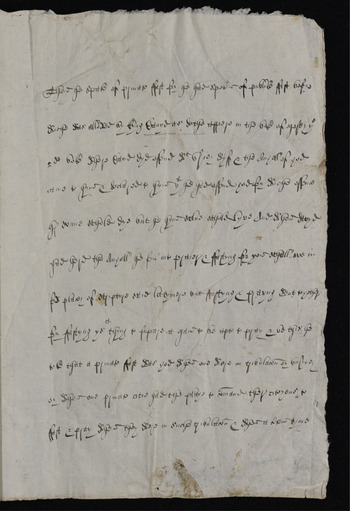
The document contains two fragments, presumably notes on the same sermon. What seems to have happened is that Gell wrote notes on the recto sides of an unstitched quire of paper, and that some of the pages were subsequently lost.Footnote 6 It clearly dates from Edward's reign because it mentions the dissolution of the monasteries as a past event, so postdates 1540, and Latimer was in no position to be preaching public sermons in Henry's reign after 1539, when he fell into disgrace after opposing the Act of Six Articles. The first fragment (fo. 2r) (see Fig. 1) is a discussion of private fasting, which likely indicates that this sermon was delivered at Lent, sometime between 1547 and 1553, when Edward of course died.Footnote 7 Thus, it is probably not one of the three lost sermons which Latimer is known to have preached at St Paul's Cross in January 1548.Footnote 8 Nevertheless, Gell probably heard the sermon in London, possibly at Paul's Cross. This is suggested by the facts that Latimer mentions the privy council, and that Gell was living in London for a large part or possibly the entirety of Edward's reign.
‘Notes on a Sermon by Hugh Latimer’, fo. 2r. © The trustees of the Gell Archive.

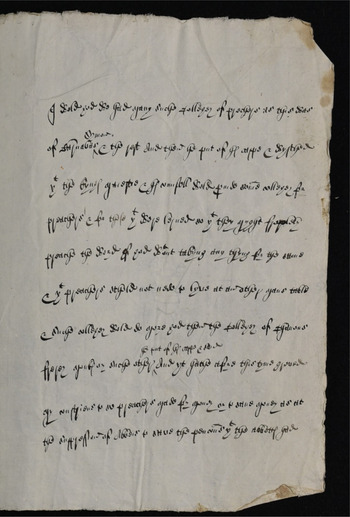
In the second fragment (fo. 3r) (see Fig. 2), Latimer calls for better clerical education and expresses his desire that ‘the kynges majestie and his counsell wold provide somme collegez for preachers’. This subject was close to Latimer's heart, for he made similar pleas on many occasions, for instance in his fifth sermon before Edward vi and in his sermon at Stamford in 1550.Footnote 9 In fact, as early as the reign of Henry viii, Latimer had joined Thomas Cranmer and Thomas Cromwell in expressing similar concerns.Footnote 10 In the present sermon, Latimer is making two specific points on the subject: firstly, that preachers should not be dependent on day-to-day patronage, so that they might speak ‘freely’, which perhaps carries the implication that they would thus be better able to speak truth to power. Secondly, he is criticising the policy which granted livings to former heads of monastic houses to save money on pensions: no fewer than twenty monks and canons were granted established or newly created bishoprics within a decade of the dissolution.Footnote 11 Latimer similarly complained, in his second sermon before Edward vi, that abbots had been ‘made bishops … to save and redeem their pensions’.Footnote 12 He may have been thinking of men like John Wakeman, last abbot of Tewkesbury, who had been appointed bishop of Gloucester in 1541, and whose bishopric had previously been part of the see of Worcester, which Latimer resigned in 1539.Footnote 13
‘Notes on a Sermon by Hugh Latimer’, fo. 3r. © The trustees of the Gell Archive.

Finally, the document contains a noteworthy detail about Latimer's style of delivery: Gell writes that the preacher removed his cap on two occasions. On the first occasion, he removed it before appealing to the king and council, which was appropriate since it was customary to remove one's hat in response to a mention of the crown.Footnote 14 Removing one's hat was also a prelude to prayer, so when Latimer removed his cap a second time before complaining about abbots being transferred to bishoprics, it may have been interpreted as an appeal to God for wiser government policy. Besides all that, the act of cap-removal was also a considered piece of theatre, clearly notable enough for Gell to think it worth mentioning.
APPENDIX
Notes of a Sermon of Hugh Latimer
Derbyshire Record Office, D258/36/7/16
[fo. 2r] Then he spake of private fast for he had spoken of publike fast before wiche was allowed by Kyng Davyd as dothe appere in the boke of Mosez the 2de boke where David dyd offend with UriezFootnote * wyff and the Angell of god came to hym and declared to hym that he had offend[ed] god for wiche offence his sonne schold dye but he hym selve schold lyve. And when Devyd had herd the Angell he fell into praier and fastyngFootnote † for you schall see in sexFootnote ‡ places of scripture said Latymere, but fastyng and pray[i]ng went together for fastyng ys a thyng to prepare a man to be apte to pray, and be this he toke that a private fast was go[o]d when one were in tribulacion or busynez or when one private citie had the plage to command ther citezens to fast and pray when they were in suche tribulacion and when a certen tyme…
[fo. 3r] I wold god we had many suche Collegez of prechers as this was of Barnabas, Sym[e]on and the rest.Footnote § And then he put of his cappe and wysched that the kynges majestie and his counsell wold provide somme collegez for preachers and for those that were lerned so that they myght freelyFootnote ** preache the word of god without takyng any thyng for the same and that preachers shold not nede to lyve at an other mans table and suche collegez wold do more go[o]d then the collegez of chanons, frerez, monkes or suche other. He put of his cappe and said[:] and yt hathe afore this tyme greved my consciens [conscience] to se preachers made for money or to save money as at the suppression of Abbeis to save the pencions that the abbottes had…