One of my favourite photos of my son is him as an over-tired, dishevelled and very disgruntled five-year-old. He stands, holding out two globs of unidentifiable rusted metal, and looks at the camera (at me), with an accusing, penetrating glare (Fig. 1). As a distracted, overextended parent trying to run an archaeological field project (the Rising Sun Hotel in New Orleans), I had sent him to play in the dirt—the back dirt of our discard pile. I thought that's where he couldn't get into any trouble. I didn't imagine that it would get me into trouble. He was mad because we had overlooked these obvious artefacts (he had already grasped the subtle nature/culture distinction of the archaeological sorting process). We had disregarded them. We had attempted to make them unworthy of notice. What my son, in his innocence, was enunciating is the intentionality of ignoring something—and with intentionality, there is always a potential politics. That is what I would like to focus on here: how can we approach Beiläufigkeit—the incidental and taken-for-granted—as indexical of politics?
Taking notice in the backdirt pile. (Photograph: Shannon Lee Dawdy.)

Our authors and instigators begin with the strikingly political example of Auschwitz, where a blade of grass can be noticed in its nutrient singularity, or blend into the dangerously banal landscape of Holocaust tourism. Towards the end of the essay, they also note that Beiläufigkeit ‘appears to be the opposite of anything political’, but also that ‘the threshold that separates the non-incidental from the casual, unperceived reality is deeply ideological’. I counter that Beiläufigkeit can be political long before that threshold is crossed. Beiläufigkeit is the realm of the hegemonic—the naturalized order of things. Once something unnoticed becomes significant, it then has the potential of becoming ideological. This distinction matters in terms of attempting to apply these ideas to our archaeological practice.
I laud the reality-check provided by the authors: that human relationships to the object world are never unbiased, and never will be. There are always objects that matter more than others, for one reason or another, and while the epistemological point of symmetrical archaeology—that the attention of archaeologists should be capacious and ecumenical (i.e. not overly directed towards the singular, the pretty, or the spectacular)—is well taken (Olsen Reference Olsen2010; Witmore Reference Witmore2014), it is much harder to put it into practice, given the realities of curation and the demands of interpretation. My precocious kid was trying to get me to do symmetrical archaeology back in 2005. But the trouble is, if we don't sort, highlight, and prioritize our findings in a deliberate way, it will be difficult to say much about other people. One result would be a truly post-human archaeology—a history of things regardless of human regard. But I'm not sure what the value of such a history would be. While all knowledge need not be ‘useful’, it is still an effort at narration, and thus a translation into human terms. A post-human history, like a post-human anthropology, when taken to its logical extreme is an oxymoron.
Pollock et al. also note, in a footnote that poignantly follows their opening at Auschwitz, that some of the co-authors have a discomfort with deploying the ideas of Heidegger (his concept of the ready-at-hand being a close cognate of Beiläufigkeit). Perhaps nothing underscores the impossibility of perception being non-political—even of one that occurs below the level of spoken consciousness—than the fact that the father of modern phenomenology was an unrepentant Nazi sympathizer. That's one problem. The other problem is one that has been with us since the advent of post-processual archaeology: the difficulty of doing an archaeology of mind. It is not that archaeological deposits don't reflect the thoughts, feelings and mindsets of past people—they most certainly do—but the conjectural leaps we must make are necessarily large and unreliably based upon analogy to our own experiences (for critiques of interpretive archaeology, including those coming from within, see Fleming Reference Fleming2006; Hodder et al. Reference Hodder, Shanks, Alexandri, Buchli, Carman, Last and Lucas1995). To identify something like Beiläufigkeit or ready-at-hand phenomena, the problem is exponentially greater because we are essentially talking about the archaeology of the unconscious. It is an archaeology of what gets unexpressed, and of what may be intentionally repressed.
I am not sure which is the priority of the authors—to use the idea of Beiläufigkeit to adjust the epistemology of living archaeologists, or to urge us to look for how past human subjects relegated some objects in their world to the realm of the incidental. The latter is more interesting to me, but also more challenging. Our best approach may be to look for those moments, as in Heidegger's famous example, when the hammer breaks and thus suddenly moves from one level of human perception to another. Taphonomically, this might mean looking for features that reflect an effort to sort, arrange and dispose of objects to make them recede into the background (as we did as we disposed of non-diagnostic artefacts in the backdirt pile) or for assemblages that seem to reflect ubiquity and redundancy in material life. Acts of demolition can be blatantly ideological because some objects are politically problematic when they attract attention. It is not insignificant that the Nazis attempted to erase the material traces of concentration camps as they were losing the war. They didn't want them noticed. This is a blatant act of concealment that suggests a possible analogy for other dramatic archaeological examples of ground-clearing and erasure (see some of the contributions to Rakoczy Reference Rakoczy2008).
Other political acts to push objects into the background of human attention are far more banal. In some sense, most forms of trash disposal are an effort to move artefacts from the spheres of the sensorial and instrumental to the forgotten fringes (of settlements, of notice). Intentional concealment is not the same as Beiläufigkeit, but they are not unrelated. Concealment is to Beiläufigkeit as ideology is to hegemony. I would like to take the extreme case of the disposal of disaster debris to highlight the difference between ideological and hegemonic sorting of materials. First, though, some theoretical clarification.
It is not often that people are careful about the differences between ideology and hegemony, but the distinction is important when we are discussing the political meaning of what gets noticed and what doesn't. Comaroff and Comaroff define ideology as explicit, enunciated and agentive justifications for power and class interests (an idea mostly associated with Marx, although he was also attentive to the more latent forms of power, such as the commodity fetish). They define hegemony (an idea credited to Gramsci) as the ideas and values supporting the political and/or class order that are perceived as non-agentive, implicit, and natural: ‘we take hegemony to refer to that order of signs and practices, relations and distinctions, images and epistemologies—drawn from a historically situated cultural field—that come to be taken-for-granted as the natural and received shape of the world and everything that inhabits it’ (Comaroff & Comaroff Reference Comaroff and Comaroff1991, 23). Hegemony includes incidental materials. Hegemony is the realm of unspoken understandings. However, ‘once its internal contradictions are revealed, when what seemed natural comes to be negotiable, when the ineffable is put into words—then hegemony becomes something other than itself. It turns into ideology and counterideology, into the “orthodoxy” and “heterodoxy” of Bourdieu's […] formulation’ (Comaroff & Comaroff Reference Comaroff and Comaroff1991, 23). That sounds like a hammer breaking.
Hammers, chairs, refrigerators, quilts, photo albums, automobiles and whole houses—a lot of things broke down in the wake of Hurricane Katrina in the summer of 2005, just a few weeks after I took that photo of my annoyed five-year-old. One could say that an entire lifeworld went from the realm of Beiläufigkeit to the poignant and remarkable. Media coverage dwelled on the material strangeness of breakdown. Broken houses became signs of a broken government and of a society riven with contradicting values. Things we used to take for granted—like the role of refrigerators in our lives—became noticeable as returning New Orleanians rolled them out to the streets, mould-covered and putrid. For months after the storm, they were impossible to ignore, and they became ideological—they were a favourite medium for anti-government graffiti.
As many have noted, racial discourse in the US has not been the same since Katrina. Racism and anti-racism have ebbed and flowed over the course of American history, but they were mostly in a latent, hegemonic state in the early 2000s. Economic disparity along racial lines was simply a taken-for-granted reality of the post-Civil Rights era. But the breakdowns made visible by Katrina enabled a revival of critiques of structural racism. Some say this renewed ideological consciousness led to the election of the country's first black president in 2008 and the enunciation of the Black Lives Matter movement. But in the immediate aftermath of the storm, the national movement I noticed most from my vantage point as a historic preservation consultant to the Federal Emergency Management Agency (FEMA) was an obsession with demolition and debris clearing. Environmental laws were bypassed, hasty decisions were made, illegal dumps were opened and billions of dollars were spent in trying to make broken objects disappear. There was a sense of urgency, almost a federal panic, about making broken things disappear because, in that state, they threatened the hegemonic order.
One might protest that this was all about pragmatics—that rebuilding of lives could not happen without debris clearing. But for many, this was not simply debris but their lives in pieces—pieces they needed to sort through and salvage. Why the hurry? There's very little that FEMA does to help rebuild lives. Its legal mandate focuses on the acute period of a disaster emergency, not long-term recovery. Its budget for debris removal is more than double what it provides in assistance to individuals for things like crisis counselling, medical services, or home safety inspections. What did I learn from my time with FEMA, an agency run by the militaristic Department of Homeland Security? That debris removal is a highly political process—a vital national security interest. In fact, many demolitions and debris-removal efforts took place quickly, without consulting property owners. In a 2008 report to Congress, even the government itself had difficulty estimating how much money it had spent on debris removal, but it was acknowledged to be the largest single ticket item in the Katrina budget and to be somewhere in the neighbourhood of $4 billion (Luther Reference Luther2008, 6). To put this in perspective, the total budget request for FEMA the year the storm hit was $5.4 billion.
Did the federal government succeed in disappearing all those broken objects? Mostly. Today, the main Katrina landfill in Orleans Parish, sequestered in a derelict industrial zone in the eastern part of the city, is even difficult to find using Google Maps. As you drive by, you might notice the illegal dumping that announces one's approach to the landfill, and a small, discreet sign listing the landfill's hours. But it's much more visible from a Google Earth image. Although the landfill is the tallest landscape feature for miles around (rising 20 m above sea level, or 20 m above the average elevation of the region), it is not a destination. Back in the city's central neighbourhoods, new houses and new consumer objects have in-filled most of the gaps left by debris clearing. Their noticeable newness wears off quickly and they take on their own Beiläufigkeit character in everyday lives throughout the gentrifying city. What is it that these objects of recovery represent hegemonically? That consumer capitalism is the pillar of the US political system. So long as people can re-populate their lives with taken-for-granted things, the power structure will chug along. Thus, the hurry to make room for new construction and new consumables. As Bill Clinton once famously said, and Trump recently re-tweeted, ‘It's the economy, stupid’.
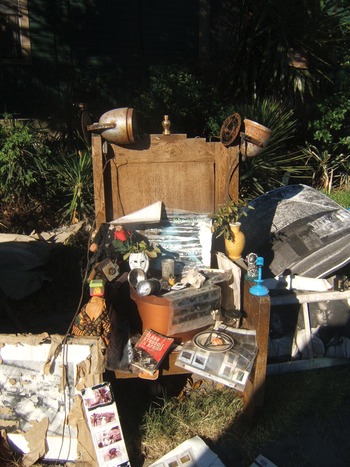
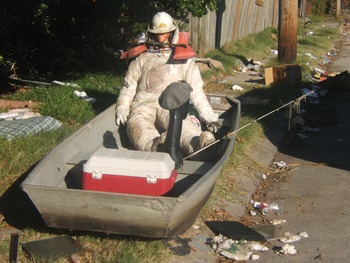
But not everyone is duped by disappearance and replicability. As I went about my work for FEMA, trying to assess impacts to historic resources under the mandate of a different federal law, I came across a series of deliberate assemblages of debris, such as the chair in Figure 2 and the boat in Figure 3. These tableaux were messages from an unknown artist who was going about his flooded-out neighbourhood in the autumn of 2005 (neighbourhood rumour said it was a ‘he’, although I have since forgotten his name). Out of the chaos of breakdown—out of all those artefacts of breakdown that FEMA was trying to make disappear by categorizing them as debris—this artist seemed to say: ‘wait, slow down, take notice’. These objects, affectively re-arranged and displayed, exceeded the categories of either debris or commodity. They were the stuff of human lives. They were a materialization of experience. They were partners in a lifeworld now devastated. And perhaps that is what art most fundamentally does—it pushes what is taken-for-granted back into the centre of our perceptual field. And with the boat's wry commentary on rescue efforts, there is no question that this was political art, a political resistance to the cover-up of both concealment and Beiläufigkeit (for more on Katrina art, see Longman Reference Longman2005). For weeks, the garbage men worked around these assemblages, leaving them in place. They knew they were supposed to take notice. A great cry went out when my neighbours woke one morning to find that the talking trash had finally been silenced, deliberately scooped up and sent to the fringe of consciousness.
Talking Trash: Katrina Debris Assemblage 1. (Photograph: Shannon Lee Dawdy.)

Talking Trash: Katrina Debris Assemblage 2. (Photograph: Shannon Lee Dawdy.)