In recent years, the percutaneous closure of atrial septal defects has been more commonly applied as an alternative to surgical methods in children. Transcatheter closure of atrial septal defects is a popular method that spares the patient from various traumas and potential complications associated with open heart surgery.Reference Butera, Zoccai and Sangiorgi 1
In paediatric cardiac catheterisation laboratories, many drugs are generally used in combinations.Reference Kogan, Efrat, Katz and Vidne 2 – Reference Munro, Tirotta and Felix 6 The combinations of drugs minimise the side-effects by reducing the doses, and are useful for children who have cardiac problems. The application of anaesthesia may influence the accuracy of the results during cardiac catheterisation and angiography. For instance, excessively decreased blood pressure during a haemodynamic study will lead to an altered shunt formation or a higher value than the actual one;Reference Öklü, Bulutcu, Özbek, Ozbek, Cakali and Bayindir 7 using oxygen may also affect the pulmonary pressure measurements. Therefore, the selection and application of anaesthetic drugs in this patient group is very important.
In this study, we aimed to compare ketamine–propofol sedation, which is commonly used in paediatric cardiac catheterisation, with dexmedetomidine–propofol sedation.Reference Kogan, Efrat, Katz and Vidne 2 – Reference Tosun, Akın, Güler, Esmaoglu and Boyaci 4 The primary endpoint of the study was to maintain haemodynamic stability and immobility after the administration of dexmedetomidine–propofol and ketamine–propofol. The secondary endpoint was to evaluate recovery times in the groups.
Methods
The Institute's ethics committee (Karar No: 62, 2011) approved the study, and written informed consent was obtained from the parents of the participants. A total of 46 children, aged 3–14 years, with American Society of Anesthesiologists status II, were scheduled for transcatheter closure of atrial septal defects. Patients requiring mechanical ventilation, supplemental oxygen, or inotropic support were excluded. After a minimum fasting period of 6 hours, patients were admitted to the angiography unit. Electrocardiography, non-invasive blood-pressure measurements, pulse oximetry, and Ramsey sedation scores of all patients were recorded as baseline after the induction of sedation and every 5 minutes for 30 minutes, and then every 10 minutes throughout the procedure. We defined movement as mild – slight movement of the upper or lower extremities or both; moderate – movement of the upper or lower extremity or both, or slight movement of the body; and severe – movement, preventing the intervention.
Local anaesthetic spray was applied by mouth before sedation. Premedication was not given. D5 0.3% NaCl infusion (5 ml/kg/h) was continued. Patients were randomly divided into two groups using the closed-envelope method.
In the dexmedetomidine group (n = 23), dexmedetomidine (1 μg/kg for 5 minutes) and propofol as a bolus (1 mg/kg) were administered for induction and then continued as dexmedetomidine (0.5 μg/kg/hour) and propofol (100 μg/kg/minute). In the ketamine group (n = 23), patients received 1 mg/kg of ketamine and 1 mg/kg of propofol for induction, and continued with ketamine (1 mg/kg/hour) and propofol (100 μg/kg/minute). If the patient showed discomfort, or showed a reaction to the trans-oesophageal echocardiography probe, or Ramsey sedation score ≤4, additional propofol was administered (0.5 mg/kg) as a bolus and recorded. Propofol was titrated according to the patient's sedation score. The cardiologist performed local infiltration with 1% lidocaine. If the blood pressure decreased more than 20%, the plan was to increase basal fluid infusion to 10 ml/kg/hour during the procedure, and the propofol infusion dose was decreased 30%. In both groups, 1 μg/kg fentanil was administered during the induction period.
Oxygen was given (3 L/minute) via nasal cannula in all cases, and blood gas measurements were recorded. Side effects – airway complications, nausea, vomiting, agitation, convulsion, and bradycardia – during the study were recorded. The anaesthetic drug application was discontinued when the groin bandage was applied.
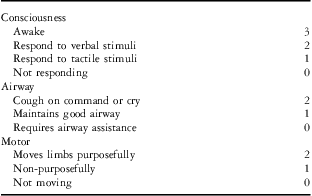
The patients were observed until their Steward recovery scoresReference Steward 8 (Table 1) became 6, and then they were transferred to the paediatric intensive care unit.

A preliminary power analysis suggested that 18 patients were needed in each group to detect a difference with a power of 90% at the 5% level of significance.Reference Tosun, Akın, Güler, Esmaoglu and Boyaci 4 Statistical analyses were performed using SPSS software (version 15.0, SPSS Inc, Chicago, Illinois, United States of America). The statistical analysis of the difference between the two groups with respect to age, weight, duration of cardiac catheterisation, recovery time, heart rate, mean arterial pressure, peripheral oxygen saturation, respiratory rate, bispectral index, and total propofol consumption was performed using an unpaired Student's t-test. Data on gender and side effects were analysed with the χ2 test. A repeated measure of analysis of variance was used for serial data. The sedation score was analysed with a Mann–Whitney U-test. A p-value <0.05 was considered statistically significant.
Results
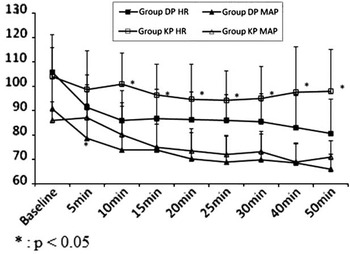
Transcatheter closure of atrial septal defects were successfully applied in all of the patients (n = 46). The patients’ demographic data are presented in Table 2. The procedural durations were similar in both groups (Table 2). Heart rate values were found to be decreased by 20% from the baseline value in 10 patients (43.4%) in the dexmedetomidine group and in three patients (13%) in the ketamine group (p = 0.047). Heart rate values were observed to be lower in the dexmedetomidine group throughout the procedure after the first 10 minutes. In all, 11 patients in the dexmedetomidine group (47.8%) and one patient in the ketamine group (4.3%) demonstrated a ≥20% decrease from the baseline in mean arterial pressure (p = 0.01), and fluid infusion was increased to 10 ml/kg/hour in these patients. The heart rate and mean arterial pressure values are summarised in Figure 1. No patient experienced an increase >20% for either heart rate or blood pressure in each group.
Demographic data of the groups.

DP = dexmedetomidine–propofol; KP = ketamine–propofol
Heart rates and mean arterial pressure of the groups.

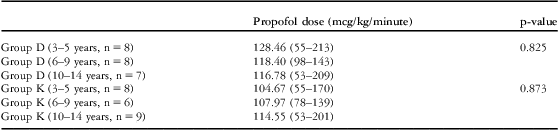
In all, 13 patients in the dexmedetomidine group (56.5%) and five patients in the ketamine group (21.7%) exhibited mild movement of extremities – all of them pulled their hands and feet – during the local anaesthetic infiltration (p = 0.033). Throughout the procedure, 11 patients in the dexmedetomidine group (47.8%) and three patients in the ketamine group (13%) demonstrated mild movement of extremities – all of them pulled their hands and feet – (p = 0.023). Average propofol consumption was 121 μg/kg/minute in the dexmedetomidine group and 107 μg/kg/minute in the ketamine group (Table 3); propofol consumption according to age is shown in Table 4. In all, 15 patients (62.5%) in the dexmedetomidine group and seven (29.1%) in the ketamine group needed additional propofol administration (Table 3) (p = 0.01).
Patient numbers need additional propofol, propofol dose, and recovery times of the groups.

DP = dexmedetomidine–propofol; KP = ketamine–propofol
Propofol consumption according to age

D = dexmedetomidine; K = ketamine
Chin-lift manoeuvre was needed for five patients in the dexmedetomidine group and three patients in the ketamine group because of airway obstruction. There were no other airway complications; in addition, there was no difference between the groups with respect to blood pCO2 and pO2 values (Table 5). Side effects – such as nausea, vomiting, convulsion, or agitation – were not observed in any of the groups.
The blood gases values of the patients.

DP = dexmedetomidine–propofol; KP = ketamine–propofol
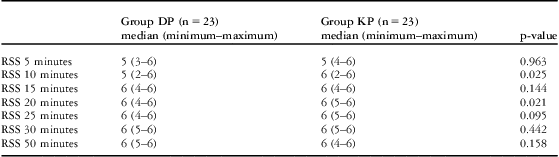
The time to the administration of sedation and insertion of vascular access was 4 minutes in the dexmedetomidine group and 5 minutes in the ketamine group. Time to insertion of the trans-oesophageal echocardiogram probe was 18 minutes in the dexmedetomidine group and 21 minutes in the ketamine group. Ramsey sedation scores of the patients are shown in Table 6.
RSS of the groups.

DP = dexmedetomidine–propofol; KP = ketamine–propofol; RSS = Ramsey sedation scores
The time to reach a Steward score of ≥6 was 15.86 ± 6.50 minutes for the dexmedetomidine group and 19.65 ± 8.19 minutes for the ketamine group (Table 2) (p = 0.09).
Discussion
In this study, we showed that the ketamine–propofol combination was better than the dexmedetomidine–propofol combination with regard to the achievement of haemodynamic stability and immobility.
The common anaesthesia technique for transcatheter closure of atrial septal defects is general anaesthesia. By applying general anaesthesia, the aim is to use mechanical ventilation while avoiding deep respiration, which can cause air embolisation throughout the sheath. Another reason to apply general anaesthesia is to keep the patient immobile. However, in recent years, studies in paediatric cardiac catheterisation laboratories have developed considerably, the experience of the doctors has increased, and we can provide good sedation conditions through combinations and titration of drugs in a successful management of the procedure.
Dexmedetomidine is a new sedative, analgesic, and anxiolytic agent, and its intra-operative administration reduces anaesthetic requirements. It blunts sympathetic system response and speeds post-operative recovery.
The ketamine–propofol combination has been commonly applied in paediatric cardiac catheterisation for many years.Reference Akın, Esmaoğlu, Güler, Demircioglu, Narin and Boyaci 3 , Reference Tosun, Akın, Güler, Esmaoglu and Boyaci 4 , Reference Gayatri, Suneel and Sinha 9 Recently, dexmedetomidine has also been used in paediatric cardiac catheterisation laboratories. Tosun et al.Reference Tosun, Akın, Güler, Esmaoglu and Boyaci 4 compared dexmedetomidine plus ketamine and propofol plus ketamine in children scheduled for paediatric cardiac catheterisation. In the first group (n = 22), they administered 1 μg/kg dexmedetomidine and 1 mg/kg ketamine for induction and continued with 0.7 μg/kg/hour dexmedetomidine and 1 mg/kg/hour ketamine. In the second group, they administered 1 μg/kg dexmedetomidine and 1 mg/kg propofol for induction and continued with 0.7 μg/kg/hour dexmedetomidine and 100 μg/kg/minute propofol. They reported that both of the combinations could be used safely in paediatric cardiac catheterisation in children. Mester et al.Reference Mester, Easley, Bredy, Chilson and Tobias 5 used 2 mg/kg ketamine and 1 μg/kg dexmedetomidine in a cohort group consisting of 16 patients, and reported that this combination effectively provided sedation conditions without causing any significant respiratory or cardiac changes. In our study, we preferred the safe doses recommended for paediatric cardiac catheterisation procedures.
To our knowledge, there has been no study on the application of sedation in paediatric transcatheter closure of atrial septal defects. Koruk et al.Reference Koruk, Mizrak, Kaya Ugur, Ilhan, Baspinar and Oner 10 studied a small group of patients (n = 18) and compared the same combinations as in our study of general anaesthesia; their view was that these combinations were well tolerated in paediatric transcatheter closure of atrial septal defects. They did not find any differences between the groups in terms of systolic and diastolic blood pressures. Heart rates were higher in the ketamine group. In group analyses of haemodynamic variables, no differences were found in the dexmedetomidine group; however, in the ketamine group an increase in heart rates was detected after extubation. In the study by Tosun et al.,Reference Tosun, Akın, Güler, Esmaoglu and Boyaci 4 systolic arterial pressure decreased >20% in 13.6% of patients in the dexmedetomidine group and 36.4% of patients in the ketamine group. Heart rates decreased >20% in 18.2% of the patients in both of the groups. In our study, the incidence of hypotension was very low (4.3%) in the ketamine group. Propofol diminishes systemic vascular resistance, blood pressure, and heart rate. Ketamine increases blood pressure and heart rate and has an analgesic effect, provides excellent sedation conditions, and maintains airway reflexes and respiratory drive. A combination of ketamine and propofol makes pharmacological sense and provides haemodynamic stability. In the study by Tosun et al., contrary to expectation, the incidence of hypotension was higher in the ketamine group. The reason for this result may be the use of ketamine as a rescue sedation in both groups and the higher need for rescue sedation in the dexmedetomidine group (2.03 ± 1.33 versus 1.25 ± 0.67 mg/kg/hour). The hypotension incidence in the dexmedetomidine group in our study is higher than with the same combination in the study of Tosun et al., but these workers used high-dose ketamine as rescue sedation in the dexmedetomidine group, and ketamine may blunt the hypotensive effect of dexmedetomidine and propofol. In our study, the heart rates decreased three times more in the dexmedetomidine group than in the ketamine group, and this may be the result of the dexmedetomidine and propofol having vagotonic effects. None of the patients experienced transient hypertension, which may be due to the combination with the propofol. In our study, in respect to both blood pressure and heart rates, the ketamine group had the more stable haemodynamic conditions throughout the procedure.
Immobility is necessary and very important in paediatric cardiac catheterisation interventions. In the study by Mester et al.,Reference Mester, Easley, Bredy, Chilson and Tobias 5 18.6% of patients needed rescue sedation. They reported that no patient responded to local infiltration of the groin and placement of the arterial and venous cannulae after the bolus dose of ketamine and dexmedetomidine, but they did not report the recovery times. In the study by Mester et al., the excellent conditions in relation to immobility may be due to the combination of two drugs, both of which have analgesic effects. Munro et al.Reference Munro, Tirotta and Felix 6 performed a paediatric cardiac catheterisation in 20 patients by delivering a loading dose of 1 μg/kg of dexmedetomidine and a maintenance dose of 1 μg/kg/hour of dexmedetomidine, and they used propofol for rescue sedation. The rate of using rescue sedation was 60%, and the rate of movement was 25%. In our study, in the ketamine group patients made little movement both during the infiltration of groin and during the procedure. The combination ketamine–propofol provided good conditions for intervention, and the rescue sedation rate was also less than that in the dexmedetomidine group.
In the study of Koruk et al.,Reference Koruk, Mizrak, Kaya Ugur, Ilhan, Baspinar and Oner 10 the recovery time was 10.5 minutes in the ketamine group and 5.7 minutes in the dexmedetomidine group. In our study, recovery times were longer. We used ketamine as 1 mg/kg/hour for maintenance, but they used 0.5 μg/kg/hour; we administered propofol 6 mg/kg/hour, whereas they used propofol 4–6 mg/kg/hour and did not need rescue sedation because they applied muscle relaxants. In our study, recovery times are longer than those of Koruk et al.;Reference Koruk, Mizrak, Kaya Ugur, Ilhan, Baspinar and Oner 10 however, they were much shorter than those of Tosun et al.Reference Tosun, Akın, Güler, Esmaoglu and Boyaci 4 – 49.54 minutes in dexmedetomidine group and 23.16 in ketamine group, who used higher doses of ketamine.
Mester et al.Reference Mester, Easley, Bredy, Chilson and Tobias 5 applied 2 mg/kg of ketamine and 1 μg/kg of dexmedetomidine, and they observed airway obstruction in two patients. In our study, a chin-lift manoeuvre was needed because of airway obstruction in five patients in the dexmedetomidine group and three patients in the ketamine group. We did not observe increased secretion, bronchospasm, or cough. No patients needed endotracheal intubation in either of the groups. Ketamine is known to have the potential to cause agitation and delirium profiles, whereas dexmedetomidine is known to be capable of preventing those adverse effects. Koruk et al.Reference Koruk, Mizrak, Kaya Ugur, Ilhan, Baspinar and Oner 10 reported agitation in one patient in the ketamine group, whereas Tosun et al.Reference Tosun, Akın, Güler, Esmaoglu and Boyaci 4 observed convulsions in two patients in the dexmedetomidine–ketamine group. In our study, no patients demonstrated nausea, vomiting, or convulsions.
There were some limitations to this study. It was not possible to use capnography, and thus oxygen saturation was used instead, which may have led to underreporting of respiratory depression. Premedication was not given to any of the patients, and therefore changes in haemodynamic values at baseline and after sedation may have been higher than expected.
In conclusion, the combination ketamine–propofol provided good haemodynamic conditions and immobility. The recovery times were similar in both groups.
Acknowledgement
The authors thank the study patients and families for participating in the trial.
Financial support
This research received no specific grant from any funding agency, commercial or not-for-profit sector.
Conflicts of Interest
None.