Regenerative farming is an idea whose time has more than come, but it is not as well known in environmental literature and among environmental educators as it needs to be. Symbolic headlines of climate change and fossil-fuel pollution focus on more spectacular storms and bushfires or coral reefs. Schools and university instructors need to be familiar with the role of regenerative farming, inserting into curricula its potential importance for carbon sequestration, biodiversity and water-soil care. These issues will become key global policy settings compared to present-day practices. David Pocock (Reference Pocock2020), former Australian Wallabies rugby captain, is a promoter of regenerative agriculture:
Regenerative agriculture is ‘an underground insurgency’ that is regenerating soil health. Soil health is the foundation of healthy life on this planet. This regeneration starts with new ways of seeing and thinking, which lead to new ways of managing and farming. Regenerative agriculture seeks to work with nature, to provide food and fibre while building soil, resilience, diversity, and community. It challenges farmers to go from reductionist to holistic thinking and find ways to work with nature by mimicking natural systems and generating fertility on the farm as much as possible.
Repeated missed opportunities are currently allowing onward-and-downward degradation of the planet’s lands, water and species. That is, an urgent shift is needed from aspirational (good) talking about sustainability to actually understanding and implementing regenerative farming. This article selects material to advance a position advocating environmental education change to include regenerative farming. It does not attempt to review either social science or biophysical literature.
What is regenerative farming?
Regenerative farming is the shift from modern-day conventional farming and small-scale adjustments toward sustainability, to wholesale changes to farming practices. The regenerative shift is being brought about by farmers conscious of destructive effects in conventional farming. Regenerative farming relates to the language of agroecology (Loconto & Fouilleux, Reference Loconto and Fouilleux2019), restorative, holistic (Savory, Reference Savory2020), or sequence agriculture (Andrews, Reference Andrews2014). One definition offers a starting point (Terra Genesis International [TGI], 2020):
Regenerative Agriculture is a system of farming principles and practices that increases biodiversity, enriches soils, improves watersheds, and enhances ecosystem services. Regenerative Agriculture aims to capture carbon in soil and aboveground biomass, reversing current global trends of atmospheric accumulation. At the same time, it offers increased yields, resilience to climate instability, and higher health and vitality for farming and ranching communities. The system draws from decades of scientific and applied research by the global communities of organic farming, agroecology, Holistic Management, and agroforestry.
This definition includes the big picture of global climate while focusing attention on a series of specific land management practices. Farmer definitions incorporate decision making and economic viability (Brown, Reference Brown2018). What counts as farming may vary between rice, wheat, croplands, animal pasturage or range grazing. Whatever form of farming is being referred to, however, farmland has the potential to be a major contributor to controlling greenhouse gases. It can do this by parking carbon in the soil, changing from monocultures, moving from species loss to increasing biodiversity, and stopping land and water degradation. These practices currently — without action to reverse them — are continuing well past the tipping point of sustainability. Environmental educators could pivot teaching, as shown by one example of distilling regenerative agriculture practice on United States food processor General Mills’ (2020) six core principles of regenerative agriculture: (1) understand the context of your farm operation, (2) minimise soil disturbance, (3) maximise crop diversity, (4) keep the soil covered, (5) maintain living roots year round, and (6) integrate livestock. Other similar learning matrices are available.
Regenerative puts the emphasis on the land and its health and water, not the methods and inputs. It is potentially a broad pragmatic alliance that could grow to a larger scale as the climate paradigm bites more deeply. Several important things can be said about the word ‘regenerative’. Perhaps most easily understood for educators without detailed rural or land practice knowledge, the idea of regenerative goes beyond sustainable and sustainability. It is too late for mere sustainability: water, species, land, soil quality and urban environments all continue to be degraded from overuse, lost biodiversity, pollution and extinctions. It is no longer a question about keeping what we currently have, since the Anthropogenic world continues towards unviable human outcomes. Regenerative farming and agriculture is much more than just carbon sequestration in the soil, it is holistically inclusive of rebuilding land health through broader integration of land health issues into contemporary farming practices. Examples of this include biodiversity conservation, waterways restoration and on-farm drought resilience. Environmental educators play key roles in articulating what this will mean for knowledge and skills required for delivering regenerative farming. This includes up to degree-level expertise.
The word ‘regenerative’ does not appear in the Australian Journal of Environmental Education. Three references to farming can be found, one a video review of salinity facing farming communities in Australian soils (Kelly, Reference Kelly1999), a second encouraging farm forestry, and the third an ethnographic study of young adults in ecotourism as Willing Workers on Organic Farms (Nakagawa, Reference Nakagawa2017). It is surprising that farming as a whole has not formed the focus of scholars in the journal, given the following: (1) major parts of the Earth’s land surface (and increasing) have been made into farmed landscapes; (2) there are sharp public debates centring around Western-style, sheep-cattle-wheat farming and plant milks versus animal milk; and (3) there is substantial critique of monoculture and desertification. The present contribution helps address that gap, outlining points nonfarming teachers can assimilate as key propositions to influence environmental learning in schools and tertiary institutions. Searching the journal Environmental Sociology produced a similar result. Eight articles mention some cognate of regenerative; only one implies a broader policy intent, but still not about farming.
W. Smith’s (Reference Smith2020) recent article in this journal advocating the importance of teachers being exemplars is one to wholeheartedly endorse. This brief introduction to regenerative farming supports building that capability. It goes to the heart of the ongoing struggle that more scientific knowledge does not always change behaviour through education about substantive issues and causes of current global climate problems. Education is also needed about regulatory requirements to deliver that science and shape desired behaviour, as well as to constrain continuance of extractive and externalising logics. Siegel, Cutter-Mackenzie-Knowles, and Bellert (Reference Siegel, Cutter-Mackenzie-Knowles and Bellert2018) reaffirm this continuing brief for environmental education. These authors extend Kollmuss and Agyeman’s (Reference Kollmuss and Agyeman2002) fundamental question: Why do people act environmentally and what are the barriers to proenvironmental behaviour?
Regenerative farming addresses the question that globally 30% of all carbon emissions come from agriculture. This is more than all mining and industrial emissions combined. No wonder New Zealand scientists started experimenting with reducing ruminant emission in its dominant dairy farming sector (Waghorn & Woodward, Reference Waghorn, Woodward, Bhatti, Lal, Apps and Price2006). This realisation was politicised, and (in)famously and wittily derided as a ‘fart tax’ by climate deniers. Most of us did not realise at the time, nearly two decades ago, how significant these emissions are in planetary terms (Fickling, Reference Fickling2003). The idea seemed preposterous to farmers previously enjoying normative positioning as ‘salt-of-the-earth’ producers of food — something no longer axiomatic today. Farmers find themselves aggrieved to be positioned as ‘bad guys’, despite their economic importance. Greenhouse gas emissions (GHG) constitute an incredibly serious aspect of farming. Regenerative agriculture speaks to climate issues through another route, not immediately attacking the cow or the cow farmer. It may well be that educators can engage the subversive humour of children in recounting this story, illuminating the global seriousness needing action.
There is a good story for farmers to tell about regenerative agriculture. Educators telling it well also make a contribution. Not many teaching-oriented articles are available, but books and internet videos tell the story eloquently and persuasively. These can be brought into the classroom in multiple ways and at different levels of science, agricultural practice or environmental focus. Savory’s (Reference Savory2013) TED Talk, ‘How to fight desertification and reverse climate change’ is a pivot point in this narrative. That story emerges from the fusion of previously separate strands of farming activity, conservation, emerging ideas from ecology, chemistry, biology — science generally. At the same time regenerative farming is about on-farm choices and decisions. Using a different paradigm than the capitalist farming vision of ‘always more’, regenerative farming is at the point of becoming mainstream. Email networking among policy officials is one evidence of this in New Zealand. One Australian university has announced a world-first degree in regenerative agriculture (Pedersen, Reference Pedersen2019).
Farming has shared the modernisation trajectory of extracting resources and wittingly and unwittingly using up millennia of accumulated fertility, water availability, water quality and forest coverage. Commercial businesses as externalising machines want to shed the costs of spillage clean-up, labour injuries and infrastructure requirements onto clients, local bodies and government. Farmers have similar pressures to externalise operational costs. As a general proposition, each of those externalising-the-costs, internalising-the-profits practices for both farms and urban business have never adequately paid for the costs to the environment. Suddenly, today, the world is realising the enormity of what we have done, and are still doing. But many stakeholders, including consumer-citizens, are invested in the keeping things the way they are now, even though this violates our collective future.
P. Smith et al. (Reference Smith, Martino, Cai, Gwary, Janzen, Kumar and Smith2007) summarise the science:
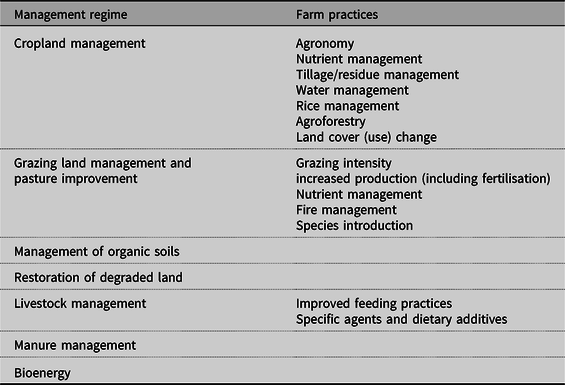
Agricultural lands occupy 37% of the earth’s land surface. Agriculture accounts for 52 and 84% of global anthropogenic methane and nitrous oxide emissions. Agricultural soils may also act as a sink or source for CO 2 , but the net flux is small. Many agricultural practices can potentially mitigate greenhouse gas (GHG) emissions, the most prominent of which are improved cropland and grazing land management and restoration of degraded lands and cultivated organic soils. Lower, but still significant mitigation potential is provided by water and rice management, set-aside, land use change and agroforestry, livestock management and manure management. (p. 789)
These authors estimate more than 6000 metric tonnes of CO2 equivalence yearly as a global mitigation potential and proceed to economic calculations about other agricultural mitigations. They then list farm practices that could improve things (see Table 1).
Conventional science — how farming could change

This is explanatory, systematic, well-organised and well-researched data, and academically detailed. What regenerative farming is doing is taking these points and making them into a live social movement driven by farmers, activating paradigm change and a new mindset for how farming should be done.
A new relationship to water
Most environmental educators are sympathetic to the emphasis on water as something visually evident to nonspecialists. Regenerative farming gives priority to understanding the flow of water through farmland. Water is fundamental to the health of land, enabling the creation of organic matter and organisms, restoring soil fertility, and changing erosion patterns in conjunction with protective planting. The new paradigm echoes ancient and Indigenous societies’ recognition that managing water involves respect for water’s role in biological diversity (bacteria and fungi) and ways that water affects soil chemistry and fertility in the land, and seasonal variation. Every parcel of land (including cities) forms part of a system of water catchments or watersheds that can be managed either to protect water systems or over-used thereby depleting water. The Colorado River in the United States and Aral Sea in Central Asia are case studies of the tragic modern unsustainable water story.
Ever more water extraction, damming, canalising, draining, devegetating, filling wetlands eventually comes to biophysical limits. But regenerative farming shows how even dry landscapes can be renewed — enormously changed and made viable by respecting and utilising the natural processes of water. Andrews (Reference Andrews2014), Massy (Reference Massy2017), and Savory (Reference Savory2020), among many others, show immense changes can be achieved relatively quickly by changing the water paradigm. Kravčík, Pokorný, Kohutiar, Kováč, and Tóth (Reference Kravčík, Pokorný, Kohutiar, Kováč and Tóth2007, p. 7) observed: ‘The relationship of civilizations to water has changed over the course of history. In some civilizations water was worshipped. In the 20th century people attempted to confine and subjugate water … Water cannot be commanded.’ These authors argue for a new water paradigm, something deeply embedded in the regenerative farming paradigm, which:
opens the possibility of a constructive solution to many of the problems associated with climatic changes. The plan for saturating the small water cycle through the conservation of rainwater on land is, from the point of view of the authors of this publication, a revolutionary solution to the given problems. (p. 7)
The centrality of hydrological ‘sensitivity’ in regenerative farming reappears interactively through the other ecological components achieving balance with each other and building up over time. Andrew’s (Reference Andrews2018) aptly named ‘sequence farming’ starts with retaining water. Educator advocacy for the commonsense logic of water as culturally and literally something that cannot be endlessly bought or assumed to be available, supports what famers are doing in regenerative farming. As microbiologist Jehne (Reference Jehne2017) demonstrates, the cycle of water through pastureland takes the conversation back to soil and carbon.
Regenerative farming sequesters carbon in large amounts in paddocks
A key claim is the drawing-down of atmospheric carbon. Perry (Reference Perry2019) explains:
Photosynthesis is the operative mechanism here, as plants capture carbon dioxide from the air to build their stems, leaves, and roots, and release the remaining carbon deep within the ground. Carbon enriched soils have demonstrated greater resilience to floods and droughts — some of the most detrimental effects of climate change.
Carbon enriched soils also yield crops with higher nutritional content and less pesticide residue. Carbon, up to 15 tonnes of it per acre per year, according to the United States Department of Agriculture, can stay locked in the earth as long as regenerative practices are maintained.
Forty tonnes per hectare is for most people an astonishing amount of carbon that can be stored in the soil. For some farmers, learning they might earn a carbon sequester payment per tonne is a positive transition incentive compared to carbon taxes. Regenerative farming enabling a new enthusiasm and way forward for the rural sector is emerging as farmers realise this big public good can be tackled. Critique of the attraction of simple ideas like this is usually needed in ongoing assessment that what is claimed is being achieved. This is an important aspect to include, given the huge potential for farming. Current arguments by scientists and economists, for example, challenge the one trillion trees to offset climate change mantras circulating globally. Ellis, Maslin, and Lewis (Reference Ellis, Maslin and Lewis2020) argue trenchantly that this is too slow and misdirected:
More than $5 trillion per year is spent globally to subsidize fossil energy and the long-term costs of carbon pollution are orders of magnitude above those. Do not imagine that free markets are what sustain the fossil fuel industry either: at least 12 of the world’s 20 largest fossil fuel companies are state owned … When it comes to reducing emissions fast, let’s put the focus where it needs to be: regulating carbon pollution and making clean energy available to everyone. Planting trees can’t do that.
Whether it is the science or the politics that raises the critique, regenerative farming’s potential to rapidly draw down carbon in huge quantities needs the challenges to refine the program.
Toensmeier (Reference Toensmeier2016, p. 29) discusses carbon capture potentials in various kinds of regenerative farming. For educators less familiar with the intricacies of scientific calculation, the headline question is simply: ‘How much carbon can agriculture sequester?’ Different landscapes and plants and climates are among the variables affecting the ‘lifetime carbon accumulation ability of soils’ as his Table 3.1 shows. New carbon sequestering practices continue to be developed on farms and for other land uses. Debates and preferences are strongly expressed, but the science and practices are steadily developing. Toensmeier (Reference Toensmeier2016, p. 34) acknowledges that ‘we still lack a comprehensive understanding of (and ability to predict) the carbon sequestration impact of various practices and crops in different regions, with different soils and with different climate’. But clearly the potential is enormous for improving soil carbon status globally. The low-hanging fruit of climate change, changing 3.3 billion hectares of pasture, occupying two-thirds of the world’s farmland, has already begun to alter government and industry support towards accelerating necessary shifts in the end-game we currently occupy.
Toensmeier (Reference Toensmeier2016, p. 36) also asks, ‘So can carbon farming alone resolve our climate change problem?’
Not even close. Carbon farming does not work without dramatic emission reductions (including clean energy and reduced consumption in wealthy countries), as even a small fraction of the remaining 5 to 10 trillion tons of carbon in the fossil pool would far overwhelm the theoretical maximum sequestration capacity of soils and biomass, estimated at 320 billion tonnes. Emissions reduction also does not work without carbon farming, since even if emissions stop today, we are already over the tipping point with no way to return without sequestration. These two strategies are two halves of the whole, and each cannot succeed without the other
Toensmeier (Reference Toensmeier2016) continues his questioning: ‘Of the 200-plus billion tonnes of carbon that must be sequestered how much can come through agriculture?’ (p. 36). He says we cannot yet answer that question but he is working on it. Further, proposals incentivising carbon offsets — all needing academic debate and critique — have several potential benefits moving to higher levels of mitigation.
Regenerative farming adopts different growing, grazing practices and priorities
Carbon removal leads to other parts of the story. Perry (Reference Perry2019) argues that ‘Regenerative growing practices’ which avoid tilling and minimise soil erosion, have the potential to store a significant portion of carbon in the soil, while improving the nutrition in our food.’
Farmers have traditionally relied on fertilisers and chemicals to maintain yields. But advances in microbiology and data science now give farmers more options to replace many of those synthetic inputs with natural means. Aggregating data on these new technologies and getting useful information to the farmers themselves is a critically important step in transitioning our agricultural sector.
Several of the accounts of changing farming practices include ideas of mob stocking-and-moving. This deposits a lot of manure that increases growth, and with tight management of grazing keeps fresh feed ahead of animals. Greatly reduced or even avoided fertiliser use comes from much more organic matter and carbon-rich soils. One sustainable farmer spoken to referred to the traditional farmers around her who were suspicious of her practices, not yet mainstream in her district. Privately she called them ‘moron farmers’ — that is, ‘more fertiliser on, more head of stock, more tonnes of crop, more …’. These farmers’ 20th-century training and agricultural advisers had well inculcated in them that more is always better and the goal of their farming practices.
Yet these farmers sense that this is not necessarily true. They too see the pulverised soil, the literally dropping land levels, the need for deeper pumping of artesian aquifers, some riverbeds drying, and the disappearance of wetlands, insects and birds. They too feel hurt by the urban or government excoriation of their practices, but they are for the most part locked into, trained into, an industrial agricultural capitalist complex. Even those in advanced agricultural economies — perhaps especially the family farmer in Anglo-settler societies — sense the need for a better way that does not contribute to the degradation of the farms for which they feel stewardship responsibility (Burton, Reference Burton2004).
The preceding steps can be expressed in a different way in regenerative farming by considering economics, a necessary concern of farmers as business enterprises, at whatever scale. The regenerative proposal is to shift from a logic that says more profitability comes with more outputs. Aim instead for profitability, not more production. Shift from Western logics of linear improvement and ‘more is better’ — ever more sophisticated ways of extracting or pushing the margins of production — to ecologically steady-state farming that no longer robs the environment for short- and medium-term gains, degrading waterways and diminishing species, and impacting the health of the land. That this proposition might be better economics opens doors for farmers and others whose starting point is their economic livelihood and viability. LaCanne and Lundgren (Reference LaCanne and Lundgren2018) raise this issue of economic security. That logic is being unlinked with the argument that regenerative farming is not a ‘woolly-headed alternative lifestyle’, but can seriously maintain and even add to profitability by letting go the false equation that more outputs is the same as, or driver of, more profit. Regenerative water health of the land is not a balance with profit. Water’s primacy is the foundation of farm profitability and of the social licence to farm within and across water catchments.
Regenerative farming is a social movement
The possibilities of reaffirming farmer initiative and reputation, and negotiating autonomy in a world requiring increasing compliance is something that at least some farmers see worth pursuing. Taking positive action seems more meaningful than complaining about townspeople, government demands and fickle markets. Regenerative farming, under a variety of labels is a necessary movement today (Massy, Reference Massy2017; Montgomery, Reference Montgomery2017). Conventional farming releases carbon into the air; regenerative farming draws it down into the land. This new — actually very ancient — set of farming practices builds up organic material in the soil. This has the effect of storing more water in the ground, drawing more carbon from the atmosphere, and enabling bacterial and fungal biodiversity to flourish.
Early-adopter farmers are driving much of the conversation about how to do regenerative farming and why others should farm this way (Rhodes, Reference Rhodes2017). Regenerative farming combines narratives from organic farming approaches as well as incorporating science advocacy for restorative practices. Organic farming was seen for many decades as fringe in Western agriculture, using alternative lifestyles or local food philosophies. Mainstreaming the regenerative farming concept brings together key holistic ideas with scientific contributions measuring and theorising changes. Further, regenerative contributions of such whole of catchment/watershed or systems analysis converge under new regulatory pressure. Resistant farmers and political leaders’ refusal to act does not impress a growing percentage of civil society, both urban and rural, who are increasingly concerned that agriculture is beyond environmental limits and needs to change.
Why is regenerative farming important? Farming occupies about 40% of the earth’s land area. Environmental educators are familiar with Amazon rainforest hectares cut down every single day and turned into even more agriculture (Reid, Reference Reid2016). Most of humanity’s food supplies come from farmland. But land fertility is dropping steadily; and related to this is the diminishing available and quality of water in lakes, river and aquifers. Regenerative farming shifts from a downward narrative denying people agency, suggesting instead the capacity to make a difference Lal (Reference Lal2011). Toensmeier (Reference Toensmeier2016) estimates that with ‘global adoption of conservation agriculture, world cropland could sequester 400 million to 1.2 billion tonnes of carbon annually over a period of 50 to 100 years’ (p. 37).
Farmers regain enjoyment in regenerative farming. Online videos of farmers who have begun the shift frequently film across both sides of a fenceline, literally showing the dramatic impacts of applying regenerative farming practices. These are consistent with the books of farmers recounting enthusiastically or persuasively how switching to regenerative farming affects land and family (Andrews & Williams, Reference Andrews and Williams2014; Brown, Reference Brown2018; Massy, Reference Massy2017). Characteristic of the switch to regenerative farming is that many farmers get their enjoyment for farming back again. This is mentioned last here to avoid pleading any special interest, but farmer realisation that ecologically based farming is possible creates hope and opportunity. These in turn inspire new levels of insight and thinking about refinements for the regenerative farming movement and practices. As science continues to ask questions on behalf of the regenerative farming movement and is integrated more with the actions of famers, in-the-paddock actions and decisions will be modulated according to a plethora of variables from soil types, to crop types, to local water and climate.
We can posit a shift from ‘carbon democracy’ (Mitchell, Reference Mitchell2009) to ‘carbon farming’ (Toensmeier, Reference Toensmeier2016). The first is an ironic phrase about the attenuated polity of Western capitalist society addicted to fossil fuels and twisting its governance to the current victors in that contest. The latter phrase, ‘carbon farming’, holds the promise of several profound reversals of the downward pathway that modern capitalist human society has followed despite apparent wins of the 20th-century model, at the cost to the environment and human vulnerability. Beyond the transactional aspect of trading carbon credits through regulatory schemes, regenerative farming is proactive in finally integrating the environment into agricultural practice.
Conclusion
Teaching students and helping colleagues learn that regenerative farming is the emerging voice of a new era in farming opens large possibilities for addressing climate heating. Regenerative farming is of course not the only answer for climate change. But it is a substantial answer and a strong, positive response in an unheralded sector of society that is the world’s major single GHG polluter. Two final things are urged in educational terms for a new generation to understand and expect conformity as professionals, citizens and consumers.
First, there are many great stories that make the regenerative point without the exactitude of the science underlying them. This provides a great first stage and scaffolding for learners at whatever level, in whatever field, to go on educating themselves about this paradigm change and great step forward globally — in this article as the Wozniacka (Reference Wozniacka2019) story and the Perry (Reference Perry2019) account. But there are many more: encourage students to identify two or more of these news stories and compare them: What do they have in common? How are they different? What is one story doing or showing more successfully?
Within these ‘by example’ and storytelling approaches, a special need is for preservice teachers at primary, secondary and tertiary levels to be exposed to and learn key things about regenerative farming as one important contribution to addressing climate change. W. Smith’s (Reference Smith2020) challenge for teachers to be exemplars relies on the understanding of more than facts, but being able to tell the story of why we should support regenerative farming. The other special group that needs the learning that regenerative farming brings, is not simply farmers themselves but their sons and daughters and partners — those aspiring to own a block of land or farm. They too are part of the solution if they understand the benefits and opportunities they face by farming in new ways. They can go beyond merely attempting to sustain, but actively regenerate the Earth’s capacity to bury carbon and enable species and agriculture to flourish.
Second, this article has mentioned several videos of regenerative farmers and scientists explaining their ideas and what they have done. These references are a tiny sampling of video clips that are great teaching aids, making it easier for instructors and teachers to explain regenerative farming to students, and perhaps better understand the story themselves. These videos, of varying length, often convey the importance in ways that interest students and support what educators are saying. Many are science-based. In terms of narrative and presentation, those in which a farmer tells their story are often compelling for students. Often the most powerful effect is how farmers tell the hard, hard story of recognising they needed to change their minds and practice. Students who get enthusiastic about what they see can follow up these video resources at home, accelerating their own learning. This can lead to experimental willingness to try out regenerative farming ideas at home or some project of relevance at family scale — composting, worm farms, vegetable growing, club or group membership, tree planting and others.
The question gets asked as these hopeful conversations start to take off, ‘Can regenerative agriculture reverse climate change?’ Wozniacka (Reference Wozniacka2019), without directly answering that question, describes success stories and how large food corporations are becoming involved, increasing the viability of the transition.
More than 20 years ago, Will Harris was a cattle farmer who relied on common industrial tools like pesticides, synthetic fertilisers and antibiotics. Today, his 2500-acre ranch in Bluffton, Georgia is a holistically managed, no-waste operation with 10 species of livestock rotated to graze the rolling pastures and fertilize the land without chemicals, resulting in rich, healthy soil.
Known as regenerative agricultural practices, those methods have not only improved the land of his ranch, White Oak Pastures, they also have led to the land becoming a carbon sink, pulling carbon from the air and storing it in the ground. As a result, Harris’ ranch has been able to offset a majority of the emissions related to its beef production. A key supplier of General Mills, the ranch has become a model of how to transition to a form of farming that the company says can provide a solution for climate change.
Agriculture, like fossil-fuel companies and corporations, is often asserted to be the problem. Backing away from the generalised accusation enables more diverse conversational viewpoints to be heard. Students need to be reminded often that farmers would not grow and companies would not sell if consumers chose not to buy. So, finger-pointing is a fraught exercise. Any positive and potentially sustainable or restorative gain is worth striving for.
We can leave it to sociologists and other academics to develop more overall critiques of false promises and unintended consequences. The initiative of farmers is sometimes nudged by the companies to whom they supply milk or meat. Examples include planting along stream edges and adopting better wetland practices. There are as many gains from such a paradigm shift, or even more, as there are from new technologies. Teaching that recognises this and aims instruction towards regenerative farming, applying technologies within that frame, is a better educative route than staying with silver-bullet solutions and little-changed industrial farming.
Acknowledgments
Appreciation is expressed to insightful comments and examples provided by reviewers.
Edgar Burns has taught in the tertiary sector more than 20 years. His interdisciplinary approach starts from his core sociology teaching and research roles. Current work focuses on communities, policy, and motivations responding to environmental issues. He recently published Theorising Professions: A Sociological Introduction and is currently writing about farmer professionalism and the environment. ORCID: 0000-0002-6645-3358