Introduction
The HIV/AIDS and Malaria Indicator Survey conducted in 2007/2008 in Tanzania showed that the national HIV/AIDS prevalence rate was 5.7%. Iringa region had the highest prevalence rate of 15.7%. Arusha, with a prevalence rate of 1.6%, was among the few regions with a very low prevalence rate (United Republic of Tanzania, 2008). The survey showed that women were generally more affected by HIV/AIDS than men: the national prevalence rate for women was 6.6% while that of men was 4.6%. In Iringa region, the prevalence rate for women was 18.6% and that of men was 12.1%. On the other hand, in Arusha region the prevalence rate for women was lower than that of men, being 0.8% and 2.7% respectively. Among women in mainland Tanzania, Iringa region had the highest HIV/AIDS prevalence rate (18.6%) while Arusha region had the lowest (0.8%).
Arusha region is in the north-east part of mainland Tanzania; the regional headquarters is in Arusha district. Iringa region is in the south-west part of mainland Tanzania and its regional headquarters is in Iringa urban district. According to the 2002 population and housing census, Arusha district had a population of 281,608 people while Iringa urban district had a population of 106,371 people (United Republic of Tanzania, 2003). Thus the population of Arusha district was more than twice that of Iringa urban district.
In September and October, 2009, a survey was conducted in eight regions of mainland Tanzania by the Champion project of EngenderHealth; assessing the responses of men and women of reproductive age to questions on HIV/AIDS was one of the main objectives of the survey. In each of the eight regions, the survey was conducted in a district where the region's headquarters was located, and Iringa and Arusha regions were among the eight regions in the survey. The survey had three questionnaires: the household, men's and women's questionnaires. The questionnaires collected data on household characteristics and responses to questions on HIV/AIDS from men aged 15–59 years and women aged 15–49 years in the selected households. The survey did not involve any HIV testing although there were questions on whether a respondent had ever been tested for HIV and their willingness to be tested for HIV.
In this paper, data from the women's questionnaire for Arusha and Iringa regions are analysed to compare women's responses to questions on HIV/AIDS. In this way, it is possible to get a glimpse of why women in Iringa region have the highest HIV/AIDS prevalence rate in the country while their counterparts in Arusha region have the lowest (18.6% versus 0.8%; United Republic of Tanzania, 2008).
Methods
Sampling procedure
For the 2009 survey, a three-stage sampling procedure was applied to collect data from women in the selected districts. The first stage involved selection of a sample of population census Enumeration Areas in urban wards of the selected districts. An Enumeration Area is a group of households within defined geographic boundaries. The Enumeration Areas were developed by the Tanzania National Bureau of Statistics and were used in the 2002 Population and Housing Census and also in the Tanzania Demographic and Health Survey in 2004/05 and the Tanzania HIV/AIDS and Malaria Indicator Survey in 2007/08.
The second stage involved selection of households. An enumeration of all households within each selected Enumeration Area was conducted and a sample of 30 households was selected from that list by applying systematic sampling. In each of the selected households, a man aged between 25 and 59 years was randomly selected as a respondent to the men's questionnaire. Later a male youth aged 15–24 years was selected from a household in 10% of the selected households. Data from men are not analysed in this paper.
Another sampling stage was required for selecting women respondents. The third stage involved selecting women in the 30 selected households in each Enumeration Area. A woman aged between 15 and 49 years in every third household in the systematic sample of the 30 households was selected for the survey. If a selected household had more than one eligible woman for the survey, one of them was randomly selected. These samples should be considered representative of the more urban areas in the two districts, not the whole populations of the two districts.
Sample size
Twelve Enumeration Areas in Arusha district and five Enumeration Areas in Iringa urban district were selected for the survey. This was appropriate since Enumeration Areas were based on population and the population of Arusha district was more than twice that of Iringa urban district (United Republic of Tanzania, 2003). According to the design of selecting ten women from each participating Enumeration Area, the expected sample sizes were 120 women in Arusha district and 50 women in Iringa urban district. The actual sample sizes were 121 women in Arusha district and 52 women in Iringa urban district.
Data collection
Data were collected by a team of research assistants with a minimum qualification of a first university degree or its equivalent. They were accompanied in the field by a supervisor who was an experienced researcher. The same research team collected data in both districts. One-to-one interviewing with the selected women took place in Iringa district from the 9th to 15th September 2009 and in Arusha from 26th September to 4th October, 2009. Confidentiality of the information was assured. The women were told that the interviewer would not discuss the information with anybody else and that their names would be removed from the questionnaires before data entry took place.
Data analysis
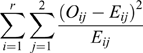
Knowledge, attitude and practice on HIV/AIDS of married and unmarried women aged 15–49 years were compared in Arusha and Iringa regions. Initially, a chi-squared distribution was used in making comparisons between the women in the two regions for each variable of interest. The chi-squared test is of the form:
 $$\sum ^r_{i=1} \sum ^2_{j=1} {(O_{ij}- E_{ij})^2\over E_{ij}}$$
, where Oij is the observed value in the (i, j)th cell and Eij is the expected value in the same cell; the variable of interest has r possible responses and j stands for the regions (j=1 for Arusha, j=2 for Iringa).
Results
Socio-demographic characteristics
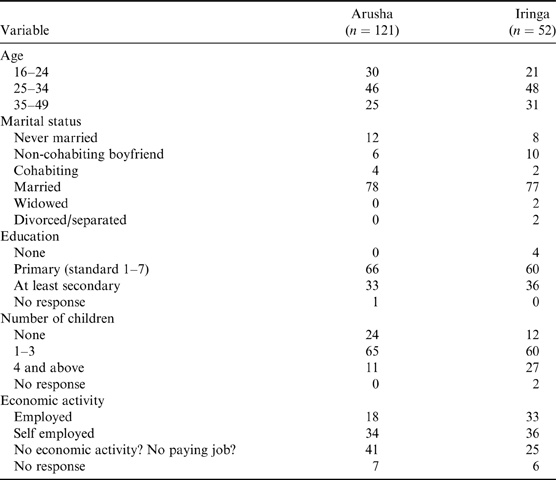
Women in Iringa region were slightly older than women in Arusha region; the mean ages were 31 and 29 years and the median ages were 30 and 28 years respectively. While a small percentage of women in Iringa region were either widowed or divorced/separated (4%), not a single woman in the Arusha sample was in that marital category. On the other hand, almost equal percentages of women in the two regions were married (77% in Iringa and 78% in Arusha). A small percentage of women in Iringa region had never been to school (4%) while all women in Arusha region had some formal education. The percentage of women who did not have children in Arusha was twice that of women in Iringa (24% versus 12%). The frequency distributions of the socio-demographic characteristics of the women are given in Table 1.
Percentage distribution of women by socio-demographic and economic variables, Iringa and Arusha regions, Tanzania

For the women who had ever had children, the mean number of children in Arusha region was 2 versus 3 in Iringa region.
Chi-squared tests were performed to compare the women in the two regions on the basis of age, education, number of children and employment status. Age had three categories: 16–24, 25–34 and 35–49 years. Education had two categories: primary/none or post-primary school education. The number of children had three categories: none, 1–3 and 4 and above. Economic activity had three categories: employed, self-employed and no economic activity. A Chi-squared test was not performed to compare the marital status because in both regions more than three-quarters of the women were married and the other marital categories had small frequencies.
It was found that the differences in ages and educational levels of the two groups of women were statistically insignificant. The difference between the numbers of children per woman in the two regions was statistically significant (1% significance level) and a statistically significant higher percentage of women in Iringa had children as compared with women in Arusha (86% versus 76%). Also, the difference in involvement in economic activities was statistically significant (at 5% significance level), with more women in Iringa region being economically active than women in Arusha region (69% versus 52%).
HIV/AIDS knowledge
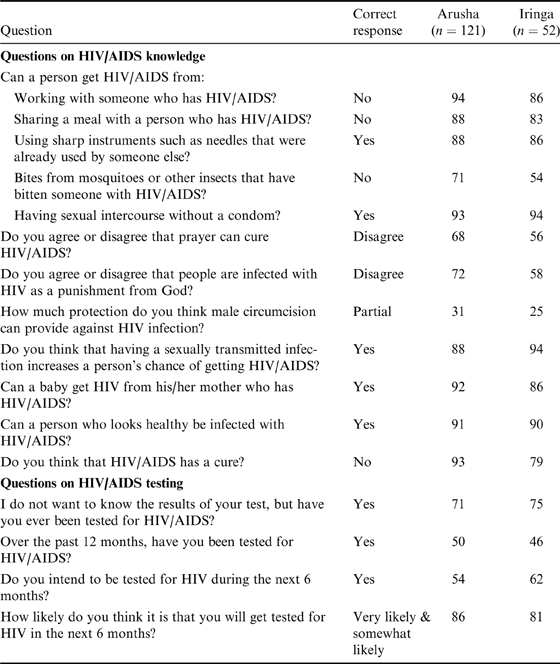
The women were asked questions about HIV/AIDS knowledge. A higher percentage of women in Arusha than Iringa region provided correct responses on whether a person can get HIV/AIDS from: working with someone who has HIV/AIDS, sharing a meal with a person who has HIV/AIDS, using sharp instruments such as needles that were already used by someone else, and bites from mosquitoes or other insects that have bitten someone with HIV/AIDS. It was encouraging that more than 90% of women in each of the two districts were aware that a person can get HIV/AIDS by having sexual intercourse without a condom.
A higher percentage of women in Arusha than Iringa region provided correct responses on prayers not being a cure for HIV/AIDS, HIV infection not being a punishment from God, HIV/AIDS having no cure and the possibility of mother-to-child HIV transmission. Knowledge on the role of male circumcision providing partial protection against HIV was not known by the majority of women in both districts; only 31% of women in Arusha and 25% of women in Iringa were aware of this. The women's responses to questions on HIVAIDS knowledge variables are presented in Table 2.
Percentage distribution of women by HIV/AIDS knowledge and testing, Iringa and Arusha regions, Tanzania
A chi-squared test showed that the difference in responses of Arusha and Iringa women on HIV/AIDS having no cure was highly statistically significant (<1%). The response on whether a person can get HIV/AIDS from mosquito bites or bites of other insects that have bitten someone with HIV/AIDS was significant at the 5% statistical significance level. In both cases, women in Arusha region had more knowledge than women in Iringa region. Ninety-three per cent of women in Arusha region provided the correct answer that HIV/AIDS does not have a cure, and the percentage for Iringa women was 79%. Similarly, 71% women in Arusha stated that a person cannot get HIV/AIDS from mosquito bites or bites of another insect that has bitten someone with HIV/AIDS, compared with only 54% of women in Iringa region.
The chi-squared test showed that there were no statistically significant differences between the responses of women in Arusha and Iringa regions for all the other variables shown in Table 2.
HIV/AIDS testing
More than 70% of the women in each district reported that they had been tested for HIV/AIDS. Moreover, more than 80% of the women in each district said they were very likely or somewhat likely to be tested for HIV/AIDS in the next 6 months. There were no statistically significant differences between the HIV/AIDS testing behaviours of women in Arusha and Iringa regions. The women's responses on HIVAIDS testing behaviour are presented in Table 2.
Opinion on men's participation in HIV/AIDS prevention
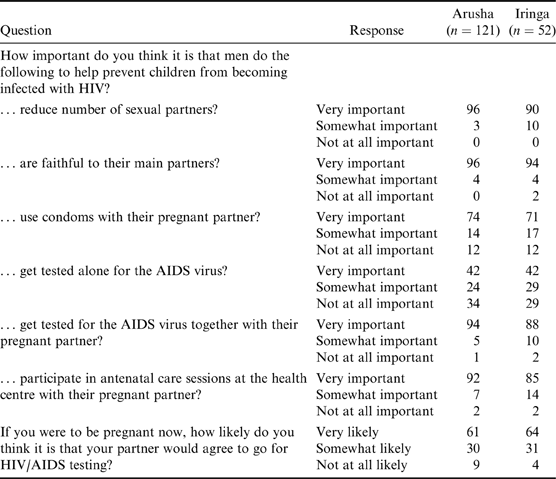
More women in Arusha region than in Iringa region believed that to prevent children from becoming infected with HIV, it is very important that men reduce their number of sexual partners (96% versus 90%), be faithful to their main partners (96% versus 94%) and use condoms with their pregnant partners (74% versus 71%). Also, more women in Arusha region than Iringa region were aware of the importance of men being tested for the AIDS virus together with their pregnant partners (94% versus 88%) and that they should participate in antenatal care sessions at the health centres with their pregnant partners (92% versus 85%). Finally, 61% and 64% of women in Arusha and Iringa regions respectively stated that if they were to be pregnant, it was very likely that their partners would go for HIV/AIDS testing. The women's opinions on men's participation in HIV/AIDS prevention are presented in Table 3. The chi-squared test did not show any statistically significant differences between the responses of women in Arusha versus those in Iringa region.
Percentage distribution of women by opinion on men's participation in HIV/AIDS prevention, Iringa and Arusha regions, Tanzania
No statistically significant differences were found between Arusha and Iringa for any of these items.
Discussion
There is a significant association between the number of children per woman and region of residence. The fact that a higher percentage of women in Arusha region than in Iringa region did not have any children (24% versus 12%) could mean that women in Arusha region were less sexually active than those in Iringa region. For women who had ever had children, the mean number of children in Arusha region was smaller than in Iringa region (two versus three). This could also imply that women in Arusha region were less sexually active than their counterparts in Iringa region. This could be the case because modern contraceptive use in Tanzania is quite low. According to the Demographic and Health survey conducted between October 2004 and January 2005, 22% of all women were using contraceptives and only 18% were using modern contraceptive methods (United Republic of Tanzania, 2005). The most recent Demographic and Health Survey conducted between December 2010 and May 2011 found that 29% of women used any contraceptive method while 24% used modern contraceptive methods (United Republic of Tanzania, 2011). Heterosexual intercourse is the largest contributor to HIV infections in sub-Saharan Africa (Lau & Muula, Reference Lau and Muula2004; UNFPA, no date). Thus if Arusha women are less sexually active than Iringa women, this might be one of the reasons as to why the HIV/AIDS prevalence rate is so much lower in Arusha region than in Iringa region. However, this is speculative since no data were available on sexual behaviour.
There is a significant association between the women's economic activities and region of residence. Women in Iringa region are more economically active than women in Arusha region. This might suggest that, due to economic activities, women in Iringa region interact more with other people than their counterparts in Arusha region. Such interaction could lead to more sexual activity and a greater risk of contracting HIV. Again, this is speculation since no direct information was available on sexual activity.
Women in Arusha region had significantly more knowledge on the spread of HIV/AIDS compared with Iringa women. They were more likely to know that mosquito bites do not spread HIV/AIDS. Almost all the women in Arusha Region knew that HIV/AIDS has no cure while a significant percentage of women in Iringa region did not know this. However, it has been pointed out in the research literature that knowledge of HIV/AIDS does not necessarily translate into appropriate behavioural change (Booysen & Summerton, Reference Booysen and Summerton2002). For example, in research conducted among women in Lobatse, Botswana, it was found that the vast majority of women were aware of HIV/AIDS, but their lifestyles, practices and perceptions did not match that knowledge (Onyango, Reference Onyango2011).
In the Nigeria 2008 Demographic and Health Survey (National Population Commission, 2009), it was shown that knowledge of HIV/AIDS increased with educational level. In this Tanzania research, responses to the question on whether a person can get HIV/AIDS from mosquito bites or those of other insects that have bitten someone with HIV/AIDS were compared by educational levels of the women in the two regions. There was no significant difference between responses of women with secondary education in the two regions (83% in Arusha and 79% in Iringa provided the correct answer). However, for the same question, there was a statistically significant difference (5% significance level) between responses of women with primary school education in Arusha and Iringa regions (65% in Arusha and 49% in Iringa provided the correct answer). Perhaps HIV/AIDS education at the primary school level is stronger in Arusha than Iringa regions.
Reported behaviour regarding testing for HIV/AIDS was not significant between the women in the two regions. This might be because once pregnant women go to the prenatal clinic, they are tested for HIV/AIDS. The majority of pregnant women in the country attend antenatal clinics. Moreover, prenatal services are free of charge. This might explain why reported rates of being tested (or intention to test) are similar in the two groups of women.
Finally, the general literature indicates that more women than men are infected with HIV in sub-Saharan Africa, including Tanzania. The situation in Arusha region is the opposite: more men than women are infected with HIV (Lau & Muula, Reference Lau and Muula2004; United Republic of Tanzania, 2008).
To conclusively understand why the HIV rate is so much higher in Iringa than Arusha, a more in-depth study is needed on the sexual behaviour of women and men in the two regions.
Conclusion
This paper found some significant differences in HIV/AIDS awareness between women in Iringa region, which has the highest HIV/AIDS prevalence, and Arusha region, with the lowest HIV/AIDS prevalence in mainland Tanzania. Women in Arusha region have more knowledge of HIV/AIDS than those in Iringa region. This maybe helps Arusha women to avoid contracting HIV/AIDS, although knowledge does not always translate into appropriate behaviour. There is also a suggestion that Iringa women are more sexually active than women in Arusha region. This may contribute to the spread of HIV/AIDS since the majority of HIV/AIDS cases are contracted through sexual activity. Besides learning more about sexual behaviour in the two regions, it would be useful to know more about the history of the epidemic in the two regions.
Acknowledgment
Data for this paper came from the data files of the Champion project of EngenderHealth in Tanzania. The CHAMPION project collected the data for a baseline study on ‘Assessment of men's gender attitudes and behaviors, and their involvement in reproductive health and HIV/AIDS in Tanzania.’