Introduction
The prevalence of overweight and obesity is increasing worldwide. In Austria, 28 per cent of the adult population are overweight and 12 per cent are obese. Of Austrian schoolchildren, 17 per cent are overweight and 7 per cent are obese.Reference Elmadfa, Hasenegger, Wagner, Putz, Weidl and Wottawa1 Recent data from the Austrian state of Tyrol revealed an overweight or obesity rate of 13 per cent in preschool children aged 4 and 5 years.Reference Greier and Riechelmann2 As a consequence, the number of overweight and obese patients undergoing otorhinolaryngological surgical procedures is increasing. Current knowledge of the role of body mass index (BMI) on surgical outcome and complication rates in ENT surgery is incomplete.
In general, obese adults and children require an adapted anaesthetic procedure.Reference Todd3, Reference Mortensen, Lenz, Abildstrom and Lauritsen4 Current data regarding the issue of whether overweight adult patients have a higher risk for surgical or anaesthesiological complications are conflicting.Reference Doyle, Lysaght and Reynolds5–Reference Waisath, Marciani, Waisath and James8 In children, upper airway obstruction in the post-anaesthesia care unit, and the need for two or more anti-emetics, were more common in overweight and obese than normal weight children.Reference Nafiu, Reynolds, Bamgbade, Tremper, Welch and Kasa-Vubu9
Tonsillectomy is one of the most common surgical procedures in the US and Europe.Reference Baugh, Archer, Mitchell, Rosenfeld, Amin and Burns10, Reference Windfuhr, Chen and Remmert11 Body mass index may be related to tonsillectomy in several ways. In overweight children, there is an increased risk for respiratory problems following tonsillectomy. In 321 children treated with tonsillectomy for obstructive sleep apnoea (OSA), obese children had an increased risk for post-operative respiratory complications.Reference Ye, Liu, Zhang, Huang, Huang and Li12 Similarly, a higher risk for peri-operative respiratory complications was found in obese children surgically treated for sleep-disordered breathing.Reference Fung, Cave, Witmans, Gan and El Hakim13 An increased risk for peri-operative respiratory complications in overweight and obese children with or without OSA was reported by Nafiu and colleagues.Reference Nafiu, Green, Walton, Morris, Reddy and Tremper14 In a matched case–control study of tonsillectomy patients, severely obese children with or without OSA had a higher risk for peri-operative complications than normal weight controls.Reference Gleich, Olson, Sprung, Weingarten, Schroeder and Warner15 The authors considered that both severe obesity itself and systemic co-morbid conditions in obese children contributed to the observed higher complication rate. Overall, the literature consistently indicates an increased risk for respiratory problems following tonsillectomy, at least in overweight children.
Body mass index may also influence wound healing, wound infection rate and bleeding risk following various interventions. In addition to cardiovascular alterations such as hypertension and metabolic changes including diabetes, an increased state of chronic inflammation and dysmetabolism observed in visceral obese patients may negatively influence surgical wound conditions.Reference Doyle, Lysaght and Reynolds5 The impact of BMI on post-tonsillectomy bleeding episodes in children and adults is not yet known. The present study aimed to collect and analyse data on this topic.
Materials and methods
All patients who underwent adenoidectomy and/or tonsillectomy at the Department of Otorhinolaryngology – Head and Neck Surgery, Medical University Innsbruck, were continuously monitored in an online hospital quality management system. In Austria, tonsillectomies are generally performed as in-patient procedures. During administrative patient discharge, the hospital information system checks the main diagnosis for International Classification of Diseases version 10 codes suggesting an adenotonsillar procedure (J03.0, J03.8, J03.9, J35.0, J35.2, J35.3, J36, R06.5 and T81.0). If one of these codes is identified by the system at discharge, a quality management window pops up and is filled in by the ward physician. The type of surgical procedure, the occurrence of post-operative haemorrhage (yes or no), the number of haemorrhages, the time interval between surgical procedure and post-operative haemorrhage, and the severity of haemorrhage is registered. For the ease of data input, only checkboxes are used.
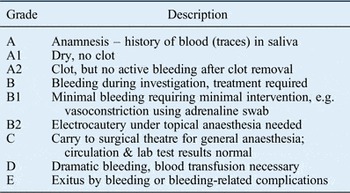
Post-operative haemorrhage was defined as any bleeding after extubation, regardless of whether or not surgical intervention was required. The severity of haemorrhage was categorised into seven grades (Table I) according to the Austrian Tonsil Study.Reference Sarny, Ossimitz, Habermann and Stammberger16 The data from the automated quality management system collected between June 2011 and June 2012 were checked for completeness and accuracy. For this purpose, the quality management monitoring data were compared with the administrative data of all surgical procedures which included a tonsillectomy during the evaluation period. Missing data in the quality management monitoring data set were retrospectively added. Body size and weight were routinely measured at hospital admission using a body height ruler and a calibrated scale.
Haemorrhage severity grading*

* According to the Austrian Tonsil Study.Reference Sarny, Ossimitz, Habermann and Stammberger16
Body mass index was calculated according to Quetelet (kg/m2) and categorised in line with the World Health Organization (WHO) BMI classification. In children and adolescents, BMI was classified according to Kromeyer-Hauschild et al.Reference Kromeyer-Hauschild, Wabitsch, Kunze, Geller, Geiß and Hesse17 This classification uses the height and weight data of several epidemiological studies conducted in Central Europe. It categorises age-specific BMI, according to lower and upper percentiles, into severe underweight, underweight, normal weight, overweight and obesity. For adults and children, the categories of severe underweight and underweight, and overweight and obese, were combined to form an underweight and an overweight category, respectively.
Surgical procedures were classified into the following categories: no surgery (if the quality management window popped up as a result of one of the above International Classification of Diseases codes without surgery performed), extracapsular tonsillectomy, adenoidectomy, abscess tonsillectomy, tonsillotomy, intracapsular shaver-assisted tonsillectomy, and uvulopalatopharyngoplasty with tonsillectomy.
Patient age was categorised according to the following: preschool children (less than 6 years old), children (6–11 years old), adolescents (12–17 years old), young adults (18–23 years old), middle-aged (24–44 years old) and older patients (more than 45 years old).
For data analysis, patients who did not undergo tonsillectomy (‘no surgery’ and ‘adenoidectomy only’ patients), and those in whom the initial tonsillectomy was performed in another hospital, were excluded. The data presented in the frequency tables were calculated and analysed using chi-square tests.
Results
The initial data set included 472 patients with International Classification of Diseases codes for tonsillar disease treated between June 2011 and June 2012 at the Department of Otorhinolaryngology – Head and Neck Surgery, Medical University of Innsbruck. Of those, 161 patients were excluded because no tonsillectomy was performed (‘no surgery’ and ‘adenoidectomy only’) and 11 patients were excluded because primary surgery was performed in a distant hospital. The remaining data set with 300 patients was used for the analysis. Of these 300 patients, 257 were identified by the quality management monitoring system and 43 were retrospectively identified from the hospital administrative data, resulting in a quality management fill-in rate of 86 per cent.
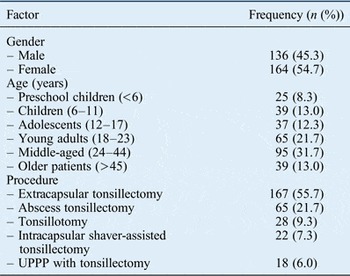
The gender distribution of the study population was balanced. Most patients were adolescents and adults rather than children. The most common surgical procedure was extracapsular tonsillectomy (Table II).
Patient data

UPPP = uvulopalatopharyngoplasty
Post-tonsillectomy haemorrhages were recorded in 55 (of the 300) patients. Of these, 29 were type A (history of blood in saliva, no active bleeding), 15 were type B (active bleeding, treatment under local anaesthesia) and 11 were type C (active bleeding, treatment under general anaesthesia). No type D (blood transfusion) or type E (lethal) bleeding was observed. More than 1 post-operative bleeding episode was observed in 13 patients. Most post-operative bleeding episodes (35 out of 55) occurred at or after post-operative day 5. Post-tonsillectomy haemorrhage was significantly less frequent in preschool children, older patients and those treated with tonsillotomy. Gender had no significant influence on bleeding frequency. The frequency of post-tonsillectomy bleeding was not significantly increased by the addition of adenoidectomy (adenotonsillectomy). Post-tonsillectomy haemorrhage occurred in 52 of 241 patients with inflammatory disease of the tonsils, and in 3 of 50 patients with tonsillar hyperplasia (p < 0.01). Moreover, post-tonsillectomy haemorrhage was more frequent in those who underwent extracapsular tonsillectomy (36 out of 132), when compared with intracapsular tonsillectomy or tonsillotomy (4 out of 46; p < 0.05).
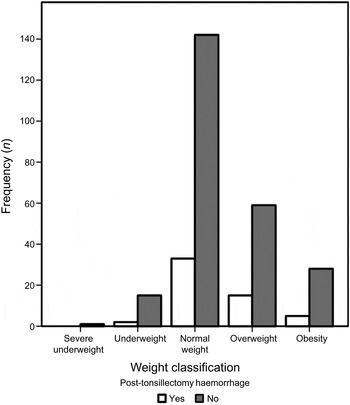
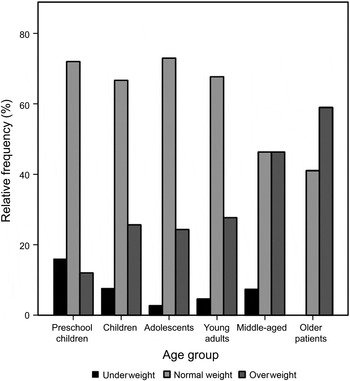
Body mass index was calculated in all 300 patients. Severe underweight was observed in 1 patient (0.3 per cent), underweight in 17 (5.7 per cent), normal weight in 175 (58.3 per cent), overweight in 74 (24.7 per cent) and obesity in 33 (11.0 per cent). Body mass index did not influence the frequency of post-tonsillectomy haemorrhage (Figure 1). After combining severe underweight and underweight, and overweight and obese, post-tonsillectomy bleeding was recorded in 2 of 18 (11.1 per cent) underweight patients, 33 of 175 (18.9 per cent) normal weight patients, and 20 of 107 (18.7 per cent) overweight patients (p = 0.7). Overweight was positively correlated with age. Overweight was observed in 3 of 25 (12 per cent) preschool children, and in 23 of 39 (59 per cent) older patients (Figure 2). When children (less than 12 years of age, n = 64) were examined separately from adolescents and adults (n = 236), BMI had no effect on the post-tonsillectomy bleeding rate (p = 0.8).
Frequency of post-tonsillectomy haemorrhage in severe underweight, underweight, normal weight, overweight and obese patients.

Relative frequency of underweight, normal weight or overweight in 300 tonsillectomy patients grouped by age.

Discussion
This study investigated the incidence of post-tonsillectomy haemorrhage in 300 underweight, normal weight, and overweight adults and children. All patients treated with tonsillectomy at a tertiary referral centre within one year were included. In adults, weight was categorised according to the BMI-based WHO classification. For children, an age and gender adapted Z-score classification appropriate for Central Europe was employed.Reference Kromeyer-Hauschild, Wabitsch, Kunze, Geller, Geiß and Hesse17 The results revealed that overweight or obesity increased with age, and was observed in 12 per cent of preschool children compared with almost 60 per cent in older patients.
The overall post-tonsillectomy bleeding rate was 18 per cent. The vast majority of post-tonsillectomy bleeding episodes were minor, with a return to operating theatre rate of 3.7 per cent. This is well within the normal range reported in recent studies.Reference Windfuhr, Chen and Remmert11, Reference Sarny, Habermann, Ossimitz and Stammberger18, Reference Lowe, van der Meulen, Cromwell, Lewsey, Copley and Browne19
Post-tonsillectomy bleeding rates are difficult to compare. Currently, there exists no consistent definition of post-tonsillectomy haemorrhage. In this study, the classification of the Austrian Tonsil Study was employed.
The frequency of post-tonsillectomy haemorrhage depends on patient age. The bleeding risk is highest in adolescents and younger adults, and lowest in children.Reference Sarny, Habermann, Ossimitz, Schmid and Stammberger20 In this study, the odds ratio for children (less than 12 years of age) to experience a post-tonsillectomy haemorrhage was 0.3 (95 per cent confidence interval (CI) = 0.11–0.78, p < 0.005) when compared with patients over 12 years of age. As a consequence, age distribution may affect reported bleeding rates. In this study, the children to adolescents and adults ratio was 1:3.5. In the recent Austrian Tonsil Study, this ratio was 1:1.3.Reference Sarny, Ossimitz, Habermann and Stammberger16 In a major analysis from Germany, the ratio was 1:2,Reference Windfuhr, Chen and Remmert11 and in the 2003/2004 National Prospective Tonsillectomy Audit,Reference Lowe, van der Meulen, Cromwell, Lewsey, Copley and Browne19 it was 1.6:1. This suggests that adolescents and adults with a higher bleeding risk were over-represented in this study.
Body weight did not influence the frequency of post-tonsillectomy haemorrhage in this study. Post-operative bleeding occurred in 11 per cent of underweight patients, 19 per cent of normal weight patients and 19 per cent of overweight patients (p = 0.7). The odds ratio for post-tonsillectomy haemorrhage for normal weight and overweight was 1.01 (95 per cent CI = 0.55–1.9). When only obese patients were analysed, no increased post-operative bleeding risk was observed. Hence, BMI had no effect on post-operative bleeding rates when children and adults were analysed separately according to weight.
A recent clinical practice guideline recommends that the rate of post-tonsillectomy haemorrhage is determined at least annually.Reference Baugh, Archer, Mitchell, Rosenfeld, Amin and Burns10 Based on this recommendation, an automated quality management system for adenoidectomy and tonsillectomy was implemented in the Department of Otorhinolaryngology – Head and Neck Surgery, Medical University Innsbruck. As the system-demanded input was in close temporal proximity to the treatment, adequate data integrity may be assumed. A thorough post hoc additional data evaluation revealed a fill-in rate of 86 per cent and high data accuracy. Furthermore, surgical procedures and peri-operative pain management were standardised. For tonsillectomy, cold extracapsular dissection and haemostasis obtained through blood vessel ligation during tonsil removal was the standard approach.Reference Sarny, Ossimitz, Habermann and Stammberger21 Peri-operative pain management, which was adapted according to pain severity, included acetaminophen, ibuprofen and nalbuphine in children, and acetaminophen, naproxen and hydromorphone in adults. As a consequence, surgical technique and peri-operative pain management differences are not considered relevant confounders in this study.
• Post-tonsillectomy bleeding episodes were assessed in 300 consecutive tonsillectomies and categorised according to the Austrian Tonsil Study
• Post-tonsillectomy haemorrhage occurred in 55 patients; return to operating theatre rate was 3.7 per cent
• Haemorrhage was more frequent in adolescents and adults than in children
• Overweight or obesity was observed in 107 patients
• Overweight or obesity did not increase the risk for post-tonsillectomy bleeding
In conclusion, no increased risk of post-tonsillectomy haemorrhage was observed in overweight or obese patients. However, the number of patients was low and clinical conclusions should be drawn with caution.