The discovery of the Sentinel Range
In the 1930s very little was known about the geography of Antarctica away from the coastal areas. The exception was the area between the Ross Sea and the South Pole that had been the scene of the pole conquest expeditions of Shackleton, Amundsen and Scott. Admiral Richard E. Byrd's 1928 and 1932 expeditions filled in some of the cartography of the Trans-Antarctic Range and the region he designated Marie Byrd Land. Byrd's geological parties and aerial reconnaissance flights, including his 29 November 1929 flight to the South Pole, added many approximate positions to the folio of the mapmakers. Still, vast reaches of the Antarctic remained unexplored until after World War II.
Byrd's successful flights inspired others, including those of Lincoln Ellsworth. A man of many facets, Ellsworth was the scion of a wealthy American industrial family, a college dropout, an adventurer, and most notably a participant in Norwegian Roald Amundsen's two pioneering flights to the North Pole, before turning his sights to the far south. Details of Ellsworth's historic Antarctic flights are documented in National Geographic Magazine (Ellsworth, L.Reference Ellsworth1936) in which he describes seeing a large mountain range that he named ‘Sentinel Range’ and named a particularly striking peak Mount Mary Louise Ulmer, for his wife. This mountain is now known to be a minor peak near the northern end of the Sentinel Range, and it seems certain that Ellsworth never saw the main part of the range. Still, his sighting late in the day on 22 November 1935 is often cited as the discovery of the Sentinel Range; in any case this remained the only sighting for the following two decades.
The discovery of Mt. Vinson had to wait until 1957, when US scientists were preparing for over snow scientific traverses being planned for the International Geophysical Year (IGY). One of these traverses was to be east of Byrd Station in an area where nothing was known about ice thickness, rate of snow accumulation, etc. On a pre-traverse reconnaissance flight by US Navy aircraft in January 1957, the scientists and plane crew had the first clear and close look at the Sentinel Range, viewing and photographing the big peaks that were obscured by clouds during Ellsworth's flight some 22 years before. Today the 1957 flight crew and scientists onboard are credited with the discovery of the Sentinel Range.
The subsequent IGY traverse party recorded the first sighting and surveying of the Sentinel Range from the ground. Theodolite angles from stations along the traverse route established the locations and heights of major peaks on the range. Geology was not an IGY discipline but the traverse party ascended several outlying small peaks, collected rock specimens from outcrops and took many photographs of the mountains. The 1957 traverse party assigned unofficial names to the major peaks of the range to assist their geographic surveying; several of these names were accepted by the US Board on Geographic Names. One of the traverse geologists, William E. (Bill) Long became one of the party of four to achieve the first ascent of Mt. Vinson in December of 1966. Some of the photographs taken by the IGY reconnaissance flights were published in the internationally-read Swiss publication, The Mountain World (1960–1961), electrifying the international climbing community on the mountaineering possibilities in the Sentinel Range (Hoinkes Reference Hoinkes and Barnes1961). The US Board on Geographic Names gave the name ‘Vinson’ to the highest peak. This was in honour of Congressman Carl Vinson of Georgia, long the chairman of the US House of Representatives Naval Affairs Committee and a champion of US exploration in Antarctica. The name Mt. Vinson is now assigned to the true highpoint of the Antarctic continent, the highest of the five named sub-peaks within the 15,000 ft summit plateau of the Vinson Massif. Mt. Vinson's height is 4892 m and its location is 78° 35′ S, 85° 25′ W (US Board on Geographic Names 1995).
Competing US Antarctic and other national mountaineering interests
Unlike Europe and Great Britain where the ascent of high peaks and difficult routes began in the1800s, mountaineering in the US remained unorganised and rather rudimentary until the turn of the 20th century. The American Alpine Club (AAC) was founded in 1902, soon followed by the Seattle-based Mountaineers, the Harvard Mountaineering Club, and others. For the first decades of the 20th century the numbers of American mountaineers remained small; a situation that changed dramatically in World War II when the US Army established the 10th Mountain Division at Ft. Carson, Colorado. This special operations unit introduced many young American men to climbing and cold weather conditions and subsequently gained fame in the Italian campaign. Following the war, several groups of climbers in the US focused on high peaks in the Pacific northwest, Alaska, the Rocky Mountains, and then on vertical walls such as those in Yosemite National Park. American mountaineers were soon to distinguish themselves in many of the great ranges of the world, with many first ascents of high peaks and new technical routes on those and other summits. By the time that world attention was beginning to take note of American climbing accomplishments, it was also beginning to focus on mountaineering possibilities in Antarctica. This focus was sharpened by the realisation that following the Hillary-Tenzing ascent of Everest in 1953, the Earth's sole remaining unclimbed continental summit was in Antarctica, giving to both mountaineers and political entities worldwide a strong and immediate interest in making the first ascent of Mt. Vinson, coupled with a sense of urgency lest some other nation claim this prize.
Initial interest in the United States was centered primarily in two climbing groups, one on each coast. A Washington-Oregon group was formed under the leadership of Peter K. (Pete) Schoening, an extraordinary mountaineer who had distinguished himself on the Himalayan giant K2. A second group based in New England and New York was led by Robert Page, a geologist at Columbia University's Lamont-Doherty Earth Observatory, Sam Silverstein, a research physician also at Columbia, and Charles Hollister, a geologist at Woods Hole Oceanographic Institution. The northwestern and the northeastern groups took quite different approaches in their efforts to gain permission and logistics support from the various US governmental authorities such as the National Science Foundation (NSF), the Navy, and the Department of State. The northeastern group sought to gain the endorsement of the American Alpine Club, and also to use their scientific connections to obtain support from the NSF through the US Antarctic Research Program (USARP). The northwestern climbers were less connected to the AAC and authorities in Washington DC, but were able to gain the endorsement of US Senator Henry M. Jackson of the state of Washington, a powerful political leader. The northwestern group subsequently gained the support of Warren Magnuson, Washington's other senator, also influential in the Senate. The leaders of the two competing groups knew each other, but both groups presented regionally-based, not nationally-based climbing proposals to their respective governmental supporters; their focus on achieving a ‘first ascent’ was seemingly at least as much for their particular parochial interests as for the nation's prestige.
As these machinations went forward, a third American party of Vinson aspirants appeared. This group was led by Woodrow Wilson (Woody) Sayre, grandson of the former US president and brother of Francis B. Sayre, dean of Washington's National Cathedral who also was influential in Washington's officialdom. For all his political connections, Woody Sayre had made himself something of a persona non grata in both mountaineering and diplomatic circles because of an international incident he had created in 1962 by illegally entering Tibet from Nepal with the object of attempting Everest (Sayre Reference Sayre1964.) Political reverberations from this incident led Sayre to conclude that any approach via US government sources for support for a Vinson expedition would not be well received. Sayre therefore developed a plan to reach Vinson via a small private aircraft from the tip of South America with a four-man party. For a pilot he enlisted Max Conrad, the legendary ‘Flying Grandfather’ from Minnesota. Although not known until much later, it appears that Sayre's expedition never got farther south than Argentina, due (among other things) to the fact that Conrad's modified aircraft, with skis and a large fuel tank in the passenger cabin, failed to satisfy Argentine aviation requirements.
Climbing teams in Italy and Japan also expressed enthusiasm for Mt. Vinson. Japan, a participant in the IGY and signatory to the Antarctic Treaty, had many strong mountaineers with climbing and cold weather experience. An Italian team, another nation with a mountaineering tradition, was interested in the peak. These climbing groups did not have ties to their governments and at the time Italy was neither working in Antarctica nor was a signatory to the Antarctic Treaty. The efforts by Japanese and Italian teams did not materialise, but by 1965 the prospect was growing rapidly that one or the other, or perhaps some other climbing team, would make an attempt and claim the first ascent for its country. These nebulous plans added urgency to the various US aspirations.
US policy on mountaineering and other adventure activities, 1960–1965
IGY and the 1959 Antarctic Treaty created a surge of interest in Antarctica. Many of the national programmes participating in IGY were in territorial claimant nations that had research efforts and stations in Antarctica prior to IGY. The US had a long history of exploration and research in Antarctica but, like several other Antarctic IGY nations, had no active research stations in Antarctica prior to IGY (Sullivan Reference Sullivan1957). Countries and their national science programmes that had not conducted research immediately before IGY had many decisions to consider about committing to a continuing research effort. What would be scope of the programme be and at what costs? In the case of the US, how many of its seven IGY stations would remain open? Slowly over 1959–1960 US policy decisions were made. Many research elements and some stations of the US IGY programme would continue; management of the programme would be the responsibility of the NSF. In 1960 the NSF was but a decade old and its appropriation not large. The responsibility of Antarctic scientific management and the comparatively large budget it required were challenges for the NSF, and the director and his key associates worried that the Antarctic budget would swamp the rest of the NSF appropriation. The USARP was established within NSF to operate McMurdo, Byrd, and South Pole Station supporting the research disciplines of astronomy, meteorology, upper atmosphere physics, geology, biology, cartography, as well as an expanded oceanography programme. Austral summer field research was greatly aided by the use of the Navy's ski-equipped Lockheed C-130 Hercules aircraft for air support.
Throughout 1960–1962, US government officials paid only limited attention to the growing inquiries for non-scientific activities such as tourist ship operations and adventure expeditions like mountaineering. Commercial enterprises and private parties sought advice and in many cases logistics support from the US government. Aside from the science programme, those asking about access to Antarctica were answered in the negative. The costly and formidable logistics and the likely diversion of resources from science-based operations were cited. The unstated and informal policy view was that such non-science activities could be deferred until the distant future. It was a policy of discouragement with a hope that requests, if denied, would diminish. In retrospect, this was an unrealistic approach for three reasons. First, the US had no diplomatic control over access to Antarctic via the ports in the Southern Hemisphere and thus could not prevent departures for Antarctica in the same way it could from its own ports and airports. Second, and unrecognised by NSF science officials, the 1960s represented a period of growing interest in the general population to see nature in the far reaches of the Earth, individuals now termed eco-tourists. Third, Antarctica beckoned for hardy adventurers including mountaineers who sought new challenges. Officialdom's hope that these inquiries would go away was bureaucratically naive. In sum, it was a non-policy ranging from denial to legitimate concerns about diverted logistics assets to concerns about unplanned search and rescue to postponement to future years to outright dissembling.
It was in this context that the northwestern and northeastern US climbing groups were working out their dreams of a climbing expedition to Vinson. NSF archives document the ambivalent US non-policy, and the slow but steady acknowledgement that climbing and other adventurous pursuits were becoming a part of the human landscape in Antarctica. When the northeastern group contacted USARP about a Vinson expedition in the 1963–1964 austral summer, NSF officials suggested that they submit a proposal with a science programme so the proposal could be peer-reviewed in accord with standard NSF procedures. In response, the northeastern group submitted a proposal to the NSF for geological study and research in cold weather physiology, and at the same time they sought AAC endorsement. AAC officers were reluctant to provide a letter of support as they were aware of the competing northwestern group and did not want to favour one group over the other. The NSF rejected the science proposal, and subsequent discussions in 1965 did not yield a more positive response. The northeastern group's discussions with USARP were initially complicated by the fact that one member of the proposed climbing team, Henry S. Francis, Jr., was in the post-IGY startup of USARP and since he was planning to return to NSF following the expedition, there was a potential conflict of interest that concerned USARP leaders. Francis subsequently withdrew from the northeastern team.
In the same 1963–1964 time frame the northwestern group initiated vigorous correspondence with Senator Jackson and his staff, who in turn wrote to USARP officials strongly backing the climb. Despite continued pressure from Senator Jackson and repeated proposals from the competing northeastern group, USARP responses were consistently negative through this period, generally citing the fact that logistics were fully committed to the ambitious science programme.
While this bureaucratic drama was playing itself out, another dilemma for US officials arose in the form of commercial Antarctic tourism, featuring visits to coastal research stations, penguin rookeries, and historic structures from the early 20th century. Lars Eric Lindblad, who had already established natural history tours in Africa, the Galapagos, Easter Island and elsewhere wanted to extend his reach to the Arctic and Antarctica. Boldly, he commissioned the use of an Argentine naval vessel, the Lapataia to take 56 paying adventurers to the Antarctic Peninsula during the 1964–1965 austral summer. Lindblad's gamble paid off; the expedition was a huge success. He then announced three Antarctic expeditions for the 1965–1966 austral summer. Since many of Lindblad's customers were Americans there would be enormous pressure to provide search and rescue assistance if a need should arise. This became another policy concern for US officials (Lindblad Reference Lindblad1983).
By mid-1965, US policy on mountaineering, such as it was, was being driven towards change by political pressures fueled by persistent lobbying pressures of climbing groups. Realisation was slowly dawning on government officials that if an American team was not the first to summit Mt. Vinson, a team from another nation would be. The consequences of letting the summit slip away from a US team were understood at the Departments of State and Defense and NSF but not formally discussed.
US Antarctic Policy Group 1966 reversal of prior policy
As the early 1960s unfolded it became increasingly clear that the US government lacked a policy coordination body to deal with Antarctic affairs. Paramount was the entry into force of the Antarctic Treaty and the successful beginning of the consultative process among the then twelve nations that had signed the Treaty and were participating in Antarctic research. There also were issues surrounding USARP's budget and logistics support, and these also required a coordinated US government deliberative mechanism. Tourism and adventure expeditions, mountaineering and small plane flights to the pole, were looming. In response to these concerns a three-person Antarctic Policy Group (APG) was established in May of 1965, consisting of the Director of the NSF, the Assistant Secretary of State for International Organizational Affairs, and the Assistant Secretary of Defense (DOD) for International Affairs. The creation of the APG was announced to all US embassies on 7 May, and at the same time a diplomatic communique was dispatched to the Washington ambassadors of the eleven other treaty signatories working in Antarctica. The creation of the APG was generally supported by legislators, but some committee chairs in the House of Representatives wanted to establish an Antarctic commission that would be independent from the executive branch and under more congressional oversight; those congressional ideas died because of the success of the APG.
Although the APG was aware of the mounting pressures within the US and internationally for a first ascent of Mt. Vinson, no formal discussion of the matter occurred in 1965. Both the DOD and NSF had statutory constraints on the extent to which they could support private expeditions, although DOD had traditionally been generous in the use of resources for search and rescue and other humanitarian purposes. DOD and NSF would require new policy authority to provide assistance to a private group.
By mid-1966 it was apparent that climbing expeditions could not be held at bay. In late September 1966 staff at NSF, State, and DOD began drafting a discussion document on Antarctic climbing for review by the APG. It was in this period that the potential of an American ascent of Vinson came to the attention of the National Geographic Society (NGS). Through back-channel discussions between NSF, the AAC, and the NGS it was determined that a unified US climbing team with some members from both the northeastern and northwestern groups could be formed under the aegis of the AAC. The explicit task of the AAC was to develop a mountaineering team that would have equal representation from the northwestern and northeastern groups, and with an expedition leader not affiliated with either. Nicholas B. (Nick) Clinch, a Los Angeles attorney and well-known and respected mountaineer and expedition leader accepted the leadership of the incipient expedition and played a major role in the final team selection.
A plan developed under which NGS would pay for many of the expenses of the AAC climbers such as cold weather clothing, rations, climbing equipment and commercial transportation to Christchurch, New Zealand, with donations of other items to be solicited by various team members. The Antarctic naval support force commander had been briefed on the proposed expedition and was on record as being supportive; he pointed out that the AAC field party could be dispatched in mid-December 1966 when a C-130 was scheduled to make a flight to the vicinity of Mt. Vinson to establish an NSF geology party for a month's field work. The dilemma of how to deal with Sayre remained. State staff still hoped that Sayre could be incorporated into the consolidated party in spite of the international incident his 1962 Everest sortie had created. NSF was skeptical about his integration into a national team and DOD considered Sayre's participation dangerous because of his past performance. The department adamantly opposed Sayre's expedition to Vinson because, among other concerns, of the likelihood of a demand for the Navy's assistance if Sayre and his climbing team got into trouble. Of course the US government had no ability to stop Sayre. AAC leaders and team leader Clinch said they would not be involved if Sayre was to be included as a member of the climbing team.
All of this became fodder for the APG decision memorandum ‘American Antarctic Mountain Climbing Expeditions’ that was drafted in October 1966. The paper was typical of high level government decision papers: it stated the policy issue, namely whether the government should offer policy support and some logistic assistance for a climbing party. Background facts were summarised with decision alternatives ranging from denying support for the AAC and the Sayre parties, to supporting one or the other group to encouraging the formation of an international group by the AAC. The decision paper noted that the AAC had been encouraged by the NSF over a three-year period to form a nationally representative climbing team and the present proposal reflected this. The decision paper also reflected the views of the NSF and the Antarctic naval support commander that they considered Sayre irresponsible and that if Sayre were involved the ACC would withdraw. The memorandum pointed out that Mt. Vinson was the only summit among the seven continents that had not been climbed and that national pride and prestige would flow to the nation that first successfully climbed Vinson. The discussion paper also stated that formation of an international expedition would take some time and in the meantime Mt. Vinson was likely to be climbed; under these circumstances it was in the US national interest to have an American team try for the summit as soon as practicable. Finally, the paper noted that the proposed AAC team could undertake limited but useful geological research and sample collection. The decision memorandum concluded with three recommendations: 1) that the AAC proposal be supported since limited but valuable geological work would be carried out in the course of the expedition, 2) that Sayre be informed of the government's intent to support the AAC effort because his logistic plan was not considered safe nor was any science planned, and 3) that members of the legislative branch who had an interest in the climb either because of their Antarctic oversight responsibilities or an expressed interest in the climb be informed of the APG decision to support an AAC attempt on Mt. Vinson.
APG support of these recommendations was reached in the early days of November 1966. NGS signaled its financial support of the expedition, and Congress was informed. Senator Jackson who had long championed the northwestern climbing team called the NSF director to say how pleased he was with the outcome of the APG decision. There are no known records documenting how, when or, even, if Sayre was informed of the APG policy decision. Sayre in a press statement had indicated that he would leave the US in mid-November 1966. His movements are poorly documented, characteristic of his style, but on 21 December 1966 the USARP senior representative at McMurdo Station cabled NSF that he had received news that Sayre had called off his expedition.
Six years of US policy indecision on climbing in Antarctica had come to an end. It would be some months later before a government guidance memorandum on climbing and other private adventure expeditions would be promulgated. The immediate issues in November and early December 1966 for AAC, NSF and the US Navy related to fielding the climbing party.
The American Antarctic Mountaineering Expedition 1966–1967
The 1966–1967 American Antarctic Mountaineering Expedition (AAME) was both a major impetus for, and the prime beneficiary of, the new APG policy. Underlying it all were the sometimes tacit, sometimes explicit considerations of national pride. The United States, for all its then unique prestige on the world stage, had until fairly recently never been among countries with either a strong national interest in mountaineering or a history of major mountaineering achievements.
As described, the problem of selecting a team from the various hopefuls was solved by deferring the matter to the American Alpine Cub with the stipulation that the team should be more-or-less equally represented by the two prominent contending groups and with a leader not aligned with either. The result was a team of ten to be led by Clinch. Consistent with USARP and Navy policy at the time, no female participation was contemplated.
US officials at NSF and DOD now had a mandate to provide limited support to a mountaineering effort, a limitation subsequently overcome thanks largely to the financial support of the NGS. Even the National Geographic Society insisted on a research component - a requirement imposed on and hastily responded to by the AAME expedition members in late October in a proposal hurriedly drafted and delivered to NSF staff who in turn hand delivered it to NGS.
Final NGS funding only materialised in the third week of November, less than three weeks before the team's planned departure for Antarctica. Meanwhile, many essentials of food and equipment had been obtained and packed for air shipment to New Zealand on the promise that bills would be paid. The AAME team convened as a group for the first time in Christchurch on 5 December 1966. The participants from the northeastern and northwestern groups, under Clinch's able leadership, quickly bonded and the climbers departed for McMurdo Station the following morning. At McMurdo everything was repacked and organised for a flight to the Sentinels on 7 December. Low clouds prevented landing, so the flight diverted to Byrd Station for a few hours rest before finally returning for a successful landing some 20 miles from the big peaks. This remarkably fast schedule was driven at least in part by concerns that Sayre might already be there (shades of Scott arriving at the South Pole only to find Amundsen's tent and note). Concerns about being preempted by Sayre haunted the AAME party until they landed at the base of the Vinson Massif in mid-December and found no trace of him.
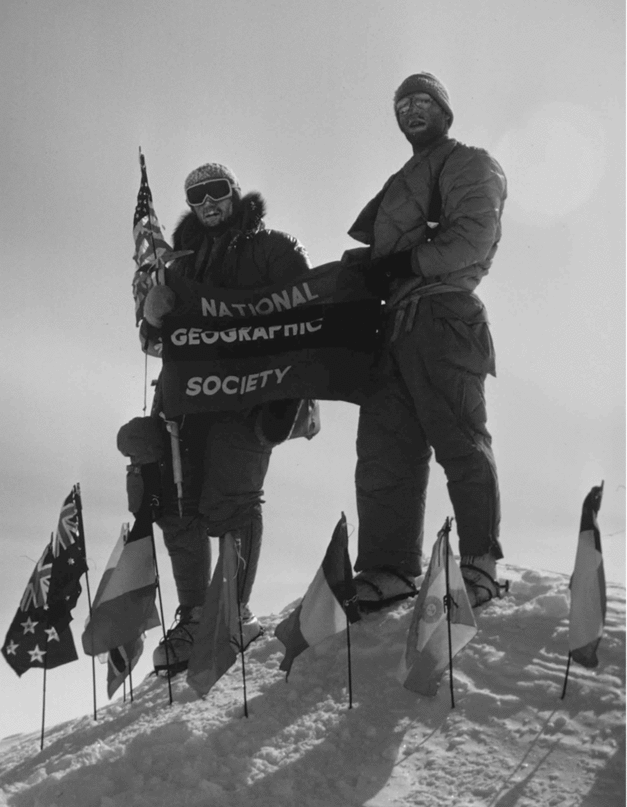
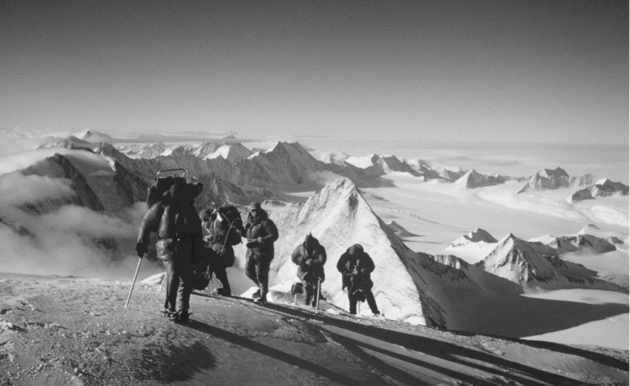
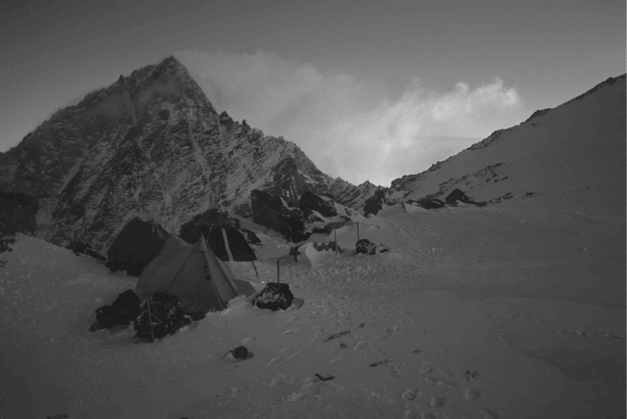
Details of the AAME expedition have been well documented in the National Geographic of June 1967 (Clinch Reference Clinch1967) and elsewhere, and do not warrant repeating here. It should be noted, however, that the AAME was a remarkable success; the Vinson summit was reached by four team members on 18 December, followed by all the other team members in the next few days. Bill Long photographed the US flag, the NGS flag and the flags of the (then) twelve Treaty nations on the summit (Fig. 1). The first ascents of another five peaks had been made by the time the team was picked up by a navy C-130 on 17 January to return to McMurdo. The climbs achieved by the expedition have all been repeated, with the exception of the route to the summit of Mt. Tyree from the Gardner-Tyree col by Barry Corbett and John Evans (Fig. 2 and 3). USARP leaders organized a welcoming reception in Christchurch, attended by many New Zealand climbers, other New Zealand adventurers, US naval support force leaders, New Zealand Christchurch and national officials and the deputy chief of mission of the US Embassy in Wellington. In Washington on 3 March 1967 NGS awarded its John Oliver La Gorce Medal to the AAME team members in a ceremony attended by 2,550 members and friends of the NGS, with the medal presented by Chief Justice Earl Warren of the US Supreme Court and chair of the NGS board of directors.
Peter Schoening and John Evans, two of the four members of the AAME who first reached the summit of Mt. Vinson, 18 December 1966. Photo by W.E. Long.

The AAME team heads towards Mt. Gardner and other summits after climbing Mt. Vinson. Photo by W.E. Long.
Mt. Tyree, second tallest mountain in Antarctica seen above Gardner Camp Two. Photo by W.E. Long.
Conclusion
The American Alpine Journal reported 183 successful Mt. Vinson summit climbs during the 2010–2011 austral summer (Gildea Reference Gildea2011). This number of climbers seems to be a new ‘norm’ up somewhat from the annual average of the preceding decade. The first decade after the AAME saw few climbs, as the NSF, resting on precedent, pointed out that the major summits had all been reached and therefore further mountaineering was not worthy of support. In the mid-1980s access to the Sentinel Mountains changed greatly when Adventure Network, Inc. (ANI), a private company, initiated commercial flights from Punta Arenas, Chile to the Sentinel Range, with guided climbs of Vinson. Thanks to ANI's vision, climbers from their early teens to early 70's have reached the summit of Mt. Vinson and a number of climbers have added Mt. Vinson to their personal lists of climbs of the highest peaks on all seven continents. Antarctic mountaineering has spread from the Sentinels into many other of the mountainous areas on the continent. The ANI enterprise and its successors are politically and environmentally compliant with the Antarctic Treaty; all housing and supplies are brought in at the commencement of the austral summer season and all of housing, supplies and wastes are removed before the onset of winter. Other climbing teams that provide their own logistics or are supported by a company also are Treaty compliant.
None of this was foreseen when the APG reversed US policy. The evolution of US policy in the 1960s was slow and typical of governmental decision making in democracies. Initially cautious, DOD and NSF cited lack of statutory authority to aid private expeditions, with the associated rescue concerns and potential logistics requirements. Climbing proposals with modest science programmes appended were rejected in peer review. Political support was not rebutted; it was pushed to the future. Political pressure became more persistent as did climbing plans. The reality that Mt. Vinson might first be climbed by a non-American team grew. These forces converged in late 1966, leading to a policy reversal by the APG. Six weeks later the AAME reached the summit of Mt. Vinson.
Notes
The passage of time has eroded the archival record of the AAME. At the start of our effort to reconstruct this account we gathered the surviving members of the AAME for a two-day discussion in Evergreen, CO in 2007. Only a few had diaries or logs that contributed documentary information; moreover many members of the AAME were only peripherally involved in the higher level multi-year discussions between the climbing teams’ leaders and the government. Others, such as W. Sayre and M. Conrad, who could have contributed are also deceased. Other searches for archival documentation, for example in The Explorers Club archives, produced dead ends. Extant archival sources are the Henry Francis papers at the Rauner Special Collections Library, Dartmouth College and the files of the National Science Foundation Office of Polar Programs at the US Archives and Records Administration and we have acknowledged these sources below.
Acknowledgements
The authors thank the staff of the Rauner Special Collections Library, Dartmouth College for assistance in locating correspondence and memoranda of Henry S. Francis, Jr. who in the 1960s was on the Polar staff of the NSF handling Antarctic Treaty and other international affairs; his personal papers are at the library. Mrs. Sharon Francis located certain other letters of her late husband. Staff at the US National Archives and Records Administration provided access to a large number of NSF files that are deposited in its Silver Spring, Maryland facility. The Piper Aviation Company helped verify Max Conrad's flight activities as he served over many years as a transport pilot for the delivery of new aircraft built by the company. Dorothea Sartain, Curator of Archives, Collections, and Books, at the Explorers Club, searched Club publications and archives for information relating to Sayre's aborted flight via Argentina. Paul Dix and Peter Bruchhausen, both members of the team, shared their memories of the Sayre Mt. Vinson campaign.