Journalism: A stressful occupation
Journalists are acknowledged as having a highly stressful occupation (e.g., Backholm & Björkqvist, Reference Backholm and Björkqvist2012; Weidmann & Papsdorf, Reference Weidmann and Papsdorf2010) and, according to the Center for Disease Control and Prevention (2006) and CareerCast (2016), journalism is one of the top ten most stressful occupations.
Since the 9/11 terrorist attacks in New York in 2001, journalists have become the target of greater attention on the part of scientific research on occupational stress (Sibbald, Reference Sibbald2002; Strupp & Cosper, Reference Strupp and Cosper2001). Most of the research has focused on the daily stress of these professionals, however some data has emerged on the occupational stress variables of journalists deployed to critical events such as war scenarios (e.g., Feinstein, Owen, & Blair, Reference Feinstein, Owen and Blair2002; Pyevich, Newman, & Daleiden, Reference Pyevich, Newman and Daleiden2003) and on the aftermath of a natural catastrophe (e.g., Weidmann, Fehm, & Fydrich, Reference Weidmann, Fehm and Fydrich2008; for a review of studies from 2001 to 2015 on journalists’ occupational stress see the meta-analyses of Monteiro, Marques Pinto, & Roberto, Reference Monteiro, Marques Pinto and Roberto2016).
The distinct nature of each of these professional settings needs to be made clear from the outset of this article. Domestic news, or daily work, focuses on news reported by journalists on a day to day basis, in their geographical area of activity, and may sometimes involve short assignments in other areas of the country. Domestic news includes various topics such as politics, sports, economy, health and may also focus, from time to time, on events that are more stressful and demanding for journalists (e.g., rivalries between sports teams and fans, car accidents, child abuse, crime, murder and violence...). All journalists have experience in this type of setting. Critical scenarios or events refer to major disasters, involving a significant number of human and material losses, worldwide disclosure, and the deployments of journalists as special envoys to destinations typically outside their home countries. In this setting, journalists are exposed to traumatic events such as wars, terrorist attacks and natural catastrophes, however only a minority of them have this type of regular experience throughout their career.
As scientific research has only turned its attention to this professional group over the last decade, limitations are bound to exist. For instance, little is known about the similarities and differences between the occupational stress variables of journalists, namely occupational stressors, emotional responses to stress and the impacts on journalists’ health and well-being, in their daily work and in the context of reporting critical events (major disasters). Furthermore, most prior studies have analyzed some of these variables individually and have done so without a theoretical framework as a backdrop to their research (Monteiro et al., Reference Monteiro, Marques Pinto and Roberto2016).
Since terrorist attacks have increased considerably over the last few years (e.g., France in 2015 and Belgium in 2016), these traumatic events are becoming more and more instilled in the daily work of journalists, therefore the danger and imminent risks of this profession may now even spill over into journalists’ daily work context, as was observed in the case of Charlie Hebdo’s journalists.
In fact, the journalistic profession has been compared to other high-risk occupations such as police officers, firefighters, emergency health personnel – i.e., first responders. Some authors (e.g., Buchanan & Keats, Reference Buchanan and Keats2011; Weidmann et al., Reference Weidmann, Fehm and Fydrich2008) even designate journalists as first responders since, in many cases, they are the first to arrive at the disaster scene, are exposed to the same critical situations, and may later present the same type of after-effects (e.g., post-traumatic stress disorder (PTSD), depression and burnout) as other responders (e.g., Anshel, Robertson, & Caputi, Reference Anshel, Robertson and Caputi1997). Nevertheless, while the effects of exposure to trauma on traditional first responders have been studied elaborately, research on the exposure of journalists to traumatic events is still scarce (Weidmann et al., Reference Weidmann, Fehm and Fydrich2008), and when it is analyzed, the focus tends only to be geared towards the impact on the health and well-being of the journalists without considering the possible impact on other occupational stress variables (e.g., perceived stressors, emotional reactions to stress…). Additionally, according to Monteiro et al. (Reference Monteiro, Marques Pinto and Roberto2016), there are no studies that focus on the positive emotional responses to stress or that try to identify the positive impacts on the life and health of these professionals.
In line with Buchanan and Keats (Reference Buchanan and Keats2011), we are also of the opinion that it “is time to address the needs of this understudied and underserviced population of ‘first responders’.’’ (p. 134). Taking the Holistic Model of Occupational Stress of Nelson and Simmons (Reference Nelson, Simmons, Quick and Tetrick2003) as a framework, this study aims to understand journalists’ occupational stress perceptions with a view to providing some cues on prevention measures tailored to the needs of this professional group.
Occupational stress: A comprehensive model
The holistic model by Nelson and Simmons (Reference Nelson, Simmons, Quick and Tetrick2003) conceptualizes the occupational stress process in a comprehensive manner, while also taking into consideration the several variables that interfere in this process, from professional demands to the resulting positive or negative outcome variables. Taking Positive Psychology contributions into account, a particular characteristic of this model is its incorporation of eustress, namely the positive emotions that emerge as a favourable response to stress, in addition to the traditional negative emotional responses, referred to as distress. It also considers the individual differences that may be particularly prominent in cognitive evaluation, in emotional reactions, in coping strategies with distress and in savoring strategies. The latter is an innovative concept the authors of the model define as positive emotion regulation strategies, thus parallel to coping strategies but for eustress responses (Nelson & Simmons, Reference Nelson, Simmons, Quick and Tetrick2003). It should be noted that this article will focus exclusively on four core variables of the model: perceived stressors, emotional responses to stress, impacts and individual differences, as presented below.
Occupational stressors
Nelson and Simmons (Reference Nelson, Simmons, Quick and Tetrick2003) define demands or occupational stressors as role demands (e.g., role conflict), interpersonal demands (e.g., leadership), physical demands (e.g., illumination), workplace policies (e.g., promotion), and job conditions (e.g., earnings). Within the scope of occupational stress, professional demands for high risk or stressful professions, such as police officers and firefighters, are frequently divided into two general types of stressors: organizational or management stressors, and task-related or operational stressors (e.g., Brough, Reference Brough2005; McCreary & Thompson, Reference McCreary and Thompson2006). The former refer to specific characteristics of the organization and its internal functioning (e.g., routine, excessive working hours, work-family conflict, conflicts with peers and superiors), and are identified as the most dominant stressors in the occupational stress process (e.g., Brough, Reference Brough2005; Hart, Wearing, & Headey, Reference Hart, Wearing and Headey1995). The latter refer to the constraints associated with task accomplishment such as danger, risk, providing aid to individuals in pain and dealing with weapons.
For journalists facing critical or hazardous events, professional demands are extremely high, given that they are first-hand witnesses to death, destruction and human strife (Feinstein et al., Reference Feinstein, Owen and Blair2002; Pyevich et al., Reference Pyevich, Newman and Daleiden2003). Both professional demands and personal and professional behaviors may put them in physical and emotional danger, frequently exposing them to high risk situations (Feinstein et al., Reference Feinstein, Owen and Blair2002; Novak & Davidson, Reference Novak and Davidson2013; Osofsky, Holloway, & Pickett, Reference Osofsky, Holloway and Pickett2005). Additionally, according to Weidmann et al. (Reference Weidmann, Fehm and Fydrich2008), these professionals perceive little recognition from their superiors and/or peers, however to the best of our knowledge, this is the only study to refer to an organizational stressor in this professional context, since all the others appear to focus on stressors associated with task performance.
With regard to the daily work context, Strupp and Cosper (Reference Strupp and Cosper2001) state that the problem of journalists’ occupational stress is not encountered in high adrenaline moments when covering a large-scale story, but rather in the daily routine of writing or reporting a day-to-day event. The main stress sources of journalists’ daily work, identified in empirical studies, point to variables such as excessive working hours, deadlines, the work-family conflict, competition, low earnings, divergences with superiors, and lack of support from the organization (e.g., Heloani, Reference Heloani2005; Reinardy, Reference Reinardy2006; Weidmann & Papsdorf, Reference Weidmann and Papsdorf2010). Hence, there is seemingly a predominance of organizational stressors in the daily work context of journalists.
Emotional responses
In their holistic model, Nelson and Simmons (Reference Nelson, Simmons, Quick and Tetrick2003) integrate both negative and positive emotional responses to stressors, namely distress and eustress, which may even co-occur during the same stressful episode. According to the authors, “Positive and negative responses are separate, distinct, multivariate and potentially interactive in nature. To assume the presence of the positive by simply observing the absence of the negative, or vice versa, is an unacceptably simplistic approach to understanding the sources, responses, and consequences of stress” (p. 105). Therefore, a strategy to assess eustress and distress concurrently in order to fully understand the stress response is required. Nelson and Simmons (Reference Nelson, Simmons, Quick and Tetrick2003) indicate anxiety, frustration, anger/hostility as examples of distress responses and suggest some positive psychological states, such as attitudes or emotions (hope, meaningfulness, manageability, and positive affect) as indicators of eustress. Workers’ emotional responses to professional demands determine their own professional performance, thus contributing to both positive and negative consequences, depending on the type of emotional response triggered. For instance, according to Nelson and Simmons (Reference Nelson, Simmons, Quick and Tetrick2003), eustressed workers are more enthusiastically involved in the demands of their work and perceive positive benefits, even when confronted with extremely demanding stressors.
Although there are studies with other professional groups (e.g., nurses – Simmons & Nelson, Reference Simmons and Nelson2001) regarding distress and eustress responses, in the recent meta-analyses conducted by Monteiro et al. (Reference Monteiro, Marques Pinto and Roberto2016), the authors conclude that neither are there studies that empirically analyze the emotional responses of journalists on a daily basis nor in critical scenarios.
Outcomes
In their holistic stress model, Nelson and Simmons (Reference Nelson, Simmons, Quick and Tetrick2003) also regard the outcome variables or impacts, such as physical and mental health, work performance and personal and family relations, as areas which may be significantly affected by occupational stress. An important distinction between this and the previous construct is the fact that the emotional response corresponds to a physiological/cognitive/behavioral activation which kicks in immediately after confrontation with the stress source (e.g., frustration, hope), (e.g., PTSD, Post Traumatic Growth Footnote 1 ) arising not only from confrontation with the stressor, but also from the associated emotional responses and their regulation. The consequences may be perceived as negative if they jeopardize the health and well-being of the individual, both in and out of the work context, or as positive, if, conversely, they boost the health and general well-being of the professional (Nelson & Simmons, Reference Nelson, Simmons, Quick and Tetrick2003).
Research on the impact of occupational stress experiences on the health and well-being of journalists working in critical scenarios is geared, primarily, towards mental health problems, particularly PTSD (Morales, Pérez, & Martinez, Reference Morales, Pérez and Martinez2012; Pyevich et al., Reference Pyevich, Newman and Daleiden2003; Weidmann & Papsdorf, Reference Weidmann and Papsdorf2010). However, there are also studies that indicate other consequences such as marital tension and high levels of worrying thoughts, difficult adaptation when returning home (Heloani, Reference Heloani2005; Osofsky et al., Reference Osofsky, Holloway and Pickett2005), and persistent substance consumption (Feinstein et al., Reference Feinstein, Owen and Blair2002).
PTSD is, again, the most studied impact in journalists reporting domestic news, and there is a significant deficit in scientific research on other possible impacts on the health and well-being of these professionals. For instance, there are very few studies that analyse burnout in journalists’ daily work (e.g., Reinardy, Reference Reinardy2006), an occupational stress variable commonly studied in other stressful jobs. Burnout is a worn out syndrome, resulting from prolonged exposure to chronic stressors (Maslach & Schaufeli, Reference Maslach, Schaufeli, Schaufeli, Maslach and Marek1993) that encompasses symptoms of emotional exhaustion, cynicism, and lack of professional efficacy (Schaufeli, Leiter, Maslach, & Jackson, Reference Schaufeli, Leiter, Maslach, Jackson, Maslach, Jackson and Leiter1996). In fact, journalists are confronted with negative psychological experiences over the course of their careers, in the form of routine or organizational stressors (Dick, Reference Dick2000), thus it is expectable that some may come to present burnout throughout their career.
The distinction between acute and chronic stress is particularly relevant here, since both forms are conceptually and experientially distinct (Anshel, Robertson, & Caputi, Reference Anshel, Robertson and Caputi1997). Acute stressors (mainly operational stressors) stem from sudden events that may be of relatively short duration and result in greater levels of psychological and physiological strain or distress than chronic stressors (Brown, Fielding, & Grover, Reference Brown, Fielding and Grover1999; Dick, Reference Dick2000). Thus, professionals subjected to acute stressors are susceptible to developing PTSD, hence requiring clinical intervention (Brown et al., Reference Brown, Fielding and Grover1999), which, in the long run, is far more prejudicial to the organizations in terms of costs and worker productivity. Therefore, one may expect journalists working in critical scenarios to present PTSD more than journalists working on domestic news, who, on the other hand, may develop burnout symptoms.
Individual differences
The occupational stress model by Nelson and Simmons (Reference Nelson, Simmons, Quick and Tetrick2003) also considers the individual differences (e.g., hardiness, locus of control) that may be prominent in cognitive evaluation and emotional reactions. In the case of journalists, we regard exposure to traumatic events as a central variable of individual differences, since their exposure to critical and potentially traumatic situations (i.e., acute stress) is irregular and unpredictable (e.g., they rarely know when a natural disaster or a terrorist attack will occur).
Some authors have investigated the impact of journalists’ exposure to potentially traumatic events (Pyevich et al., Reference Pyevich, Newman and Daleiden2003; Weidmann et al., Reference Weidmann, Fehm and Fydrich2008) on their health and well-being, revealing that it is a high risk factor for the development of symptomatology, mainly PTSD.
The current study
Taking the Holistic Stress Model of Nelson and Simmons (Reference Nelson, Simmons, Quick and Tetrick2003) as the theoretical framework, the purpose of this study is twofold:
-
a) It attempts to shed light upon the similarities and differences in stress variables perceived by journalists - occupational stressors, emotional reactions and impacts of these experiences on journalists’ health and well-being - regarding their daily work and their missions as special envoys to critical scenarios. In line with Feinstein (Reference Feinstein2004), in so far as the occupational stress process should not be restricted to pathologizing these professionals, this study also sets out to identify the perceived positive emotional reactions and positive impacts on the health and well-being of journalists.
-
b) It endeavors to ascertain whether the number of deployments to a critical event has an impact on both the perceived health and well-being of journalists, as shown by previous research, and the stressors and emotional reactions perceived by journalists, in their respective daily work and in critical events.
Since journalists’ occupational stress is still an under studied area in scientific research, given the exploratory nature of the study, and the access of the researchers to professionals with meaningful experience in a position to provide useful information, a qualitative study was deemed an appropriate approach.
Method
Participants and recruitment
The sample consisted of 25 Portuguese journalists (20 male and five female; M = 44 years, SD = 6.36) all Caucasian and from Western cultures. The participants worked for the written press (n = 5), radio (n = 7) and television (n = 13 - seven editors and six camera operators). All journalists had an extensive career (M = 21 years of professional experience; SD = 6.49), and experience in critical scenarios: 32% had been deployed to between 6 and 9 war scenes and/or natural catastrophes, 52% on between 10 and 19 occasions and 16% on over 20. Five of the interviewees occupied the positions of editor in chief or coordinator, in addition to being editors or camera operators.
In order to qualify as a participant in this study, journalists were required to be Portuguese-speaking members of the Portuguese media, employed by either the public or private press, radio stations or television channels, and to have had on-scene reporting experiences in hazardous/critical events overseas. None of the participants received any kind of compensation.
Efforts were taken to ensure that the sample was as broad as possible in order to accommodate the study aims. Interviews were set up through a media entity contact and conducted with the most nationally renowned journalist, in terms of experience in critical scenarios. This journalist had over 40 years of professional experience, having worked in the afore-mentioned types of media organisation settings, and is currently involved in the training of journalists. The contacts of professionals in various media outlets were provided by this journalist, consequently leading to additional contacts thereafter. Thus, a snowball procedure was adopted to approach the interviewees, by means of which some journalists referred to others with experience in critical events. Theoretical saturation, namely when additional data to the in-depth study of the issues ceases to emerge (Glaser & Strauss, 1967, quoted by Flick, Reference Flick2005), acted as the cut-off point for the inclusion of cases in the sample.
Measures
A protocol was designed for a semi-structured interview, since this has proven to be more effective in facilitating participants’ openness and expression of viewpoints than a structured interview or questionnaire (Flick, Reference Flick2005). The protocol contained three general questions (the interviewee’s professional experience – including number of deployments and type of critical events reported; his/her opinion on journalists being considered first responders; and, at the end of the interview, additional information or elaboration of previous topics considered relevant by the interviewee), plus six questions regarding each professional setting, totaling 15 questions. The six specific questions were constructed on the basis of occupational stress literature, particularly Nelson and Simmons’ (Reference Nelson, Simmons, Quick and Tetrick2003) holistic model, and focused on three main themes: sources of stress, emotional responses to such stressors (distress and eustress) and the positive or negative impacts on journalists’ health and well-being. For exemplification purposes, the questions regarding stressors were as follows:
-
a. What are the occupational demands (i.e., stress sources) that cause you stress in your daily work? (Probes: ask for other stress sources / stressors that cause greater stress; if the interviewee states negative stressors, ask for positive ones or vice-versa);
-
b. Recalling your experience in critical events, what are the typical stress sources that caused you stress as a special envoy? (Probes: as above, plus, in the case of war scenes, asking about being embedded with soldiers).
Data collection and analyses
The study was examined by the Faculty of Psychology, University of Lisbon Commission, which performed the scientific and ethical evaluation of all research projects at the time, as well as the Foundation for Science and Technology (Portugal).
The first researcher, a clinical psychologist with training in qualitative methodology, conducted all the interviews. Before beginning the interview, the interviewer reiterated the information previously given (when setting the interview date and location), explaining the researchers’ interest in identifying his/her perceptions of the main themes of the interview (occupational stressors, emotional reactions and impacts) and comparing them to both professional settings of journalists (daily work and critical scenarios). Confidentiality was also assured prior to initiation of the interaction. Each question was asked by the interviewer, who repeated or reformulated the question, whenever necessary, to make the meaning clearer (e.g., “It seems that you are saying...”), and probed the interviewee to gain further in-depth information relevant to his/her experience (e.g., “Can you tell me more about that?”). On average, the interviews lasted around 90 minutes, varying from one hour to a little over two hours. They were conducted over a period of 15 months, and most were held on the respective media premises of the participants.
Analysis of the transcribed interview content was conducted independently by both authors who acted as coders, by means of a deductive-inductive process, involving themes encountered in the literature review on occupational stress (e.g., two main categories were addressed for stressors: organizational stressors and task-related stressors), and also emerging domains (i.e., topics such as “individual impact” in the impacts category) from the analyses of the response units meanings provided by the participants. Taking the interview questions into account, the interview data was approached from a fresh perspective, in order to determine whether new domains would emerge, and a domain list was established by consensus between both coders.
The intracoder and intercoder agreement was verified to ensure reliability of the content analysis. To this end, 25% of the registration units were categorized independently a second time by both the first and second author, according to the defined category system. In order to calculate reliability, in both cases the number of agreements was divided among coders by the total categorizations for each one, and an agreement rate of 80% was obtained. Divergences were discussed and resolved through joint reflection and alterations were introduced in the category system. The entire interview corpus was then coded independently by the two raters until an agreement of 100% was attained.
The QSR-NVivo 10 (QSR, 2013) software program was used to search for, store and organize the qualitative data of the interviews, and also to count the frequency of answers (measure unit) in order to transform them from qualitative to quantitative variables.
Since one of the aims of the present study was to explore whether repeated exposure to critical events had impacted the three main variables under study, three groups of journalists were considered, based on the number of deployments to critical events in which they had been involved, which was one of the first questions asked at the beginning of the interview. More precisely, group 1 = journalists who had been deployed up to nine times (n = 8); group 2 = journalists who had been deployed 10 to 19 times (n = 13); group 3 = journalists who had been deployed at least 20 times to critical events (n = 4). The intervals used to form the groups were defined in accordance with the minimum (6) and maximum (24) number of the participants’ deployments to critical events and were not based on any techniques of statistical power analysis or sample size estimation. Given the size of the subsamples, the SPSS-21 statistical program was used to analyze the differences between the main categories of each variable (stressors, emotional responses and impacts) retrieved by the qualitative analysis, that is, formed by the sum of answers given in the different subcategories. These variables were assumed as continuous, ranging from 0 (never mentioned by the journalist) to 5 (the journalist referred to this category five times). In order to check whether the distribution of the variables’ main categories differed across groups of journalists, a Kruskal-Wallis test was applied. This non-parametric test was chosen as an alternative that is suited to samples with fewer than 30 participants when the data does not respect normality assumptions. Pairwise comparisons using the Dunn-Test with Bonferroni-adjusted p-values were then computed to verify where the differences occurred among the groups.
Results
The content analysis of the interviewees’ answers yielded 77 inter-related categories, structured in a hierarchical system. In journalists’ daily professional context, 31 categories (40%) were identified, while in critical events to which journalists were deployed as special envoys, 46 categories (60%) were constructed.
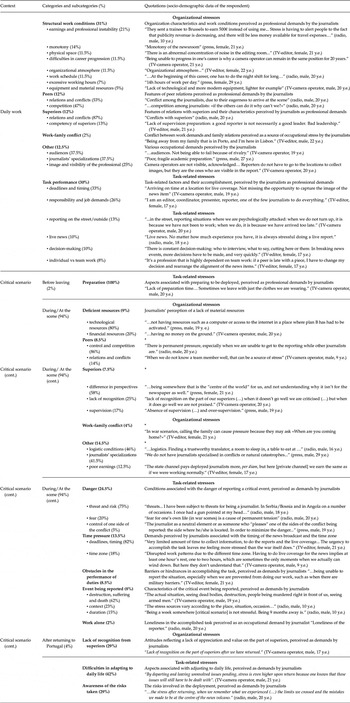
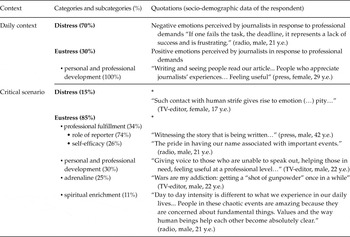
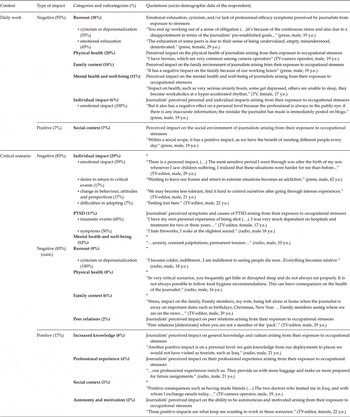
Tables 1 to 3 present all the response categories regarding each respective stress variable, stressors, emotional responses and impacts, according to the occupational context. The operational definition of each category is presented in the tables whenever they emerge for the first time. Each table presents the coding topics ordered hierarchically, the frequency of quotations, and a quote (chosen as being emblematic of the code) as an example, with the respective socio-demographic data of the respondent, including years of experience (y.e.), in order to help understand the phenomenon under study and to provide an insight into how it was experienced by the participants.
Context-related Categories of Occupational Stress Sources

Note: *category previously operationalized.
Categories of Emotional Responses to Stress According to the Context

Note: *category previously operationalized.
Categories of Impacts of Occupational Stress According to the Context

Note: *category previously operationalized.
Occupational stressors
Regarding sources of stress, more stressors for critical scenarios were mentioned (58%) than for journalists’ daily context (42%). In journalists’ daily work there is a predominance of perceived organizational stressors (70%), since only one category (task performance) may be considered as task-related stressors. In critical events, the stress sources or professional demands indicated by the interviewees differed across three points in time: before leaving for a critical event as a special envoy, during the period of time they were at the scene to accomplish the task, and after returning to Portugal. Expressiveness at the first and third of the above-mentioned time references proved to be residual (totaling 6%). The only demand found in the first phase, before leaving for the critical event, falls under the task-related stressors category, as it refers to the journalist’s preparation to leave and arrive at the epicenter of the event in order to broadcast the incident. After returning to their homes and jobs, three demands were mentioned, namely difficulties in adapting to daily life, awareness of the risks they had taken (relative to task-related stressors and totaling 71%) and a lack of recognition on the part of their superiors (characterized as an organizational stressor). The most frequent sources of stress for the interviewees in critical events were restricted to the period in which they were special envoys in such situations, where there a slight predominance of task-related stressors (56.5%) over organizational stressors (43.5%) may be observed.
The data obtained suggests that journalists experience more stress from organizational stressors in their daily work, and face more task-related stressors when deployed as special envoys to major critical incidents.
Emotional responses
In relation to emotional responses, both negative and positive emotional states were far more frequently mentioned for critical events (90%) than for the daily work context (10%). Overall, the positive emotional responses, or eustress, to stress sources were more frequent (80%) than the negative emotions, or distress (20%). Interviewee responses regarding eustress reactions in critical events covered four main categories, with which positive emotions are associated. Only one of those categories (personal and professional development) was also identified in the daily context. No categories emerged for distress.
In sum, distress was mentioned more than twice as often as eustress for the daily context. In contrast, in critical scenarios, eustress yielded over five times as many references as distress.
Impacts
References to occupational stress impacts were higher among the responses for critical event settings (65%) than for the daily work context (35%), and were mainly negative (83% in critical events and 93% in daily contexts).
The same kind of negative impacts were mentioned by participants in both professional settings, resulting solely in two additional categories for critical events: relations with peers and PTSD. Although some burnout symptoms were mentioned in both professional settings, in the daily work of journalists, burnout was referred to almost five times more frequently than in critical events.
As for the positive consequences, social context was the only category to emerge in both professional settings. In critical scenarios, there were references to other types of positive impacts, such as increased knowledge, professional experience, autonomy and motivation. Hence, it may be argued that the journalists who participated in this study identified positive impacts on their well-being as a result of their professional activity.
Quantitative data
Significant differences were found for perceived stress sources in critical events Before leaving - Preparation between groups, H(2, 23) = 7.543, p = .023. More specifically, Dunn-Bonferroni pairwise comparisons with adjusted p-values revealed mean score distinctions for critical events Before leaving - Preparation between group 2 (M = .080, SD = .289) and group 3 (M = .400, SD = .548), z = –4.600, p = .030. There were no significant differences in the mean scores between group 1 and group 2 (z = 0, p > .999) and between the former and group 3 (z = –4.600, p = .053).
Further significant differences were also observed for stress sources in critical events for the After returning to Portugal - Difficulties in adapting to daily life phase, H(2, 24) = 7.945, p = .019, this time between group 1 (M = 0, SD = 0) and group 3 (M = .400, SD = .548), z = –4.800, p = .039 and between the latter and group 2 (M = .080, SD = .289), z = –4.800, p = .026. No significant differences were found in the mean scores between group 1 and group 3 (z = 0, p > .999).
Significant differences in the distress referred to for critical events were also found (H(2, 22) = 7.639, p = .022) between group 2 (M = .330, SD = .651) and group 1 (M = 1, SD = 1.069), z = 7.125, p = .018. There were no significant differences in the mean scores between group 1 and group 3 (z = 3.125, p = .910) and between the latter and group 2 (z = –4.000, p = .534).
With regard to the perceived impacts on the health and well-being of the journalists, significant differences were only found in the two burnout dimensions identified in the daily context, namely in cynicism (H(2, 25) = 7.170, p = .028) where the mean value of group 3 was significantly higher (M = 0.8, SD = .837) than the mean value of group 1 (M = 0, SD = 0) (z = –7.700, p = .025), and in emotional exhaustion, (H(2, 23) = 6.188, p = .045), differences were found between group 2 (M = 0.17, SD = .389) and group 1 (M = 0.38, SD = .518), z = 4.312, p = .022. No significant differences were found in the mean scores between group 2 and group 1, z = –2, p > .999 or between the former and group 3, z = –5.700, p = .110. Neither were any significant differences observed in the mean scores between group 3 and group 1, z = 4.312, p = .168 nor between the former and group 2, z = 0, p > .999. Therefore, journalists with a higher number of deployments were found to have a higher tendency to refer more frequently to burnout symptoms. Furthermore, and in response to the second research question, repeated exposure to trauma undoubtedly affects stressors, emotional responses and impacts.
Discussion
This study adopted Nelson and Simmons’ (Reference Nelson, Simmons, Quick and Tetrick2003) holistic approach to stress with a view to broadening knowledge on the occupational stress variables - occupational stressors, emotional responses and impacts on health and well-being - perceived by Portuguese journalists in both critical events and in the daily context of their work.
Despite having questioned the journalists on each variable under analysis in both contexts, the answers obtained for stressors, reactions to stress and impacts were found to lean more towards critical events. This may be an indication that experience in these settings (a criterion for participation in the study) is more salient for the interviewees who mention them, thus, emerging more frequently in their reflections on the addressed themes.
Our findings reveal that in daily work, the main stress sources referred to are of an organizational nature, while in critical settings the main perceived professional demands appear to be task-related. This data is in line with studies on other at-risk professionals such as first responders, where the task-related stressors are more associated with acute stress situations, while the organizational stressors are more related to chronic stress situations (Anshel et al., Reference Anshel, Robertson and Caputi1997; Brown et al., Reference Brown, Fielding and Grover1999; Dick, Reference Dick2000). From another perspective, it may be considered that given the nature of organizational stressors, they are more influenced and controlled by the media organization, while some of the identified operational stressors seem to depend on the psychological and structural functioning characteristics of the individual. This information may be relevant for the recruitment and selection of journalists.
This study also furthers the knowledge on the unique occupational stressors perceived by journalists exposed to tragedy, war, and human strife by acknowledging that in critical and hazardous events, stressors are recognized at three different stages: before the journalists depart for the event, while they are reporting the event, and after returning to their home country, the second of which is the most mentioned phase. Significant differences according to the number of deployments to critical events only emerged in two of the stressors identified in this context, namely Preparation, during the pre-departure phase and Difficulties in adapting to daily life upon journalists’ return. Indeed, repeated exposure to critical events tends to heighten these stress sources, both task-related stressors, intensifying the stress associated with preparation in the pre-departure phase and hindering adaptation and pending professional and personal issues upon return. Overall, these results suggest that the stress process of journalists is phased, and depending on the given point in time, these professionals would benefit from specific support on the part of the organization.
The fact that reference to positive emotional responses to stress sources is four times higher than to negative emotions, or distress, is also of particular relevance. When comparing the two contexts, perceived eustress reactions are more frequent and diverse in critical or hazardous events, suggesting that there is a narrow spectrum of different opportunities for positive emotions in journalists’ daily work. In line with data obtained by Feinstein (see Feinstein, Reference Feinstein2004) and Novak and Davidson (Reference Novak and Davidson2013), eustress responses may be an expression of satisfaction of the prevalent motivations among these individuals. As considered by Nelson and Simmons (Reference Nelson, Simmons, Quick and Tetrick2003), engagement is one of the primary indicators of eustress, so professionals whose jobs provide eustress reactions on a frequent basis are likely to be more engaged, motivated to keep on doing their work, more satisfied with their job and better suited to deal with (avoid) burnout symptoms and other negative impacts of their occupation. Another possible explanation for the predominance of references to eustress responses may, as stated by Feinstein (Reference Feinstein2004), be linked to a better biological preparation of these individuals for risky and dangerous professions - in that they choose the drama and excitement of the battle field over a routine 9am to 5pm schedule. Since journalists perceive eustress in critical scenarios, and given that it is in such a context that they truly feel like journalists and attribute meaning to their work, one might expect them to receive positive benefits from these professional experiences, even in view of all the risks and dangers with which they are confronted, and that these benefits (i.e., eustress) fuel their urge to return to such scenarios. Finally, a possible explanation for the high number of references to positive emotional reactions in comparison to negative responses may, perhaps, stem from journalists dealing more effectively with daily stress through their experience as special envoys in critical events (Wallace, Reference Wallace2013). After deployment to critical scenarios, journalists may more frequently relativize stressful situations, evaluate stressors differently and manage the typical occupational stressors of a daily context more effectively. This consideration is reinforced by the fact that the distress responses mentioned in critical scenarios are significantly reduced by the number of deployments to critical events, as shown by the quantitative data analysis. Thus, apparently, the more experience journalists have with critical events, the more they become accustomed to that context and the more they experience positively associated emotions (perhaps journalists internalize these learning experiences in such a way that they become better prepared for future situations of the same nature).
As for the impact of professional stress on both the contexts under study, the negative consequences are more frequently referred to than the positive. In the case of critical events, individual impact, the symptoms and traumatic experiences of PTSD and mental and emotional health obtain more than half of the answers, hence, partly corroborating previous data (e.g., Hatanaka et al., Reference Hatanaka, Matsui, Ando, Inoue, Fukuoka, Koshiro and Itamura2010; Morales et al., Reference Morales, Pérez and Martinez2012; Weidmann et al., Reference Weidmann, Fehm and Fydrich2008) as far as the last two categories are concerned. Within the daily context, the most mentioned negative after-effects by the journalists interviewed were burnout, family context, mental and emotional health and physical health, in keeping with the findings of previous studies (e.g., Heloani, Reference Heloani2005; Reinardy, Reference Reinardy2006). It should be noted that journalists mentioned burnout symptoms far more frequently when discussing their work on domestic news and PTSD symptoms when referring to working as special envoys.
Several positive consequences for journalists’ health and well-being are mentioned, stemming from their experience in critical events and the social environment in both settings, nevertheless none obtained very expressive values. Therefore, despite the higher frequency of references to eustress responses, particularly for critical events, journalists tend to perceive the impact of such experiences as being essentially harmful to their health and well-being, indicating a cleft between emotional responses and impacts. Media organizations should invest in promoting more positive impacts so as to duly ensure the well-being of their professionals.
In terms of the impact of repeated exposure to critical events on journalists’ perceptions of health and well-being, significant differences were only observed in this study in the cynicism and emotional exhaustion dimensions of burnout in daily work. Hence, several deployments to critical events apparently foster a devaluation of daily “routine” work and reduce empathy in relation to other agents in the accomplishment of tasks (increased cynicism), leading journalists to relativize their daily work situations, and simultaneously protecting them from the associated emotional exhaustion (reduced emotional exhaustion). According to some authors (e.g., Maslach & Schaufeli, Reference Maslach, Schaufeli, Schaufeli, Maslach and Marek1993), the burnout syndrome includes several dimensions of symptoms which begin, primarily, with emotional exhaustion, and only with longer exposure to the stressors does the cynicism dimension develop. This data may well reflect the development of these burnout symptoms.
The current study offers a valuable contribution to broadening knowledge on the occupational stress variables perceived by journalists in both critical events and in the daily context of their work. Moreover, it goes beyond the typical focus on negative variables and contributes to the knowledge of the perceived positive emotional responses and positive impacts of occupational stress, variables that are understudied in the literature. Additionally, this study analyzed whether there were differences among those variables according to journalists’ exposure to critical events, and did so by not focusing solely on their impact on the health and well-being of these professionals, as is most prevalent in previous research. Finally, the study also provides some cues on prevention measures tailored to the needs of this professional group.
Notwithstanding, this study presents a number of limitations that should be considered when analyzing the findings and reflecting on future research studies within this scope. From the onset, the fact that retrospective methodology was used, and with a small sample size, may have skewed the results on individuals’ perceptions of the variables under study. Participants’ recollections of work experiences are influenced not only by their memory range, but mainly by their interest in talking about the issues under discussion and in revealing their private thoughts, opinions and insights to the interviewer. Hence, in some cases, depending on the importance of the topic to the journalist, or his/her identification with the issue in hand, greater elaboration or investment in the discussion of this subject may occur, consequently leading to more information for a specific category to the detriment of another. Thus, conceptually, the analysis conducted does not focus merely on the frequency of responses, but rather on the prevalence of the themes addressed as they emerged in the interview. Future studies should consider a larger sample and, with regard to critical event scenarios, participants should have had at least one recent experience (if possible, in the last one to three months).
As a qualitative study, based on a semi-structured interview, the results presented may also be skewed by interviewer bias. Nonetheless, it should be noted that contradictory evidence during the interview and during the content analysis was accounted for in order to reduce the researchers’ bias.
As for exposure to potentially traumatic situations, the fact that only situations in a professional context were addressed may have limited participants’ answers and, consequently, the findings. Therefore, further studies should be conducted to also include the possibility of personal traumatic experiences and the magnitude of the worst reported critical event, as stressed by other authors (i.e., Backholm & Björkqvist, Reference Backholm and Björkqvist2010; Reference Backholm and Björkqvist2012).
Another limiting factor is that only journalists with experience in critical events were interviewed. Future studies, even when geared towards daily occupational stress, should compare journalists with and without experience in critical events. Since the present study is restricted to Portuguese journalists, it presents further limitations in terms of generalizing its findings to other populations.
The fact that coping and savoring strategies, relevant in the evaluation of experienced stressors and impacts, have not been included is another limitation in this study. However, given the importance and innovative nature of savoring, these variables will be dealt with in future studies.
The other equally relevant impacts identified in this article (besides burnout and PTSD) also require further investigation in future studies. Further studies for a more in-depth analysis of positive impacts and, if possible, to identify the specific stressors of each emotional reaction and impact are sorely needed. These studies should also focus on identifying positive impacts and, among other possible variables, an analysis of post traumatic growth (Tedeschi & Calhoun, Reference Tedeschi and Calhoun1996), given the findings that have been brought to light with other first responders (e.g., Paton, Reference Paton, Calhoun and Tedeschi2006). A more targeted research approached is needed, by comparing, for instance, different contexts, different stages throughout the process and the magnitude and frequency of exposure to traumatic events.
The use of a non-parametric test for the study of the differences in frequency of the occupational stressors, emotional responses and impacts, according to the number of deployments, coupled with the reduced number of journalists in each of the three groups, compromises the quality of the inferences made. However, given the scarcity of studies on the impact of exposure to critical events, and the difficulty in accessing a larger sample of Portuguese journalists with more diversified experiences, we consider our analyses to be exploratory. Furthermore, we stress the need for future studies with larger groups of journalists so that it is possible to use parametric statistics and obtain more robust inferences.
This study solely reflects the opinions of the interviewed journalists regarding occupational stressors, emotional responses and impacts on both daily and critical event work settings. These points of view may alert media organizations to the fact that awareness is required of these issues so that suitable preparation and support is made available to journalists in the performance of their work. Moreover, future research should compare media organizations that put into practice the intervention suggestions presented in this study with organizations that do not apply them, in order to fully understand whether these participants’ opinions are feasible cues for intervention. Only with that empirical information will it be possible to define directions for prevention efforts, both in the context of domestic news and critical event settings.