INTRODUCTION
Parasites obtain food, habitat and dispersal from their hosts (Valkiūnas, Reference Valkiunas2005). A generalist parasite is one that is capable of infecting and completing its life cycle in many host species, while a specialist will be found in only a few host species. Specialist parasites may be very well adapted to particular hosts, but will be unable to infect other closely related species if they come into contact with them.
A parasite's probability of infecting a suitable host depends on many factors, including the host-parasite compatibility and rate of encounter (Combes, Reference Combes1997). The probability of physical contact with a susceptible host is influenced by the host and parasite's behaviour, life-cycle, population density, etc. Vector-transmitted parasites have complex systems of interactions, which also include the vector's behaviour and population dynamics. If the vectors contact with many possible host species, then the parasites present in the vector might end up in incompatible or suboptimal hosts, which reduces the probability of successful infections (Dobson, Reference Dobson2004). Therefore, a vector-transmitted parasite in a host-rich community has advantages in being host-generalist, that is, maintaining compatibility with a wide set of hosts, even if some of them are not optimal. This should increase its encounter rate with suitable hosts and, therefore, its overall prevalence in the community (Dobson, Reference Dobson2004; Hellgren et al. Reference Hellgren, Pérez-Tris and Bensch2009).
But does a parasite always appear as a specialist or as a generalist, or will parasites be considered more or less generalist according to the conditions that they face? In different parts of their distribution range, parasites will find different assemblages of possible hosts, vectors and even other competitor parasites. According to the different communities that they find, they might appear to be more or less host-specialist. A parasite that is a generalist in one community may be unable to infect most of the hosts present in a different place, thus appearing to be more specialist; and a parasite that is fully adapted to few hosts may encounter a new community of naive hosts and be able to infect many of them, therefore becoming a generalist in that community.
At a community level, the interactions between parasites and their hosts define an antagonistic network. Determining the general ecological pattern of these interactions may help to understand and predict the spread of parasites and diseases in general (Graham et al. Reference Graham, Hassan, Burkett-Cadena, Guyer and Unnasch2009). Nestedness is a particular structure reported for many networks, in which specialists only interact with subsets of the species that interact with more generalist organisms. The nested pattern has been described for many mutualistic webs (Bascompte et al. Reference Bascompte, Jordano, Melian and Olesen2003; Bascompte and Jordano, Reference Bascompte and Jordano2007) and, although it has been suggested that it should not apply to most antagonistic networks (Thompson, Reference Thompson2006), nestedness was also found in host-ectoparasite networks (Graham et al. Reference Graham, Hassan, Burkett-Cadena, Guyer and Unnasch2009). Applied to host-parasite networks, a nested pattern would mean that specialist parasites should only be able to infect a few of the host species that generalist parasites can infect – or, in other words, that more resistant hosts would only be infected by a few generalist parasites, while the less-resistant hosts would be infected both by generalist and specialist parasites (Graham et al. Reference Graham, Hassan, Burkett-Cadena, Guyer and Unnasch2009).
Protists of the genera Plasmodium (also referred to as avian malaria parasites) and Haemoproteus (Apicomplexa: Haemosporida) infect the blood cells of birds through the bite of an infected dipteran vector – a mosquito in the case of Plasmodium spp., a biting midge or an hippoboscid fly for Haemoproteus spp. (Valkiunas, Reference Valkiunas2005). The use of molecular techniques (Bensch et al. Reference Bensch, Pérez-Tris, Waldenstrom and Hellgren2004; Ricklefs et al. Reference Ricklefs, Fallon and Bermingham2004; Waldenström et al. Reference Waldenström, Bensch, Hasselquist and Ostman2004) has unveiled that this is a very diverse group and has defined mitochondrial lineages, which greatly outnumber the traditional morpho-species and may be considered as separate species (Bensch et al. Reference Bensch, Pérez-Tris, Waldenstrom and Hellgren2004; Pérez-Tris et al. Reference Pérez-Tris, Hellgren, Krizanauskiene, Waldenstrom, Secondi, Bonneaud, Fjeldsa, Hasselquist and Bensch2007). At the lineage level, the host specificity of haemosporidians is still poorly understood, although at the genus level, the Plasmodium genus seems to contain more generalist parasites than Haemoproteus (Fallon et al. 2005). In both genera, while some lineages infect hosts from a wide range of families, others are very host-specific (Waldenström et al. Reference Waldenström, Bensch, Kiboi, Hasselquist and Ottosson2002). The structure of these host-endoparasite interaction networks is also unknown. Passerine species are known to suffer from relatively high haemoparasite infection rates, but these vary greatly between host species and between geographical areas (Valkiunas, Reference Valkiunas2005).
This study focused on the presence of Haemoproteus and Plasmodium lineages in bird assemblages (2 species of sparrows (family Passeridae) and 7 species of Old World warblers (4 families of the superfamily Sylvioidea)) at 4 reed beds in Portugal. The bird's parasite fauna was analysed using molecular techniques. The structure of the host-parasite interaction network was assessed and the host specificity of each parasite lineage was compared with other cases reported in the literature. Overall, this study evaluated the degree of specialization of haemoparasite lineages in a rich community of bird hosts.
MATERIALS AND METHODS
Study area
This study took place in 4 Portuguese wetlands: Taipal (N 40°11′, W 8°41′), Tornada (N 39°27′, W 09°3′) Santo André (N 38°4′, W 8°48′) and Vilamoura (N 37°04′, W 8°07′). Populations of several species of mosquitoes, possible vectors of avian haemosporidians, reproduce here. All 4 wetlands have vast extensions of common reed bed (Phragmites australis), which attracts a wide variety of ducks, waders and other waterbirds, both resident and migratory. They are important breeding and refuelling areas for migrating passerines such as the reed warbler (Acrocephalus scirpaceus), the great reed warbler (Acrocephalus arundinaceus) and the Savi's warbler (Locustella luscinioides) and also harbour important populations of resident passerines, such as the Cetti's warbler (Cettia cetti).
Field work
Passerines were captured with mist nets from March 2007 to November 2008 in all areas and from July to September 2009 in the Tornada site only. The most abundant species in these sites were sampled: the reed and the great reed warblers, the Savi´s warbler, the willow warbler (Phylloscopus trochilus), the common and the Iberian chiffchaffs (Phylloscopus collybita and P. ibericus), the Cetti's warbler, the Eurasian tree sparrow (Passer montanus) and the house sparrow (Passer domesticus, although this sparrow spends a great part of the day outside the reed bed). The 2 sparrows and the Cetti's warbler are residents, the willow warbler is a passage migrant, the common chiffchaff winters in the study area and all the other species reproduce in these Portuguese marshes. Less-abundant species that were present (of finches, thrushes, tits, warblers, etc.) were not sampled.
Individuals were ringed, weighed, measured and then sexed and aged according to Svensson (1995). A blood sample (around 40 μl) was collected from the jugular or brachial veins using a 25 G or 30 G needle and stored in 96% ethanol, after which the birds were released.
Laboratory methods
Total DNA was extracted using a standard ammonium acetate protocol. Birds were sexed by a polymerase chain reaction (PCR) amplifying a CDH gene's fragment, using the primers 0057F (CGTCAATTTCCATTTCAGGTAAG) and 002R (TTATTGATCCATCAAGTCTC). Resulting products were run in 2% agarose gels for band visualization. The successful sexing of a sample confirmed that the extracted DNA was in good enough condition to be amplified by PCR.
Samples were diagnosed for haemoparasite infections using a nested PCR developed by Waldenström et al. (Reference Waldenström, Bensch, Hasselquist and Ostman2004). A portion of the parasite's mitochondrial cytochrome b gene was amplified using the primers HaemNF/HaemNR2 (for pre-amplification) followed by HaemF/HaemR2 (Bensch et al. 2000), which are specific to Haemoproteus and Plasmodium spp. Each PCR included approximately 25 ng of genomic DNA, 1·5 mm MgCl2, 2·5 μl of 10× PCR buffer II, 400 mm of each deoxynucleoside triphosphates, 0·6 mm of each primer, and 0·625 U of AmpliTaq DNA polymerase (Applied Biosystems, Foster City, California), in a total volume of 25 μl. The thermal profile started with 3 min of denaturation at 94°C, followed by cycles of 94°C for 30 sec, 50°C for 30 sec, 72°C for 45 sec, and ended with an elongation step at 72°C for 10 min. One μl of the products of the pre-amplification PCR was used as template for the second PCR. This final reaction used the same reagents in the same concentrations and the same thermal profile, the only difference being that the pre-amplification PCR ran for 20 cycles while the final PCR ran for 35 cycles (Waldenström et al. Reference Waldenström, Bensch, Hasselquist and Ostman2004). Final amplification products (479 bp) were run in a 2% agarose gel.
We controlled for contamination by including a negative control per each 24 samples during extraction and a negative control (water) for each 8 samples during PCR. None of these controls ever showed amplification. Samples that were negative for infection were confirmed by a second nested PCR, while all samples showing positive amplification were precipitated with ammonium acetate and ethanol and sequenced using primer HaemF. The obtained sequences were aligned and edited with BIOEDIT (Hall, Reference Hall1999) and compared with the sequences stored at GenBank and the MalAvi database (Bensch et al. Reference Bensch, Hellgren and Pérez-Tris2009) for identification of the parasite's genus and lineage. New parasite lineages and new host-parasite associations were confirmed by repeating the whole process.
Data analysis
In order to test for a nested distribution of parasite lineages in the host species, a matrix of presences/absences of all lineages in all host species was built and then ordered from the more parasitized hosts (lines filled with more presences) to the less parasitized hosts (less filled lines). The matrix's nestedness metric NODF (Nestedness based on Overlap and Decreasing Fill; Almeida-Neto et al. Reference Almeida-Neto, Guimarães, Guimarães, Loyola and Ulrich2008) was calculated using ANINHADO 3 (Guimarães and Guimarães, Reference Guimarães and Guimarães2006). The same software performed a nestedness analysis, which compares the filling structure of our matrix with the structure of a random matrix. Nestedness was tested for using χ 2 tests against the null hypothesis that the parasites present in less parasitized hosts are a subset of the parasites in more infected hosts. The programme's CE null model builds random matrices by filling cells in proportion to the row and column totals of each lineage and species, against which our matrix was compared (Graham et al. Reference Graham, Hassan, Burkett-Cadena, Guyer and Unnasch2009). This analysis was made first for each site, then for all birds from the 4 locations pooled together.
Each parasite's host-specificity was calculated considering the number of host species it could infect, the prevalence in all the infected species and also the taxonomic distance between such hosts. Two different specificity indices were calculated: the host breadth index (HB; Fallon et al. 2005) and the standardized host range index STD* (Poulin and Mouillot, 2005). With both indices, low values indicate parasite lineages that primarily infected closely related hosts, while high values reflect parasite lineages that were found across divergent host species. The higher the indices are, the more generalist is the parasite. However, the two indices have slightly different behaviours.
The HB is based on the phylogenetic distance between a parasite's hosts, weighted by the parasite's prevalence in the different hosts (Fallon et al. 2005):
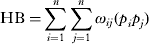
p i and p j being the prevalence of the parasite in host species i and j. Because not all the phylogenetic distances between hosts were available, in this study they were replaced by the taxonomic distinctness (Clarke and Warwick, Reference Clarke and Warwick1998): ω ij is the number of taxonomical steps (from the species to the genera, family, infra-order or order level) needed to get to the common ancestor of any pair of hosts. This modification also allows a more direct comparison with the STD* index, which originally uses taxonomic distinctness (Clarke and Warwick, Reference Clarke and Warwick1998; Poulin and Mouillot, 2005). For parasites with only 1 host (i), the HB was calculated as p i2. This index increases whenever the number of host species increases, but can be greatly influenced by the prevalences in each host, giving out very different results for parasites with a similar number of hosts (for example, for parasites with only 1 host species).
The STD* (Poulin and Mouillot, 2005) shows the mean taxonomic distinctness among the host species used by a parasite, weighted for the parasite's prevalence in the different hosts:
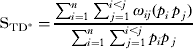
p i and p j being the prevalence of the parasite in host species i and j and ωij the taxonomic distinctness between 2 host species. Whenever there was only 1 host, the STD* was considered to equal 1. This index has a narrower variation range, allowing easier interpretation of values, and is more stable when hosts with a similar number of hosts are compared; but it does not necessarily grow as the number of hosts increases (the addiction of closely related hosts will actually lower the index, by reducing the average distinctness between hosts).
To assess whether parasites always show the same degree of apparent host specificity in all the studied systems, we compared our own data with previously reported cases. For each parasite lineage found in this study, a list of prevalences in all the reported passerine hosts was compiled from the MalAvi database (Bensch et al. Reference Bensch, Hellgren and Pérez-Tris2009). We assume that the sampling effort was the same for all parasite lineages in the total tested individuals, as all lineages can potentially be detected every time a blood sample is analysed by this method. However, the sampling effort for all host species is unavoidably not constant across all the consulted studies, which is a frequent problem in comparative studies.
Assemblages of 9 bird species were simulated: a subset of 9 birds was randomly selected from the compiled host list and each parasite's host range index was calculated for that subset of hosts. In this way, all the selected hosts had at least 1 parasite, but some parasites could be absent from all 9 hosts (in this case, their indices were considered to be zero). This simulation was repeated 1000 times. The probability of a lineage appearing to be more specialist in this particular system than is generally described is the probability of finding lower indices in these simulations than in the real case under study.
RESULTS
Prevalence of Haemoproteus and Plasmodium
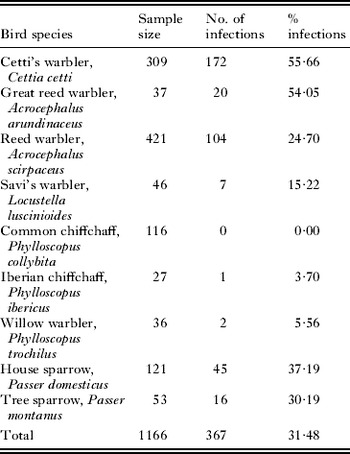
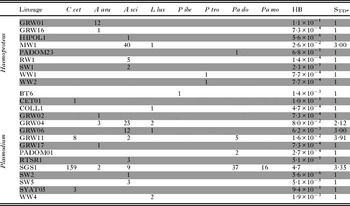
In total, 1166 birds from 4 species were sampled (Table 1), out of which 367 (31·5%) revealed infections (5·6% by Haemoproteus spp. and 25·9% by Plasmodium spp.). However, infection rates varied considerably between species, from 55·7% for the Cetti's warbler to zero infections for the common chiffchaff. These 9 bird species hosted 24 parasite lineages, 9 of Haemoproteus and 15 of Plasmodium (Table 2). Two lineages of Haemoproteus and 2 of Plasmodium were identified for the first time: H. GRW16 and P. GRW17 in the great reed warbler, H. PADOM23 in a house sparrow and P. CET01 in a Cetti's warbler (GenBank Accession numbers HQ262948 to HQ262951); these were named following the guidelines proposed by Bensch et al. (Reference Bensch, Hellgren and Pérez-Tris2009). Only 3 mixed infections were detected: 1 of P. PADOM01 and an unidentified Plasmodium lineage (in a house sparrow) and 2 of a pair of unidentified Plasmodium lineages (one in a Cetti's warbler, the other in a reed warbler). This is surely an underestimation of the real number of mixed infections, which is a known limitation of the used technique (Valkiunas et al. Reference Valkiunas, Bensch, Iezhova, Krizanauskiene, Hellgren and Bolshakov2006).
Sample size of all bird species and number of detected infections in each species

Number of infections of each parasite lineage found in each host species, followed by the host range indices HB and STD* for each lineage

Most of the host-parasite associations found in this report had already been described in previous studies (Bensch et al. Reference Bensch, Hellgren and Pérez-Tris2009 and references therein), except for 6 parasites in the reed warbler and for the newly identified lineages. One lineage of Haemoproteus (MW1) and 4 of Plasmodium (GRW04, GRW06, GRW11 and SGS1) infected more than one host.
Haemoproteus lineages were only present in migrant species, with 1 exception: an adult house sparrow, a species known to spend limited time in the reed bed. Almost all the migrants infected with Haemoproteus spp. were adults; only 2 willow warblers sampled during migration, in autumn 2007, were juveniles. This suggests that Haemoproteus lineages are not transmitted locally and that the infected birds probably acquired the parasite elsewhere. In the Plasmodium genus, there were also some lineages that were only present in adult individuals of migratory species, hinting for non-local transmission: GRW4, GRW6, RTSR1 and WW4. On the other hand, lineages COLL1, GRW11, GRW17, SGS1, SW2, SW5 and SYAT05 occurred in resident species and/or were detected in juveniles that were still attached to their birth reed bed, which shows local transmission.
Lineage host specificity
The nestedness analysis revealed a non-random and non-nested pattern of parasites in each host, for each site as well as for the 4 areas pooled together (Coimbra: NODF=6·74, null model's NODF=10·05, p=0·80. Santo André: NODF=11·62, null model's NODF=14·09, p=0·68. Vilamoura: NODF=6·13, null model's NODF=9·15, p=0·73. Tornada: NODF=2·56, null model's NODF=5·78, p=0·81; all areas: NODF=20·61, null model's NODF=19·70, p=0·39).
The parasites in the studied community had HB indices between 5·6×10−6 and 4·7, and STD* indices between 1 (when only 1 host species was found) and 3·91 (Table 2). When compared with the host range indices obtained from MalAvi with Monte Carlo simulations, the lineage H. MW1 appeared as significantly more generalist in our study than in studies reported in MalAvi: the probability of finding a smaller index in the random simulations than in the studied system was 0·028 using HB and 0·049 using STD*. Two other lineages, BT6 and WW4, also showed as being significantly more generalist in the studied system, with the HB index (P=0·005 and 0·002, respectively). Because these lineages only had 1 host species in this study, they did not give significant results with STD* (the significant result with HB being due only to higher prevalences in our study than in the simulations).
DISCUSSION
Haemoproteus lineages were mostly found in migrants, and almost always in adults, with 3 exceptions: 1 resident house sparrow and 2 juvenile willow warblers during their post-breeding migration. All these individuals had certainly spent plenty of time outside the studied reed beds and could have been infected elsewhere. This suggests that there is no transmission of Haemoproteus lineages in our study areas. However, this is not the case for other European areas; for example, transmission of H. WW2 to the willow warbler has been proved to happen in Swedish woodlands (Bensch and Akesson, Reference Bensch and Akesson2003). This agrees with the fact that Haemoproteus main known vectors, the biting midges (genus Culicoides, Ceratopogonidae), prefer forested habitats and seem to be absent from the studied reed beds (R. Ventim, unpublished data). Also, Haemoproteus spp. appears to have high affiliation to a single transmission area and a single bird fauna, despite the vast numbers of infected birds that perform annual migrations between Africa and Europe (Hellgren et al. Reference Hellgren, Waldenstrom, Pérez-Tris, Szollosi, Hasselquist, Krizanauskiene, Ottosson and Bensch2007). Therefore, it is not expected that African-transmitted Haemoproteus lineages would be able to adapt to the European conditions and vectors and be able to be transmitted to new hosts in their breeding quarters. Plasmodium parasites do this more often, as is the case for SGS1 (Hellgren et al. Reference Hellgren, Waldenstrom, Pérez-Tris, Szollosi, Hasselquist, Krizanauskiene, Ottosson and Bensch2007); so some of the Plasmodium lineages that were present in this community are expected to be transmitted locally as well as in Africa. Local transmission of Plasmodium lineages COLL1, GRW17, GRW11, SGS1, SW2, SW5 and SYAT05 was proven in our studied reed beds, because these parasites were found in birds that should have spent most of their lives in those areas (resident species or juveniles from migrant warbler species, all still attached to their birth reed bed).
Parasite distribution in the different hosts was not random, indicating that there are specific host preferences for each lineage. This agrees with the fact that most lineages in this study were only detected in 1 of the analysed bird species, supporting our assumption that these are relatively specialized parasites. Nestedness was not detected in this interaction network. In a nested matrix, specialist parasites would concentrate in the most parasitized species of birds, sharing their hosts with generalist parasites (Bascompte et al. Reference Bascompte, Jordano, Melian and Olesen2003; Bascompte and Jordano, Reference Bascompte and Jordano2007). Since our matrix is not nested, in our case specialists do not always share hosts with generalist parasites, so they are free from the competitive pressure of generalists. This happened with BT6, WW1 and WW2, lineages that appeared as specialists in the matrix and were present in bird species that were not infected by generalist haemoparasites (the Iberian chiffchaff and the willow warbler). These findings are the opposite from what was found by Graham et al. (Reference Graham, Hassan, Burkett-Cadena, Guyer and Unnasch2009) for ectoparasite-vertebrate host networks in general; this large-scale study analysed networks of mosquitoes, lice, mites, ticks and fleas and mammals, birds, reptiles, amphibians and fish. It found nested structures, meaning that specialized ectoparasites interact with hosts that attract many parasites, while generalist parasites interact with these hosts as well as those that attract fewer parasites. This structure does not seem to apply to all host-parasite interaction networks.
Parasite lineages with higher overall prevalence in the bird community were those infecting a greater number of host species. Moreover, parasites with a broad host range reached high prevalence over a greater number of species, as was also found by Ricklefs et al. (Reference Ricklefs, Swanson, Fallon, Martinez-Abrain, Scheuerlein, Gray and Latta2005) and Hellgren et al. (Reference Hellgren, Pérez-Tris and Bensch2009). Such lineages will be transmitted to vectors more often and, if they are host generalist, a higher proportion of the vectors' bloodmeals will end up in successful transmission. The encounter rate between these parasites and all species in the bird community increases, leading to higher prevalence in all of the hosts. Hence, the prevalence in each host species is amplified due to a wide host range (Hellgren et al. Reference Hellgren, Pérez-Tris and Bensch2009).
The most prevalent of all lineages was P. SGS1, a lineage of the morpho-species Plasmodium relictum (Palinauskas et al. 2007). This parasite is known to be very host generalist, infecting hosts from over a dozen different families in distinct continents (Bensch et al. Reference Bensch, Hellgren and Pérez-Tris2009 and references therein, such as: Hellgren et al. Reference Hellgren, Waldenstrom, Pérez-Tris, Szollosi, Hasselquist, Krizanauskiene, Ottosson and Bensch2007; Beadell et al. Reference Beadell, Ishtiaq, Covas, Melo, Warren, Atkinson, Bensch, Graves, Jhala, Peirce, Rahmani, Fonseca and Fleischer2006). In our study, P. SGS1 had a high prevalence in the domestic sparrow and Cetti's warbler, but was not as successful infecting reed and great reed warblers, two hosts that had high infection rates by other parasite lineages. These host species had already been described to be infected with SGS1 at similarly low prevalences (Dimitrov et al. Reference Dimitrov, Zehtindjiev and Bensch2010; Waldenström et al. Reference Waldenström, Bensch, Kiboi, Hasselquist and Ottosson2002; Zethindjiev et al. Reference Zehtindjiev, Ilieva, Westerdahl, Hansson, Valkiunas and Bensch2008). This suggests that these are not optimal hosts and that even a generalist parasite can have limited success infecting some hosts.
H. MW1 appeared to be significantly more generalist in our study areas than in most studies reported in MalAvi. Until now, MW1 had only been found in 3 Acrocephalus species (Krizanauskiene et al. Reference Krizanauskiene, Hellgren, Kosarev, Sokolov, Bensch and Valkiunas2006; Waldenström et al. Reference Waldenström, Bensch, Kiboi, Hasselquist and Ottosson2002), even when many other host families were sampled concurrently. The present study found that it is also capable of infecting the Savi's warbler, a host from a different genus and family that had not been sampled in the previous studies. This lineage seems to have narrow habitat preferences, concentrating in marsh warblers; therefore, it appeared to be more generalist in the studied reed bed communities than in studies (or simulations) involving hosts from other habitats. This exemplifies how the apparent specialization can sometimes depend on the type of host species that are sampled. More research is needed in order to discover more host-parasite associations and thus unveil more details of these complex interaction systems.
ACKNOWLEDGEMENTS
The Portuguese Instituto para a Conservação da Natureza e Biodiversidade provided official permits for bird sampling, as well as logistic support in the field. The authors would like to thank the help of volunteer students and ringers during the field work, as well as the comments of two anonymous referees to earlier versions of the manuscript.
FINANCIAL SUPPORT
This project was supported by the Fundação para a Ciência e Tecnologia (R.V., grant number SFRH/BD/28930/2006; L. M., grant number SFRH/BPD/20682/2004) and the Spanish Ministry of Science and Innovation (J.P.-T., project number CGL2007-62937/BOS).