Histories of Western music in the long twentieth century might not yet fully acknowledge it, but one of the period's most important movements was the spread and absorption of “black music” styles and practices beyond the African diaspora. It was in trying to account for the particular impact of the rhythmic techniques identified with those musics that, shortly before his death in 2002, the music scholar (and polymath) Jeff Pressing published a study of what he termed—with a nod to Paul Gilroy—“Black Atlantic rhythm.” The article, which appeared in Music Perception and has been widely and favorably cited in the music psychology literature many times since, asks big questions: how does such rhythm work, and why has it appealed so widely?Footnote 1
Pressing argues that Black Atlantic rhythm is founded on two main “approaches to time”: groove and speech rhythms. The latter, found in jazz singing, rapping, and elsewhere, “float[s] above the regularity of the underlying rhythm section, giving aligning reference to it only at certain points.” Meanwhile, groove, Pressing writes, is the foundation of any dance music style, including European forms ancient and modern. But whereas various other traditions make use of unequal pulse lengths and additive rhythms—Pressing cites the Balkan (3+2+2)/8 grouping—Black Atlantic music “overwhelmingly favors equal pulse durations” like 4/4 or 8/8, this regularity allowing for overlay of the speech rhythm syncopation already described, and, just as importantly, for metric subdivision. So while “groove beat subdivision is based on a strong cognitive predilection toward simplicity—division of durations into 2, 3, or 4 parts,”
subdivisions of greater complexity are produced hierarchically by subdivisions of subdivisions . . . For example, a triplet sub-subdivision of triplet subdivision is used in some very slow gospel tunes, where each beat is effectively divided into 9 parts . . . Higher prime numbers (5, 7, 11) violate this predilection for simplicity . . . Thus, groove design presents a prioritization of rhythmic subdivision distinct from that generated by such attitudes as asymmetric Romantic expression (e.g., Chopin's piano music) or intellectual numerical extension (e.g., multiserialist techniques stemming from 1960s Western composers), and generally relies on hierarchical application of elements of length 2 and 3 to achieve complexity.Footnote 2
Pressing is attempting to account for patterns that span huge swathes of geography and history, so it might be churlish to complain that “asymmetric Romantic expression” and prime-numbered “intellectual numerical extension” might not account for the rest of the world's music, or, indeed, to suggest that one doesn't have to think very hard before coming up with “Black Atlantic” musicians—Aretha Franklin, Louis Moholo-Moholo—who make use of those kinds of devices. Still, however generalized, this description is useful for many “Black Atlantic” styles’ workings. But description is not enough: Pressing wants to explain why such rhythm has achieved such global popularity and presence, and to do so scientifically through the application of evolutionary psychology.Footnote 3 And it's here that the cracks between the enormous totalities the writer has been trying to manipulate begin to cleave open.
Pressing suggests that for a groove to be successfully conceived, executed and, moreover, perceived by both musicians and audiences, it must call up a series of shared motor responses and musical interests or values. Groove is a social musical phenomenon, and “[s]uccess relies on shared or at least compatible conceptions of timing and accentuation by the performers.”Footnote 4 Added to this notion of sociality is the claim that those devices that overlay the groove—here Pressing cites common (if ethnocentrically identified) techniques of syncopation, off-beat phrasing, polyrhythm, hocketing, heterophony, swing and call-and-response—cause a pleasing “perceptual challenge” to the musician or listener guided by the basic, unchanging, and underlying pulse.Footnote 5 Perception is one of the “3 Ps” that have been taken as accounting for human cognition more generally; aside from that capacity (“how well the animal notices changes in its environment”) are those of production (“how well the animal operates within and upon its environment”) and prediction (“how well the animal predicts future events in its environment”).Footnote 6 “My hypothesis is as follows,” Pressing continues. “Musical rhythm arises from the evolved cognitive capacity to form and use predictive models of events—specifically, predictions of the timing of anticipated future events.”Footnote 7 Those syncopating (or otherwise complexifying) groove overlays give pleasure owing to the cognitive dissonance that arises from a temporary upsetting of our capacities of prediction. The fact of this upsetting engages our interest because evolution has taught us to be aware of the environmentally unexpected for survival's sake. So Black Atlantic rhythmic approaches are formed in the play of cognitive skills originally developed according to specific evolutionary needs; in a comparatively happy time for homo sapiens, Pressing asserts, the perception of present change, the production of motor action, and the prediction of upcoming change are shaped into musical skills used to groove rather than to remain alive.Footnote 8
Black musical rhythm, then, is globally (or as Pressing's title has it, “transculturally”) communicative because it is so basic to human experience; the logical ramification is that other musics must have evolved away from that fundamental state, making less use of the cognitive and perceptual skills learned in the jungle and on the veldt, acquiring in the process some kind of rarefied, non-popular “intellectual extension” opposed to the simple, immediate, embodied rhythm Pressing validates. “The clearest psychological distinction between [Western art] musics and those of the African and African diasporic traditions,” the author concludes, “is the continued adherence to a relationship with the simple, direct experience of groove in the latter, with, it may be argued, concomitant heightened power to evoke emotion and affect in the nonspecialist.”Footnote 9
It doesn't matter that Pressing means it as a compliment. How much violence that notion of “continued adherence” has done through history: linking blacks with a supposedly unshakeable primality, separating whites from the same, here identifying black rhythm with the pre-reflective and bodily and some whiter kind of music with the mind (the latter apparently comprehended but not felt, perceived without perception). In the search for “hard,” scientific, universal truths about musical practice and taste, the researcher rules factors of culture, history, learning, and environment out of bounds—at least once those ancient hunters on the lookout for rampaging wildebeest have had their mention—and black music and rhythm are once again cloaked in the garb of primitivism.Footnote 10
Pressing long worked and wrote as an advocate of “Black Atlantic” music. Yet his thinking here seems to participate in a fraught but centuries-long tradition of study that takes bio-cultural evolution as its subject and in which, among other disciplines, anthropology, philosophy, science, and musicology have all been implicated. This work has been the subject of extensive critique since the 1990s, so a survey of these appraisals will be doubly useful. Firstly, it will allow us to sketch a brief history of musical-evolutionary thought—in which race and intelligence, harmonic form and rhythm come to be mutually defined and musical difference pathologized—so as to set Pressing's project in its scholarly longue durée. Secondly, though, it will give a sense of the “hermeneutics of suspicion” prominent, even dominant, in contemporary readings of old theoretical tracts, readings that were being published while Pressing was authoring his own study. In asking how far Pressing's work was an anomaly in its early-century context, I will push beyond a history of race in musicological method and on to broader debates in critical race theory, lingering specifically on the problem of, and the literature on, “whiteness”—its conceptual formulations, its mooted histories, and its institutional logics. Using these ideas to divine the power dynamics of a specific contemporary academic discourse, I will consider how, Pressing apart, some schools of thought and method might still be seen to encourage and reward (accidentally) racialized analytical treatments of the human subjects of musical study. I will conclude by reflecting on the sometimes raced nature of scholarly identities in twenty-first-century music studies, considering how writers on music might better acknowledge and come to terms with the roles they play in a pre-postracial world.
Race, Rhythm, and (Musical) Intelligence
Enlightenment concepts of “Man” the newly self-possessed subject were made in relation to the obvious contradistinction: beast. In his Anthropology from a Pragmatic Point of View (1798), Kant (in similar ways to Linnaeus and Hume before him) outlined his notion of the human being as a moral agent, “one capable of experiencing oneself as an ego, an ‘I,’ who thinks (self-reflects) and wills.” This capacity, in Kant's words, “raises him above all other creatures living on earth.”Footnote 11 As historians of philosophy and critical race theorists have shown, the question was where humanity stopped and animality began, and it was here that the modern humanities inaugurated their own racialization. Through the 1990s, Emmanuel Chukwudi Eze collected and brought this philosophical tradition's ignominious moments to attention. Kant claimed that the “African has no feeling beyond the trifling”—the thinker thus denying that continent's people entry to the full, moral subjecthood that separated animal from human, the latter “at its greatest perfection in the race of the whites”—and Eze showed this assertion as chiming, among other writings, with Hegel's later positioning of Africans outside history. On the grounds that their supposed lack of writing doomed them merely to react to events rather than act with a teleological project of “becoming” in their minds, Hegel determined those people to be outside full subjectivity, toiling in a “primitive state of nature” that was “in fact a state of animality.”Footnote 12
Such statements were symptoms of a wider metaphysical effort to parse humanity, and as that work progressed so did taxonomic studies and theories of race, developed in Europe during the eighteenth and nineteenth centuries by men like Cuvier, Gobineau, and Blumenbach and generating figures like the “Caucasian” and the “Negroid.” A number of contemporary historians have reconstructed the tradition of anthropological race science, showing how such distinctions often relied on new techniques such as phrenology—in which types’ characteristic skull shapes were linked to putative racial characteristics including beauty, enterprise, and intelligence (or their lack)—and eugenics, the discipline that, from Francis Galton's first work on “hereditary genius” in the 1860s, attempted to map individual and group genetic makeup onto cultural potential.Footnote 13 Even though those methods fell from grace, the project continued; as critical studies by the anthropologist Alexander Alland and the theorist of education John White have described, the belief that the many varieties of human cognitive capacity were reducible to a single unit of measurement took hold in the early twentieth century, and standardized intelligence tests—developed by Western governments in an age of colonial expansion abroad and newly universal education at home—were employed as tools of anthropological exploration and pedagogical prediction.Footnote 14
General theories of musical evolution, style, and value were developing alongside this work, and a number of scholars writing in the twenty-first century have made detailed critical studies of the (paradoxically) raced universalisms displayed in musical theories of the eighteenth and nineteenth centuries. Peter Hoyt has shown that early theoretical treatises such as Jean-Philippe Rameau's work of 1722 presented rhythm as natural to all living beings. Hoyt argues that a rhythmic “savage” functioned as a point of reference in a number of the period's works of music theory, the supposed constancy of that figure's untrained responses establishing the ground level of musical function and affect.Footnote 15 The resonances with Pressing's conclusions of more than 250 years later seem clear.
Yet the common relative valuation between this ground level and some higher musical state was of course inversely opposed to Pressing's own: as Matthew Riley has written, a theorist like Johann Georg Sulzer could in the 1740s argue that human history represented the development away from that “state of nature” toward institutionally organized civil society, and that the cultivated arts were an important tool in this civilizing process.Footnote 16 Thinking was forever bound up with literacy and writing in these evolutionary tracts, both scientific and artistic. In Europe, increasingly complex techniques of notation had helped produce music of formal sophistication, and a discourse of sophistication produced an outside world of naturally rhythmic non-sophisticates. As Gary Tomlinson has noted, Johann Nikolaus Forkel argued in his Allgemeine Geschichte der Musik (1788) that the literacy of Western bourgeois society was a prerequisite for the compositional and evolutionary perfection of music, which still dwelt in its crude form “among many Asiatic, African, and American peoples, whom we also know to have made no progress for millennia in other branches of culture.”Footnote 17 Similar arguments are found in Fétis's nineteenth-century work, along with the belief that bourgeois European practices represented the fulfillment of a universal historical destiny—in this case, tonality—that had simply not yet been reached by those Others.Footnote 18
Later, as Ronald Radano, Ian Cross, and other writers on music have demonstrated, Darwinian and Spencerian ideas of evolutionary descent and teleology were employed to shore up music-theoretical imaginings and cultural hierarchies.Footnote 19 By hook or by crook, “primitive” rhythmicality was imagined out of an organizationally, harmonically complex Western tradition and practice. Work by Kofi Agawu and Radano shows how a penchant for rhythm was continually projected upon those outside that culture, usually as a mark of their animalistic inferiority.Footnote 20
It was at this moment that new, and—setting sights now on this study's next stage—still-central analytical methods and attitudes emerged as part of an increasingly formalized discipline of musicology. Theoretical practice reflected the creative, and both had long proven inseparable from wider projects in aesthetics and pedagogy even as trends in philosophical, scientific, and artistic enquiry were converging in the notion of organicism.Footnote 21 Especially in Germany, organicist ideals were advanced by the most influential music theorists through the nineteenth century—Forkel, A. B. Marx, Nottebohm—and their basic assumptions were generally followed.Footnote 22 In its weaker strain, organicism was to many nineteenth-century artists and critics an account of total formal unity, one that described the ideal relationship between a work's parts and its whole. But in the fanatical form not unusually espoused by its theorist proponents, it became an ideology of integration that married the procedural and the ineffable.Footnote 23 For Heinrich Schenker, whose music-analytical work and method is still in the twenty-first century often considered central to that sub-discipline and its curricula, a musician's or listener's analytical consciousness of the unity of the musical work's relationships—its fore-, middle-, and background—was at the same time consciousness of tradition and teleology; the Hegelian theorist's contention that the tonal plan's “goal and the course to the goal are primary” was analogous to the consciousness of history and project of becoming that raised Hegel's European subject above the animalistic African.Footnote 24 Schenker inevitably decried what he called “the nature-music of the Negro” for its apparent emphasis on rhythm and its lack of tonal teleology: “Jazz stirs the bones, not the mind. But a mind that is forever empty totters like a senile old man,” he railed, making a small contribution to what Radano has shown to be the musical-evolutionary discourse's “medicomoral” trope.Footnote 25
“The science of race and the science of music,” Philip Bohlman has written, “are sister discourses of modernity,” and it's clear that theoretical writing on (black) peoples and (black) music authored by Europeans and their American descendants during the eighteenth and nineteenth centuries functioned better in the construction of an “evolved” and notably “white” cultural and intellectual identity than it did as the committed study of difference in musical cultures.Footnote 26 But is something like that still the case in the twenty-first? It's important to recognize Pressing's piece for its problematic construction of a certain kind of blackness, one projected from without. But rather than stopping at that level of critique, it will be telling to go further, and ask how far contemporary (white) theorists of black music like Pressing are, in following their forebears, unwittingly theorizing themselves.
Whiteness and “White Logic”
That sweep from Kant to Galton forms an early part of several texts now identified with “whiteness studies,” a sub-field of critical race studies that emerged in earnest during the last decades of the twentieth century, and the projects described above are susceptible to what Woody Doane has called that literature's “essential insight”: that the scientific, cultural, and colonialist endeavors of the modern period had generated a resilient idea of whiteness as “invisible,” normative, and ideal, while the non-white was always positioned as remarkable, troublesome.Footnote 27 If Pressing's study reverses those terms—for him, it is Black Atlantic rhythm that is the ordinary and (white) Western art music the obscure—then in its appeals to the universal and its racialized theoretical bifurcation, it seems all too readily to subscribe to that tradition's categorical norms. By describing a basic black rhythm and a developed white intellectuality, it helps shore up the same circumscribed notions of blackness and whiteness as did those earlier bio-cultural theories of music. For scholars working in critical race and whiteness studies, many of the canonic thinkers of the post-Enlightenment period are figured as the founders of an exclusive whiteness and a form of white supremacy that endures as long as their disciplines remain ensconced. Relying as it does on bio-cultural argumentation familiar from nineteenth-century work, condoning as it does the early twentieth-century music-analytical attitude that pitted bodily experience against intellect and teleology, it may be tempting to take Pressing's twenty first-century piece as evidence of the immutability of such methods and identities and leave it there.
But race studies’ common and overarching narrative of the long life of whiteness has not always come with an acknowledgement that each of its chapters might be fraught with complexities that would render such a singular interpretative trajectory questionable. Whiteness studies was (and remains) a field largely defined by North American scholars in response to modern North American race problematics, and the central criticism of early work in this area—especially the many confessionals in which white authors recounted coming to an awareness of their “raced” identity—was that, mistaking the experiences of contemporary North Americans as those of “whites” in the world tout court, many writers masked what had in fact been a conglomeration of complex, localized discourses and social practices designed to ensure the hegemony of privileged classes of different and developing groups elsewhere. The whiteness this work portrayed—so the complaint ran—had been allowed to congeal into a timeless, universal category, the studies thus replicating the absolutism of the thing they critiqued.Footnote 28
A history lining up Kant, Hegel, Galton, Schenker, and Pressing as co-constructors of whiteness—indebted as their methods could be to philosophical and bio-cultural thinking that had done disservice to those not white—would thus be useful in part; the implication that any contemporary work making use of such thinking might be bound to reproduce historic bias would be worth exploring. But neither judgment nor hunch would respect the historical complexities in play, since specific political dynamics, and specific uses of intellectual technologies, have often been more significant than any simple, enduring notion of ethnic or cultural identity. Schenker's xenophobic advocacy of the Germanic tradition associated a certain set of transcendent moral-aesthetic values with a certain people—and was built on the backs of low and sometimes black Others to boot—yet this vision contrasted strongly with the treatment of the Jewish theorist's own works meted out by the Nazi arbiters of Aryanism.Footnote 29 Similarly, Pressing's piece rests on old, raced divisions of mind and body, but it is couched in the advocational language and intent of a contemporary liberal academic culture in which black music cultures have come to be celebrated far more often than decried.
“Whiteness” waxes and wanes. But that fluidity might in fact justify the critical concept. Where earlier racial denominators were usually bound up in the essentialist language of being and spirit, this contemporary theoretical whiteness—the product of a post-structural age—is always positioned as a social signifier, one which, wherever it is temporarily held in place, is done so by linguistic, legal, and political glue rather than ontological truth or genetic fact. In this way of thinking, whiteness is not equivalent to, and does not account for, white people; it is not a natural way of being. It is, on the contrary, a constructed way of being towards those constructed as not-white, a number of procedures and behaviors that may not be simply racist—they may even be instituted in the name of anti-racism—yet still act, purposefully or not, to maintain familiar hierarchies of status and power. Classic work by scholars like David Roediger has provided close historical descriptions of the ways that legal and rhetorical formations of white belonging and exclusion came into being, how categories of “Anglo-Saxon” and “Aryan” whiteness could, over time, shapeshift to include or exclude the poor, Jews, Irish, or Italians as the particular social situation dictated. If anachronism and transhistoricism is the worry in conceptualizing a critical whiteness, then that writing shows that it is surely possible to identify a system of localized but extensively textualized institutional practices that have produced and protected certain kinds of racial identities and privileges.
Building on that reading of Pressing, I want to test the extent to which antique race discourses and hierarchies are recognizable in contemporary academic work more widely. The findings of scholars like Roediger suggest a way to go about that investigation, but if such concepts as “whiteness” are going to be of any use here, then the demarcation of the specific institutional contexts in which they operate—of specific textual procedures in which specific race-identity forms come into being—is necessary in order to avoid schematic grand narrative.
To begin with, we can draw a proper contrast between the theorists Schenker and Pressing, brought close here and perhaps representing some kind of methodological continuity, but surely also marking disciplinary change and difference. If opinions might have varied as to whether the “intelligence” behind the art music of Schenker's (very) long nineteenth century belonged to composers, listeners, or the musical Geist itself, it was in its teleological dimension that intelligence (and thus high-cultural value) was always seen to inhere, just as intelligence's opposite was presumed responsible for teleology's lack. But these views, where still deemed credible at all, are hardly hegemonic any longer.Footnote 30 Although the academic place, prestige, and analytical potential of “intensional” rather than “extensional” popular music forms has often been put into question, analytical studies of (African American) popular music have, since at least the 1990s and the time in which Pressing was publishing, acquired a range of interests and investigative techniques that show teleology to be one among a great many avenues of exploration, and likely not the most important; the latter theorist's own non-teleological interests, and his references to the cognitive sciences, suggest some of the distance travelled by music studies during the twentieth century.Footnote 31
And yet, as I will show, dividing practices more subtle are still much in evidence, just as abstractive musical intelligence is still implicated in racialized contexts. Now, though, that intelligence is not primarily positioned as something that black musical subjects forego—contemporary music theorists have no appreciable interest in the racist projects of the past—but as something that only academic analytical practices fully conjure into being.Footnote 32 The problems here attend less to “intelligence” as defined by psychology than they do “intelligence” as defined by government: rhythm is observed, encoded, reported, and only then given a new strategic value within the institution.
The focus shifts from an analytical construction of race identity bound up with Romantic-Idealist notions of cosmic becoming towards one working from the guidelines of contemporary technocracy. After all, during music's high-modernist period, compositional notions of development and narrative had been revolutionized: even if organicist thinking sometimes lingered, post-war analytical and theoretical vocabularies were often drawn from systems theory, quantum mechanics, and other new scientific fields. As M. J. Grant has written, many of the theorist-composers of the serialist school were in the 1950s looking for ways to recover a sense of formal logic often lost in non-tonal (and thus often non-teleological) music, leading to compositional and theoretical work in which the canons of Western scientific methodology were picked at magpie-like.Footnote 33 Beyond the metaphor of the totally unified creative organism—but perhaps not that far beyond—was the totally intrarelational system; the emphasis on part-whole relationality, on integral coherence and derivation, was now recast for the atomic age, and the location of music's intelligent creation shifted from development narrowly defined towards the systemic more generally. Such was as true for analysts as it was for composers. The idea that deep and hidden compositional structures might be revealed by the analytical stripping away of layers of musical detail—that methods of reduction or transfiguration could turn musical notation into a diagrammatic sign of workings more fundamental—had come into its own by the end of the nineteenth century. But that thinking remained just as crucial to the most influential late twentieth-century methods (Forte's set theory, Lerdahl and Jackendoff's theories of musical grammar) as it did to the lesser (Böker-Heil's information theory–informed, computer-plotted 3D charts of Palestrina madrigals).Footnote 34
The appeal to scientific method and purpose made by a large number of theorists and practitioners in the postwar West was bound up with other cold- and post-war notions of research and knowledge production. And it was one made while a wider cultural paternalism was failing: Milton Babbitt's strange dream of lab-bound composer-theorists, published in 1958 as “Who Cares if You Listen,” was over subsequent decades realized in institutes and (especially) universities across the northern hemisphere, as musical thinkers sought refuge, territory, and status increasingly denied them in more public spaces. One of the most notable outcomes of this ongoing disciplinary repositioning was Pierre Boulez's Institut de Recherche et Coordination Acoustique/Musique (IRCAM), created in the mid-1970s and dedicated to the computational creation and study of Western art music. As Boulez put it in some early publicity material for the Parisian institute:
The creator's intuition alone is powerless to provide a comprehensive translation of musical invention. It is thus necessary for him to collaborate with the scientific research worker in order to envision the distant future, to imagine less personal, and thus broader, solutions . . . At educational meetings scientists and musicians will become familiar with one another's point of view and approach. In this way, we hope to forge a kind of common language that scarcely exists at present.Footnote 35
In view of those old universalist fascinations with the paradoxical Other, it was perhaps unsurprising that IRCAM had as one of the first projects a study of the “problem” of jazz swing, which was subjected to an involved (though relatively low-status) research program during the 1980s. Swing, program director André Hodeir wrote in summarizing the program, was a quality subjectively known to all jazz musicians and educated listeners, yet it was one that analysis had found difficult to define. However, he continued, “persuaded as we were of the objective existence of the phenomenon, it seemed to us rational to use the modern technology available to researchers to evidence its laws. We turned towards the computer.” Having produced computational analyses of solo lines from jazz recordings, a second stage of the project saw the writing of a program to simulate such swung phrases, this “an improvising machine” that was demonstrated in concerts at IRCAM and elsewhere.Footnote 36
The project, led by a life-long adherent to jazz's cause, was no doubt born of genuine curiosity. Yet this work might be the kind in which, as the sociologists Tukufu Zuberi and Eduardo Bonilla-Silva have argued, a kind of scientific whiteness is encountered. And if we are to think about the ways that musical research may or may not be said still to construct a kind of “white” academic identity through reflection on “black” musical materials, then we need to look at the ways that formulations of whiteness have been identified in cognate institutional contexts.
Zuberi and Bonilla-Silva, who have often written on the academic production of whiteness, launch numerous attacks on the social sciences’ methods and policy impact in their 2008 book White Logic, White Methods: Racism and Methodology. “That the founder of statistical analysis also developed a system of White supremacy is not an accident,” the authors contend, gesturing towards Francis Galton's work in both those areas. Defining their evidently provocative epithet “white logic,” Zuberi and Bonilla-Silva write:
By speaking of logic we refer to both the foundation of the techniques used in analyzing empirical reality, and the reasoning used by researchers in their efforts to understand society. White logic, then, refers to a context in which White supremacy has defined the techniques and processes of reasoning about social facts. White logic assumes a historical posture that grants eternal objectivity to the views of elite Whites and condemns the views of non-Whites to perpetual subjectivity; it is the anchor of the Western imagination, which grants centrality to the knowledge, history, science, and culture of elite White men and classifies “others” as people without knowledge, history, or science, as people with folklore but not culture.Footnote 37
Mandarin cultures of control surely antedate the methodological whiteness that the authors target. But those complexes of centrality and hierarchy we have seen at work throughout this article; moreover, despite the obvious good intentions (and long-standing anti-racism) of the IRCAM project's participants, it's difficult to know what else to make of the jazz swing study, its attempted transplanting of subjectivity with objective laws, the removal of problematic people and their replacement with an ideal machine, and the institutional transformation of social practice into scientific fact.
If putative white logic might be read as informing the projects already detailed, then it can be read as informing other musicological and scientifically minded studies of “black” rhythm stretching back to the 1920s.Footnote 38 So it will pay to keep Zuberi and Bonilla-Silva's concept at hand, even though it is too early to deem it unproblematically useful: the staging of an imaginary face off between the always-white analysts of music and their always-black objects of study risks reductivism. Nevertheless, the Western academy, including its music departments, is a place overwhelmingly populated by white scholars, some of whom (as we already know) can be seen to be broadcasting powerful and conflicted messages about black expressive culture. In light of this understanding it may well be that Pressing's errors are not contained, but are in some ways symptomatic of an unreflexive attitude easy to adopt in an area of music studies where—whatever the sympathies and cultural backgrounds of its practitioners, and whatever the contemporary analytical method and rhetoric—textual conversations tend to be about rather than with black music, musicians, or theorists.
I began by wondering whether one problematic study represented wider trends in the racialization of music theory, and that query now finds its final focus. In the second part of this article I will survey twenty-first-century studies on African American rhythmic practices, which are almost always authored by apparently white writers (and not by my selection or design). I will examine how the methods and resources of an institutionalized, postwar, music-analytical discipline—enacting familiar and yet specifically contemporary kinds of symbolization and intellectual abstraction upon sensory materials—have been mobilized in such work. In concluding, I will determine whether these theoretical discourses on notionally black music function as the laboratories of a notionally “white” cultural and intellectual identity in ways redolent of their historical counterparts.
African American Rhythm in Twenty-First Century Theory
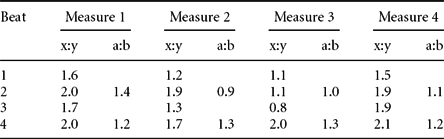
Fernando Benadon and Ted Gioia's 2009 Popular Music investigation of John Lee Hooker's “boogie” establishes its premise—that the success of recordings like “Boogie Chillen” (1949) is a mystery that must, in their words, be “unraveled” through close, statistical analysis—by dotting around the opening paragraphs a number of insinuations about the music about to be operated upon. Successful popular songs have hooks, they write, but some of this music's “melodic and harmonic content is practically nil.” Again, the division of musical practices into the rhythmic and the harmonic, the one black and the other not, is a necessary first move in the establishment of a properly analytical attitude, and the delimitation—inadvertent, certainly—of a racialized musical object. Neither can the song's lyrics have any communicative power, the analysts write, since Hooker's words here are “almost simple-minded.”Footnote 39 Instead, meaning such as it resides in this work remains to be uncovered by those investigators who proceed to taxonomize and label Hooker's early recordings, and to describe the workings of his rhythmic body—hands playing the guitar, foot stomping time—by reducing that body to a statistical abstraction of itself, as they do for “Boogie Awhile” (also 1949; see Table 1).
Durational ratios for “Boogie Awhile.” The x:y ratio measures beats/upbeats between foot and guitar; the a:b ratio measures upbeats/beats in the guitar. Values above 1.0 denote long-short patterns. Bernadon and Gioia, 23.
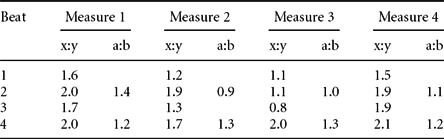
Normally, if a rhythm's beat/upbeat pattern is long-short, then its upbeat/beat pattern should be the reverse, short-long. But not here. The duration ratios for Example 1 are shown in Table 1. Values near 2.0 represent a ternary long-short 2-to-1 ratio between two adjacent notes, values near 1.0 represent an even 1-to-1 ratio (two equidurational quavers), and intermediate values (such as 1.5) denote evened-out long-short patterns. Two concurrent relationships are at play: beat/upbeat (x:y) and upbeat/beat (a:b) pairs. The foot acts as a metronome that provides the beats; they are subdivided by the guitar's upbeats. These x:y ratios are usually tripleted (shown in bold type), but enough of them are not to preclude a tidy triplet feel from forming. Still, the overall feel produced by foot beats and guitar upbeats is long-short (x greater than y), as expected in compound time. But the guitar line in isolation reveals a puzzling piece of evidence. The a:b ratio measures the guitar's upbeats (a) against its—rather than the foot’s—beat attacks (b). To agree with the long-short x:y ratio, the a:b ratio should be short-long and therefore less than 1.0 (a short upbeat followed by a longer duration on the beat). In other words, the value of a should be smaller than the value of b. However, in this case the guitar follows the opposite route: a is almost always longer than b, yielding a:b ratio values above 1.0. This occurs because the downward guitar slides lead to constant delays with respect to the foot. The result is a kaleidoscopic rhythm consisting predominantly of long-short patterns regardless of whether one listens to pairs of beats/upbeats (x:y) or upbeats/beats (a:b).Footnote 40
The piece's title is “How Hooker Found His Boogie,” but the analysts do not investigate how Hooker developed his rhythmic practice. Indeed, what is really “found” is a kind of read-out of what was previously only bodily, pre-symbolic. The significance the authors derive from this analytical operation is not clear until near the end, when discussion of Hooker's “kaleidoscopic” pulse leads to a vague gesture made towards non-Western musical trance and shamanism; the statistical data and rhetoric so fetishized throughout is hastily discarded as insufficiently telling, and mathematical modernity is supplanted by an appeal to a generalized, extra-modern Other that smacks of the primitivism Gioia has critiqued in other contexts.Footnote 41
But the authors are clearly enthused about Hooker's craft and his music, and some of Benadon's other studies do a better job of exploring African American rhythmic practices analytically without calling upon these kinds of scholarly power. Whatever the (ironic) scientism of its title, Benadon's 2009 Music Theory Spectrum article, “Time Warps in Early Jazz,”—which describes metrical superimpositions and modulations found in solos by Louis Armstrong, Coleman Hawkins, and others—succeeds in detailing not just musical events, but also the ways they might be perceived and accounted for by both performer's and analyst's subjectivities. There is a sense throughout that Benadon is performing an analytical virtuosity out of respect for and in response to the music he engagingly describes, a kind of disciplinary translation in some way equivalent to the metrical substitutions under discussion.Footnote 42
This discourse is not a dead loss. But neither are its problems localized, and issues similar to those found in Benadon and Gioia's piece are encountered in a 2004 Journal of the Royal Musical Association article by Lawrence Zbikowski.Footnote 43 Although, again, this analytical study of groove reads as a musicologist talking about music he cares deeply about, it is in the first instance authorized by the authoritative talking over of an expert practitioner. Zbikowski asks what it is that musicians and listeners “know when they know a good groove” and complains that those people's pre-analytical descriptions rarely provide a satisfactory answer. The jazz drummer Charli Persip's observations on the matter are cited as proof: “When you get into that groove,” Persip says, “you ride right down with that groove with no strain and no pain—you can't lay back or go forward.”Footnote 44 Although this description is deemed not good enough, Zbikowski argues that it is important that musicologists learn to “think about musical knowledge as involving a network of information that includes assessments about bodily states or the possibilities of bodily motion.”Footnote 45 For many, that would seem to be exactly what Persip does, and with much more precise affective description than Zbikowski himself arrives at. Because after twenty-five pages of analytical taxonomy—“G2P1: The music has a double time feel”—the theorist's conclusions are very much of the no-kidding variety: they who “know” groove, he writes, “know what makes for musical rhythm, how the body might respond to rhythm, and the context within which large-scale, multi-layered patterns of pitch and rhythmic materials are produced. In short, they know music.”Footnote 46
Rather avuncular, perhaps, but this statement of what many musicians and listeners would find obvious is hardly dangerous in itself. Yet the feeling remains that however unremarkable the judgment, it is made from a place of particular authority, and Persip's verbalization stands for what we take to be a variety of less valuable understandings of what groove “is.” Zbikowski acknowledges that because his study pivots on the idea of “knowing,” a reflection on what might constitute rhythmic epistemology is in order. But the opportunity is squandered, and rather than considering the differing status of academic and practitioner or everyday musical descriptions, the author mounts a rather solipsistic defense of the musical-analytical project. “If knowledge is indeed limited to that which is or can be written down,” he writes, “then much of popular music is beyond knowledge: to ask what a listener knows when he or she knows a groove is to entertain a question that can have no answer.”Footnote 47 Persip's comments have already suggested otherwise, but even if such a question could be incongruous if posed verbally, it would not if posed musically; if implicit challenges to groove are not clear enough, then explicit calls and responses to that effect litter African American music history.Footnote 48 That fact does not seem to interest Zbikowski, who determines that it would be “silly” to look too far into such epistemological concerns, “as it places a vital part of contemporary life beyond inquiry.”Footnote 49 He means paper-based, non-sounding academic inquiry; scholarly knowledge, produced under certain conditions for certain purposes, is confused with knowledge in general.
A very different approach is taken by Anne Danielsen in her book-length study of funk, Presence and Pleasure: The Funk Grooves of James Brown and Parliament (2006). The author's own primary experience of groove, she relates, came as a performer: Danielsen argues that the situated, social knowledge she gained thereby—together with the European context of her own experiences—is crucial in her intellectual orientation towards this African American form, and the interplay of presumed closeness and presumed distance gives rise to both acute descriptions of various funk rhythmic techniques and suggestive ruminations on the ultimate non-translatability of the groove experience. The book provides a nuanced study of funk rhythm's modes of timeliness and embodiment, and, highlighting also the music's socio-political contexts and meanings, calls for a “non-dualistic” approach to the style as both a “bodily” experience and “intellectual” skill or construct.Footnote 50
But the eminently dualistic trappings of that infamous white logic seem set to be reintroduced by a 2010 collected volume edited by the same author, Musical Rhythm in the Age of Digital Reproduction. Whatever their respective weaknesses and strengths, all the studies discussed so far demonstrate a key strategy of any scientistic investigation: the early establishment of a lack of knowledge, followed by the promise that such a lack will be overcome if only the right analytical techniques can be identified. The same is true here. “The neglect of rhythm and groove within musicology and its subdisciplines of music psychology and music theory,” Danielsen writes her introduction, in part “arises from the limitations of the notation-based analytical tradition.” In this assertion she is no doubt correct, since, like all methods, what it cannot account for, notation leaves unstudied.Footnote 51 However, she continues:
[Digital recording techniques have] allowed us to better capture, manipulate and systematically analyze rhythm and sound, particularly at the level of microrhythm. Through a combination of auditory analysis and visual interpretation via graphic representations of sound in sonograms and amplitude graphs, this book will help demonstrate these possibilities. Both sonograms and amplitude graphs help the scholar by “freezing” time and especially by detailing microrhythmic subtleties.Footnote 52
So the Cartesian moment that is so meaningfully deferred in Presence and Pleasure is here brought about immediately, by this appeal to the “capturing” and “freezing” of rhythm and by the several sonograms that show off the neutralized quarry. Danielsen's earlier reflections on the nature of musical knowledge were eminently subjective, but here the chapters are provided by a team of researchers working with seemingly impersonal, laboratory methods. It seems significant that these later essays result from a five-year research project funded by the Norwegian Research Council, bureaucratic bodies by their very nature both facilitating and privileging the objectively measured and measurable over the soft and philosophical. The volume threatens to represent those institutional prerogatives after all.
Yet little of that suspicion is borne out by the work itself, in which such issues of analytical power and politics are—unless one is predisposed to discount the entire music-academic project—essentially absent. The sonograms are generally used to measure time, but they also to show how different instrument timbres and frequencies influence perceptions of timing or the places where rhythm meets pitch, producing differing kinds of phenomenological affect. These kinds of concerns lead not to a stressing of so-called white logic's objectivity but of experiential variance, and analysis is not applied to its primitive, mystical “folkloric” other, but put in the service of a constantly reaffirmed creative sophistication.Footnote 53 Danielsen's own chapter on D’Angelo's 2000 track “Left and Right”—which is based on a loping groove that incorporates major discrepancies among bass, percussion, and guitar demarcations of pulse—discusses ways that such incongruity can be lost over time as the listener becomes accustomed to the much wider notion of pulse, or “beat shape,” that the groove teaches. This engaged and convincing writing seeks to understand musical subjectivity rather than institute analytical objectivity or authority over it.Footnote 54
As so often, the technologies are not as significant as the uses to which they are put. Similar sonographic transcription methods are much in evidence in another article, whose analytical tendency contrasts with both the strong and the problematic work discussed above. In this 2010 essay, “Laptop Composition at the Turn of the Millennium,” by John Latartara, elements of what we might identify as African American rhythmic practices are not emphasized, but instead screened out.Footnote 55 Latartara has studied Merzbow, Oval, and Kid606, the last-named of whom labored at the turn of the twenty-first century under the generic banner of Intelligent Dance Music (IDM). As has been noted by numerous critics, this generic label enacted a racialized division between thinking (and very often white) musicians and audiences and the artists’ presumably base, bodily, “Black Atlantic” sources: the style's mooted “intelligence” was in large part owed to the abstracting-out of rhythmic materials, the rolling funk breakbeats of hip hop and the (significantly named) UK form jungle exploded digitally, groove and dance disallowed, rhythmic fragmentation celebrated.Footnote 56
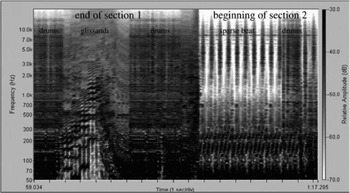
This cultural-political dynamic left richly significant rhythmic traces in the music, but they are unaddressed by Latartara, whose Old Musicological purpose is to present and valorize his musicians as “composers” in the Western art music tradition (their educational and subcultural distance from that canon notwithstanding). He positions Schaeffer, Varèse, and Xenakis as the orienting names to investigate technologically abetted music making; terms as innocuous (and as germane) as loop and techno are called “colloquial” and sectioned off with scare quotes.Footnote 57 The critical context constructed, even the typographical conventions adopted, help claim extra-institutional music for academic study in the art music tradition. But this ownership is most strongly asserted in the sonogram transcription of the music under discussion. Latartara makes a lengthy defense of this method of illustration, specifically situating it within the lineage of Schenkerian visual modeling.Footnote 58 Although the article ultimately reads as a celebration of that technique rather than of the music considered, the analyst's frequency snapshots reveal little more than basic musical structure: as in the following diagram showing Kid606's “Powerbookfiend.” Latartara simply bolts verbal description of audible musical events on to their clinical visual illustration (see Figure 1).Footnote 59
Latartara's sonogram of Kid606's “Powerbookfiend”.Footnote 60

Clearly this analytical method cannot elucidate the critical censure to which Kid606 had, by 2003, when he released the music under discussion, already been subject. Several writers and musicians identified a kind of race anxiety in his willful twisting and seeming ridicule of “black” rhythm and voice samples (the producer's response was incoherent and defensive).Footnote 61 Latartara's written commentary does no better. Kid606, the author writes, is “the most pop-influenced” of his studied “composers,” and the track analyzed uses what he calls “pop drum samples.” These “pop” samples are in fact hallowed funk breakbeats derived from “Amen, Brother” by the Winstons (Metromedia, 1969) and “Think (About It)” by Lyn Collins (People, 1972): fragments of ubiquitous musical material that, in straightforwardly looped form, had defined jungle, and—once fragmented, critiqued—separated off IDM from that supposedly “unintelligent” dance form.Footnote 62 Kid606's samples do not begin as neutral markers of pulse, and nor, in this analysis, do they end as such: Latartara writes that their more-or-less continual presence in the track examined “rhythmically unifies the entire composition,” an analytical harking back to an old organicist terminology impossible to resist even as the sonograms enact a later stage of music-analytical thinking.Footnote 63
Conclusions
Zuberi and Bonilla-Silva's formulation of white logic was challenging: “a historical posture that grants eternal objectivity to the views of elite Whites and condemns the views of non-Whites to perpetual subjectivity,” giving “centrality to the knowledge, history, science, and culture of elite White men” while classifying “‘others’ as people without knowledge, history, or science, as people with folklore but not culture.” That would be an overly forceful way of describing the work just criticized and unfair towards writers who are clearly acting to support rather than detract from African American music: and yet. Surely some of those tendencies are detectable when, for instance, musical subjectivities are deemed lacking until translated into mathematical, symbolic, or even merely peer-reviewed representations of themselves (as apparently marking the only form of meaningful knowledge); or when analysts, blindly faithful to their methodology and scientific truth regime, ignore (or remain ignorant of) musical meanings absolutely present yet not contained in the sounding facts alone; or when a cartoonish collection of scientific kit—symbolizations, sonograms, computers, improvising robots—acts as guarantor of a rigorous, objective, institutionally authorized knowledge beyond mere experience.
But some of the work discussed above is persuasive. Besides, to suggest that analytical, scientistic intelligence about black music is necessarily “white”—a more properly “black” response presumably felt and instinctive—would further reinforce the distinction between the rational and the sensual I have criticized throughout and revisit old primitivist advocacy of supposedly extra-modern African American musical practices. It would also imply, absurdly, that Eileen Southern, Kofi Agawu, Guthrie Ramsey, and other black music academics of mainstream institutional training and employ have somehow been the patsies of white supremacy. I certainly do not argue for the return to an anti-intellectual, mystified notion of “black rhythm.” Nor do I contend that African American music and musical theory or analysis are forever incompatible, or that to maintain some kind of inherent oppositionality such music should be kept and tended to outside the academy.
Given the sensitivity of these subjects, perhaps it's necessary to spell out what else I do not conclude. I do not claim that any of the contemporary writers discussed in this piece are anything other than advocates of the musical traditions they consider; they are not conservative guardians of disciplinary rectitude, or—as I hope I have underlined—malign agents of prejudice. I do not claim that the apparent (if perhaps illusory) “genetic whiteness” of these writers on African American music simply invalidates their work or renders it inherently beside the point (that would be odd, coming from me); I do not claim that there lies elsewhere a singularly correct interpretive system, but I have suggested, above and elsewhere, that the idiosyncratic interpretation of one set of cultural works within the analytical frameworks of another can be a productive as well as a problematic way of coming to terms with difference (indeed, it is probably the only way). However present that “white logic” or institutionally enacted whiteness can seem to be in some areas of music studies, those concepts need heavy qualification.
And as I’ve already noted, the difficulties here are not reducible to race alone. Were the history and politics of black-white encounters somehow removable from both world and work, many of the objections raised above would stand: the problems of translating vernacular styles into institutionally valorized symbols of themselves were some of the most extensively investigated in the early academic popular music studies of the 1980s and the ethnomusicological literature before and since.Footnote 64 Questions about such propriety, about who was asking what and why, were common in those disciplines that, in the post-Foucauldian and post-colonial era, had suddenly been confronted by questions of power's relationship to epistemology. But these questions might be asked less frequently now that moment has passed and the place of popular (often meaning “African American”) music forms in academic study is less frequently challenged, even though another reality stares us in the face: in terms of high-prestige posts and journal publications at least, those theorizing black music for a living are, more often than not, “white,” their black would-be colleagues presumably either diverted into other professions or employed in less visible musical-pedagogical contexts.Footnote 65 It's time to ask again whether the issue of scholarly rightfulness—in which questions of the ownership and revelation of knowledge are constants—is not more alive than these contemporary writings on rhythm might allow.
The present study focuses on a contemporary moment of great academic anxiety around race, and, having focused on pieces that I claim betray under-examined attitudes towards racialized scholarly power, it's important to acknowledge that music studies since the 1990s has also seen the self-conscious playing out of contrasting modes of what we might call scholarly whiteness. One rather defensive form can be seen in books by Richard Sudhalter and Randall Sandke that argue for the importance of white musicians in early jazz, figures supposedly marginalized because of the popular conception of the genre as a black music. But most turn-of-the-century examinations or performances of scholarly whiteness have been in some way critical, as is shown in different ways and contexts in work by Lawrence Kramer on Charles Ives and Theo Cateforis on Devo. There, compositional and performance techniques are shown, respectively, to assert and ironize “white” subjectivities.Footnote 66 Meanwhile, white writers of an ethnomusicological bent encountering practices and traditions identified as black—writers like Charles Keil—have sometimes chosen not to neutralize but to foreground their investigative roles and identities in their texts.Footnote 67 Even when the writer's identity is not directly addressed, it is unusual for contemporary, white-authored work on African American music to betray anything other than an empathetic, solidaristic attitude towards the subjects concerned; Ingrid Monson's ethnographic approach to her jazz musician informants and Eithne Quinn's critical discussions of gangsta rap can stand as examples.Footnote 68
These diverse works of recent years show how whiteness has been asserted and denied, but more often challenged, ironized, and, even if indirectly, undermined: white scholarly identity is by no means monolithic, and in a field in which liberal attitudes towards race and identity are notionally preeminent, many areas of music study display the kinds of political care one might expect.Footnote 69 But the analytical studies discussed earlier suggest that, these values notwithstanding, certain kinds of more “scientifically” oriented academic method might be less responsive to, or compatible with, the relativism commonly found in the postmodern humanities, and that this lack of reflexivity might lead to the new articulation of old problems, of “old” kinds of whiteness, of forms that produce themselves silently (and often unthinkingly) through the bureaucratic institution of privilege and authority.
It's striking that an old race politics is more often found to linger when methods are redolent of technocratic rather than (auto)ethnographic thinking. But I’ve argued that studies both skillful and problematic make use of similar approaches and technologies, their differences lying in attitude and self-awareness rather than basic orientation. So this assertion is neither one of righteousness, nor, really, an attack on those black musical advocates in whose work I have found fault. Rather, it is an affirmation that anyone working on musical topics must take responsibility for the racialized scholarly identities that they, we, can enact. In a different field, George Yancy has written:
It is one thing for white and Black philosophers to theorize race as an epistemologically bankrupt category. It is quite another for them to engage the issue of whiteness and Blackness in terms of what these social categories have come to mean for them personally, and how, despite their philosophical analyses of race, they existentially live the sociopolitical dimensions of their whiteness or Blackness.Footnote 70
The same is surely true of musicologists eager to critique the solecisms of distant forebears but apparently less willing to recognize similar problems in contemporary form. That might not mean that (white) analysts of (black) music must endlessly foreground their own cultural background or subjectivity. But it does mean acknowledging the tensions inherent in a Western institutional practice historically and politically encumbered in this way, a practice that is still in the twenty-first century so determinedly representative of a privileged tranche of what historically has been imagined as “white society.”
That line of thinking is central to a competing trend in the study of African American music: work that, through reading and respecting different forms and vocabularies of musical understanding in their respective socio-political contexts, engages musical-theoretical problems while remaining notably non-scientistic in outlook. Writers like Anne Danielsen, Matthew Butterfield, Robert Fink, Ingrid Monson, and Guthrie Ramsey have been concerned to move the study of music and rhythm beyond the page and into a more social space, examining the ways that multiple musical subjectivities participate in the construction of swing or groove, and asking how social settings help construct for those musical practices what might (or might not) be thought of as “extra musical” notions of associated ethnic identities and histories. Perhaps such “social” music analysis threatens at times to become as hegemonic a concept as Schenker's Urlinie. Nevertheless, in this way, Butterfield in particular has arrived at analytical descriptions of rhythmic techniques that recognize the historical “blackness” of their modes and meanings without resorting to the race fundamentalism of musical-evolutionary inherence or to performer (in)authenticity. This is “blackness as practice” rather than “blackness as essence,” Butterfield writes, alluding to a distinction of Ramsey’s.Footnote 71
But if we are ready to accept that formulation, then we must also accept that, in an academic discourse for now dominated by white scholars, some aspects of black musical analysis can look like a corresponding “whiteness as practice.” There's nothing essential about it, but when interested (white) academics participate in a tradition of musical theorizing without a keen critical awareness of that tradition's delimiting, exclusionary, and racialized past, they can't help but revoice clichés of the rhythmic and the musical, bodily and intelligent, folkloric and objective, black and white.
Also worth considering is how musicologists “practicing blackness” have sometimes framed work by white scholars that has not fully respected familiar African American stories of racial-musical becoming. Efforts on the part of white writers to unsettle historical black/white binaries—Brian Ward and Ronald Radano are the most notable figures here—have on occasion been attacked by black scholars for that very reason; the academics’ presumed cultural distance from their subject, their critics have variously charged, leads to findings either otiose or dangerous, white scholars’ impositions of a race-criticality acting perversely, but once more, to make a claim on black cultural heritage.Footnote 72 Although working from different kinds of intellectual premise, the small amount of close musical study emerging from the post-1960s Afrocentric intellectual tradition has also fostered ongoing reinforcement rather than deconstruction of cultural-intellectual “blackness,” and, necessarily, its white foil.Footnote 73 Such strategic, consolidatory maneuvers, along with reductive or regressive visions such as those studied earlier, are inevitable as long as musicological methods, literatures, and institutions continue to inscribe and reward stagings of mythically “white” abstraction, absence, observerdom, and objectivity on the one hand, mythically “black” situatedness, presence, and active subjectivity on the other. These raced oppositions are inevitable as long as Western music departments remain so monocultural in their course offerings and staffing, and perhaps as long as true social equality remains unrealized.
It's no use pretending that the grounds of this study, and the path away from it, are surer than they are. But rather than stumble over fault lines of race, surely musicologists should install themselves firmly, knowingly within them—using analytical methods identifiable with a historical “white logic” perhaps, but always situating their products within that context, engaging with “black sociality” for sure, but without letting that concept become an explanatory panacea as totalizing as any other.Footnote 74 It's only in this way that the durable but false binary signaled in this piece's title will be collapsed. Music studies, especially those dealing with African American styles and such fraught categories as the body and intelligence, can never be sufficiently abstract to be removed from the historical and present realities of race, and musicologists cannot explore sounding practices without also reproducing stifled social relations. To forget that means acting old problems and scholarly identities.