Introduction
Monazite senso lato is a widespread accessory mineral of various igneous and metamorphic rocks, some hydrothermal systems, and rarely it is an authigenic or clastic mineral in sediments. Moreover, monazite is a principal ore mineral of rare-earth elements (REE, lanthanoids), particularly Ce3+ and other REE3+ cations with larger ionic radii (‘light’ REE, especially La to Nd), the key elements in modern industry and technology. Monazite is stable over a very wide range of P–T conditions, including ultra-high-pressure diamond-bearing metamorphic rocks (e.g. Petrík et al., Reference Petrík, Janák, Klonowska, Majka, Froitzheim, Yoshida, Sasinková, Konečný and Vaculovič2019; Závada et al., Reference Závada, Štípská, Hasalová, Racek, Jeřábek, Schulmann, Kylander-Clark and Holder2021) to nearly surface authigenic associations (e.g. Čopjaková et al., Reference Čopjaková, Novák and Franců2011), it has also been described from extraterrestrial lunar rocks (Kartashov et al., Reference Kartashov, Bogatnikov, Mokhov, Gorshkov, Ashikhmina, Magazina and Koporulina2006) and Martian meteorites (Liu et al., Reference Liu, Ma, Beckett, Chen and Guan2016). Internal textures, variations of chemical composition, and alteration products of monazite reflect crystal and host-rock evolution and, therefore, monazite represents one of the most important indicators of geological processes and P-T-X conditions. Moreover, due to the common presence of radioactive Th and U in their structure, monazite is widely used in petrochronology for dating of magmatic and metamorphic processes in the parental rocks (e.g. Engi, Reference Engi, Kohn, Engi and Lanari2017).
Cerium is the dominant REE cation in almost all natural monazites, therefore, the end-member formula for its overwhelmingly most common member is expressed as CePO4. However, advanced analytical techniques since the second half of the 20th Century has also revealed monazites with different dominant REE cations (La3+, Nd3+, Sm3+ and Gd3+) or Ca2+ + Th4+ substituting for REE. Such monazite compositions with another dominant cation represent independent mineral species with proper names and end-member formulae. For the naming of essential REE minerals, the Levinson rules were approved by the Commission on New Minerals, Nomenclature and Classification of the International Mineralogical Association (IMA-CNMNC), and they have been widely used. Here, the dominant REE cation is written as a suffix of the chemical abbreviation of the dominant element (Levinson, Reference Levinson1966; Bayliss and Levinson, Reference Bayliss and Levinson1988).
Consequently, except for the most widespread monazite-(Ce) member, we have recognized several other rare monazite species with dominant La, Nd, Sm and Gd. The La-dominant composition of monazite was first noted by Borovsky and Gerasimovsky (Reference Borovsky and Gerasimovsky1945) and defined as the independent mineral monazite-(La) by Levinson (Reference Levinson1966). The Nd-dominant member was firstly described by Maksimović and Pantó (Reference Maksimović and Pantó1980), but it was approved as a new mineral monazite-(Nd) only after its crystal structure was determined (Graeser and Schwander, Reference Graeser and Schwander1987). Later, monazite-(Sm) (Masau et al., Reference Masau, Černý, Cooper, Chapman and Grice2002) and more recently monazite-(Gd) (Ondrejka et al., Reference Ondrejka, Uher, Ferenc, Majzlan, Pollok, Mikuš, Milovská, Molnárová, Škoda, Kopáčik, Kurylo and Bačík2023a, Reference Ondrejka, Uher, Ferenc, Milovská, Mikuš, Molnárová, Škoda, Kopáčik and Bačík2023b) were discovered and both have been approved as independent mineral species.
The monazite-(Ce), monazite-(La), monazite-(Nd), ‘brabantite’, cheralite, gasparite-(Ce) and rooseveltite were classified as members of the monazite group in the phosphates mineral class (Strunz and Nickel, Reference Strunz and Nickel2001) or monazite group (without rooseveltite) in the anhydrous phosphates class (Gaines et al., Reference Gaines, Skinner, Foord, Mason and Rosenzweig1997). However, a consistent nomenclature and classification system of the monazites and isostructural minerals following the CNMNC IMA rules (Mills et al., Reference Mills, Hatert, Nickel and Ferraris2009) was missing until now. This present contribution brings such recommended nomenclature of the monazite supergroup minerals including basic characterization of their members, naming rules, classification scheme, and recommended formula calculation. The new nomenclature and classification of the monazite supergroup has been approved by the International Mineralogical Association (IMA) Commission on New Minerals, Nomenclature and Classification (CNMNC) (Bosi et al., Reference Bosi, Hatert, Pasero and Mills2025).
Monazite structure and site occupancy
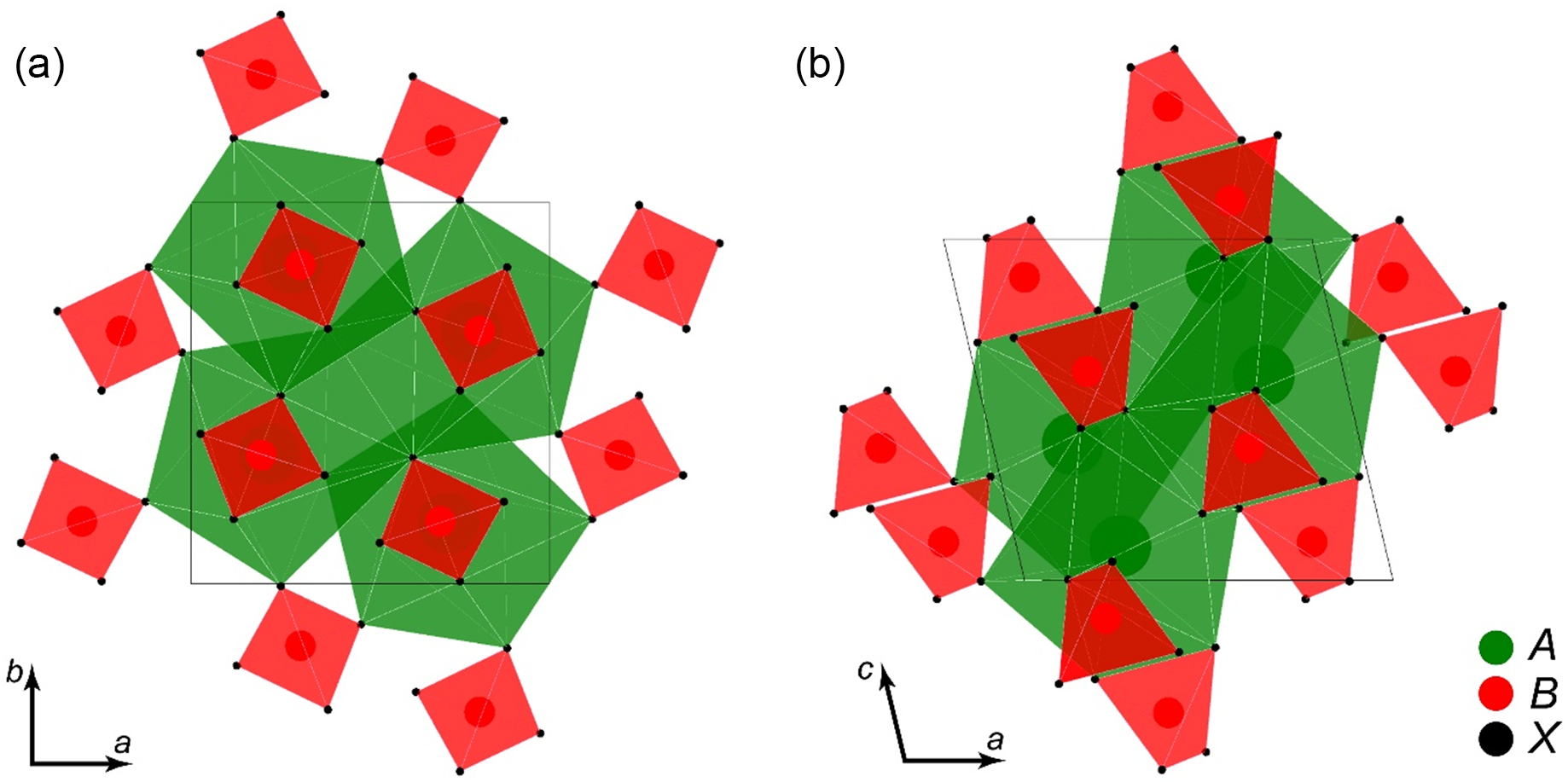
The crystal structures of the trivalent La, Ce, Pr and Nd phosphates were determined by X-ray diffraction techniques in 1944 for the Manhattan Project (Mooney, Reference Mooney1948). Monazite and isostructural minerals form compounds with general ABX 4 stoichiometry, monoclinic symmetry, space group P21/n (14), and Z = 4. The monazite-type crystal structure (Fig. 1) consists of irregular 9-coordinated cations of the A site, which are linked together by isolated distorted BX 4 tetrahedra, the AX 9 polyhedra and BX 4 tetrahedra form chains sharing X edges along the c axis, and the X atom is coordinated to one B and two A atoms (e.g. Ueda, Reference Ueda1967; Ni et al., Reference Ni, Hughes and Mariano1995; Boatner, Reference Boatner, Kohn, Rakovan and Hughes2002; Clavier et al., Reference Clavier, Podor and Dacheux2011; Zaman and Antao, Reference Zaman and Antao2020).
Monazite-type structure viewed in the (a) c- and (b) b-axis direction.

Figure 1 Long description
The diagram consists of two panels labeled (a) and (b), illustrating monazite-type crystal structures viewed along different crystallographic axes. Panel (a) shows the structure along the b-axis and a-axis, while panel (b) shows it along the c-axis and a-axis. Both panels feature a central cluster of green polyhedra representing A sites, surrounded by red polyhedra representing B sites. Red spheres indicate X anions, positioned within or near the polyhedra. Small black dots at the vertices likely represent atom positions. The polyhedra outlines suggest coordination and connectivity between the A and B sites. The legend indicates green for A, red for B and red spheres for X.
The cation and anion site occupancy of ABX 4 in the monazite-type structure minerals is the following (less represented and rare or questionable cations and anions are listed in () and [] parentheses, respectively):
A-site cations: La3+, Ce3+, Nd3+, Sm3+, Gd3+ (+ small amounts of Y3+ and other REE3+), Ca2+, Pb2+, (Sr2+), Bi3+, Th4+, U4+, (U5+, U6+), [vacancy, Na+, K+, Mg2+, Fe2+, Cu2+. Zn2+, Ni2+, Ba2+, Sc3+, Al3+, Fe3+, Sb3+, Zr4+];
B-site cations: P5+, As5+, (V5+), Si4+, (S4+), Cr6+, (S6+, Se6+, Te6+);
X-site anions: O2– (F–, OH–, S2–), [Cl–].
Naming of minerals
Monazite, the first discovered mineral of the supergroup, was described from Miass (Russia) and named by Johann Friedrich August Breithaupt (Reference Breithaupt1829) from the Greek word μουάζω (to be solitary) in allusion to the rarity of its presence in the first known occurrences. Six years before, a new mineral from Dauphiné (France) was named ‘turnerite’ by Levy (Reference Levy1823); later, ‘turnerite’ was identified as a synonym or variety of monazite (e.g. Miers, Reference Miers1885; Gliszczynski, Reference Gliszczynski1939). However, the commonly used term monazite takes precedence over the currently unused archaic term ‘turnerite’, regardless of its time priority.
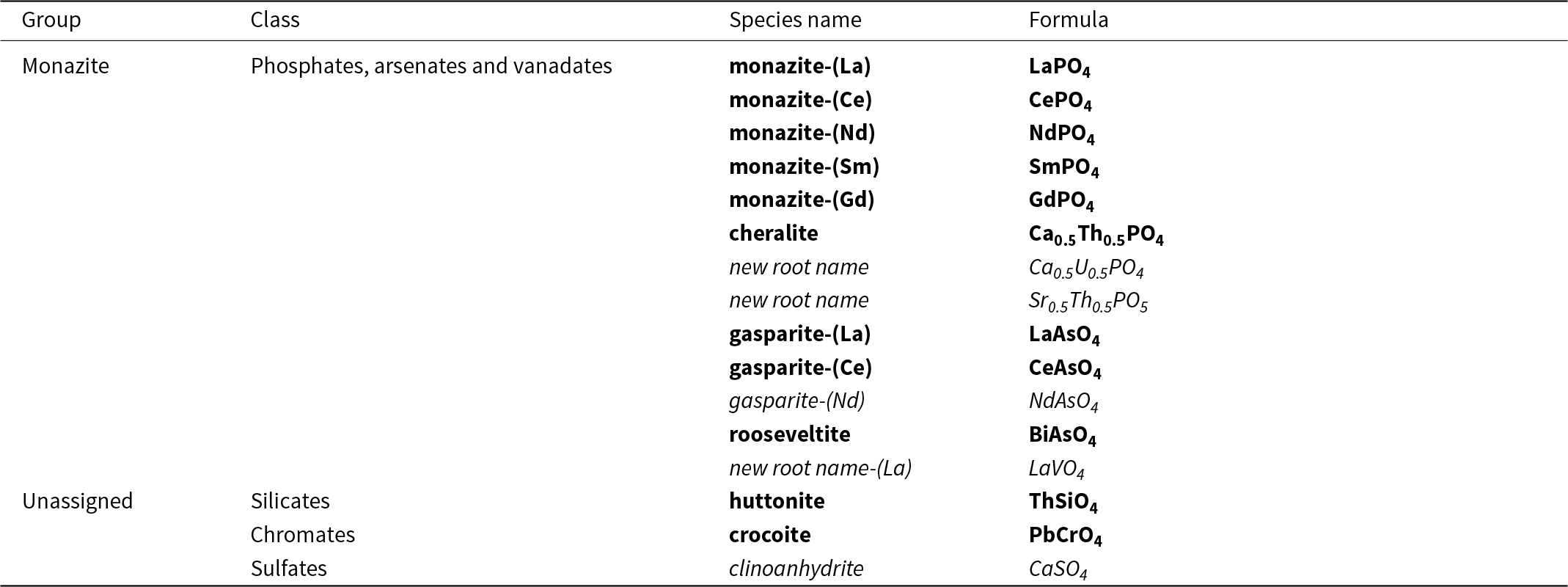
The root name monazite plus element suffixes -(La), -(Ce), -(Nd), -(Sm) and -(Gd) conform to the Levinson rule for REE phosphate minerals with the monazite-type structure and the La, Ce, etc. dominant monazite members (Levinson, Reference Levinson1966; Bayliss and Levinson, Reference Bayliss and Levinson1988). Therefore, monazite-(La), monazite-(Ce), monazite-(Nd), monazite-(Sm) and monazite-(Gd) have been described and approved as valid mineral species names up to the present (Table 1). The same method is applied for gasparite members, the REE-dominant arsenate phases with monazite-type structure: gasparite-(La) and gasparite-(Ce). Therefore, for any new mineral with the monazite-type structure and dominancy of another as previously described A-site REE cation, the root name monazite or gasparite (or new root name) plus the suffix of dominant REE abbreviation is used, for example gasparite-(Nd).
Nomenclature and classification of the monazite-supergroup minerals. Valid members are in bold font, and potential (hypothetical) members are in italics

Table 1 Long description
Group Class Species name Formula Monazite Phosphates, arsenates and vanadates monazite-(La) LaPO4 Monazite Phosphates, arsenates and vanadates monazite-(Ce) CePO4 Monazite Phosphates, arsenates and vanadates monazite-(Nd) NdPO4 Monazite Phosphates, arsenates and vanadates monazite-(Sm) SmPO4 Monazite Phosphates, arsenates and vanadates monazite-(Gd) GdPO4 Monazite Phosphates, arsenates and vanadates cheralite Ca0.5Th0.5PO4 Monazite Phosphates, arsenates and vanadates new root name Ca0.5U0.5PO4 Monazite Phosphates, arsenates and vanadates new root name Sr0.5Th0.5PO5 Monazite Phosphates, arsenates and vanadates gasparite-(La) LaAsO4 Monazite Phosphates, arsenates and vanadates gasparite-(Ce) CeAsO4 Monazite Phosphates, arsenates and vanadates gasparite-(Nd) NdAsO4 Monazite Phosphates, arsenates and vanadates rooseveltite BiAsO4 Monazite Phosphates, arsenates and vanadates new root name-(La) LaVO4 Unassigned Silicates huttonite ThSiO4 Unassigned Chromates crocoite PbCrO4 Unassigned Sulfates clinoanhydrite CaSO4
For related monazite-structure minerals without dominant REE occupancy of A site, independent root names without suffixes are applied: rooseveltite, cheralite, huttonite, crocoite, or new root names for future new members (Table 1). For a potential (hypothetical) mineral with a dominant CaSO4 molecule and monazite-type structure, the name clinoanhydrite is proposed in our nomenclature to emphasize its monoclinic symmetry and dimorphous relation to anhydrite, the orthorhombic modification of CaSO4 (see also text below).
Classification of the monazite-supergroup minerals
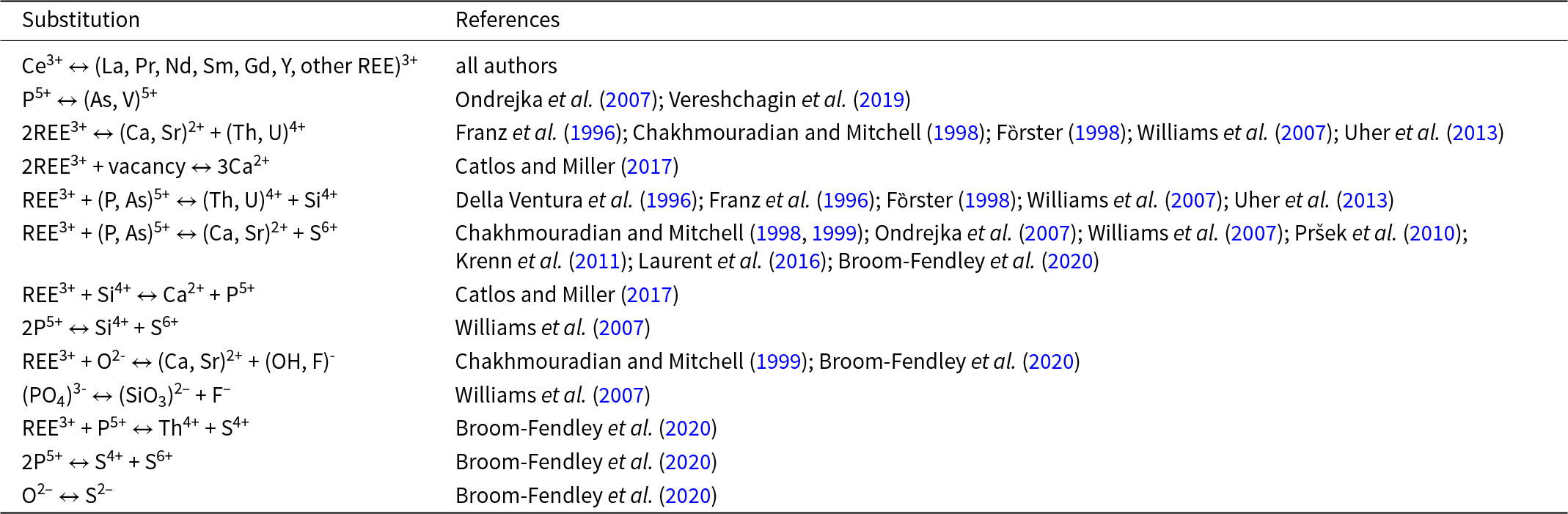
The minerals with ABX 4 stoichiometry and monazite structure contain various tetrahedrally coordinated B-site cations with the same or different valency (P5+, As5+, V5+, Si4+, Cr6+, S6+) and consequently, they belong to different mineral classes according to the system of Strunz and Nickel (Reference Strunz and Nickel2001): phosphates, arsenates, silicates, chromates and potentially also vanadates and sulfates (Table 1). Similarities of ionic radii between most A- or B-site cations enable broad isomorphic homovalent and coupled heterovalent substitutions within the monazite-type structure (Table 2). Such closely related isostructural minerals, which formally belong to several groups in various chemical classes, could be classified into the same unit, named supergroup, with the following definition (Mills et al., Reference Mills, Hatert, Nickel and Ferraris2009): “A mineral supergroup consists of two or more groups which have essentially the same structure and composed of chemically similar elements. Generally, a supergroup will contain members from the same mineral class (e.g., the epidote supergroup); however, in rare cases, a supergroup may also contain groups belonging to different classes, as for example, in the alunite supergroup. A supergroup may also contain isolated mineral species which do not belong to any mineral group, as for example, vanadinite, which is the only vanadate in the apatite supergroup”. Since the 2010s, this hierarchy between supergroup and its groups belonging to different mineral classes has been applied to several important mineral nomenclatures and classifications: the apatite (Pasero et al., Reference Pasero, Kampf, Ferraris, Pekov, Rakovan and White2010), pyrochlore (Atencio et al., Reference Atencio, Andrade, Christy, Gieré and Kartashov2010), alunite (Bayliss et al., Reference Bayliss, Kolitsch, Nickel and Pring2010), garnet (Grew et al., Reference Grew, Locock, Mills, Galuskina, Galuskin and Hålenius2013), gadolinite (Bačík et al., Reference Bačík, Miyawaki, Atencio, Cámara and Fridrichová2017), spinel (Bosi et al., Reference Bosi, Biagioni and Pasero2019), and other mineral supergroups.
The substitution mechanisms of the monazite-supergroup minerals

Table 2 Long description
Substitution References Ce3+ with (La, Pr, Nd, Sm, Gd, Y, other REE)3+ all authors P5+ with (As, V)5+ Ondrejka et al. (2007); Vereshchagin et al. (2019) 2REE3+ with (Ca, Sr)2+ + (Th, U)4+ Franz et al. (1996); Chakhmouradian and Mitchell (1998); Fȍrster (1998); Williams et al. (2007); Uher et al. (2013) 2REE3+ + vacancy with 3Ca2+ Catlos and Miller (2017) REE3+ + (P, As)5+ with (Th, U)4+ + Si4+ Della Ventura et al. (1996); Franz et al. (1996); Fȍrster (1998); Williams et al. (2007); Uher et al. (2013) REE3+ + (P, As)5+ with (Ca, Sr)2+ + S6+ Chakhmouradian and Mitchell (1998, 1999); Ondrejka et al. (2007); Williams et al. (2007); Pršek et al. (2010); Krenn et al. (2011); Laurent et al. (2016); Broom-Fendley et al. (2020) REE3+ + Si4+ with Ca2+ + P5+ Catlos and Miller (2017) 2P5+ with Si4+ + S6+ Williams et al. (2007) REE3+ + O2– with (Ca, Sr)2+ + (OH, F)- Chakhmouradian and Mitchell (1999); Broom-Fendley et al. (2020) (PO4)3– with (SiO3)2– + F– Williams et al. (2007) REE3+ + P5+ with Th4+ + S4+ Broom-Fendley et al. (2020) 2P5+ with S4+ + S6+ Broom-Fendley et al. (2020) O2– with S2– Broom-Fendley et al. (2020)
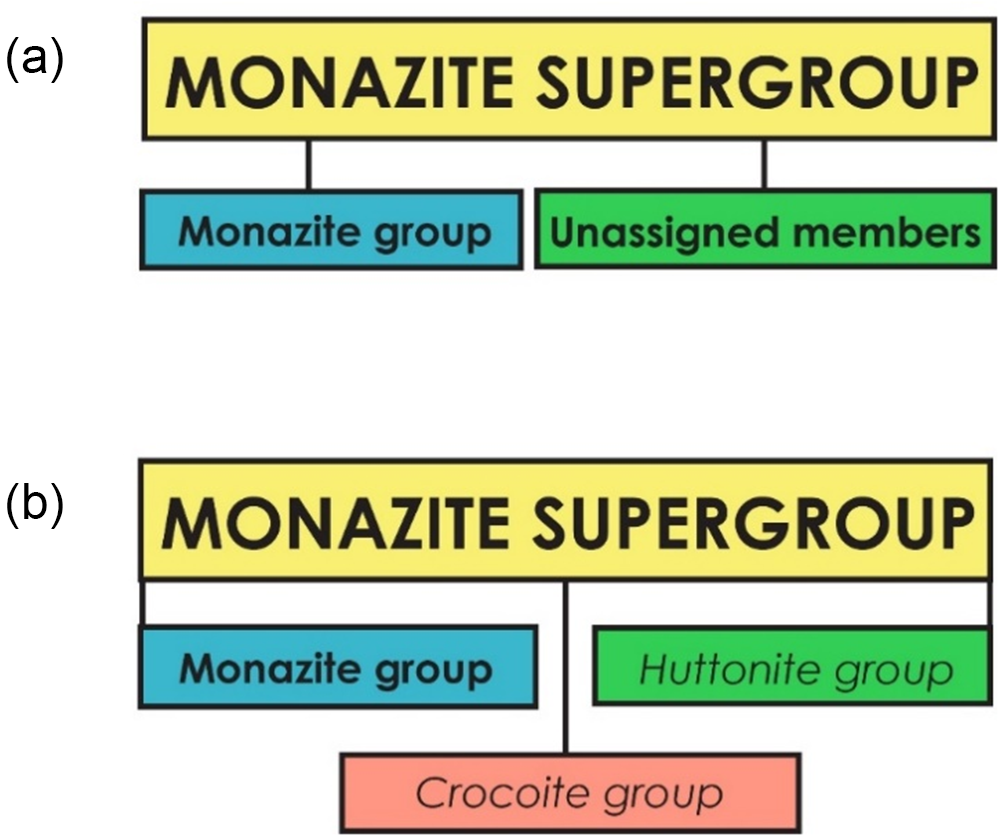
Consequently, the newly defined monazite supergroup (Table 1, Fig. 2) includes the monazite group (phosphates, arsenates, vanadates) and unassigned members huttonite (silicates) and crocoite (chromates, sulfates). The group is defined by the charge of the cation at the B site and corresponding mineral class, which is following dividing into mineral species (Table 1). Because only one possible group with B occupied by a cation with a charge of +5 contains more than one valid mineral species, only the monazite group can be defined now. However, other hypothetical groups can be established, including the huttonite (B = 4+) or crocoite groups (B = 6+), if additional new members are described with a composition meeting the classification criteria (Fig. 2).
Classification scheme of the monazite supergroup: (a) with a currently defined group and unassigned members; and (b) with hypothetical groups.

Some aspects of natural monazite-supergroup chemical composition
A site: REE, Zr and Sc
The monazite-type structure is accommodated for the preferable implementation of REE with larger ionic radii (‘light’ REE, mainly La to Nd) and with nine-fold coordination with oxygen anions in contrast to eight-fold coordinated REE cations in the tetragonal zircon-type structure (Ushakov, Reference Ushakov, Helean, Navrotsky and Boatner2001; Boatner, Reference Boatner, Kohn, Rakovan and Hughes2002; Clavier et al., Reference Clavier, Podor and Dacheux2011). Consequently, synthetic La to Gd orthophosphates, La to Nd arsenates, and LaVO4 are stable monazite-structure compounds, and Tb to Ho orthophosphates and Ce to Nd vanadates are rather metastable in this structure (Kolitsch and Holtstam, Reference Kolitsch and Holtstam2004; Clavier et al., Reference Clavier, Podor and Dacheux2011, and references therein). Chemical compositions of natural monazites and gasparites are in accordance with this behaviour, and mineral species with dominant LaPO4 to GdPO4, LaAsO4 and CeAsO4 molecules have been described. Moreover, the composition corresponding to Nd-dominant gasparite (NdAsO4) with the empirical formula [(Nd0.60Pr0.19Ca0.09La0.06Y0.03Ce0.02Th0.01Gd0.01)Σ0.98(As0.94V0.07)Σ1.01O4] is also known (Cabella et al., Reference Cabella, Lucchetti and Marescotti1999).
Miscibility between larger (‘light’, La3+ to Eu3+) and smaller (‘heavy’, Gd3+ to Lu3+ and Y3+) REE cations increases and the miscibility gap decreases, with the growth of temperature, and this phenomenon is successfully applied as a geothermometer (Heinrich et al., Reference Heinrich, Andrehs and Franz1997; Gratz and Heinrich, Reference Gratz and Heinrich1997, Reference Gratz and Heinrich1998; Pyle et al., Reference Pyle, Spear, Rudnick and McDonough2001; Mogilevsky, Reference Mogilevsky2007). Consequently, the monazites, which originated under high-temperature conditions, can accommodate more Y and other smaller REE3+ cations in their structure. For example, monazite-(Ce) from high-temperature granulite contains 21–42 mol.% of the (Y, HREE)PO4 component [6.5–14 wt.% Y2O3, 6–11 wt.% (Gd–Yb)2O3], which corresponds to the minimum precipitation temperature of ca. 1050°C (Krenn and Finger, Reference Krenn and Finger2010).
Low contents of zirconium (up to 0.02 Zr atoms per formula unit, ≤0.9 wt.% ZrO2) have been documented rarely in several electron probe microanalyses of monazite-(Nd) (Graeser and Schwander, Reference Graeser and Schwander1987), monazite-(Ce) (Bea, Reference Bea1996; Santos et al., Reference Santos, Conceição, Leandro and Rosa2018) and monazite-(Sm) (Masau et al., Reference Masau, Černý, Cooper, Chapman and Grice2002). Such relatively low Zr concentrations are limited by the relatively small size of the Zr4+ ionic radius for its effective accommodation in the monazite-type structure. The even smaller Sc3+ cation is usually below the detection limit of the WDS analyses of monazites.
A site: Actinides (Th, U), Ca, Sr and Pb
Some members of the monazite supergroup commonly contain appreciable contents of the actinide elements, thorium and uranium. In huttonite, Th4+ is an essential cation and, together with Ca2+ in cheralite, can be an important substituent in monazite-(Ce), which commonly forms a solid solution with both huttonite and cheralite (e.g. Kucha, Reference Kucha1980; Della Ventura et al., Reference Della Ventura, Mottana, Parodi, Raudsepp, Bellatreccia, Caprilli, Rossi and Fiori1996; Förster, Reference Förster1998).
Concentrations of uranium, on the other hand, are usually relatively low due to the restricted accommodation of a smaller U4+ cation into the monazite structure in comparison with the larger Th4+cation. The content of U in magmatic and metamorphic monazites reaches usually up to 1 wt.% UO2 (below 0.01 U atoms per formula unit). However, some accessory monazite-(Ce) in pegmatites and granites contain high amounts of uranium (∼5 to 16 wt.% UO2, Gramaccioli and Segalstad, Reference Gramaccioli and Segalstad1978; Mannucci et al., Reference Mannucci, Diella, Gramaccioli and Pilati1986; Bea, Reference Bea1996; Uher et al., Reference Uher, Plašienka, Ondrejka, Hraško and Konečný2013), even up to 23.1 wt.% UO2 or ≤0.21 U apfu (Pérez-Soba et al., Reference Pérez-Soba, Villaseca, Orejana and Jeffries2014). Such monazite-(Ce) shows incorporation of the U4+ cation mainly through the Ca0.5U0.5PO4 molecule, a uranium-analogue of cheralite (Gramaccioli and Segalstad, Reference Gramaccioli and Segalstad1978; Uher et al., Reference Uher, Plašienka, Ondrejka, Hraško and Konečný2013; Pérez-Soba et al., Reference Pérez-Soba, Villaseca, Orejana and Jeffries2014). Besides dominant U4+, part of the uranium in monazite could be present in U5+ and U6+ form (up to 22 % of total U cation; Puchkova et al., Reference Puchkova, Bogdanov and Gieré2016).
Natural monazites usually show no irradiation-induced amorphization of the crystal structure (metamictization) due to radioactive decay of Th and U admixtures, a phenomenon common in zircon and other actinide-bearing minerals. The ability of the monazite structure for α-healing, a mechanism of defect recovery due to the electronic energy loss of α particles (4He nuclei), explains the absence of the monazite structure amorphization (Seydoux-Guillaume et al., Reference Seydoux-Guillaume, Deschanels, Baumier, Neumeier, Weber and Peuget2018) and its gradual structural restoration by the 4He ions (Nasdala et al., Reference Nasdala, Akhmadaliev, Burakov, Chanmuang and Škoda2020).
Calcium in monazite (as Ca2+ cation) is usually accommodated via a coupled CaThREE–2 cheralite substitution. Monazite rich in Ca and Th (sometimes referred to as cheralitic monazite) and cheralite itself are relatively common accessory minerals in granitic pegmatites and aplites (e.g. Gramaccioli and Segalstad, Reference Gramaccioli and Segalstad1978; Bea, Reference Bea1996; Förster, Reference Förster1998; Pérez-Soba et al., Reference Pérez-Soba, Villaseca, Orejana and Jeffries2014; Uher et al., Reference Uher, Kohút, Ondrejka, Konečný and Siman2014; Sobocký et al., Reference Sobocký, Ondrejka, Uher, Mikuš and Konečný2020). Some Ca-rich and Th,U-low monazites suggest Ca accommodation via Ca3REE–2 and/or CaPREE–1Si–1 substitution mechanisms (Catlos and Miller, Reference Catlos and Miller2017).
The Sr2+ cation rarely occurs in the monazite-group minerals, it attains up to 8.7 wt.% SrO or 0.18 apfu Sr (Chakhmouradian and Mitchell, Reference Chakhmouradian and Mitchell1998, Reference Chakhmouradian and Mitchell1999; Del Blanco et al., Reference Del Blanco, Costas Ulbrich, Echeveste and Vlach1998; Bulakh et al., Reference Bulakh, Nesterov, Zaitsev, Pilipiuk, Wall and Kirillov2000; Pršek et al., Reference Pršek, Ondrejka, Bačík, Budzyń and Uher2010; Nikolenko et al., Reference Nikolenko, Redina, Doroshkevich, Prokopyev, Ragozin and Vladykin2018; Broom-Fendley et al., Reference Broom-Fendley, Smith, Andrade, Ray, Banks, Loye, Atencio, Pickles and Wall2020). These Sr-rich monazite-(Ce) compositions also show an usually elevated content of sulfur in (SO4)2– form (see below) and represent metamorphic, hydrothermal, or low-temperature secondary monazite in specific lithologies, such as carbonatites, kimberlites, or magnetite-rich metamorphic rocks.
Moreover, a composition with a dominant Sr0.5Th0.5PO4 molecule and empirical formula (Sr0.20Ca0.12Th0.32)Σ0.64(Ce0.22Nd0.08Pr0.04La0.01)Σ0.35P1.00O4 was described as a low-temperature secondary mineral in carbonatite (Chakhmouradian and Mitchell, Reference Chakhmouradian and Mitchell1998).
The concentration of Pb in monazite members is usually negligible (up to 0.5 wt.% PbO). The isotopic composition of Pb in the monazite-group minerals indicates it is almost completely radiogenic isotopes (206Pb, 207Pb, and 208Pb), products of U and Th radioactive decay, whereas the content of non-radiogenic lead (204Pb isotope) is very low, usually less than 1 μg.g–1 or ppm (Parrish, Reference Parrish1990; Montel et al., Reference Montel, Foret, Veschambre, Nicollet and Provost1996). Consequently, old Archean to Proterozoic monazites, especially Th- and U-rich, could contain a significant content of Pb, for example up to 3.7 wt.% PbO for 2.4 Ga old metamorphic monazite-(Ce) with 28 wt.% ThO2 and 1.2 wt.% UO2 (Zhu and OʼNions, Reference Zhu and OʼNions1999). In rare cases, a relatively high Pb content (up to 0.5 wt.% PbO) in Th-poor monazite-(Ce) indicates a presence of non-radiogenic (‘common’) Pb, entered the monazite structure as the PbSO4 molecule (Krenn et al., Reference Krenn, Putz, Finger and Paar2011). Similarly, high lead content in U,Th-poor rooseveltite (up to 6.4 wt.% PbO; Krinov et al., Reference Krinov, Azarova, Struzhkov, Natalenko and Radchenko2011) represents undoubtedly a non-radiogenic lead, most probably incorporated as the Pb2+ cation in the structure. A divalent A-site Pb2+ cation in the monazite structure has been documented by XANES and XPS studies (Dubrail et al., Reference Dubrail, Farges, Gautron, Harfouche, Borca and Grolimund2009; Tang et al., Reference Tang, Li, Zhang, Wang, Gu, Ling, Fei and Li2020).
A site: Fe, Al, and other elements
Some electron probe microanalyses of the monazite-group minerals reported elevated contents of Fe. These monazite analyses contain ∼0.5 to 9.6 wt.% FeO (up to 0.31 Fe apfu; e.g. Bulakh et al., Reference Bulakh, Nesterov, Zaitsev, Pilipiuk, Wall and Kirillov2000; Janots et al., Reference Janots, Negro, Brunet, Goffé, Engi and Bouybaouène2006; Pršek et al., Reference Pršek, Ondrejka, Bačík, Budzyń and Uher2010; Bowins and Crocket, Reference Bowins and Crocket2011; Čopjaková et al., Reference Čopjaková, Novák and Franců2011; Starijaš Mayer et al., Reference Starijaš Mayer, Krenn and Finger2014; Enkhbayar et al., Reference Enkhbayar, Seo, Choi, Lee and Batmunkh2016; Broom-Fendley et al., Reference Broom-Fendley, Smith, Andrade, Ray, Banks, Loye, Atencio, Pickles and Wall2020). However, calculation of such Fe-rich compositions gave usually non-stoichiometric formulae with an apparent excess of A-site cations (commonly ΣA-cations attain 1.1 to 1.2 apfu), corresponding roughly to the Fe content. Consequently, the presence of micro- to nanoinclusions of Fe-(hydro)oxide phases or Fe-bearing minerals [e.g. allanite-(Ce), Starijaš Mayer et al., Reference Starijaš Mayer, Krenn and Finger2014] is the most plausible explanation of such high iron content in the monazites measured.
Analyses of monazite-(Ce) and monazite-(La) infrequently also show an elevated content of aluminium with Al2O3 values reaching 0.5 to 1.4 wt.% (Bea, Reference Bea1996; Bulakh et al., Reference Bulakh, Nesterov, Zaitsev, Pilipiuk, Wall and Kirillov2000; Čopjaková et al., Reference Čopjaková, Novák and Franců2011; Starijaš Mayer et al., Reference Starijaš Mayer, Krenn and Finger2014; Santos et al., Reference Santos, Conceição, Leandro and Rosa2018), rarely up to 6.7 wt.% Al2O3 (Janots et al., Reference Janots, Negro, Brunet, Goffé, Engi and Bouybaouène2006; Bowins and Crocket, Reference Bowins and Crocket2011). Similarly, as in the case of Fe, a small Al3+ cation is not incorporated in the monazite structure, and admixture of some Al-rich minerals is the most probable reason for elevated measured Al in monazite. For example, an admixture of closely associated allanite-(Ce) caused high Al content in monazite (Starijaš Mayer et al., Reference Starijaš Mayer, Krenn and Finger2014).
Magnesium (0.1–0.8 wt.% MgO; 0.01–0.05 apfu Mg) and Na (0.1–0.2 wt.% Na2O; ≤0.01 apfu Na) were detected in monazite-(Ce) from the NWA 7034 Martian regolith breccia meteorite (Liu et al., Reference Liu, Ma, Beckett, Chen and Guan2016). Sulfatian Sr-enriched monazite-(Ce) contains up to 0.3 wt.% Na2O (Enkhbayar et al., Reference Enkhbayar, Seo, Choi, Lee and Batmunkh2016; Broom-Fendley et al., Reference Broom-Fendley, Smith, Andrade, Ray, Banks, Loye, Atencio, Pickles and Wall2020). Moreover, 0.7 wt.% K2O (0.04 apfu K) was detected in U-rich monazite-(Ce) from a granitic pegmatite (Gramaccioli and Segalstad, Reference Gramaccioli and Segalstad1978).
Arsenate minerals of the monazite group sometimes display 0.1 to 3.3 oxide wt.% of Pb, Fe, Ni, Co, Cu and Zn (rooseveltite: Krinov et al., Reference Krinov, Azarova, Struzhkov, Natalenko and Radchenko2011; Sejkora et al., Reference Sejkora, Pauliš, Gramblička, Malíková, Pour, Dolníček, Ulmanová and Vrtiška2019), or Mn [1.3 wt.% MnO, 0.05 apfu Mn in gasparite-(La), Vereschagin et al., Reference Vereshchagin, Britvin, Perova, Brusnitsyn, Polekhovsky, Shilovskikh, Bocharov, van der Burgt, Cuchet and Meisser2019], probably in the form of divalent cations in A site. However, they could be also related to micro- or nano-inclusions of various minerals.
B site: V, Cr and S
Valid members of the monazite supergroup minerals (Table 1) are usually phosphates and arsenates, rarely silicates (huttonite) and chromates (crocoite). Some gasparite compositions also revealed high contents of V5+, replacing dominant As5+ and P5+ in the B site, as in vanadium-rich gasparite-(La) with up to 11.2 wt.% V2O5 (∼0.3 apfu V; Cabella et al., Reference Cabella, Lucchetti and Marescotti1999; Vereshchagin et al., Reference Vereshchagin, Britvin, Perova, Brusnitsyn, Polekhovsky, Shilovskikh, Bocharov, van der Burgt, Cuchet and Meisser2019).
Crocoite, PbCrO4 (Beudant Reference Beudant1832) represents the only known chromate mineral with a monazite-type structure. Its structural identity with monazite has been known for a long time (Gliszczynski, Reference Gliszczynski1939; Effenberger and Pertlik, Reference Effenberger and Pertlik1986; Errandonea et al., Reference Errandonea, Muñoz, Rodríguez-Hernández, Proctor, Sapiña and Bettinelli2015). However, natural crocoite shows near end-member composition without recognized elevated contents of REE, P, As or other elements typical for members of the monazite-supergroup minerals and their possible solid solution is probably very restricted, apparently due to relatively different Pb2+ and Cr6+ versus REE3+ (Th4+, U4+, Ca2+, Bi3+) and P5+ (As5+, V5+, Si4+) ionic radii. Dissimilar parental lithologies also play a role; crocoite occurs in oxidation zones of sulfidic minerals with the influence of (ultra)basic Cr-rich rocks, whereas other monazite-structure minerals are found usually in Cr-poor felsic rocks (mainly granites, pegmatites, carbonatites, metamorphic rocks).
Sulfur is not a common substituent in natural monazite-structure minerals. However, this B-site element has been repeatedly determined in secondary, hydrothermal, or low-temperature monazite-(Ce), from altered carbonatites, kimberlites, rhyolites, quartz veins, and various ore-bearing metamorphic assemblages in concentration up to 11.2 wt.% SO3 or ≤0.30 apfu S (Chakhmouradian and Mitchell, Reference Chakhmouradian and Mitchell1999; Bulakh et al., Reference Bulakh, Nesterov, Zaitsev, Pilipiuk, Wall and Kirillov2000; Ondrejka et al., Reference Ondrejka, Uher, Pršek and Ozdín2007; Repina, Reference Repina2008; Pršek et al., Reference Pršek, Ondrejka, Bačík, Budzyń and Uher2010; Krenn et al., Reference Krenn, Putz, Finger and Paar2011; Enkhbayar et al., Reference Enkhbayar, Seo, Choi, Lee and Batmunkh2016; Nikolenko et al., Reference Nikolenko, Redina, Doroshkevich, Prokopyev, Ragozin and Vladykin2018; Broom-Fendley et al., Reference Broom-Fendley, Smith, Andrade, Ray, Banks, Loye, Atencio, Pickles and Wall2020). Moreover, a slightly elevated S content was also determined in primary magmatic monazite where it is probably connected with a specific oxidized environment during its crystallization from a melt with higher oxygen fugacity (fO2) and S activity (Ondrejka et al., Reference Ondrejka, Broska, Uher, Kohút, Putiš and Konečný2013).
The sulfur in monazite occurs in the sulfate form (S6+O4)2– replacing P, As, or Si along the REE3+ + (P, As)5+ ↔ (Ca, Sr)2+ + S6+ or 2P5+ ↔ Si4+ + S6+ substitutions (Table 2). The monoclinic CaSO4 compound with the monazite structure was synthesized at high pressure (over 2 GPa) and room to high-temperature experiments (e.g. Borg and Smith, Reference Borg and Smith1975, Crichton et al., Reference Crichton, Parise, Antao and Grzechnik2005; Ma et al., Reference Ma, Zhou, He, Li, Yang, Cui and Zou2007; Bradbury and Williams, Reference Bradbury and Williams2009; Gracia et al., Reference Gracia, Beltrán, Errandonea and Andrés2012). In addition to the mentioned predominant sulfate form, the X-ray photoelectron spectroscopy measurements also indicate a subordinate presence of four-valent sulfur in the sulfite anionic group (S4+O3)2–, possibly along the 2P5+ ↔ S4+ + S6+ substitution in sulfur-rich monazite-(Ce) (Broom-Fendley et al., Reference Broom-Fendley, Smith, Andrade, Ray, Banks, Loye, Atencio, Pickles and Wall2020; Table 2).
X site: Fluorine, hydroxyl and sulfide anions
Oxygen is the fairly dominant anion of the monazite-structure X-site position. However, some electron probe microanalyses of monazite-(Ce), gasparite-(Ce) and huttonite revealed a noticeable amount of the fluorine anion, replacing oxygen, 0.4–1.5 wt.% or ≤0.2 apfu F (Kucha, Reference Kucha1980; Andreoli et al., Reference Andreoli, Smith, Watkeys, Moore, Ashwal and Hart1994; Baldwin et al., Reference Baldwin, Bowring, Williams and Mahan2006; Ondrejka et al., Reference Ondrejka, Uher, Pršek and Ozdín2007; Hetherington and Harlov, Reference Hetherington and Harlov2008; Bowins and Crocket, Reference Bowins and Crocket2011; Catlos and Miller, Reference Catlos and Miller2017; Broska and Kubiš, Reference Broska and Kubiš2018; Santos et al., Reference Santos, Conceição, Leandro and Rosa2018; Broom-Fendley et al., Reference Broom-Fendley, Smith, Andrade, Ray, Banks, Loye, Atencio, Pickles and Wall2020; Maraszewska et al., Reference Maraszewska, Broska, Kurylo and Konečný2023). The presence of a hydroxyl anion in natural monazite causes defects attributed mainly to post-crystallization hydration of a radiation-damaged structure, along with heterovalent substitution (Abe et al., Reference Abe, Kuribayashi and Nakamura2017). The entry of F– or (OH)– anions into structure of the monazite-supergroup minerals has been explained by the REE3+ + O2– ↔ (Ca, Sr)2+ + (OH, F)– (Chakhmouradian and Mitchell, Reference Chakhmouradian and Mitchell1999; Broom-Fendley et al., Reference Broom-Fendley, Smith, Andrade, Ray, Banks, Loye, Atencio, Pickles and Wall2020) or (PO4)3– ↔ (SiO3)2- + F– (Williams et al., Reference Williams, Jercinovic and Hetherington2007) substitution mechanisms (Table 2). The X-ray photoelectron spectroscopy also reveals a rare presence of sulfide (S2–) anion in monazite-(Ce), possibly along the O2– ↔ S2– substitution (Broom-Fendley et al., Reference Broom-Fendley, Smith, Andrade, Ray, Banks, Loye, Atencio, Pickles and Wall2020; Table 2).
Calculation of monazite-supergroup mineral formulae
The ABX 4 stoichiometry of the monazite-supergroup minerals enables the following procedures for the calculation of chemical analyses (in wt.%) into the mineral formulae (in apfu):
(1) Normalization on the basis of 4 oxygen atoms (X = 4 O).
(2) Normalization on the basis of (A + B) = 2 cations.
(3) Normalization on the basis of B = 1 cation.
(4) Normalization on the basis of A = 1 cation.
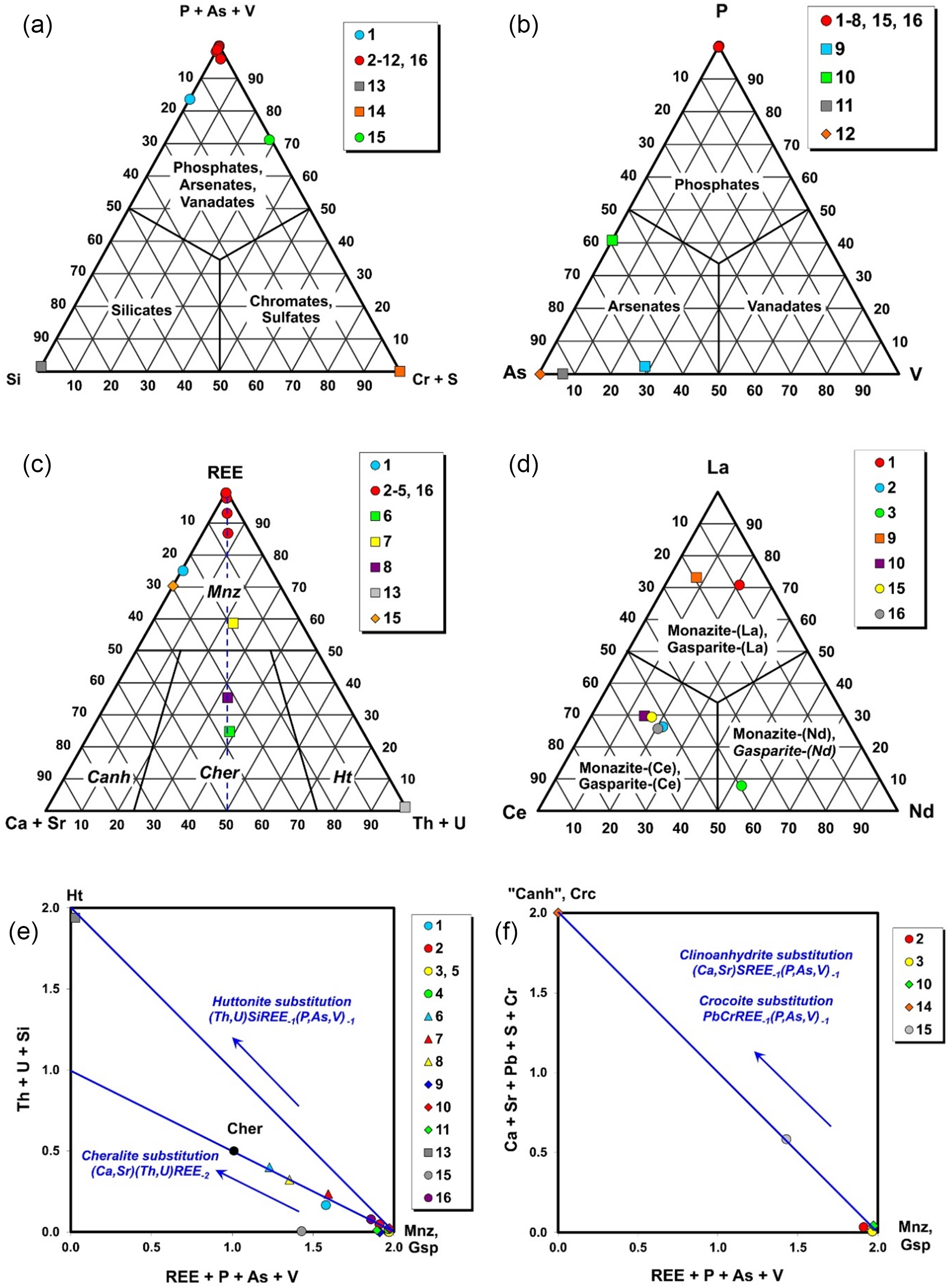
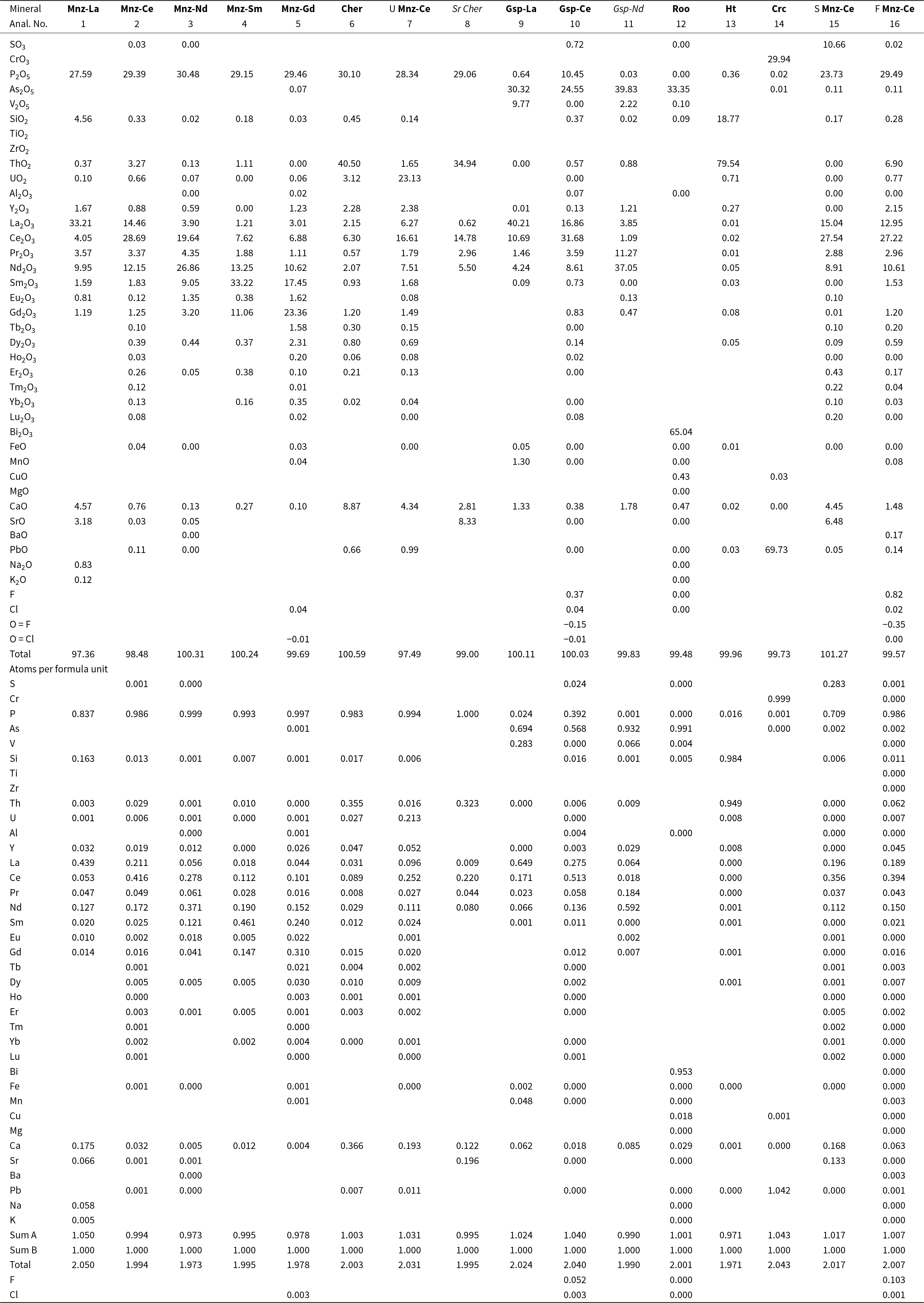
Procedure (1) is recommended for most of the monazite-supergroup members where nearly the whole X-anion site is occupied by O2– and the content of other anions (F–, OH– and S2–) is negligible. However, procedures (2) to (4) are suitable for monazite compositions with the presence of the above-mentioned anions other than O2–. If some additional A-site elements are possibly present but were not analysed (e.g. some REE, especially in older analyses), we recommend using the procedure (3), based on the sum of the B-site cations (P5+, As5+, V5+, Si4+, S6+, Cr6+, etc.). Conversely, procedure (4) is recommended when some smaller amount of the B-site element (e.g. As and V in phosphate members) is expected but missing in the given analysis. The monazite-supergroup minerals have Z = 4 (number of chemical formula units per one unit cell); therefore, all above-mentioned calculations can be multiplied by 4, and the formulae will be based on 16 oxygen atoms (1), (A + B) = 8 cations (2), B = 4 cations (3), or A = 4 cations (4). Representative chemical analyses of the monazite-supergroup minerals with their formula calculation (based on B = 1 cation) are in Appendix 1, and the proposed classification and substitution diagrams of the monazite-supergroup minerals are shown in Fig. 3.
Moreover, molecular amounts of the monazite (super)group end-members can be calculated, especially for common magmatic and metamorphic monazite-(Ce) with detectable contents of Si, Th and Ca (huttonite and cheralite components). The procedure for such mole fraction calculation is described in Pyle et al. (Reference Pyle, Spear, Rudnick and McDonough2001).
The proposed classification and substitution diagrams of the monazite-supergroup minerals. The numbers correspond to the analyses in Appendix 1.

Figure 3 Long description
The proposed classification and substitution diagrams of the monazite-supergroup minerals. The numbers correspond to the analyses in Appendix 1. The image A showing a ternary diagram for monazite supergroup classification with corners labeled P plus As plus V, Si and Cr plus S, representing phosphate, arsenate, vanadate, silicate, chromate and sulfate proportions (0 to 100 percent). Points mainly cluster in the Phosphates field, with some in Chromates/Sulfates. The image B showing a ternary diagram with corners labeled P, As and V, representing phosphate, arsenate and vanadate proportions. Points are concentrated in the Phosphates field. The image C showing a ternary diagram with corners labeled REE, Ca plus Sr and Th plus U, representing rare earth elements, calcium plus strontium and thorium plus uranium proportions. Points cluster in the Mnz (monazite) field, with some spread toward Canh (cheralite) and Cher (huttonite). The image D showing a ternary diagram with corners labeled La, Ce and Nd, representing lanthanum, cerium and neodymium proportions. Points are mainly in the Monazite La and Gasparite La fields. The image E showing a line graph with x-axis labeled REE plus P plus As plus V and y-axis labeled Th plus U plus Si, representing rare earth elements, phosphate, arsenate, vanadate, thorium, uranium and silicon. Arrows indicate Huttonite and Cheralite substitution trends. Points cluster near Mnz and Gsp (gasparite). The image F showing a line graph with x-axis labeled REE plus P plus As plus V and y-axis labeled Ca plus Sr plus Pb plus Th plus U, representing rare earth elements, phosphate, arsenate, vanadate, calcium, strontium, lead, thorium and uranium. Arrows indicate Clinoanhydrite and Crocoite substitution trends. Points are near Mnz and Gsp. These diagrams illustrate compositional fields and substitution mechanisms in monazite supergroup minerals.
Valid, potential, and discredited members of the monazite supergroup
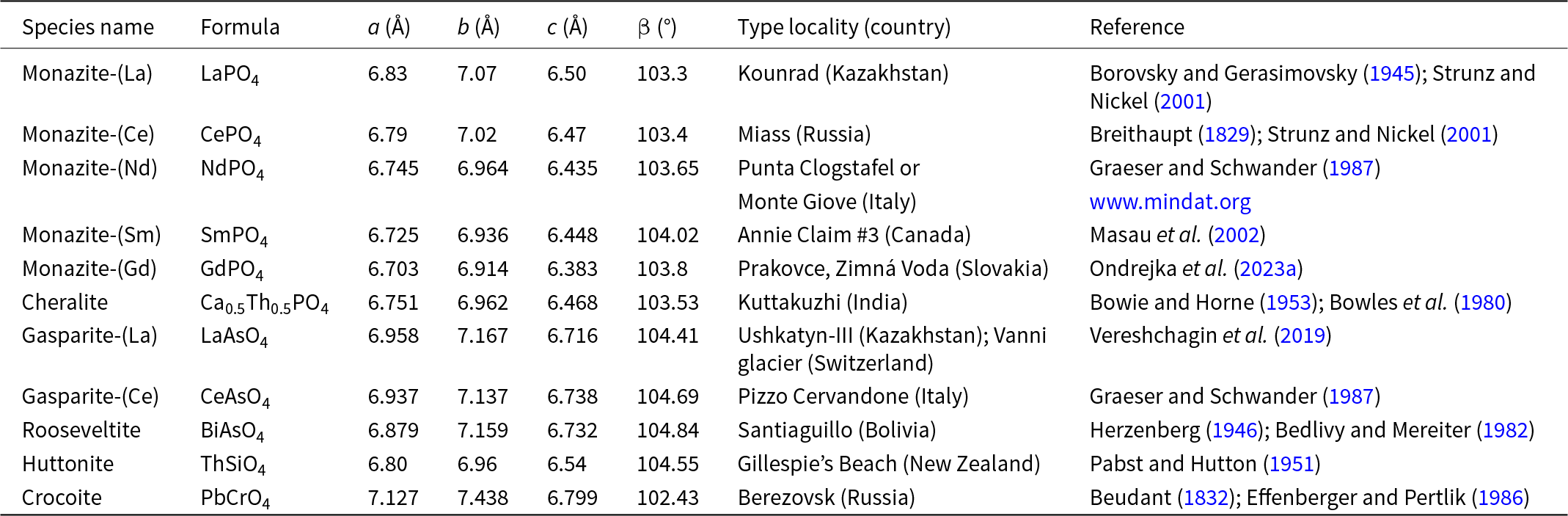
The following eleven valid mineral species of the monazite supergroup are known (see List of minerals at www.cnmnc.units.it/imalist.htm [accessed on July 1, 2026]): monazite-(La), monazite-(Ce), monazite-(Nd), monazite-(Sm), monazite-(Gd), cheralite, gasparite-(La), gasparite-(Ce), rooseveltite, huttonite, and crocoite (Table 3). Rooseveltite, huttonite and crocoite are grandfathered minerals, cheralite is a redefined member, monazite-(Ce) and monazite-(La) are renamed species, while monazite-(Nd), monazite-(Sm), monazite-(Gd), gasparite-(La) and gasparite-(Ce) are IMA approved mineral species. In addition, mineral analyses and synthesized compounds indicate the potential existence of several other new members (mineral species) of the monazite supergroup in natural environments. They include at least minerals with Ca0.5U0.5PO4 (U-analogue of cheralite), Sr0.5Th0.5PO4 (Sr-analogue of cheralite), NdAsO4 [gasparite-(Nd)], LaVO4 [vanadate analogue of monazite-(La) or gasparite-(La)], and CaSO4 (clinoanhydrite), a monazite-structured dimorph of anhydrite) end-member compositions, see above paragraphs. Minerals of the monazite supergroup discredited by the CNMNC IMA include ‘brabantite’, ‘cheralite-(Ce)’, and ‘tombarthite-(Y)’. ‘Brabantite’ was originally described and approved as a new mineral with the end-member formula CaTh[PO4]2 (Rose, Reference Rose1980). However, it represents only a synonym of cheralite, the previously described mineral (Bowie and Horne, Reference Bowie and Horne1953). Consequently, according to the IMA rules, the name cheralite has priority over ‘brabantite’, which was later discredited (Linthout, Reference Linthout2007). Moreover, ‘cheralite-(Ce)’ with suffix ‘-(Ce)’ was also discredited as a separate mineral species because Ce or other REE is not a dominant (essential) element in its end-member formula and the mineral denoted as ‘cheralite-(Ce)’ (e.g. Förster, Reference Förster1998) represents only Ca-Th-rich monazite-(Ce) composition (Burke, Reference Burke2006). Consequently, the term cheralite (without the suffix) is the only valid mineral name with the dominant Ca0.5Th0.5PO4 end-member formula. ‘Tombarthite-(Y)’, originally named ‘tombarthite’, was described and approved by IMA as a new mineral, hydrated silicate of dominant Y [approximately with (Y,REE,Ca,Fe,Mn,Th)(Si,H4)4(O,OH)4 formula], with unit-cell parameters similar to monazite (Neumann and Nilssen, Reference Neumann and Nilssen1968). However, a recent study of the ‘tombarthite-(Y)’ neotype material revealed its mixture character with dominant thalénite-(Y), xenotime-(Y), and kainosite-(Y), and consequently ‘tombarthite-(Y)’ was discredited as a valid mineral (Friis, Reference Friis2018).
Valid mineral species of the monazite supergroup and their basic data

Table 3 Long description
Species name Formula a (Å) b (Å) c (Å) β (°) Type locality (country) Reference monazite-(La) LaPO4 6.83 7.07 6.50 103.3 Kounrad (Kazakhstan) Borovsky and Gerasimovsky (1945); Strunz and Nickel (2001) monazite-(Ce) CePO4 6.79 7.02 6.47 103.4 Miass (Russia) Breithaupt (1829); Strunz and Nickel (2001) monazite-(Nd) NdPO4 6.745 6.964 6.435 103.65 Punta Clogstafel or Graeser and Schwander (1987) monazite-(Nd) NdPO4 6.745 6.964 6.435 103.65 Monte Giove (Italy) www.mindat.org monazite-(Sm) SmPO4 6.725 6.936 6.448 104.02 Annie Claim #3 (Canada) Masau et al. (2002) monazite-(Gd) GdPO4 6.703 6.914 6.383 103.8 Prakovce, Zimná Voda (Slovakia) Ondrejka et al. (2023a) cheralite Ca0.5Th0.5PO4 6.751 6.962 6.468 103.53 Kuttakuzhi (India) Bowie and Horne (1953); Bowles et al. (1980) gasparite-(La) LaAsO4 6.958 7.167 6.716 104.41 Ushkatyn-III (Kazakhstan); Vanni glacier (Switzerland) Vereshchagin et al. (2019) gasparite-(Ce) CeAsO4 6.937 7.137 6.738 104.69 Pizzo Cervandone (Italy) Graeser and Schwander (1987) rooseveltite BiAsO4 6.879 7.159 6.732 104.84 Santiaguillo (Bolivia) Herzenberg (1946); Bedlivy and Mereiter (1982) huttonite ThSiO4 6.80 6.96 6.54 104.55 Gillespie's Beach (New Zealand) Pabst and Hutton (1951) crocoite PbCrO4 7.127 7.438 6.799 102.43 Berezovsk (Russia) Beudant (1832); Effenberger and Pertlik (1986)
Relationships with the other mineral (super)groups
The monazite supergroup minerals represent natural compounds with general ABX4 stoichiometry and monoclinic symmetry, space group P21/n (14), and Z = 4. Their large divalent to tetravalent A-site cation is coordinated by nine X-site anions (usually O2–), whereas the B-site cation shows tetrahedral coordination. Many minerals reveal the analogous ABX4 stoichiometry with a large A-site cation (commonly Ca2+, Pb2+, REE3+, Zr4+, Th4+, U4+), a B-site cation in 4-fold coordination (usually Si4+, P5+, As5+, V5+, Nb5+, Ta5+, S6+, W6+) and oxygen as the fairly dominant X-site anion.
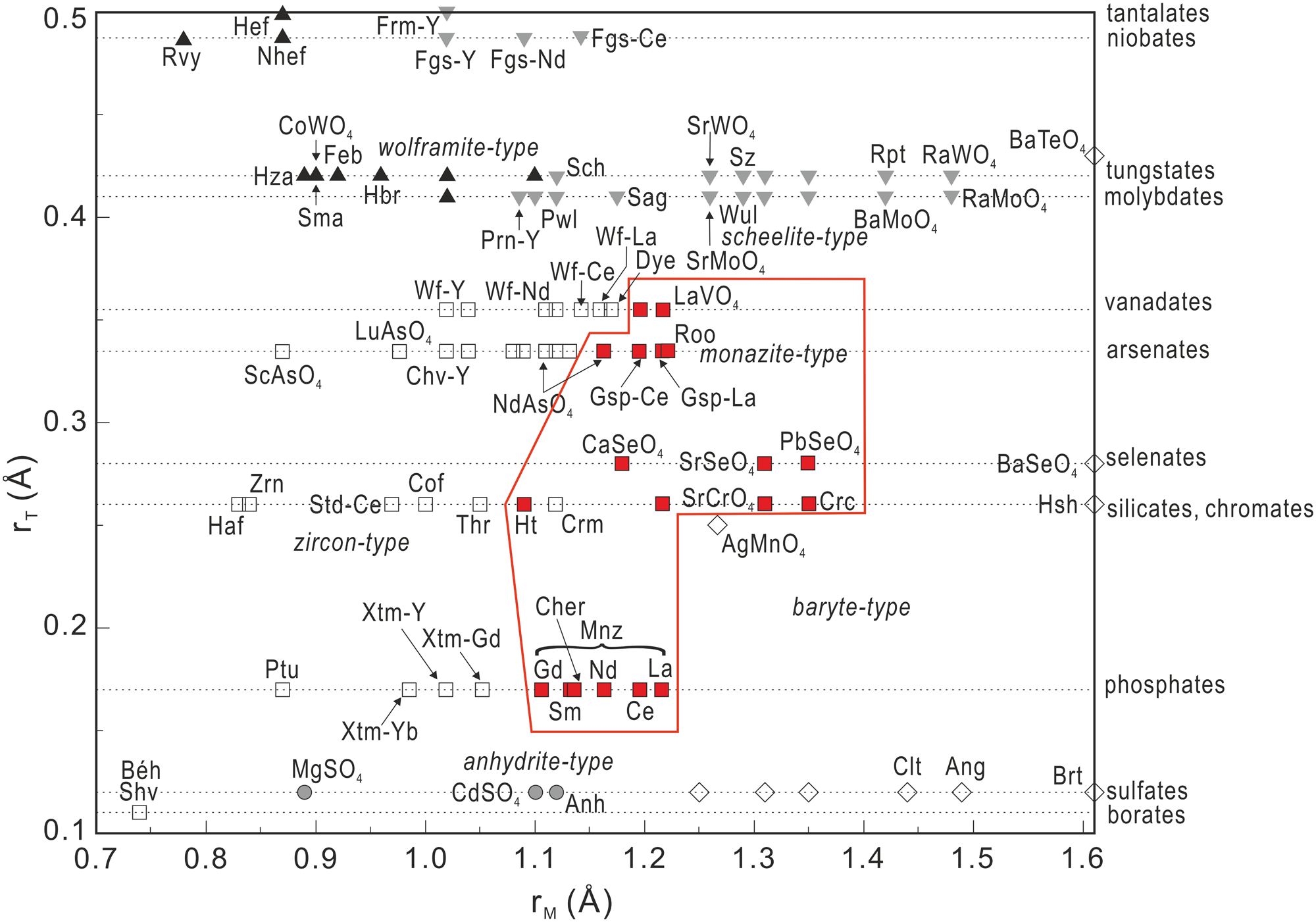
The monazite supergroup minerals show the closest compositional and structural relationships with the tetragonal zircon and xenotime groups, tetragonal scheelite group [including fergusonite-(Y) and formanite-(Y)], orthorhombic baryte and anhydrite groups, and to a lesser extent with members of the rhabdophane and gypsum groups (ABO4 + molecular H2O minerals). However, they show different structural and bond-valence arrangements, reflected in different symmetry and space groups. Mutual relationships between monazite and other ABX4 compounds, expressed in P-T stability fields, crystal structure, and chemistry, have been discussed in numerous experimental studies (e.g. Clavier et al., Reference Clavier, Podor and Dacheux2011 and references therein) and are illustrated in Fig. 4.
Mutual relationships between monazite and other ABX4 compounds expressed by the ionic radius of the A-site cation (rM) versus the ionic radius of the B-site cation (rT); the effective ionic radii in corresponding coordination number are according to Shannon (Reference Shannon1976). Mineral abbreviations (according to Warr, Reference Warr2021) are the following (in alphabetical order): Ang – anglesite, Anh – anhydrite, Béh – béhierite, Brt – baryte, Cher – cheralite, Chv-Y – chernovite-(Y), Clt – celestine, Cof – coffinite, Crc – crocoite, Crm – chromatite, Dye – dreyerite, Feb – ferberite, Fgs-Ce – fergusonite-(Ce), Fgs-Nd – fergusonite-(Nd) (not IMA approved mineral), Fgs-Y – fergusonite-(Y), Frm-Y – formanite-(Y), Gsp-Ce – gasparite-(Ce), Gsp-La – gasparite-(La), Haf – hafnon, Hef – heftetjernite, Hsh – hashemite, Ht – huttonite, Hza – huanzalaite, Mnz-Ce – monazite-(Ce), Mnz-Gd – monazite-(Gd), Mnz-La – monazite-(La), Mnz-Nd – monazite-(Nd), Mnz-Sm – monazite-(Sm), Nhef – nioboheftetjernite, Prn-Y – paraniite-(Y), Ptu – pretulite, Pwl – powellite, Roo – rooseveltite, Rpt – ronpetersonite, Rvy – rossovskyite, Sag – suseinargiuite, Sch – scheelite, Shv – schiavinatoite, Sma – sanmartinite, Std-Ce – stetindite-(Ce), Sz – stolzite, Thr – thorite, Wf-Ce – wakefieldite-(Ce), Wf-La – wakefieldite-(La), Wf-Nd – wakefieldite-(Nd), Wf-Y – wakefieldite-(Y), Wul – wulfenite, Xtm-Gd – xenotime-(Gd), Xtm-(Y) – xenotime-(Y), Xtm-Yb – xenotime-(Yb), Zrn – zircon.

Figure 4 Long description
The scatter plot shows relationships between monazite and other compounds based on ionic radii. The x-axis is labeled r subscript M in angstroms, ranging from 0.7 to 1.6. The y-axis is labeled r subscript R in angstroms, ranging from 0.1 to 0.5. Variables represent ionic radii of cation sites M and R. Different symbols indicate mineral groups: monazite-type, baryte-type, zircon-type and wolframite-type. Monazite-type minerals, such as Mnz-Ce and Mnz-La, are highlighted within a specific region. The plot illustrates how these minerals are grouped by structure type, with monazite-type showing distinct separation from zircon-type and baryte-type. Key regions are defined by approximate ranges of r subscript M and r subscript R, aiding in understanding the structural relationships. The plot provides a visual representation of how these minerals relate based on their ionic radii, with distinct symbol mapping for each type.
Acknowledgements
We thank all members of the IMA CNMNC for their constructive criticism and comments during the approval procedure. We thank two anonymous reviewers, as well as principal editor Stuart Mills and associate editor for their useful comments. This work was supported by the Slovak Research and Development Agency under the contract APVV-22-0092 and by the Ministry of Culture of the Czech Republic (long-term project DKRVO 2024-2028/1.II.c; National Museum, 00023272) for JS.
Competing interests
The authors declare none.
Appendix
Representative chemical compositions (wt.%) and formulae (apfu) of the monazite-supergroup minerals (apfu)*. Mineral formulae based on B-site (S + Cr + P + As + V + Si) = 1 atom. Mineral abbreviations are according to Warr (Reference Warr2021). Valid members are written in bold, potential unapproved members in italic font

Appendix 1 Long description
Sixteen mineral analyses labeled Mnz-La through F Mnz-Ce list oxide weight percent totals, followed by atoms per formula unit for the same elements plus Sum A, Sum B, and Total. P2O5 is high in the monazite and cheralite columns, including 27.59 in Mnz-La, 30.48 in Mnz-Nd, 30.10 in Cher, 29.06 in Sr Cher, 23.73 in S Mnz-Ce, and 29.49 in F Mnz-Ce, but is low in the gasparite and related columns, including 0.64 in Gsp-La, 10.45 in Gsp-Ce, 0.03 in Gsp-Nd, 0.00 in Roo, 0.36 in Ht, and 0.02 in Crc. As2O5 is 30.32 in Gsp-La, 24.55 in Gsp-Ce, 39.83 in Gsp-Nd, and 33.35 in Roo, while most other columns are blank or near zero, such as 0.07 in Mnz-Gd and 0.11 in S Mnz-Ce and F Mnz-Ce. ThO2 ranges from 0.00 in Mnz-Gd, Gsp-La, and S Mnz-Ce to 40.50 in Cher, 34.94 in Sr Cher, and 79.54 in Ht; UO2 reaches 23.13 in U Mnz-Ce and is 3.12 in Cher, with smaller values such as 0.10 in Mnz-La and 0.77 in F Mnz-Ce. PbO is 69.73 in Crc and is otherwise small where present, including 0.66 in Cher and 0.99 in U Mnz-Ce. SO3 is 10.66 in S Mnz-Ce and 0.72 in Gsp-Ce, and CrO3 appears as 29.94 only in Crc. Totals are near 100 for all columns, from 97.36 in Mnz-La to 101.27 in S Mnz-Ce. In atoms per formula unit, P is near 1.000 for Mnz-Ce, Mnz-Nd, Mnz-Sm, Mnz-Gd, Cher, U Mnz-Ce, and Sr Cher, while As is 0.694 in Gsp-La, 0.568 in Gsp-Ce, 0.932 in Gsp-Nd, and 0.991 in Roo; Cr is 0.999 in Crc and S is 0.283 in S Mnz-Ce. Sum A ranges from 0.971 in Ht to 1.050 in Mnz-La, Sum B is 1.000 in every column, and Total ranges from 1.971 in Ht to 2.050 in Mnz-La.
Notes: Sample details: 1: Monazite-(La), hydrothermal in alkaline pegmatite, Lovozero Massif, Russia (Pekov, Reference Pekov2000). 2: Monazite-(Ce), ultra-high-pressure gneiss, Seve Nappe Complex, Norway (Petrík et al., Reference Petrík, Janák, Klonowska, Majka, Froitzheim, Yoshida, Sasinková, Konečný and Vaculovič2019). 3: Monazite-(Nd): authigenic in graywacke, Drahany Upland, Czech Republic (Čopjaková et al., Reference Čopjaková, Novák and Franců2011). 4: Monazite-(Sm): granitic pegmatite, Piława Górna, Poland (Twardak et al., Reference Twardak, Pieczka, Kotowski and Nejbert2023). 5: Monazite-(Gd): hydrothermal quartz vein, Prakovce-Zimná Voda, Slovakia (Ondrejka et al., Reference Ondrejka, Uher, Ferenc, Majzlan, Pollok, Mikuš, Milovská, Molnárová, Škoda, Kopáčik, Kurylo and Bačík2023a). 6: Cheralite, Li-mica granite, Eibenstock pluton, Germany (Förster, Reference Förster1998). 7: U-rich monazite-(Ce), P-rich granite, Belvís de Monroy pluton, Spain (Pérez-Soba et al., Reference Pérez-Soba, Villaseca, Orejana and Jeffries2014). 8: Sr-dominant cheralite, carbonatite, Lesnaya Varaka, Russia (Chakhmouradian and Mitchell, Reference Chakhmouradian and Mitchell1998). 9: Gasparite-(La), hydrothermal in calcite vein, Ushkatyn-III Mn deposit, Kazakhstan (Vereshchagin et al., Reference Vereshchagin, Britvin, Perova, Brusnitsyn, Polekhovsky, Shilovskikh, Bocharov, van der Burgt, Cuchet and Meisser2019). FeO originally as Fe2O3. 10: Gasparite-(Ce): post-magmatic in altered rhyolite, Tisovec-Rejkovo, Slovakia (Ondrejka et al., Reference Ondrejka, Uher, Pršek and Ozdín2007). 11: Nd-dominant gasparite, hydrothermal-metamorphic, Ponte dei Gonazzi Fe-Mn deposit, Italy (Cabella et al., Reference Cabella, Lucchetti and Marescotti1999). 12: Rooseveltite, supergene in hydrothermal Bi-Co-Ni-As-U-V mineralization, Přísečnice, Czech Republic (Sejkora et al., Reference Sejkora, Pauliš, Gramblička, Malíková, Pour, Dolníček, Ulmanová and Vrtiška2019). 13: Huttonite, clastic mineral in sand, Gillespie’s Beach, New Zealand (Förster et al., Reference Förster, Harlov and Milke2000). 14: Crocoite, supergene, oxidation zone of Pb deposit, Red Lead Mine, Dundas, Australia (Crane et al., Reference Crane, Leverett, Shaddick, Williams, Kloprogge and Frost2001). 15: S-rich monazite-(Ce), hydrothermal in metamorphic magnetite deposit, Bacúch, Slovakia (Pršek et al., Reference Pršek, Ondrejka, Bačík, Budzyń and Uher2010). 16: F-rich monazite-(Ce), muscovite leucogranite, Zámostská Hoľa, Slovakia (Maraszewska et al., Reference Maraszewska, Broska, Kurylo and Konečný2023). *Blank entries incidate not measured, 0.00 wt.% indicates measured but below the detection limit