1. Introduction
The sympatric association of large-sized apex predators belonging to the same taxon or not, irrespective of taxonomic level (i.e. species, family, order), appears to be common both in ancient and present-day marine ecosystems. It occurs notably in modern killer whales (Foote et al. Reference Foote, Morin, Durban, Willerslev, Orlando and Gilbert2011), Late Jurassic metriorhynchid crocodyliforms (Young et al. Reference Young, Brusatte, de Andrade, Desojo, Beatty, Steel, Fernández, Sakamoto, Ruiz-Omeñaca and Schoch2012), latest Cretaceous mosasaurids and selachians (Vincent et al. Reference Vincent, Bardet, Houssaye, Amaghzaz and Meslouh2013) and Miocene sharks and raptorial sperm whales (Lambert et al. Reference Lambert, Bianucci, Post, de Muizon, Salas-Gismondi, Urbina and Reumer2010). However, the geographical extent of these associations appears reduced, and they are usually poorly known in the fossil record.
A similar association of large predators has been reported among marine reptile assemblages from a limited number of upper Albian – upper Cenomanian (mid-Cretaceous) successions in western Europe, with the co-occurrence of the platypterygiine ophthalmosaurid ‘Platypterygius’ and the pliosaurid Polyptychodon interruptus. This association has been documented mainly from the Cambridge Greensand Member (i.e. the base of the Lower Chalk Formation) in eastern England (Owen, Reference Owen1840, Reference Owen1851–1864; Seeley, Reference Seeley1869, Reference Seeley1876; Fischer et al. Reference Fischer, Bardet, Guiomar and Godefroit2014c ) and in the Paris Basin (Sauvage, Reference Sauvage1882; Buffetaut, Tomasson & Tong, Reference Buffetaut, Tomasson and Tong2003; Buffetaut et al. Reference Buffetaut, Colletė, Dubus and Petit2005; Fischer, Reference Fischer2012). Eichwald (Reference Eichwald1853, Reference Eichwald1865–1868) and Kiprijanoff (Reference Kiprijanoff1881, Reference Kiprijanoff1882, Reference Kiprijanoff1883a , Reference Kiprijanoff b ) described similar associations in the Kursk region in Russia. With the exception of the French specimens, these remains usually occur in reworked bonebed-like deposits that originated during the early phases of the great mid-Cretaceous transgression. The time represented by such bone-rich deposits is comparatively limited geologically speaking, at least for the English greensands (Cookson & Hughes, Reference Cookson and Hughes1964; Hopson, Reference Hopson2005; Woods et al. Reference Woods, Wilkinson, Booth, Farrant, Hopson and Newell2008; Hopson, Wilkinson & Woods, Reference Hopson, Wilkinson and Woods2008; Owen, Reference Owen2012).
Here we report the presence of the ‘Platypterygius’–Polyptychodon interruptus association from the mid-Cretaceous condensed succession exposed in Annopol, Poland, also documenting the remainder of the ichthyosaur/plesiosaur fauna from this area. This locality has yielded a vast number of vertebrate and invertebrate fossils, providing a representative picture of the evolution of a marine ecosystem within the European archipelago at the transition between the Early and Late Cretaceous.
In addition to ichthyosaur and plesiosaur remains, those of bony fish, lamniform sharks, chimaeroids (Radwański, Reference Radwański1968; Marcinowski & Radwański, Reference Marcinowski and Radwański1983; Popov & Machalski, Reference Popov and Machalski2014), marine protostegid turtles and pterosaurs (ornithocheiroids and/or azhdarchoids; see Machalski & Martill, Reference Machalski and Martill2013) are known from the Annopol succession. Prior to the present study, remains of ichthyosaurs and plesiosaurs had merely been listed, but not described, by Samsonowicz (Reference Samsonowicz1925, Reference Samsonowicz1934), Cieśliński & Milakovič (Reference Cieśliński and Milakovič1962), Marcinowski & Radwański (Reference Marcinowski and Radwański1983) and Machalski, Komorowski & Harasimiuk (Reference Machalski, Komorowski and Harasimiuk2009).
2. Institutional abbreviations
CAMSM: Sedgwick Museum of Earth Sciences, Cambridge University, Cambridge, UK; IRSNB: Royal Belgian Institute of Natural Sciences, Brussels, Belgium; MWGUW: Geological Museum of the Geology Department, University of Warsaw, Poland; NHMUK: Natural History Museum, London, UK; RGHP: Réserve Naturelle Géologique de Haute-Provence, Digne-les-Bains, France; SSU: Saratov State University, Saratov, Saratov Oblast', Russian Federation; ZPAL: Institute of Paleobiology, Polish Academy of Sciences, Warszawa, Poland.
3. Geological setting
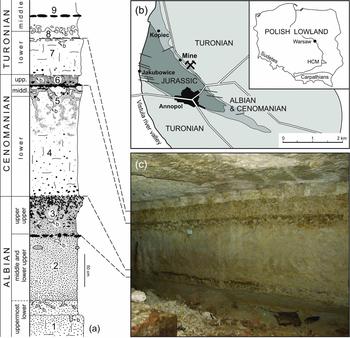
The ichthyosaur and plesiosaur remains studied come from the middle Albian – middle Cenomanian part of the mid-Cretaceous (uppermost lower Albian – lower Turonian) condensed, phosphorite-bearing succession as exposed along the limbs of the Annopol anticline, central Poland (Fig. 1a–c). This area is located on the east bank of the Wisła (Vistula) River, central Poland (Fig. 1b) and forms the easternmost part of the so-called Mesozoic Border of the Holy Cross Mountains (Marcinowski & Radwański, Reference Marcinowski and Radwański1983).
(a) The mid-Cretaceous succession of the Annopol anticline (modified after Machalski & Kennedy, Reference Machalski and Kennedy2013). 1: quartzose sandstone and quartz sands truncated by a burrowed surface; 2: quartz sands with glauconite, rare sandstone nodules near the top, and phosphate horizon at the top; 3: quartz sands and marly sands with glauconite and phosphate horizon in the upper part; 4: quartzose marls with glauconite and phosphates; 5: glauconitic marls infilling earlier burrows, truncated by a hardground; 6: strongly glauconitic marls with burrowed omission surface at the top; 7: limestone with rare phosphatic nodules and glauconite, capped by a hardground; 8: marls with burrowed surface at the top; 9: marls with black flint; b: burrows. (b) Sketch map of the Annopol anticline with localities studied and location within Poland (HCM: Holy Cross Mountains). (c) A section exposed underground at the Annopol mine.

The lithology of the mid-Cretaceous succession in the Annopol area was described by Samsonowicz (Reference Samsonowicz1925, Reference Samsonowicz1934), Pożaryski (Reference Pożaryski1947), Cieśliński (Reference Cieśliński1959) and Walaszczyk (unpub. M.Sc. thesis, University of Warszawa, 1984; Reference Walaszczyk1987). The biostratigraphy is based mainly on ammonites, inoceramid bivalves and foraminifera (Samsonowicz, Reference Samsonowicz1925, Reference Samsonowicz1934; Pożaryski, Reference Pożaryski1947; Cieśliński, Reference Cieśliński1959, Reference Cieśliński1987; Marcinowski, Reference Marcinowski1980; Marcinowski & Radwański, Reference Marcinowski and Radwański1983, Reference Marcinowski and Radwański1989; Peryt, Reference Peryt1983; Marcinowski & Walaszczyk, Reference Marcinowski and Walaszczyk1985; Marcinowski & Wiedmann, Reference Marcinowski and Wiedmann1985, Reference Marcinowski and Wiedmann1990; Walaszczyk, Reference Walaszczyk1992). The upper Albian ammonite biostratigraphy has recently been revised by Machalski & Kennedy (Reference Machalski and Kennedy2013).
The Annopol sedimentary succession may be subdivided into a series of thin transgressive units, based on the model of Juignet (Reference Juignet1980) and Hancock (Reference Hancock1990). These units are capped by layers of reworked phosphatic nodules and clasts (often with biostratigraphically mixed ammonite assemblages), hardgrounds and burrowed omission and/or erosional surfaces (Fig. 1a), reflecting a series of regression maxima. The general bathymetrical trend for the Annopol area is an upwards deepening, as based on foraminiferal spectra and facies development (Walaszczyk, Reference Walaszczyk1987). The latter is characterized by a transition from terrigenous to pelagic carbonate sedimentation, reflecting the progress of the mid-Cretaceous transgression (Cieśliński, Reference Cieśliński1976; Marcinowski & Radwański, Reference Marcinowski and Radwański1983). At the bottom, the uppermost lower Albian sands and sandstones (unit 2 in Fig. 1a) contain Ophiomorpha burrows which point to deposition in extremely shallow-marine, marginal environments (compare Radwański, Wysocka & Górka, Reference Radwański, Wysocka and Górka2012). There are pure chalks with flints at the top of succession, corresponding to a relatively deep-marine, offshore setting (unit 9 in Fig. 1a). The Annopol succession is extremely thin in comparison to coeval strata in adjacent areas due to its position on a submarine high (Cieśliński, Reference Cieśliński1976).
The fossils studied originate from the interval that ranges from the upper part of the Albian unit 2 to the top of the Cenomanian unit 5 (Fig. 1a). Most of this material is from unit 3, which is the most fossiliferous interval of the succession. This unit was deposited during a transgressive pulse in the late Albian (‘Vraconnian’, sensu Amédro, Reference Amédro2002) in a relatively shallow-marine, highly productive, phosphogenic environment (Walaszczyk, Reference Walaszczyk1987). Unit 3 and the top of the underlying unit 2 were collectively referred to as ‘the Phosphorite Bed’ by previous authors (e.g. Marcinowski & Wiedmann, Reference Marcinowski and Wiedmann1985; Marcinowski & Radwański, Reference Marcinowski and Radwański1983, Reference Marcinowski and Radwański1989). Those authors subdivided the Phosphorite Bed into two parts: a lower and an upper part (Marcinowski & Radwański, Reference Marcinowski and Radwański1983, fig. 6). More detailed accounts on fossil content, sedimentary history and stratigraphy of particular bone-bearing levels of the Annopol succession are given in Popov & Machalski (Reference Popov and Machalski2014) and Machalski & Kennedy (Reference Machalski and Kennedy2013).
4. Material and methods
The present study is based on two collections. One of these was amassed before World War II by Jan Samsonowicz, a geologist who discovered the Annopol anticline in 1923. This collection is housed at the Geological Museum of the Geology Department, University of Warsaw (prefix MWGUW). Another collection was acquired from the Annopol area between 2008 and 2012 by a team led by one of us (MM); additionally, a large and well-preserved pliosaur tooth found in 2014 by the same team has been included in this study. All this material is housed at the Institute of Paleobiology, Polish Academy of Sciences (abbreviated ZPAL), Warsaw, Poland.
4.a. MWGUW collection
This collection is composed exclusively of isolated skeletal elements (teeth and vertebrae, 30 in total) with no precise provenance data within the Annopol area and succession. There are nine teeth and two vertebrae of ichthyosaurs and ten teeth and nine vertebrae of pliosaurs. In view of their preservation, all these fossils must have come from the Albian part of the succession (top of unit 2 and unit 3; see Fig. 1a). Based on the nature of the matrix, which is sandy in the former and marly in the latter, only specimens with adhering matrix in the MWGUW collection can be more precisely allocated either to the upper part of unit 2 or to unit 3 (Walaszczyk, Reference Walaszczyk1987). As a consequence, a middle or early late Albian and a late late Albian age, respectively, is assigned to these specimens. As far as the specimens without adhering matrix in the MWGUW material are concerned, their most probable source is unit 3 (especially its lower part) based on in situ observations at the succession exposed underground (see the following section). Consequently, they are most probably of late late Albian age.
4.b. ZPAL collection
The ZPAL collection is dominated by ichthyosaur remains, including 20 isolated teeth and vertebrae, five disarticulated partial skeletons and a single skull. In addition, six plesiosaur teeth are available. In view of the presence of disarticulated partial skeletons, the number of catalogued elements is larger than that of individuals.
The remains studied come from two localities situated along the northern limb of the Annopol anticline (Fig. 1b): (1) the abandoned underground phosphorite mine Jan 1; and (2) a series of temporary trenches dug near the old sandstone quarry south of the village of Kopiec, referred to as the locality of Kopiec.
The specimens from the mine have been collected in situ in the interval from the bottom of unit 3 to the top of unit 5 (Fig. 1a); they are therefore late late Albian – middle Cenomanian in age. They represent a full spectrum of preservational states, from isolated elements (teeth and vertebrae), through rare disarticulated partial skeletons to a single articulated (albeit fragmentary) skull. In the Albian part of the underground succession, the majority of the well-preserved isolated elements without adhering phosphatic matrix were recovered from the lowermost part of unit 3.
In contrast, the material collected at Kopiec is represented exclusively by isolated elements. It stems from screen washing of Albian sands, forming the matrix of the Phosphorite Bed of previous authors (top of unit 2 and unit 3). Two screens with an 8mm mesh size and a motorized pump were used. Material for washing was amassed by using an excavator and, for technical reasons, this could be subdivided into two portions. The lower portion corresponded approximately to the highest 20cm of unit 2 and the lowest 20cm of unit 3 (Fig. 1a). The upper portion corresponded to the remainder of unit 3. However, some mixing of sediment (and fossils) from these (and adjacent) horizons was unavoidable during field operations.
For reasons outlined above, the stratigraphic position of the reptile remains recovered by means of screen washing at Kopiec could not be precisely determined. Specimens with adhering phosphatic matrix form a notable exception, analogous to the MWGUW collection. An assignment either to the phosphorite bed at the top of unit 2 or to the phosphorite bed in the upper part of unit 3 is possible, based on differences in phosphatic matrix. Specimens without adhering matrix are thought to have come mostly from unit 3, in particular from its lower part, based on the abovementioned relationships observed in the mine. These loose elements are therefore most probably of late late Albian age.
5. Taphonomy
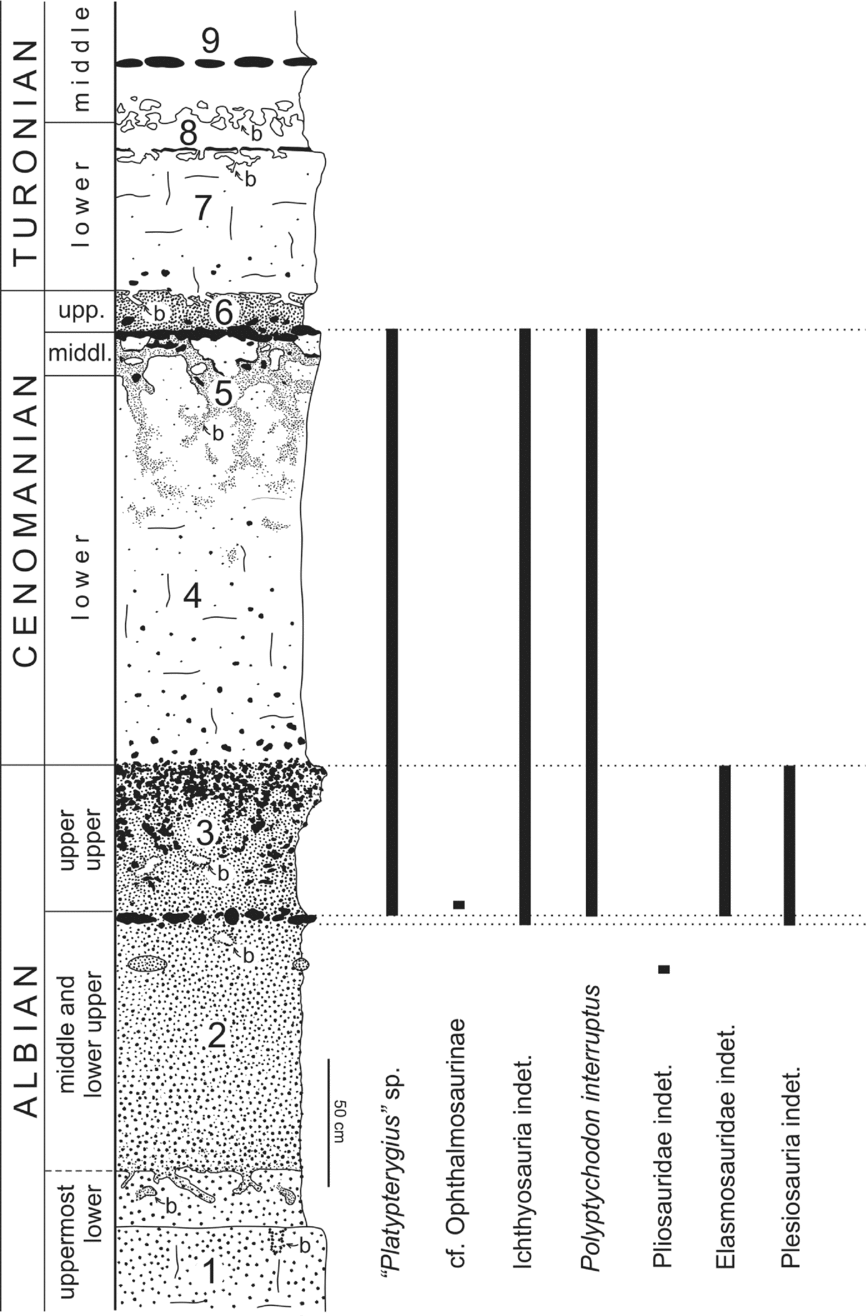
Seven ichthyosaur and plesiosaur taxa have been identified in the Annopol sedimentary succession (Fig. 2). These are ‘Platypterygius’ sp., cf. Ophthalmosaurinae, Ichthyosauria indet., Polyptychodon interruptus, Pliosauridae indet., Elasmosauridae indet. and Plesiosauria indet. All these taxa are present in the Albian horizon corresponding to the Phosphorite Bed of previous authors (see Section 3) which ranges from the top of unit 2 to the top of unit 3 in the present subdivision. Only three taxa – ‘Platypterygius’ sp., Ichthyosauria indet. and Polyptychodon interruptus – are recorded higher upsection, ranging to the middle Cenomanian unit 5 (Fig. 2). The material studied can be assigned to three taphonomic categories: (1) isolated skeletal elements; (2) disarticulated partial skeletons; and (3) articulated partial skeletons.
Stratigraphic ranges of the ichthyosaurs and plesiosaurs in the Annopol succession. See Figure 1 caption for characteristics of particular units.

The isolated skeletal elements are mainly vertebrae, tooth crowns and complete teeth (with preserved roots), 52 specimens in total. Most of these are well preserved and show no or few signs of mechanical abrasion. The isolated tooth crowns may represent specimens shed by the living animals during feeding. In contrast, complete teeth and isolated vertebrae may stem either from drifting carcasses or from those which had already landed on the sea floor, subsequently ripped apart by scavengers.
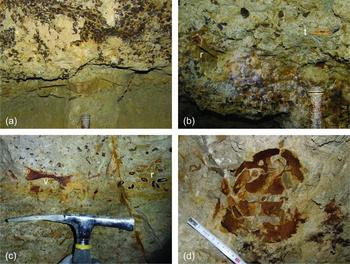
Disarticulated partial skeletons are represented by remains of five ichthyosaur individuals: (1) skull elements of an ichthyosaur referred to as cf. Opthalmosaurinae (ZPAL V.38/51–57, 59); (2) an accumulation of vertebrae of an indeterminate ichthyosaur (ZPAL V. 38/433, 875, 888, 889), both from the lower part of unit 3; (3) jaw elements and well-preserved teeth of ‘Platypterygius’ sp. (jaw bones ZPAL V.38/4, 65–69, 72–81, 83–88; complete teeth ZPAL V.38/1–3, 23–26, 28) from the upper part of unit 3; (4) jaw elements and teeth of ‘Platypterygius’ sp. (V.38/38, 44–47; teeth ZPAL V.38/18, 42, 43; Fig. 3b) and (5) vertebrae and ribs of an indeterminate ichthyosaur (ZPAL V.38/49 and 100–106; Fig. 3c), both from the lower part of unit 4. Only one of these concentrations (3) occurs in a reworked horizon (phosphatic bed in the upper part of unit 3). This taphonomic category most probably involves parts of carcasses dismembered on the sea floor by scavengers (as suggested by bite marks seen on some bones and teeth), subsequently locally reworked in the case of the individual characterized above.
Multi-element finds of (a, c, d) Ichthyosauria indet. and (b) ‘Platypterygius’ sp., based on field photographs at the Annopol mine. (a) Group of vertebrae, including ZPAL V.38/888 (see Fig. 5f), lower part of unit 3, late late Albian. (b) Ribs (r) and teeth (t) of ‘Platypterygius’ sp., lower part of unit 4, early Cenomanian. (c) Ribs (r) and vertebrae (v) of Ichthyosauria indet., lower part of unit 4, early Cenomanian, photo A. Komorowski. (d) Skull in transverse cross-section, Ichthyosauria indet., top of unit 4, early Cenomanian.

Articulated partial skeletons are represented by a single fragmentary skull of an indeterminate ichthyosaur of early Cenomanian age. It is embedded in the limestone matrix of unit 4, and still visible in cross-section in the roof of an underground gallery (Fig. 3d). A fragmentary rostrum of the same individual is preserved in close proximity. The orientation of the skull suggests vertical landing of an ichthyosaur on the sea floor and embedding of its head in subvertical position within a firm mud. It can be speculated that the touchdown was relatively ‘hard’, which resulted in fracture of the rostrum. The remainder of the body was probably removed by scavengers and sea currents, possibly even prior to the lithification and eventual erosional truncation of the deposit containing these. Similar cases from Jurassic strata have been described by Martill (Reference Martill1993), Wetzel & Reisdorf (Reference Wetzel, Reisdorf, Bromley, Buatois, Genise and Melchor2007) and Wahl (Reference Wahl2009).
6. Systematic palaeontology
Order ICHTHYOSAURIA de Blainville, Reference Blainville1835
Family OPHTHALMOSAURIDAE Baur, Reference Baur1887
Subfamily PLATYPTERYGIINAE Arkhangelsky, Reference Arkhangelsky2001 (sensu Fischer et al.
Reference Fischer, Maisch, Naish, Liston, Kosma, Joger, Krüger, Pardo-Pérez, Tainsh and Appleby2012)
Genus: Platypterygius von Huene, Reference Huene1922
Note. Recent analyses suggest that the platypterygiine Platypterygius is not monophyletic, representing a variety of platypterygiine taxa. The name has been applied by default for Cretaceous ichthyosaur material for decades (Fischer, Reference Fischer2012; Fischer et al. Reference Fischer, Arkhangelsky, Naish, Stenshin, Uspensky and Godefroit2014a ). An unambiguous definition of Platypterygius is still required (Fischer et al. Reference Fischer, Arkhangelsky, Naish, Stenshin, Uspensky and Godefroit2014a ); in the meantime, we use the name ‘Platypterygius’ for large-sized platypterygiine specimens from the mid-Cretaceous of Eurasia.
‘Platypterygius'sp. Figures 4a–d, 5d
Referred material. Disarticulated partial skeletons: (1) fragmentary jaw bones ZPAL V.38/4, 65–69, 72–81, 83–88 and complete teeth ZPAL V.38/1–3, 23–26, 28. 2; and (2) fragmentary ribs ZPAL V.38/38, 44–47 associated with teeth ZPAL V.38/18, 42, 43. Isolated teeth: ZPAL V. 38/427, 440, 690, 856 and MWGUW ZI/60/12–18.
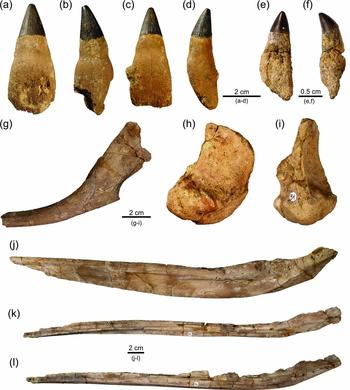
Ophthalmosaurid ichthyosaurs. (a–d) Associated teeth of ‘Platypterygius’ sp. (a, b) ZPAL V.38/2. (c, d) ZPAL V.38/3, upper part of unit 3, late late Albian, mine. (e–l) Associated elements of a partial skull of cf. Ophthalmosaurinae, lower part of unit 3, late late Albian, mine. (e, f) Posterior tooth ZPAL V.38/52 in (e) labial and (f) anterior or posterior views. (g) Partial left jugal ZPAL V.38/57 in lateral view; note the posterior process on the posteroventral margin of the jugal. (h, i) Partial right quadrate ZPAL V.38/51 in (h) lateral and (i) anterior views. (j) Left surangular ZPAL V.38/55 in lateral view. (k, l) Left angular ZPAL V.38/53 in (k) dorsal and (l) lateral views.

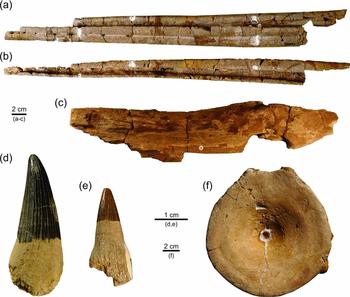
(a–c, e–f) Ichthyosauria indet. and (e) opthalmosaurid ichthyosaurs. (a, b) Rostrum fragment ZPAL V.38/900, lower part of unit 3, late late Albian, Kopiec, in (a) lateral and (b) ‘dental/apical’ views. (c) Large right surangular ZPAL V.38/82, upper part of unit 3, late late Albian, mine, in medial view. (d) Isolated tooth ZPAL V.38/427 of ‘Platypterygius’ sp., lower part of unit 3, late late Albian, mine. (e) Isolated tooth MWGUW ZI/60/12 which shares affinities with Sisteronia seeleyi, probably unit 3, late late Albian, locality unknown. (f) Large anterior caudal centrum ZPAL V.38/888, lower part of unit 3, late late Albian, mine.

Horizon and age. Units 3–5, late late Albian – middle Cenomanian.
Description and comparison. Teeth constitute the sole diagnostic element in the present material. The crown is conical, robust and straight (Figs 4a–c, 5d). Numerous apicobasal striations texture the black enamel and most apices are broken and polished, indicating moderate to intense tooth wear (e.g. Fischer et al. Reference Fischer, Arkhangelsky, Naish, Stenshin, Uspensky and Godefroit2011a). Larger-sized teeth have a rugose enamel, a ridged acellular cementum ring and deep apicobasal grooves texturing the root, a combination commonly found in some species referred to as ‘Platypterygius’ (e.g. Kiprijanoff, Reference Kiprijanoff1881; Bardet, Reference Bardet1989; Bardet, Wellnhofer & Herm, Reference Bardet, Wellnhofer and Herm1994; Maxwell, Caldwell & Lamoureux, Reference Maxwell, Caldwell and Lamoureux2011; Fischer, Reference Fischer2012). The root is square in cross-section, as in platypterygiine ophthalmosaurids (Fischer et al. Reference Fischer, Maisch, Naish, Liston, Kosma, Joger, Krüger, Pardo-Pérez, Tainsh and Appleby2012) and bulbous, as in some species referred to as Platypterygius (Fischer, Reference Fischer2012; Fischer et al. Reference Fischer, Bardet, Guiomar and Godefroit2014c). More posterior teeth are smaller and have a ‘ratched-shaped’ apex. Their enamel is devoid of apicobasal striation.
Subfamily OPHTHALMOSAURINAE Baur, Reference Baur1887 (sensu Fischer et al. Reference Fischer, Maisch, Naish, Liston, Kosma, Joger, Krüger, Pardo-Pérez, Tainsh and Appleby2012) cf. OPHTHALMOSAURINAE Figure 5e–l
Referred material. A disarticulated partial skeleton: skull elements ZPAL V.38/51–57, 59, including ZPAL V.38/51 (quadrate), ZPAL V.38/52 (tooth), ZPAL V.38/53 (angular), ZPAL V.38/55 (surangular) and ZPAL V.38/57 (jugal).
Horizon and age. Lower part of unit 3, late late Albian.
Description and comparison. The posterior half of the jugal (ZPAL V.38/57) is preserved (Fig. 4g). The anterior ramus is slender but its cross-section is rounded. Posteriorly, the jugal forms a thin lamella; posteroventrally, this lamella possesses a facet, presumably for the anterior ramus of the quadratojugal, terminating anteriorly by a prominent and right-angled hook, a feature previously recorded solely in the ophthalmosaurine Ophthalmosaurus icenicus (see A. M. Kirton, unpub. Ph.D. thesis, University of Newcastle upon Tyne, UK, 1983).
The quadrate (ZPAL V.38/51) (Fig. 4h, i) is ear shaped as in most ophthalmosaurids, but the articular condyle appears robust and markedly convex ventrally, unlike many ophthalmosaurids where the condyle is divided by a deep and wide groove (Ophthalmosaurus icenicus, A. M. Kirton, unpub. Ph.D. thesis, University of Newcastle upon Tyne, UK, 1983; Sveltonectes insolitus, V.F. personal observation of holotype IRSNB R269; Acamptonectes densus, see Fischer et al. Reference Fischer, Maisch, Naish, Liston, Kosma, Joger, Krüger, Pardo-Pérez, Tainsh and Appleby2012; Platypterygius australis, see Kear, Reference Kear2005). Quite similar condyles are also found in some specimens of ‘Platypterygius’ from the Cambridge Greensand Member (Grey Chalk Formation) as well (V.F. personal observation of CAMSM and NHMUK material). A high bony ridge borders the stapedial facet of the quadrate ventrally.
The surangular (ZPAL V.38/55) (Fig. 4j) is slender and slightly arched; together with the angular, this suggests a slender and curved mandible, distinct from that of contemporaneous ‘Platypterygius’ from Eurasia with straight and robust jaws (e.g. Bardet, Wellnhofer & Herm, Reference Bardet, Wellnhofer and Herm1994; Fischer, Reference Fischer2012; Fischer et al. Reference Fischer, Bardet, Guiomar and Godefroit2014c ). The coronoid process is low and barely protrudes from the body of the surangular. A fossa surangularis is present, unlike in Sveltonectes insolitus (Fischer et al. Reference Fischer, Arkhangelsky, Uspensky, Stenshin and Godefroit2011b ).
The angular (ZPAL V.38/53) is well preserved and nearly complete (Fig. 4k, l), measuring 33cm in length. It is flattened, markedly differing from that of Pervushovisaurus, in which it is thick and semi-circular in cross-section (Fischer et al. Reference Fischer, Arkhangelsky, Naish, Stenshin, Uspensky and Godefroit2014a ). In dorsal view, the angular is slightly sinusoidal, denoting the widening of the mandible behind the symphysis. The angular forms a typical ‘3’-shaped dorsal surface whose lateral groove houses the ventral edge of the surangular. The ventral edge is rounded and smooth.
A small posterior tooth (ZPAL V.38/52) (Fig. 4e, f), the crown enamel of which is totally devoid of apicobasal ridges. Among ophthalmosaurids, small tooth size with enamel texture reduction is usually found in ophthalmosaurines (e.g. Fischer et al. Reference Fischer, Arkhangelsky, Uspensky, Stenshin and Godefroit2014b ). The root is rounded in cross-section; this cannot be used as a criterion for taxonomic assignment since the root of posterior teeth usually lacks clade-specific synapomorphies in ophthalmosaurids (Fischer et al. Reference Fischer, Bardet, Guiomar and Godefroit2014c ).
Identification. Among ophthalmosaurids, the combination of slender jaws and small teeth lacking enamel texture is found in, yet does not strictly characterize, ophthalmosaurines (Fischer et al. Reference Fischer, Arkhangelsky, Uspensky, Stenshin and Godefroit2014b ; Roberts et al. Reference Roberts, Druckenmiller, Sætre and Hurum2014). The jugal also possesses a feature that was previously restricted to Ophthalmosaurus icenicus, further suggesting ophthalmosaurine affinities. However, the paucity of the present remains does not allow unambiguous placement of this specimen. We therefore refer to it as cf. Ophthalmosaurinae.
ICHTHYOSAURIA indet.
Figure 5a–c, e–f
Referred material. Disarticulated partial skeletons: (1) vertebrae ZPAL V.38/433, 875, 888, 889; and (2) fragmentary ribs ZPAL V. 38/49, 100–106. Articulated partial skeleton: skull fragment still in quarry face of underground gallery with detached jaw fragment ZPAL V.38/50. Isolated jaw fragments: ZPAL V.38/35, 82 (surangular), 449, 900 (rostrum). Isolated centra: ZPAL V.38/193, and MWGUW ZI/60/11, 28.
Horizon and age: Top of unit 2, middle or early late Albian; unit 3, late late Albian; unit 4, early Cenomanian.
Description and comparison. A partial surangular (ZPAL V.38/82, see Fig. 5c) lacks distinguishing features, except for its large size. A large coronoid process is present unlike in the surangular of cf. Ophthalmosaurinae (ZPAL V.38/55). The surangular lacks a M.a.m.e process, unlike in some ophthalmosaurine taxa (O. icenicus, A. densus; see Fischer et al. Reference Fischer, Maisch, Naish, Liston, Kosma, Joger, Krüger, Pardo-Pérez, Tainsh and Appleby2012). Contrary to Sveltonectes insolitus (Fischer et al. Reference Fischer, Arkhangelsky, Uspensky, Stenshin and Godefroit2011b), the fossa surangularis appears well developed.
Of the single rostrum (ZPAL V.38/900, see Fig. 5a, b) it cannot be determined whether this originated from a premaxilla or a dentary. Anteriorly, the labial and lingual walls of the groove form numerous shallow dorsoventral ridges separating functional teeth as in many ichthyosaurs (e.g. Kiprijanoff, Reference Kiprijanoff1881; Godefroit, Reference Godefroit1993; Bardet et al. Reference Bardet, Duffaud, Martin, Mazin, Pereda Suberbiola and Vidier1997; Fischer et al. Reference Fischer, Arkhangelsky, Naish, Stenshin, Uspensky and Godefroit2011a ). This rostrum appears much more slender than that of contemporaneous taxa referred to as ‘Platypterygius’ (see Owen, Reference Owen1851–1864; Fischer, Reference Fischer2012; Fischer et al. Reference Fischer, Bardet, Guiomar and Godefroit2014c ) and likely belongs to a discrete taxon with a distinct ecological niche.
The following can be stated of the dentition (MWGUW ZI/60/12, see Fig. 5e, f). While belonging to a platypterygiine ophthalmosaurid, as indicated by the quadrangular cross-section of the root, the crown of the present tooth appears much more slender and the enamel possesses delicate apicobasal ridges and invariably has a distinct orange colour. This tooth morphotype bears many similarities to that of Sisteronia seeleyi, which was described from coeval strata in England and France (Fischer et al. Reference Fischer, Bardet, Guiomar and Godefroit2014c ). Because it is poorly represented in the Annopol assemblage, we regard these specimens as Ichthyosauria indet. until more diagnostic remains are recovered.
The centra (ZPAL V.38/193, ZPAL V. 38/433, 875, 888, 889) are large (diameter 12cm), forming the posterior dorsal–anterior caudal region. The centra are weakly amphicoelous and their rib facets are prominent (Fig. 5f). These centra are thick, with a H/L ratio of c. 2.
Order PLESIOSAURIA de Blainville, Reference Blainville1835
Family PLIOSAURIDAE Seeley, Reference Seeley1874
Genus: Polyptychodon Owen, Reference Owen1841
Polyptychodon interruptus Owen, Reference Owen1841
Figures 6, 7a–c
Referred material. Isolated incomplete teeth: MWGUW ZI/60/1, 19–27, ZPAL V.38/170, 443, 689, 893, 894, 2034.
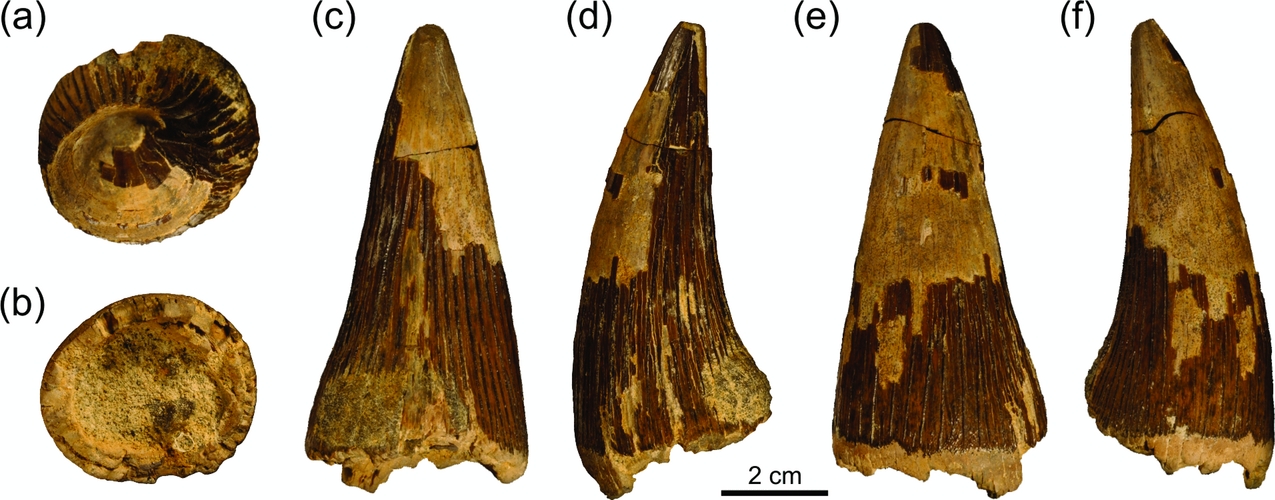
Polyptychodon interruptus, isolated tooth ZPAL V.38/2034, probably unit 3, late late Albian, Kopiec, in (a) occlusal, (b) basal, (c) anterior, (e) posterior, and (d, f) labial/lingual views.

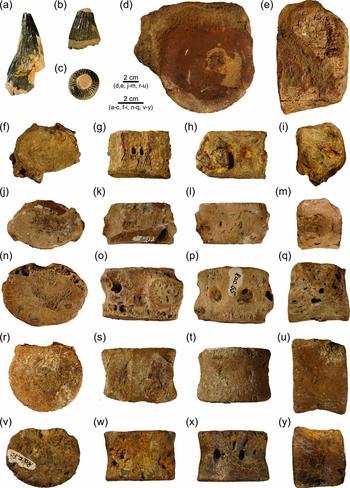
Plesiosaurs. (a–c) Teeth of Polyptychodon interruptus. (a) ZPAL V.38/893, unit 5, middle Cenomanian, mine, tooth in labial/lingual view. (b, c) MWGUW ZI/60/1, probably unit 3, late late Albian, locality unknown, tooth in (b) labial/lingual and (c) occlusal views. (d–y) Isolated centra, localities unknown. (d, e) Pliosauridae indet., MWGUW ZI/60/2, unit 2 (matrix), middle or early late Albian, cervical centrum. (f–q) Elasmosauridae indet. (f–i) MWGUW ZI/60/3, unit 3 (matrix), late late Albian, posterior cervical centrum. (j–m) MWGUW ZI/60/5, unit 3, late late Albian (matrix), posterior cervical centrum, probably more posterior than MWGUW ZI/60/3. (n–q) MWGUW ZI/60/4, probably unit 3, late late Albian, pectoral centrum. (r–y) Plesiosauria indet. (r–u) MWGUW ZI/60/7, unit 2 (matrix), middle or early late Albian, median dorsal centrum. (v–y) MWGUW ZI/60/6, probably unit 3, late late Albian, posterior dorsal centrum. (d, f, j, n, r, v) Articular view; (g, k, o, s, w) dorsal view; (h, i, p, t, x) ventral view; (e, i, m, q, u, y) lateral view.

Horizon and age. Unit 3, late late Albian; unit 4, early Cenomanian; unit 5, middle Cenomanian.
Description and comparison. All teeth are large and stout, with a rounded basal cross-section (Fig. 6). They bear strong and coarse ridges all along the crown except, when complete, for the last upper quarter where only a very few of them reach the apex. These crowns are only slightly posteriorly recurved and bear carinae that are visible only near the apex (see ZPAL 893; Fig. 7a). Most of these teeth exhibit a broken apex (Fig. 7b, c) with a rounded and polished top surface, probably indicating a preference for large fleshy and bony prey such as large fish and marine reptiles (see Massare, Reference Massare1987).
Such teeth are fairly common in Albian strata across Europe (N.B., personal observation) and are most often referred to Polyptychodon Owen, Reference Owen1841. As already noted (i.e. Albright, Gillette & Titus, Reference Albright, Gillette and Titus2007; Schumacher, Reference Schumacher2008), the status of this genus remains highly problematic as it is based on very few and poorly diagnostic material, mainly isolated teeth. Indeed, Owen defined two species from the Albian greensands of England in his ‘Odontography’ (Owen, Reference Owen1841), namely P. continuus and P. Interruptus. These were differentiated on the basis of tooth enamel ornament, the former having ridges reaching the apex and the latter lacking these. Another species, Polyptychodon hudsoni, was described much later based on a skull fragment of Turonian age from Texas (Welles & Slaughter, Reference Welles and Slaughter1963). Polyptychodon continuus was regarded as a nomen vanum by Welles (Reference Welles1962).
Identification. Although displaying general pliosaurid morphology and, pending a detailed review of this genus, the teeth from Annopol are here referred to Polyptychodon interruptus, the only pliosaurid taxon currently recognized in the Albian succession of the European Archipelago (e.g. Bardet & Godefroit Reference Bardet and Godefroit1995; Buffetaut et al. Reference Buffetaut, Colletė, Dubus and Petit2005). The general characteristics of the teeth (size, robustness, intense apical wear) of Polyptychodon strongly indicate that this genus was an apex predator in the Annopol trophic web and in coeval European environments.
PLIOSAURIDAE indet.
Figure 7d, e
Referred material. MWGUW ZI/60/2.
Horizon and age. Top of unit 2 (based on adhering matrix), middle or early late Albian.
Description. A large (diameter >10cm), amphicoelous centrum (Fig. 7d, e), which, although poorly preserved, is typically shorter than tall and wide, so that it may belong to an indeterminate pliosaurid. It could correspond to Polyptychodon, but this cannot be demonstrated beyond doubt as this centrum is not diagnostic and there is also an absence of homologous material for comparison; as noted above, Polyptychodon is mainly known from isolated teeth.
Superfamily PLESIOSAUROIDEA Gray, Reference Gray1825 (sensu Welles, Reference Welles1943)
Family ELASMOSAURIDAE Cope, Reference Cope1869
ELASMOSAURIDAE indet.
Figure 7f–q
Referred material. MWGUW ZI/60/3–5.
Horizon and age: Unit 3 (based on adhering matrix), late late Albian.
Description. Several centra from the posterior part of the neck and probably from the pectoral region of the vertebral column are preserved. None of these retain the neural arch, indicating that they belong to immature specimens.
MWGUW ZI/60/3 (Fig. 7f–i) is a posterior cervical centrum which is much wider than high and long. The articular surfaces are amphicoelous, ovoid in shape without any ventral notch, and with roughly rounded margins. The dorsal surface bears two large median foramina, close set on the floor of the neural canal. The articular surfaces for the neural arch are long and narrow. The ventral surface bears two large foramina subcentralia separated by a rounded median ridge. The lateral surfaces are poorly preserved. On one of them a longitudinal crest might be preserved, just dorsal of remains of bone that could belong to the corresponding rib.
MWGUW ZI/60/5 (Fig. 7j–m) is another posterior cervical centrum, probably more posterior than MWGUW ZI/60/3, because of the rib facet that is situated higher on the lateral surface of the centrum. It is much wider than high and long and its weight is of note. The articular surfaces are amphicoelous, ovoid in shape without a ventral notch and bear sharp margins. The dorsal surface is poorly preserved. The ventral surface is convex from side to side and bears two foramina subcentralia that are wider apart than in MWGUW ZI/60/3, another feature pointing to a more posterior position of this vertebra in the cervical series. The rib processes are situated medially on the lateral surfaces; they are rounded and large, occupying half of the lateral surface.
MWGUW ZI/60/4 (Fig. 7n–q) is probably a pectoral centrum. It is much wider than high and long. The articular surfaces are amphicoelous, ovoid without a ventral notch and with well-defined margins. The dorsal surface bears large articular facets for the neural arch that also extend, in part, along the upper part of the lateral surface, indicating that this centrum was probably the last pectoral vertebra. The ventral surface is convex from side to side and bears two very large foramina subcentralia, separated from each other. The lateral surfaces as a whole are pierced by large foramina from place to place and its texture appears highly spongiose.
Identification. In view of their general morphology and proportions, in particular the ovoid shape of the articular surface which is much wider than high and long, these centra could belong, among Plesiosauroidea, to an indeterminate elasmosaurid. These centra lack the ventral notch that gives the articular surface a typical ‘binocular’ shape. The ventral notch is common in Late Cretaceous elasmosaurids (e.g. Bardet, Godefroit & Sciau, Reference Bardet, Godefroit and Sciau1999; O'Keefe, Reference O'keefe2001; Druckenmiller & Russell, Reference Druckenmiller and Russell2008), but is commonly absent from Early Cretaceous representatives of this group (Sachs & Kear, Reference Sachs and Kear2014).
PLESIOSAURIA indet.
Figure 7r–y
Referred material. Isolated dorsal centra: MWGUW ZI/60/6–10.
Horizon and age. Top of unit 2, based on adhering matrix, middle or early late Albian; unit 3, based on adhering matrix, late late Albian.
Description. Of all specimens only the centra are preserved, indicating that the neural arches were not fused and that specimens were immature.
All exhibit more or less the same characteristics, being all slightly wider than high and long and bearing either rounded or slightly oval articular surfaces which are slightly concave to amphicoelous and with, when preserved, well-defined margins. The lateral and ventral surfaces are regularly convex and smooth from side to side and bear foramina subventralia more or less upwardly facing, depending on their respective position in the dorsal series. These foramina are generally large. The dorsal surface bears large, hourglass-shaped articular surfaces for the neural arch. The floor of the neural canal is flat and narrow and devoid of foramina.
The more elliptical centra (MWGUW ZI/60/6; see Fig. 7v–y) could correspond to posterior dorsals located near the sacral series whereas the largest, such as MWGUW ZI/60/7 (Fig. 7r–u), are probably median dorsals.
Identification. Plesiosaur dorsal vertebrae are very poorly diagnostic as a whole and even the classic dichotomy between Plesiosauroidea and Pliosauroidea cannot be determined on the basis of the present material. The dorsal vertebrae from Annopol can therefore only be referred to indeterminate members of the clade Plesiosauria, although it is clear that in this lot some specimens might correspond either to the pliosaurid Polyptychodon or to an elasmosaurid taxon; this cannot be demonstrated however because of the lack of associated material.
7. Discussion
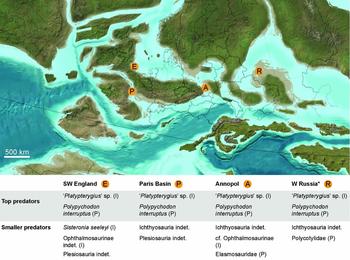
Localities with mid-Cretaceous strata across Europe and Russia have yielded abundant vertebrate remains, mainly of late Albian age (Fig. 8). Arguably, the best known are the Gault and Upper Greensand formations, in addition to the Cambridge Greensand Member of the Grey Chalk Formation of east and southeast England, which contain thousands of isolated remains of marine reptiles (e.g. Seeley, Reference Seeley1869; Fischer et al. Reference Fischer, Bardet, Guiomar and Godefroit2014c ). The predators at the top of the food chains in these marine ecosystems were the ophthalmosaurid ichthyosaur ‘Platypterygius’ sp. and the pliosaurid plesiosaur Polyptychodon interruptus (Owen, Reference Owen1860; Seeley, Reference Seeley1876; Bardet, Reference Bardet1992; Bardet & Godefroit, Reference Bardet and Godefroit1995), but also yield diversified assemblages of distinct, smaller ichthyosaurs (Bardet, Reference Bardet1992; Fischer et al. Reference Fischer, Bardet, Guiomar and Godefroit2014c ) and plesiosaurs (Owen, Reference Owen1851–1864; Seeley, Reference Seeley1869; Lydekker, Reference Lydekker1889). However, these are in need of a modern revision.
Palaeobiogeography of the Albian marine reptile faunas of Eurasia. I: ichthyosaurian; P: plesiosaurian; *preliminary results of an ongoing study. Palaeogeographical map courtesy of R. Blakey.

The Paris Basin yielded some late Albian marine reptiles. Again, this assemblage is characterized by the co-occurrence of Polyptychodon interruptus (see Sauvage, Reference Sauvage1878; Buffetaut et al. Reference Buffetaut, Colletė, Dubus and Petit2005; numerous unregistered specimens in local museums in this region, N.B., personal observation) and frequent large platypterygiine ophthalmosaurids referred to as ‘Platypterygius’ (Barrois, Reference Barrois1875; Sauvage, Reference Sauvage1882; Buffetaut, Reference Buffetaut1977; Debris, Reference Debris1977, Reference Debris1978; Buffetaut et al. Reference Buffetaut, Colletė, Dubus and Petit2005; Colleté, Reference Colleté2010; Fischer, Reference Fischer2012; V.F., personal observation from several local museums in this region). Similar ichthyosaur remains have also been recorded from southern France (Pouech, Reference Pouech1881; Bardet et al. Reference Bardet, Mazin, Azéma, Bégouen and Masure1991; Fischer et al. Reference Fischer, Bardet, Guiomar and Godefroit2014c ) and Italy (Capellini, Reference Capellini1890; Sirotti & Papazzoni, Reference Sirotti and Papazzoni2002), but many of them have yet to be properly described (V. Fischer, unpub. PhD thesis, Université de Liège, Reference Vincent, Bardet, Houssaye, Amaghzaz and Meslouh2013).
Coeval assemblages have also been described from the Kursk area, western Russia (Eichwald, Reference Eichwald1853, Reference Eichwald1865–1868; Kiprijanoff, Reference Kiprijanoff1881, Reference Kiprijanoff1882, Reference Kiprijanoff1883a , Reference Kiprijanoff b ; Rozhdestvenskiy, Reference Rozhdestvenskiy1973), including a new locality, currently under investigation. A preliminary assessment of this material suggests the presence of ‘Platypterygius’ sp. and Polyptychodon interruptus, as well as new small ichthyosaurs and abundant polycotylid remains, the latter feature distinguishing this locality from other European localities.
Although most marine reptilian specimens have been found as isolated bones at Annopol, of note is the co-occurrence from the late late Albian to the middle Cenomanian of both ‘Platypterygius’ and Polyptychodon, as well as of elasmosaurids and a smaller ichthyosaur taxon (Figs 2, 8). As a result, the Annopol marine reptile assemblage appears to have been distinct from other coeval Eurasian ecosystems in containing elasmosaurids, but was similar in being dominated by the ubiquitous apex predators ‘Platypterygius’ and Polyptychodon and in also containing at least one smaller ichthyosaur which occupied an ecological niche different from that of ‘Platyperygius’.
To summarize, these two top predators formed a stable ecological sympatry along the entire NW margin of the Tethys Ocean during the Albian – middle Cenomanian. Conversely, each of these ecosystems (SW England, Paris Basin, Annopol in Poland, western Russia) differed in marine reptilian taxa that occupied lower trophic levels: elasmosaurids in Annopol, polycotylid plesiosaurs in western Russia and abundant ophthalmosaurid ichthyosaurs in SW England (Fig. 8). These differences perhaps reflect regional differences in ecosystems and/or profound modifications occurring at a very fine temporal scale.
Acknowledgements
The present study was financed by the Polish National Centre of Science (grant no. N N307 529238, ‘Taphonomy of vertebrates from condensed mid-Cretaceous deposits of the Annopol anticline (NE border of the Holy Cross Mts)’ and, to a lesser extent, by another grant of the Polish National Centre of Science ‘The Albian phosphorite horizon at Annopol – a unique “Fossil Lagerstätte” in Poland, and its palaeobiological significance’ (decision DEC-2012/05/B/ST10/00710), both grants to MM. We thank: Wiesław Liwiński (Mayor of Annopol) for enthusiastic support and assistance during field work; Agnieszka Kapuścińska, Adam Zaremba, Maciej Duda, Maciej Małysiak, Krzysztof Nejbert, Michał Andziak and the OSP Sucha Wólka fire-fighters for their participation in fieldwork; Witold Biernat, Artur Komorowski, Michał Klimek, Tomasz Mleczek, Grzegorz Gajek and Zbigniew Lis for participation in exploration of the underground phosphorite mine at Annopol; Aleksandra Hołda-Michalska and Agnieszka Kapuścińska for computer processing of figures; and Grażyna Dziewińska for photographs of specimens. VF is a Newton International Fellow of the Royal Society (UK) and a Research Associate (Chargé de Recherches) of the Fond National de la Recherche Scientifique (F.R.S.–FNRS, Belgium). John W.M. Jagt and Elena A. Jagt-Yazykova are thanked for linguistic corrections of the text. The journal referees are acknowledged for their constructive criticism.
Declaration of interests
There are no conflicts of interests.