In 1521, as they fought their way across Tenochtitlan, the Aztec capital, the Spaniards under Cortés were harassed by showers of arrows and light spears. As Fray Bernardino de Sahagún (writing in the 1550s) described the fighting, after the Spaniards massacred celebrants at the Toxcatl festival (Sahagún Reference Sahagún, Anderson and Dibble1975; translated quote from Lockhart Reference Lockhart1993:136)Footnote 1 “[t]he warriors quickly came outfitted, bunched together, carrying arrows and shields. Then the fighting began; they shot at them with barbed darts, spears, and tridents, and they hurled darts with broad obsidian points at them.” So heavy was the hail of projectiles that the chronicle goes on to say “A cloud of yellow reeds spread over the Spaniards.” The various Nahuatl and Spanish words used by Sahagún, translated as darts, spears, javelins or arrows, must often refer to light spears thrown with a weapon new to the Europeans. A stick the length of a man's arm, with a grip at one end and a hook to engage the spear at the other, these spear-throwers were called atlatl in the Nahuatl language of the Aztecs. The leverage of the long atlatl allowed a thrower to fling a light spear much farther and faster than by hand alone (Whittaker Reference Whittaker and Ferguson2010, Reference Whittaker2011, Reference Whittaker, Iovita and Sano2015). The chronicles are vague about this weapon because it was unfamiliar to the Spaniards when they encountered it, and also to subsequent scholars until recently.Footnote 2
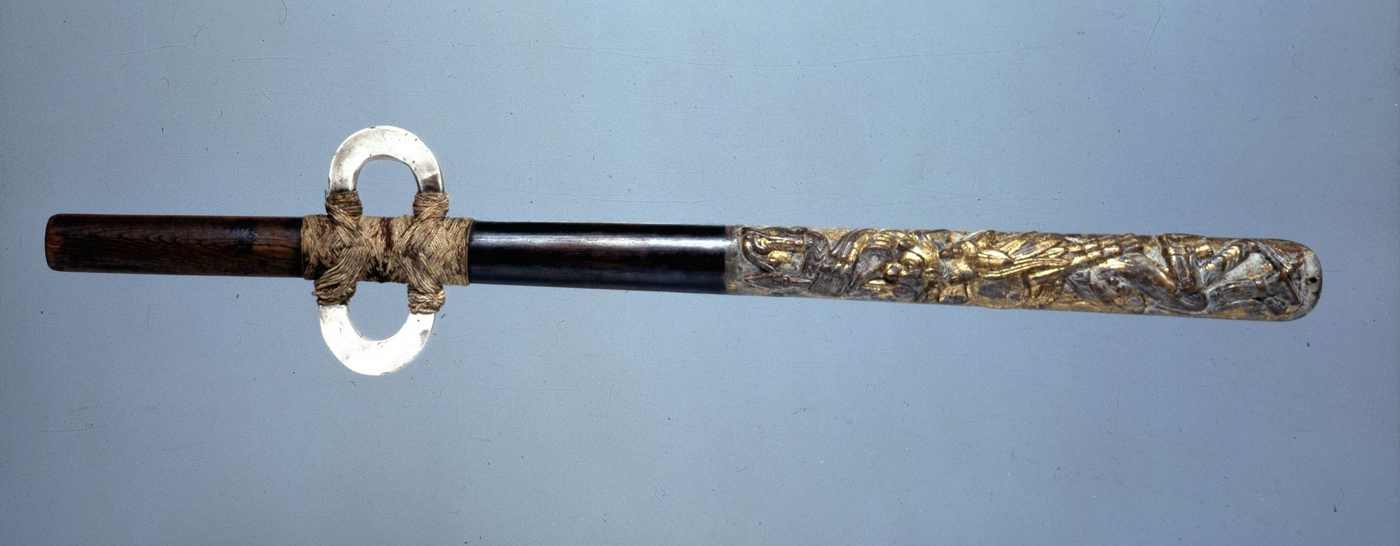
Toward the end of the nineteenth century, anthropologists began to report spear-throwersFootnote 3 and related weapons among the Australians, arctic peoples, and some South American and Mexican groups (Mason Reference Mason1885; Uhle Reference Uhle1887; Starr Reference Starr1901; Whittaker Reference Whittaker2009) and began to recognize archaeological specimens (Cushing Reference Cushing1895; Lansac Reference Lansac2001). Several examples of ancient Mexican atlatls turned up in European museums, and Nuttall (Reference Nuttall1891) and others (Bushnell Reference Bushnell1905, Reference Bushnell1906; Seler Reference Seler1890; Stolpe Reference Stolpe1890; Uhle Reference Uhle1887) discussed artistic depictions from Mexican codices and archaeological sites. The best known specimen is probably the Aztec atlatl in the British Museum. It is frequently pictured, but it has apparently never been closely examined in light of modern atlatl knowledge, and no detailed description is available. In 2004, the display in which the atlatl was included was being remodeled, and through the kindness of the museum and its personnel, Kathryn Kamp and I were able to examine and measure this legendary object (Figures 1–5).
Overall view of the atlatl, showing carved underside and elaborate grips. British Museum photograph AN00334834_001_l © Trustees of the British Museum.

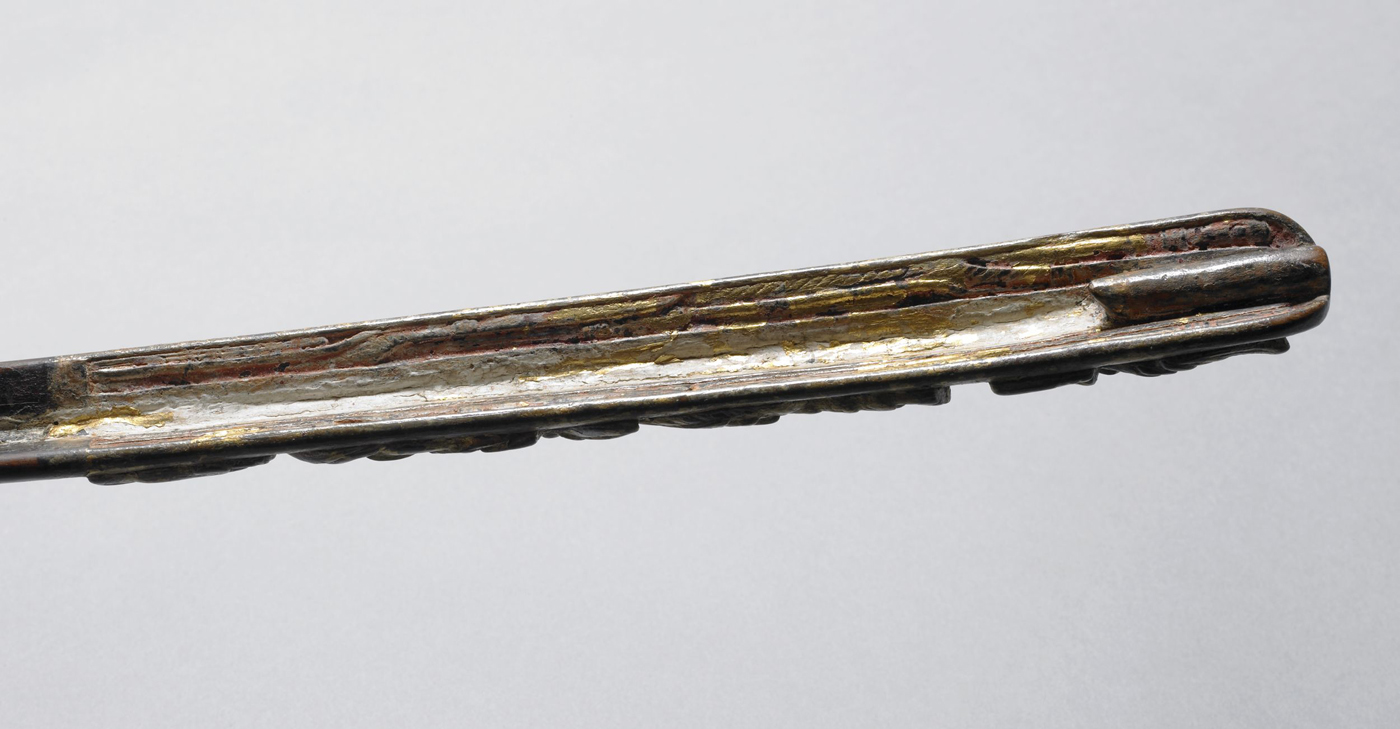
Upper face of the atlatl, showing decoration and hook. British Museum photograph AN00522856_001_l © Trustees of the British Museum.

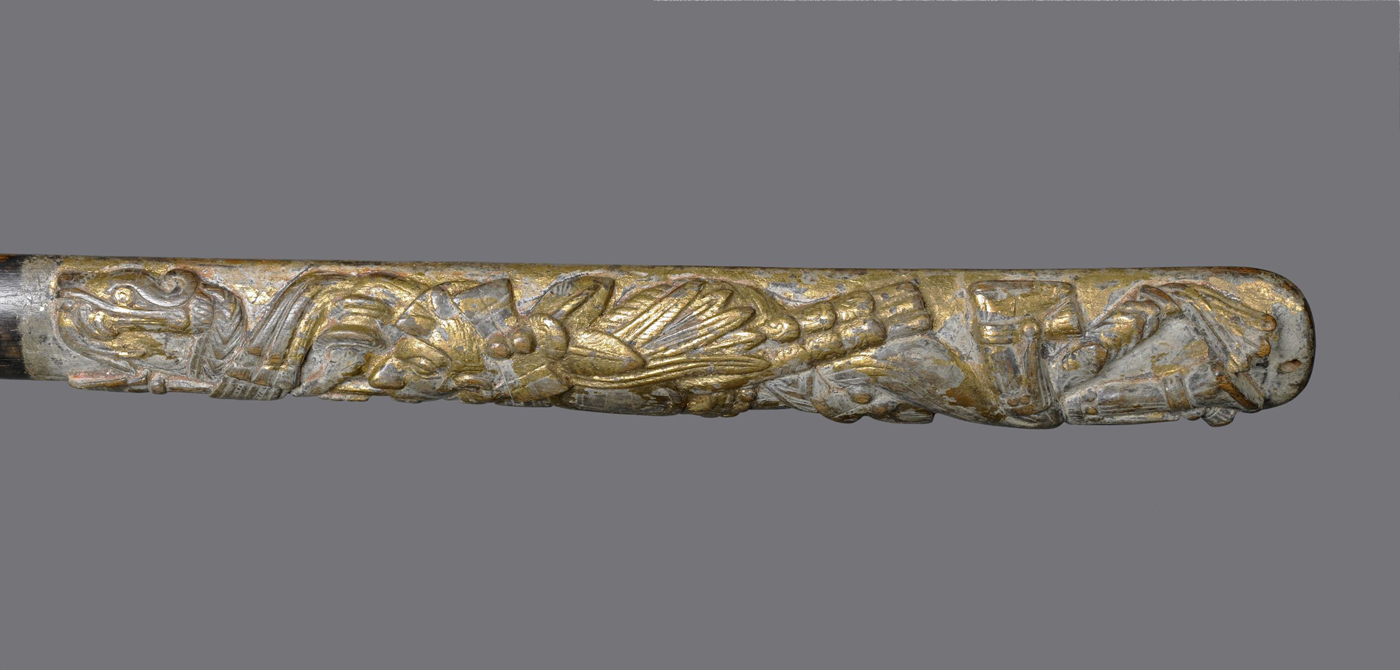
The high relief carving of deity and serpent on the underside of the atlatl. British Museum photograph AN00522854_001_l © Trustees of the British Museum.

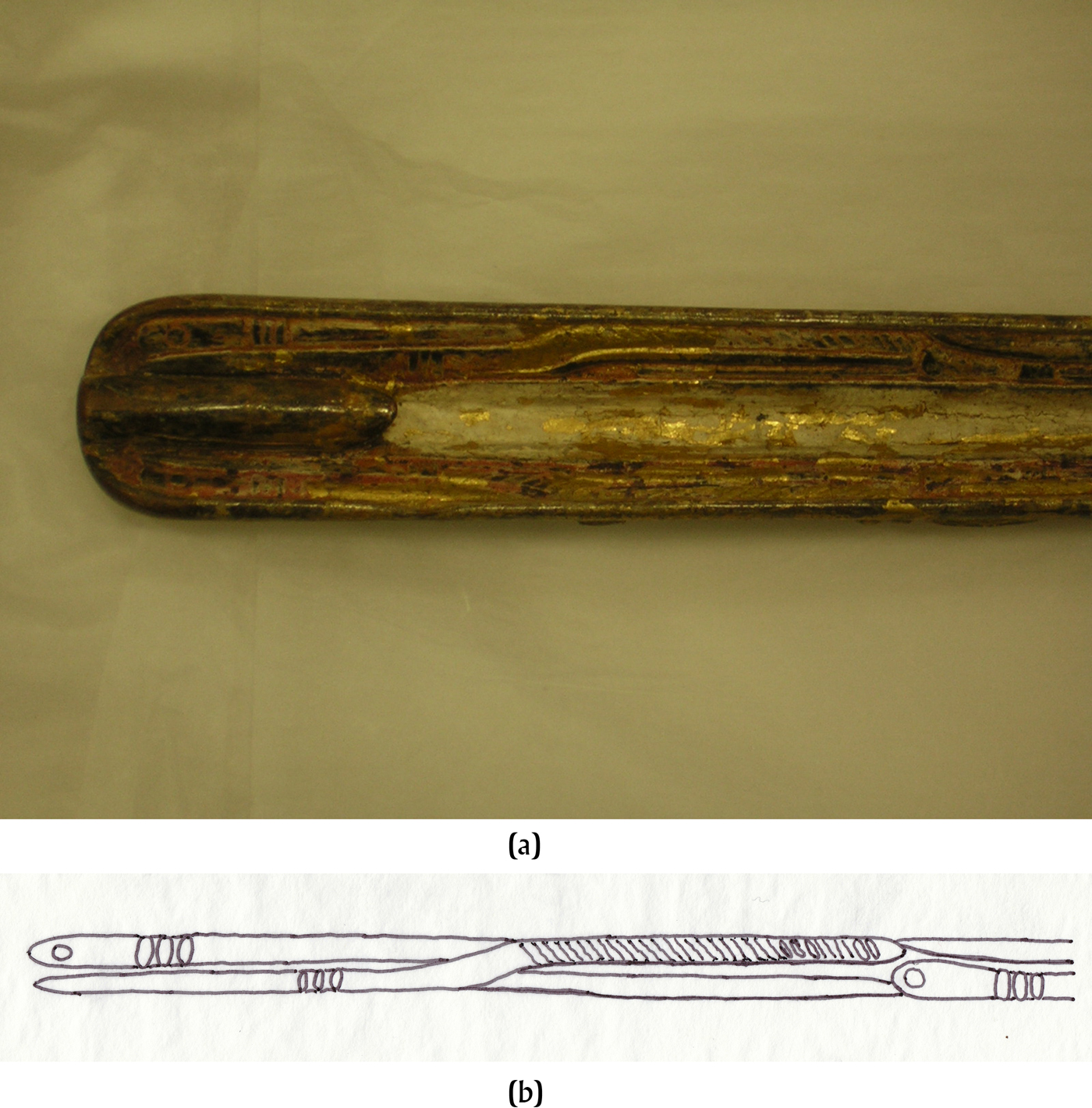
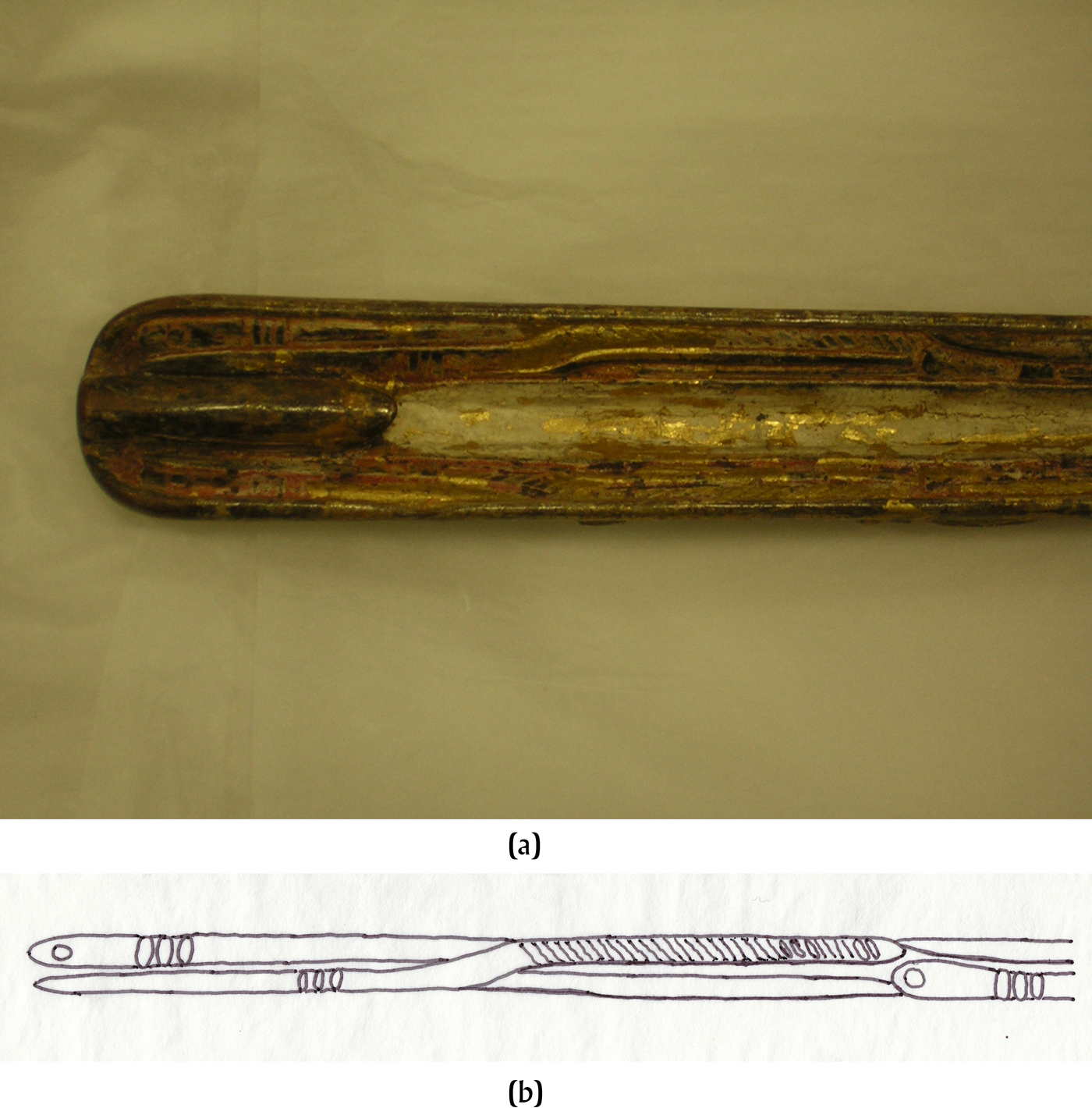
(a) Upper face of the atlatl, showing low relief decoration and hook. Photograph by John Whittaker. (b) Drawn interpretation of the decorative motif on the upper surface. Drawing by John Whittaker.
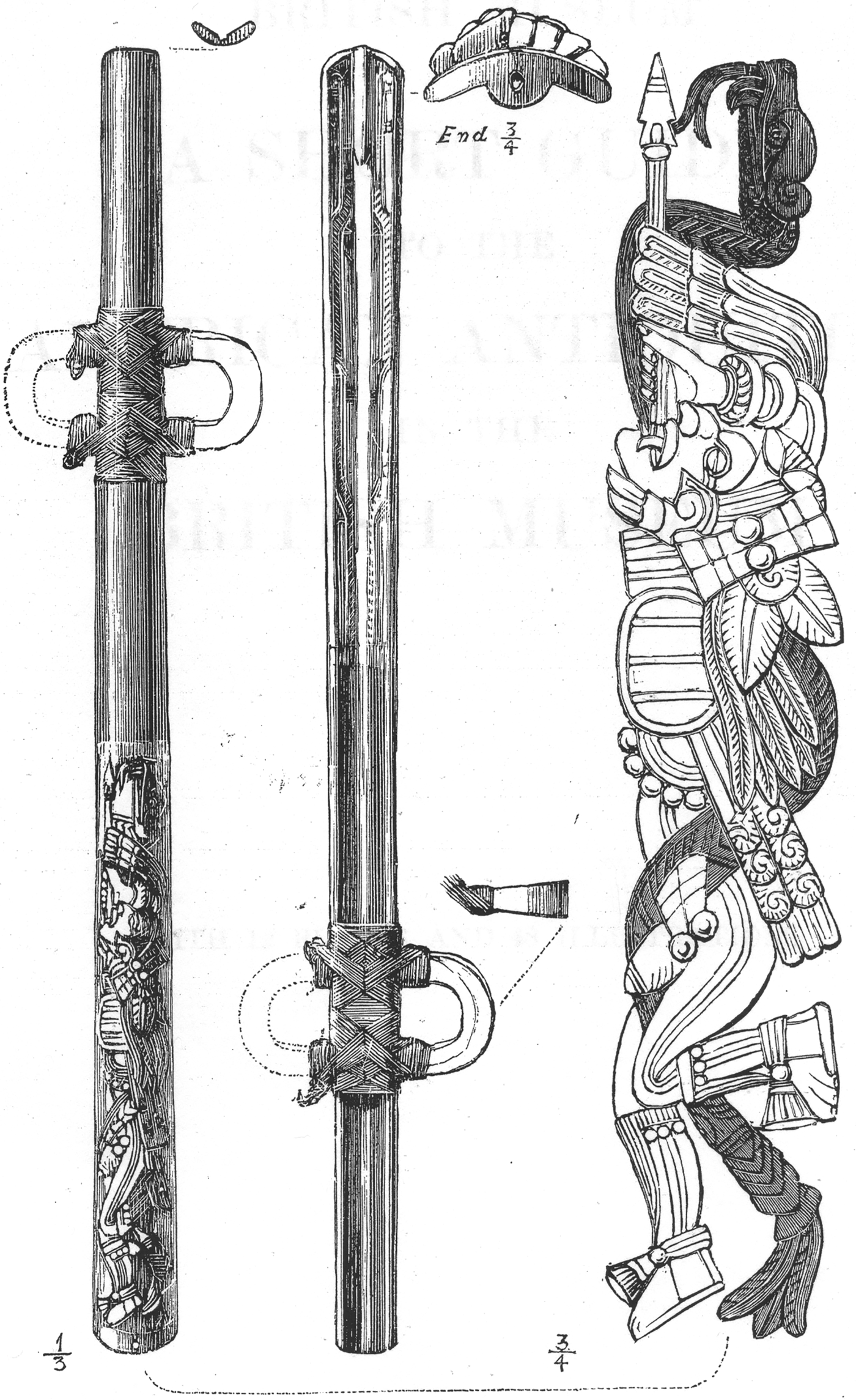
The atlatl and its decoration as shown in the British Museum Guide (1912).

THE BRITISH MUSEUM ATLATL
Provenance
The catalog entries for object Am 5226 record how it reached the British Museum in the nineteenth century, but not its earlier travels. The Aztec atlatl is included with the “Christy Additions 1868–1877, Plate 118, Number 1.” It was presented to the museum January 1, 1870, by Sir Augustus Wollaston Franks, who apparently gave other objects as well. Franks had purchased it in 1868 from the collection of Dr. Gustav Friedrich Klemm (1802–1867). Klemm was an influential German anthropologist and collector who spent most of his life as Director of the Royal Library, Dresden. I have been unable to trace how the atlatl got to Dresden. Saville (Reference Saville1925) notes that atlatls were among the loot sent by Cortés in 1519 to Charles V, Holy Roman Emperor and King of Spain (Saville Reference Saville1925; Maudslay Reference Maudslay1908). This is the most likely origin, although it can no longer be proven. Other uncertainties include the ascription as “Aztec;” Cortés encountered various other groups in his travels through Mexico, and acquired objects as gifts as well as plunder. Some of the objects he amassed were apparently distributed to Italy and Germany as well, but Saville says the listed atlatls appear to be mosaic decorated, in which case none of them have survived. The several atlatls of this period in European collections, however, are decorated with gold leaf, attractive enough for royal gifts, and they may indeed have come from Cortés. A number of Mesoamerican artifacts apparently passed from Cortés or Spanish royalty to the Medici popes and family collections but are now held by museums and private individuals, and include other Christy Collection pieces (Bushnell Reference Bushnell1906; Maudslay Reference Maudslay1908:299–302).
DESCRIPTION
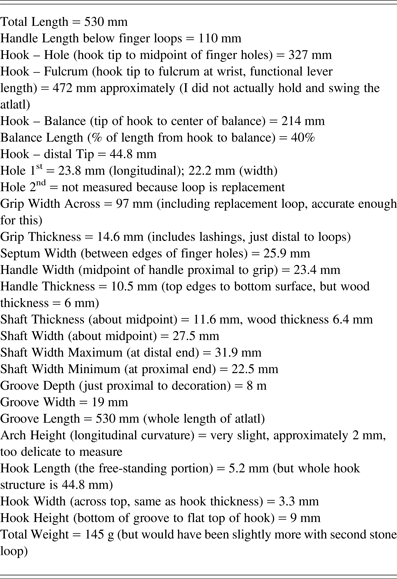
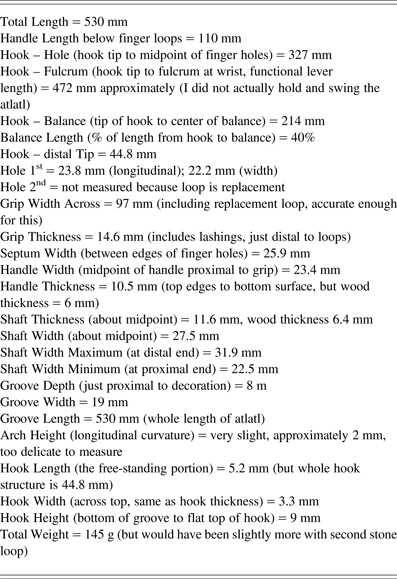
Measurements of the atlatl are given in Table 1 for the purpose of documentation and replication. The length of 530 mm is rather shorter than the three specimens in Italy, which range from 565–605 mm (Bushnell Reference Bushnell1905, Reference Bushnell1906). The basic form and the highly decorated style is consistent with the other specimens, and one of the questions asked must be whether or not the atlatl was intended or used as a functional weapon. Most observers concur with Bushnell (Reference Bushnell1906:244) that “no actual weapon would have been so elaborately decorated and covered with gold.” But this has always been a foolish comment—high status weapons owned by elite members of society are often both functional and of great intrinsic and symbolic value. It is also well to remember that however iconic this artifact has become, it cannot be taken as reliably representing all Aztec atlatls. In the first place, the Conquest-era atlatls now in Europe were selected as splendid examples. Furthermore, iconographic evidence (Nuttall Reference Nuttall1891) and fragments of other Mesoamerican atlatls suggest that other forms of grip were also used (Coggins and Shane Reference Coggins and Shane1984; Cook de Leonard Reference Cook de Leonard1956; Minelli Reference Minelli1993). Nevertheless, close examination of one specimen often sheds light on larger issues.
Detailed measurements of the British Museum atlatl
The British Museum atlatl shaft is made of some dark hardwood with a straight grain and high polish. The color is currently a dark brown, with blackened surfaces that could be merely patinated, but look more as if the shaft surface was treated anciently with oil or varnish of some sort, since cleaner wood is visible along the upper edges, the handle, and mid-shaft where there appears to be handling wear. The interior of the groove is especially dark, and almost looks charred. On the handle, an irregular patch of material remains adhering to the underside, and dark material appears to pass under the loop lashings, arguing for an intentional original finish.
The shaft is slightly tapered from handle to broader distal end, and has a very slight curvature upward. The upper surface is hollow the entire length, almost as if it were cane (but it is not). This concavity has been considered the “groove” for measurement purposes. Some other atlatls from different parts of the world also have a groove, which increases the relief of the hook, allowing space under it so it can engage the socket in the end of the dart. It has also been suggested that a groove allows a dart to be loaded by feel, useful in hunting or battle. The interior sides are slightly rounded to almost flat, and there is a secondary narrow groove at the bottom which is about 2 mm wide and 2 mm deep (shown adequately on the British Museum Reference Museum1912 Guide, drawn in cross-section; see Figure 5).
The handle is a continuation of the basic shaft, and the grip was formed by lashing on a pair of loops with a complex cordage binding which passes around and across the shaft. The shaft is apparently hollow at this point, but no obvious gap is visible under the binding, and we did not probe to see if, perhaps, there is a solid area. The cordage appears to be soft vegetal fiber, probably cotton, in a quite regular two-ply S-twist yarn. Traces of black and red-pigmented encrustation cover much of the cordage. Daniels and Oddy (Reference Daniels and Oddy1993) identified cochineal pigment in material from elsewhere under the gilding. Here on the cordage, there may or may not be similar cochineal pigment. The darker encrustations could just be old greasy dirt, but may also be a varnish or oil. They could perhaps be blood as well, and it would be worth testing. The intent never seems to have been to cover the binding and obscure the decorative weave pattern, so whatever they are, these are probably all secondary deposits.
There are strands of a much thinner, very regular two-ply Z-twist gold thread visible among the disarrayed areas of the lashing. Initially we believed this was a strand of gold thread mostly concealed under the cotton, but it is more likely gilded modern thread used to fasten on the replacement loop (the left loop, as viewed with the atlatl hook up and distal). The 1870 catalog entry shows the loop missing, but an earlier replica had been provided by Saville's time (1925). The Museum's online catalog describes a 1994 conservation treatment in which an older replica loop “of cardboard and animal glue, not particularly aesthetic” was replaced with a replica of polyester resin.
The one original loop is made of a very hard shiny white material, usually described as shell. Under 10× hand lens magnification, however, no shell structure was visible, nor is it bone or ivory. We suspect stone, although we were unable to identify any diagnostic inclusions—it is very pure and clean. Under a bright polish are visible some quite deep striations with a variety of orientations, and finer sets of multiple, parallel-oriented striations that apparently result from the cutting and shaping processes. The sharp corners on the inside of the loop have been rounded off and taken a high polish, and are less polished and rounded close to the lashings. This is suggestive of actual use. The interior surface of the loop, and the striations, also have black residue—oil, dirt, or varnish—again most suggestive of use in dirty hands. The lashings are not worn, however, or furred out the way cordage would be if rubbed by the hand in use, especially on the “septum” which would be between the first and second fingers, assuming the atlatl was used with a “split-finger” grip, as seems natural to someone familiar with atlatl use. The loop is firmly fixed to the atlatl, but the lashings flex readily, so it has some movement up and down. The loop is apparently drilled from top to bottom for the lashing (Ekholm Reference Ekholm1962:181), which is unusual among other examples. As the shafts of other atlatls that are now missing their loops are not pierced (see, for example, Urcid Reference Urcid and Evans2010), it seems the lashing must pass over and around the shaft. We did not probe beneath the lashings to confirm these details.
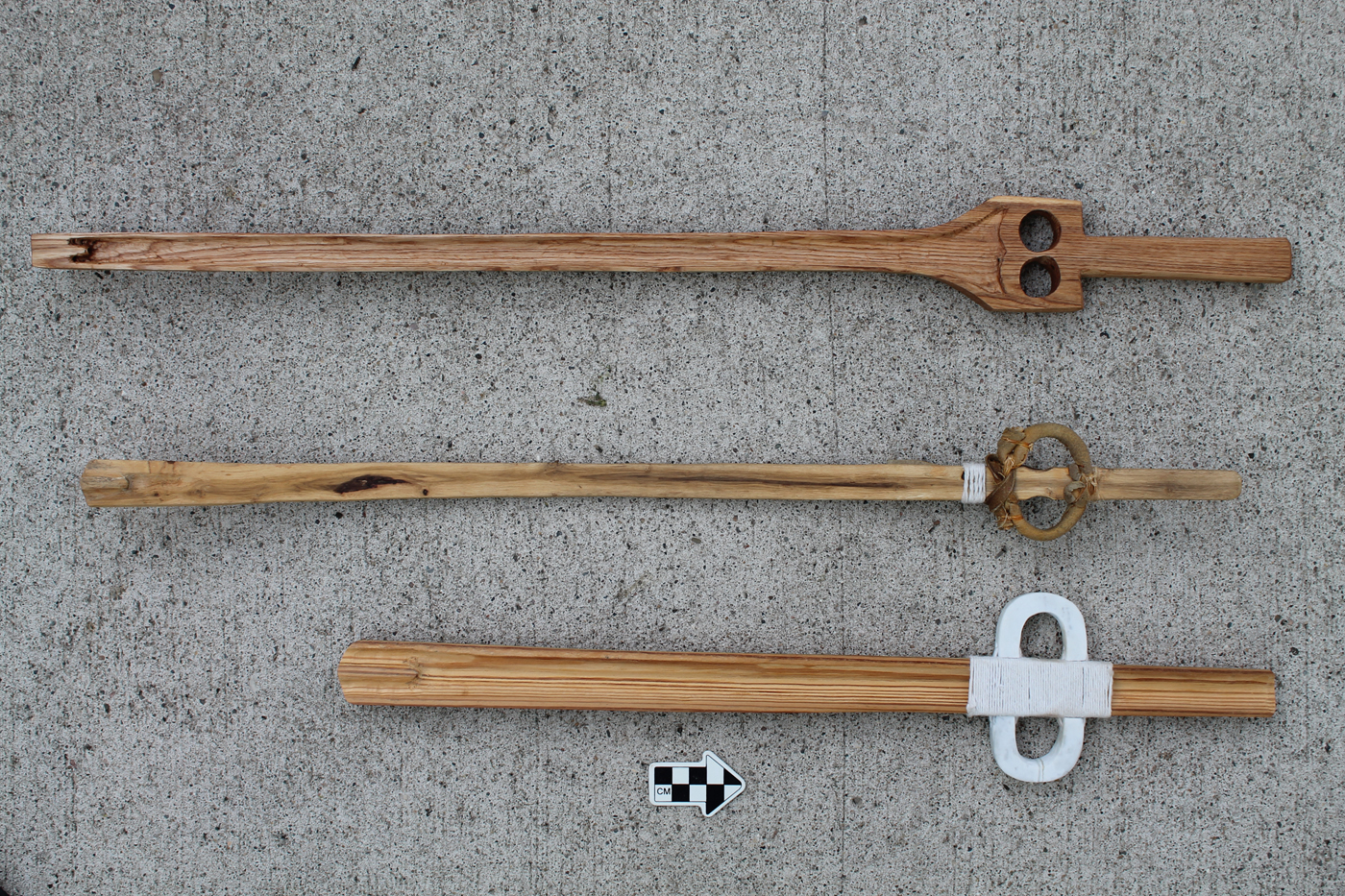
In use, the atlatl would presumably be held with a “split-finger” grip, with first and second finger in the loops, as were ethnographic atlatls from Lake Patzcuaro, and prehistoric Southwestern United States atlatls, both of which are related forms with similar finger loops (Figure 6). Many codex depictions also show such a grip (see Figures 7 and 8). One could also throw with thumb and first finger in the loops, the “hammer” grip common on many other atlatls. The “septum” between loops seems rather wide to be comfortable with a split-finger grip, even with soft cotton lashing and, as noted, these do not seem worn. The handle has a moderate polish, but we did not see clear areas of differential wear where fingers should have gripped.
Measured replicas of three atlatls, made by the author for experimental throwing: (top) ethnographic Mexican atlatl from Lake Patzcuaro; (center) prehistoric Basketmaker atlatl from Sand Dune Cave; (bottom) British Museum Aztec atlatl.

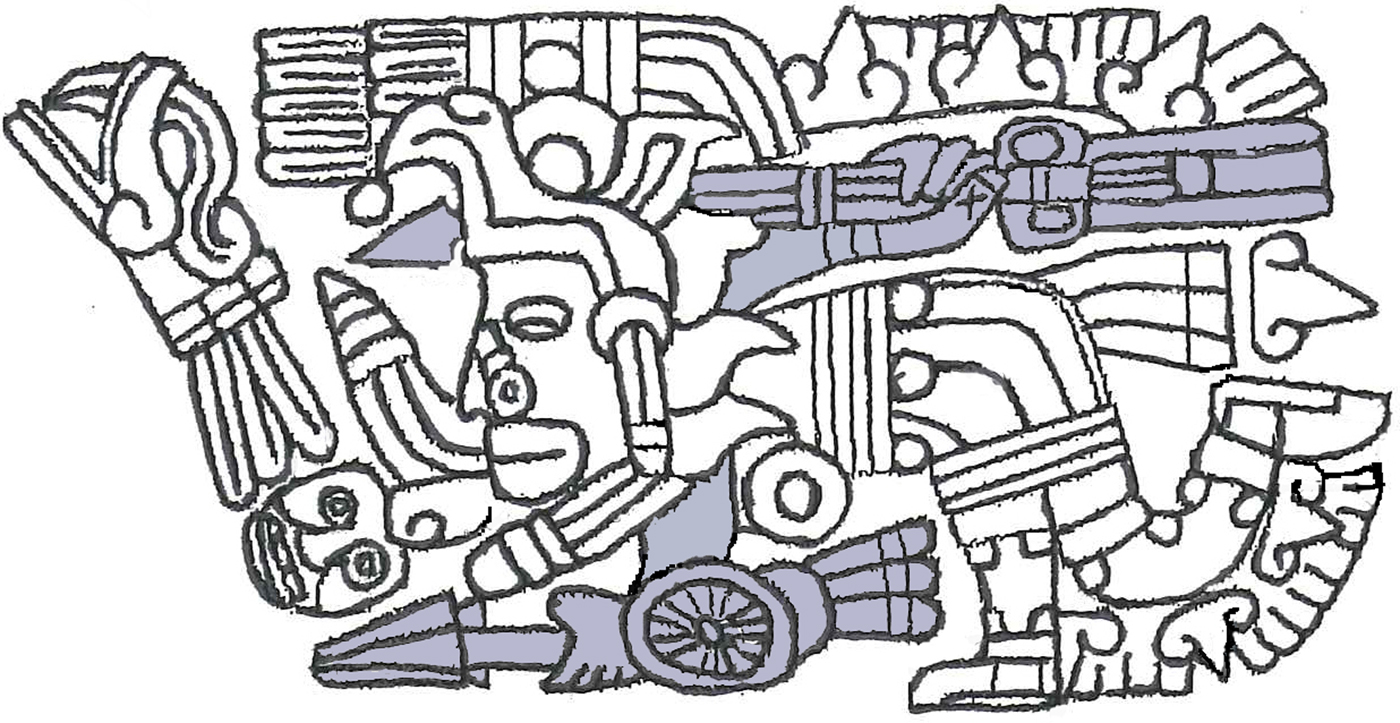
Lead figure from the Bliss Collection atlatl, Dumbarton Oaks. Redrawn from Urcid (Reference Urcid and Evans2010:Plate 73). Simplified with atlatl elements shaded for contrast. As on the British Museum atlatl, the figure holds a dart-and-shield element and is associated with a serpent. An atlatl and dart is held in the right hand over the back, with the dart point near the forehead. The figure is masked as an eagle, and a solar band behind him (at the hook end of the atlatl), relates him to the solar deity and the Voladores sacrifice (Urcid Reference Urcid and Evans2010).

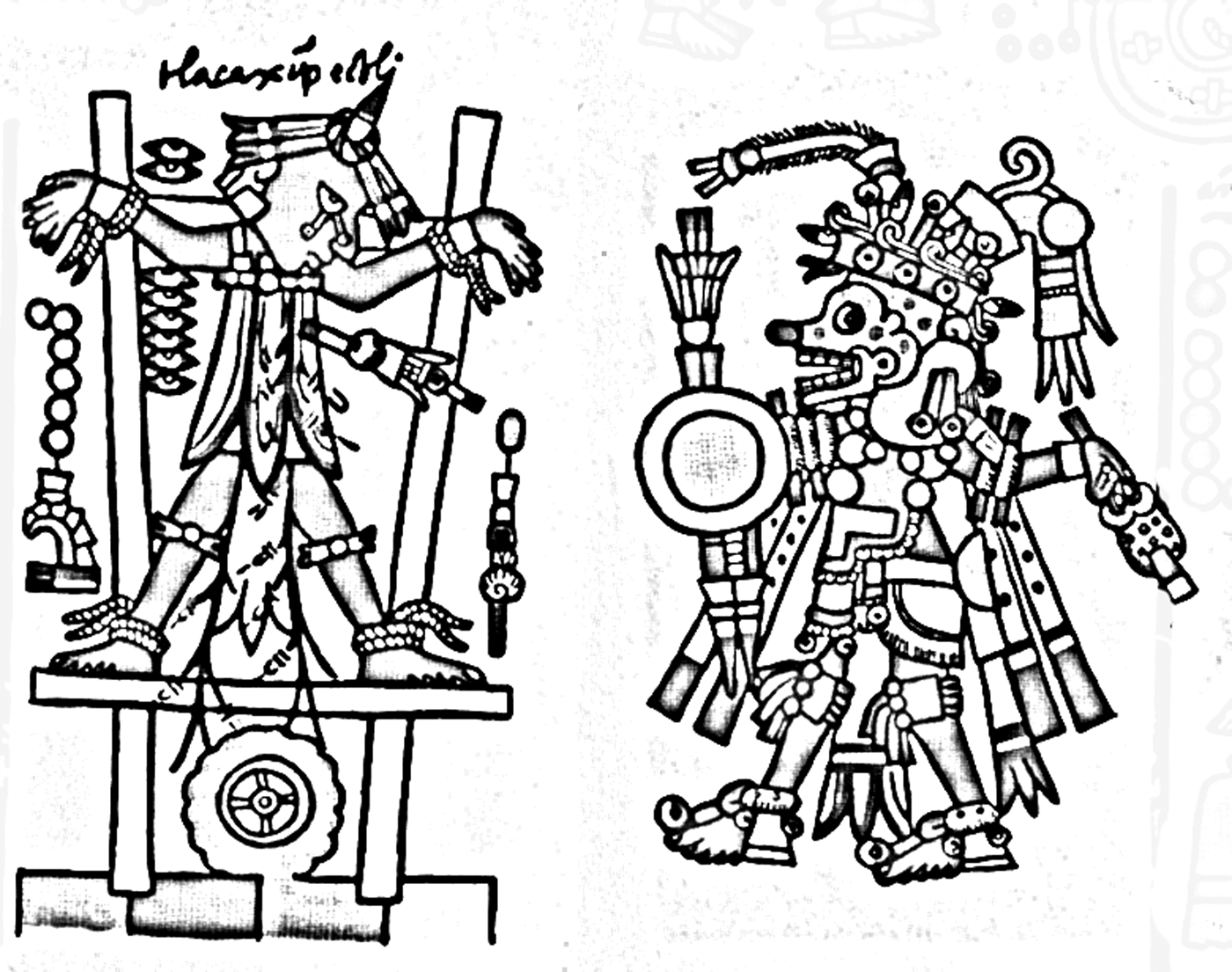
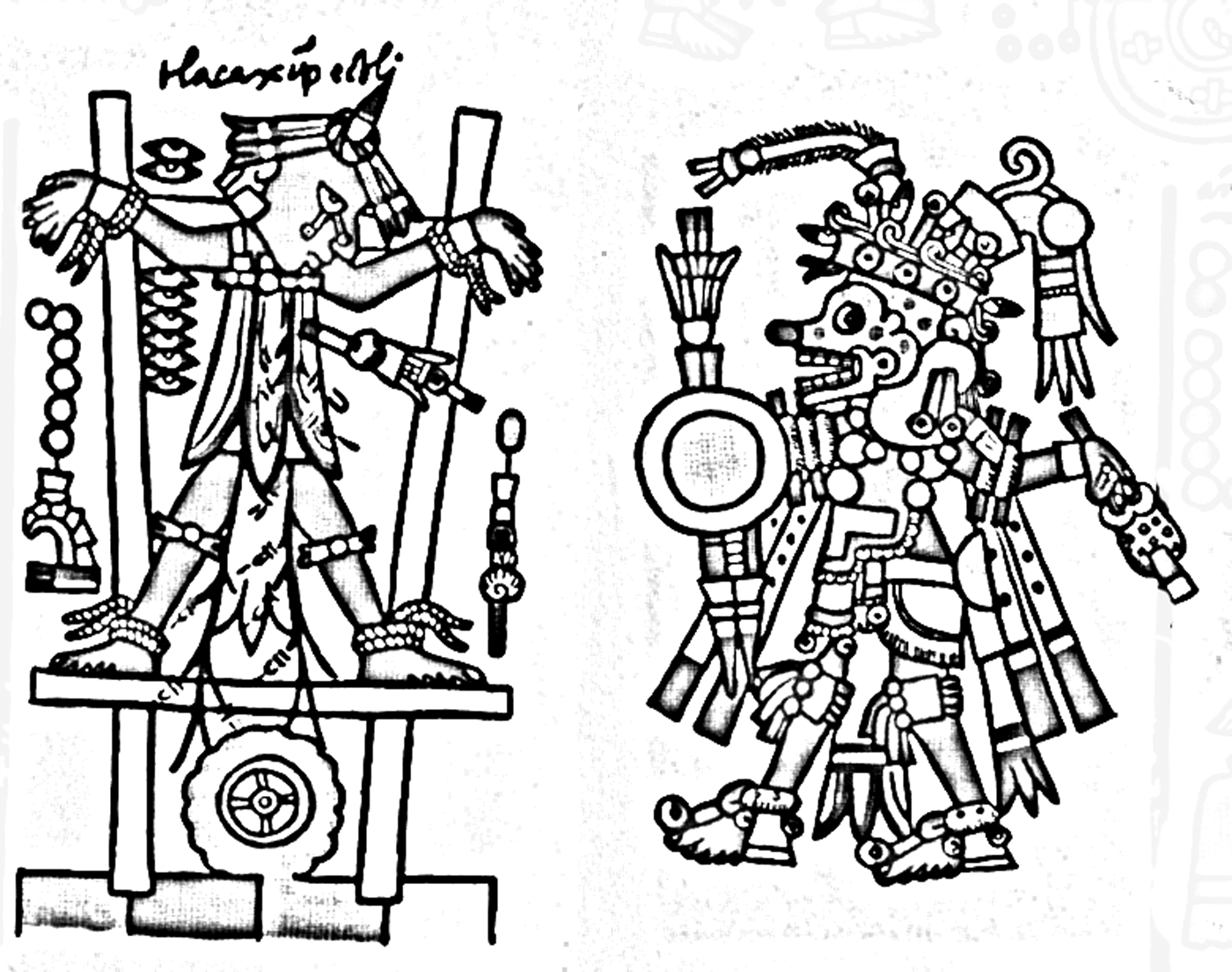
Scaffold sacrifice by atlatl, from the Codex Nuttall, pages 83–84. Redrawn and simplified from Nuttall (1975).
The hook is an integral carving, cylindrical or barrel shaped, lying horizontally in the groove of the atlatl (Figures 2 and 4a). The tip of the hook is moderately pointed, and undercut to give about 9 mm clearance to the groove below. It was once gilded like the groove and other surfaces. Wear patterns, comparable to those observed on ethnographic spear-throwers and experimentally (Cattelain Reference Cattelain1986) are equivocal. The extreme distal upper surface of the hook is worn, with the gilding and underlying material removed down to polished bright wood. This could be from striking the nock end of the dart in the follow-through of a throw, but it is also a vulnerable area of the atlatl, which might be rubbed if the specimen was stored or displayed with the carved under-surface facing up. The wear does not seem to be dented, as it often is if the dart is struck. The tip of the hook retains traces of gilding and high polish, and the gilding would almost certainly be worn off in use, so we regard these traits as evidence that the atlatl was not used, although it is possible that it was indeed used and then refurbished or gilded afterwards.
Decoration
The decoration is elaborate (Figures 1–5). From mid-shaft to the distal end, on both upper and under surfaces, the atlatl was carved, painted, and gilded. The material under the gilding has been identified (Daniels and Oddy Reference Daniels and Oddy1993) as gypsum-based gesso (white, especially visible in the central groove), and a clay material pigmented red with carminic acid, thus probably colored with cochineal insects. This could be simply a substratum for the gilding, but more likely was an earlier decorative scheme using paint and carving alone, that was later covered with gilding. This is suggested to us by the apparent pattern of white in the groove and red elsewhere on the upper face. On the lower face, we did not check closely enough with that in mind to see if there is evidence that the warrior and serpent were painted to follow the carved details. This should be checked by someone with more expertise in Aztec art and in analysis of painting. Minelli (Reference Minelli1993) suggested that the similarly gilded atlatls in the Museo Nazionale di Antropologica e Etnologia in Florence were gilded after arrival in Europe. The gilding on the British Museum atlatl, however, was analyzed by Meeks (Reference Meeks1992), who found it to be gold foil 5–7 microns thick, an alloy (8% silver and copper traces) consistent with pre-Columbian gilding, but not with European gold leaf.
The decorative scheme on the underside of the atlatl is well known and accurately illustrated in the British Museum Reference Museum1912 Guide, Saville (Reference Saville1925), and with photographs in several publications (McEwan Reference McEwan2009; Pasztory Reference Pasztory1983), but the upper surface decoration is unclearly depicted in the British Museum Reference Museum1912 Guide and not at all elsewhere. Currently, the British Museum online catalog includes excellent photos, some of which are reproduced in Figures 1–3.Footnote 4
The underside is carved in high relief with a warrior, deity, or costumed impersonator of a deity, intertwined with a serpent. The illustration in Saville (Reference Saville1925) and the British Museum Guide (Figure 5) shows the serpent darker than the warrior, but only to clarify the drawing; both were gilded. The warrior is dancing, reclining, or flying, with one foot extended, the other knee bent. A fang in his mouth identifies him as a supernatural being. His right hand is visible, grasping the shaft of a spear or atlatl dart. The stemmed form of the projectile point is duplicated in stone points recovered from the Cenote of Sacrifice at Chichen Itza (Coggins and Shane Reference Coggins and Shane1984:47) and elsewhere (Pastrana and Hirth Reference Pastrana, Hirth and Hirth2002). The warrior also has a shield at his chest, and protruding from behind the shield down past his hip is a three-lobed motif that could be a group of feathers, but is probably the feathered ends of atlatl darts. There is an oval motif between his legs that is probably phallic, but which also resembles the flint knife glyph. The serpent's tail ends in a tuft of feathers, sufficient to identify it as a “feathered serpent.”
On the upper surface, a simpler motif in low relief appears on both sides of the groove, but its details are obscured by paint and gilding (Figure 4a, 4b). At the distal end beside the hook, the design begins with a rod with a hole in it like the eye of a needle. The rod then has three rings, and continues to a point, while alongside it, another motif, a more rectangular bar with feathers or bands, and also with three rings, runs beneath the “needle” from the distal end then bends upward and crosses over the “needle” to follow the edge of the atlatl. The effect is of two linear forms crossed in the middle. The sequence is repeated twice on each side. We are tempted to see this as a sort of stylized atlatl and dart motif, but cannot quite convince ourselves. Darts are plainly depicted beside the groove on the Mixtec atlatl in the Dumbarton Oaks collection (Urcid Reference Urcid and Evans2010). McEwan and López Luján (Reference McEwan and López Luján2009:205) consider the motif on the British Museum specimen to be serpents, representing darts, but that is not clear to us either.
Iconography
The images on the British Museum atlatl are related to those on other atlatls, and to the uses of atlatls themselves as symbols of the power of elites and deities, linked to war, sacrifice, and rain (Slater Reference Slater2011).
The armed figure has been identified by Beyer (Reference Beyer1965) as Mixcoatl, accompanied by a Cloud-Serpent that signifies rain (Urcid Reference Urcid and Evans2010). According to Beyer, Mixcoatl, god of the hunter tribes of Chichimec in the northern deserts, was often depicted in “savage nudity.” Considering all the ornamentation worn by the British Museum figure, this seems an overstatement. Beyer (Reference Beyer1965:x) interprets the oval between his legs as his penis, adorned with paper strips, as in a comparable Mixcoatl from the Codex Vaticanus B. Ear ornaments of deer hooves identify him as a hunter (Beyer Reference Beyer1965) or reference the symbolic equation of deer hunting with war and capturing sacrifices for the sun (Urcid Reference Urcid and Evans2010). Beyer felt that the parallel lines on the legs, arm, and belly of the warrior index the Milky Way or light of dawn and dusk. They may equally be part of the complex imagery of sacrifice that abounds in this depiction, representing the lines painted on the bodies of individuals destined for sacrifice, who additionally were often seen as embodying deities. Mixcoatl is always shown as hunter/captor, most often with striped body, and striped bodies may signal the potential of a warrior to become a captive/sacrifice, or reference dripping blood, which in turn symbolizes and calls forth dripping water (Urcid, personal communication 2013).
Beyer suggests that the spear or arrow issuing from the figure's mouth is probably just an accident or lack of space, but other Mixcoatl images also grasp a spear. The juxtaposition of dart and mouth may be meaningless, but it seems unlikely that the features in this masterful carving are accidental, and the dart may be issuing from the mouth of a deity of rain as lightning flashes from a storm. The associations of rain and lightning and divine powers with darts, arrows, and other weapons are almost universal, and not just in Mesoamerica (Blinkenberg Reference Blinkenberg1911; Nuttall Reference Nuttall1891; Slater Reference Slater2011).
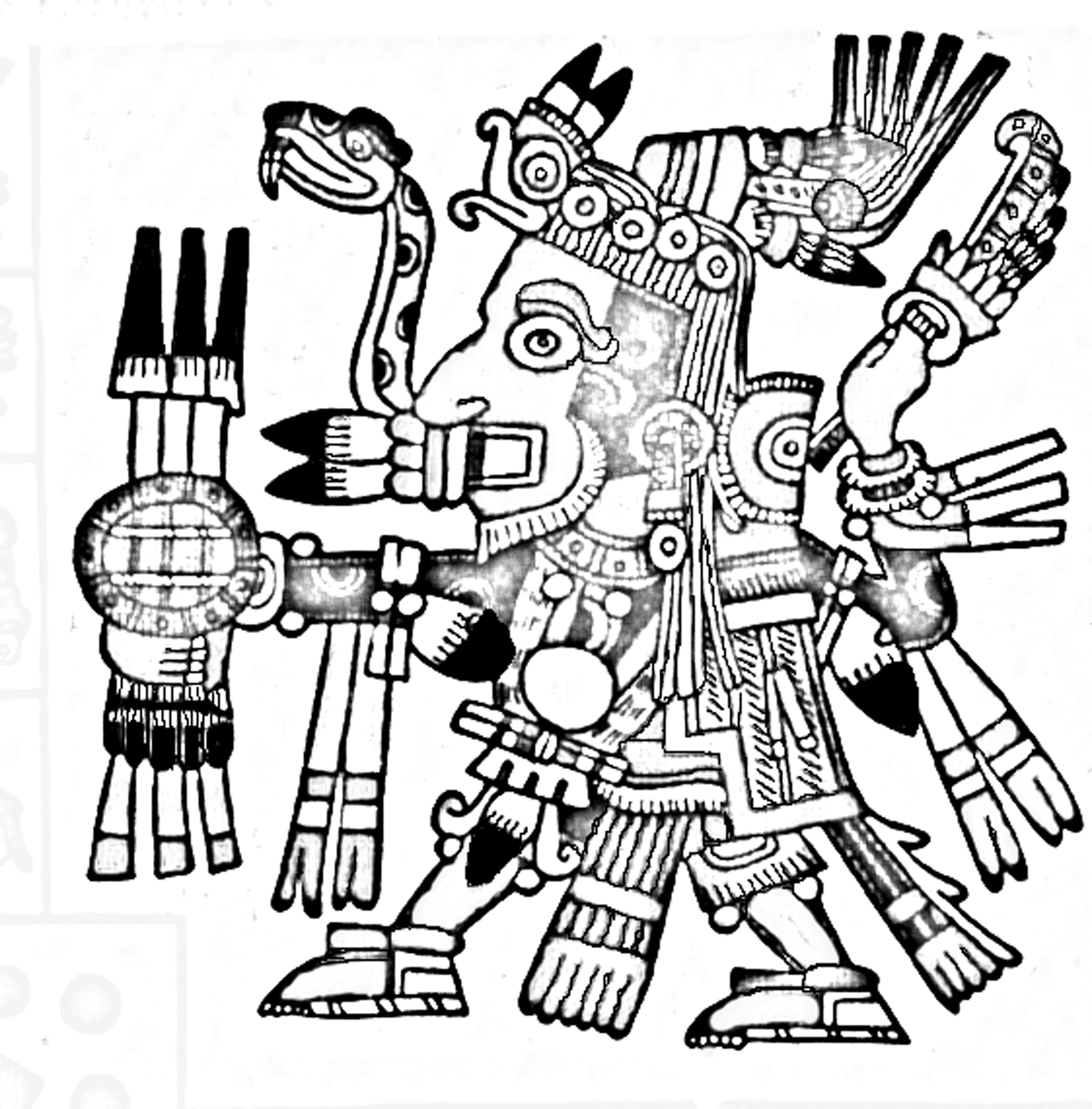
The “spear” is more likely an atlatl dart, and a similar depiction of Mixcoatl in the Codex Borgia (Figure 9) (Díaz and Rodgers Reference Díaz and Rodgers1993: Plate 25) is clearly holding an atlatl, as well as a shield and three darts. The lead figure on the Bliss collection Mixtec atlatl (Figure 7) is in a very similar posture to the example on the British Museum specimen, but costumed as an eagle and associated with a solar band (Urcid Reference Urcid and Evans2010:Figure 73). It wields an atlatl in one hand and grasps a shield and atlatl dart or bundle of darts in the other. The shield-and-darts motif represents the whole warrior outfit in other images even when the atlatl is not depicted, and is also a metaphor for war itself (Urcid Reference Urcid and Evans2010).
Mixcoatl depicted in the Codex Borgia. Redrawn and simplified after Díaz and Rodgers (Reference Díaz and Rodgers1993:Plate 25). Motifs shared among the images here include stylized ornate atlatl, shield with three darts, serpent, knives (at mouth, elbows, and breech cloth), and eagle (head dress). Similarities of iconography unite feather motifs on headdress, atlatl and dart, and sharp stone (obsidian or flint) motifs on dart tips and knives.

Urcid (Reference Urcid2006, Reference Urcid and Evans2010) shows that the images on the British Museum specimen and two other extant atlatls relate to the “Voladores” ceremony, in which dancers swing by their legs, descending from a high pole as eagles flying down to receive a sacrifice. The sacrifice in ancient times was often a victim tied to a scaffold and pierced by arrows or darts to produce copious bleeding (rain), before heart extraction. The final scene in the Codex Nuttall (Nuttall and Miller Reference Nuttall and Miller1975:83–84) shows a Mixtec lord costumed as Death, performing a scaffold sacrifice with an atlatl (Figure 8). The figure on the British Museum atlatl can be read as a descending dancer, costumed as a god and armed for the sacrifice, and the atlatl itself could have been intended for use in such a ceremony.
Function and Performance
As discussed above, there is no clear evidence of use-wear. The gilding is worn and flaked off; probably less than 30% remains. High polish on the handle, upper edges, and other exposed wood is probably from both careful original finish, and from handling, but not necessarily original use. The proximal end of the handle is cracked, with the crack running most of the way toward the grip. There is a small round hole drilled in the distal end, which is depicted in the British Museum Reference Museum1912 Guide. Some other atlatls apparently have such a hole, allowing feathers or other ornaments to be attached (Saville Reference Saville1925:46). The perforation on this atlatl is very straight-sided and precise; it looked to us like it was done to hang or mount the atlatl, probably by Klemm or another early owner rather than originally.
There are no darts associated with this atlatl. The depictions in codices and the comments in documents suggest that they would have been compound darts with cane shafts, and hardwood foreshafts, such as those examples from the Cenote of Sacrifice at Chichen Itza (Coggins and Ladd Reference Coggins, Ladd and Coggins1992), tipped with a variety of materials, from flint or obsidian points, to simple sharpened hardwood. The multi-barbed spears mentioned in the opening quotation are reminiscent of the ethnographic spears used on Lake Patzcuaro to hunt ducks (Starr Reference Starr1898; Stirling Reference Stirling1960). These are long and heavy, as are the atlatls used with them. The British Museum atlatl is a light, but sturdy and well-crafted atlatl, a bit shorter than the other ancient Mexican specimens.
The codex depictions often show atlatl-wielding deities with atlatl in one hand and shield and three to five darts in the other. This is so consistent, it may represent a common outfit for a warrior, and the dart and shield motif appears to be shorthand for the rest of the gear. The darts appear to have fletching, and usually a triangular point, presumably of stone, with side notches, corner notches, or a flared stem. Obsidian and chert points consistent with these depictions occur at Aztec, Maya, and Toltec sites (Aguirre and Chávez Reference Aguirre and Chávez2012; Coggins and Shane Reference Coggins and Shane1984:47, 100; López Luján Reference López Luján2005:176, 191; Parsons Reference Parsons, Brumfiel and Feinman2008:42; Pastrana and Hirth Reference Pastrana, Hirth and Hirth2002; Sheets et al. Reference Sheets, Ladd, Bathgate and Coggins1992). The cane shafts mentioned in the chronicles were probably Gynerium sagittatum (arrow cane, wild cane, caña brava) (Stirling Reference Stirling1960; Justin Garnett, personal communication 2013). The depictions of darts may be complicated by multiple symbolic references. The day sign “reed” is essentially the same as the fletched end of dart depictions, and the name sign of the ruler Acamapichtli (Handful of Reeds) shows a hand grasping a pair of reeds that appear to be darts without points (see, for example, Boone Reference Boone, Brumfiel and Feinman2008). Nevertheless, it appears that Aztec darts would have been fletched, and given Mesoamerican fondness for spectacular feather work, might have been highly decorated as well.
Lacking the proper darts, it is hard to evaluate the throwing performance of the British Museum atlatl. I made a measured but undecorated replica, however, and tried it with a variety of darts. This can be no more than a subjective judgment, but it is based on more than 15 years of experience and formal experimentation with many different atlatl forms (Whittaker Reference Whittaker and Ferguson2010, Reference Whittaker2011). I found it somewhat shorter than I would like for optimum throwing. My preferred atlatls are replicas of prehistoric Southwestern “Basketmaker” forms, around 60 cm long (Figure 6). With these longer atlatls, I can throw the same darts faster than with the shorter Aztec atlatl, but I found it perfectly functional, working well with light cane darts (weighing 75–150 g and 150–220 cm in length), as well as heavier wooden darts (weighing 150–180 g and 180–200 cm in length).
A curious myth has grown up about the supposed power of the atlatl. Atlatl darts are relatively heavy, compared to an arrow, but slower. The greater weight produces considerable momentum, and penetration is expected to be good, one reason atlatls were successful weapons against large game and humans. As atlatls are being revived for sport and science, and as they become more familiar to the public, there are many references in both popular culture and more scholarly works to Aztec atlatl darts “penetrating Spanish armor” (Bacon Reference Bacon1995; Cahill Reference Cahill1987; Chastain Reference Chastain2008; Crosby Reference Crosby2002; Hassig Reference Hassig1988) and even “pinning a Spaniard inside his breastplate” (Wiltens Reference Wiltens1990).
The exaggeration of atlatl power seems to derive from Bernal Díaz del Castillo's account of the Conquest of Mexico, and Swanton's (Reference Swanton1938:358) Spanish text and translation from Garcilaso de la Vega's account of de Soto's 1543 expedition to Florida: “El Amiento es de palo, de dos tercias en largo, con el qual tiran el bohordo con grandissima pujança, que se ha visto pasar vna hombre armado con vna cota. The stock [atlatl] is of wood two thirds long [of a vara, so 512–608 mm (Javier Urcid, personal communication 2013)] and they shoot the dart [bohordo, currently meaning a light javelin thrown by competitors on horseback] with it with extreme force, so that it has been known to pass through a man armed with a coat of mail.” De la Vega adds a gory tale of a Spaniard wounded by a barbed dart through his thigh, and claims that the atlatl was the weapon most feared by the Spanish in Peru. Bernal Díaz del Castillo's account of battles with the Aztec includes dramatic vignettes of the suffering inflicted on the Spaniards by slingstones, arrows, and javelins: “What a hail of stones sped from their slings…the javelins lay like corn on the threshing floor; all of them barbed and fire-hardened, which would pierce any armour and reach the vitals where there is no protection” (Maudslay Reference Maudslay1908:238). The javelins are surely atlatl darts; elsewhere in Maudslay's translation (Reference Maudslay1908:285, lvii) he says they were “hurled with throwing sticks” and identifies those as atlatls in a footnote and his introduction.
All the Spanish accounts are slightly garbled, using descriptive words for the atlatl and dart that have caused some confusion among translators and early scholars unfamiliar with the weapon (Bandelier Reference Bandelier1877:105; Schwaller Reference Schwaller2009; see also Nuttall [Reference Nuttall1891] for lengthy discussion), and even some recent descriptions of Aztec warfare ignore it (for example, Smith Reference Smith1996). Modern readers, equally unfamiliar with armor and atlatls, have exaggerated what information there is to claim that atlatl darts penetrated steel plate, making it seem a powerful weapon indeed. Díaz del Castillo, however, mentions again and again that the Spanish imitated their native adversaries in wearing cotton and leather armor. The cota which Swanton (Reference Swanton1938:358) translates as mail is also not steel plate, and Diaz moreover mentions that the darts were most dangerous “where there is no protection,” although Nuttall (Reference Nuttall1891:177) gives this passage as “against them there were no means of protection.” In any case, anyone familiar with the use of stone tools will be skeptical of their ability to penetrate plate armor and, fortunately, we do not have to speculate. The rather hokey Discovery Channel (Reference Channel2011) show “Weapon Masters” did a segment on atlatls, and repeated the story that Díaz claimed they could penetrate armor. To test the veracity of this account, the show assembled a group of expert modern throwers to test stone tipped darts against a steel breastplate. While they dented it, unsurprisingly, none pierced it. It was hardly a controlled experiment, but it was a convincing demonstration.
CONCLUSION
The British Museum Aztec atlatl is comparable to other surviving specimens in form and iconography. With such a small sample, we cannot know how representative it really is, and the codices and other information suggest that there were other forms of spear-thrower in contemporary use in Mesoamerica. As most existing examples are elaborate and of unusual provenience, mostly selected for collection by the conquering Spaniards, we especially do not know what a “normal” fighting weapon would have been like. There is no reason, however, to assume that just because a weapon is elaborately decorated, it would not have been usable or actually used. High status weapons with much symbolic value would be unsurprising in ritualized warfare or as an instrument of sacrifice. The balance of evidence suggests that the British Museum Aztec atlatl was not used extensively, at least after its final decoration with gilding. As an object of elite prestige and ritual, it could have been used only once or on a few occasions before being “retired,” captured, or presented to Cortés.
RESUMEN
Los atlatls o lanzaderas fueron armas mesoamericanas importantes en el momento de la Conquista y antes. La documentación histórica ha padecido porque los atlatls eran armas desconocidas para los españoles, y también mal entendidas por los eruditos posteriores. Uno de los ejemplares más conocidos que ha sobrevivido se encuentra en el Museo Británico. A pesar de que su procedencia histórica completa no es totalmente clara, es muy probable que haya sido parte del botín de las expediciones de Cortés. Cuando los atlatls comenzaron a ser estudiados y reconocidos por los arqueólogos en el siglo XIX (Nuttall Reference Nuttall1891; Saville Reference Saville1925), este espécimen ocupó un lugar destacado y sin embargo algunos importantes detalles no han sido publicados o discutidos a la luz de la comprensión moderna de los atlatls.
El atlatl del Museo Británico es de madera tallada y dorada, con agarraderas de concha o piedra para los dedos (falta uno de ellos), atados a través de un elaborado amarre de hilo de algodón. La Tabla 1 proporciona dimensiones detalladas para la documentación y la replicación. El alto relieve tallado en la parte inferior representa a un guerrero o deidad entrelazada con una serpiente emplumada. La figura está identificada como Mixcoatl (Beyer Reference Beyer1965). La figura lleva un escudo y una gavilla de dardos atlatl, con otra lanza, probablemente, la cual también representa un dardo (aunque el atlatl no se muestra) en su mano derecha. Varias representaciones relacionadas ocurren en otros atlatls, códices y medios diversos. Urcid (Reference Urcid and Evans2010) identifica las figuras sobre el atlatl Museo de Británico y otros atlatls, como la representación de una ceremonia de sacrificio de voladores, donde los bailarines disfrazados de águilas descienden de un palo y pueden utilizar los atlatls para matar a una víctima amarrada a un andamio. Los elementos iconográficos repetidos relacionan estas imágenes de manera más amplia con la guerra y el sacrificio, las serpientes, la lluvia y los relámpagos, y las deidades solares. Las armas elaboradas y las imágenes en ellas las identifican como marcadores del poder de la élite y de las actividades de la élite de la guerra y del sacrificio (Slater Reference Slater2011).
Una pregunta acerca de este tipo de armas adornadas siempre ha sido si en realidad eran o no funcionales. Las replicaciones modernas de atlatls para el deporte y para los experimentos nos permiten confirmar que los atlatls eran armas eficaces. Sin embargo, la falta de comprensión popular e incluso por parte de los eruditos de los relatos españoles ha dado lugar a exageraciones sobre su poder. El atlatl del Museo de Británico es un poco corto en comparación con otros atlatls mesoamericanos sobrevivientes pero las pruebas con una réplica del mismo tamaño mostraron que habría sido un arma eficaz con una variedad de tamaños de dardos, aunque los atlatls nunca podrían haber “atravesado corazas españolas” como los proclama el mito popular. Aunque el autor tiene 15 años de experiencia experimental y deportiva con atlatls (Whittaker Reference Whittaker and Ferguson2010), estas pruebas siguen siendo las evaluaciones subjetivas y parciales sólo del artefacto, ya que nos faltan los dardos originales. La evidencia más directa del desgaste del atlatl Museo Británico en sí es ambigua. En general, muestra poco deterioro en relación con un arma que se utilizaba con frecuencia. Sin embargo, fue probablemente utilizable para la guerra o el sacrificio y pudo haber sido restaurado posteriormente. Las armas de la élite suelen ser a la vez funcionales y elaboradas.
ACKNOWLEDGEMENT
Kathryn Kamp recorded the atlatl with me in the British Museum. Colin McEwan (Curator of Latin American Collections) gave us access, and he and other museum staff were present. Jim Hanill and Sovati Taylor in the Center for Anthropology assisted with catalog research. Valerie Benoist translated abstract and summary into Spanish. Javier Urcid, Donald Slater, and an anonymous reviewer provided extensive and helpful comments.