Introduction
Both natural and man-made disasters such as armed conflicts have devastating effects on populations world-wide. Reference Leaning and Guha-Sapir1 On February 24, 2022, Russia invaded Ukraine, which resulted in a humanitarian crisis where over four million of its citizens, mostly women and children, fled and thus became refugees. Reference Dzhus and Golovach2,3 Poland, Moldova, and Hungary provided most of the immediate support to more than seven million refugees. 4 Medical care was provided by both governmental and nongovernmental organizations (NGOs). 3,Reference Haque, Naeem and Wang5,Reference Fatyga, Dzięgielewska-Gęsiak and Muc-Wierzgoń6
Disaster medical assistance in the form of governmental (civilian and military teams) organizations, NGOs, and international organizations must comply with the global classification and minimum standards set by the Pan American Health Organization (PAHO; Washington, DC USA) and the World Health Organization (WHO; Geneva, Switzerland). Thus, teams are expected to come trained and self-sufficient for shelter, food, water, sanitation, and full equipment and supplies for the initial phase of the response. Reference Albina, Archer and Boivin7 As part of this global humanitarian response to the refugee crisis, several medical response teams were sent from Israel to Ukraine and neighboring countries. The teams included a field hospital that was deployed in Lviv, Ukraine operated by the Israel Ministry of Health (Jerusalem, Israel) and several NGO emergency care clinics that operated in large refugee facilities along the Ukraine borders.
To date, there are no validated questionnaires focusing on DM training. To respond to this need, members of these medical response teams were asked to assess their DM training and education pre-, intra-, and post-deployment to Ukraine.
Methods
A survey of Israel’s major response teams who were sent to aid during the Ukraine refugee crisis was conducted in October 2022. One team was deployed to Poland, one to Moldova, and one field hospital was set up in Ukraine itself. Most were deployed in a refugee clinic (63; 60.0%), 14 (13.3%) in a hospital, and 28 (26.6%) in other medical facilities.
This anonymous survey examined pediatric DM training pre- and post-deployment. Participation was voluntary. The questionnaire development and data collection implemented NEMALA, a Research Electronic Data program. The pilot questionnaire was reviewed by three faculty members of the Pediatric Emergency Medicine Department at Hadassah-Hebrew University Medical Center (Jerusalem, Israel). The 25 items covered demographic information, followed by items probing pre-, post-, and intra-deployment and DM training, including situational awareness and psychosocial support preparedness (Supplementary Material; available online only). To assess the challenges of caring for children in a disaster zone, one item also queried their concerns about caring for pediatric patients in an austere environment.
E-mail addresses and contact numbers of the potential study participants were uploaded into a secure, password-protected database, and a survey link was e-mailed and sent by SMS to the team members with a presentation of the study and a request for informed consent. An identical reminder was sent two weeks later. This study met the exempt criteria of the Hadassah-Hebrew University Medical Center institutional review boards (HMO 0403-22).
Statistical Analysis
Descriptive analyses were conducted for continuous variables and reported as means with standard deviations (SD); ordinal variables of responses on the Likert scale to the questionnaire items are reported as medians with interquartile ranges (IQRs).
Results
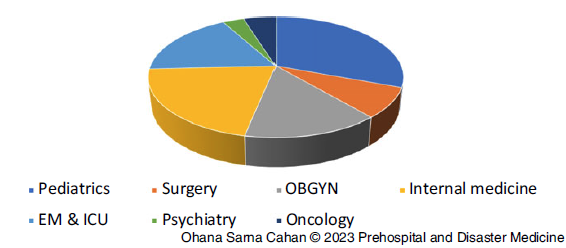
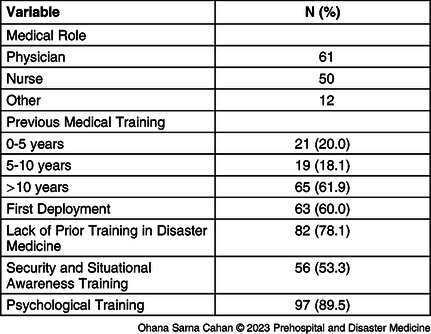
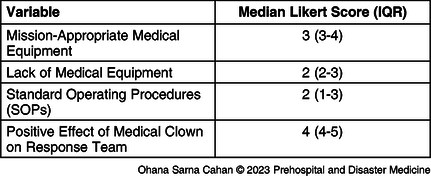
Of the 171 members of medical teams deployed to the Ukraine border, a total of 105 responses were submitted for a 61.4% response rate. Questionnaires were completed by 61 physicians, 50 nurses, and 12 other medical personnel. Sixty-four (64) respondents (60.9%) were female. Their previous medical training (post-internship experience in years) ranged from zero-to-five years for 21 members (20.0%), five-to-ten years for 19 members (18.1%), and more than ten years for 65 members (61.9%). The teams were composed of physicians from different fields including pediatrics (31.6%), internal medicine (21.6%), Emergency Medicine and intensive care (18.1%), gynecology (15.2%), and other (16.6%); Figure 1. Most of the team members (60.0%) were deployed for the first time in their career. Out of the 105 team members, 82 (78.1%) had received no formal training in DM prior to their deployment. The participants rated the need for DM pre-deployment training at a median of 4/5 (IQR 3-5). Out of the 105 respondents, 49 (46.6%) had no training in security or situational awareness issues. Ninety-seven (97) respondents (89.5%) were not trained in the recognition and management of acute stress reactions. They rated the need for disaster psychology training prior to deployment at a median of 4/5 (IQR 3-5). A question regarding the compatibility of medical equipment with deployment needs was rated at a median of 3/5 (IQR3-4). The use of standard operating procedures (SOPs) for patient care was rated at a median of 2/5 (IQR1-3), ranging from one being no SOPs to five being all work according to SOPs. The participants estimated that using SOPs for patient care would improve patient care (rated at a median of 4/5, IQR 3-4). Ninety-one (91) participants (86.6%) were not familiar with the Sphere project. Reference Kobliner-Friedman, Merin, Mashiach, Kedar, Schul and Alpert8 The responders characterized their concerns about providing medical aid to children and adults at 2/5 (IQR 1-3) on a scale ranging from one being no concerns to five being extreme concerns. The more experienced team members, participants with more than ten years of experience, expressed their levels of concern at a median of 2/5 (IQR 1-3). The participants with zero-to-five years of experience rated their concerns at 3/5 (IQR 2-3), as compared to 2/5 (IQR 1.5-3) for participants with five-to-ten years of experience. Physicians expressed a median of 2/5 (IQR 2-3) level of concern about providing care for the pediatric population, whereas nurses rated this concern at 2/5 (IQR 1-3). Non-pediatrician physicians rated their level of concern in treating the pediatric population at a median of 3/5 (IQR 2-3.25). A female physician expressed higher level of concern in providing medical aid for children with a mean of 3/5 (IQR 2-3). A male nurse expressed their level of concern in treating pediatric patients at a median of 3/5 (IQR 3-4).
Deployed Members’ Subspecialties.
Abbreviations: OBGYN, obstetrics and gynecology; EM, Emergency Medicine; ICU, intensive care unit.

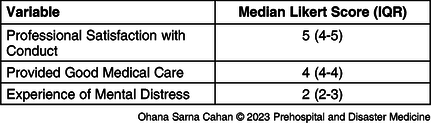
The presence of a medical clown as part of the deployed medical team was rated as beneficial (4/5, IQR 4-5). The team members evaluated their professional contribution at 4/5 (IQR 4-5). Most team members indicated that more training in DM was needed at a median of 5/5 (IQR 3-5). Interestingly, members from medical teams that included a medical clown rated their concern of treating pediatric population at a median of 2/5 (IQR 2-3), similar to teams without a presence of a medical clown with a median of 2/5 (IQR 1-3). Table 1, Table 2, and Table 3 summarize these pre-deployment, deployment, and post-deployment responses.
Demographics

Assessment of Deployment

Post-Deployment Self-Assessment

Discussion
This study explored Israeli emergency response teams’ evaluations of DM training pre-, post-, and intra-deployment during the Ukrainian refugee crisis. The findings point strongly to deficiencies in the training process. Team members expressed their concerns over the care of children in an austere environment, as well as their lack of background in disaster psychology and responses to acute stress reactions. The team members expressed their willingness to take part in pre-deployment DM training.
Multiple post-event evaluations have consistently identified the need to improve disaster education for deployed medical response teams. Reference Albina, Archer and Boivin7,Reference Gebbie, Hutton and Plummer9–Reference Amat Camacho, Hughes and Burkle14 Just-in-time training (JITT) has been documented in medical education as an efficient and valuable tool to disseminate new concepts in timely manner and has been argued to be important for the training of medical response teams. Reference Stoler, Johnston, Stevenson and Suyama15,Reference Knutson, Park, Smith, Tracy, Reed and Olsen16
Children represent approximately 30% of the world’s population but may be disproportionately impacted by disasters, Reference Ohana Sarna Cahan, Tin and Markovic17 as demonstrated in the Ukrainian refugee crisis which has displaced millions of children. 3 Nevertheless, disaster planning in general fails to take child patients into consideration. Pediatric DM training is thus of growing importance in DM education. Reference Behar, Upperman, Ramirez, Dorey and Nager18–Reference Burke, Lehman-Huskamp and Whitney20 The recognition of the special needs and vulnerabilities of the pediatric population make it critical for emergency response team members to acquire skills in specific aspects of disaster preparedness and responses for this population. Reference Ohana Sarna Cahan, Tin and Markovic17
When emergency response teams lack essential skills during deployment, this can result in poor morale and significantly higher posttraumatic stress disorder/PTSD symptoms in emergency response team members and patients alike. Reference Stevens, Byrne, Raphael and Ollerton11,Reference Aitken, Leggat, Robertson, Harley, Speare and Leclercq13,Reference Armagan, Engindeniz, Devay, Erdur and Ozcakir21 War, violence, and life-threatening events can have a devastating psychological impact. Reference Murthy and Lakshminarayana22 Psychological interventions provided by medical response team members are likely to have a positive impact on mental health outcomes post-disaster. Reference Winders, Bustamante and Garbern23
Medical clowns alleviate pain and anxiety in children. Reference Zhang, Yang, Lau, Garg and Lao24–Reference Sridharan and Sivaramakrishnan26 The advantage of medical clowns in disasters has been described in both children Reference Ilan, Davidov, Mendlovic and Weiser27 and post-disaster in adults Reference Kanemoto, Tanimoto and Shimmura28 and was confirmed here since the presence of medical clowns was rated as beneficial (4.01/5) by the participants.
A disaster zone is inherently chaotic, which suggests that the use of SOPs is essential. The effectiveness of SOPs was shown to be valuable to health care workers who provided wound care during disasters. In particular, clear appropriate guidance is needed for early wound management. Reference Wuthisuthimethawee, Lindquist and Sandler29 In another study, the PAHO/WHO SOPs were shown to be cost-effective in the disaster responses to tsunami-affected areas. Reference Roy30
Limitations
Although this study had a national multicenter design and the emergency response teams came from different representative organizations, the overall cohort was small and originated from only one country. Hence, the results cannot be generalized to emergency response teams elsewhere. Second, the findings were based on self-reports, which might have led to bias as to objective disaster response readiness. Despite these limitations, the results clearly highlight the need for improvement in the disaster education for the emergency response teams included in this study.
Conclusion
This survey highlights the need to develop a national medical response team model for DM education that includes pediatric DM. Disaster Medicine education and pediatric DM training in particular needs to be improved, including JITT for emergency response teams, as well as standardization of the deployed response teams’ responses.
Conflicts of interest/funding
All authors have no conflicts of interest to disclose. No funding was secured for this study.
Supplementary Materials
To view supplementary material for this article, please visit https://doi.org/10.1017/S1049023X23000420