Implications
Piglets can show impaired antioxidant status and inflammation processes during post-weaning, leading to lower growth rates than expected. This is especially true when occasional presence of pathogens in the farm causes a chronic inflammation status. In this context superoxide dismutase (SOD) administration could be a feasible way to overcome inflammation, impaired antioxidant status and low performance. The present study demonstrates that oral supplementation with melon pulp concentrate, rich in SOD, is able to increase the total antioxidant capacity (TAOC) of weaned pigs, contributing to sustain the health status and the growth rate of these animals.
Introduction
Inflammation and oxidative stress are closely linked together (Kick et al., Reference Kick, Tompkins, Flowers, Whisnant and Almond2012; Carillon et al., Reference Carillon, Rouanet, Cristol and Brion2013a) and lead to decreased growth rates and feed efficiency in weaned piglets. This is mainly due to the imbalance in oxidant/antioxidant equilibrium, the decreased activity of major antioxidant enzymes (AOX), and the increase in radical-mediated lipid peroxidation and protein and DNA oxidation (Campbell et al., Reference Campbell, Crenshaw and Polo2013; Gessner et al., Reference Gessner, Ringseis and Eder2017). In this context, the use of dietary antioxidant compounds after weaning seems to be a feasible way to overcome impaired antioxidant status and poor immune response in piglets (Bontempo et al., Reference Bontempo, Jiang, Cheli, Lo Verso, Mantovani, Vitari, Domeneghini and Agazzi2014; Jiang et al., Reference Jiang, Agazzi, Awati, Vitari, Bento, Ferrari, Alborali, Crestani, Domeneghini and Bontempo2015a and Reference Jiang, Awati, Agazzi, Vitari, Ferrari, Bento, Crestani, Domeneghini and Bontempo2015b). Nowadays there is great interest in the therapeutic application of dietary SOD (Carillon et al., Reference Carillon, Rouanet, Cristol and Brion2013a and Reference Carillon, Fouret, Feillet-Coudray, Lacan, Cristol and Rouanet2013b), as a primary antioxidant molecule. A specific cantaloupe melon (Cucumis melo L.) from the Cucurbitaceae family, known to be characterized by high SOD activity, showed antioxidant and anti-inflammatory properties in in vitro and in vivo animal models such as rodents and horses (Vouldoukis et al., Reference Vouldoukis, Conti, Krauss, Kamate, Blazquez, Tefit, Mazier, Calenda and Dugas2004a and Reference Vouldoukis, Lacan, Kamate, Coste, Calenda, Mazier, Conti and Dugas2004b; Notin et al., Reference Niekamp, Sutherland, Dahl and Salak-Johnson2010).
Although some trials have been conducted on orally melon concentrate administration in different species, at the present moment the effects of feeding SOD-rich melon pulp concentrate on piglets subjected to stress are only reported in two studies by Lallès et al. (Reference Lallès, Lacan and David2011) and Royer et al. (Reference Royer, Barbé, Guillou, Rousseliere and Chevaux2016) on stress proteins along the gastrointestinal tract and changes in blood oxidative stress biomarkers, respectively. At experimental level, oxidative and inflammatory stress conditions can be mimed by chronic immune system stimulation with an increasing dose of lipopolysaccharide (LPS) challenge (Rakhshandeh and de Lange, Reference Rakhshandeh and de Lange2012). The aim of the present study is to evaluate the effects of oral supplementation of a SOD-rich melon pulp concentrate in increasing antioxidant status, inflammation response and growth performance in LPS-chronically challenged weaning piglets.
Material and methods
Animals housing and experimental design
The present trial was performed at the Centro Clinico-Veterinario e Zootecnico-Sperimentale d’Ateneo di Lodi, Università degli Studi di Milano. In total, 48 crossbred female piglets (Topigs 40×Topdelta) from the same herd were weaned at 24±1 days of age (BW 7.79±0.17 kg) and divided in four homogeneous experimental groups of 12 animals each in a 2×2 factorial arrangement. The piglets were placed in individual pens (0.47 m2) and allocated in the same environmentally controlled post-weaning room on slatted floor. Each pen was equipped with one standard nursery pig bite-style nipple drinker and a self-feeder to allow for ad libitum access to water and feed. Room temperature and ventilation were electronically controlled over a 24-h period. Starting room temperature was 28°C with a ventilation of 10 m3/h per piglet and was decreased by 1°C/week until 25°C at the end of the trial.
The first factorial arrangement consisted of the administration of a basal diet or the same basal diet plus melon pulp concentrate (Melofeed; Lallemand SAS, Blagnac, France). The second factorial arrangement consisted on a LPS challenge, with repeated increasing intramuscular injections of LPS from Escherichia coli (serotype 055:B5; cat. no. L2880; Sigma-Aldrich Canada Ltd, Oakville, ON, Canada) (+) to mimic chronic inflammation, or the injection of an equivalent amount of PBS solution (−). The challenge was performed starting on day 19 of the trial and subsequent injections were performed on days 21, 23 and 25. The initial LPS dosage of 60 µg/kg of BW was increased by 12% at each subsequent injection to reduce endotoxin tolerance (Rakhshandeh and de Lange, Reference Rakhshandeh and de Lange2012). Specifically, the applied concentrations of LPS from the second to the fourth injection day were 67.2, 75.26 and 84.30 µg/kg of BW. Individual BW was determined before each LPS injection to calculate individual total LPS amount to be injected.
Experimental diets
To avoid any other influencing stress factor besides the weaning and the challenge, in the present trial pigs were fed with a mash wheat-based basal diet (Table 1) for all the trial period with (MPC) or without (CTR) the inclusion of 30 g/ton of melon pulp concentrate. Melon pulp concentrate was provided in powder form and incorporated through the premix at 1.5 kg/ton of feed to get the final content of 30 g of Melofeed/ton of feed. The applied dosage of melon pulp concentrate was based on the previous publication of Lallès et al. (Reference Lallès, Lacan and David2001) where Promutase (former name of Melofeed) was supplemented at 5 and 20 g/ton feed. Because a decrease of feed intake (FI) was expected due to the LPS challenge, in the present trial the dosage was increased to 30 g/ton feed during the whole experimental period.
Ingredients (% w/w) and chemical composition (g/100 g dry matter) of the basal diet fed to the experimental piglets

Lys=lysine; Thr=threonine; Met=methionine; Cyst=cysteine; Trp=tryptophan.
1 The vitamin–mineral premix provided the following quantities of vitamins and micro minerals per kilogram of complete diet: vitamin A, 10,500 IU; vitamin D3, 2500 IU; vitamin E, 15 mg; vitamin B1, 1.5 mg; vitamin B2, 3.8 mg; vitamin B12, 0.025 mg; vitamin B6, 1.6 mg; calcium pantotenate, 12 mg; nicotinic acid, 15 mg; biotin, 0.15 mg; folic acid, 0.5 mg; vitamin K3, 3 mg; Fe, 100 mg; Cu, 6 mg; Co, 0.75 mg; Zn, 150 mg; Mn, 65 mg; I, 0.75 mg; Se, 0.3 mg; ethoxyquin, 150 mg.
2 The sweetener (Optisweet®) was provided by Nutriad (Dendermonde, Belgium).
3 Feeds were analyzed for DM, CP, ether extract, ash, NDF, Ca and total P according to AOAC (2005). All other values were calculated from NRC (Reference Notin, Vallon, Desbordes and Leleu2012).
The experimental diets were formulated to be isocaloric and isoproteic on net energy and CP basis, and were produced with the same batches of feeds by Tracciaverde S.R.L. (Bonemerse, Italy). Both CTR and MPC diets did not contain any antimicrobials or growth promoters, being designed to meet or exceed the nutrient requirements of weaned piglets recommended by National Research Council (NRC, Reference Notin, Vallon, Desbordes and Leleu2012), with the exception of suboptimal concentration of tryptophan. In the present trial no inclusion of tryptophan was performed beside its content in the feeds in order to amplify the inflammation effect of the LPS challenge performed in the experimental animals (Le Floc’h and Seve, Reference Le Floc’h and Seve2007).
Samples and data collection
Blood samples for pro-inflammatory interleukin 1β (IL-1β), interleukin 6 (IL-6) and tumour necrosis factor-α (TNF-α) and haptoglobin were collected on days 0, 19, 21, 23, 25 and 29, whereas blood samples for plasma SOD activity, TAOC, and reactive oxygen species (ROS) serum content were obtained on days 0, 19, 21, 23, 25, 27 and 29. Each blood sample under the challenge period was collected prior the LPS injection. For sampling procedures a 10 ml clot activator vacutainer tube (VF-109SP, Venoject®; Terumo Europe N.V., Leuven, Belgium) was used to yield serum from the cranial vena cava. Blood sample for plasma SOD activity was collected separately using a 4 ml vacutainer tube containing EDTA (VF054STK, Venoject®). The serum was obtained by allowing the whole blood to clot at room temperature for 30 min. The tubes were then centrifuged at 1500×g, 10 min at 4°C, the supernatant was placed in 2 ml Eppendorf tubes (Eppendorf AG, Hamburg, Germany) and subsequently stored at −80°C to prevent changes in antioxidant and inflammation biomarkers. Blood samples for the whole blood and red blood cells (RBC) resistance to haemolysis and plasma contribution by Kit Radicaux Libres (KRL), and 8-oxo-7,8-dihydro-2′-deoxyguanosine (8-oxo-dGuo) were collected on days 19, 25 and 29 of the trial. Blood samples for KRL test were collected by 4 ml vacutainer tubes containing EDTA (VF054STK, Venoject®) (Rossi et al., Reference Rossi, Pastorelli and Corino2013), immediately stored at 4°C, processed within 3 h from sampling, and analyzed in the next 24 h after collection. Blood samples for 8-oxo-dGuo were collected with a 10 ml clot activator vacutainer tube (VF-109SP, Venoject®) and serum was obtained by centrifugation at 1500×g, 10 min at 4°C. Serum was then placed in a 2 ml Eppendorf tube (Eppendorf AG), and stored at −80°C for pending analysis.
A sample of the basal diet was collected at the beginning of the trial and stored at −20°C for pending analyses. Individual piglet BW was recorded on days 0, 8, 15, 19, 21, 23, 25, 26 and 29 with an electronic scale (ES100L, Ohaus, Switzerland), and individual FI for 0 to 19 and 19 to 29-day periods was calculated by subtracting the relative orts to the total daily-administered amount of feed. Subsequently ADG and G : F were calculated. The health status of the piglets was daily checked and any sanitary treatment was recorded. Morbidity and mortality were recorded. Rectal temperature was manually measured before each LPS injection as a baseline measurement, after 2 h from each LPS injection, and on the last day of trial.
Chemical analysis
Serum pro-inflammatory cytokines IL-1β, IL-6 and TNF-α were measured by porcine-specific ELISA kit according to the recommendations of the manufacturer (R & D Systems Inc., Abingdon Science Park, UK). The serum concentrations of haptoglobin were determined by colorimetric assay (Tridelta Phaserange serum haptoglobin assay, cat. no. TP-801) and expressed on the basis of a standard curve (Cooke and Arthington, Reference Cooke and Arthington2013). All samples were assayed in duplicate. Intra-assay CV were 5.71%, 6.33%, 5.83% and 7.41%, while inter-assay CV were 5.59%, 6.38%, 5.34% and 6.18%, respectively for IL-1β, IL-6, TNF-α and haptoglobin. All the intra- and inter-assay CV were within the range of values declared by the commercial product data sheet. Plasma SOD activity and serum TAOC were measured using commercial available kits according to the manufacturer’s instructions (cat. no. 19160 and cat. no. CS0790, respectively; Sigma-Aldrich), while ROS were evaluated by Cyt C reduction assay (cat. no. C2506; Sigma-Aldrich), as reported by Sartorelli et al. (Reference Sartorelli, Paltrinieri and Comazzi2000). The total antiradical activity of whole blood, RBC and the plasma contribution was determined using the KRL biological test (Rossi et al., Reference Rossi, Pastorelli and Corino2013). Results were expressed as the time (min) that is required to reach 50% of maximal haemolysis. Half-haemolysis time for total blood cells (HT50WB) and for red blood cells (HT50RBC) refers to the whole blood and the red cell resistance to free-radical attack, respectively. Lastly, the plasma resistance to haemolysis (HT50PC) was calculated by subtracting HT50RBC from HT50WB. Serum concentration of 8-oxo-dGuo were determined using a competitive ELISA method based on monoclonal antibody highly specific to 8-OHdG (Japan Institute for Control Aging Fukuroi, Japan) following the manufacturer’s instructions. For 8-oxo-dGuo assays six different standard dilutions were used in triplicate for each ELISA plate. Intra- and inter-assay CV were, respectively, 5.56% and 8.86%.
The chemical composition of the basal diet was analyzed at the beginning of the trial to determine DM (method 930.15), CP (method 984.13), ether extract (method 920.39A), ash (method 942.05), Ca (method 968.08) and P (method 946.06) content following the relative Association of Official Analytical Chemists methods of analysis (Association of Official Analytical Chemists, 2005) (Table 1). Neutral detergent fibre content in the diet was determined as reported by Van Soest et al. (Reference Van Soest, Robertson and Lewis1991).
Statistical analyses
Data relative to inflammatory and oxidative biomarkers, BW and rectal temperature were performed by ANOVA using the Proc MIXED for repeated measurements in SAS (SAS Institute Inc., Cary, NC, USA), with the piglet as the experimental unit. The statistical model included the effects of LPS challenge, dietary treatment (CTR, MPC), time and their interaction as fixed effects. Average daily gain, FI and G : F considered two different trial periods corresponding to days 0 to 19 (pre-challenge) and 19 to 29 (challenge and post-challenge) of the trial. Statistical analyses for these parameters were performed by a GLM procedure in SAS with the piglet as the experimental unit and the corresponding data relative to the pre-challenge period (0 to 19 days) as covariate for 19 to 29-day period. Differences were considered significant for P<0.05. A tendency toward a significant difference between treatment means was also considered at P<0.10.
Results
Inflammatory and oxidative biomarkers status
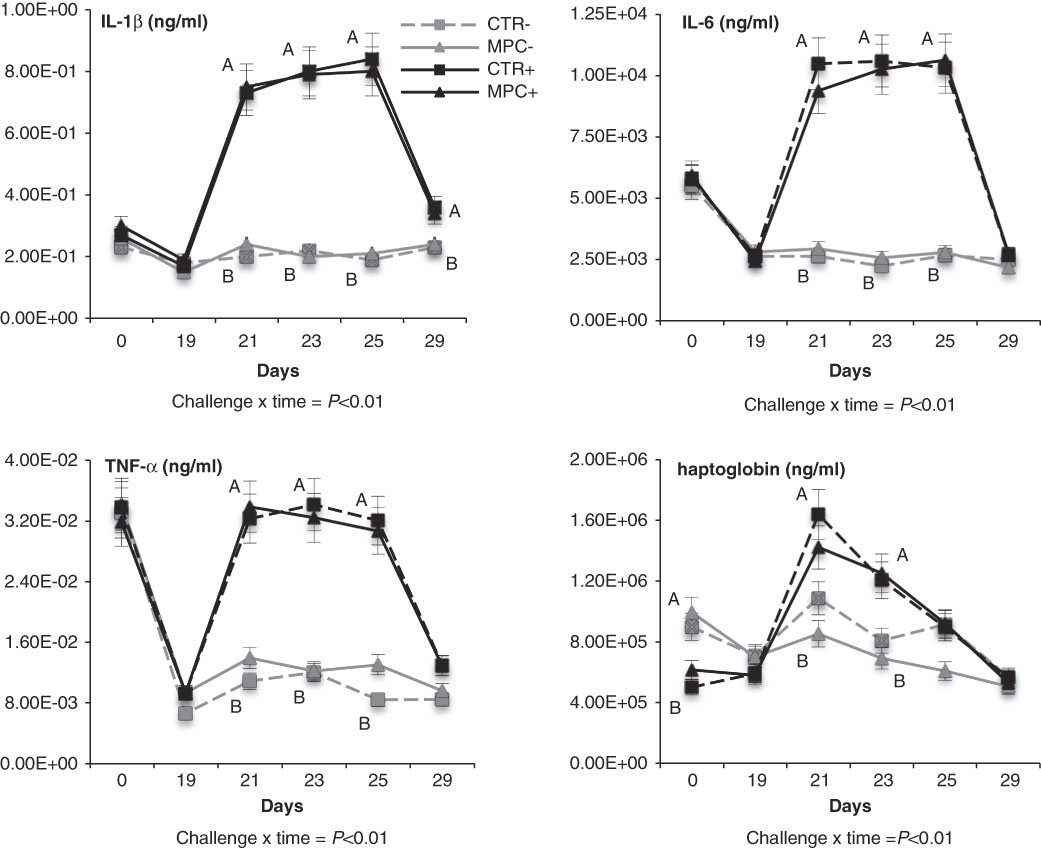
In the present trial LPS challenge induced a strong effect on inflammatory status with increased serum concentration of IL-1β (0.53 ng/ml v. 0.21 ng/ml, P<0.01), IL-6 (6.99×10³ ng/ml v. 3.10×10³ ng/ml, P<0.01), TNF-α (2.56×10⁻² ng/ml v. 1.44×10⁻² ng/ml, P<0.01), and haptoglobin (8.96×10⁵ ng/ ml v. 7.82×10⁵ ng/ml, P<0.05) (Figure 1), while melon pulp concentrate supplementation did not induce any significant change in these parameters. Time effect and the interaction between LPS challenge and time were always significant (P<0.01) (Figure 1). No significant differences between challenged or not challenged piglets were found at the beginning of the trial for IL-1β, IL-6 and TNF-α, while a higher haptoglobin content was found in piglets not subjected to LPS on day 0 (9.50×10⁵ ng/ml v. 5.62×10⁵ ng/ml; P<0.01). Starting from day 21 challenged groups showed an increased concentration of all inflammation biomarkers until day 23 for haptoglobin or day 25 for interleukins and TNF-α (P<0.01).
Challenge effect on interleukin 1β (IL-1β), interleukin 6 (IL-6), tumour necrosis factor α (TNF-α) and haptoglobin serum concentration in post-weaning piglets supplemented with melon pulp concentrate (dietary treatments: CTR−=piglets fed the basal diet and not subjected to the LPS challenge; CTR+=piglets fed the basal diet and subjected to the LPS challenge; MPC−=piglets fed the basal diet added with 30 g/ton of melon pulp concentrate (Melofeed; Lallemand SAS, Blagnac, France) and not subjected to LPS challenge; MPC+=piglets fed the basal diet added with 30 g/ton of melon pulp concentrate (Melofeed) and subjected to LPS challenge) in the diet and subjected to chronic lipopolysaccharide (LPS) challenge (the challenge was performed from day 19 to 25 of the trial with increasing dosages of LPS (from E. coli serotype 055:B5). Subsequent intramuscular injections of LPS were performed on days 19, 21, 23 and 25. Initial concentration of LPS was 60 µg/kg of BW and the dosage was increased by 12% at each subsequent injection to reduce endotoxin tolerance and mimic a chronic inflammation in piglets. The applied concentrations of LPS from the second to the fourth injection day were 67.2, 75.26 and 84.30 µg/kg of BW. Individual BW was determined prior each LPS injection to calculate individual total LPS amount to be injected). A,BDifferent letters refer to significant differences between challenged and not challenge piglets for P<0.01.

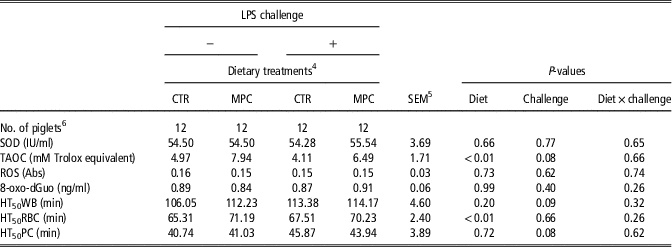
Oxidative biomarkers were not affected by LPS challenge (Table 2), although some trends were found for decreased TAOC (5.30 mM Trolox equivalent v. 6.46 mM Trolox, P=0.08), and increased HT50WB (113.78 min v. 109.14 min, P=0.09) and HT50PC (44.90 min v. 40.89 min, P=0.08). Melon pulp concentrate supplementation increased serum TAOC (7.22 mM Trolox equivalent v. 4.54 mM Trolox equivalent, P<0.01) and HT50RBC (70.71 min v. 66.41 min, P<0.01), but did not induce significant effects on HT50WB, HT50PC, 8-oxo-dGuo concentration, SOD activity and ROS. Sampling time was always significant (P<0.01), with the exception of SOD activity and HT50PC, but no difference was detected considering the interaction between dietary treatment, challenge and time.
Mean concentration of oxidative biomarkersFootnote 1 , Footnote 2 of post-weaning piglets supplemented with melon pulp concentrate in the diet and subjected to a chronic lipopolysaccharide (LPS) challengeFootnote 3 , Footnote 4

SEM=standard error of the means; SOD=superoxide dismutase; TAOC=total antioxidant activity; ROS=reactive oxygen species; 8-oxo-dGuo=8-oxo-7, 8-dihydro-2′-deoxyguanosine; HT50WB=half-haemolysis time of whole blood; HT50RBC=half-haemolysis time of red blood cells; HT50PC=plasma contribution to half haemolysis.
1 SOD and TAOC were performed on plasma samples; ROS and 8-oxo-dGuo were performed in serum; HT50WB and HT50RBC were performed on whole blood. HT50PC was obtained as the difference between HT50WB and HT50RBC.
2 Total antioxidant activity was performed by Kit Radicaux Libres (KRL) biological test (Rossi et al., Reference Rossi, Pastorelli and Corino2013). Results are expressed as the time (min) required to reach 50% of maximal haemolysis (HT50), which refers to the whole blood, red blood cells and plasma resistance to free-radical attack.
3 The challenge was performed from day 19 to 25 of the trial with increasing dosages of lipopolysaccharide (LPS from E. coli serotype 055:B5). Subsequent intramuscular injections of LPS were performed on days 19, 21, 23 and 25. Initial concentration of LPS was 60 µg/kg of BW and the dosage was increased by 12% at each subsequent injection to reduce endotoxin tolerance and mimic a chronic inflammation in piglets. The applied concentrations of LPS from the second to the fourth injection day were 67.2, 75.26 and 84.30 µg/kg of BW. Individual BW was determined prior each LPS injection to calculate individual total LPS amount to be injected.
4 Dietary treatments: CTR−= piglets fed the basal diet and not subjected to the LPS challenge; CTR+=piglets fed the basal diet and subjected to the LPS challenge; MPC−=piglets fed the basal diet added with 30 g/ton of melon pulp concentrate (Melofeed; Lallemand SAS, Blagnac, France) and not subjected to LPS challenge; MPC+=piglets fed the basal diet added with 30 g/ton of melon pulp concentrate (Melofeed) and subjected to LPS challenge.
5 SEM=pooled SEM. Means are presented as least square means.
6 Piglets were reared in individual pens (0.47 m2) with ad libitum access to feed and water.
Growth performance and rectal temperature
No significant effects of LPS challenge (P=0.47) or melon pulp concentrate supplementation (P=0.70) and their interactions (P=0.73) were found on BW. The LPS challenge impaired ADG (291 v. 490 g/day, P<0.01), FI (5.57 v. 7.76 kg, P<0.01) and G : F (0.52 v. 0.62, P<0.01) from days 19 to 29. Average daily gain and FI were increased in pigs fed melon pulp concentrate under the challenge and post-challenge period (19 to 29 days on trial) (422 v. 359 g/day for ADG, P<0.05; 7.18 v. 6.15 kg for FI, P<0.01) (Table 3), but no differences were found during the first 19 days of the trial and overall the experimental period. No significant differences were outlined for G : F among the dietary treatments, and the diet×challenge interaction was found not to affect growing performance.
Body weight, average daily gain (ADG), feed intake (FI) and gain : feed (G : F) of post-weaning piglets supplemented with melon pulp concentrate in the diet and subjected lipopolysaccharide (LPS) challengeFootnote 1

SEM=standard error of the means.
1 The challenge was performed from day 19 to 25 of the trial with increasing dosages of LPS (from E. coli serotype 055:B5). Subsequent intramuscular injections of LPS were performed on days 19, 21, 23 and 25. Initial concentration of LPS was 60 µg/kg of BW and the dosage was increased by 12% at each subsequent injection to reduce endotoxin tolerance and mimic a chronic inflammation in piglets. The applied concentrations of LPS from the second to the fourth injection day were 67.2, 75.26 and 84.30 µg/kg of BW. Individual BW was determined prior each LPS injection to calculate individual total LPS amount to be injected.
2 Dietary treatments: CTR−=piglets fed the basal diet and not subjected to the LPS challenge; CTR+=piglets fed the basal diet and subjected to the LPS challenge; MPC−=piglets fed the basal diet added with 30 g/ton of melon pulp concentrate (Melofeed; Lallemand SAS, Blagnac, France) and not subjected to LPS challenge; MPC+=piglets fed the basal diet added with 30 g/ton of melon pulp concentrate and subjected to LPS challenge.
3 Piglets were reared in individual pens (0.47 m2) with ad libitum access to feed and water.
4 SEM=pooled SEM. Means are presented as least square means.
Rectal temperature was always increased by LPS challenge at 2 h after injection (P<0.01, data not shown), while no effect of dietary melon pulp concentrate supplementation was evidenced, with the exception of a significant reduction at 2 h after the fourth LPS injection (day 25 of the trial) (CTR=40.25±0.09°C v. MPC=40.12±0.08°C, P=0.02). No differences in piglet’s rectal temperature at the end of the trial (day 29) were found between CTR and MPC groups, also considering the challenge effect or the diet×challenge interaction. During the trial no antibiotic treatments were performed on experimental animals and no deaths occurred within CTR and MPC groups.
Discussion
Weaning is a critical stress period for piglets and it is characterized by decreased immune response, FI and nutrient absorption (Niekamp et al., 2007). During this period, pigs are subjected to a number of stressors such as a sudden separation from the sow, transportation and handling, different environment, liquid to solid feed shift, establishment of a new social hierarchy, and increased exposure to pathogens. All these factors lead to metabolism, immune system and intestinal functions alterations. Several studies report how serum pro-inflammatory cytokines and their gene expression are increased at weaning (Pié et al., Reference Pié, Lallès, Blazy, Laffitte, Seve and Oswald2004; Lallès et al., Reference Lallès, Lacan and David2011). In accordance with this, in the present trial initial high concentrations of IL-6 and TNF-α were found in all the experimental subjects, although they were decreased just before the LPS challenge (day 19). At the starting of the trial IL-6 showed half of the concentration further evidenced during the challenge, while TNF-α concentration detected on day 0 and during the LPS injection were comparable, outlining how weaning is able to strongly affect the immune response of piglets.
Pro-inflammatory cytokines IL-1β, IL-6 and TNF-α are reported to be important inducers of the synthesis of acute phase proteins, such as haptoglobin, among others (Carroll et al., Reference Carroll, Matteri, Dyer, Beausang and Zannelli2004). In the present trial a higher concentration of haptoglobin in both no-challenge groups compared with challenge groups was found at the beginning of melon pulp concentrate supplementation. Although all the experimental animals were selected, grouped and placed in the experimental facilities at the same time, this initial difference seems to be unfortunately related to some un-accounted (not estimable) stress factors (Salamano et al., Reference Salamano, Mellia, Candiani, Ingravalle, Bruno, Ru and Doglione2008; Cray et al., Reference Cray, Zaias and Altman2009) rather than a direct effect of high concentration of interleukins that could lead to increased levels of haptoglobin.
Besides the strong effect of weaning, occasional presence of pathogens in the farm can causes a chronic inflammation status that can further impairs the immune response and the antioxidant status of piglets. This last scenario can be efficiently obtained from an experimental point of view applying a chronic challenge in the post-weaning period. With this purpose, in the present trial a chronic challenge procedure with LPS was adopted to mimic subclinical or mild clinical disease conditions that frequently occur in the field due to the presence of pathogens that lead to immune system stimulation (Rakhshandeh and de Lange, Reference Rakhshandeh and de Lange2012; de Ridder et al., Reference de Ridder, Levesque, Htoo and de Lange2012). As a result, in the present trial LPS was found to act on the immune system through increased concentration of serum pro-inflammatory cytokines IL-1β, IL-6 and TNF-α and haptoglobin according to Carroll et al. (Reference Carroll, Fangman, Hambach and Wiedmeyer2001) and Frank et al. (Reference Frank, Mellencamp, Carroll, Boyd and Allee2005), while the administration of melon pulp concentrate did not lead to any significant variation on immune response.
Inflammation and oxidative stress have been reported to be closely linked to each other, since the pathways generating the mediators of inflammation are all induced by oxidative stress (Carillon et al., Reference Carillon, Rouanet, Cristol and Brion2013a). Oxidative stress decreases antioxidant defences and induces elevated radical-mediated lipid peroxidation driven by reactive oxygen and nitrogen species (Campbell et al., Reference Campbell, Crenshaw and Polo2013). At weaning, piglets can be subjected to an accumulation of ROS that could exceed the antioxidant capacities of the animal, leading to a high susceptibility to oxidative stress (Zhu et al., Reference Zhu, Zhao, Chen and Xu2012).
As a strong effect of the LPS challenge on immune response can be highlighted in this trial, the general lack of significant changes in oxidative biomarkers, with the exception of a trend for decreased serum content of TAOC, can be attributed to other numerous factors. Moreover, independently from the applied dosage to mimic a chronic inflammation in the present trial, it must be noted that the effects of an immune challenge did not always lead to univocal results on oxidative stress biomarkers, depending on the quantification of different antioxidant or pro-oxidant components of oxidative stress (van de Crommenacker et al., Reference van de Crommenacker, Horrocks, Versteegh, Komdeur, Tieleman and Matson2010). In the present trial oxidative markers such as plasma SOD activity, ROS and 8-oxo-dGuo were not influenced by melon pulp administration, while TAOC and HT50RBC were improved in MPC groups. If the obtained results on ROS can be attributed to their reported very short half-life and high instability, the SOD activity could have been influenced by several factors and can be interpreted in different ways, as the activity of major AOX is quite variable depending on the experimental design adopted, the challenge performed or the animal species. Increased activity of AOX (SOD, CAT, GPx) can be related both to the reaction of the organism to oxidative stress, or to the stimulation of antioxidant defences when supplying antioxidant compounds in the diet. To discriminate between these two opposite interpretations, additional biomarkers of oxidative stress, such as oxidized proteins (e.g. protein carbonyls) or oxidized lipids (e.g. TBARS, MDA, isoprostanes, lipid peroxides) could have been measured. In fact a study by Royer et al. (Reference Royer, Barbé, Guillou, Rousseliere and Chevaux2016) found that a decreased concentration of oxidative stress biomarkers and an increased activity of AOX confirmed the efficacy of melon pulp concentrate supplementation in pigs. Although dietary SOD mechanism of action is not fully understood at the present moment, Carillon et al. (Reference Carillon, Rouanet, Cristol and Brion2013a) suggested that melon pulp concentrate administration could induce increased antioxidant defence, as outlined by TAOC and RBC blood resistance to haemolysis in the present trial, through the activation of mRNA transcription or the regulation or induction of complex cellular pathways, involving different transcription factors. These authors hypothesized that the induction of AOX could be regulated at the transcriptional level through the nuclear-factor-E2-related factor (Nrf2)/antioxidant response as demonstrated in some other studies with different antioxidant supplements in humans and in vitro (Muchová et al., Reference Muchová, Śustrová, Garaiová, Liptáková, Blazíček, Kvasnička, Pueschel and Duračková2001; Zhang et al., Reference Zhang, Chae, Lee and Hyun2012).
In the present study, decreased FI and impaired growth performance during LPS challenge period were observed according with Gessner et al. (Reference Gessner, Ringseis and Eder2017). Lower performance under the challenged corresponded to a higher concentration of inflammation markers and an increased rectal temperature of the piglets at 2 h after each LPS injection as a sign of the presence of a systemic inflammation (Ceciliani et al., Reference Ceciliani, Ceron, Eckersall and Sauerwein2012). When an infection occurs, metabolic shifts are characterized by the redistribution of nutrients away from the growth processes toward the immune system function, with a subsequent decrease in feed efficiency for growth (Gessner et al., Reference Gessner, Ringseis and Eder2017). Moreover the suboptimal concentration of tryptophan supplied in the present trial (~78% of the requirements on total basis for piglets ranging from 7 to 25 kg BW) (NRC, Reference Notin, Vallon, Desbordes and Leleu2012) could have represent an amplification factor for the effectiveness of the applied challenge, since tryptophan metabolic demand is strongly increased by the synthesis of acute phase proteins during immune stimulation, with a consequent lower availability for growth (de Ridder et al., Reference de Ridder, Levesque, Htoo and de Lange2012).
Besides the inflammation effect of the applied challenge, the administration of melon pulp concentrate led to increased performance, which instead was not observed by Lallès et al. (Reference Lallès, Lacan and David2011). It must be outlined that the total duration of administration in the work of Lallès et al. (Reference Lallès, Lacan and David2011) was 5 or 12 days, after an initial 2-day period of fasting to induce greater stress protein concentrations. Animals were then slaughtered on days 7 and 14 after weaning. The lack of improved performance in the work of Lallès et al. (Reference Lallès, Lacan and David2011) can be probably due to the short duration of melon pulp concentrate supplementation to translate any positive effect in the gastrointestinal tract or on immune response into improved growth performance.
In conclusion, the present study demonstrates that oral supplementation with melon pulp concentrate rich in SOD during the post-weaning period can enhances the TAOC, half-haemolysis time of red blood cells and growth rate of post-weaning piglets when oxidative stress and/or inflammation are increased.
Acknowledgements
Authors would like to thank Dr. Eric Chevaux and Dr. Mathieu Castex (Lallemand SAS, Blagnac, France) for cooperation and research funding.
Declaration of interest
The authors declare no conflicts of interest.
Ethics statement
The protocol for care, handling, and sampling of animals defined in the present study was reviewed and approved by the Università degli Studi di Milano Animal Care and Use Committee (protocol no. 82/14).
Software and data repository resources
Data or models from the present work are not deposited in an official repository.