INTRODUCTION
Community conservation programmes aim to involve local people in the management of natural resources. They were developed in response to a number of factors including the need for solutions to biodiversity loss outside of protected areas (Hulme & Murphree Reference Hulme and Murphree1999; Adams Reference Adams2004; Marshall Reference Marshall2005), the failure of top-down conservation approaches, and an understanding that conservation success would rely partly on social and economic factors (Ghimire & Pimbert Reference Ghimire and Pimbert1997). Known across southern Africa as community-based natural resource management (CBNRM) programmes, they aim to achieve the joint objectives of biodiversity conservation and improved rural livelihoods, based on the premise that the sustainable use of wildlife could occur given the right set of incentives (for example Kiss Reference Kiss1990; Emerton Reference Emerton1998; Bond Reference Bond, Hulme and Murphree2001). Additional objectives relate to devolution of resource management responsibility (thus the increased participation of local communities in decision making, and the ability to derive benefits from those resources) social justice and efficiency (for example Agrawal & Gibson Reference Agrawal and Gibson1999; Jones & Murphree Reference Jones, Murphree and Child2004; Neumann Reference Neumann, Brosius, Tsing and Zerner2005). While such programmes have similar objectives, specific definitions and activities implemented differ across the region and indeed across the world (for example Hulme & Murphree Reference Hulme, Murphree, Hulme and Murphree2001; Blaikie Reference Blaikie2006). Following several decades of implementation, it might be expected that there would be readily available and robust measures of the performance of these programmes. However, there is little systematically collected and analysed data demonstrating the long-term ecological, social and economic impacts of CBNRM.
The CBNRM programme in Namibia is an example of a CBNRM programme considered relatively successful in terms of achieving livelihood impacts (see for example Bandyopadhyay et al. Reference Bandyopadhyay, Humavindu, Shyamsundar and Wang2004; Jones Reference Jones2006; Ogbaharya Reference Ogbaharya2006; Boudreaux Reference Boudreaux2007; Jones & Weaver Reference Jones, Weaver, Suich, Child and Spenceley2009). While there is a considerable volume of literature that deals with CBNRM and livelihoods in Namibia, much of it describes only the benefits of the programme, typically uses highly aggregated data, and is rarely accompanied by explanations of how the described benefits have been valued, how they have been distributed or to whom. Much of the literature is also narrowly focused either on only one or a few aspects of CBNRM activities, considers only positive or negative impacts or has a limited geographical scope. Therefore, there are almost no quantitative data dealing with livelihood impacts that are drawn from sufficiently large samples as to be representative, either time series or cross-sectional. Meta-synthesis is useful because it can generate a more complete understanding of the range of both positive and negative livelihood impacts arising from CBNRM and related activities, and the factors affecting how these impacts are felt by individuals and/or households. Our aim was to conduct a meta-synthesis to determine the range of positive and negative livelihood impacts of CBNRM and related activities in Namibia, and the factors affecting household or individual perceptions of their effects.
CBNRM IN NAMIBIA
Conservation activities working with rural communities in Namibia started in the north-west (now the Kunene Region) during the 1980s (Jacobsohn & Owen-Smith Reference Jacobsohn and Owen-Smith2003). However, it was not until 1992, that the then Ministry of Wildlife, Conservation and Tourism developed the first draft of a policy providing rights over wildlife and tourism for communities that formed a common property resource management institution called a ‘conservancy’. The Wildlife Management, Utilisation and Tourism in Communal Areas Policy was approved by Cabinet in 1995, followed by the passing of the communal area conservancy legislation in 1996 (the Nature Conservation Amendment Act, Act No.5 of 1996) (Jones & Weaver Reference Jones, Weaver, Suich, Child and Spenceley2009). The national Communal Area Conservancy Programme was officially launched in 1998, when the first four communal conservancies were gazetted; together they covered approximately 16 800 km2 and contained about 14 500 people living within their boundaries. By 2007, there were 50 established conservancies across the country, managing more than 118 704 km2 of communal land (just over 14% of total land area) and around 220 600 residents living within them (NACSO [Namibian Association of CBNRM Support Organizations] 2007).
Activities in the early years of the programme focused almost exclusively on wildlife resources, considered to be ‘high value’ because of their potential to generate relatively high returns quite quickly through photographic and trophy hunting tourism (Murphree Reference Murphree1993; IIED [International Institute for Environment and Development] 1994). Over time, the scope of the programme has expanded to include, amongst other things, craft production (and the sustainable harvesting of the resources required for that activity) and more recently, the commercialization of a number of plant products, and in some areas the development of conservation farming activities (Nott & Curtis Reference Nott and Curtis2005; Davidson Reference Davidson2008). However, tourism has remained the dominant revenue generator. In 2007, programme activities generated approximately US$ 5.7 million, 52% of which came from joint venture tourism agreements, and a further 26% from trophy hunting activities. Revenue from other uses of game (game meat distributions, shoot and sell, own use game, live sales and premium hunting) generated a further 17%, followed by other natural resource-using activities (craft sales and veld product sales) at 4% and campsites and other community-based tourism enterprises the final 1% (NACSO 2007).
Conservancies vary greatly in size, environment and human population densities, as well as in their available (and potential) wildlife resources and tourism potential. Thus they also vary in terms of their ability to generate financial and other benefits from various CBNRM activities. The differences, particularly in population densities, have significant ramifications for conservancy management in terms of the size of benefits generated and (negative) impact mitigation activities that are required to significantly and positively impact on conservancy residents.
In 2006, 32 conservancies earned cash income, ranging from a low of US$ 1090 (Kunene River Conservancy) to a high of US$ 140 400 (Torra Conservancy) (NACSO 2007). Thirteen conservancies covered their operating costs from revenue generated by conservancy income while 18 conservancies did not generate any cash income in 2006 (Jones & Weaver Reference Jones, Weaver, Suich, Child and Spenceley2009) indicating the differing potential to generate revenue (and the different stages of development).
METHODS
Study area
This analysis was limited to parts of the Kunene and Caprivi regions of Namibia, where CBNRM activities have been running the longest in the country. Attention was focused on those conservancies in Caprivi and Kunene whose activities have been facilitated by the non-government organization Integrated Rural Development and Nature Conservation (IRDNC). The Caprivi region of Namibia is a semi-arid region with an average annual rainfall of c. 550mm, and is one of the few areas of Namibia where people practise both cropping and livestock keeping (Mendelsohn et al. Reference Mendelsohn, Jarvis, Roberts and Robertson2002). The Kunene region is in the arid north-west of the country and, with an average annual rainfall of < 100 mm, residents of the region are heavily reliant on pastoralism for subsistence (Mendelsohn et al. Reference Mendelsohn, Jarvis, Roberts and Robertson2002). Caprivi is one of the poorest regions in Namibia, while Kunene is more affluent. Of the 13 regions in the country, Caprivi is ranked 10th and 11th with respect to the human poverty and human development indices, while Kunene is ranked 8th and 6th, respectively (Levine Reference Levine2007).
Of the established conservancies in 2007, nine were in Caprivi (covering 2563 km2), and 14 were in the north-west (covering 32 168 km2). These conservancies included 28% of land under conservancies nationally, and c. 32% of the population living within conservancies.
The average conservancy size in Kunene is 2298 km2 (range 745–3568 km2), with an average population density of 1.4 people km−2 (range 0.1–2.7 people km−2). In contrast, in Caprivi, the average conservancy size is just 285 km2 (range 73–930 km2), with mean population densities of 13 people km−2 (range 5–23 people km−2) (IRDNC, unpublished data 2008; see also Mendelsohn et al. Reference Mendelsohn, Jarvis, Roberts and Robertson2002).
Meta-synthesis
A meta-synthesis is a rigorous study examining and interpreting the findings (as opposed to the raw data) of a number of qualitative research studies, using qualitative methods (Finfgeld Reference Finfgeld2003). Unlike quantitative meta-analysis, which aims to increase the certainty of conclusions surrounding cause an effect and is aggregative across studies (Walsh & Downe Reference Walsh and Downe2005), meta-synthesis is interpretive. Its goal is to produce new, integrated findings that are more substantive than those of the individual studies analysed.
Meta-synthesis should be viewed as a group of approaches for analysing qualitative research findings in order to generate new knowledge (Thorne et al. Reference Thorne, Jensen, Kearney, Noblit and Sandelowski2004). A number of (often overlapping) forms of meta-synthesis have been described (Thorne et al. Reference Thorne, Jensen, Kearney, Noblit and Sandelowski2004; see also Bondas & Hall Reference Bondas and Hall2007). The approach adopted in this paper is akin to descriptive meta-synthesis (Finfgeld Reference Finfgeld2003); a synthesis of qualitative findings and results, in a comprehensive analysis, rather than an approach related to theory development.
There are two important limitations associated with meta-syntheses. First, the integrity of a meta-synthesis depends on the quality of data and analysis in the studies used (Finfgeld Reference Finfgeld2003; Walsh & Downe Reference Walsh and Downe2005). As data quality was not the basis of an exclusion rule in this study, some of the data used may be of questionable quality. Second, meta-syntheses are limited to studies that have already been conducted (Bair & Haworth Reference Bair, Haworth and Smart2005). It is thus possible that the full range of livelihood impacts have not been identified in existing studies and therefore remain unidentified.
Following an initial (and very broad) search covering both published and grey literature, approximately 206 documents were identified as relating to CBNRM in Namibia. As part of the initial search, reference lists of identified papers and reports were checked, and consultations with key informants (authors of relevant papers) were made to ensure the search was comprehensive, and included published, little known and hard to find studies. In the first screening process, papers were excluded if they did not deal with both livelihoods and CBNRM in Namibia. (Livelihoods were understood to comprise the capabilities, material and social assets and activities required for a means of living.) A second screening was undertaken to ensure that documents included in the review considered (1) some aspect of the livelihood impacts of CBNRM and related activities; (2) were at least partially conducted in the IRDNC target conservancies; and (3) were based on the analysis of primary data. Sixty-four papers and reports remained after the second screening. The third screening removed documents where the consideration of livelihood impacts was only a peripheral part of the study. Twenty-five papers were included in the meta-synthesis (Appendix 1, see supplementary material at URL journals.cambridge.org/ENC), which was conducted in early 2009.
The sustainable livelihoods framework was used to help understand the factors that affect people's livelihoods and the relationships between these factors. The framework highlights the variety of assets that are key to livelihoods (financial, human, natural, physical and social) and the interdependence between them, recognizing that no single asset can deliver all of the livelihood outcomes that people seek (see for example Carney Reference Carney1998; Carney et al. Reference Carney, Drinkwater, Rusinow, Neefjes, Wanmali and Singh1999, DFID [Department for International Development] 1999). Livelihoods can be highly diverse, and the many different CBNRM and related activities can have a variety of impacts at the individual and household level. This meta-synthesis used the sustainable livelihoods framework to consider the positive and negative impacts on these five asset types, in terms of changes in access to and/or returns from assets. Thus, employment impacts positively on financial and human assets (for example through income, skills and training received), while increased wildlife numbers impact on financial, human and physical assets (such as through reducing agricultural production for home consumption or sale, or damage to infrastructure). While the importance of policies, institutions and processes described in the framework are recognized, a multiple level policy and institutional analysis was beyond the scope of this meta-synthesis. Where possible, quantitative data are used to illustrate the extent of the impact under discussion (see Finfgeld Reference Finfgeld2003).
RESULTS
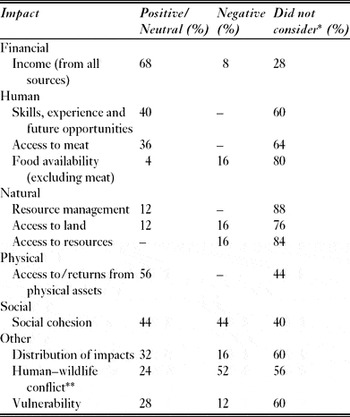
The ways of reporting positive and negative livelihood impacts arising from CBNRM and related activities are at least as diverse as the range of disciplines from which the authors come. Those mentioned most frequently in the studies analysed include positive impacts from income earned, from skills and experience gained and increased opportunities in the future, all the result of employment (Table 1). Other frequently mentioned positive impacts include increased access to and/or returns from physical assets and increased social cohesion. The most frequently mentioned negative impacts result from human-wildlife conflict, and those related to conflict. While the nuances and subtleties of impacts cannot be determined, Table 1 demonstrates the uneven consideration in the literature of positive and negative impacts, and of the full range of impacts generated by the various activities.
Analysis of studies discussing each type of livelihood impact (n = 25). *Do not necessarily add to 100% as some papers may discuss both positive and negative aspects; **Positive impacts of human–wildlife conflict refer to the Human–Animal Conflict Conservancy Self–Insurance Scheme (see for example Mosimane & Muranda Reference Mosimane and Muranda2007).

Because each conservancy has implemented a range of activities modified to suit its context, the results presented do not suggest that all impacts affect each individual and/or household equally within a conservancy, nor even that they occur in each and every conservancy within that region.
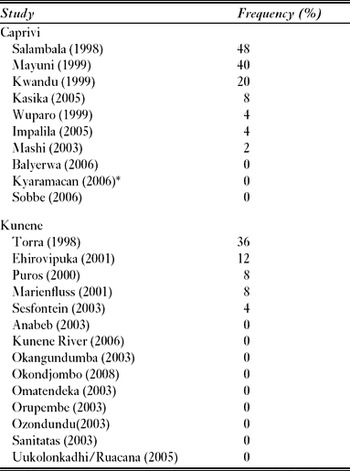
Those few conservancies in each region that have most frequently been the subject of research (Table 2) have typically been established the longest, and are amongst the highest (CBNRM) revenue generators in the country.
Frequency analysis of studies of the target conservancies (n = 25). Conservancy registration year shown in brackets. 0 = the conservancy was not discussed in the literature reviewed. * = The Kyaramacan Residents’ Association is a special case of communal natural resource management institution, as its members reside within what is now the Bwabwata National Park.

Financial assets
One hundred and thirty-eight individuals were in full-time employment and 374 had obtained part-time or casual employment in Kunene in 2007; the figures for Caprivi were 242 and 48, respectively (IRDNC, unpublished data 2008). Conservancy and tourism enterprise employees valued the salaries and income security brought by the employment. The direct impact of the increase in financial resources was related to the ability to better meet the basic needs of the individual employed, and typically their family. Similar positive impacts were also felt by those able to obtain casual or piece work through the conservancy (such as with trophy hunters or community hunting operations), though to a lesser degree, owing to the temporary or casual nature of such employment.
Income earned by craft producers and some natural resource harvesters (for example those harvesting Commiphora and Harpagophytum [devils claw]) has also had a positive effect on these households. Cash earned tended to be used to meet the basic needs of households, including expenditures on food, education and health, clothes and other domestic consumables and on occasions to invest in productive goods or services (such as hiring oxen or tractors for ploughing fields, trade goods and even livestock). Other sources of cash income at the household level included a cash payout to individuals in one conservancy in 2003 (the vast majority of which was spent on the purchase of food and household items and education costs), and compensation for stock losses in the same conservancy.
In terms of the negative impacts on household income, the impact of human-wildlife conflict (HWC), particularly crop damage in Caprivi, reduced the standards of living of some residents; the decline in harvests resulting from HWC reduced the ability to sell any surplus. HWC often meant that the household had to go without necessities, and struggled to meet payments (for example for school fees), and in some cases lead to indebtedness when households had borrowed money to purchase food. Around 67% of households in Caprivi had suffered from some level of cereal crop damage by wildlife in 2002; 60% of maize gardens in Kunene had also suffered wildlife damage in that year (Suich Reference Suich2003). The impact of livestock losses to predators in Kunene also resulted in a loss of income to the 6% of cattle owners and 25% of goat owners suffered from predation in Kunene in 2002 (Suich Reference Suich2003).
Human assets
Skills, experience and future opportunities
Employment impacted positively not only on individual and household finances, it also increased the sense of empowerment and independence achieved amongst those who gained employment, reinforced particularly by the availability of local employment. The skills and experience gained had also led to opportunities for promotion and/or for improved employment opportunities elsewhere. Such positive impacts had been strengthened by training and capacity building provided by tourism enterprises to their employees, and by non-government organizations and others providing training to conservancy staff.
Other effects of training provided to community resource monitors included support to HIV/AIDS patients and the increased confidence of women in sharing their ideas and opinions in meetings, the result not only of training provided, but also the increased support of men for women's activities.
Changes in food availability
Changes in food availability were considered to affect human capital owing to their impact on nutrition. Several CBNRM-related activities contribute to increased food availability in certain areas, in particular the distribution of legal game meat, typically from trophy or community hunting activities in Kunene. In one conservancy (Torra), the increase in food availability was significant, and meat distributions were said to provide for three to four months, depending on the size of the household; during this time they did not need to slaughter their livestock. Meat distributions were considerably smaller in Caprivi, and were not considered sufficient to change household circumstances. While not discussed in the literature reviewed, this is likely to be related to the considerably higher (human) population densities in Caprivi. Wildlife densities are also likely to have impacted on the relative importance of the change in food availability in both areas.
Other positive impacts on food availability resulted from activities such as the distribution of grocery ‘hampers’ in one conservancy and the protection of crops/gardens from HWC using electric fences (in that same conservancy) which provided a positive contribution to people's diets. The introduction of conservation farming activities has enabled participating farmers to increase their agricultural harvests, and thus household food availability (in one conservancy).
Increases in wildlife have resulted in reductions in food availability, particularly through wildlife damage to cereal crops in Caprivi, threatening household food security. Though rarely discussed in the literature, damage to crops can have indirect effects on natural resources, as households often shifted dependence from agriculture to natural resource based activities (such as fishing, collecting water lilies, selling building poles and thatching grass). Livestock losses to predators in Kunene also resulted in the reduced food availability of those households affected.
Some households experienced reductions in food availability as a result of the improved effectiveness of wildlife monitoring, which reduced the amount of hunting and therefore access to (illegal) game meat. The improvement in monitoring can have additional negative impacts on individuals caught hunting, and depending on whether they are arrested or warned. The impacts of being caught poaching are little described, though the chances of being caught appear to have increased, and there are reports of hunters changing hunting methods to reduce the chance of being caught.
Natural assets
A number of resource management activities were described in the literature, for example the improved integration of resource management and improved range management in Kunene and fire management activities in Caprivi, which could be expected to have long-term positive impacts on livelihoods, though such impacts remain undocumented.
In some conservancies, some individuals have had access to land curtailed when it has been zoned for tourism or wildlife use. While this is typically a collective and voluntary decision, it does impact directly at the household level, and can lead to lengthy conflicts (for example in Salambala). Some households in Caprivi have also suffered a localized reduction in grazing and cropping and/or restricted access to wild food and fruit harvesting areas resulting from the zoning of land for wildlife and/or tourism activities.
Incomplete control over local resource management, particularly the right to keep ‘outsiders’ out in Kunene, may have increased competition for grazing and water resources for livestock, and reduced tourism potential because of ‘uncontrolled’ settlement and grazing activity by ‘outsiders’. A lack of control over the movement of tourists passing through conservancies was also an issue. The incomplete devolution of rights over wildlife means that HWC can be difficult to manage locally, with certain (typically protected) species. However, while these issues were raised, neither current nor potential livelihood impacts were described.
Physical assets
Impacts on access to, or returns from physical assets are the most conservancy-specific of CBNRM-related impacts, as they are entirely dependent on (1) whether any investments in physical assets have been made, and (2) on the type of investments made. Several examples of an increase in access to, or returns from physical assets exist, primarily in conservancies at the higher end of the revenue generation scale, where the conservancy invested directly in physical assets, or conducted a ‘benefit distribution’ to villages, and the villagers took the decisions about what to invest in. Any impact on livelihoods was obviously dependent on the type of infrastructure or physical asset(s) provided, such as a vehicle (sometimes used as an ambulance), electric fence, market places, maize storage facilities, upgrading of roads and digging wells. Given the variety of investments made, no conclusions about specific impacts could be drawn, though it would seem that they were generally positive.
Social assets
There was evidence of local support for, and appreciation of, the presence of wildlife; positive attitudes which have apparently been reinforced by the receipt of benefits and the expectation of future benefits. Pride in the revival of traditional skills (such as craft making) was also reported, particularly by those who could benefit financially from these skills.
The ability to participate in local decision-making contributed to greater social cohesion, and the ability of local institutions to meet local needs was valued, increasing the sense of local ownership. Providing support to, and receiving it from, other local institutions, including for example, traditional authorities and sporting associations, schools and the police (the last specifically in Kunene), has also provided benefits to different sections of local society, and strengthened overall social cohesion. However, participation in decision-making was not felt to be equally available to all residents, though the extent of exclusion from decision-making appeared to vary greatly between conservancies.
In both Caprivi and Kunene, the exacerbation, and in some cases creation, of conflicts had led to negative impacts on social assets. Documented examples included conflicts over conservancy formation, over exclusion from decision-making, management styles and benefit distribution. The negative impacts of these conflicts may be compounded when they hinder activities and reduce the ability of the conservancy to deliver benefits to its members. However, conflicts were not only seen in a negative light; they could also, in time be seen (once they were resolved) to have produced the best solutions to the problem that caused the initial conflict.
FACTORS AFFECTING THE SIZE AND EXTENT OF IMPACTS FELT
The degree to which impacts are felt at the individual or household level is affected by a combination of the potential of the conservancy (particularly the tourism and revenue generation potential), the duration, frequency and timing of the impact, household circumstances and preferences and their access to benefits, and the change in activities undertaken within conservancies over time. These factors have been identified and illustrated using examples from conservancies in the Kunene and Caprivi regions. However, the factors affecting the extent and degree to which individuals and households experience these impacts are probably applicable to conservation programmes with livelihoods components more generally.
Perhaps the most important factor affecting the level and extent of impacts is the uneven distribution of benefits across conservancies; there are divergent experiences in implementing CBNRM. Revenue-generating potential differs considerably between conservancies, related to the accessibility of the conservancy, wildlife populations (including both range of species and population densities) and scenic attractions. The social context of the conservancy also makes a considerable difference to the size of the impacts felt at the household level; where revenues are high and human populations are relatively low, individual or household payouts can be sizable. However, they have typically been low where human population densities are high.
As CBNRM and related activities change over time, so too do their impacts. Relatively stable craft sales were maintained in Caprivi between 1999 and 2002, while the tourism industry collapsed owing to the poor security situation. Since 2002, the tourism industry has grown rapidly, increasing the relative contribution of this activity (and its importance to livelihoods) with respect to all CBNRM-related activities. The ability of some conservancies to earn sufficient income and take over some (or all) of their running costs meant that the salaries of field rangers dropped when they switched from being employed by IRDNC to being employed by the conservancies.
The timing of an impact can also change the perceived value of the impact. In one case a cash payout began in January (when school fees are due and household resources are often at a low point after the festive season), in order to meet critical livelihood needs; over 40% of this payout was reportedly spent on education-related expenses, and a further 37% on household needs (see Mulonga & Murphy Reference Mulonga and Murphy2003; Vaughan et al. Reference Vaughan, Mulonga and Katjiua2003b). Some impacts are relatively short lived (for example cash payouts), while others are substantially longer lasting (such as employment or infrastructure investments).
Highly seasonal activities (such as casual and piecework with trophy and community hunting activities) have seasonal impacts, while others activities are more regular (for example craft producers can make sales throughout the year). Impacts may also depend partly on returns from other activities. Cash distributions may be relatively more important in drought years and relatively less important in good rainfall years, even if they are small. Crop damage impacts may be particularly extreme in drought years, when yields are already likely to be poor.
The degree to which CBNRM and related activities can affect livelihoods depends partly on the initial circumstances of households; while a high proportion of households experienced crop and livestock losses, poorer households were affected more intensely, as these households often did not have alternative means of meeting livelihood needs, nor did they possess other household resources to rely on in times of need. The relative value of benefits also depends on the preferences of households and their members.
Perceived inequities in the distribution of benefits may have serious negative impacts on social capital within conservancies. While it is impossible to please everyone all of the time, in some conservancies relatively high levels of dissatisfaction have been expressed. Differential access to and control over benefits between men and women has also been reported. However, in several cases, the impacts of some activities were specifically targeted at the poorest households, or those most negatively affected by conservancy activities. In one conservancy, the distribution of grocery hampers was targeted at the disabled and elderly; in another, first consideration for employment was given to households that had been relocated out of the core wildlife area. Poachers in yet another conservancy were sometimes preferentially given employment owing to fears they would continue poaching otherwise.
DISCUSSION
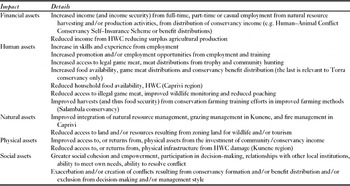
This meta-synthesis highlighted a number of positive and negative livelihood impacts resulting from CBNRM and related activities (Table 3). The overall impact on households within conservancies differed primarily according to the type of impacts felt, but also according to the duration, frequency and timing of the impacts, the circumstances and preferences of households and their access to particular activities and consequent impacts.
Impacts on access to and returns from various livelihood assets and their causes. HWC = human-wildlife conflict.

Much of the literature considered in the meta-synthesis examined the impacts arising from an individual activity associated with the CBNRM programme; very few addressed a range of different activities and their resultant impacts. Existing research has also focused narrowly on a few of the longest running and higher revenue generating conservancies, which is likely to give a skewed picture of the range of impacts generated, and the level and extent over which they are spread (Adams & Hulme Reference Adams, Hulme, Hulme and Murphree2001 cite Chambers 1983 in their discussion of such ‘project bias’).
There is little information available regarding the differential impacts on recipients at the individual or household level, as opposed to descriptions of anticipated impacts, or anecdotal evidence of changes. These combination of these gaps means that limited conclusions can be drawn about the type and extent of impacts on individual and households, or about the relative importance of each type of impact. Of particular importance, the lack of systematic analysis of the costs of CBNRM and related activities imposed at the individual or household level means it is virtually impossible to get a clear idea of the net benefits of CBNRM and related activities at the household livelihood level, and how these might differ in different contexts.
Currently, when considering impacts on income or financial assets, most studies restrict themselves to the consideration of the extra revenues from CBNRM activities, and do not compare them with other sources of household (or individual) income or with the poverty datum line. Studies providing useful contextual information, such as the share of total income provided by particular resources and/or the intervention being studied, are available in the wider conservation and development literature (for example Shackleton et al. Reference Shackleton, Shackleton, Netshiluvhi, Geach, Ballance and Fairbanks2002; Pagiola et al. Reference Pagiola, Arcenas and Platais2005; Wunder Reference Wunder2008).
CONCLUSIONS
To improve understanding of livelihood impacts in the future, provision of contextual information would allow the relative importance of impacts to be better understood, particularly in terms of the relative contribution of CBNRM activities to livelihoods. Spatial and temporal comparison of cases within CBNRM areas, as well as between CBNRM and ‘control’ locations, is required to gain an understanding of what would have occurred in the absence of the programme if robust conclusions are to be drawn about the overall impact of CBNRM and related activities at the household or individual level (see for example Ferraro & Pattanayak Reference Ferraro and Pattanayak2006; Pagiola et al. Reference Pagiola, Rios and Arcenas2008; Ferraro Reference Ferraro2009).
The issue of equity, in terms of participation in decision-making and in the distribution of benefits and costs associated with programme activities, must also be considered. There are few data on issues relating to gender and HIV/AIDS, but these probably have significant impacts on the ability of households to participate in CBNRM activities and benefit from the programme. Future work must address such issues.
ACKNOWLEDGEMENTS
I thank Mary Milne, Ross Lambie and three anonymous reviewers for helpful comments on drafts of this paper. Any errors of course remain mine. This research was been developed with the financial support of WWF-UK, Integrated Rural Development and Nature Conservation (Namibia) and WWF in Namibia.