


I
Suppose the following: two groups of people require our aid but we can help only one group; there are more people in the first group than in the second group; every person in both groups has an equal claim on our aid; and we have a duty to help and no other special obligations or duties.
Intuitions about which group we ought to aid differ. Some people contend that we ought to aid the larger group because it is better to aid more people than to aid fewer people. Others hold that we ought to toss a fair coin to determine which group to aid because we ought to afford each person equal concern and respect, which requires us to give each person an equal and positive chance of receiving aid.Footnote 1 Still others contend that we ought to aid the larger group because we ought to afford each person equal concern and respect, which requires that the presence of each person ‘makes a difference’ to which group we ought to aid, either by balancing the equal and opposite claim of another person or by breaking a tie between such claims.Footnote 2 Finally, some people believe that we ought to determine which group to aid by following a procedure of proportional chances.Footnote 3 Proportional chances means that each group is given a chance of receiving aid that is proportional to the size of that group. For instance, if there is one person in the smaller group and there are five people in the larger group, proportional chances assigns the smaller group a one-in-six chance of receiving aid and the larger group a five-in-six chance of receiving aid.
Philosophers who are tempted by proportional chances might think that it strikes an appropriate compromise between distributing our aid fairly and aiding as many people as possible.Footnote 4 To address this suggestion, suppose that fairness and the expected number of claims on aid satisfied (expected satisfaction) are the only values relevant to how we ought to decide which group to aid. In order to determine whether proportional chances can strike a compromise of this sort, we must measure the goodness of degrees of fairness, or, conversely, the badness of degrees of unfairness, that result from distributing our aid in ways that are not maximally fair. Fairness seems to admit of degrees because if it is perfectly fair to distribute a good equally between two groups, it is less fair to give three-fourths of the good to one group and one-fourth of the good to the other group, and still less fair to give all of the good to one group and none of the good to the other group. There is currently no theory, however, that specifies how the goodness of degrees of fairness is to be measured.
I argue that there exists at least one fairness function, which is a function that measures the goodness of degrees of fairness, that implies proportional chances. While my point is not to argue that this formula provides serious support for proportional chances, I argue that the existence of such a formula suggests that proportional chances can serve as a compromise between fairness and expected satisfaction.
II
John Broome offers an account of fairness according to which fairness requires that claims be satisfied in proportion to their strength.Footnote 5 This means that fairness requires that equal claims be satisfied equally. In the case under discussion, it would be perfectly fair to aid both groups and it would be perfectly fair to aid neither group because both options would satisfy each person's claim on aid equally. However, neither of these options is available to us because we cannot aid both groups and we have a duty to aid at least one group. Thus, everyone's claim on aid will not be satisfied. Either the people in the larger group will have full satisfaction of their claims and the people in the smaller group none, or the people in the smaller group will have full satisfaction of their claims and the people in the larger group none.
We can achieve something close to equality of satisfaction of claims, however. We can afford each person an equal chance of receiving aid by tossing a fair coin to determine which group to aid. The chance of receiving aid is something of a surrogate for having one's claim on aid satisfied, so affording each person an equal chance of receiving aid provides a degree of fairness. Since we cannot aid both groups, and we have a duty to aid one group, it is most fair to assign each person an equal, one-in-two, chance of receiving aid. In the case we are considering, fairness functions, which measure the goodness of degrees of fairness, are thus maximized by assigning each group a one-in-two chance of receiving aid. And, something less than complete fairness will result when the chance assigned to each group deviates from equality.
III
Is there any fairness function that gives proportional chances? There is at least one, and it is a function of the chance we assign to aiding the larger group (p), the chance we assign to aiding the smaller group (1 − p), and the size of the smaller group (n).

To see that this fairness function implies proportional chances, suppose that fairness and expected satisfaction are equally weighty and that we ought to distribute our aid so as to maximize their sum. Understood in this way, assigning proportional chances maximizes neither fairness nor expected satisfaction but instead maximizes the sum of these values.
Note that expected satisfaction is a function of the chance we assign to aiding the larger group (p), the size of the larger group (m), the chance we assign to aiding the smaller group (1 − p), and the size of the smaller group (n):

Expected satisfaction is maximized when the larger group is assigned a certain chance and it is minimized when the smaller group is assigned a certain chance. And, as the chance of aiding the larger group varies, expected satisfaction varies.
The sum of fairness and expected satisfaction is (from (1) and (2)):

The maximum of the sum of fairness and expected satisfaction lies at the value of p where the derivative of (3) with respect to p equals zero. The derivative of (3) with respect to p is:
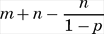
When we substitute proportional chances ( ) for p we find that (4) equals zero. Moreover, there is no other value of p that implies this. Therefore, the maximum of (3) lies at proportional chances. Hence, (1) is a fairness function that implies proportional chances.
IV
The fairness function I propose possesses several features that make it a possible measure of degrees of fairness. If we specify that the smaller group has one member and the larger group has five members then (1) can be graphed as:
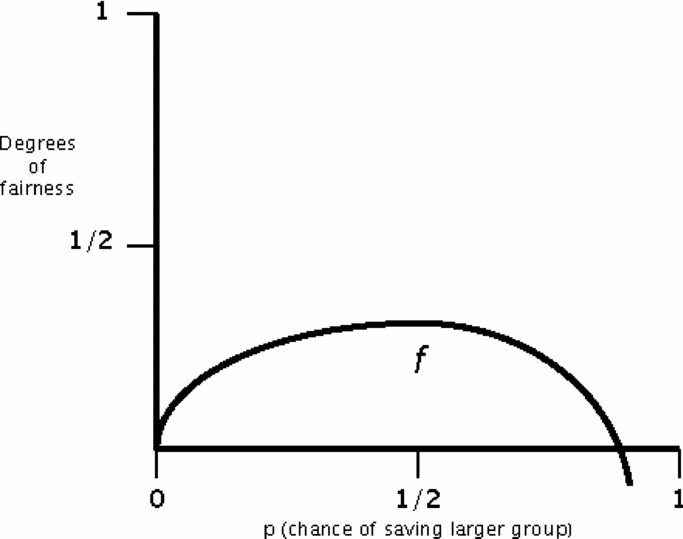
As this graph shows, (1) has a maximum where pequals one-half and slopes downward as papproaches zero and one. Some people might find it attractive that the shape of this function is strictly concave, which means that the badness of deviating from perfect fairness decreases slowly at first and accelerates as the chance of aiding the larger group approaches zero and one. One conspicuous feature of (1), however, is that it implies that affording the larger group a certain chance is infinitely unfair while affording the smaller group a certain chance is finitely unfair. Though this feature must be unacceptable, we can safely ignore it. Assigning proportional chances to the larger group means that their chance of receiving aid (p) will fall between p = 1/2 and p = 1. Expected satisfaction is a linear function with a maximum at p = 1. The only part of (1) that is relevant to proportional chances thus lies between p = 1/2 and p = 1, so we can ignore all but this part of the function. And if we do so, it seems possible that it is infinitely unfair to afford the larger group a certain chance of receiving aid.
The fairness function I provide is one among many fairness functions that imply proportional chances. I do not claim that it is a plausible formula. Rather, the fact that one such formula exists suggests that proportional chances can serve as a compromise between fairness and expected satisfaction.Footnote 6


