Bullying and victimisation is a pervasive and continuing problem within schools. A survey of Australian primary and secondary students reported that approximately 17% of students were victimised at school on a weekly basis (Rigby, Reference Rigby1997). Currently, much of the research examining bullying and victimisation within Australian schools has analysed student samples as homogenous groups and has not considered the heterogeneity of ethnicity within student samples. The Australian population comprises people from more than 270 countries (Australian Bureau of Statistics [ABS], 2006a) with approximately 30% of children aged 10–14 years having parents who were both born overseas (ABS, 2006b). This study aims to increase our understanding of the relationship between strength of ethnic identity and acculturation orientation among ethnic minority children and bullying and victimisation, to inform the continuing development of interventions to reduce bullying in Australian schools.
Bullying is defined as a repeated, intentional, unprovoked, aggressive behaviour aimed at hurting or harming a person either physically or psychologically (Monks & Smith, Reference Monks and Smith2006). Bullying behaviours are characterised by three criteria: intention, repetition and an imbalance of power between the perpetrator and the victim (Rigby, Reference Rigby2002; Smorti, Menesini & Smith, Reference Smorti, Menesini and Smith2003). Bullying behaviours can be conducted in a variety of ways. For example, bullying can be conducted in direct face to face encounters, and can be physical (e.g., hitting, kicking, or punching) or verbal (e.g., name calling, teasing or threatening) (Crick & Grotpeter, Reference Crick and Grotpeter1995; Monks & Smith, Reference Monks and Smith2006; Rivers & Smith, Reference Rivers and Smith1994). In contrast, indirect bullying, also referred to as relational aggression, (Paquette & Underwood, Reference Paquette and Underwood1999) consists of behaviours conducted towards victims either directly (e.g., telling someone that they cannot play with a group) or indirectly (e.g., spreading of rumours) primarily with the intention of causing harm to the peer relationships of the victim (Espelage & Swearer, Reference Espelage and Swearer2003; Hodges, Malone & Perry, Reference Hodges, Malone and Perry1997; Paquette & Underwood, Reference Paquette and Underwood1999). Irrespective of the type, bullying can have negative effects on children's mental health and well-being for both victims and perpetrators (Delfabbro et al., Reference Delfabbro, Winefield, Trainor, Dollard, Anderson, Metzer and Hammarstrom2006).
Bullying and victimisation occurs at all ages, however Australian research has shown increasing levels through primary school with peak prevalence in 12 to 13- year-old students and then a decline in the later years of secondary schooling (Rigby & Slee, Reference Rigby and Slee1993). Similarly, Eslea & Rees (Reference Eslea and Rees2001) reported greatest prevalence throughout childhood and adolescence to be in children aged 11 to 13. Consequently, the present study will focus on children aged 11 to 13 as they are in the age range most likely to report bullying and victimisation.
Ethnicity, Strength of Ethnic Identity, Bullying and Victimisation
Ethnicity is a multi-faceted construct (Bhopal, Reference Bhopal2004), not encompassed by fixed parameters but a fluid process (Bottomley, Reference Bottomley1997). When determining the distinguishing attributes which define an ethnic group, there is no universally agreed definition to make this distinction. Ethnic group identification in some studies is distinguished by the attribution of individuals who share a language or religion (Bottomley, Reference Bottomley1997), or alternatively, based upon one's country of origin (Branch, Tayal & Triplett, Reference Branch, Tayal and Triplett2000), or in accordance with ones parent's country of origin (Phinney, Reference Phinney1992). Within the literature examining ethnicity, a consensus has emerged that encompassed within each individual ethnic group located within a particular society is a unique history, traditions, values and culture (Phinney, Reference Phinney1992). Lehman, Chiu and Schaller (Reference Lehman, Chiu and Schaller2004) define culture as ‘representing an integration of behavioral norms and cognitions shared by individuals within some definable population that are distinct from those shared within other populations’ (p.690). These shared cultural norms influence and shape children's behaviours, social interactions and attitudes (Lonner & Malpass, Reference Lonner and Malpass1994). Cultural socialisation practices of parents and family who instill in children cultural norms, skills, behaviours and values (Romero, Cuellar & Roberts, Reference Romero, Cuellar and Roberts2000) influence their behaviours. For instance, Bergeron and Schneider's (Reference Bergeron and Schneider2005) cross-national review of studies which examined peer directed aggression, showed that adolescents who were members of individualistic societies that socialise children to value one's individual needs, desires and ambitions (such as Australia, the United States and Canada) exhibited higher levels of aggression directed toward peers, in comparison with adolescents who were members of collectivistic societies that place greater emphasis on children valuing family and the community over their own individualistic needs (such as Thailand, Taiwan and Venezuela).
Much of the research examining bullying and victimisation has been conducted with children from Western European backgrounds; however, there is evidence to demonstrate that experiences of bullying and victimisation differ according to ethnicity. Ethnic minority children, conceptualised as individuals with a cultural heritage distinct from the majority population (Manthorpe & Hettiartchy, Reference Manthorpe and Hettiaratchy1993) have been found to experience higher levels of victimisation in comparison with ethnic majority children (Wolke, Woods, Stanford & Schulz, Reference Wolke, Woods, Stanford and Schulz2001). For instance, Rigby (Reference Rigby2002) found that Australian Aboriginal students reported experiencing higher levels of victimisation in comparison to non-Aboriginal students and a study in US schools in which Latino students were the ethnic majority group found Asian students were victimised more often than Latino students (Mouttapa, Valente, Gallaher, Rohrbach & Unger, Reference Mouttapa, Valente, Gallaher, Rohrbach and Unger2004). Furthermore, children from ethnic minority backgrounds were more likely to experience victimisation directed towards them pertaining specifically to their ethnicity such as being called derogatory names about colour or race, or being excluded for reasons based on ethnicity (Eslea & Mukhtar, Reference Eslea and Mukhtar2000; Verkuyten & Thijs, Reference Verkuyten and Thijs2002). However, not all studies examining ethnic variability in bullying experiences have found significant differences in reported experiences of victimisation between ethnic minority and majority children, or across different ethnic groups (Lockhart & Rawson, 1994; Monks, Ortega-Ruiz & Rodriguez-Hidalgo, Reference Monks, Ortega-Ruiz and Rodriguez-Hidalgo2008; Nguy & Hunt, Reference Nguy and Hunt2004; Seals & Young, Reference Seals and Young2003; Siann, Callaghan, Glissov et al., Reference Siann, Callaghan, Glissov, Lockhart and Rawson1994).
Disparate findings have also been reported in studies examining ethnic variability in the engagement of bullying behaviour amongst children from different ethnic backgrounds. Seals and Young (Reference Seals and Young2003) and Siann et al. (Reference Siann, Callaghan, Glissov, Lockhart and Rawson1994) found no significant difference in engagement in bullying behaviours between ethnic minority and ethnic majority school students, whereas others have reported bullying behaviours to be more prevalent amongst members of ethnic minority groups (Nansel et al., Reference Nansel, Overpeck, Pilla, Ruan, Simons-Morton and Scheidt2001). These last findings have been attributed to the ethnic composition of classrooms, which have been shown to reflect differences in reports of likely perpetrators of bullying. Graham and Juvonen (Reference Graham and Juvonen2002) found that ethnic minority students who were the numerical majority in classes were more likely to be nominated by peers as being perpetrators of bullying in comparison with ethnic majority students who were the numerical minority. The mixed findings within the literature examining ethnic minority or majority status in children's bullying experiences suggest that this issue warrants further examination and this study will compare bullying experiences between ethnic minority and majority students in the Australian school setting.
Ethnic identity is defined as the psychological relationship a person has in identifying with his or her own ethnic group (Phinney, Reference Phinney1990) and is considered to be a critical component of the self concept (Britto, Reference Britto2008; Phinney, Cantu & Kurtz, Reference Phinney, Cantu and Kurtz1997). The strength to which a person feels a sense of belonging, commitment and self-identification with their own ethnic group is correlated with an individual's behaviours and attitudes (Phinney, Reference Phinney1992) and is positively associated with psychological well-being (Roberts et al., Reference Roberts, Phinney, Masse, Chen, Roberts and Romero1999). Research examining the association between positive psychological well-being and strength of ethnic identity has found that stronger ethnic identity is associated with higher self-esteem (Phinney et al., Reference Phinney, Cantu and Kurtz1997; Verkuyten, Reference Verkuyten2003). These findings are significant in relation to bullying, as consistent associations between children's self-esteem and bullying behaviour is noted in the literature. Children with lower self-esteem are more likely to be victimised and also more likely to report being a perpetrator of bullying (Delfabbro et al., Reference Delfabbro, Winefield, Trainor, Dollard, Anderson, Metzer and Hammarstrom2006; O'Moore & Kirkham, Reference O'Moore and Kirkham2001). It would be expected therefore, that children with stronger ethnic identity would be less likely to be victimised or be perpetrators of bullying.
Acculturation, Bullying and Victimisation
Acculturation orientation has been used to examine differences in experiences of individuals across ethnic groups. For instance, an individual's acculturation orientation has been used to examine the manner in which immigrants and first and second generation children of immigrants from one cultural context, adapt and re-establish their lives within another cultural context (Berry, Reference Berry1997). The most widely cited definition of acculturation is that of Redfield et al. (1936, as cited in Berry, Reference Berry1997) who define acculturation as a ‘phenomena which results when groups of individuals having different cultures come into continuous first hand contact with subsequent changes in the original cultural patterns of either or both groups’ (p. 7). Acculturation is a multi-dimensional process in which individuals can have either a strong or weak identification with both their own culture and the dominant culture in which they live (Kvernmo & Heyerdahl, Reference Kvernmo and Heyerdahl2003). Berry describes four different acculturation orientations (Reference Berry, Organista, Chun and Marin1998): (a) integration – maintenance of the cultural integrity of the culture of origin as well as movement to become an integral part of the host culture, (b) assimilation – relinquishing one's cultural identity and moving into the host culture, (c) separation – no relations with the host culture accompanied by maintenance of a distinct ethnic identity and traditions, or (d) marginalisation – losing cultural contact with both cultures.
The acculturation orientation adopted has been found to result in different psychological outcomes for individuals, for example, the adoption of integration and assimilation acculturation orientations is associated with more positive psychological outcomes for adolescents compared with the adoption of separation or marginalisation orientations which are associated with negative psychological outcomes (Kvernmo & Heyerdahl, Reference Kvernmo and Heyerdahl2003). In a review of work in this area, Schwartz et al. (Reference Schwartz, Unger, Zamboanga and Szapocznik2010) suggested that biculturalism (integration) is generally the most adaptive approach to acculturation. A literature search identified only one study examining the relationship between acculturation orientation and victimisation. Bauman (Reference Bauman2008) examined 118 Mexican American primary school students and contrary to expectations found no association between acculturation orientation and victimisation. She noted that among the largely Mexican American sample other factors may have been more salient, but also suggested that this should be examined in larger samples. Acculturation orientation and being a perpetrator of bullying has not yet been examined to the author's knowledge and was also examined in the current study to test whether the proposed relationships between acculturation orientation and bullying and victimisation are consistent with previous findings that positive psychological outcomes are associated with adoption of integration and assimilation acculturation orientations.
Study Hypotheses
This study investigated the relationship between bullying and victimisation, ethnic minority and majority status, strength of ethnic identity and acculturation orientation. The following hypotheses were tested:
1. Children of ethnic minority status have more victimisation experiences than children of ethnic majority status.
2. Among ethnic minority children, weaker ethnic identity is associated with higher levels of experiencing direct and indirect victimisation and engagement in bullying.
3. Ethnic minority children who adopt a separation or marginalisation acculturation orientation will report partaking in higher levels of bullying, and experience higher levels of victimisation in comparison to children who adopt an integration or assimilation acculturation orientation.
Method
Participants
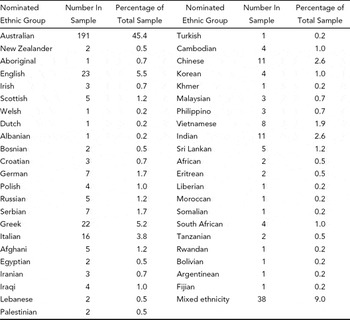
Of the 1162 potential participants in grades 6 and 7 attending a private or government primary school in Adelaide, South Australia, parents or guardians of 475 children gave consent for their child to participate in this study. The sample was reduced to 421 (response rate of 36.2%; M = 11.8 years, SD = 0.6; 219 females, 202 males) due to absenteeism (44), voluntary withdrawal (5) and incomplete questionnaires (5). Reflecting the ethnic diversity of children in South Australian schools, 72 ethnic identities were identified and are presented in Table 1. Almost half of the sample (45.4%) were identified as from an Anglo-Celtic Australian ethnic background, that is, Australian born, with a British cultural background. All other children were included in the ethnic minority group, including one Aboriginal participant. The ethnic majority group included 226 participants, and the ethnic minority group included 195 participants.
Nominated ethnic group of participants

Measures
Demographic information was collected including age, gender, country of birth (years living in Australia if not born in Australia), main language spoken and birth country of parents and grandparents.
Peer Relations Questionnaire
The extent to which participants experienced being a victim of direct physical (e.g., hit) or direct verbal (e.g., called names) bullying or engaged in direct physical or verbal bullying behaviours was assessed using the Peer Relations Questionnaire (Rigby & Slee, Reference Rigby and Slee1993). The 4-item Bully scale measured the tendency of participants to bully others, for example, ‘I like to make others scared of me’, and the 4-item Victim scale measured the tendency for participants to be victimized, for example, ‘I get picked on by other kids’. Participants were given four response options ‘(1) never’, ‘(2) once in a while’, ‘(3) pretty often’ and ‘(4) often’. Total scores for both scales ranged from 4 to 16. Higher bullying scores indicated high engagement in bullying; higher direct victimisation scores indicated participants had a high tendency to be the victim of direct forms of bullying. Both the Bully and Victim scales had good reliability (α = 0.77, α = 0.88).
Relational Aggression Scale
The 10-item Relational Aggression Scale, developed by Rigby and Bagshaw (Reference Rigby and Bagshaw2001), was used to measure the frequency that participants experienced indirect victimisation, for example, ‘having rumours spread about them’. Participants rated how often these actions occurred using a 3-point Likert scale ‘(1) never’, ‘(2) sometimes’, and ‘(3) often’. Total scores ranged from 10 to 30. Higher scores indicated participants experienced higher levels of indirect victimisation. Reliability was good (a = 0.86).
Multi-group Ethnic Identity Measure
Ethnic group identification was determined by responses to an item in the Multi-group Ethnic Identity Measure (Roberts et al., Reference Roberts, Phinney, Masse, Chen, Roberts and Romero1999) which asked participants to complete the open-ended item ‘my ethnic background is. . . .’ Verification and cross-referencing of ethnic identification for participants who did not fill in this question was determined by the response to questions which sought ‘the birth place of parents/grandparents’ and ‘language spoken’. Participants who self-identified as being Australian, New Zealander, English, Irish, Scottish or Welsh were categorised into the ethnic majority group.
The revised 12-item Multi-group Ethnic Identity Measure (MIEM; Roberts et al., Reference Roberts, Phinney, Masse, Chen, Roberts and Romero1999) measured the strength to which participants identified with their ethnic group. This has been found to be a reliable measure of ethnic identity among Australian students from diverse ethnic backgrounds (Dandy et al., Reference Dandy, Durkin, McEvoy, Barber and Houghton2008). The instrument contained two sub-scales; (1) Affirmation, Belonging, Commitment which measured the extent participants felt good about their ethnic background and their sense of belonging with their ethnic group (e.g., ‘I am happy that I am a member of the group I belong to’) and (2) Exploration which measured the extent participants were involved in activities to explore the meaning of one's ethnicity (e.g., ‘I have spent time trying to find out more about my ethnic group such as it's history, traditions and customs’). Participants responded on a reverse scored 4-point Likert scale indicating how much they agreed or disagreed with each statement from ‘(4) strongly agree’, ‘(3) agree’, “(2) disagree’, to ‘(1) strongly disagree’. Total scores were measured by summing the two subscales and ranged from 12–48. Higher scores indicate stronger ethnic identity. Reliability was good (α = 0.85).
Acculturation, Habits and Interests Multicultural Scale for Adolescents Acculturation Scale
To assess acculturation orientation participants completed the Acculturation, Habits and Interests Multicultural Scale for Adolescents Acculturation Scale (AHIMSA; Unger et al., Reference Unger, Gallaher, Shakib, Ritt-Olson, Palmer and Johnson2002). Eight items assess aspects of ethnic interaction (e.g., “my best friends are from. . . . . .”), cultural heritage (e.g., ‘the holidays I celebrate are from. . . . . .’) and ethnic behaviours (e.g., ‘my favorite music is from. . . . .’). Participants indicated which behavioural orientation was most true of them. Each response category represented one of four acculturation orientations: Australia (assimilation), the country my family is from (separation), both (integration) and neither (marginalisation). Participants were assigned to one of the four acculturation orientations based on their most commonly selected response and for those with equal numbers of responses the assignments used by Weiss et al. (Reference Weiss, Cen, Schuster, Unger, Johnson, Mouttapa, Schreiner and Cruz2006) were made.
Procedure
Approval was obtained from the University of Adelaide, School of Psychology Ethics Committee. Of the 40 schools approached, 12 participated. All classrooms with years 6 and 7 students participated at these 12 schools. Reasons given by principals for non-participation were a commitment to other research (4), a full curriculum (2), not interested (3), no reason given (10), and no reply (9). Information packages were provided to schools to distribute to students able to read and write English proficiently to take home to parents. While it was acknowledged that some parents would not be able to read the information packages, written parental consent was a requirement of this research. The researcher attended each school and remained in the room while participants completed the questionnaire. However, the researcher remained at the front of the room and did not interact with the children unless they had a question regarding the questionnaire. The children saw the researcher place all questionnaires together at the end of the session and as they had not placed their name or any other identifying information on the questionnaire could see that their individual responses could not be identified.
Analysis
T- tests and one-way analysis of variance with Games-Howell post hoc tests were used to analyse group differences. The Welch F-ratio was reported in instances when the Levene's assumption of homogeneity was violated (p < 0.05). All post-hoc analyses were conducted using Games-Howell as a result of the unequal sample sizes (Field, Reference Field2005). Effect sizes of the significance between groups were calculated using Cohen's d. All findings were considered statistically significant at the p < 0.05 level.
Results
Bullying and Victimisation Experiences of Ethnic Minority and Majority Children
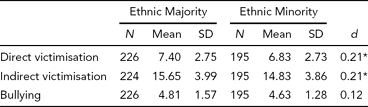
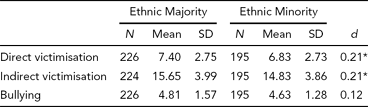
The bullying experiences of children by ethnic minority and ethnic majority groups are reported in Table 2. Contrary to expectations, ethnic majority children reported significantly higher levels of direct victimisation than ethnic minority children, (t(419) = 2.13, p = 0.03) reflecting a small effect size (d = 0.21). Similarly, ethnic majority children also reported experiencing significantly higher levels of indirect victimisation than ethnic minority children (t(417) = 2.15, p = 0.03), reflecting a small effect (d = 0.21). There was no significant difference between ethnic groups in levels of engagement in bullying (t (419) = 1.30, p = 0.19, d = 0.12).
Direct and indirect victimisation and bullying among ethnic minority and majority children
*p < .05
Strength of Ethnic Identity and Bullying and Victimisation Experiences
As a result of non-normal distributions, Spearman's rho correlations were used to examine the relationship among ethnic minority children between strength of ethnic identity and bullying and victimisation experiences. It was predicted that weaker ethnic identity would be associated with higher levels of experiencing direct and indirect victimisation. This was partially supported by a significant negative weak correlation between strength of ethnic identity and experiences of direct victimisation (rho = −0.13, p = 0.03). However, there was no significant relationship between strength of ethnic identify and indirect victimisation (rho = −0.10, p = 08) or bullying (rho = −0.05, p = 0.26) among ethnic minority children.
Acculturation Orientation and Bullying and Victimisation Experiences
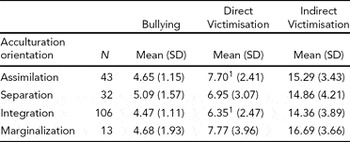
Descriptive statistics for bullying and victimisation experiences according to acculturation group for ethnic minority children are presented in Table 3. It was predicted that ethnic minority children in the separation and marginalisation groups would engage in higher levels of bullying behaviours than ethnic minority children in the integration and assimilation group. A significant difference was not found in reported levels of engagement in bullying behaviours between groups (Welch F (3, 41.50) = 1.48, p = 0.23).
Total scores for bullying and victimisation experiences by acculturation group

1 Significant difference.
It was predicted that ethnic minority children in the separation and marginalisation groups would experience higher levels of direct victimisation than children in the integration and assimilation group. A significant difference was found in the levels of direct victimisation experienced across acculturation groups (F(3, 42.18) = 3.35, p = 0.03). Results of the post hoc analysis revealed a significant difference (p = 0.02, d = 0.55) between the assimilation and integration groups, indicating that ethnic minority children in the assimilation group experienced higher levels of direct victimisation than children in the integration group.
Finally, it was predicted that ethnic minority children in the separation and marginalisation groups would report higher levels of indirect victimisation than children in the integration and assimilation groups. A significant difference was not found in reported levels of experiencing indirect victimisation between the acculturation groups (F (3,190) = 1.75, p = 0.16).
Discussion
This study aimed to extend research on bullying and victimisation by exploring the relationship between ethnic majority or minority status, strength of ethnic identity and acculturation on children's experiences of bullying and victimisation in Australia. Overall there were low levels of both bullying and victimisation experiences reported consistent with a likely reduction in the prevalence of peer victimisation in schools worldwide (Rigby & Smith, Reference Rigby and Smith2011). Contrary to expectations, ethnic majority children reported being more likely to experience direct and indirect victimisation than ethnic minority children. Interpretation of these results may be considered within two contexts. Firstly, the results may be a reflection of the ethnic composition of classrooms. Studies which have incorporated the ethnic composition of classrooms in reports of victimisation across ethnic groups have demonstrated that when ethnic minority or ethnic majority children are the numerical minority within classrooms, they are more likely to experience higher levels of victimisation (Vervoort, Scholte & Overbeek, Reference Vervoort, Scholte and Overbeek2008). Most South Australian schools have high levels of ethnic diversity reflecting the third of primary school aged children whose parents were both born overseas (ABS, 2006b) and the 16.6% of South Australians who speak a language other than English at home (ABS, 2006c). As such it is possible that ethnic majority children were the numerical minority within some classroom settings, possibly increasing their likelihood of being victimised. However, Australian patterns of residential segregation of ethnic groups are much less than in other countries (e.g., United States) and there is large diversity in the ethnic populations of Australian cities (and schools) such that no ethnic minority group dominates among non-Anglo-Celtic Australians (Hugo, Reference Hugo1995). This is in contrast to the ethnic composition of schools involved in previous overseas work in this area, such as Bauman's work with students in the US where 92% of children self-reported their race/ethnicity as Hispanic/Latino and Vervoort, Scholte and Overbeek's work in the Netherlands where 68% of children were of Dutch origin, while of the children from non-Western ethnic minorities, 40% were Turkish and 27% Moroccan (2008). In the current study, the ethnic majority group was only 54% of the sample, while the next most numerous group were the children with Greek ethnicity, however, they only represented 5.2% of the sample. This study's conclusions are limited by the absence of data on the ethnic composition of individual classrooms or schools. Secondly, the results may reflect the exclusion of specific examination of direct and indirect experiences of racist bullying. Previous research which has included this form of bullying have shown ethnic minority children are more likely to experience this in comparison to ethnic majority children (Verkuyten & Thijs, Reference Verkuyten and Thijs2002). Subsequently, the inclusion of racist forms of bullying within the current study may have found variations in victimisation between groups. Future research would benefit from including specific assessment of racist forms of bullying to further aid in establishing the relationship between ethnicity and victimisation.
While among ethnic minority children, weaker ethnic identity was not associated with higher levels of engagement in bullying or higher levels of indirect victimisation, it was associated with direct victimisation. A lack of identification with a child's ethnic group may mean that children do not benefit from the mediating affects of strong self esteem and friendships from other group members. Previous research has shown having friends can decrease children's susceptibility to victimisation as they provide a protective role by offering retaliation against bullies (Hodges, Boivin, Vitaro & Bukowski, Reference Hodges, Boivin, Vitaro and Bukowski1999). Schools may benefit by supporting ethnic minority children to develop a strong sense of ethnic identity as this may mediate children's vulnerability to victimisation.
Few studies have explored the manner in which the acculturation orientation adopted by ethnic minority children influence their experiences of victimisation and bullying. Children who adopted an assimilation acculturation orientation experienced more direct victimisation in comparison with children who adopted an integration acculturation orientation but there were no differences across acculturation groups for indirect victimisation or bullying behaviours. These results show that ethnic minority children in this study who adopted the cultural behaviours of the Australian culture at the same time as taking part in the cultural behaviours of their own ethnic group were less likely to be victimised than children who only adopted the Australian culture while rejecting their cultural origins. These results are somewhat incongruent with previous research which has found separation and marginalisation as opposed to assimilation and integration orientations, to be significant negative predictors for adolescents’ psychological well-being, and behaviours (Fosados et al., Reference Fosados, McClain, Ritt-Olson, Sussman, Soto, Baezconde-Garbantani and Unger2007; Kvernmo & Heyerdahl, Reference Kvernmo and Heyerdahl2003). Low numbers of participants were classified as adopting a marginalisation (n = 13) and separation (n = 32) acculturation orientations. This is a positive result given the usually poor psychological outcomes found for these orientations and is consistent with previous work using similar categorisation of acculturation which has questioned the validity of marginalisation as an approach to acculturation and has noted that often studies find few participants endorse this approach (Schwartz et al., Reference Schwartz, Unger, Zamboanga and Szapocznik2010). However, this meant that the current study did not have sufficient statistical power to detect differences in bullying or victimisation experiences between these and other acculturation orientation groups. Future work with larger numbers of participants should further examine bullying and victimisation among children in both marginalisation and separation groups. However, these results are consistent with a more recent review that suggested that biculturalism (integration) rather than assimilation is generally the most adaptive approach to acculturation (Schwartz et al., Reference Schwartz, Unger, Zamboanga and Szapocznik2010). The only other located study to examine this relationship within the context of bullying found no significant influence of acculturation orientations in the experiences of bullying and victimisation of Mexican American students (Bauman, Reference Bauman2008). The significant findings in the current study may be associated with the diversity and minority status of the sample, as was evident from the 72 different ethnic identities reported by the current sample. Future work should consider the influence of acculturation among different ethnic groups, as well as the immigration status of children (e.g., refugee, immigrant) within those groups.
Another issue to be considered in future work is the direction of causality between acculturation orientation and victimisation, as it is likely that victimisation experiences may contribute to the acculturation orientation adopted, particularly when racist bullying is experienced.
Limitations to this study include the inability to examine the bullying and victimisation experiences of children within specific ethnic groups because of the small sample sizes. However, this sample reflects the current diversity of ethnic backgrounds among children in Australian primary schools. Children from minority ethnic backgrounds are likely to be attending schools where there are children from a diverse range of backgrounds, where no ethnic group has a numerical majority. The use of a self-report instrument is also a potential limitation, in particular concerning the potential for participants to respond in a socially desirable manner both in reporting bullying and victimisation as well as acculturation orientation. When evaluating children's bullying and victimisation experiences, participants may be reluctant to identify themselves as either a perpetrator or a victim of bullying to maintain social desirability (Smith & Sharp, Reference Smith, Sharp, Smith and Sharp1994). This effect may have been present in the current study which found low reports of participants engaging in bullying or being a victim. Alternatively, it is possible that recent focuses on reducing bullying experiences in South Australian schools have been effective. Future research would benefit from incorporating multiple measures of bullying and victimisation such as peer nominations or parent and teacher reports to assist in minimising the effect of social desirability as well as overcoming the issue of shared method variance in the current study.
A further issue in the current study was that there were not sufficient resources to include children in the study who had insufficient English literacy skills to complete the questionnaire or to include children who were absent from school on the day of the study. As such we have not included the experiences of children with low literacy skills due to learning difficulties or due to a non-English speaking background, in particular, recent arrivals to Australia. Similarly, we have excluded children where school attendance may be impacted by health or family issues. It is possible that by excluding these children, the most vulnerable children with experiences of victimisation have not been considered and future work should aim to incorporate the perspectives of these children.
Conclusions
Few Australian studies have examined bullying, victimisation and ethnicity. The results of this study suggest that strength of ethnicity and acculturation do play a role in children's experiences of bullying and victimisation and should be considered along with other factors know to influence these experiences (e.g., peer status, social competence)(Cook, Williams, Guerra, Kim & Sadek, Reference Cook, Williams, Guerra, Kim and Sadek2010). In recent years, policies have emerged which encourage children's cultural identity and cultural diversity within South Australian schools, and strive to educate children to appreciate, accept and understand different cultural perspective's by exposing children to different experiences which reflect different cultures in society (Department of Education and Children's Services, 2007). The findings of this study suggest that supporting children from ethnic minority backgrounds to develop a strong ethnic identity and to develop integration acculturation orientations (rather than assimilation acculturation orientations in particular) may assist in reducing the victimisation of ethnic minority children within Australian schools. Future directions for school-based anti-bullying interventions may also benefit from the explicit inclusion of racist forms of bullying within these programmes and when defining bullying to children.