The acquisition of an economic, political, and colonial empire that stretched across North America, the Caribbean, Central America, and the Pacific world transformed the United States during the Gilded Age and Progressive Era. The dynamics so central to “domestic” U.S. history at the turn of the century—hothouse industrialization, rapid economic growth, rising inequality, energetic social reform, and contestations over the role and breadth of the federal government—were intertwined in complex ways with the remaking of the relationship between the United States and the world. While scholars have examined many aspects of U.S. expansionism, a key yet neglected issue involved the imperial labor migrations it required. From across North America, the Caribbean, southern Europe, and Asia, men and women were recruited to labor in the service of building U.S. global power at the turn of the twentieth century. They built roads and canals; cooked, washed, and cleaned homes; they served in the military to assist in colonization and the pacification of foreign populations; they nursed the wounded; and they harvested bananas and sugar cane to build profits for corporate capitalism. Their labor built the empire from the bottom up; their movability was essential to the empire's strategy, and hence became central to working people's experiences throughout these decades.Footnote 1
U.S. expansionism embraced and exploited mobility and migration in multiple ways: it was indeed a “Movable Empire.” First, the empire itself was changeable, fluid, and profoundly movable. It exerted its power in different ways in different places. Expansion across the North American continent relied upon wars against indigenous people as well as settler colonialism; victory in the War of 1898 against Spain led to acquisition of Puerto Rico, Guam, and the Philippines, and effective control over Cuba in return for paying $20 million to Spain. Seizing the moment, the United States annexed Hawaii in 1898. The decision to colonize the Philippines required a lengthy war against the Filipinos’ independence campaign and, although victory was declared in 1902, in fact warfare continued for another decade. Victory ultimately came at a high human cost, particularly for Filipinos—approximately 4,000 U.S. soldiers were dead, roughly 50,000 Filipino soldiers, and hundreds of thousands of Filipino civilians.Footnote 2 With these wars, the United States acquired an empire that stretched half way around the world. And although these events unleashed a ferocious debate in the United States about the morality and costs of imperialism, they proved a useful foundation for more expansionist activities in the next decades. The United States helped Panama achieve independence from Columbia and then negotiated complete control over a broad swath of land at the heart of the new republic so it could construct a canal—a project that became central both to the rise of U.S. global power and the ways it articulated that power as selfless and beneficial to the world. It sent troops to occupy Cuba, the Dominican Republic, Nicaragua, Mexico, and Haiti repeatedly in the next years; it developed an aggressive economic strategy for penetrating markets in China and worked to support and enable the expansionist efforts of U.S. corporations around the world.
The U.S. expansionist strategy thus was quite fluid; formal colonialism in the Philippines was accompanied by a wide range of other strategies for control, matching direct military interventions and occupations with an aggressive economic, political, and cultural presence. In Cuba, the United States established a military government for three years after the War of 1898, and then intervened militarily again and again. By the mid-1920s, U.S. corporations had taken over much of the Cuban economy—60 percent of the profitable sugar industry was owned by the United States, for example. In Haiti, on the other hand, the United States invaded in 1915 to protect the interests of U.S. corporations, then remained to occupy the island, exerting massive control over the government and economy until 1934. In Puerto Rico, the United States established at first a military government; in 1900 the island nation received some degree of popular government, including a popularly elected legislature. But the United States continued to appoint the governor of Puerto Rico even after Puerto Ricans became citizens of the United States in 1917; the first popularly elected governor did not take office until 1948. Every site of U.S. Empire, in short, has a slightly different story to tell.
The complexity of U.S. Empire has often encouraged Americans to deny its very existence. To many it seems different from the “classic” cases of the British or French empires that relied more on formal colonialism. As a result, scholars of empire have often seen the U.S. case as an outlier, as marginal to the major patterns of imperial expansionism. However, as Ann Laura Stoler has noted, all empires rely on diverse strategies. They embrace “supremely mobile polities of dislocation”; they require movable rather than static populations; and they deploy “relocations and dispersions” to achieve their ends. In the case of the United States, a wide range of strategies, from formal colonization to de facto economic control, each with complex forms of gradated sovereignty, became central to its long-standing power and its ability to deny its imperial characteristics. The United States was, as Stoler says, “not an aberrant empire but a quintessential one, a consummate producer of excepted populations, excepted spaces, and its own exception from international and domestic law.”Footnote 3 Thus the U.S. approach was indeed different from that of the classic European empires, but not as much as we think. In the fluidity of its empire the United States was not only masterful but also a pioneer, shaping what would become common approaches by the late 20th and 21st centuries.
Secondly, as Stoler's comments suggest, this “movable empire” relied centrally on mobility as a tool for ruling over, disciplining, and managing those who performed the actual labor of empire building. Although much of the recent work on empire has focused on commodities, routes of communication and transportation, or on elite officials and their policymaking, in fact controlling the bodies of working people was essential to creating and empowering the empire. On this point consider, for example, William Howard Taft. Taft was one of the great architects of the U.S. global empire. In 1900 he became president of the Philippine Commission, working to establish civil government there, and then served as the first governor of the colony. As secretary of war from 1903 to 1908 Taft oversaw the creation of a protectorate in Cuba as well as early stages of the Panama Canal's construction. Finally as president of the United States from 1908 to 1912, he focused particularly on economic expansionism and dollar diplomacy. While Theodore Roosevelt has rightly received great attention as the visionary of U.S. expansionism, Taft was the prosaic one who constructed and managed the empire from the ground up.Footnote 4
While serving as president of the Philippine Commission in 1901, Taft received from Hawaiian planters a request to import Filipino laborers. His observations are noteworthy. Taft cast his eye around the globe and, though he was concerned that precautions be taken to safeguard the migrant Filipinos, he also observed that mobility of labor was essential to empire building. In so many places, including Hawaii, Samoa, and Fiji, he argued, it was impracticable to rely only on the islands’ inhabitants as a labor source. The managers of empire needed to go to other sites: “it has been found that when taken from their ordinary environment … continuous labor is not difficult, and the great mass of people so carried from their own homes to other islands become industrious and useful laborers.”Footnote 5 Relocating, dispersing, mobilizing: such processes became central to the logic of U.S. Empire building. Thus, West Indians were recruited for sugar plantations in Puerto Rico, while Puerto Ricans went on to Hawaii; and Filipinos migrated to Hawaii to work while Chinese laborers worked in the Philippines. These examples also remind us that mobility as key to managing labor was often a racial matter. The workers recruited and made mobile, the workers who needed to be alienated from their home environments, were almost always workers of color. In this way, the U.S. Empire set in motion vast diasporas of workers of color, bringing them into contact with a global working class composed of metropolitan migrants as well as those from diverse parts of the periphery. This suggests a third and final point: if labor mobility emerged as central to U.S. Empire, thereby shaping workers and their world in profound ways, it was also deployed by them as a resource and tool to improve their own lives. Mobility became a key terrain of struggle.
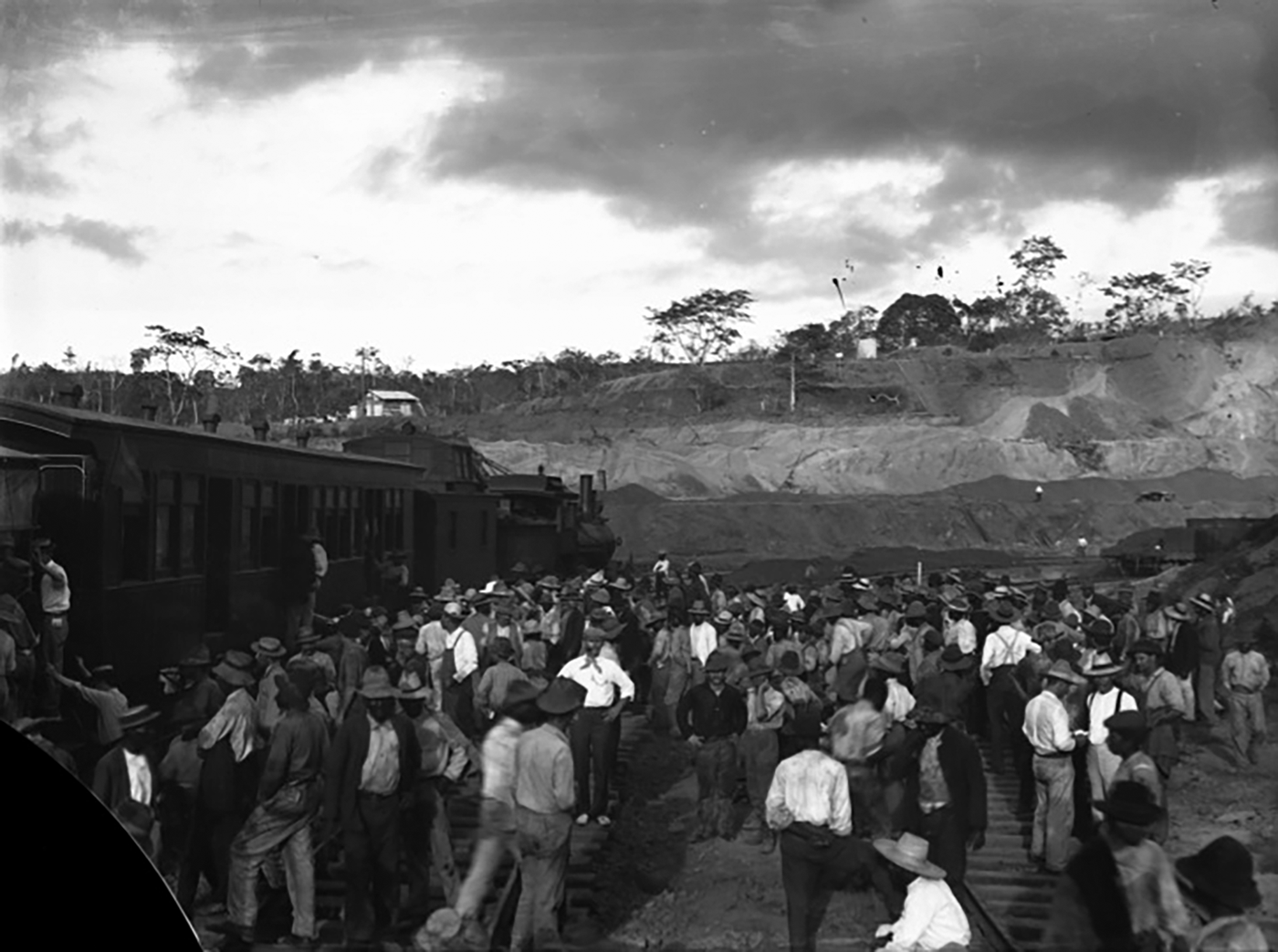
Payday at San Obispo, Panama Canal Zone. National Archives.

Consider the case of Hawaii. After the United States annexed Hawaii in 1898, U.S. capital flooded into the country, taking over and modernizing more and more of the sugar industry. Simultaneously, however, the U.S. government began applying Chinese exclusion laws to Hawaii. This made planters more dependent on Japanese workers who consequently launched more strikes, succeeded in raising wages, and generally defied the authority of their employers. Planters in Hawaii had long scoured the globe for sources of labor, casting their eyes across Europe, the United States, the East Indies, the Pacific Islands, and Asia, but the challenge lay, according to the U.S. Commissioner of Labor, in the fact that the government and the planters desired different qualities; the former desired people who would become good citizens (and thus preferred families), while the latter merely wanted industrious laborers. How to balance those two needs constituted the challenge: as the commissioner himself stated it, “nowhere was a people found combining the civic capacity to build up a state with the humility of ambition necessary for a contract laborer.”Footnote 6
With the U.S. acquisition of imperial possessions, potential sources of new labor revealed themselves. In Puerto Rico, social and economic upheaval generated by the influx of U.S. capital, particularly a shift from coffee to sugar production that displaced many small landholders, combined with the 1899 hurricane to make emigration attractive. The Hawaiian Planters’ Association sent recruiters to the island, furnished them with labor contracts, and paid to send some five thousand Puerto Rican men and women to Hawaii in 1900 and 1901 alone. The labor commissioner noted that Puerto Ricans faced difficulty adjusting to their new surroundings; even after time passed, planters argued that Puerto Ricans labored inconsistently, had to be taught to eat wholesome food, and were “untidy.” In the end, the commissioner declared an important result of bringing Puerto Ricans to Hawaii was their “moral effect” upon the Japanese: “The latter had begun to fancy that with the enforcement of Federal Chinese exclusion and contract laws after annexation they were complete masters of the labor situation in Hawaii.” The arrival of Puerto Ricans “disabused them of this sense of monopoly and made them much more reasonable in their relations with their employers.” Yet for all such benefits they provided to planters, Puerto Ricans took command of their own mobility in ways that complicated their employers’ lives: rather than settling on the plantations to which recruiters assigned them, the migrants sought better conditions elsewhere. The labor commissioner complained: “In most cases, however, the men have left the plantations originally employing them and wandered from place to place, taking such positions as their fancy or necessity dictated, like other free agricultural laborers.” In the end, Puerto Rican migration proved an unsatisfactory solution; as concerns continued that Japanese migration was not only dominating the labor supply but also enabling Japanese to gain increased access to skilled occupations, planters pushed hard to be allowed to recruit Chinese laborers. The solution would come in the form of another U.S. imperial acquisition: the Philippines. In 1906, Filipinos began arriving to work on Hawaiian sugar plantations; a decade later, thousands would be on their way.Footnote 7
In this way the rise to power of the United States during the Gilded Age and Progressive Era—and particularly the burst of overseas expansionism from 1898 onwards—generated new systems of mobility that pushed hundreds of thousands of people into new circuits of global migration: soldiers and canal workers, contract laborers heading off to harvest bananas or build roads, nurses migrating to care for people in zones of war or occupation. The world was becoming smaller as a result not only of these mass migrations but also as a global communications network was established and as transportation became faster and more efficient. These journeys changed our world, requiring new notions of the landscape of U.S. history and power, and creating imagined communities that crossed space and time in new ways. Helen Herron Taft, the wife of William Howard Taft, captured some of this when she visited Panama with her husband. After living for several years in the Philippines, then returning to Washington, DC, to serve as secretary of war, Taft had been put in charge of the Panama Canal project. When in November 1904 he traveled to the Isthmus to inspect the progress, Helen Taft accompanied him. She noted years later regarding her arrival in Colón: “I remember distinctly that it seemed more like ‘getting home’ than like getting to a strange place. The whole atmosphere and surroundings, the people, the language they spoke, the houses and streets, the rank earth odours, and the very feel of the air reminded me so strongly of the Philippines as to give me immediately a delightful sense of friendly familiarity with everything and everybody.”Footnote 8 Women like Helen Taft were central to the project of making new U.S. territorial and colonial possessions a “home” to American officials, laborers, and military personnel; in this reflection we capture her in the labor of rethinking landscapes and creating new communities that linked them to one another.Footnote 9
These same dynamics shaped a world that was central to the building of U.S. global power in the early 20th century: the construction of the Panama Canal. Built by the United States between 1904 and 1914, the Canal required the labor of a global working class that was recruited and moved—dislocated—to the Isthmus of Panama. The United States rejected Panamanians to carry out the bulk of the labor, employing them only for either a few white-collar jobs or for some of the hardest menial labor of clearing jungle to make way for railroad tracks. In this case, as on so many other sites of U.S. Empire, officials believed indigenous labor would not work hard enough, would leave the labor sites to return home, or would cause trouble. Indeed, the National Archives are filled with boxes organized by nation, reflecting the search of canal officials for ideal workers. They scanned the globe, ruling out Mexicans as too prone to strike, Chinese as violating anti-Chinese laws, South Asians as expensive and likely to cause trouble, and on and on, around the globe.
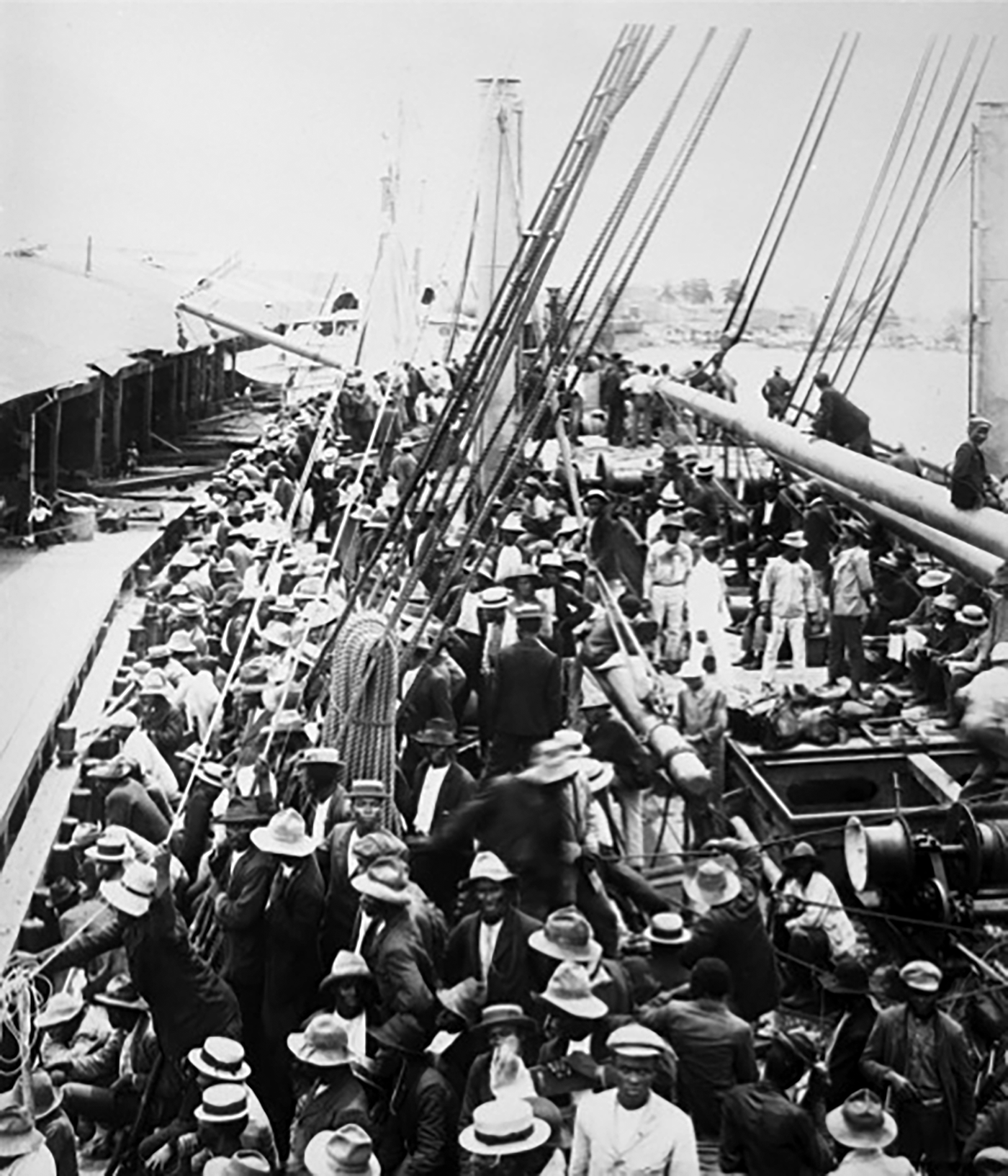
Canal officials ultimately brought laborers from dozens of different countries. Thousands came from the United States, northern and southern Europe, and India. For the bulk of the labor, Chief Engineer John Stevens fervently desired to recruit Chinese laborers; when this was finally, firmly, denied, Stevens promptly resigned. His successor George Washington Goethals turned instead to Caribbean workers of African descent. They had been recruited during the previous French effort to build an Isthmian canal. Most came from Jamaica and Barbados, but many also from smaller islands such as Antigua, Grenada, and Martinique; most were men but women gradually played a key role as well. Between 150,000 and 200,000 Caribbeans migrated to the Isthmus of Panama during the construction decade, originally performing the so-called unskilled labor of digging the canal, but increasingly they were trained to do skilled labor as well, working as helpers to machinists, carpenters, and blacksmiths. To manage a labor force that grew as large as 45,000 at a time, the United States employed a system of racial and ethnic segregation, known as the silver and gold rolls. The system was challenged in diverse ways by workers. I have written extensively about the segregation system elsewhere. For here, it is important to note how thoroughly racialized life and work in the Canal Zone truly was, and that segregation was important for managing labor.Footnote 10
Barbadians arrive in Panama, National Archives.
Managing mobility was also critical for making workers fully productive. Taking workers from their homes, bringing them to the Isthmus, deporting them—or threatening to deport them—if they were unproductive became central. And when officials began to despair that Caribbeans would not work hard enough, their approach was to generate yet more mobility, by recruiting another group of workers. Beginning in 1907–08, the U.S. government imported thousands of Spaniards, Greeks, and Italians, hoping they would push the Afro-Caribbeans to work harder.
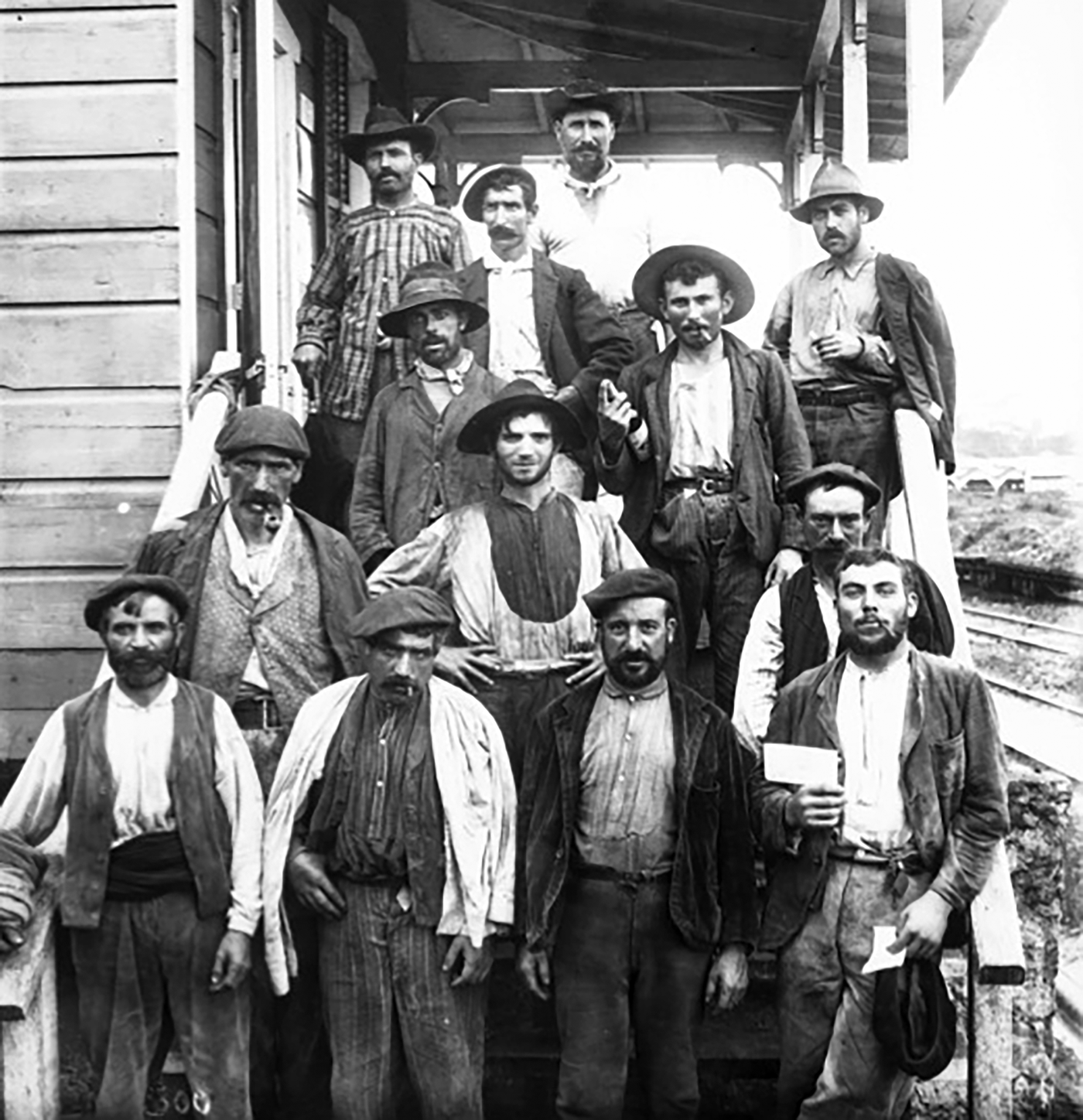
This only created new labor discipline challenges for officials. The southern Europeans—particularly the Spaniards—rioted, went on strike, and created a lively anarchist movement. Yet the imperial and racially charged setting profoundly shaped Spanish and Italian anarchism in the Canal Zone. Their movement targeted not only the U.S. officials for oppressing laborers; anarchists also aimed their rage at the Afro-Caribbeans around them. While historically, anarchist movements have tended toward international and interracial solidarities, in the Canal Zone the anarchist Spaniards expressed great anger at the Afro-Caribbeans who were competing with them for jobs, and forcing them, as one put it, “to go about the Isthmus begging.”Footnote 11
Spaniards in Las Cascadas, Panama Canal Zone, National Archives.
The vast Caribbean migrations to and beyond the Panama Canal Zone allow us to explore these dynamics of mobility, class, and empire. In 1963 the Isthmian Historical Society conducted a competition for the “Best True Stories of Life and Work on the Isthmus of Panama During the Construction of the Panama Canal.” The competition was advertised in newspapers across the Caribbean, in Panama and the Canal Zone, and in food packages given to disability relief recipients. The competition promised prizes to the best three entries: $50, $30, and $20 respectively. More than 100 canal workers submitted brief memoirs to the competition. Most were handwritten; men rather than women sent in all but one of them. These short testimonies, a few pages each, provide one of the best sources that exists today on the thinking and experiences of Caribbean canal workers. Although the workers were describing events 50 years earlier, many of them struggling with failing eyesight and arthritic hands, they wrote vividly. They expressed pride and some astonishment at the work they had done decades earlier as young men, most fresh off the boats from Barbados, Jamaica, Grenada, or Antigua. They told stories of leaving their island homes, of working hard as diggers or dynamiters or blacksmith helpers. They spoke of premature dynamite explosions, avalanches, and train accidents. Much to the chagrin of Panamanians, this key primary source is now held in Box 25 of the Panama Canal Zone Library-Museum Collection at the Library of Congress in Washington DC.Footnote 12
These hundred or so workers formed a small part of the tidal wave of Caribbeans heading to the Panama Canal Zone in the early 20th century to work on the construction project. From 1904 to 1914, 20,000 men signed labor contracts from Barbados alone; probably that number again, many of them women and children, traveled to the Canal Zone from Barbados without contracts. Typically they were leaving impoverished lives as sugar cane workers, becoming global travelers in hopes of economic mobility and new experiences working on the Yankees’ canal. Many of the men who submitted testimonies to the competition originated in Barbados, Jamaica, or smaller islands, while others had been born in Panama to Caribbean families that had been lured to the Isthmus during the French construction effort in the 1880s.
Box 25 includes the memoir of George Martin of Barbados, the second prize winner, who came to the Canal Zone at the age of eighteen. It was, he said, “like a new world.” His was a relatively cheerful testimony, surely framed to please the Americans conducting the competition, yet he nonetheless noted challenges workers faced due to weather, disease, and industrial accidents. In 1909 and 1910, he said, we “worked in the rain as if it were sun. … We had a white boss whose name were Atkins, a young looking fellow at the time, the rain beat him, it turned us colored people almost white, but our boss, it brought him like white Calico, I mean white. …” They tolerated the rain, but feared malaria. He described watching a gang of men approach him one day, then two fell to the ground shaking: “in those days, you watch men shake, gentlemen, you think they would shake to pieces. …” In this case, one of the men was dead before help arrived. Or as Albert Peters, a migrant from the Bahamas, put it: “If you had a friend that you always see and missed him for a week or two, don't wonder, he's either in the hospital or at Monkey Hill [the cemetery], resting in piece.”Footnote 13
When I was researching my book on the construction project, The Canal Builders, the words of Constantine Parkinson's competition entry leaped off the page to me. The son of a Jamaican immigrant who had worked on the French canal effort in the 1880s, Parkinson was born in a little town on the Atlantic coast of Panama, with mango and coconut trees around him. As a 9-year-old, Parkinson watched when the U.S. government officials arrived, having acquired permanent and complete control over the Panama Canal Zone, and began building coastal fortifications and military forts that would soon erase his hometown altogether. Parkinson started work as a flagman on a survey gang for the U.S. government at the age of 15, but like most workers he changed jobs when he could to improve his pay and working conditions. He soon became a water boy, and then gradually worked his way up to become a brakeman for the Panama Railroad. He described many challenges and dangers in his work—drinking quinine to prevent malaria, confronting snakes, watching a landslide swallow a score of European workers, or seeing a premature dynamite explosion send flesh flying in the air—and then ended his testimony by telling the tale of the railroad accident that took his right leg. He had attempted to climb aboard a fast-moving train, slipped, and fell under the train. The horse-pulled ambulance rushed Parkinson to Colón Hospital where doctors amputated one leg and part of his other foot. Undoubtedly Parkinson was lucky to survive the accident. He vividly recalled his awakening post-surgery: “after coming out of the operation in the ward I notice all kinds of cripples around my bed without arms foot one eye telling me to cheer up not to fret we all good soldiers.” After his release Parkinson used crutches for a year until the government was able to provide an artificial leg: “It was a big day for me returning home, as many said I would not live.”Footnote 14
The migrations of men such as Parkinson, Peters, and Martin resulted both from the U.S. government's decision that local, Panamanian laborers would not serve their needs for the construction project, as well as Caribbean men's own strategic decision to make the journey. These twin sets of decisions, in turn, exerted a huge influence on the Americas, operating like a tidal wave of migratory transformation that not only made Caribbean cultures and life strategies central to societies of Central America like Panama and Costa Rica; they also provided the catalyst that brought tens of thousands of Caribbean men and women to the United States. Globetrotting Caribbean Americans, one of the most literate migrant groups in history, flush with their experiences laboring amidst two different empires, became participants and leaders in U.S. labor activism, radical politics, and culture. Over the course of the twentieth century, the Caribbean immigrant stream played a central role in remaking the African American experience. Many other Caribbean laborers returned to their island homes after working on the canal project, migrated onward to plantations across the Americas, or remained working for the United States and living in Panama.Footnote 15
The testimonies in Box 25 provide an evocative window into workers’ experiences; they have been used by many historians over the last decades. They bring alive for us the world of labor on the canal, yet they tend to stress only certain aspects—particularly the most dramatic accidents and hardships. I wondered, who were these men? Were they representative of the broader Caribbean diaspora? Could they illuminate for us the world of Caribbean migrants, and could I liberate them from the confines of Box 25 to see what their lives were like before and after the experiences they described so powerfully? With such questions in mind, I headed to the National Personnel Records Center in St. Louis (a branch of the National Archives) in the summer and autumn of 2014 to try and discover more about Constantine Parkinson, George Martin, and the others. There I found the personnel records of thousands of canal employees, including those for many of the men in Box 25. These records opened up the world of canal laborers in numerous ways. Working with graduate assistants at the University of Maryland and with the Maryland Institute for Technology in the Humanities, we have digitized and analyzed information from the personnel records for several hundred canal workers. The files allow us to trace canal employees’ shifting occupations over the years; their troubles with the U.S. government; their search for loved ones who had migrated onward and lost touch; their disagreements with family members; and as the decades wore on, their struggles with disability, old age, and death.
The personnel records taught me more, for example, about Constantine Parkinson. One document among the hundreds in Parkinson's personnel record, the Application for Photo Metal Check created in 1918, included a photograph of this man I had spent much time thinking about. He stared up out of the document, holding a large number in front of him, almost as a convict might. Black man, it said; able to read and write; bald. Employed as watchman at Cristobal Dock at $1.10 per day. Physical deformities or peculiarities? “Lost right leg.” Parkinson's story unfolded in the pages that followed. After the amputation of his leg Parkinson recuperated for two years but then, remarkably, he spent another forty-two years working for the U.S. government on the Panama Canal. He labored as a telephone attendant, issuer of tools, and then finally, for most of those decades, as a watchman in the customs department. The file documented not only his decades of work for the Canal, but also that he regularly petitioned the U.S. government, sometimes relentlessly and usually successfully, for a new artificial leg as medical technologies improved. In 1957, after Parkinson had worked forty-eight years for the canal, officials slated him for retirement. His AFSCME union representatives asked that Parkinson's retirement be delayed as a reward for his years of work with the union. The Canal Zone governor demurred: “I regret very much the necessity of removing any of our older employees from the rolls; however there comes a time when each of us must leave active employment and retire.” Upon Parkinson's retirement, the Star and Herald published a brief notice about his work for canal government. He had often been called upon to serve as interpreter for customs or police, he was credited with inventing a new checking system for employees that “reduced disturbances among the men,” and he was a long-time shop steward for the AFSCME's Local 900. The newspaper also noted his many contributions to Canal Zone community programs over the years. Parkinson received modest disability pay from the Canal Zone government and lived thirty more years after his retirement, finally passing away in 1989.Footnote 16
As I examined personnel files for other silver roll workers, I focused in particular on the Applications for Photo Metal Checks from 1918. Each of those documents reduced silver roll employees’ lives to occupation, color, place of birth, and a listing of their physical deformities or peculiarities. Douglas Mitchell of Obeah, Martinique, black, scar over left eye; James Mitchell of Grenada, black, small scars on first finger of left hand; Fitz Thomas of Barbados, black, upper row of teeth missing; John Butcher of Barbados, missing joint second finger left hand; Cedric Milne, brown, of Jamaica, scar on back of left hand; Handel Carr, black, of St. Vincent, mole over left eye. Such fragments of information reflect the dangers of work on the canal or plantation labor on their home islands, as well as the physical toll their working-class lives involved. For the Canal Zone bureaucrats, the notations served a different purpose, helping to mark and permanently identify employees that officials found difficult to tell apart from one another—especially since those employees deployed mobility repeatedly and regularly to suit their needs, changing jobs, homes, even their names, more rapidly than the bureaucracy could handle. Indeed, that was the very point: Caribbean employees relied on their own mobility as a way to evade the government's eye of surveillance and to improve their pay and working conditions. Other pages in the personnel files attempted—often futilely—to track and register that remarkable mobility.Footnote 17
Application for Photo-Metal Check, National Personnel Records Center.
The Panama Canal is a particularly dramatic example, but it is important to keep in mind that managing and disciplining labor, and managing movement, was important always and everywhere in the new—formal and informal—empire of the United States. For soldiers occupying the Philippines or Haiti, or managing the labor of road builders in Cuba or Puerto Rico; for officials of UFCO managing their laborers in Costa Rica, Honduras, or Panama; for U.S. citizen nurses who traveled from the Philippines to Hawaii and onward to the Panama Canal Zone; for Caribbean or Filipino women who worked as laundresses, domestic servants, or on plantations; for the “Big Five” sugar growers managing Japanese, Filipino, and Puerto Rican laborers in Hawaii: in all these cases mobility, alienation, vulnerability, and ease of deportation were central to U.S. global power.
All this is, we might say, the history of empire from the perspective of those who built it. Along the way, the travels and travails have significance for the way we think about the United States in the world. The vastness of the movement and circuitry not only made possible the building of empire, it also generated a globetrotting, cosmopolitan worldview among the hundreds of thousands—perhaps millions—of migrants. It suggests the need for a more global perspective on the making of the U.S. working class. How did the experiences of Caribbeans or U.S. white or black citizens in U.S. territories, for example, experience their class identity? How did they interact with other identities? Did empire itself, as well as race or gender, serve as a vehicle through which they experienced their class, thereby shaping the degree to which they did or did not feel class solidarity with others? How did these various elements shape their lives, particularly in a context of rapid and long-term mobility? Mobility clearly shaped experiences, identities, interrelationships, and ongoing processes of migration. But scholars are just beginning to understand how.
These dynamics emerge clearly in the life of canal worker Constantine Parkinson. As someone who lived and moved amidst various empires and governmental regimes, even despite the tragedy that took his leg, Parkinson strategically used occupational mobility and careful negotiations with the U.S. government to improve his life. Class, race, and empire intertwined to shape the world that he navigated. In Parkinson's case the expansionist character of the United States led him into and between empires and people of various nationalities, races, and ethnicities. Thus we should reject the notion that the only way empire impacted the working class was to harden and rigidify the racial outlook of white U.S. workers. Empire and class interacted in complex ways for the many workers of color pulled into the orbit of the United States as well.
Another effort began in the 1960s to capture the experiences of workers who helped build U.S. Empire—but this time it was military personnel. The United States Army Heritage and Education Center in Carlisle, Pennsylvania, began surveying veterans of the War of 1898 and the Philippine-American War that followed quickly after it. Archivists sent surveys to thousands of military veterans and received numerous responses. In addition, many veterans also sent letters, diaries, and artifacts—sometimes a pair of old boots, a cartridge bag, or a souvenir from Cuba or the Philippines—from their wartime experiences. These men were now aged, some unable to see, so many asked a daughter or son (usually the former) to write for them. Edward Dunbar, who served in the California Volunteer Infantry, had his daughter write for him. She sent his answers to the survey, a typed copy of his letters from the war that they had recently discovered, “and tin of beef he had kept for the seventy years since. Regarding the latter she noted “a few misgivings”: “Several years back it enveloped a leak. For a time, we were not even sure but what it might explode. However, … it may be that the can will remain intact.”Footnote 18 We can imagine the archivists’ joy upon receiving a seventy-year-old tin of leaking meat.
Reading the veterans’ letters and survey responses, I was struck by the sense of history that flowed across their twentieth century. Like the canal workers whose memoirs now rest in Box 25 at the Library of Congress, the military veterans were nearing the end of their lives and looking back across the decades to a very different time, assessing their own contributions to building United States global power. They wrote at a time when the role of the United States in the world was being hotly debated around them and involvement in the Vietnam War rapidly escalating. Many struggled to make sense of how their experiences compared to those of contemporary military personnel. We served proudly, they would comment, unlike these draft dodgers around us now. What has happened to the America we loved and served?
The U.S. Army grew from a small force of only 25,000 men during the Gilded Age (smaller than Mexico's army at the time, for example), then ballooned rapidly to 61,000 enlisted men and 200,000 volunteers upon the declaration of war in 1898. The military served as an option particularly for working-class men from rural or urban backgrounds; laborer and farmer were the most common occupations listed until well into the twentieth century.Footnote 19 The veterans’ diaries and letters held at the U.S. Army Heritage and Education Center help us map the experiences of soldiers as U.S. expansionism globalized in 1898 and beyond. The documents are especially useful for understanding the perspective of white soldiers (almost none of the respondents were African American). They suggest the complex impact that military service, empire, and mobility exerted on white working-class men. As the military engaged in war against Spain, facing the enemy in Cuba, Puerto Rico, and the Philippines, and then as the war shifted to one against Filipinos seeking independence, soldiers recounted the challenges they faced while they trained, engaged in tedious labors in camp, or conducted the work of conquest and killing. Most of the young men who responded to the Carlisle surveys were themselves on the move in the spring of 1898—looking for work, training to become a blacksmith or carpenter, seeking their fortunes in life—when they learned the USS Maine had exploded. The sense of crisis and patriotism the explosion unleashed led them to enlist or volunteer for the military. Edward Dunbar was one such man. A native of California, Dunbar was looking for a mining job when he learned of the Maine's explosion. He headed to San Francisco to volunteer, heeding advice from a family friend who said avoid the regulars because “they treated a man like a dog.” Once on board the ship and headed to the Philippines, Dunbar remembered decades later, “It was like a great holiday.” He and many other soldiers recalled their excitement upon heading off to see the world, visiting Hawaii, seeing sights such as Iolani Palace, and then finally reaching Manila.Footnote 20
Upon reaching the Philippines, or Cuba or Puerto Rico, most soldiers had a rude awakening. A harsh labor regime, strict military discipline, and the trauma of war awaited them. One soldier wrote home to Kankakee, Illinois, from Puerto Rico: “I am tired of living in an uncivilized locality, with no chance to move off the little anthill we are encamped on, with nothing to eat but sour bread (successor to mouldy hardtack) and black coffee, and nothing to do but hustle with a pick, shovel and ax, cutting out stump and roots and digging ditches to drain the camp.” Dinner last night consisted of two small potatoes, he said, and nearly everyone has been sick and in the hospital at some point. Another son of Kankakee wrote that the entire camp was one large mud puddle: “The men spread their ponchos on the damp ground and curl themselves up in their blankets when they wish to sleep. This cannot fail to be productive of malaria and kidney troubles …”Footnote 21 Soldiers frequently commented on unfair privileges given to officers and the poor leadership manifested by the latter. They also experienced the harsh cost of questioning their superiors. When Edward Dunbar didn't receive some woolen cloth as other soldiers had, he became angry and told his superior “where he could put his cloth.” “I had not quite got used to being spoken to like a dog by the high and mighty beings called non-commissioned officers, so when I flew off the handle I got the worst of it.” His challenge to superiors won him an afternoon sweltering in a tiny guardhouse tent with twenty-four other men.Footnote 22
The work of warfare and occupation generated violent forms of racialization, while the rapidly changing military goals of the United States' “movable empire” and the violence of warfare confused many soldiers. Several, especially volunteer soldiers, wrote of feeling bewildered by the way a war against the corrupt Spanish Empire had turned into a war against Filipinos: “Many of the volunteers are not in sympathy with this war, and having volunteered for another, which is ended, feel that they should not be held for service in this one.” As the enemy changed from a Spaniard to a Filipino, shooting at him was compared more often to hunting rabbits or deer back home in Kansas or California; just as common, Filipinos became “niggers” in white soldiers’ lexicon. Men sometimes juxtaposed their work of killing alongside their descriptions of leisure and entertainment in a way that can be jarring to readers. George Haworth of Iowa wrote the following to his grandmother: “We kill a nigger pretty near every night on the out posts. We have a pretty good time here as Buddy has his banjo and I have my mandolin and there is a piano across the street so we pass away our time that way.”Footnote 23
Yet there could be no avoiding the brutality of war. One description of a typical skirmish on Samar noted the key strategy of setting fire to Filipino huts, then shooting and killing those—including women and children—who fled the inferno. A general confessed to fearing the impact that warfare was exerting on U.S. soldiers: “The episode both unsettles and hardens the troops who see evidence that non-combatants harbored and aided the enemy. Word spreads among the villagers and the outlying farms that the Americans have killed two women, or two unarmed young men. Some of the Filipinos, embittered or not, decide now that they must come to the American side, resistance is futile.” Some soldiers responded by deserting; most simply described to loved ones at home the shock and trauma they felt from their work killing. George Buchanan, an infantry soldier from Kansas, was surely not the only soldier noting thusly to family: “Old Brother Sherman was a wise guy when he remarked that war was hell.” He continued, “I've heard the whiz of the Remingtons and the ‘ping’ of the Mausers around my head till I've come to the conclusion that the finest thing on earth is peace and the best body of men are peace commissioners. I've shot my old gun at the place where I thought the insurgents were, I've stood in water to my waist and kept up fighting. I've been scared most to death, slept in wet duty clothes, lived on hard tack, hugged the ground, begged for water, and a thousand other things that all go to make war hell.”Footnote 24
White soldiers like those discussed here learned lessons of brutality, violence, and racism. Like Caribbean canal workers, they became more cosmopolitan, but they also became more skilled at using power to dominate and control others. Yet even for them the new mobility of empire involved a complex, multilayered legacy. For many men, military service created an opportunity for social or economic mobility. Ed Dunbar was seeking mining work when the USS Maine exploded; after serving in the War of 1898 and in the Philippine-American War, he managed to attend dental school and become a dentist. David Kennybrook grew up in the impoverished household of an Alabama steelworker; his daughter described how the military changed him: “Dad went into the army an illiterate boy of 17 years and came out of the army with proof of his manhood, with a broader vision of the world and of life, and with an amazing power of speech … he bears to this day the stamp of the courtly manner, the attitudes, and the sophisticated vocabulary of those men with whom he was associated in such a special way under such specifically trying condition.” Kennybrook worked after the war as an investigator for railroads and coal companies.Footnote 25
The stories of working-class men from different parts of the world, men like Constantine Parkinson who journeyed to the Panama Canal, or Ed Dunbar who helped build U.S. colonialism in the Philippines, cannot fully capture the interconnections between labor and migration in the making of U.S. global power during the Gilded Age and Progressive Era. But they suggest a few of the complexities involved. Migration was an essential strategy in the building of U.S. Empire. Officials saw recruiting and moving laborers from far away as necessary to ensure productivity and discipline. This required U.S. government and corporate leaders to experiment with labor management in ways that shaped the “long twentieth century” of U.S. history. Furthermore, as the United States expanded and acquired a larger and more global empire, a new working class emerged as well. This new working class moved in and out of the orbit of U.S. expansionism, as workers deployed mobility in their own ways and for their own reasons. It was not a united working class by any means—indeed, as the processes of expansionism and corporate capitalism exerted themselves and generated diverse reactions by diverse people, they created new tensions more often than new solidarities. Yet certain qualities were shared by all of the hundreds of thousands of workers from across the Americas and the Pacific who were pulled into the territories of the global United States: mobility and migration would be central to their lives, often bringing as well new kinds of vulnerability and alienation. At the same time, their travels made this new working class more worldly and cosmopolitan, and workers added new skills to their personal toolkits. Imperial migrations not only made U.S. global power possible, along the way they remade the broad outlines of U.S. labor, race, and immigration history during the Gilded Age and Progressive Era.