Introduction
The risk of falling among elderly community-dwelling people is a common problem, and one which can have very serious consequences in terms of both injuries and trauma, leading to reduced quality of life and increased medical care costs (Chang et al., Reference Chang2010). Indeed, it is estimated that approximately 30% of all persons over the age of 65 years living in the community will experience at least one fall during any given year (Rubenstein et al., Reference Rubenstein and Josephson2002; Ganz et al., Reference Ganz, Higashi and Rubenstein2005). Studies carried out in Asian countries suggest that out of every 100 elderly people, approximately 15 to 30 will experience injurious falls each year (Kwan et al., Reference Kwan, Close, Wong and Lord2011). In Taiwan in particular, annual incidences of falls have been reported among approximately 15% of all elderly people, with about 60%–70% of these incidents resulting in injuries (Lin et al., Reference Lin, Tsai, Chen and Tzeng2002; Huang et al., Reference Huang, Chen and Chou2005).
Numerous risk factors have been identified as having an association with falls among elderly community dwellers, with personal characteristics, such as increasing age, female gender, lower education levels, and single-person households, being shown to have associations with a higher risk of falling, as well as mortality attributable to falls (Lin et al., Reference Lin, Tsai, Chen and Tzeng2002; Reference Lin and Wang2004; Chin et al., Reference Chin, Lu and Wu2008).
Chronic medical conditions involving visual disorders, hypertension, diabetes, cardiovascular diseases, arthritis, and multiple medication usage have been shown to increase the risk of falling among elderly people (Chang et al., Reference Chang2011; Kwan et al., Reference Kwan, Close, Wong and Lord2011), while psychological concerns, including the fear of falling, depressive status, and impaired cognition have also been shown to be factors associated with the risk of falling among the elderly (Delbaere et al., Reference Delbaere2010). Furthermore, numerous prior studies have reported that depression is a predictor of adverse fall events in elderly healthcare patients residing in geriatric clinic units, with a strong association having been demonstrated between postural abnormality and the predisposition for falling (Turcu et al., Reference Turcu, Toubin, Mourey, D'Athis, Manckoundia and Pfitzenmeyer2004; Byers et al., Reference Byers, Sheeran, Mlodzianowski, Meyers, Nassisi and Bruce2008).
Depression, which is a common factor increasing the risk of falling among the elderly (Kose et al., Reference Kose, Cuvalci, Ekici, Otman and Karakaya2005), may also be an indicator of increasing physical frailty and generally worsening health status (Gruber-Baldini et al., Reference Gruber-Baldini, Zimmerman, Boustani, Watson, Williams and Reed2005). Poorer mental heath is also reported to have an association with poorer physical functioning among elderly people living in the community (Garber et al., Reference Garber, Greaney, Riebe, Nigg, Burbank and Clark2010). Not only is depression found to have direct influences on fall incidents, but apparently it also modulates other factors impacting on the risk of falling, such as physical or mental status.
Within the literature, there are few studies that focus on the evaluation of the impact of the combined effects of psychological and physiological factors on the risk of falling. The purpose of the present study was to assess the combined effects of depression (in terms of modulating chronic conditions) and current medication status on the risk of falling among elderly community dwellers.
Methods
Participants
Our study sample of elderly community-dwelling residents (aged 65 years or over) was collected from the NeiHu district of Taipei City, with those unable to walk independently being excluded from the sample. Furthermore, all cases involving falls attributable to strokes, traffic accidents or loss of consciousness were also excluded. A total of 360 participants were recruited from the activity centers, sport centers, and health centers in the 39 villages of the Neihu district, where they were subsequently asked to complete a questionnaire. Our investigation comprised interview-based research, with trained research assistants helping to explain the questions and recording the responses. Surveys were also completed during the interview, with physical measurements of height and weight also being gathered.
Approval for this study was provided by the Institute Review Board of the Tri-Service General Hospital, National Defense Medical Center (Approval No: 097-05-065). Prior to completing the questionnaire, the participants were informed of the study content and given the opportunity to decline to participate.
Fall history
As in some of the prior studies, an experience of a fall was defined in the present study as “an unexpected event in which the person comes to rest on the ground, floor or lower level” (Delbaere et al., Reference Delbaere2010). Based on face-to-face interviews, the participants were asked to relate their experiences of falls over the previous one-year period in detail to avoid the recall bias, including the frequency of falls, the location of each fall, their activities at the time of such falls, their physical status at that time, and whether any fall resulted in an injurious incident requiring medical assistance. Standard scenarios were presented by trained interviewers to remind the participants of their fall experience such as the location of each fall indoors (with 10 preset scenarios) or outdoors (11 preset scenarios), their activity at the time of such falls (12 preset activities for indoors and 10 activities for outdoors). The participants could select from a predetermined list of ten types of injuries and eight injured parts of the body and asked the relevant details of the environment about the incident, including eight preset items for indoors and six items for outdoors.
In this study, any participant with two or more falls, or with at least one injurious fall, was defined as a “faller,” while all others with a single fall or no falls were defined as “non-fallers.”
Variables associated with falls
The related factors that are commonly associated with falls among the elderly include fear of falling, measured by a single question of “do you fear having a fall?” (yes/no) (Tinetti et al., Reference Tinetti, Richman and Powell1990) in this study, and the personal demographic variables of age, gender, household type, educational level, and economic status. Household type was based on whether they lived with a spouse or not and categorized as alone or as a couple. Education level was recorded as their highest educational status (illiterate, primary school, high school or college/above) and then categorized as high school or less versus college or above. Economic status was based on their major income sources and whether they had a sufficient income or needed an overdraft. As regards the medical condition variables, the participants were asked about their overall medical history in terms of the state of their health, referring to issues such as whether they had ever been diagnosed with systemic chronic diseases, including any visual disorder, cardiovascular disease, neural disease, hypertension, diabetes or arthritis, all of which are widely reported to have some correlation with the risk of falling among the elderly (Chin et al., Reference Chin, Lu and Wu2008; Chang et al., Reference Chang2011; Kwan et al., Reference Kwan, Close, Wong and Lord2011).
Questions on the use of ancillary walking devices or hearing aids, as well as the total amount of different types of medication, were also included within the structured questionnaire. This consisted of multiple choices from seven categories of medications: antihypertensive medicine, antidiabetic medicine, cardiovascular medicine, analgesic drugs, hypnotic sedative medicine, antidepressants, and antipsychotic medicine which in general will affect postural stability. Those who were taking four drugs or more (≥4) were categorized as multimedication users, and thus, in line with the findings of Lin and Wang (Reference Lin and Wang2004), were regarded as having a higher risk of falling.
Measurement of depression and cognitive function
The short (15-question) version of the Chinese-translated Geriatric Depression Scale (GDS-15) was used to assess the mood of elderly people (Liu et al., Reference Liu1997). The scores ranged from 0 to 15, with a score of 4/5 being the cut-off point for the categorization of “depressed symptom” (“yes” or “no”). Cognitive performance was investigated using the Mini-Mental State Examination (MMSE), which includes 11 items, giving a maximum score of 30 to assess cognitive function of elderly (Folstein et al., Reference Folstein, Folstein and McHugh1975). The measured scores were categorized as “normal” or “abnormal,” which were adjusted by educational level (Yu et al., Reference Yu1989). The cut-off point was set at 17/18 for the illiterate, 21/22 for those with primary school education, and 24/25 for those educated to at least high school level.
Statistical analysis
All analyses were conducted using PASW Statistics 18.0 software, with a χ2 test being used to assess the association between the categorical variables and depression status in the univariate model, and an independent t-test being used for comparison of the continuous variables by grouped data. The outcome variable relating to falls was defined as two or more falls, or one fall resulting in injury.
The logistic regression method was used for the overall analyses of fall risk in the multivariate model, with the aim of assessing the relationship between falls and the independent related factors comprising personal demographic data, medical conditions, and psychological conditions with depression status and cognitive functioning, with an odds ratio (OR) also being calculated with a 95% confidence interval.
In order to examine the combined effects on the risk of falling attributable to depression and each of the medical conditions, each medical condition were stratified on a depressive/non-depressive basis by using logistic regression to identify and compare the individual and combined odds on the risk of falling with personal variables, the other medical conditions, and cognitive function as covariates. Expected combined effects for the two indicators from an additive model are calculated as (ORmedical condition + ORdepression – 1), and from the multiplicative model calculated as (ORmedical condition * ORdepression) as previously described (Andersson et al., Reference Andersson, Alfredsson, Kallberg, Zdravkovic and Ahlbom2005; Chu et al., Reference Chu, Nie and Cole2011). Expected OR and observed OR (ORmedical condition and depression) of two indicators on fall risk were then compared to examine the existence of interaction effect. In all of the tests carried out in this study, a p-value of <0.05 was considered to be statistically significant.
Results
Sample description
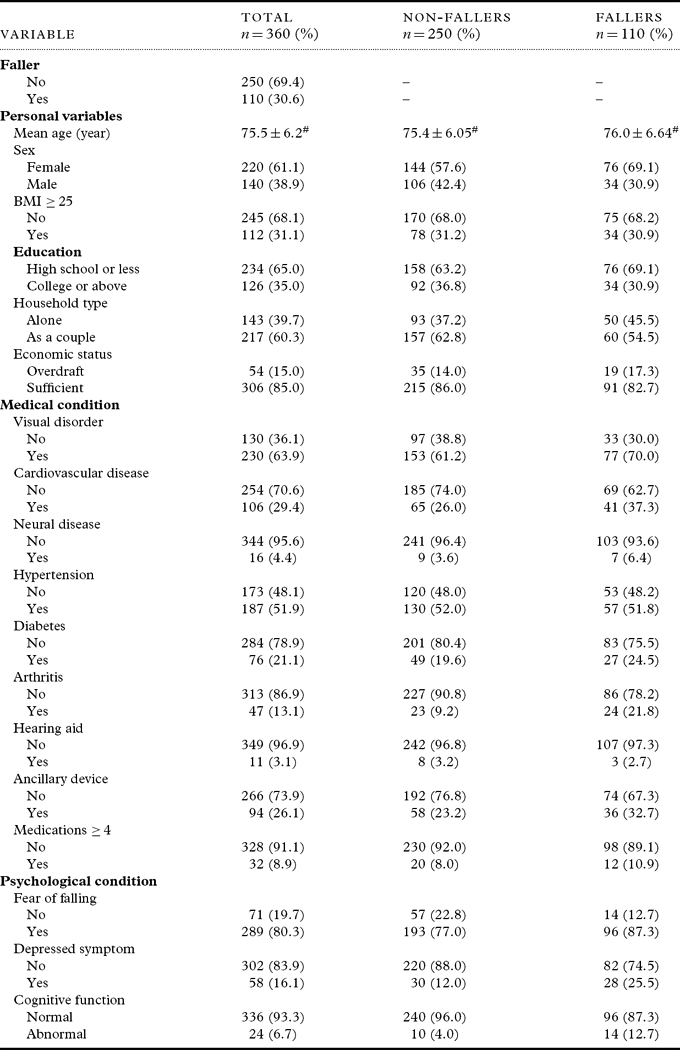
A total of 360 participants were recruited as the sample for this study, comprising 140 men and 220 women, with a mean age of 75.5 years (ranging between 64.2 and 90.7). As shown in Table 1, 112 of the participants (31.1%) had a “body mass index” (BMI) of ≥25, indicating that they were obese (WHO, BMI categories for Asia); most of the participants (65.0%) were educated only to high school level or less; 143 (39.7%) lived alone and the economic status of 54 (15.0%) showed that they survived on an overdraft.
Demographic characteristics of the elderly study sample
BMI = Body Mass Index; depression status was measured with GDS-15 scale; cognitive function was measured with Mini-Mental State Examination; # Mean ± SD. Faller defined as having at least two falls or one injurious fall during past year.
Of the total sample of 360 elderly participants, 110 (30.6%) had reported at least two falls during the previous year, or one fall resulting in injury. Of all of the medical conditions considered, more than half of all the participants were found to have visual disorders (64%) or hypertension (52%), while 29% had cardiovascular disease and 26% were using ancillary walking devices to aid their mobility in daily life. Approximately 20% of the participants had diabetes, 13% suffered from arthritis, and 8.9% were multiple medication users (≥4 types of medication), but only 4.4% of the participants had neural diseases, and just 3.1% were found to be in need of hearing aids. As regards the measurement of mental health, 58 of the 360 participants (16%) were defined as depressive cases, with GDS scores of ≥5, while 24 of the participants (6.7%) were categorized as having impaired cognitive function.
Variables associated with a history of falls among the elderly
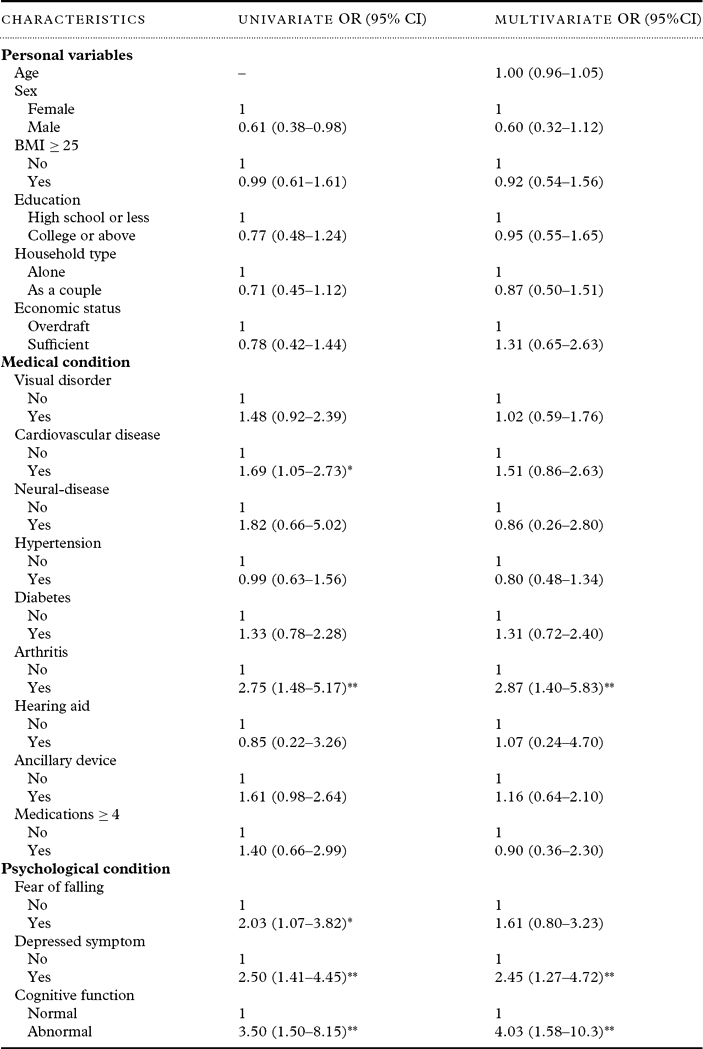
Based on the analysis of the measured variables on the history of falls shown in Table 2, the personal characteristic variables of the elders living within the community, comprising age, gender, BMI, education, household type, and economic status were not found to have any significance.
Characteristics associated with the risk of falling among the elderly
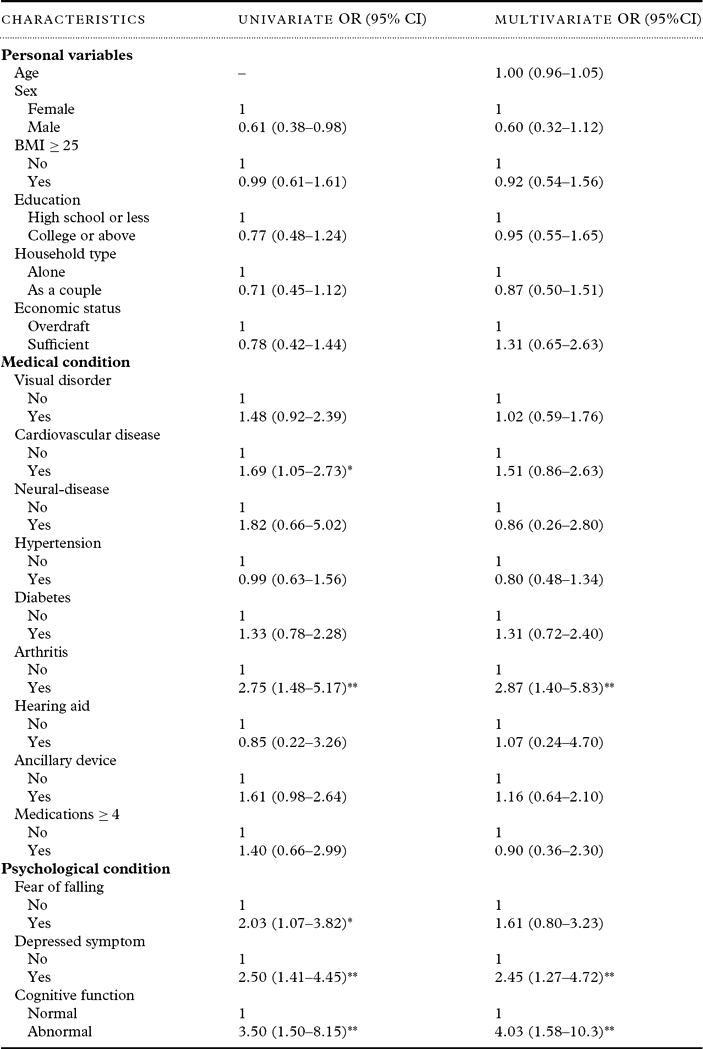
χ2 test was used to calculate fall risk in univariate model; logistic regression was used to calculate fall risk in multivariate model, * p < 0.05. ** p < 0.01.
As regards the assessment of the chronic medical condition variables on the risk of falling, based on univariate analysis using χ2 test, arthritis was found to be associated with odds of 2.75, and cardiovascular disease with odds of 1.69.
Based on the multivariate logistic regression model, arthritis, depression status, and cognitive function were all found to have significant associations with the risk of falling. The risk for those participants with depressive symptom (a GDS score of ≥5) was found to be 2.45 times that for the GDS <5 group, while the risk for participants of abnormal cognitive function was found to be 4.03 times that for a medium level association with the risk of falling.
Interactive effects of depression and medical condition variables
The multivariate analysis of logistic regression revealed that depression independently had significant association with the risk of falling among the elderly. In order to further examine the interactive effects between depression and medical conditions, we stratified the sample by depression so as to evaluate the synergistic effects on the risk of falling for the combined variables.
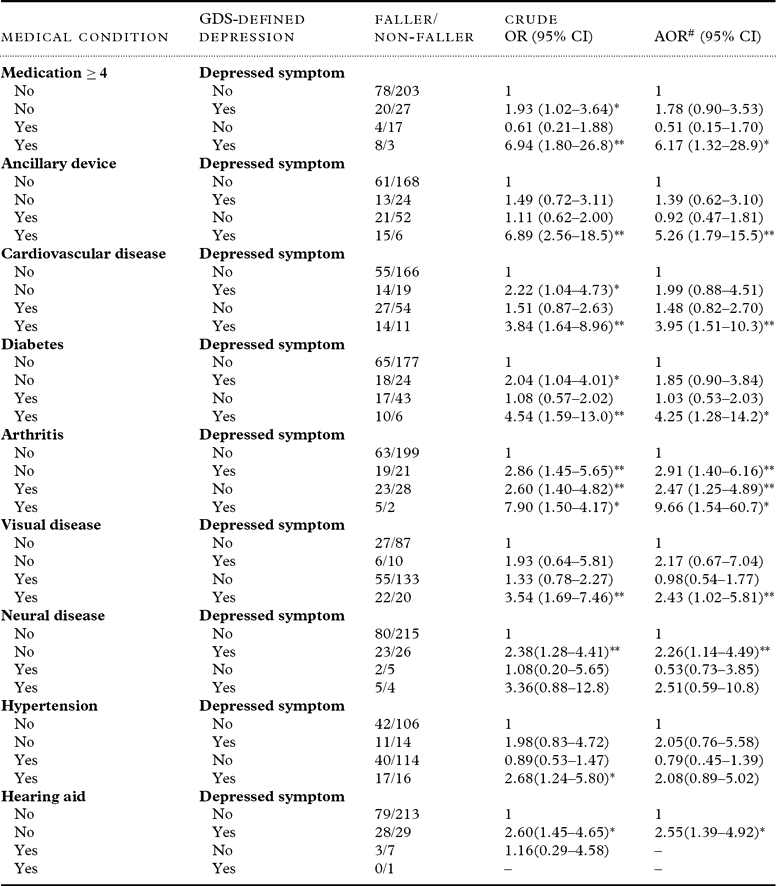
As shown in Table 3, the individual odds ratio on the risk of falling for multiple medication usage (≥4 types of medication) was found to be weak, with no significance, as compared to the reference group. The adjusted expected combined effects of depression and multiple medication usage in the adjusted logistic regression model were found to be 1.29 (0.51 + 1.78 – 1) under the additive model, and 0.91 (0.51 × 1.78) under the multiplicative model. The adjusted observed combined effects of the two variables, which showed an odds ratio of 6.17, thereby revealed a strong association with the risk of falling among the elderly. This clearly demonstrates the existence of interactive effects in those cases where the participants had depressive symptoms and multiple medication usage.
Combined effects of medical condition and depression status on the risk of falling among the elderly
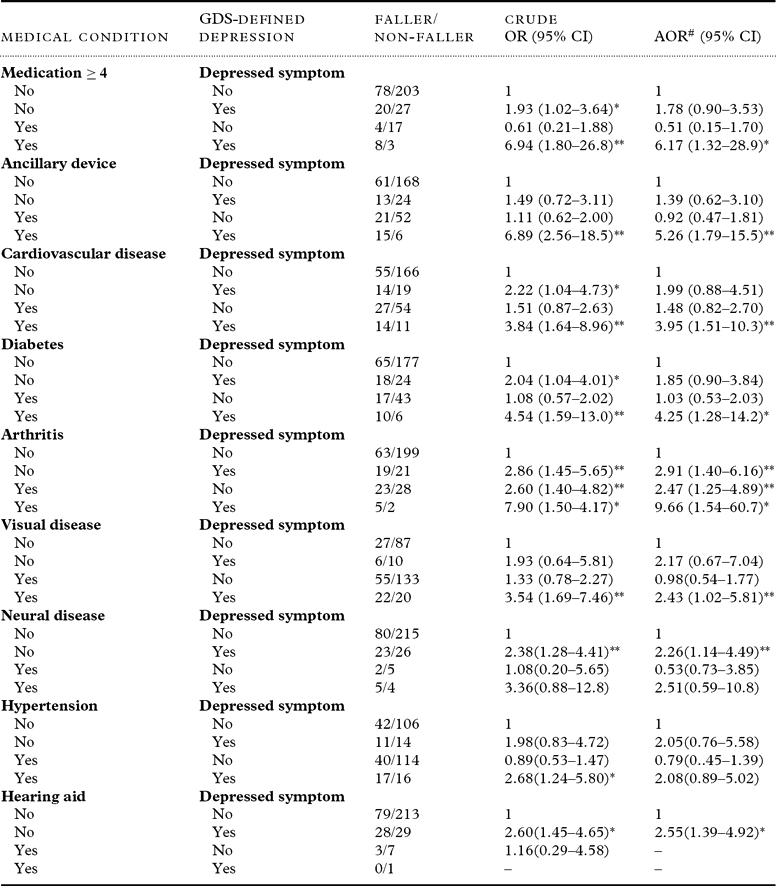
#Logistic regression with personal variables, medical conditions other than the combined predictor and cognitive function was used as covariates to calculate adjusted odds ratio (AOR), * p < 0.05, ** p < 0.01.
The interactive effects between depression status and the use of ancillary walking devices were subsequently analyzed using the same method. As compared to the reference group, the individual odds ratios of the two variables on the risk of falling among the elderly were 0.92 for depressive status, and 1.39 for ancillary walking devices. The expected combined effects of the two variables were found to be 1.31 (0.92 + 1.39 – 1) under the additive model, and 1.28 (0.92 × 1.39) under the multiplicative model. However, the adjusted observed combined effects of the two variables on the risk of falling incidents among the elderly were found to be 5.26 times higher, thereby demonstrating the presence of synergistic effects in those cases where the participants were defined as having both depressive symptoms and required the use of ancillary walking devices.
As regards the interactive effects between depression status and chronic diseases, the observed combined effects of depression and cardiovascular disease were found to be 3.95 times higher, as compared to those without either depressive status or cardiovascular disease, with the observed odds of the interactive effects being found to be much stronger than the summation of the individual effects of depression and the relevant chronic disease. Similar interactive effects on the risk of falling among the elderly were also discernible between depressive status and diabetes, or arthritis, with the respective observed synergistic effects being 4.25 and 9.66 higher than the reference group, and also higher than the summation of the two independent variable effects.
Discussion
Our results show that 110 of the 360 community-dwelling elderly participants (30.6%) had fallen at least twice during the previous one-year period, or had a single fall resulting in injury. Incidences of such falls are found to be largely in line with a similar domestic study on community-dwelling elderly in Taiwan (Chin et al., Reference Chin, Lu and Wu2008). Our study further reveals the existence of interactions between depression and chronic medical conditions on the risk of falling among the elderly. As compared to the absence of depressive symptoms, the presence of such symptoms combined with medical conditions of cardiovascular disease, diabetes, arthritis, and the use of multiple medications or ancillary walking devices was found to result in a four- to nine-fold increase in the risk of falling. Thus, depression is not just one independent risk factor for falling, but also an enhancing modifier on chronic conditions for falling in the elderly. Screening for depression could therefore be a useful strategy in the prevention of falls among the elderly with poor health.
A review of risk factors for falls among Chinese elderly, undertaken by Kwan et al. (Reference Kwan, Close, Wong and Lord2011), revealed that the odds of falls attributable to multiple medications were between 1.1 and 2.6, while those attributable to walking aids were between 0.6 and 2.8. In the present study, when depression is not taken into account, both multiple medications and the use of walking aids are found to have no significance on the risk of falling. This may be partly due to sample size, and the fact that the participants were selected from a community-dwelling population whose physical conditions are likely to have been healthier than those of the hospital-based samples examined in some of the earlier studies. No mention is made in the prior studies of the modifying role of depression status on the odds of falling among those with multiple medications or the use of ancillary walking devices, which we have found creates an exponential increase in the risk of falling, as shown in our stratification analysis.
Furthermore, we demonstrate the interactive effects among elderly people with depressive symptoms as well as those with chronic conditions involving cardiovascular disease, diabetes, or arthritis. Significant evidence is provided in earlier studies to show that depression is a modifiable cardiac risk factor and that it increases the risk of cardiac mortality (Penninx et al., Reference Penninx2001; Frasure-Smith et al., Reference Frasure-Smith and Lesperance2008). Depressive symptoms have also been reported to have a bidirectional association with Type-2 diabetes, which is partly explained by lifestyle and lack of exercise (Golden et al., Reference Golden2008; Pan et al., Reference Pan2010). In our results, depression was found to be a significant, interactive factor with cardiovascular disease and/or diabetes, giving rise to a synergistic increase in the risk of falling among the elderly. We find that depression plays a crucial role, as a modulator or enhancing factor for chronic diseases, in the risk of falling among the elderly.
In our results, depression was demonstrated to have a modification effect with some medical conditions on fall risks in the elderly. Taking into account the higher prevalence of depression among females, the association of economic status and household type with fall risk in other reports (Yu et al., Reference Yu2009, Kwan et al., Reference Kwan, Close, Wong and Lord2011), we also examined whether depression was a modifier with gender, economic status, and living alone on fall risk. Results showed that gender was significantly associated with fall only in the univariate analysis, but not in the adjusted model as shown in Table 2. Maybe the sample size was not adequate to detect the difference. Examination of the combined effects of gender and depression on falls showed female elders with depression had a higher fall risk (OR = 3.81) than males with depression (OR = 2.78) or females without depression (OR = 1.70). Nevertheless, there seems no obviously synergistic effect of gender and depression on fall risk in this study.
In the analysis of the combined effects of depression and economic status on fall risk, there was no obvious relationship, whereas depression and living alone showed an increased risk of falling of 3.1 which was higher than the sum (2.0 + 1.0 – 1.0 = 2.0) of two independent effects of depression (OR = 2.0) and living alone (OR = 1.0). In Tong's report, living alone was highly associated with depression in both elderly Hispanics and Chinese (Tong et al., Reference Tong, Lai, Zeng and Xu2011). The influences of living alone in late life may interact with depression and result in increasing combined effects on fall risk in our participants.
According to Tinetti and Speechley (Tinetti et al., Reference Tinetti and Speechley1989), two-thirds of all falls among elderly people are potentially preventable. In our analysis, depression is found to enhance the factors relating to the risk of falls. Depression apparently plays a key role in fall events among the elderly; thus, a strategy aimed at reducing depression among the elderly is seen as a practicable method of preventing falls among the elderly. Antidepressants have been reported to reduce fall risk (Kerse, et al., Reference Kerse2008), so a well-designed program of intervention to improve mental health should be considered.
Based on the multivariate logistic regression analysis, we were able to assess both the independent and interactive relationships between GDS-defined depressive status and the medical condition variables on the risk of falling among the elderly. As the results in Table 2 have shown, the three variables of arthritis, depression, and cognitive function were found to have a moderate association with the risk of falling. The results in Table 3 revealed moderate effects on the risk of falls between chronic conditions and depression. Those participants suffering from depression, who also suffered from cardiovascular disease, diabetes, arthritis, multiple medications (≥4) or used ancillary walking devices, were found to have a risk of falling which was four to nine times higher than that for participants with no apparent depressive symptoms and free of the correspondent chronic conditions, and also higher than the sum of the risks of the two independent variables. In the earlier studies examining the various issues covered in the present study, depression status among elderly people was not combined with chronic medical conditions; thus, the combined synergistic effects on the risk of falling may have been neglected. Our results reveal a vital link between depression and medical conditions in the evaluation of the risk of falls among the elderly which has not been mentioned before in other studies. From our experience, screening of elderly people in the community with depressive symptoms using the GDS-15 scale for groups with a high risk of falls is recommended.
Due to the design of this retrospective, cross-sectional study, we have been unable to establish any causal relationship consequences between depression status, medical conditions, and the risk of falls among the elderly. In addition, the participants were recruited from city area communities which may not appropriately represent other suburban or rural areas.
Conclusions
This study provides evidence of the existence of interactions between depression and chronic medical conditions on the risk of falling among the elderly. The presence of depressive symptoms combined with medical conditions of cardiovascular disease, diabetes, arthritis, the use of multiple medications or ancillary walking devices is found to produce a four- to nine-fold increase in the risk of falling. Screening of depression could therefore be a useful strategy in the prevention of falls among the elderly with poor health.
Conflict of interest
None.
Description of authors' roles
Senyeong Kao formulated the research questions and designed the study. Ya-Mei Tzeng and Chang-Kuo Liang conducted the data collection and analysis. Yun-Chang Wang helped to prepare the paper and the statistical design. Fu-Gong Lin analyzed the data and wrote the paper.
Acknowledgments
The authors gratefully acknowledge the financial support provided for this research by the National Science Council of the Executive Yuan, Republic of China, Taiwan (Grant No. NSC97-2314-B-016-035-MY3). The authors also gratefully acknowledge the contributions of the numerous colleagues who have participated in this study.