Introduction
The soybean aphid, Aphis glycines Matsumura (Homoptera: Aphididae), is an important pest in all soybean-growing regions (Wu et al. Reference Wu, Schenk-Hamlin, Zhan, Ragsdale and Heimpel2004; Liu and Zhao Reference Liu and Zhao2007). It can cause direct damage by sucking fluids from leaves (or stems) and indirect damage through the production of honeydew on which saprophytic fungi grow (Chen and Yu Reference Chen and Yu1988). Under suitable conditions, A. glycines population densities can quickly increase to very high levels. Damage from aphids can cause significant yield losses in outbreak years (Sun et al. Reference Sun, Liang and Zhao2000; Wang et al. Reference Wang, Deng, Yin, Song, Zhang and Shen2005). In addition, A. glycines can vector plant viruses, such as soybean mosaic (Burrows et al. Reference Burrows, Boerboom, Gaska and Grau2005), alfalfa mosaic, and tobacco ringspot viruses (Clark and Perry Reference Clark and Perry2002). It is a new vector of potato virus Y in potatoes (Davis et al. Reference Davis, Radcliffe and Ragsdale2005). After this pest invaded North America in 2000, it introduced potential economic threats to local soybean production (Losey et al. Reference Losey, Waldron, Hoebeke, Macomber and Scott2002).
In China, A. glycines is only a sporadic pest and rarely reaches pest status. Insecticide applications are infrequently used for its control, and those only during short lived outbreaks (Sun et al. Reference Sun, Liang and Zhao2000; Wang et al. Reference Wang, Deng, Yin, Song, Zhang and Shen2005). One of the possible reasons for its limited damage is that there are numerous natural enemies that maintain soybean aphid populations at low densities. Some species of predators, including Metasyrphus corollae (Fabricius), Paragus quadrifasciatus Meigen, Episyrphus balteatus (De Geer), Ischyrosyrphus laternarius (Müller), Scaeva pyrastri (Linnaeus), and Sphaerophoria scripta (Linnaeus) (Diptera: Syrphidae) (Gao Reference Gao1991; Xue et al. Reference Xue, Gao and Wang2000), and a parasitoid Lysiphlebia japonica (Ashmead) (Hymenoptera: Braconidae) (Gao Reference Gao1994) were found in Tonghua, China. Propylaea japonica (Thunberg), Harmonia axyridis (Pallas), and Coccinella septempunctata Linnaeus (Coleoptera: Coccinellidae) were found in Jingzhou, China (Meng and Liu Reference Meng and Liu2002). Brumoides lineatus (Weise) (Coleoptera: Coccinellidae) was recorded in Fuzhou, China (Weng and Huang Reference Weng and Huang1988). Liu et al. (Reference Liu, Wu, Hopper and Zhao2004) reported that P. japonica, Scymnus (Neopullus) babai Sasaji (Coleoptera: Coccinellidae), and Paragus tibialis (Fallén) (Diptera: Syrphidae) were important predators in Langfang, China. Though many species of natural enemies have been identified in these regions, the diversity and abundance of soybean aphid's natural enemies in northeast China have not been studied in detail.
In northeast China, the primary crops are soybeans, maize, potatoes, and rice. Soybean is usually interplanted with maize and potatoes, and these crops are planted just once a year due to the cold winters. But in other regions, such as in Langfang, the primary crops of wheat, maize, cotton, and soybeans are rotated in after wheat is harvested each year. Because of its different crop system and unique climate, a totally different natural enemy community of A. glycines might be found in northeast China.
The objective of this study was to ascertain the abundance and efficacy of natural enemies of A. glycines in northeast China. Predatory insects were surveyed and the biological control exerted by these natural enemies was studied using an exclosure experiment. A similar study was performed earlier (Liu et al. Reference Liu, Wu, Hopper and Zhao2004) in another area of China and differences between the results of the two studies are discussed.
Materials and methods
Field sites
The investigation was conducted at the Xiangfang Experiment Station, Northeast Agricultural University, Harbin, Heilongjiang Province, northeast China (45.4°N, 126.4°E) during 2004 and 2005. On 30 April 2004, a 1-ha field was planted with the soybean variety Dongnong 42 (provided by Soybean Research Institute, Northeast Agricultural University), at a rate of 60 kg seeds/ha in 65-cm rows. Surrounding fields had newly sown soybeans. The experimental field was hoed on 30 May and 14 June, and ploughed on 3 and 17 June. In 2005, Dongnong 42 was planted in the field at the same rate in 65-cm rows on 20 May, which was hoed on 15 and 30 June, and ploughed on 17 June and 2 July. No insecticides or herbicides were applied on the field during those 2 years.
Field survey
The survey was conducted in the field on an individual plot of ∼0.20 ha. Sampling started on 14 June 2004 on 21 sites, and on 6 July 2005, on 17 sites, when soybean seedlings were in V4 (2004) and V6 (2005) growth stage (Fehr and Caviness Reference Fehr and Caviness1977). Each sample consisted of 10 plants, at least one of which had been colonised by the aphid. Samples were collected every 3 days through early September. Each plant was visually examined, and all insects were counted. Vouchers of all species were stored at Department of Entomology, College of Agriculture, Northeast Agricultural University, Harbin, China.
Exclosure experiment
This experiment was performed in a 0.75-ha plot in the soybean field. The impact of natural enemies on A. glycines abundance was measured by an exclosure experiment. Three levels of natural enemy exclosure were used on the plants: small-mesh (1 by 1-mm holes) cages, large-mesh (2 by 2-mm holes) cages, and plants with no cages. Cages were polyester sacks 1 m in width by 2 m in length by 1.2 m in height, supported on wood poles at each corner, with the bottom edge of these sacks buried in the soil. The small mesh allowed some emigration/immigration of aphids and parasitoids. The large mesh allowed some emigration/immigration of aphids, parasitoids, and small predators. Insect natural enemies had complete access to aphids on the plants with no cages (Liu et al. Reference Liu, Wu, Hopper and Zhao2004).
Twenty soybean plants were selected in each experimental unit (1 by 2-m area of soybean plants per exclosure level). These plants were artificially infested with a total of 20 aphids (apterae and fourth instars, one aphid per plant). To provide aphids for artificial infestation, soybean aphids were collected from experimental fields and were cultured on soybean seedlings in the laboratory. To infest plants, we took soybean plants infested by aphids in the laboratory to the field and transferred soybean aphids to the experimental plants by using a small brush. Five days before infesting plants with aphids, any resident aphids and natural enemies were removed by spraying with insecticide. To do this, Cyhalothrin (2.5%; Imperial Chemical Industries Ltd., Runcorn, United Kingdom) was sprayed from a nozzle held 0.2–0.3 m above the soybean plants by using a backpack sprayer. The spray dose was 5 ppm with a 3–5-second spray on each plant (Liu et al. Reference Liu, Wu, Hopper and Zhao2004).
The plot layout followed a random group block design. In 2004, each of the three exclosure levels was sampled on 13 sample dates with three replicates per exclosure per date. Population densities were counted every 6 days from 4 July to 14 September. In 2005, an experiment was done using the same three exclosure levels, from 21 July to 1 September, with 15 sample dates and three replicates per exclosure level per date. Samples were counted every 3 days. Every plant was visually examined and all insects were counted. During sampling events, some unexpected insects, including natural enemies, entered when the cages were opened. If these natural enemies entered and preyed on A. glycines, aphid population numbers in cages will be affected. To avoid this, every nine exclosure set-ups (three large mesh, three small mesh, three plants with no cages) were examined on each sample date and then were abandoned after sampling (Miao et al. Reference Miao, Wu, Hopper and Li2007).
Another nine exclosure set-ups (three large mesh, three small mesh, three plants with no cages) were set as fixed testing sites in field. Nine wooden sticks (1.2 m in height) were buried in the soil of each treatment. On each sample date (24 July to 1 September) in 2005, temperature and relative humidity among caged and uncaged treatments were measured by pocket hygrothermograph. At 0800 hours on each sample date, hygrothermographs were set at soybean canopy height and tied onto the wooden sticks with thin ropes. Temperature and relative humidity were measured and recorded at 0900, 1100, and 1300 hours.
Data analyses
Soybean aphid densities among caged and uncaged treatments were nonnormally distributed and therefore were log (x + 1) transformed for analyses. For the exclosure experiment, we tested the effects of exclosure level, date, and their interaction on aphid density by using repeated measures analysis of variance (ANOVA). Relative humidity data were arcsin-square-root transformed for normal distribution. Repeated measures ANOVA were used to assess the statistical significance of exclosure level, date, and their interaction on temperature and relative humidity at 0900, 1100, and 1300 hours, respectively. All analyses were done with the SAS program, version 8.1 (SAS Institute Inc., Cary, North Carolina, United States of America).
Results
Diversity and abundance of A. glycines natural enemies
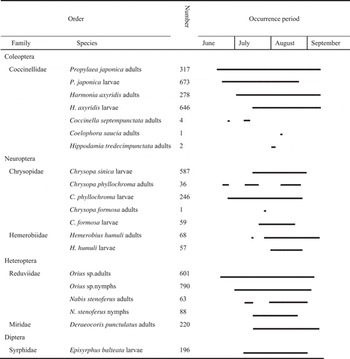
During the 2-year surveys, 13 species of predators were detected (Table 1).
Species of Aphis glycines predators and their seasonal occurrence on soybeans, in Harbin, China, during 2004 and 2005.

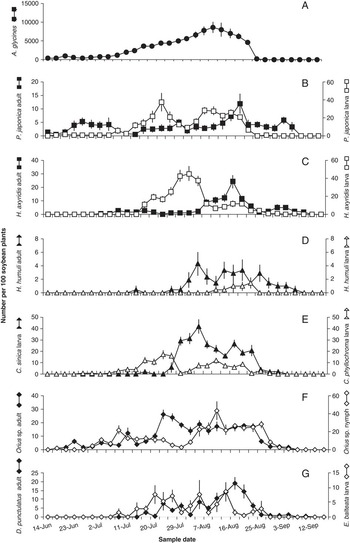
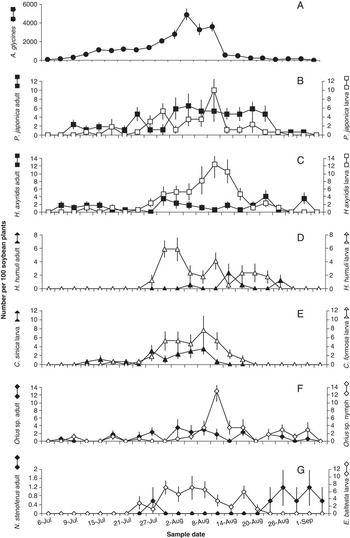
Propylaea japonica and Orius sp. occurred early and were the first to be found attacking soybean aphids in the field. Numbers of P. japonica adults (with standard errors of the means) were already up to 1.43 ± 0.78 per 100 soybeans on the first sampling date (14 June) in 2004 (Fig. 1B). In 2005, adults of P. japonica were found on the third sampling date (12 July) at densities of 2.35 ± 1.06 per 100 plants (Fig. 2B). The population density increased gradually, with some fluctuations. These numbers of P. japonica emerging in the field were high and a total of 317 adults and 673 larvae were found during 2004 and 2005 (Table 1). In 2004, maximum adult densities of P. japonica reached 11.90 ± 3.69 per 100 soybeans on 19 August and maximum larval densities were 37.62 ± 10.21 per 100 soybeans on 23 July (Fig. 1B). Larva densities of P. japonica were as high as 10.00 ± 3.43 per 100 soybeans on 14 August 2005 (Fig. 2B). Orius sp. on the second sampling date in 2004 reached 0.95 ± 0.66 adults per 100 plants and 1.43 ± 0.78 nymphs per 100 plants (Fig. 1F). In 2005, Orius sp. occurred on the second sampling date (9 July) at 0.59 ± 0.59 adults per 100 plants (Fig. 2F). A total of 601 adults and 790 nymphs of Orius sp. were found over 2 years (Table 1). In 2004, peak population density of Orius sp. adults occurred on 23 July with 26.19 ± 3.34 per 100 plants, and the peak density of nymphs occurred on 10 August at 43.33 ± 9.79 per 100 plants (Fig. 1F). In 2005, the peak value of adults was 3.53 ± 2.09 per 100 plants (5 August), and the peak value of the nymphs was 12.94 ± 2.68 per 100 plants (14 August) (Fig. 2F). Harmonia axyridis occurred early in the season in 2005 (Fig. 2C), though it occurred later in 2004 (Fig. 1C). High numbers of H. axyridis also were found during 2004 and 2005, with a total of 278 adults and 646 larvae (Table 1). In all of these species of identified natural enemies, P. japonica, Orius sp., and H. axyridis could be detected almost throughout the entire sampling period (Figs. 1, 2).
Population dynamics of Aphis glycines and its primary natural enemies in Harbin in 2004. Vertical bars are standard errors of the means. (A) Aphis glycines, (B) Propylaea japonica, (C) Harmonia axyridis, (D) Hemerobius humuli, (E) Chrysopa sinica and Chrysopa phyllochroma, (F) Orius sp., and (G) Deraeocoris punctulatus and Episyrphus balteata.

Population dynamics of Aphis glycines and its primary natural enemies in Harbin in 2005. Vertical bars are standard errors of the means. (A) Aphis glycines, (B) Propylaea japonica, (C) Harmonia axyridis, (D) Hemerobius humuli, (E) Chrysopa sinica and Chrysopa formosa, (F) Orius sp., and (G) Nabis stenoferus and Episyrphus balteata.

Chrysopa sinica larvae (Figs. 1E, 2E), Chrysopa phyllochroma larvae (Fig. 1E), Deraeocoris punctulatus adults (Fig. 1G), and E. balteata larvae (Figs. 1G, 2G) usually occur later in soybeans and in larger numbers (Table 1). Hemerobius humuli (Figs. 1D, 2D,), Chrysopa formosa larvae (Fig. 2E), and Nabis stenoferus adults (Fig. 2G) occur later in the season and in lower numbers (Table 1). For instance, the peak density of H. humuli was only 4.29 ± 1.77 adults per 100 soybeans (2004) and 5.88 ± 1.23 larvae per 100 soybeans (2005) (Figs. 1D, 2D). Altogether 68 H. humuli adults and 57 larvae were found during 2004 and 2005 (Table 1). The highest densities of C. formosa larvae were 7.65 ± 3.15 per 100 soybeans in 2005 (Fig. 2E). Forty-nine larvae of C. formosa were found in the 2-year study (Table 1). Peak values of N. stenoferus adults were merely 1.18 ± 0.81 per 100 soybeans in 2005 (Fig. 2G). Adults of C. septempunctata, Coelophora saucia (Mulsant), Hippodamia tredecimpunctata (Linnaeus), and C. formosa only occurred sporadically (Table 1).
Effect of A. glycines natural enemies in exclosure experiment
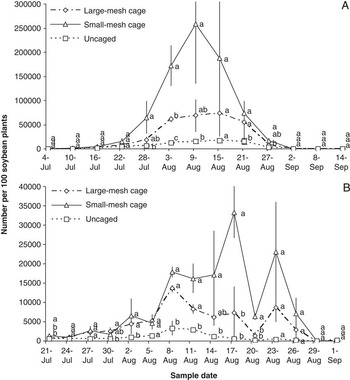
Exclosure of natural enemies led to an increase in A. glycines density in both 2004 and 2005 (Fig. 3). Aphis glycines density in small-mesh cages peaked at a level 3.75-fold higher than that in large-mesh cages and 17.44-fold higher than that on plants with no cages in 2004 (Fig. 3A; for differences among exclosure levels, F = 32.48; df = 2, 78; P < 0.01). In 2005, A. glycines populations in cages increased steadily. Aphid densities reached 6500.00 ± 4523.77 and 4380.00 ± 1163.32 per 100 soybeans, in small-mesh and large-mesh cages, respectively, on 2 August (2 weeks after artificial infestation). In comparison, population densities on plants with no cages were as low as 980.00 ± 210.98 aphids per 100 soybeans (Fig. 3B). Aphis glycines densities in small-mesh cages peaked 4.59-fold higher than that in large-mesh and 60.98-fold higher than that on plants with no cages (Fig. 3B; for differences among exclosure levels, F = 43.03; df = 2, 90; P < 0.01).
Dynamics of Aphis glycines under different exclosure levels of natural enemies in 2004 (A) and in 2005 (B). Vertical bars are standard errors of the means. Points with common letter indicate no difference between means for each sample date (P < 0.05, Duncan's multiple-range test).

Temperature and relative humidity among caged and uncaged treatments
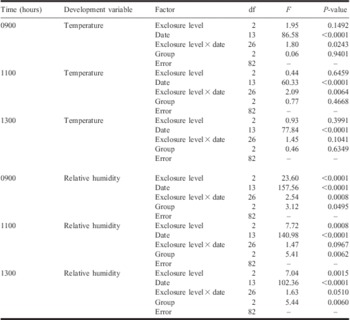
Temperature and relative humidity varied significantly with sampling date (Table 2). Measurements were taken separately at 0900, 1100, and 1300 hours. Cage treatment type had no effect on temperature, also tested at 0900, 1100, and 1300 hours, but did have a significant effect on relative humidity, tested at 0900, 1100, and 1300 hours (Table 2).
ANOVA analysis of effects of natural enemy exclosure levels and sample dates on temperature and relative humidity.

Natural enemies of A. glycines in the exclosure experiment
Some mummies of soybean aphids were found in the small-mesh cages, though no parasitoids were detected during the field survey. Orius sp., and larva of P. japonica, H. axyridis, C. sinica, and H. humuli were found in large-mesh cages. All of the natural enemies listed in Table 1 were found attacking A. glycines on plants with no cages, with the exception of C. septempunctata, Coelophora saucia, and H. tredecimpunctata.
Discussion
Our study showed that there are many species of A. glycines natural enemies in Harbin, northeast China. A total of 13 species of A. glycines predators, including D. punctulatus and H. humuli, were found in the region (Table 1). Studies on A. glycines natural enemies had been conducted in Langfang, northern China in 2002 (Liu et al. Reference Liu, Wu, Hopper and Zhao2004) and during 2003 to 2004 (Miao et al. Reference Miao, Wu, Hopper and Li2007). Many natural enemies of A. glycines were found in Langfang, but the community of natural enemies is different in that area compared with those in Harbin. For example, D. punctulatus and H. humuli were not detected in Langfang (Liu et al. Reference Liu, Wu, Hopper and Zhao2004; Miao et al. Reference Miao, Wu, Hopper and Li2007) and Chrysopa shansiensis Kawa was not detected in Harbin (Table 1). Three species of parasitoids were detected in Langfang (Liu et al. Reference Liu, Wu, Hopper and Zhao2004; Miao et al. Reference Miao, Wu, Hopper and Li2007). In Harbin, though attention was given to other species of natural enemies in the field survey, parasitoids and pathogens were so rare that they were virtually undetected. To some extent, these differences could be ascribed to geographic, climatic, and biological factors. Langfang (39.3°N, 116.4°E) and Harbin (45.4°N, 126.4°E) are far away each other and their climate and local crop systems are very different. Unique conditions in each region could result in different natural enemy communities of A. glycines. If this hypothesis holds true, more natural enemies of soybean aphids may be identified with further studies conducted in additional places.
Though the collective impact of many predator species could determine aphid density in the field, there is still a need to focus research on finding those predators that can have the greatest impact on aphid dynamics. Natural enemies, some of which occur early and in high numbers, are more likely to contribute to preventing pest outbreaks than those that only occur later in the season (Rutledge et al. Reference Rutledge, O'Neil, Fox and Landis2004). In northeast China, P. japonica, Orius sp., and H. axyridis probably suppress the A. glycines population more effectively because of their early occurrence (Figs. 1, 2) and high numbers (Table 1). Hemerobius humuli adults and larvae, adults of D. punctulatus and N. stenoferus, and larvae of C. sinica, C. formosa, C. phyllochroma, E. balteata are still considered as important predators. Though the predators usually occur late in the season (Figs. 1, 2) and are not generally present to attack aphids when they first invade or increase in soybeans systems, all these predator species are presumed to be capable of reducing A. glycines densities after the aphids achieve high population levels.
Though many natural enemies were found by field surveys, sampling only took place every 3 days. This less frequent sampling method might have narrowed the list of predators. If these samples have been collected daily, it is likely that more predator species would have been found. Surveys were conducted by daylight and only foliar-foraging natural enemies were recorded. Other ground-dwelling, nocturnal natural enemies might have been missed. Carabidae and Staphylinidae beetles, which are often active at night, were also important predators of soybean aphid (Rutledge et al. Reference Rutledge, O'Neil, Fox and Landis2004; Fox et al. Reference Fox, Landis, Cardoso and Difonzo2005), but neither family appeared in this experiment. Another notable exception was the lack of information on spiders, which were not effectively sampled and identified using our techniques. There may be other species of predators in the field, which only attack soybean aphids occasionally and cannot easily be found by direct observation methods. Cytochrome oxidase subunit II gene segment of A. glycines has been cloned and sequenced by polymerase chain reaction (PCR) and it showed that a gene segment could be detected in the guts of some predators, such as H. axyridis, P. japonica, and C. septempunctata (Gao et al. Reference Gao, Han, Zhao, Fan and Liu2006). If the PCR-method could be used effectively, it is likely that identification of soybean aphid's predators would be faster and more direct, especially for these species that only occasionally attack soybean aphids or consumed fewer aphids in the field.
Population numbers of aphids in large- and small-mesh cages were both much larger than that on plants with no cages (Fig. 3), which suggests that natural enemies can partially suppress A. glycines numbers in northeast China. These differences in aphid numbers among caged and uncaged treatments could be partially attributed to the different relative humidity among treatments, because it was known that aphids were sensitive to relative humidity (Chen et al. Reference Chen, Wen and Pan1992; Cheng et al. Reference Cheng, Tian, Li, Sun and Chen2002). The economic threshold of A. glycines has been studied (Ragsdale et al. Reference Ragsdale, McCornack, Venette, Potter, MacRae and Hodgson2007; McCarville et al. Reference McCarville, Kanobe, MacIntosh and O'Neal2011) and the accepted number was 250 aphids per soybean (McCarville et al. Reference McCarville, Kanobe, MacIntosh and O'Neal2011). During exclosure experiments, these average population numbers of A. glycines on plants with no cages at each sampling date were below 162.35 ± 44.70 (Fig 3A) and 33.63 ± 17.68 aphids per soybean (Fig 3B), respectively, in 2004 and 2005, which were all below the 250 aphids per soybean. It showed that these predators were probably enough to keep aphid numbers below the economic threshold. Though pathogens were still not found in the exclosure experiments, more attention should be focused on this in further studies. If these pathogens occur in higher relative humidity cages, they might cause high mortality of A. glycines. The effects of cages on temperature and relative humidity should be studied in greater detail, because they were tested only at three times per day in our study. A different result of the exclosure experiment was found by previous researchers, who found that relative humidity varied little among treatments (Meihls et al. Reference Meihls, Clark, Bailey and Ellersieck2010). Their cage size was 1 m in width by 1 m in length by 1 m in height, which was only 0.42-fold larger than ours in volume. The question whether microclimate is influenced less by small cages remains open.
Acknowledgements
The authors gratefully acknowledge Liwang Cui (Department of Entomology, Pennsylvania State University) for his constructive reviews of an early draft of the manuscript and Changchun Dai (College of Agriculture, Northeast Agricultural University) for his part work with studies on the exclosure experiment in 2004. This work was supported in part by the Modern Agricultural Technology System fund (Ministry of Agriculture, the People's Republic of China), and the Key Laboratory of Soybean Biology fund (SB06A05) (Ministry of Education, the People's Republic of China), and in part by the Doctor Research Startup fund of Northeast Agricultural University, China.