Introduction
Chrysoberyl, ideally BeAl2O4, is an oxide mineral of olivine-type structure with Be2+ cations in tetrahedral and Al3+ in octahedral coordination. The main substituents of Al3+ are Cr3+ (mariinskite BeCr2O4, a Cr-dominant member; Pautov et al., Reference Pautov, Popov, Erokhin, Khiller and Karpenko2013) and Fe3+ (up to ~6 wt.% Fe2O3, Žáček and Vrána, Reference Žáček and Vrána2002). Alexandrite, a gemstone variety of chrysoberyl, is characterised by two distinct optical effects, including the alexandrite effect produced by Cr3+ and V3+ impurities and the cat's eye effect. Three principal lithological types of magmatic or metamorphic chrysoberyl occurrences have been recognised: (1) granitic pegmatites and exceptionally leucogranites; (2) metasomatic skarn zones and related dykes along/near the contacts between ultrabasic or carbonate rocks and intruded granites to pegmatites; and (3) high-temperature metamorphic rocks of granulite facies (e.g. Martin-Izard et al., Reference Martin-Izard, Paniagua and Moreiras1995; Barton and Young, Reference Barton, Young and Grew2002; Downes and Bevans, Reference Downes and Bevan2002; Černý, Reference Černý and Grew2002; Franz and Morteani, Reference Franz, Morteani and Grew2002; Marschall and Walton, Reference Marschall, Walton and Groat2014).
Chrysoberyl has been described as an accessory mineral in numerous rare-element, peraluminous granitic pegmatites of the beryl type or, rarely, in pegmatites of the abyssal class (Grew, Reference Grew1981; Černý and Ercit, Reference Černý and Ercit2005; Cempírek and Novák, Reference Cempírek and Novák2006). Chrysoberyl is usually associated with primary rock-forming minerals such as quartz, feldspars and muscovite, and locally with beryl. However, the origin of chrysoberyl in granitic pegmatites is typically uncertain: it is considered to be a product of primary magmatic precipitation or metamorphic overprinting of a parental pegmatite. A primary magmatic origin for chrysoberyl is suggested for pegmatites in Southern Kerala, India (Soman and Nair, Reference Soman and Nair1985), the Malga Garbella pegmatite, Italy (Vignola et al., Reference Vignola, Zucali, Rotiroti, Marotta, Risplendente, Pavese, Boscardin, Mattioli and Bertoldi2018), Tablada I pegmatite, Argentina (Colombo et al., Reference Colombo, Sfragulla, del Tánago J. and Miner E.2021) and the Tashisayi pegmatites, China (Hong et al., Reference Hong, Zhai, Xu, Li, Wu, Ma, Niu, Ke and Wang2021). Magmatic chrysoberyl in assemblage with beryl, sillimanite and gahnite was described from the highly-evolved, peraluminous Belvís de Monroy leucogranite, Spain (Merino et al., Reference Merino, Villaseca, Orejana and Jeffries2013). However, most occurrences of chrysoberyl consider it to have formed from the breakdown of primary beryl as a result of metamorphic overprinting of the pegmatite e.g: Kolsva, Sweden; Haddam, USA; and Maršíkov, Czech Republic (Franz and Morteani, Reference Franz and Morteani1984, Reference Franz, Morteani and Grew2002; Černý et al., Reference Černý, Novák and Chapman1992); Kalanga Hill, Zambia (Žáček and Vrána, Reference Žáček and Vrána2002); Ethel Mary and Virorco, Argentina (Lira and Sfragulla, Reference Lira and Sfragulla2011; Galliski et al., Reference Galliski, Márquez-Zavalía, Lira, Cempírek and Škoda2012); New York, USA (Lupulescu et al., Reference Lupulescu, Chiarenzelli and Bailey2012); Roncadeira, Brazil (Beurlen et al., Reference Beurlen, Thomas, Melgarejo, Da Silva, Rhede, Soares and Da Silva2013); and Mt. Begbie, Canada (Dixon et al., Reference Dixon, Cempírek and Groat2014).
In this investigation we examine the composition of chrysoberyl and associated minerals at the Maršíkov–Schinderhübel III granitic pegmatite, the first reported occurrence of chrysoberyl in Europe (Hruschka, Reference Hruschka1824). The principal objectives of our study were to characterise textural, paragenetic and compositional relations of chrysoberyl and associated Be minerals, and to estimate the conditions of formation of assemblages containing these minerals, and to relate these to the metamorphic evolution of the pegmatites.
Regional geology and pegmatite description
The granitic pegmatite occurs in the Desná Dome, Neoproterozoic to Devonian crystalline basement of the Silesian Domain of Bohemian Massif, a part of the European Variscan orogenic belt (Fig. 1). The Silesian Domain represents an orogenic wedge belonging to the Moravo–Silesian Zone, a metamorphosed and imbricated margin at the eastern Variscan front in NE Bohemian Massif (Schulmann and Gayer, Reference Schulmann and Gayer2000; Schulmann et al., Reference Schulmann, Oliot, Košuličová, Montigny and Štípská2014). The central part of the Desná Dome consists of orthogneisses, paragneisses and amphibolites showing Neoproterozoic protolith ages (570–650 Ma; Kröner et al., Reference Kröner, Štípská, Schulmann and Jaeckel2000; Jastrzębski et al., Reference Jastrzębski, Żelaźniewcz, Sláma, Machowiak, Śliwiński, Jaźwa and Kocjan2021) and Palaeozoic cover rocks, mainly metaquartzites, metaconglomerates, metapelites and marbles, which are intruded locally by Middle Devonian (Givetian) volcanic rocks of arc and back-arc affinity (Janoušek et al., Reference Janoušek, Aichler, Hanžl, Gerdes, Erban, Žáček, Pecina, Pudilová, Hrdličková, Mixa and Žáčková2014). This metamorphic complex underwent Variscan medium-pressure, Barrovian-type metamorphism at P ≈ 500–700 MPa and T ≈ 540–660°C (Souček, Reference Souček1978; René, Reference René1983, Cháb et al., Reference Cháb, Fediuková, Fišera, Novotný and Opletal1990; Schulmann and Gayer, Reference Schulmann and Gayer2000; Košuličová and Štípská, Reference Košuličová and Štípská2007; Schulmann et al., Reference Schulmann, Oliot, Košuličová, Montigny and Štípská2014).
Simplified geological situation of the Maršíkov District with individual pegmatite occurrences (Cháb et al., Reference Cháb, Stráník and Eliáš2007 and on-line map application of the Czech Geological Survey 2019, Chládek et al., Reference Chládek, Uher and Novák2020, modified).

The metamorphic rocks were intruded by Variscan, Carboniferous to Early Permian granitic rocks and pegmatites. Zircon U–Pb radiometric age determination of pegmatitic leucogranite at Čertovy Kameny hill near Jeseník gave 334 Ma (Hegner and Kröner, Reference Hegner and Kröner2000), which is consistent with ages of older granitic plutons in the adjacent Sudetic block of NE margin of the Bohemian Massif: Kłodzko-Złoty Stok, Jawornik, Strzelin, and Kudowa plutons (350–330 Ma; Mikulski et al., Reference Mikulski, Williams and Bagiński2013). Moreover, a younger plutonic suite of I-type granodiorites to granites of the Žulová Pluton have late-Variscan, Early Permian emplacement ages of 292 ± 4 or 291 ± 5 Ma (LA–ICP–MS U–Pb zircon radiometric age determination; Laurent et al., Reference Laurent, Janoušek, Magna, Schulmann and Míková2014).
The metamorphic rocks of the Desná Dome were intruded primarily in the Maršíkov pegmatite district by numerous dykes or lenticular bodies of granitic pegmatites enclosed in biotite–amphibole gneisses and/or amphibolites of the Sobotín Massif (Fig. 1). The most fractionated pegmatites show an affinity to the LCT (lithium-caesium-tantalum) family and beryl–columbite subtype of the rare-element class according to the classification of Černý and Ercit (Reference Černý and Ercit2005), as were documented by their mineral assemblages (e.g. Černý et al., Reference Černý, Novák and Chapman1992, Reference Černý, Novák and Chapman1995; Novák Reference Novák1988, Reference Novák2005; Novák et al., Reference Novák, Černý and Uher2003, Reference Novák, Dolníček, Zachař, Gadas, Nepejchal, Sobek, Škoda and Vrtiška2023; Chládek and Zimák, Reference Chládek and Zimák2016; Chládek et al., Reference Chládek, Uher and Novák2020, Reference Chládek, Uher, Novák, Bačík and Opletal2021; Dolníček et al., Reference Dolníček, Nepejchal, Sejkora, Ulmanová and Chládek2020a, Reference Dolníček, Nepejchal and Novák2020b).
The Maršíkov–Schinderhübel III chrysoberyl-bearing granitic pegmatite is situated on the hill NNE of the Maršíkov settlement, a part of Velké Losiny village, ~10 km NE from Šumperk town in the southern part of the Hrubý Jeseník Mountains, northern Moravia region, Czech Republic. It forms a dyke in biotite–hornblende gneiss belonging to Sobotín amphibolite massif. The pegmatite is not exposed, excavation trenches show it to be up to 1 m thickness, with a 160° NNW–SSE strike and inclination of 20° to SW, concordantly to the adjacent gneiss (Dostál, Reference Dostál1966). The pegmatite dyke shows symmetrical internal zoning, including an aplitic unit, an intermediate albite-rich unit with coarse-grained muscovite, and a quartz core unit (Dostál, Reference Dostál1966; Staněk, Reference Staněk and Bernard1981; Černý et al., Reference Černý, Novák and Chapman1992; Fig. 2). The aplitic unit is only ~1 cm in thickness and consists of a fine-grained (~0.5 mm) aggregate of albite, quartz, muscovite and garnet (almandine–spessartine) in subordinate amounts, and rare biotite. The intermediate albite-rich unit, ~15–50 cm in thickness, is composed of a medium- to coarse-grained aggregate of albite, quartz and muscovite with abundant fibrolitic sillimanite and relatively common chrysoberyl, garnet, fluorapatite, gahnite, Nb–Ta oxide minerals (columbite- and microlite-group members and fersmite), zircon, uraninite, cheralite, native bismuth and bismutite. Sillimanite, chrysoberyl and muscovite of this unit exhibit a distinct metamorphic grain lineation parallel to foliation of the pegmatite. The central quartz core unit is ~10 to 40 cm in thickness, and is characterised by less-developed schistosity and contains aggregates of anhedral quartz in association with muscovite, beryl, rare chrysoberyl (more common along the contact of the quartz core with the intermediate unit), sillimanite, garnet, gahnite, and Nb–Ta minerals. The entire Schinderhübel III pegmatite is deficient in K-feldspar (Dostál, Reference Dostál1966; Černý et al., Reference Černý, Novák and Chapman1992). The other smaller pegmatite dykes with Be minerals (Schinderhübel I and II) occur ~80 m east and ~50 m northwest of the Schinderhübel III pegmatite, and both exhibit similar mineral assemblages with minor to rare K-feldspar and noticeable deformation although accompanied by a lesser degree of metamorphic overprinting and paucity of chrysoberyl and sillimanite (Staněk, Reference Staněk and Bernard1981; Černý et al., Reference Černý, Novák and Chapman1992).
Idealised cross-section of the Maršíkov–Schinderhübel III pegmatite.

Methods
The samples investigated were obtained from several sources, including the Moravian Museum, Brno mineralogical collection and the research collections of Š. Chládek and M. Novák. The abbreviations for the minerals used in the text and figures are after Warr (Reference Warr2021). The composition of minerals were determined on polished sections using a JEOL JXA-8530F field-emission electron-probe microanalyser (EPMA) using wavelength dispersive spectrometry (WDS) at the Institute of the Earth Sciences of the Slovak Academy of Sciences in Banská Bystrica, Slovakia. The following analytical conditions were used: accelerating voltage 15 kV; probe current 20 nA; beam diameter ranging from 3 to 5 μm; and the ZAF matrix correction. The following standards and X-ray lines were used: diopside (SiKα, MgKα, CaKα); rutile (TiKα); albite (AlKα, NaKα); cassiterite (SnLα); ScVO4 (ScKα, VKα); Cr2O3 (CrKα); GaAs (GaLα); YPO4 (YLα); hematite (FeKα); rhodonite (MnKα); forsterite (MgKα); gahnite (ZnKα); fluorapatite (CaKα); celestine (SrLα); orthoclase (KKα); Rb2ZnSi5O12 glass Rb (RbLα); pollucite (CsLα); and fluorite (FKα). Back-scattered electron (BSE) images and X-ray element maps were obtained on the same JEOL JXA-8530F instrument for detailed study of textural relationships among minerals. The element-distribution maps were produced using an accelerating voltage of 15 kV, probe current of 50 nA and 1 μm beam diameter. The maps comprise 1070 × 770 pixels, with a pixel size of 0.7 μm and a dwell time of 50 ms for each pixel.
The trace-element content of chrysoberyl was obtained by laser ablation-inductively coupled plasma-mass spectrometry (LA-ICP-MS) at the Department of Chemistry, Masaryk University, Brno, Czech Republic. The LA-ICP-MS setup consists of the laser ablation system Analyte G2+ (Teledyne Cetac) and the quadrupole ICP-MS Agilent 7900 (Agilent Technologies). The laser ablation system uses a Q-switched Nd-YAG laser-ablation device at the fifth harmonic frequency corresponding to 213 nm wavelength. The ablation cell was flushed with a He carrier gas, which transported the laser-induced aerosol to the inductively coupled plasma (1 l/min). Sample Ar gas flow was admixed with the He gas flow to 1.6 l/min total gas flow. ICP-MS parameters were optimised with respect to maximum signal-to-noise ratio and minimum oxide formation (ThO+/Th+ count ratio = 0.2%, U+/Th+ count ratio = 1.1%). The following laser ablation parameters were used for the analysis: 100 μm laser spot diameter; 8 J cm–2 laser fluence; and 20 Hz repetition rate. Fixing the sample position during laser ablation facilitated a hole-drilling duration of 60 s for each spot. The NIST SRM 610 silicate glass was used as reference material. All element measurements were normalised to the average concentration of Al in the chrysoberyl, determined by the electron microprobe.
Micro-Raman analyses of minerals were performed on the LabRAM-HR Evolution Horiba Jobin-Yvon spectrometer system with a Peltier-cooled CCD detector and Olympus BX-41 microscope (Department of Geological Sciences, Masaryk University, Brno, Czech Republic). Raman spectra were excited by a blue diode laser (473 nm) with a power of 2.5 mW in the range of 100–4,000 cm−1 and 100–10,000 cm−1 were collected from each mineral using a 50× objective. The acquisition time of 30 s and 5 s per frame, respectively, and two accumulations were used to improve the signal-to-noise ratio. Raman spectra were also obtained using a Thermo Scientific DXR3xi Raman imaging microscope at the Natural History Museum in Bratislava, Slovakia. The doubled Nd: YVO4 DPSS excitation laser (532 nm) and He–Ne laser (633 nm), 100× objective, a 25 μm confocal pinhole, and an EMCCD detector were used. The spectra were acquired at a laser power of 10–20 mW and 0.5–2 s (20 scans for a cycle), and they were processed in the Seasolve PeakFit 4.1.12 software. Raman bands were fitted by the Lorentz function with automatic background correction and Savitzky-Golay smoothing.
Powder X-ray diffraction (XRD) analysis was determined by the BRUKER D8 Advance diffractometer (Department of Mineralogy and Petrology, Comenius University, Bratislava) under the following conditions: Bragg–Brentano geometry (θ–2θ), Cu anticathode (Kα1 = 1.5406 Å), accelerating voltage = 40 kV and beam current = 40 mA; a NiK β filter was used for stripping Kβ radiation, and data were obtained by a BRUKER LynxEye detector. The step size was 0.01°2θ with a counting time of 5 s per step, and 2θ measurement ranged from 4 to 65°. The lattice parameters were refined with the Bruker DIFFRAC plus TOPAS software using the structural model for chrysoberyl (Hazen and Finger, Reference Hazen and Finger1987).
Results
Textural and paragenetic relationships of Be minerals
The following Be minerals were identified in the pegmatite: chrysoberyl; beryl; euclase; and bertrandite. Chrysoberyl occurs in intermediate and quartz core units as transparent to translucent subhedral to anhedral rarely euhedral prismatic to tabular crystals and V-shaped twins (~50 μm to 3 cm in size) with yellowgreen to pale-green colour and vitreous to adamantine lustre. Chrysoberyl is associated with beryl, quartz, albite, muscovite and sillimanite in the intermediate unit or in its contact with the quartz core. In the outer parts of the intermediate unit, platy crystals of chrysoberyl are commonly parallel to flakes of muscovite and fibrolitic sillimanite aggregates and relics of primary beryl are absent or very rare. The BSE images of chrysoberyl exhibit mostly patchy, rarely irregular lamellar or concentric zonation of crystals (Figs 3,4,5), some large platy chrysoberyl crystals without relics of beryl show fine lamellar to oscillatory growth zoning (Fig. 3e,f). Relics of primary beryl and inclusions of quartz, albite, muscovite, gahnite, and Nb–Ta oxide minerals are commonly detected in chrysoberyl (Figs 3,4,5). Secondary Fe-rich beryl, euclase, bertrandite and late muscovite are locally confined to the edges and fractures of chrysoberyl (Figs 4b,e, 5).
BSE images of chrysoberyl and associated minerals of the Maršíkov–Schinderhübel III pegmatite. Mineral abbreviations: Cbrl (chrysoberyl), Brl (primary beryl), Ecs (euclase), Qz (quartz), Ab (albite), Ms (muscovite), Sil (sillimanite), Ttl (Nb–Ta oxide minerals: tantalite, columbite and ixiolite), Ghn (gahnite).

BSE images of chrysoberyl and associated minerals of the Maršíkov–Schinderhübel III pegmatite. Mineral abbreviations as in Fig. 3, Btd (bertrandite), Grt (garnet).

BSE image: (a) and element-distribution maps of Si, Al and Fe; (b–d) of chrysoberyl from the Maršíkov–Schinderhübel III pegmatite. Chrysoberyl contains tantalite inclusion, remnants of primary beryl (Brl-I), and secondary Fe-rich beryl (Brl-II), secondary muscovite and euclase. Mineral abbreviations as in Fig. 3.

Primary beryl occurs as euhedral to subhedral pale yellow–green or bluish green translucent prismatic crystals, up to 5 cm in length and 2 cm in thickness, typically in the quartz core. In the intermediate unit, crystals of primary beryl are replaced by chrysoberyl, and locally, anhedral relicts of beryl (20–300 μm across) are associated with quartz at inner contact of the intermediate unit and quartz core units (Figs 3a,b,d, 5). Larger subhedral crystals of beryl (~200 to 500 μm) also occur with chrysoberyl and albite (Fig. 4c).
Anhedral domains of secondary Fe-rich beryl, ~50 μm large, were rarely identified in rims of chrysoberyl crystals (Fig. 5a–d). Euclase forms subhedral to anhedral overgrowths and veinlets replacing chrysoberyl, usually ~50 μm to 1 mm in size (Figs 3a, 4b,e, 5). Bertrandite occurs as anhedral grains or veinlets, up to 200 μm in size, located in chrysoberyl, and locally replaces euclase (Fig. 4b).
Composition of Be minerals
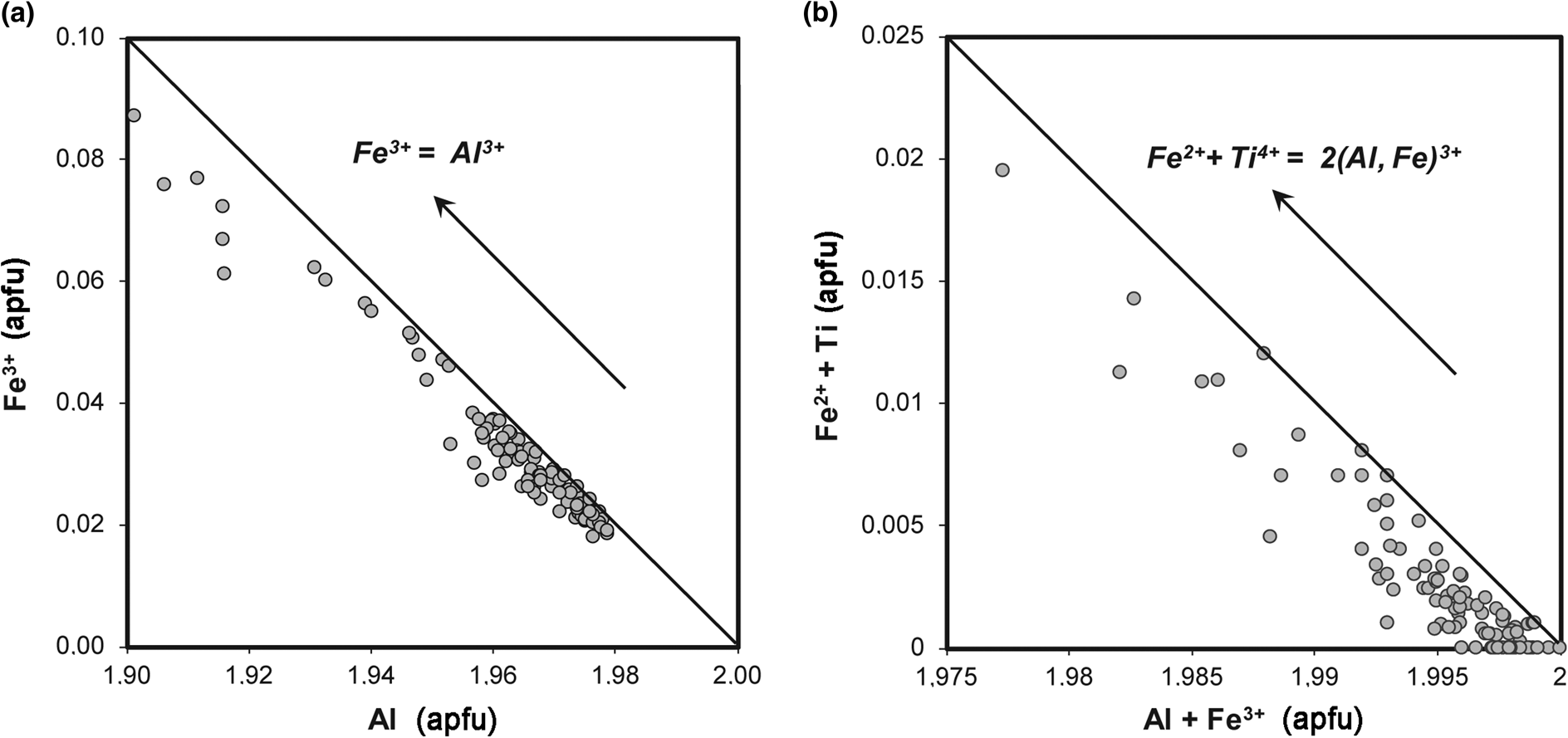
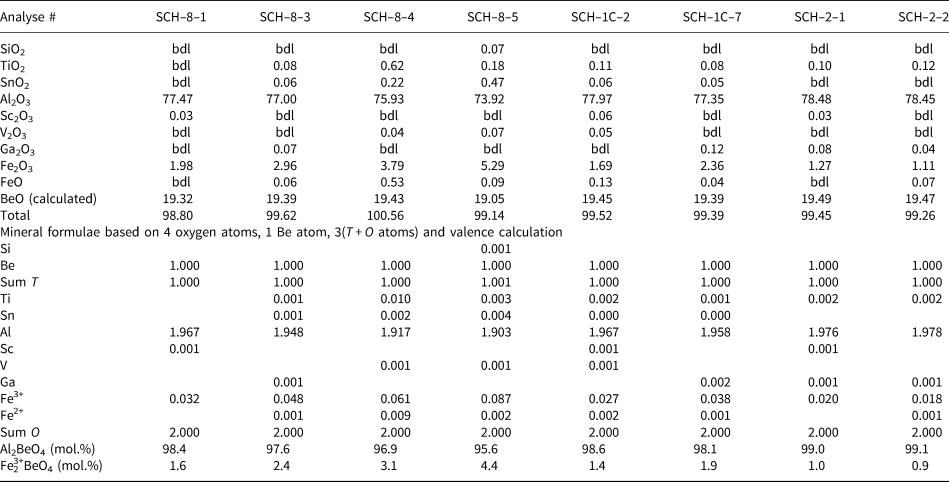
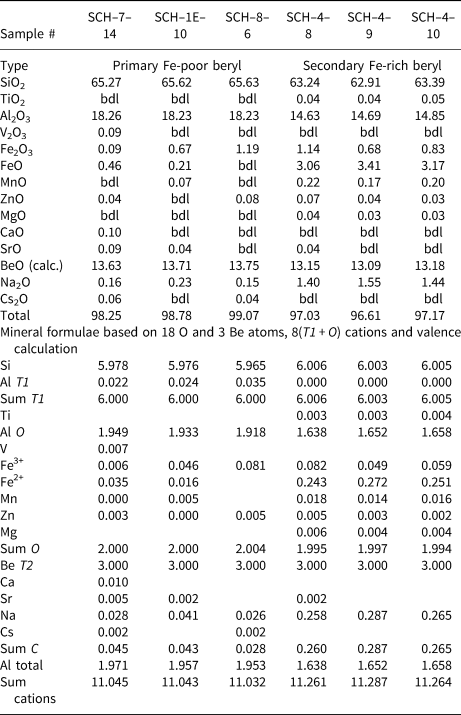
The zoning in BSE images (Figs 3–5) generally reflects different Fe concentrations in chrysoberyl with the lighter zones illustrating domains with elevated contents of Fe in chrysoberyl (Table 1). Valence calculations indicate the dominancy of trivalent Fe in chrysoberyl (1.1–5.3 wt.% Fe2O3; ≤0.09 atoms per formula unit Fe3+), however commonly a small amount of Fe2+ (≤0.5 wt.% FeO) is also present, which correlates positively with Ti (≤0.6 wt.% TiO2; ≤0.01 apfu) and Sn (≤0.5 wt.% SnO2; ≤0.004 apfu). Compositional relationships suggest two main octahedral-site substitutions in chrysoberyl: (1) dominant Fe3+ = Al3+; and (2) minor Fe2+ + Ti4+ = 2(Al,Fe)3+ substitutions (Fig. 6).
Substitution diagrams of chrysoberyl from the Maršíkov–Schinderhübel III pegmatite: (a) Fe3+ = Al3+; (b) Fe2+ + Ti4+ = 2(Al,Fe)3+.

Representative compositions (wt.%) and formulae (apfu) of chrysoberyl from the Maršíkov pegmatite.

bdl – below detection limit
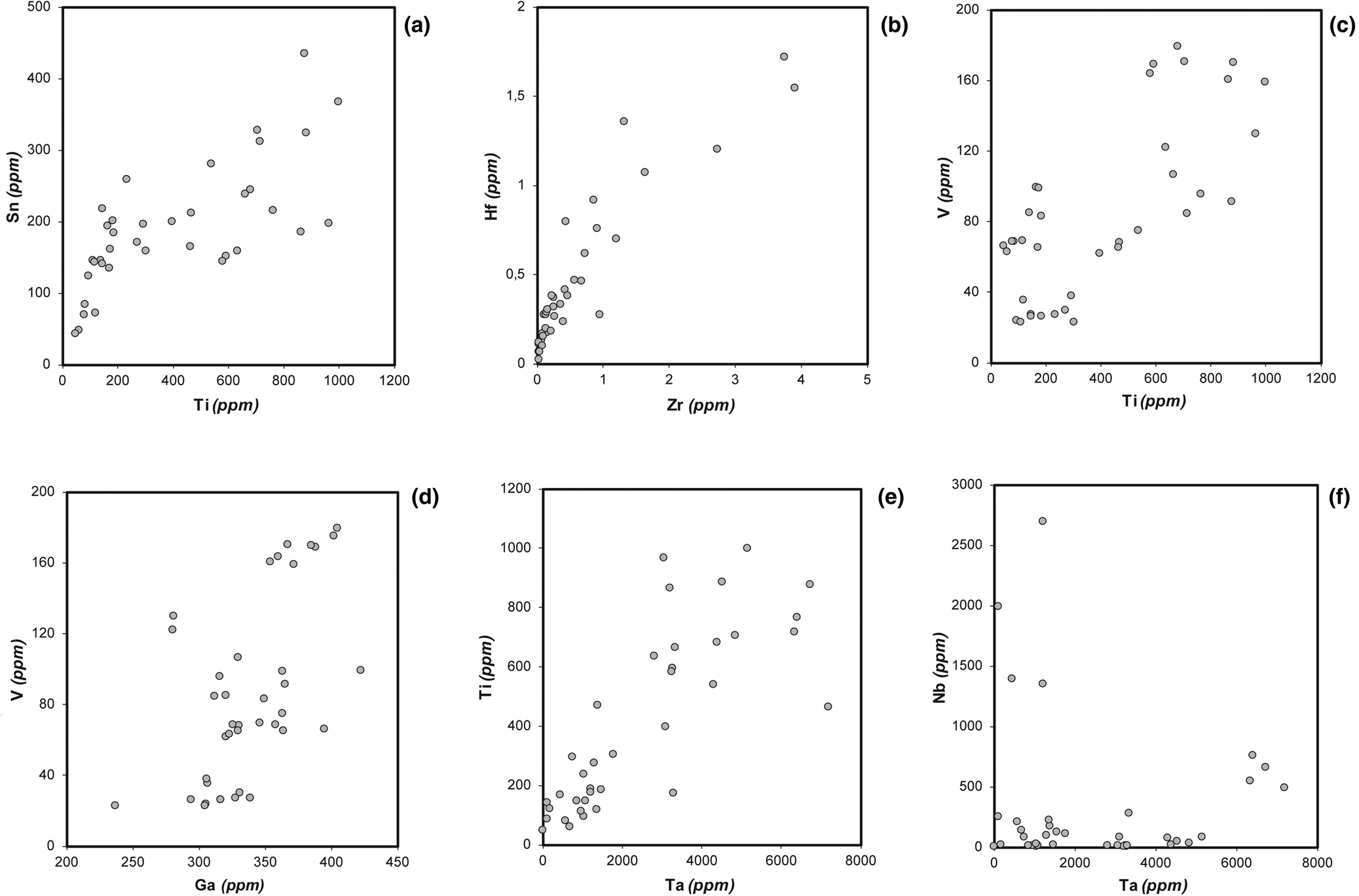
The LA-ICP-MS investigation of chrysoberyl yielded elevated concentrations of Ga (~240–420 ppm), Sn (~40–440 ppm) and V (~20–180 ppm) together with Fe and Ti (Supplementary Table S1); Cr is frequently below the detection limit. Extraordinarily high concentrations of Ta (≤7200 ppm) and Nb (≤2700 ppm) were detected locally in chrysoberyl, and they can be explained by micro- to nano-inclusions of Nb–Ta oxide minerals as documented in BSE images (Figs 3a, 4d–f, 5). Positive correlations were observed between some trace elements in chrysoberyl: Sn versus Ti, Hf vs. Zr, V vs. Ti, V vs. Ga and Ti vs. Ta (Fig. 7a–e).
Correlation diagrams of trace elements from the Maršíkov–Schinderhübel III pegmatite (in ppm): (a) Sn vs. Ti; (b) Hf vs. Zr; (c) V vs. Ti; (d) V vs. Ga; (e) Ti vs. Ta; (f) Nb vs. Ta.

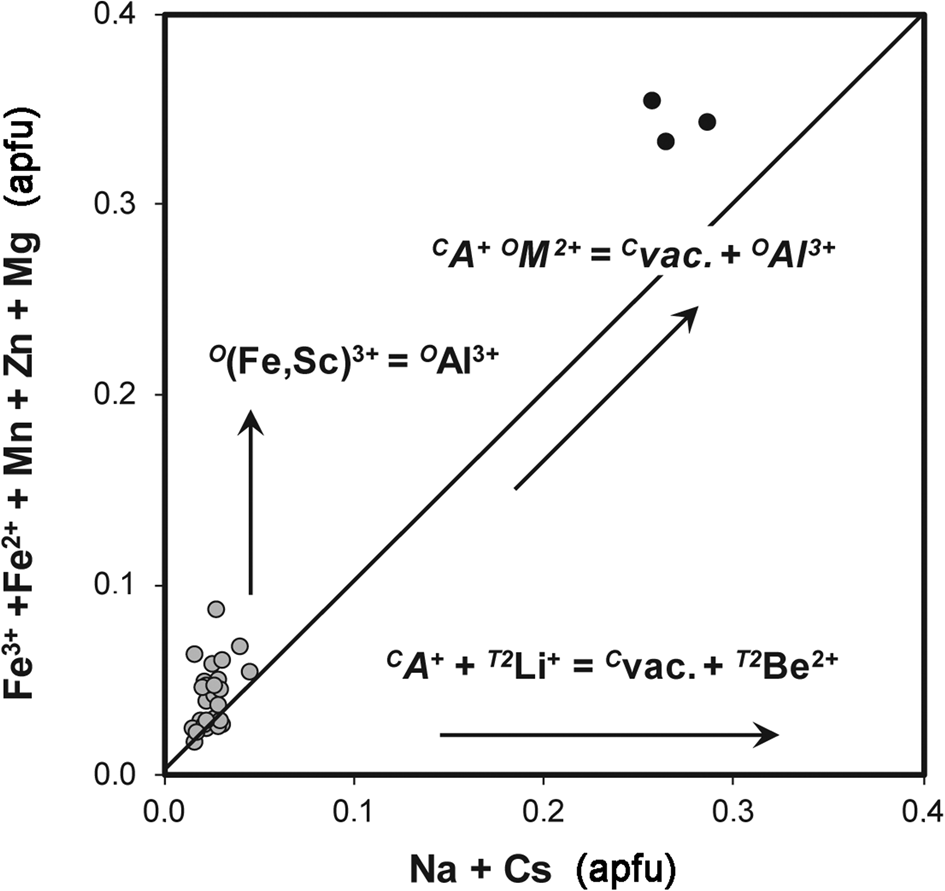
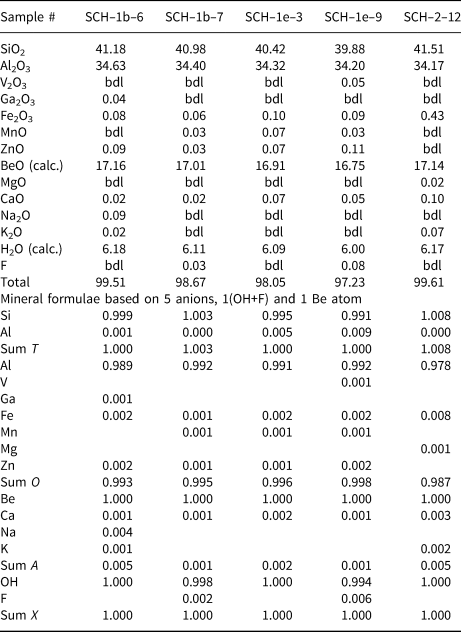
Primary beryl is characterised by a low content of Fe: up to 1.2 wt.%; Fe2O3 (≤0.08 apfu Fe3+) and up to 0.5 wt.% FeO (≤0.04 apfu Fe2+). Rare secondary Fe-rich beryl contains 0.7–1.1 wt.% Fe2O3 (0.05–0.08 apfu Fe3+), although it is distinctly enriched in FeO (3.1–3.4 wt.%; 0.24–0.27 apfu Fe2+) (Fig. 5d; Table 2). Divalent Fe is compensated by Na (up to 1.6 wt.% Na2O; ≤0.29 apfu Na) according to the channel (C) – octahedral (O) substitution: CNa+ + OM(Fe,Mn,Mg,Zn)2+ = C□ + OAl3+, and Fe3+ replaces Al in octahedral, stoppaniite-type substitution: CFe3+ = CAl3+ (Fig. 8). The concentrations of other elements are negligible except for 0.2 wt.% MnO (0.02 apfu Mn) in Fe-rich beryl (Table 2).
Substitution Fe3+ + Fe2+ + Mn + Zn + Mg vs. Na + Cs diagram of beryl from the Maršíkov–Schinderhübel III pegmatite. Notes: primary magmatic beryl (grey circles), secondary Fe-rich beryl (black circles).

Representative compositions (wt.%) and mineral formulae (apfu) of beryl from the Maršíkov pegmatite.

bdl – below detection limit. Other elements not listed: Cr, Ga, Sc, Y, K and Rb are also below the detection limit.
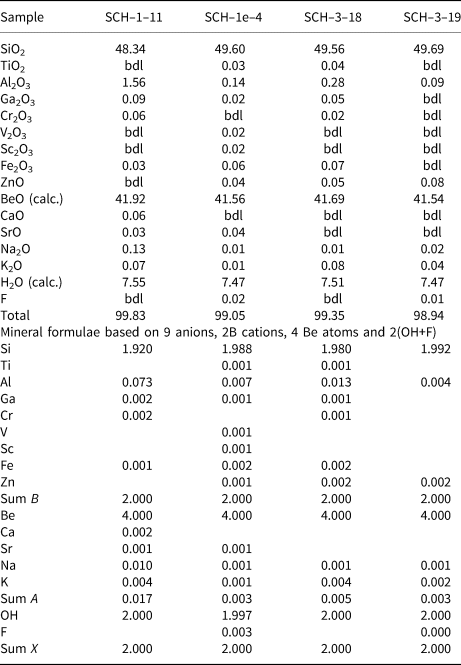
Euclase contains up to 0.4 wt.% Fe2O3 (0.01 apfu Fe) and negligible amounts of Zn and Ca (≤0.1 oxide wt.%) (Table 3). Bertrandite is also close to the end-member composition (Table 4).
Representative (wt.%) and mineral formulae (apfu) of euclase from Maršíkov pegmatite.

bdl – below detection limit. Other elements not listed: Ti, Sn, Cr, Sc, Y, Ni, Mg, Sr, Rb, Cs and Cl are also below the detection limit.
Representative (wt.%) and mineral formulae (apfu) of bertrandite from the Maršíkov pegmatite.

bdl – below detection limit. Other elements not listed: Sn, Mn, Ni, Mg, Rb, Cs and Cl are also below the detection limit.
Unit-cell parameters and Raman spectroscopy of the Be minerals
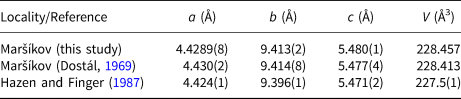
The unit-cell parameters of the chrysoberyl determined by powder X-ray diffraction (Table 5) are in excellent accordance with the previously published data (Dostál, Reference Dostál1969; Hazen and Finger, Reference Hazen and Finger1987). The presence of bertrandite was also confirmed by micro-Raman spectroscopy as EPMA cannot distinguish bertrandite from phenakite. The Raman spectra of bertrandite from the Maršíkov–Schinderhübel III pegmatite (Fig. 9) are in excellent agreement with the RRUFF database (R060803.3 and R050032.3 samples; Lafuente et al., Reference Lafuente, Downs, Yang and Stone2016). Note that the bertrandite spectrum also shows some typical bands for closely-associated euclase.
Micro-Raman spectrum of bertrandite with admixture of euclase from the Maršíkov–Schinderhübel III pegmatite.

The unit-cell parameters of chrysoberyl from the Maršíkov pegmatite calculated from powder XRD and compared with published data.

Discussion
Chrysoberyl composition
Several studies have focused on the description of minerals and geology from the Maršíkov–Schinderhübel III pegmatite (e.g. Kretschmer, Reference Kretschmer1911; Dostál, Reference Dostál1966, Reference Dostál1969; Černý et al., Reference Černý, Novák and Chapman1992); however, a detailed study of the textural relations and compositional variations in chrysoberyl and its mineral assemblage is lacking. The composition of natural chrysoberyl is typically close to the BeAl2O4 end-member formula. The olivine-type structure of chrysoberyl is composed of two principal cation sites: octahedrally coordinated M1 and M2 sites are occupied by Al3+, and the tetrahedral (T) position is filled by Be2+ cations (Hawthorne and Huminicki, Reference Hawthorne, Huminicki and Grew2002). Aluminium in the octahedral sites is commonly replaced by other trivalent cations, especially by Cr3+ and Fe3+. The maximum Fe2O3 content reported in natural chrysoberyl is 6.25 wt.% for samples from the Kalanga Hill pegmatite, Zambia (Žáček and Vrána, Reference Žáček and Vrána2002). Chrysoberyl from the Maršíkov–Schinderhübel III pegmatite exhibits relatively broad variations of Fe (1.1 to 5.3 wt.% Fe2O3 and ≤0.5 wt.% FeO). Elevated Fe contents are typical of chrysoberyl of metamorphic origin, whereas magmatic chrysoberyl from leucogranites and pegmatites usually have a lower Fe content (≤1.2 wt.% FeO total; Merino et al., Reference Merino, Villaseca, Orejana and Jeffries2013).
Contents of Ti (≤0.6 wt.% TiO2; ≤0.01 apfu), Ga (~240–420 ppm), Sn (~40–440 ppm), and V (~20–180 ppm) in the Maršíkov chrysoberyl are comparable with the published data (≤0.7 wt.% TiO2, ≤4500 ppm Sn, ≤1600 ppm Ga and (1200 ppm V; Soman and Nair, Reference Soman and Nair1985; Merino et al., Reference Merino, Villaseca, Orejana and Jeffries2013; Kanouo et al., Reference Kanouo, Ekomane, Youngue, Njonfang, Zaw, Changqian, Ghogomu, Lentz and Venkatesh2016; Schmetzer et al., Reference Schmetzer, Caucia, Gilg and Coldham2016; Sun et al., Reference Sun, Palke, Muyal, DeGhionno and McClure2019; Colombo et al., Reference Colombo, Sfragulla, del Tánago J. and Miner E.2021). High concentrations of Ta (up to ~7200 ppm) and Nb (up to ~2700 ppm), detected in the Maršíkov chrysoberyl, are very unusual and probably result from the presence of numerous nano- to micro-inclusions of Nb–Ta oxide minerals (columbite-(Fe), columbite-(Mn), tantalite-(Fe), tapiolite-(Fe), ixiolite-(Mn2+); Figs 3–5). Such high contents of Ta and Nb have not been found previously in chrysoberyl; ~510 ppm Ta and ~250 ppm Nb are the maximum reported (Merino et al., Reference Merino, Villaseca, Orejana and Jeffries2013; Kanouo et al., Reference Kanouo, Ekomane, Youngue, Njonfang, Zaw, Changqian, Ghogomu, Lentz and Venkatesh2016; Schmetzer et al., Reference Schmetzer, Caucia, Gilg and Coldham2016; Colombo et al., Reference Colombo, Sfragulla, del Tánago J. and Miner E.2021).
Evolution of the chrysoberyl assemblage
The origin of chrysoberyl in granitic pegmatites can be explained by two principal hypotheses: either primary magmatic or metamorphic genesis. The main criteria for distinguishing between these hypotheses are textural relationships, mineral paragenesis and the presence or absence of metamorphic overprint in the parental pegmatite. Moreover, Fe content in chrysoberyl can also be an indicator of magmatic versus metamorphic origin (Merino et al., Reference Merino, Villaseca, Orejana and Jeffries2013).
Schistosity and fragmentation of the pegmatite body into blocks as a result of superimposed stress, mineral lineation and presence of fine-crystalline bands of fibrolitic sillimanite parallel to the host gneiss foliation, and replacement of beryl by chrysoberyl are distinct features of metamorphic overprinting of the Maršíkov–Schinderhübel III pegmatite (Dostál, Reference Dostál1966, Reference Dostál1969; Staněk Reference Staněk and Bernard1981; Franz and Morteani, Reference Franz and Morteani1984; Černý et al., Reference Černý, Novák and Chapman1992). The metamorphic overprinting also caused partial dissolution–reprecipitation of accessory columbite–tantalite with extensive compositional and structural re-equilibration and homogenisation of primary magmatic Nb–Ta oxide minerals (Černý et al., Reference Černý, Novák and Chapman1992). Our observations corroborate metamorphic crystallisation of chrysoberyl by a breakdown of primary magmatic beryl, together with the coeval formation of metamorphic fibrolitic sillimanite, quartz and muscovite (Figs 3c, 4a). Detailed inspection of microtextures revealed the presence of small, commonly oval, relicts of primary beryl in chrysoberyl or in quartz (Figs 3a,b,d, 5a) or growth of chrysoberyl crystals at the expense of primary magmatic beryl (Fig. 4c).
The following reactions have been suggested for the formation of new metamorphic assemblages from a primary magmatic beryl and associated minerals (Franz and Morteani, Reference Franz and Morteani1984, Reference Franz, Morteani and Grew2002):


Černý et al. (Reference Černý, Novák and Chapman1992) have also proposed the folowing reactions:


The assemblage chrysoberyl + quartz ± fibrolitic sillimanite ± muscovite might be explained by the reactions 1 to 4. Aggregates of fibrolitic sillimanite (± tiny metamorphic muscovite) form overgrowths on chrysoberyl crystals, or they occur in close vicinity (Figs 3c, 4a). Reaction 4 suggests that part of the Be from primary magmatic beryl escaped into fluids which might have facilitated precipitation of a distal chrysoberyl without close contact with primary magmatic beryl (Fig. 3e,f).
Experimental data and the presence of sillimanite clearly indicate high-temperature conditions for the beryl breakdown to a chrysoberyl and quartz assemblage, generally over 500–600°C (Franz and Morteani, Reference Franz and Morteani1984, Reference Franz, Morteani and Grew2002; Barton Reference Barton1986; Barton and Young, Reference Barton, Young and Grew2002, and references therein). Černý et al. (Reference Černý, Novák and Chapman1992) estimated temperatures of 570–630°C and pressures of 250–500 MPa for the metamorphic formation of chrysoberyl in the Maršíkov–Schinderhübel III pegmatite. Variscan prograde medium- to high-temperature metamorphism at T ≈ 540–660°C and P ≈ 500–700 MPa (Souček, Reference Souček1978; René, Reference René1983, Cháb et al., Reference Cháb, Fediuková, Fišera, Novotný and Opletal1990; Schulmann and Gayer, Reference Schulmann and Gayer2000; Košuličová and Štípská, Reference Košuličová and Štípská2007; Schulmann et al., Reference Schulmann, Oliot, Košuličová, Montigny and Štípská2014) is probably responsible for the origin of metamorphic chrysoberyl and sillimanite in the Maršíkov–Schinderhübel III pegmatite. However, our textural and paragenetic observations do not support dividing the prograde metamorphic overprinting of the Maršíkov–Schinderhübel III pegmatite into two stages as Černý et al. (Reference Černý, Novák and Chapman1992) proposed as an explanation for what appeared to be two generations of chrysoberyl. Chrysoberyl has also been found at several granitic pegmatites in the northern region around Česká Ves where it is commonly associated with rare sillimanite (e.g. Novák and Rejl, Reference Novák and Rejl1993). Hence, the metamorphic assemblage chrysoberyl + sillimanite in granitic pegmatites shows a regional distribution generally consistent with a single Variscan prograde metamorphism in the examined region.
Investigation of mineral textures and composition also indicates a retrograde metamorphic stage in the Maršíkov–Schinderhübel III pegmatite. Chrysoberyl is replaced locally by secondary Fe-rich beryl, euclase, and late muscovite along veinlets and irregular rim domains (Figs 3a, 4b,e, 5). The textural relationships support partial replacement of euclase by bertrandite, whereas adjacent chrysoberyl is intact (Fig. 4b). For this retrograde stage, the following reactions are proposed:


Experimental studies indicate a lower stability of beryl at ~300–400°C, whereas euclase is stable at ~300–450°C, and bertrandite below 250°C at a pressure up to 300 MPa (Franz and Morteani Reference Franz and Morteani1981, Reference Franz, Morteani and Grew2002; Barton Reference Barton1986; Barton and Young, Reference Barton, Young and Grew2002; Grew, Reference Grew and Grew2002, and reference therein). However, a recent study of secondary Be minerals and their mineral assemblages from granitic pegmatites (Novák et al., Reference Novák, Dolníček, Zachař, Gadas, Nepejchal, Sobek, Škoda and Vrtiška2023) suggests the stability of bertrandite up to T ≈ 300°C. Consequently, this late retrograde metamorphic event occurred at T ≈ 500 to 200°C and P ≤ 250 MPa. The existence of the Permian post-Variscan thermal overprinting (~280 to 260 Ma) is documented in the Hrubý Jeseník Mountains by K–Ar mica and U–Th–Pb monazite radiometric age determinations; the event was probably associated with renewed fluid activity along the Sudetic fault system (Schulmann et al., Reference Schulmann, Oliot, Košuličová, Montigny and Štípská2014).
Conclusions
A study of the compositional variation of chrysoberyl indicates the following principal substitution mechanisms in the octahedral sites: (1) Fe3+ = Al3+ and (2) Fe2+ + Ti4+ = 2(Al,Fe)3+. Moreover, the characteristic trace elements incorporated in the chrysoberyl structure are Ga, Sn and V, whereas unusually high Ta and Nb concentrations can be attributed to nano- to micro-inclusions of Nb–Ta oxide minerals (especially columbite–tantalite).
The Maršíkov–Schinderhübel III granitic pegmatite represents a classic example of a beryl–columbite granitic pegmatite affected by extensive metamorphic overprinting. The first prograde stage of this metamorphism produced chrysoberyl, quartz, sillimanite muscovite at the expense of primary magmatic beryl, albite and muscovite at amphibolite-facies conditions (~600°C and 250–500 MPa). The subsequent second retrograde stage, probably related to fluid activity along the fault system, resulted in partial alteration of chrysoberyl and crystallisation of secondary Fe-rich beryl, euclase, bertrandite and late muscovite at low-grade conditions (~200–500°C and ≤250 MPa).
Compositions, mineral assemblages and textural relationships of the Be minerals from the Maršíkov–Schinderhübel III granitic pegmatite support the concept that they might serve as useful geochemical and petrological mineral indicators of the conditions of their formation (Barton and Young, Reference Barton, Young and Grew2002; Černý, Reference Černý and Grew2002; Franz and Morteani, Reference Franz, Morteani and Grew2002; Grew, Reference Grew and Grew2002).
Acknowledgements
Constructive comments from Pietro Vignola, an anonymous reviewer, Associate Editor Edward Grew and Principal Editor Roger Mitchell greatly improved the manuscript. The research was supported by the Ministry of Education, Science, Research and Sport of the Slovak Republic (grant number APVV–18–0065); Comenius University in Bratislava (grant numbers: UK/27/2021 and UK/172/2022); the Ministry of Education, Youth and Sport of the Czech Republic (grant number SGS SP2023/089); and the research project GAČR P210/19/05198S to M. Novák.
Supplementary material
The supplementary material for this article can be found at https://doi.org/10.1180/mgm.2023.22.
Competing interests
The authors declare none.