The alpine glaciers, and, as far as we know, those of the whole world, have been decreasing during the last hundred years or so. Since the last period of slight and irregular advance between 1912 and 1925 one can go as far as to speak of a decay of these glaciers. The interpretation of this astonishing and world-wide geophysical phenomenon has attracted the attention of many eminent scientists, more particularly H. W:son Ahlmann, H. U. Sverdrup and C. C. Wallén. Their works, which are extremely valuable both as regards the methods used and the results obtained, have shown us that the conditions existing on the glaciers of Scandinavia, and also those in Iceland, Spitsbergen and Greenland, show very great differences, and the results cannot be generalized and applied to other climatic regions. The many tests which have been made in the Alps, with series of observations of temperature and precipitation covering a large number of years, have—at least quantitatively—produced no convincing results. It seems evident that these climatic elements do not sufficiently represent the conditions of life of glaciers. According to our present knowledge the oscillations in the supplies obtainable from solid precipitation are of less importance in the economy of a glacier than the changing conditions of ablation.Reference Billwiller 2, Reference Wallén 13
The amounts of energy required for ablation are supplied to the glacier surface by:
-
Absorption of short wave and long wave solar and sky radiation.
-
Supply of perceptible heat from the air by turbulence.
-
Supply of latent heat through condensation of water vapour on the ice.
-
Supply of heat by rain.
The relative importance of these sources of energy must be known at least in order of magnitude before one can hope to find a physically reasonable correlation between the behaviour of the glaciers and the oscillations of climate. With this end in view an attempt has been made to determine the heat balance of the glacier surface. At the same time measurements of ablation were made in order to verify directly the positive sum of the supply of energy while the glacier surface was melting; when the glacier surface was frozen the negative sum was watched by measuring the ice temperature at varying depths. The investigations, divided into four groups and occupying a total of 45 days, were carried out from 1950 to 1953. At first the measurements were only made on horizontal snow-free ice surfaces, but the time and the place of the measurements were varied, as can be seen from the following:

The series of measurements 1 and 3 represent the conditions in a relatively high-altitude and widely spread out glacier basin, whilst the series of measurements 2 and 4 represent those of glacier tongues reaching fairly low down and having a northern exposure. The most important results are contained in Table I.Footnote *
Measurements of Ablation and Heat Balance in Glaciers of the Eastern Alps

The ablation, measured in each case in ro bore holes, amounts to a mean of 4.5 cm. ice, or 4.1 cm. water in 24 hours. The daily values for ablation vary to a surprisingly small degree regardless of the different position of the working places; it would seem that the higher annual amounts of ablation in the lower-lying glacier tongues are predominantly a consequence of the fact that the times of ablation there are of longer duration. In the series Vernagt I and II radiation supplies respectively 81 per cent and 84 per cent of the energy required for ablation. High values for radiation are not only found when the weather is clear and bright; the 24 working days on the Vernagtferner had a mean cloudiness of 5.0, with 3 bright days, 3 overcast and 20 days with precipitation. The large quota which radiation contributes to heat balance is easily understood if one realizes that the daily path of the sun on the broad basins of the upper glacier is a relatively large arc (for the measurement series Vernagt I it is 11 hours and for Vernagt II 12 hours), and also that the air temperature at an altitude of about 3000 m. even in mid-summer is not much above freezing point (mean temperature Vernagt 14.9° C., Vernagt II 2.2° C.); therefore during the night the glacier surface is often frozen. On the other hand the two measurement series for the lower-lying glacier tongues show that the radiation quota in the heat exchange is 58 per cent on the Hornkees and about 65 per cent on the Gepatschferner. Here the daily travel of the sun is shorter not only because of the later season in the year but also because the horizon is to a large extent reduced by the surrounding heights (on the Hornkees 8 hours, on the Gepatschferner 9½ hours). In addition to this, as a result of the lesser height, the surface of the glacier is more seldom frozen. The turbulent catabatic winds frequently found on the inclined glacier tongues bring about a higher exchange coefficient and hence an increased supply of perceptible and latent heat from the air.Reference Hoinkes 6
The amount of perceptible heat supplied from the air only contributes to the extent of about 15 to a maximum of 30 per cent in the process of heat balance, whilst the latent heat released as a result of condensation on the ice contributes about 5 to a maximum of 15 per cent. During the main period of ablation in the Alps (June to September), condensation is observed on the ice surface with about the same frequency as evaporation. The amount of evaporated ice is negligibly small and is seldom more than r per cent of total ablation; but the energy thereby consumed must be taken into account in the heat exchange. But in winter and spring the influence of evaporation is undoubtedly more considerable.10 Likewise the amount of heat given off as a result of rain on the ice is also very small. The daily course of ablation (Fig. 1, above) shows very clearly the relative importance of the two most important sources of energy. In the two Vernagt series, B, the ablation increase is almost linear up to the maximum between 12.00 and 13.00 hrs., after which it decreases again with equal rapidity. In the higher altitude glacier basins the dominant source of energy is radiation. The measurements obtained on the tongues of the Hornkees and the Gepatschferner also show with less emphasis a maximum while the sun is at its highest point, but the morning increase is quicker and the afternoon decrease is at first considerably retarded, so that between 10.00 and 16.00 hrs. the values for ablation are very uniform. On the glacier tongues radiation is appreciably supplemented by the supply of perceptible and latent heat from the air. The very marked day ablation also shows that in the alpine glaciers—precisely because of the predominant radiation energy—the difference in the ablation conditions as between day and night is for the most part greater than that due to differences in weather conditions. Contrary to the physiological impression, the positive radiation balance of the glacier surface at minimum (during clouded weather) is still about one-third to one-quarter of the maximum. On the other hand the loss of energy due to long-wave outward radiation, which occurs principally on bright days, must first be compensated by incoming day-time radiation. According to the measurements made by W. Ambach 1 the effective loss of energy of the glacier with night frost penetrating to a depth of about 15 cm. is to be estimated at about 10 to 15 cal./cm.–2; the difference on the amount of night-time effective outward radiation is compensated in equal portions of about 20 cal./cm.–2 each by release of melting heat and heat supplied by convection.
Mean daily course of ablation in millimetres of water
-
A. Hornkees, 2262 m., 7 days, September 1951 Gepatschferner, 2300 m., 7 days, September 1953
-
B. Vernagtferner, 2973 fn., II days, August 1950 Vernagtferner 2969 m., 13 days, July 1952

The absorption of solar and sky radiation as the most important source of energy for ablation may be influenced by alterations in the actual quality or quantity of the radiation, or by alterations in the albedo of ice and firn surfaces. Snow-free glacier ice reflects, according to the amount of dirt on it, 20 to 40 per cent of the radiation falling on it, firn 40 to 60 per cent, but new snow about 70 to 90 per cent. Thus a covering of new snow in the summer may fundamentally alter the conditions of ablation on the glaciers in that large amounts of energy are reflected and not used. The magnitude of the reflected energies (which without the new snow would have contributed towards ablation) is of about several hundred calories per day 11; the alterations due to temperature variations and as regards energy supply, on the other hand, amount to only about a few dozen calories. The glaciers in the Alps will therefore react more strongly to oscillations in the duration and intensity of solar radiation or albedo than to variation of air temperature or to precipitation.
The observations available are sufficient to afford a general view of the last sixty years or so. The constant decrease of glaciers in the Alps since 1856 showed an interruption in 1890 and a more marked interruption between 1912 and 1925, as is well known.
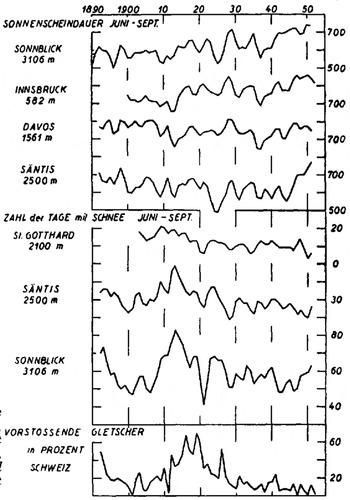
If we consider the most important months for ablation (that is to say June to September), the duration of sunshine and the number of days with snowfall (as an approximation of the alterations of albedo) we obtain the picture shown in Fig. 2 (p. 499) for some of the high-altitude stations in the Alps. The summer duration of sunshine and the number of snowfalls, both duly smoothed in accordance with the formula (a + 2b + c)/4, vary considerably at individual stations, but substantially they agree. At the turn of the century, after sunny summers combined with low snowfall, which put an end to the glacier advance of 1890, a marked reduction of sunshine, begins about 1908, which, except for the sunny summer of 1911, lasts until 1916 and this is accompanied by a very heavy increase in summer snowfalls. In 1912 the glaciers begin to react to these conditions and in 1919 70 per cent of the glaciers in Switzerland are advancing. In 1925 the duration of sunshine at the summit stations of Sonnblick and Säntis again experiences a considerable decrease (this is less marked in the valleys) at the same time as a lessér increase in snowfall; 52 per cent of the glaciers in Switzerland react thereto by an advance.Reference Maurer 8 The decreases of sunshine after 1930 and after 1936 are expressed once again in a weaker tendency of glaciers to advance (1931 22 per cent and 1941 24 per cent of the glaciers in Switzerland). Since then the sunshine duration at all stations increases considerably and the number of days with snow decreases. The correlation of the curve, indicating the number of advancing glaciers (under observation) as a percentage of the total for Switzerland, and the curves for sunshine duration and, in particular, for new snowfalls, is definite and quantitatively adequate.
The top and middle series of curves and the lower curve indicate respectively hours of sunshine, number of days with snow (smoothed, see p. 500) at the stations named in the period, June—September, and the number of advancing glaciers in Switzerland expressed as a percentage of observed glaciers, not smoothed

In recent years many authors, on the basis of careful studies, have come to the conclusion that the summer temperature is to be regarded as the most important factor influencing the behaviour of glaciers.Reference Billwiller 2 , Reference Morawetz 9 , Reference Tollner 12 , Reference Zingg 15 This result is not in contradiction to the results of the measurements which are given here (according to which radiation is the main source of energy for the ablation of the alpine glaciers) so long as this is not combined with the idea that the greater heat exchange from air to ice during a hot summer is sufficient to account for the greater ablation. In an alpine climate in most cases a high summer temperature means weather with much radiation and with infrequent incursions of cold air and snowfalls on the glaciers. A higher air temperature naturally contributes to some extent to the greater ablation, but it appears that it is to be regarded mainly as an index of higher radiation and to less power of reflection of the glacier surface. Th. ZinggReference Zingg 15 explicitly stresses the purely formal character of the relation he has found between the amount of positive temperature and of melt water. Also H. TollnerReference Tollner 12 considers the alterations of radiation and albedo at least as additional effects to the oscillations of air temperature. There is undoubtedly an increase in the summer temperatures in the Alps at present, Reference Tollner 12 , Reference Winter 14 but since the last minimum in 1912—interrupted by numerous oscillations—this only amounts to about 1° C. J. MaurerReference Maurer 7 has been alone in pointing out, in 1914, that the mighty decrease of the alpine glaciers since 1856 can only be very inadequately explained by an increase of the air temperature, and that even then an “extremely effective” period of radiation (1856–77) was the decisive factor, combined with a decrease of precipitation in the firn regions at about the same time. According to P. GötzReference Götz 3 since 1915 the winter snowfalls in Arosa have decreased, which must have had a strong influence on the decrease of the glaciers at that time, and this seems to be of more than local significance.Reference Tollner 12 J. Maurer has assessed the contribution of radiation energy to the total ablation in the Alps at 65 to 70 per cent and he has thus given a figure which is presumably very near the truth if all glaciers are taken into consideration.
The results of the quantitative measurements of heat balance which have been made so far in alpine glaciers can be summarized briefly as follows: The absorption of solar and sky radiation is the most important source of energy for ablation. From this it can be inferred that the glacier decrease in the past century in the Alps is only in a small degree the result of the increase in summer temperature and is predominantly due to the altered character of the summer weather conditions. These are the high and increasing sunshine duration and reduced albedo as a result of the decrease in the frequency of cold air incursions with snowfall on the glaciers. The investigations are to be continued.