


The concept of precedent is fundamental to domestic courts, especially in Anglo-American common law systems, where judges are bound to the court’s past decisions. By contrast, precedent has no formal authority in international law. Legal scholars point to Article 59 of the International Court of Justice (ICJ) Statute in this respect, according to which international legal rulings are binding only on the parties in the dispute at hand, and have no bearing on matters outside of the case.
This is hardly surprising. If courts were bound to earlier rulings in the name of legal consistency, it would also imply that they could impose their interpretation of the rules on the future. From the point of view of governments, this would represent considerable delegation of power. Domestic audiences often resist the idea of their government making any commitments at the international level, let alone allowing unelected judges to modify the meaning of these commitments in a way that countries cannot foresee. Legal scholars warn of the risk of judicial rule-making in this respect: since international courts are not subject to the same legislative oversight as in the domestic realm, these scholars warn that binding precedent would allow courts to “construct obligations where the Parties created none” (Appleton Reference Appleton1999; Barfield Reference Barfield2001; Ragosta, Joneja and Zeldovich Reference Ragosta, Joneja and Zeldovich2003).
In this article, I argue that despite its nonbinding nature, and indeed, in spite of explicit refutations of its authority, both legal and political actors fall under the sway of precedent in international law. Binding precedent may be a legal fiction, but it is one that courts and countries tacitly accept to be bound by. This carries important consequences for institutional change and for who gains and loses from global rules, as state actors exploit the informal authority of precedent, by seeking to shape the meaning of the rules through litigation, long past their ratification.
The invocation of precedent is also a fixture of the social world more broadly. Policymakers routinely invoke the risk of setting a “dangerous precedent” for the future to justify avoiding a path that would seem otherwise beneficial. Settings such as the UN Security Council reveal constant concerns about the precedential impact of state actions, even when these occur outside of legal fora (Johnstone Reference Johnstone2003).Footnote 1 Just as often, state actors look to the past, by claiming the need to “keep with established practice.” Yet political science, and international relations in particular, lack a good grasp of how precedent operates. The question is whether invocations of precedent are strictly rhetorical moves, or whether they observably affect outcomes and state behavior.
The domain of international law represents an ideal laboratory in which to address this question. Its practitioners are trained to recognize and codify precedent, yet as in strictly political settings, precedent holds no formal power over future decisions. It is thus a good setting in which to begin asking, what is the mechanism underlying precedent? And what are its implications for strategic state actors?
The methodological challenge in assessing the effect of precedent is the same as arises in the study of norms, to which the notion of precedent is often associated (Knight and Epstein Reference Knight and Epstein1996). It is difficult to measure the degree to which precedent influences decisions, since in any given instance, there is little means of distinguishing courts’ sincere appeals to precedent from opportunistic ones. In the latter case, rulings justified by reference to a precedent may well have been the same without it. Theory suggests that the possibility of opportunistic invocation implies that some actors must be genuinely swayed by this invocation—otherwise there would no room for opportunism.Footnote 2 Yet with precedent as with social norms, it remains difficult to assess whether on average, these affect behavior, or whether they are instead epiphenomenal.Footnote 3
To address this challenge, this article looks for clues in the behavior of states, rather than the courts themselves. If precedent operates in international law, that is, if verdicts are driven by how similar legal questions were decided in the past, this should have an observable effect on countries’ litigation strategies. Specifically, rational state actors would begin to value disputes not only in terms of how they resolved the matter at hand, but also in terms of how they reshaped the meaning of rules in their favor. One would then expect countries to sometimes strategically file (costly) disputes to achieve a “rule gain,” instead of simply resolving a disagreement. Such behavior would be consistent with a view of precedent as binding; in the alternative, it would make little sense for countries to invest in precedent that would hold no sway over the future.
I test these expectations in the realm of international trade law. The analytical benefit of trade law is that one can readily observe the commercial value of each dispute, by looking at the specific trade barriers being challenged. This allows me to separate the immediate value for the complainant of resolving the dispute from its long-term precedential value. Additionally, World Trade Organization (WTO) rules also explicitly deny the authority of precedent, reinforcing the puzzle motivating this article.Footnote 4 Finally, the question of whether precedent is binding or not at the WTO has never been of greater consequence. With the Doha Round on ice, multilateral trade negotations are at a standstill. What this means is that insofar as liberalization still occurs in the trade regime, it takes place through litigation (Steinberg Reference Steinberg2009; Goldstein and Steinberg Reference Goldstein and Steinberg2008). And if precedent holds authority in trade law, then countries could start litigating the questions they cannot legislate. In this respect, the present situation in the trade regime bears a strong resemblance to the European Union (EU) in the 1970s, which was also characterized by negotiating deadlock. There too, the courts and the notion of precedent, emerged to play a strong role in shaping the institution’s evolution. I draw out this analogy in the discussion of the findings.
I calculate the long-term precedential value of cases by relying on social network analysis. To do so, I construct an original dataset, consisting of the full network of all rulings adopted during the WTO period, and the cases they cite. The network approach allows me to observe how disputes relate to one another, and thus how a ruling impacts the legal regime’s jurisprudence. A dispute’s precedential value is then proportional to (i) the number of times it is cited by other disputes initiated by the same complainant, and to (ii) the commercial significance of those citing disputes. In other words, precedential value denotes the exploitation of a dispute in subsequent high value cases filed by the same complainant.
The article puts forth three main arguments. First, there exists a category of WTO cases that countries file not for their immediate commercial value, but for their future precedential value. Such seminal cases, in accordance with domestic legal theory, tend to be commercially unimportant and target smaller countries, yet they exert a disproportional effect on jurisprudence. And while countries set such precedents through low stakes cases, they then turn around and exploit them on high stakes disputes.
Secondly, the existence of such de facto binding precedent may hold distributional consequences: members with high legal capacity may be significantly more likely to file seminal cases which they subsequently exploit in commercially significant disputes. Insofar as litigation is a means of shaping the meaning of the rules, wealthy countries that are able to file a string of consecutive disputes appear to have a notable advantage in affecting that meaning to suit their preferences. In a twist that will be familiar to students of the politics of domestic courts, when it comes to reshaping international rules after they have been set, the “haves” may come out ahead.Footnote 5
Finally, countries filing test cases with a view to building precedent are not the only ones acting strategically. It follows that if some countries are sufficiently far-sighted to invest in precedent on low-salience disputes, others should be able to recognize and contest these efforts, if the resulting precedent would be unfavorable to them. This is what we observe: contestation of complainants’ claims by third countries appears systematically more likely in the cases that go on to garner greater precedential value. In sum, countries’ attempts to reshape the rules through litigation do not go unopposed.
Despite precedent having no formal authority in trade law, legal and political actors behave as if it were constraining. While countries could seek to undermine the very notion of precedent as binding when it suits them, they rarely do so. Instead, states tacitly accept the weight of precedent, and invest in exploiting it for their benefit.
The remainder of this article proceeds in four parts. The next section establishes what we already know about precedent, specifically in the context of international law. Next, I present the theory, and an illustration of the argument using a series of cases filed by the European Union. I then test these theoretical expectations, and conclude with a discussion of the findings’ implications.
PRECEDENT IN INTERNATIONAL LAW: WHAT DO WE KNOW?
The doctrine of stare decisis states that “past decisions must stand.” The idea that similar cases must be decided in similar ways is the fundamental belief underlying common law systems (Steinberg Reference Steinberg2004) and an inherent aspect of legal practice more generally (Kratochwil Reference Kratochwil1991). By contrast, the ICJ Statute's Article 59 states that “a decision of the ICJ has no binding force except between the parties and in respect of the particular case.” The Statute is widely seen as embodying principles applicable to international law broadly held, and representing the fullest available statement about sources of international law (Ginsburg Reference Ginsburg2005). In short, international courts are explicitly not bound by precedent.
That there would be reticence to render precedent binding in international law is hardly surprising. Countries are commonly resistant to making enforceable international commitments in the first place; binding precedent represents an important step in the direction of further delegation. Under binding precedent, the meaning of a home country’s obligations can be affected overnight as a result of an interpretation by foreign judges in a case involving foreign parties, and into which the home country may have had no input—an unnerving possibility from the point of view of domestic audiences. Nor is this reticence limited to domestic audiences: the notion of binding precedent is at odds with a widespread legal norm according to which courts—especially international courts—should not impose “definitive interpretations.” In this view, international courts lack the legislative oversight and jurisdictional controls present at the domestic level, and thus the legitimacy to modify the meaning of rules in a lasting fashion (Barfield Reference Barfield2001). Unlike in the domestic context, international courts are not “subject to review by the legislature, oversight and modification” (Ragosta, Joneja and Zeldovich Reference Ragosta, Joneja and Zeldovich2003, 703). These scholars argue that binding precedent risks exacerbating the democratic deficit flowing from international courts’ lack of accountability.
This is not to say that international courts do not cite their past decisions. As Ginsburg (Reference Ginsburg2005, 8) notes, even in the ICJ itself, 26% of cases decided between 1948 and 2002 invoked past rulings. But as he goes on to concede, this does not mean that precedent had any influence on these verdicts. The same debate also occurs in settings such as the US Supreme Court, where the role of precedent is far more established than in international law, as attested to by an ambitious literature.Footnote 6 Both Knight and Epstein (Reference Knight and Epstein1996) and Segal and Spaeth (Reference Segal and Spaeth1996), for instance, agree that there exists a norm of stare decisis at the US Supreme Court; yet while Knight and Epstein (Reference Knight and Epstein1996) argue that it constrains judicial positions, Segal and Spaeth (Reference Segal and Spaeth1996) disagree, claiming that it serves mostly as an ex post legitimation of legal opinions.
Other international and supranational courts exhibit similar ambiguity, at once denying the formal authority of precedent and promoting the desirability of judicial consistency. The European Court of Justice, the European Union’s constitutional court, also does not recognize precedent to be formally binding. But ECJ judges do “pay considerable attention to their earlier case-law” (Rosas Reference Rosas2006, 488).Footnote 7 Attempting to strike this balance can result in convoluted language, as when ICJ Judge Shahabuddeen wrote that “the Court accordingly pursues a judicial policy of not unnecessarily impairing the authority of its decisions” (Shahabuddeen Reference Shahabuddeen2007, 132). The picture looks much the same in the European Court of Human Rights (ECtHR), where, in its own words, “It is true that ... the Court is not bound by its previous judgments .... However, it usually follows and applies its own precedents.”Footnote 8 “Usually” following past practice admittedly sets a low bar for precedential constraint.
Despite continuing ambiguity over its actual function, what binding precedent entails for the purpose of empirical analysis can be clearly stated. If stare decisis holds, then there must be cases that would have been decided differently were it not for the existence of a past verdict. This is not to say that precedent need be deterministic—but if precedent is said to affect courts’ decisions, then there must be cases where a court that would have ruled one way in the absence of a past verdict rules another way because of it.Footnote 9 This counterfactual is a difficult one to test empirically, but given a sufficiently large caseload, a standing body of judges, and signed dissenting opinions, it could be tested for a specific series of cases.Footnote 10 Yet these conditions are difficult to meet in international law.
It is equally clear what precedent is not. Precedent represents a causal relationship: if the underlying causality is spurious, then we are dealing with something other than binding precedent in the sense of this article. Two possible functions of past decisions, in particular, should not be conflated with the doctrine of stare decisis. First, precedent cannot amount to information-gathering about judges’ positions. In other words, continuity in rulings could simply be the result of consistent judicial preferences across time. In this way, precedents could simply serve as previews of the likely outcome of a subsequent verdict, without earlier verdicts constraining later ones. In the specific case of the trade regime, the fact that panelists are pulled from a roster of over 400 individuals makes such a function of precedent as information-gathering about individual judicial preferences unlikely (Busch and Pelc Reference Busch and Pelc2009).
Second, precedential logic cannot be reduced to learning; indeed, it largely corresponds to its opposite. It may be that the consequences of decisions become clearer in hindsight. But precedent cannot simply be a means by which the good decisions of the past are selectively invoked and repeated. Rather, the notion of precedent takes on its full meaning precisely when past decisions are deficient: it is then that the hold of precedent on subsequent rulings faces its hardest test.Footnote 11
Precedent in the Trade Regime
As in the rest of international law, there is broad consensus over the absence of formal binding precedent at the WTO. The panel in US—Zeroing says as much in a recent ruling: “In our view, there is not a system of precedent within the WTO dispute settlement system and panels are not bound by Appellate Body reasoning.”Footnote 12 The Appellate Body, the WTO’s higher court, has explicitly struck down claims by panel judges that argued the contrary. In one such instance, a panel of judges attempted to argue that past rulings comprised “subsequent practice” within the meaning of the Vienna Convention on the Law of Treaties—to which the WTO Agreement is subject—in which case past rulings would become a source of law. The AB forcefully disagreed, arguing that the contracting parties did not intend for panels’ rulings to become definitive interpretations of the rules.Footnote 13 Similar denials of binding precedent are also found elsewhere in WTO law. Presciently, Article 3.2 of the Dispute Settlement Understanding (DSU) reads “Recommendations and rulings of the DSB cannot add to or diminish the rights and obligations provided in the covered agreements.” The intent is unambiguous: judicial rulings should not change the meaning of countries’ commitments under the agreement.
Yet these same judges appear able to tolerate some disparity between legal status and practice. When the aforementioned panel in US—Zeroing declared that there was no system of precedent in the WTO, it went on in the same breath to cite the AB in a more liberal stance:
“...we agree with Korea that adopted reports create legitimate expectations among WTO MembersFootnote 14 and that ‘following the Appellate Body’s conclusions in earlier disputes is not only appropriate, but is what would be expected from panels, especially where the issues are the same”Footnote 15
Common though it may be, whenever WTO judges invoke past rulings to justify their decision, they expose themselves to accusations of flouting DSU Article 3.2 and engaging in judicial rule-making. In the very same US—Zeroing dispute, the United States pushed back against the panel’s references to past rulings, reminding everyone that: “...the Panel is not bound to follow the reasoning of any prior report. According to the United States, the Panel is charged with making its own objective assessment of the matter before it.”Footnote 16 What is striking is how rare such explicit remonstrations on the part of countries have been.
Instead, it is legal scholars who have been most vocal in their concerns over the elevation of precedent at the WTO. These scholars are not against legal consistency per se. Rather, they recognize that an obligation to follow past decisions implies the power to impose an interpretation of the rules on the future. Precedent following cannot only be backward-looking (Schauer Reference Schauer1987). These scholars’ concern is that if rulings have effects beyond the case at hand, international courts are empowered in a way that runs into “deeper questions of legitimacy and accountability stemming from the ‘democratic deficit’ inherent in this process” (Barfield Reference Barfield2001, 43). Ragosta, Joneja and Zeldovich (Reference Ragosta, Joneja and Zeldovich2003) warn that the court might “abuse its binding nature to create WTO ‘common law,’ to which the Members never agreed.” They caution that binding precedent might empower WTO judges to create obligations where country negotiators never intended for there to be any. The result, they warn, may threaten support for additional liberalization. Some view this threat as sufficient grounds for exiting the WTO altogether (Ragosta, Joneja and Zeldovich Reference Ragosta, Joneja and Zeldovich2003). The greater point is that a commitment to legal consistency necessarily entails the empowerment of international courts beyond what some view as a legitimate threshold.
These views all support the notion that the meaning of the law cannot be derived unambiguously from the text. Law is made and changes incrementally by way of interpretation (Dworkin Reference Dworkin1982; Venzke Reference Venzke2012).Footnote 17 Strikingly, the WTO itself recognizes this intersubjective aspect of rules’ evolution, and it explicitly restricts the power of “definitive interpretation” to states.Footnote 18 Article IX:2 of the WTO Agreement states that “[t]he Ministerial Conference and the General Council [member states] shall have the exclusive authority to adopt interpretations of this Agreement and of the Multilateral Trade Agreement.”
In sum, there is considerable analytical ambiguity over the function of precedent. On the one hand, there is consensus as to precedent’s lack of formal authority in international law, and trade law in particular, and a group of observers who warn against straying from it. On the other hand, both judges and parties routinely invoke past rulings under the banner of legal consistency. It is this discrepancy between principle and practice that this article explores empirically. The underlying premise of the article is that if precedent changes state expectations over what policies the rules allow, it should have an observable effect on behavior, no matter what its formal status may be.
The empirical literature considering the implications of precedent on country behavior is limited. While many have followed in the footsteps of Bhala (Reference Bhala1998) in distinguishing between de jure and de facto stare decisis, few have suggested means of testing which one is more applicable in practice. Among these, Busch (Reference Busch2007) claims that the incentive to set a precedent multilaterally leads NAFTA members to file at the WTO instead of NAFTA, even when NAFTA rules offer a more favorable verdict on a case’s merits. More recently, Davis (Reference Davis2012) considers the spillover effects flowing from precedent, asking whether countries internalize rulings sufficiently in disputes to which they are not party to modify their own domestic legislation accordingly.
And some anecdotal evidence hints at countries employing the kind of strategy this article seeks to identify. As Simmons and Guzman (Reference Simmons and Guzman2005, 567) mention in passing, powerful countries are more likely to initiate WTO cases with “long term precedential value,” without going further into how we would know this was happening. Closest to this article’s line of argument, Porges (Reference Porges2003) claims that a “government may have as its objective the establishment of a legal precedent rather than any particular commercial outcome.” Here, I use a novel empirical approach, applied for the first time to the WTO setting, to evaluate whether these claims can be verified. Does precedent in international law affect state behavior?
RESEARCH DESIGN
The approach I take to address this question is to examine countries’ filing decision: which disputes get filed, and why? The conventional wisdom is that countries file a case to bring down discriminatory trade measures that hurt domestic exporters. This is largely seen as a demand-side story, as exporters facing noncompliant barriers abroad mobilize and lobby their government to enforce their rights under the agreement. The government then decides which disputes to pursue. Given how disputes are costly, they are seen as credible signals to the industry that the government is upholding their interests (Davis Reference Davis2011). For this exercise to be worthwhile, the underlying trade at stake needs to be significant. As Horn, Mavroidis and Nordström (Reference Horn, Mavroidis and Nordstrom1999) put it, for a discriminatory measure to be a potential candidate for a WTO dispute, bilateral trade flows in the underlying product must exceed some significant “threshold.”Footnote 19
The puzzling fact is that many disputes do not reach this threshold. Some disputes concern ostensibly minor discriminatory barriers, affecting a seemingly trivial amount of trade. This suggests that considerations other than immediate commercial interest may be motivating the filing of disputes. If past rulings are perceived as exerting a constraint on future rulings, one such consideration would be a case’s precedential value, or the extent to which a ruling can shape the agreed upon meaning of WTO rules in the complainant’s favor.
All disputes are filed by a limited number of countries. By way of illustration, the two major powers, together with Canada and Brazil, account for over half of all complaints in the caseload of an organization that now counts 159 members. In other words, the system features a number of “repeat players” (Galanter Reference Galanter1974). These are countries with sufficient legal capacity to file a dispute not primarily as a means of bringing down the contested barrier, but rather as a means of setting a precedent which could be subsequently exploited. As Davis (Reference Davis2012) puts it, “[a]s the strength of the legal case against a measure improves on the basis of past precedent, governments on the complainant side will be more likely to go forward with the case.” The point is that countries can build up this strength themselves through prior filings.
Litigation may simply be an easier means of affecting country behavior than negotiations. The EU setting provides a historical analogy: faced with disagreement over intellectual property (IP) regulations in the 1980s, affected private parties took to the courts. Current IP law in the European Union is largely beholden to this early litigation.Footnote 20 The European Court of Justice (ECJ) effectively wrote much of European IP law.Footnote 21 Similarly, in the absence of any progress under the current trade round, litigation becomes the main formal means of pressuring trade partners.
How can we tell whether countries sufficiently believe in the binding nature of precedent to invest in it? The legal literature offers some clues of what “test cases” should look like (Alter and Vargas Reference Alter and Vargas2000; Galanter Reference Galanter1974; Porges Reference Porges2003).Footnote 22 Disputes that are initiated primarily with an eye to setting precedents to exploit in subsequent higher profile cases are unlikely to target a policy that happens to be of utter importance to the defendant. Similarly, these disputes should not represent too significant a domestic industry, lest that industry capture the litigation process and influence the legal arguments the governments wants to put forth (Porges Reference Porges2003). Finally, these are, by construction, cases where the complainant is willing to take a tangible loss in exchange of a rule gain. The objective must not to be “win” the dispute per se, but rather to obtain the sought-out interpretation of the rules.
For all these reasons, “test cases” in trade are likely to target commercially unimportant markets, leaving the complainant greater latitude to push for its desired legal interpretation. When the commercial stakes are low, defendants grow less likely to dedicate many resources to contesting the complainant’s claims; the complainant faces less domestic pressure to target its arguments in a given way; and it can allow itself to lose the case, as long as it obtains its sought-out language.Footnote 23 This reasoning leads to the following theoretical expectation:
H1: All else equal, cases with lower commercial value should go on to acquire greater precedential value, from the point of view of the complainant.
This is an analytically convenient hypothesis. Absent the effect posited in H1, we would expect that commercially important cases would lead to relatively higher, rather than lower, precedential value. Indeed, commercially important cases attract more attention. They are more likely to be trumpeted by the media. They tend to draw more third party countries, who are nonlitigant countries that can be present in the room during both consultations and litigation (Busch and Reinhardt Reference Busch and Reinhardt2006). Such third parties are then better informed of the details of the dispute, and become more likely to build subsequent litigation on the basis of that ruling. Foreign industries are more likely to be aware of how commercially significant cases have affected their odds of successfully challenging a similar barrier, and would thus be more likely to lobby their government to do so. Resulting filings would entail a boost to the initial case’s precedential value. For these reasons, if the observed relationship between commercial value and precedential value is nonetheless negative, we can conclude that countries’ strategic shaping of the WTO acquis through commercially unimportant cases is significant enough to trump what one might call the publicizing effect of commercially significant cases.
Before describing how a dispute’s precedential value is calculated, it is worth addressing one possible question: one might think that if precedent were perfectly binding, then it would rarely need to be invoked. Indeed, past cases could dictate the likely outcome of disputes. These would either never need to be initiated, or they would be settled before ever making it to litigation, which is always an inefficient outcome. Two responses are in order. The first is that applying precedent is always the result of interpretation, and outcomes are thus inevitably partly uncertain. Even under stare decisis, favorable precedent could tip the scales towards one party, yet it is not deterministic. Uncertainty remains over the exact outcome. Much as with armed interstate conflicts, such uncertainty is enough to lead to a breakdown of bargaining, and resulting litigation. The second point is that for domestic political reasons, defendants often prefer to go through the motions of dispute settlement even when the outcome is certain. The recent Australia—Apples dispute is a near carbon copy of a prior case filed by the United States, Japan—Apples.Footnote 24 Despite the fact that the eventual outcome was known with high probability, Australia did not settle the case: it needed to demonstrate to its own powerful apple producers that it was fighting to preserve its more than 85 year-old ban on New Zealand apples. New Zealand won the case as expected, and Australia has used the WTO as political cover to justify lifting the ban.Footnote 25 In sum, we would often expect to see litigation even in cases where favorable precedents made the likely outcome clear.
EMPIRICS: MAPPING PRECEDENTIAL VALUE THROUGH NETWORK ANALYSIS
The jurisprudence of courts can be usefully conceived of as a network, where each ruling is a node, and each citation to another ruling is a unidirectional link. Network approaches are especially apt for the task of representing complex relationships between entities. These can be between individuals, websites, academic articles, industry patents, or in this case, legal rulings. As with scientific articles, rulings have a cumulative aspect: ruling A that cites ruling B may also be indebted to the reasoning of the disputes that ruling B has itself cited in arriving at its own conclusions. What a network approach allows one to do is to measure the level of such indebtedness for every dispute in the system vis-à-vis every other dispute.
Collecting the data required for constructing the WTO’s citation network is relatively straightforward: all citations are found in footnotes in publicly available panel rulings, and use a consistent coding format,Footnote 26 allowing for quick retrieval of all a dispute’s citations, and leaving little room for error.Footnote 27 The only difficulty consists in ensuring that the citations come from the panel or the AB itself, rather than from the litigants or third parties to the dispute presenting their arguments. The citations relevant to the network analysis are those of judges. Of course, if a litigant rests an argument on a past dispute, as is often the case, it is highly likely that judges will address this argument by citing the dispute, but only then does it enter the dataset as an additional link.Footnote 28
I restrict my attention to panel reports as citing cases, and leave out citing AB rulings—that is, I am interested in the higher court only as a cited entity. This is because the function of the AB is different from that of panels: it has no fact-finding ability, and has to limit itself to examining the panel ruling being appealed. Conversely, I allow cited cases to be either panel or AB reports. The jurisprudential impact of a panel ruling is best thought of as “net of appeal.”Footnote 29
Some additional characteristics of the data are worth mentioning. As with all citations, academic or legal, the links between vertices make no distinction as to how the citation is employed. It could be that the panel is being critical of a past ruling, and cites it for this reason, though this rarely occurs in WTO panel rulings. Moreover, a link conveys that the case being cited has relevance to the current dispute, which is sufficient for the purposes of the analysis.
The data contain only WTO cases; extra-WTO citations are omitted. Not surprisingly, early WTO cases tended to cite GATT cases and reference external agreements (such as the Vienna Convention on the Law of Treaties) to a greater degree than more recent cases, likely in a bid for legitimacy, yet this is not reflected in the data. This point touches on the importance of time. Because of the relatively short WTO history, especially when compared against other courts that have been studied through network analysis, such as the US Supreme Court or the European Court of Human Rights, one needs to be especially conscious of the effect of time. Present cases can only cite past cases.Footnote 30 In such networks, nodes representing more recent cases are less likely of having a high in-degree, that is, of being cited by many cases. I account for this by including a time parameter in all the estimations.
The Example of European Safeguards Disputes
To illustrate both the theory and the approach taken to test it, I examine a series of disputes fought over the same legal issue: safeguards. Safeguards constitute the quintessential escape clause of the trade regime: they allow members to temporarily escape their obligations when confronted with difficult domestic circumstances. Together with antidumping and countervailing duties, they form one of the regime’s three trade remedies. Up to 1995, the exercise of safeguards fell under the GATT’s Article XIX, which was then superseded by the Agreement on Safeguards with the inception of the WTO.
With the creation of the WTO, safeguards became considerably easier to use. This reflected an effort to turn countries away from resorting to alternative policy instruments, which were usually considered to be more economically distortionary.Footnote 31 Compensation, for instance, was no longer required of members using the safeguard (Pelc Reference Pelc2009). As Bown (Reference Bown2002, 58) put it at the time, it is difficult to imagine by what means the WTO’s new Agreement on Safeguards could have made the escape clause any more attractive to WTO members, short of paying members to exercise it.
The European Union has long stood out among WTO members by how little it relies on safeguards. By 2001, which was, as this discussion goes on to show, a turning point in the use of safeguards, the European Union had not filed a single safeguard investigation on behalf of its industries. The United States, by comparison, had initiated ten important investigations for large industries. Emerging economies like India, which counted as many investigations as the United States in 2001, as well as Argentina, were already heavy users by this point, on their way to becoming the most frequent users of trade remedies in the system.
Faced with what was from its standpoint a costly rise in the use of safeguards by trade partners, Europe took on the issue in dispute settlement. Given its own low use, any legal constraints on the exercise of safeguards represented a net gain from Europe’s standpoint. Such constraints would come at little cost to its own policy space, and would decrease the extent to which its trade partners could erect barriers against European exports.
Yet Europe did not take on the issue of safeguards by challenging large markets, or countries, like the United States or India, that had a high vested interest in the issue. It began by challenging a small barrier in a tiny market, over Korean safeguards on skimmed powdered milk, in 1997. In this first dispute, the European Union made a bold legal claim: despite the WTO’s Agreement on Safeguards no longer making any mention of it, the European Union invoked a clause from GATT Article XIX which required that the WTO Member exercising a safeguard action find itself faced with developments it had not “foreseen” or “expected.” This clause had gone unenforced even under the GATT, and the WTO’s Agreement on Safeguards made no reference to it.
Before the panel had ruled in the dispute against Korea, the European Union filed another safeguards dispute, this time against Argentina, over footwear. The commercial value of this case for Europe, measured in bilateral trade flows, was even lower than Korea’s powder milk market had been. Here too, Europe made its legal claim about “unforeseen developments.” Europe’s efforts did not go unnoticed. As Porges (Reference Porges2003) put it at the time, speaking of the two concurrent cases, “the disputes concerned export markets of little or no commercial concern to European exporters [...]; the very lack of stakeholder interest left Commission litigators with a free hand to target their arguments.”
Europe got its way. In both disputes, the AB affirmed the authority of the “unforeseen developments” clause, as per the European Union’s arguments. In the second of its rulings, the AB went as far as to underline the continuity of its reasoning: “[w]e have recently confirmed this principle in our Report in [Korea–Dairy].”Footnote 32
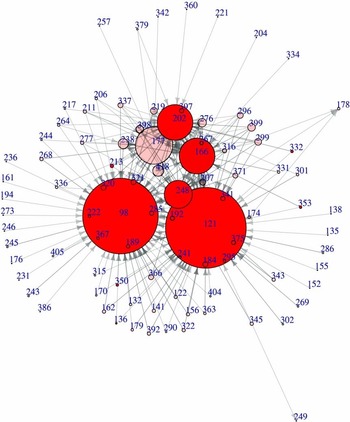
Europe obtained the language it was seeking. The precedent, as it were, was set. Every single subsequent safeguards case has cited these two rulings, net of appeal, to justify the continued relevance of the “unforeseen developments” clause, despite its absence in the Agreement on Safeguards. What some have described as judicial activism on the part of the AB was, by 1999, a fait accompli: since then, there exists a shared, WTO-wide understanding that safeguards flout the rules unless the domestic circumstances leading to their use are “unforeseen” (Goldstein and Steinberg Reference Goldstein and Steinberg2008; Pelc Reference Pelc2009). Despite the lack of formal binding precedent, for all intents and purposes, Europe obtained a rule change through litigation that it could never have obtained through negotiation. The centrality of these two disputes of negligible commercial importance to jurisprudence over safeguards comes across clearly in Figure 1. The figure shows the universe of safeguards disputes: all disputes that either cite or were cited by a ruling on safeguards. The size of the nodes is proportional to their in-degree, that is, to the number of other rulings that cite them. What is evident is that despite their commercial insignificance, Korea—Dairy (DS98) and Argentina—Footwear (DS121) have disproportional jurisprudential impact. Figure 1 also makes light of another fact: all EU-initiated disputes are shaded in red. The take-away is that all seminal safeguards cases have been filed by the European Union.
Europe’s Seminal Safeguards Cases, EU filings vs. ROW

Indeed, after the rulings in Korea—Dairy and Argentina—Footwear, the European Union filed two more safeguards disputes in short order; these were no longer over small markets. In both US—Line Pipe and US–Steel Safeguards, the amount of trade at issue was more than 55 times greater than had been at stake in the disputes against Korea and Argentina. Both US—Line Pipe and US—Steel Safeguards belong in the top 5% of all WTO disputes according to trade value. In both cases, the industries in question were politically powerful, and frequently petitioned for safeguards. The second of these cases remains one of the most notorious disputes in the WTO. When the United States raised safeguards on steel in 2001, it was widely condemned across the membership, and the legal proceedings pit the United States against much of the rest of the world. The panel ruled against the United States on all claims, and did so by invoking the rulings in the two cases the European Union had filed three years prior. When the United States appealed, the AB upheld all the panel’s findings, including the “unforeseen developments” claim, by pointing to its finding in Korea–Dairy and Argentina–Footwear. The steel safeguards dispute marked a turning point. The United States ceased relying on safeguards almost entirely (Pelc Reference Pelc2009). By 2010, it had not filed a single other safeguard investigation.
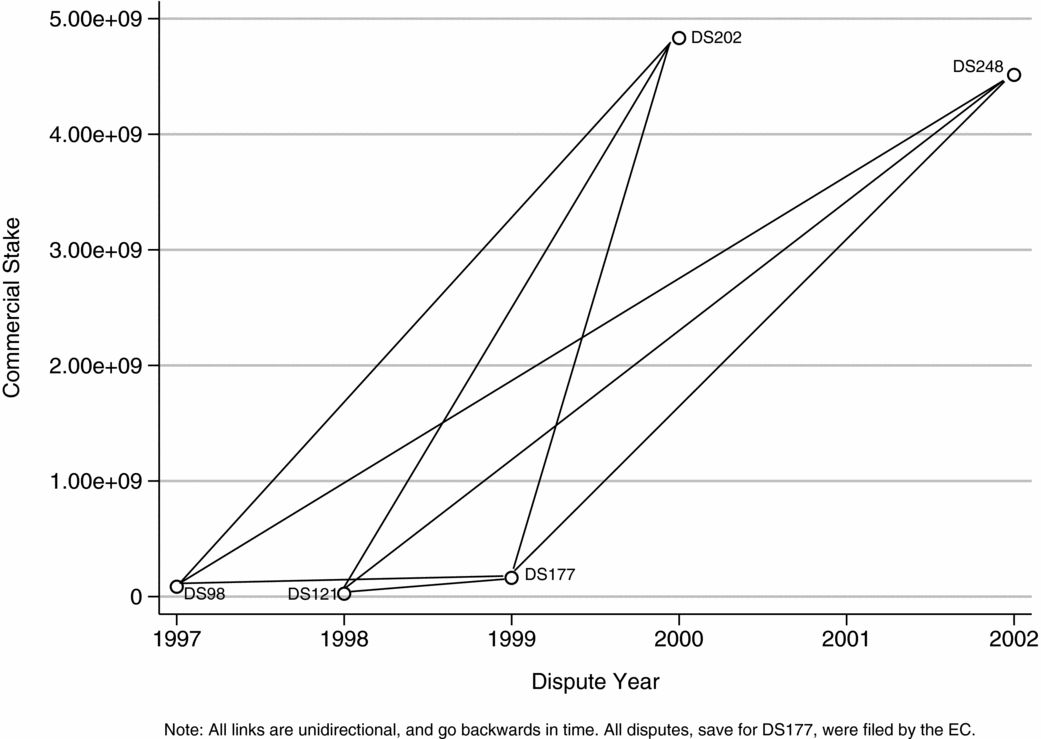
Europe thus successfully suppressed the use of safeguards through litigation. It led to an interpretation of the rules which likely could never have been achieved through negotiation within a trade round (Goldstein and Steinberg Reference Goldstein and Steinberg2008). And it did so in a specific way, by setting the precedent through a series of low commercial value disputes, and then relying on this precedent in subsequent high value cases. The resulting pattern is shown in Figure 2, which illustrates the relevant citations network across time and commercial value. Because of the acyclic nature of citation network graphs, all unidirectional citation links go back in time—a case cannot cite a future ruling to justify its reasoning. What Figure 2 makes evident is the increase in commercial value over the life of this citation path. Europe shapes the WTO acquis in low commercial value cases, and later exploits that precedent in higher value cases. The positive slope of the links, in this case, is meaningful. It suggests that when it comes to building precedent, countries “buy low and sell high”: they invest in precedent in low stakes disputes, when they encounter least resistance, and reap the benefits in higher stakes cases.
Charting the Commercial Value of a Precedent Chain Across Time

Comparing Figure 1 to Figure 2, it becomes evident that for the safeguards issue area, Europe’s legal strategy is apparent. As a result, commercial and precedential value are negatively correlated across this subset of disputes. The question is, to what extent does this pattern apply to the universe of WTO disputes? Do other countries systematically behave in a way similar to the European Union on safeguards, using low salience disputes to shape jurisprudence in a way that favors them subsequently?
Network Analysis
Most recent legal network studies aim to measure how “legally central” (Fowler, Johnson, Spriggs, Jeon and Wahlbeck Reference Fowler, Johnson, Spriggs, Jeon and Wahlbeck2007) or how “strongly embedded in case law” (Lupu and Voeten Reference Lupu and Voeten2010) a case is. Fowler, Johnson, Spriggs, Jeon and Wahlbeck (Reference Fowler, Johnson, Spriggs, Jeon and Wahlbeck2007) do so to show that reliance on precedent in the USSC has risen through time; that reversed Supreme Court decisions are more “important,” or legally central, than others; and that judges are more likely to ground such reversals in case law. Lupu and Voeten (Reference Lupu and Voeten2010), in turn, find that ECtHR cases where the value of persuading judges in domestic courts is higher tend to be more embedded in case law. Taking a further step in examining the development of legal doctrine, Clark and Lauderdale (Reference Clark and Lauderdale2012) add a useful innovation by considering the extent to which a ruling relies on past opinions to arrive at an alternative measure of legal significance.
The aim of this article is different. I am interested in the extent to which a given country files disputes that it then relies on—directly or indirectly—in subsequent commercially important disputes. The main departure from the above studies is that the level of analysis is at the complainant level: the analysis is concerned with the strategic behavior of countries pursuing their own interest through litigation. The second distinction is that I am concerned with an additional dimension, that of commercial value.
For these reasons, I depart from the prevalent method employed in the legal networks literature, which calculates centrality measures by relying on a recent advance in web search theory, called Kleinberg scores (Kleinberg Reference Kleinberg1999). Kleinberg scores measure the degree to which nodes serve as hubs and authorities. Hubs are those cases that cite many rulings; authorities are those cases that are cited by many rulings. Both have a mutually reinforcing effect: a case’s authority score grows when it is cited by many good hubs. Conversely, a case’s hub score grows as it cites many good authorities.
Yet the emphasis that Kleinberg scores put on hubs is a premise that travels poorly to the WTO context. Because of the relatively small size of the WTO network and the considerable expertise of judges, we obtain relatively little information about the “quality” of a ruling from its ability to cite good authorities. In this case, identifying and citing good authorities is neither costly, nor is it especially difficult, in a way that might tell us something about the quality of panelists’ rulings.Footnote 33
Instead, the starting point of the approach used here goes back to an earlier and simpler network measure by Katz (Reference Katz1953). Katz centrality measures the influence of a given node in a directed acyclic network by measuring all the paths leading to it, but discounting indirect citations in proportion to how far on the path they are. In other words, a ruling C adds more to the centrality of A when it cites it directly, rather than when it cites a ruling B which in turn cites A. This discount rate, or what Katz called the attenuation factor, is a tunable parameter β that is set, within certain bounds, by the user. Setting β to 1 would mean no attenuation, so that indirect citations would be just as valuable as direct citations. Setting β to 0 would mean that only direct citations mattered. The analysis here employs an α of 0.35, though varying this measure from 0.2 to 0.5 has no discernible effect on the analysis.
Using the adjacency matrix Aji , the centrality measure of node i, determined by whether node j links to it, in a network of (n + 1) nodes, is expressed as
 \begin{equation}
c_i = \sum \limits _{j=1}^n (\beta A + \beta ^2 A^2 + \beta ^3 A^3 + \cdots )_{ji}. \vspace*{-3pt}
\end{equation}
 \begin{equation}
c_i = \sum \limits _{j=1}^n (\beta A + \beta ^2 A^2 + \beta ^3 A^3 + \cdots )_{ji} W_j. \vspace*{-3pt}
\end{equation}
 \begin{equation}
c = w[(I -\beta A)^{-1} -I]. \vspace*{-3pt}
\end{equation}
 \begin{equation}
C = W((I -\beta A)^{1} -I) \vspace*{-3pt}
\end{equation}
Precedential Value vs. Inward Citations
The measure of interest, precedential value, is thus quite distinct from a case’s in-degree, or the number of disputes that cite it directly. The key distinction is that precedential value considers both indirect citations, and the commercial value of citing cases, and is measured from complainant’s point of view. Across all WTO cases, the dispute with the highest in-degree is US—Wool Shirts and Blouses. This dispute, filed by India and ruled on in 1996, set a number of important precedents.Footnote 34 Yet in terms of precedential value to the complainant, India, it ranks only 27th among the disputes in the system. A even starker example of this contrast is US—Gasoline, which was initiated by Venezuela. While it ranks as the 4th most cited dispute across the system, its precedential value is nil. What this means is that no subsequent dispute of positive commercial value initiated by Venezuela either cites US—Gasoline or cites another dispute (initiated by whomever) that in turn cites US—Gasoline. In other words, there exists no commercially significant hub filed by Venezuela that is on a citation path that counts US—Gasoline as an authority. If Venezuela set any useful precedent in the dispute, it did not exploit it subsequently.
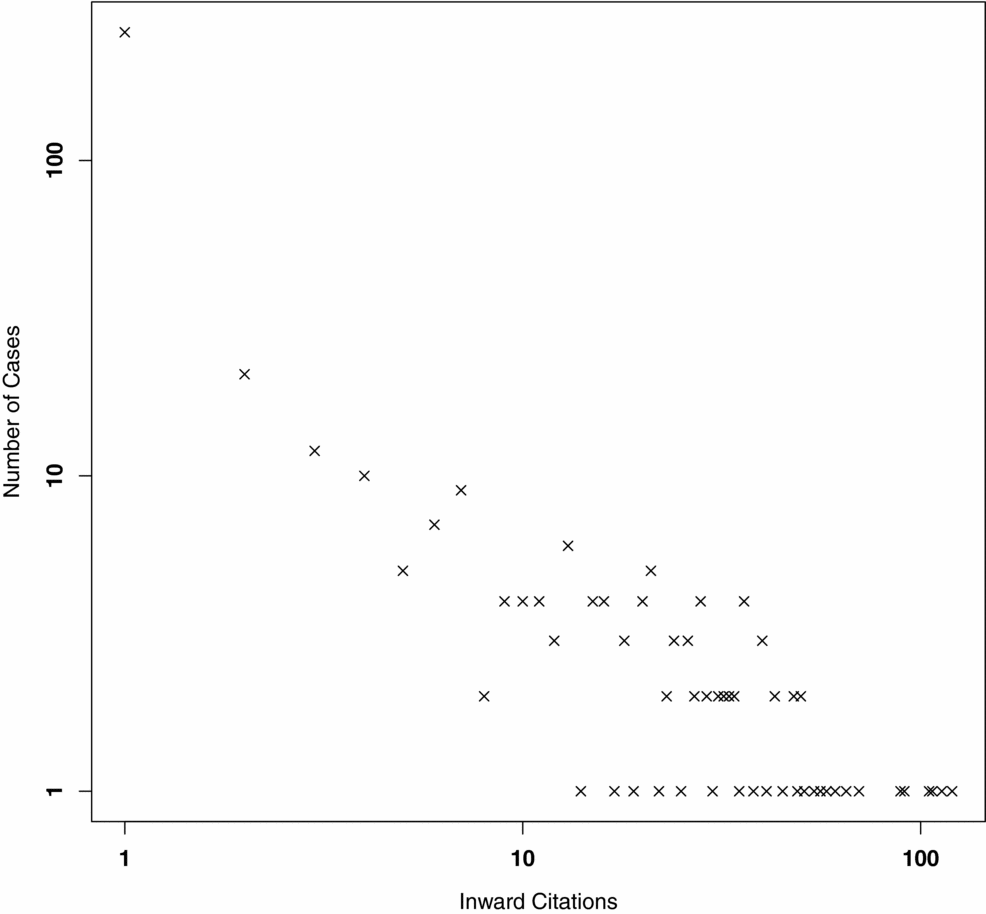
It is nonetheless useful to consider the in-degree of disputes across the network, both as a description of the network, and as a test of the data. This distribution is graphed in Figure 3, where both the number of citations, on the horizontal axis, and frequency, on the vertical axis, are logged. It shows the power-law tail that we expect from scale-free networks, or networks where nodes join in accordance with preferential attachment. In this case, there are a few cases in the network that are subsequently cited a great number of times.
Distribution of Inward Citations Across WTO Disputes

Considering instead precedential value as defined in (4), the dispute that ranks highest in the system is Japan–Alcoholic Beverages II, initiated by the European Union, and ruled on in 1996. What this means is that Europe went on to file a number of commercially important disputes that relied on the precedents set in Japan—Alcoholic Beverages II, either directly or indirectly.
Tests
Do countries strategically shape precedent? Do they file low commercial value cases to build up valuable precedent that they subsequently exploit? To answer this question, I calculate the precedential value, in the manner outlined above, of all cases since 1995 where a ruling was adopted in the WTO, which make up all the nodes in the WTO network. This measure of precedential value makes up my main dependent variable throughout the analysis. I also re-estimate the same model using the simpler in-degree measure as the dependent variable instead, and compare the results. The level of analysis is the complainant dispute, since I am interested in whether individual complainants observably invest in precedent. A few disputes include more than one complainant. The resulting sample counts 171 observations.
Both to code my main independent variable of interest, the Logged Commercial Value of every dispute, and to arrive at the weight w used in the calculation of the centrality measure above, I first identify the traded products at issue in every case. These are coded in the Harmonized System (HS) at the six-digit level, and are taken from the Horn and Mavroidis database of WTO disputes, hosted by the World Bank,Footnote 35 which I complete and extend using WTO documents. I then rely on trade flows data from the World Integrated Trade Service (WITS), also hosted by the World Bank, to calculate the bilateral trade flows of the products at issue in the dispute in the year preceding its initiation.Footnote 36
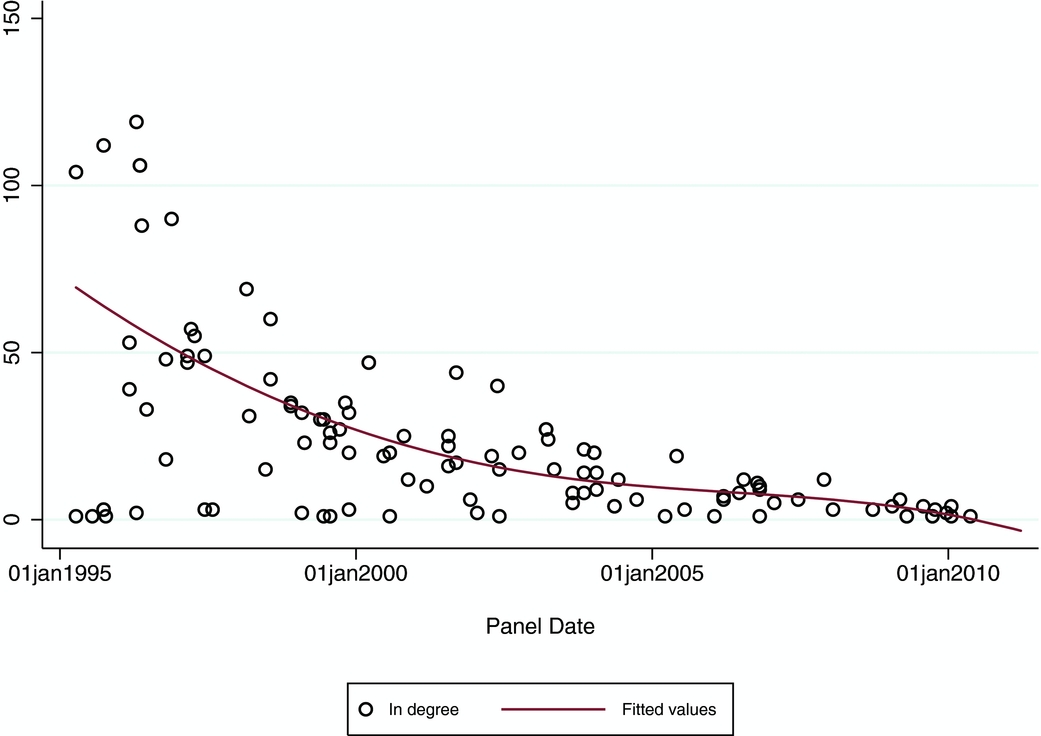
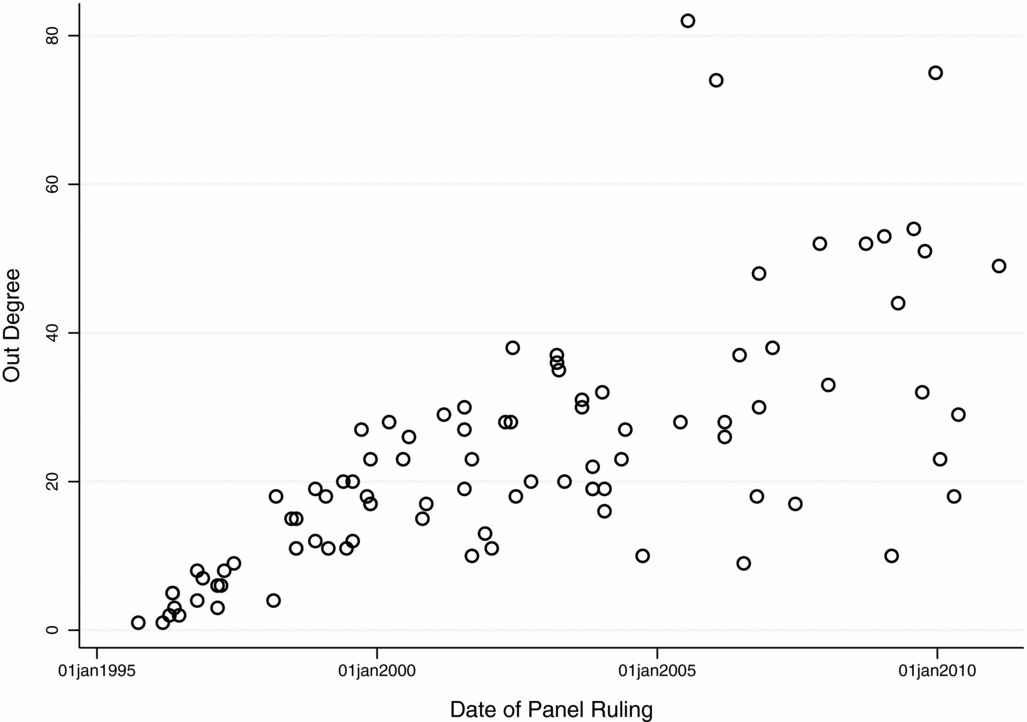
Additionally, I control for a range of other possible determinants of precedential value. The most important of these is time. The variable Panel Year is coded as the year in which the panel report was issued. We would expect this measure to be strongly negative: more recent cases are likely to have shorter citation paths, and lower precedential value. To show this simple bivariate relationship, I graph both the in-degree and out-degree of WTO disputes, according to the date of the panel ruling, in Figures 4 and 5, respectively. In both cases, the expected bivariate relationship is apparent. I also make sure that the results are robust to an inclusion of a more flexible time variable, using cubic splines, and illustrated by the fitted line in Figure 4.
In-Degree of WTO Disputes Through Time

Out-Degree of WTO Disputes Through Time

Next, I account for each complainant’s market size. This is in part to account for Simmons and Guzman (Reference Simmons and Guzman2005)’s concern that powerful countries are more likely to file disputes with long term precedential value. If richer countries have a greater ability to act strategically in this way, we should expect this coefficient to be positive. The corresponding Logged Complainant GDP variable is coded using World Development Indicators data.
I also control for some additional characteristics of the litigation process itself. Number of Third Parties is a count variable coded as the number of countries that joined the dispute as third parties. This is a proxy for how many other WTO members have a stake in the dispute. Number of Panel Claims is a count of how many legal claims the complainant made when filing the dispute. There is some anecdotal evidence suggesting that employing a “trash can approach” is a sign of low legal merit of the dispute. The last control variable I include in all estimations is a Non-Merchandise Dispute Indicator, which is coded as 1 if a dispute challenged no specific product, but rather an issue of domestic legislation, such as US Section 301 (Pelc Reference Pelc2010, Reference Pelc2013). These often relate to more opaque barriers, and tend to be highly politically sensitive, since they concern domestic statutes. By definition, these dispute do not have a measurable stake, that is, the Logged Commercial Value is zero. As such, including the variable on the right-hand side is a way of verifying whether any effect of Logged Commercial Value might not be reducible to this category of nonmerchandise disputes.
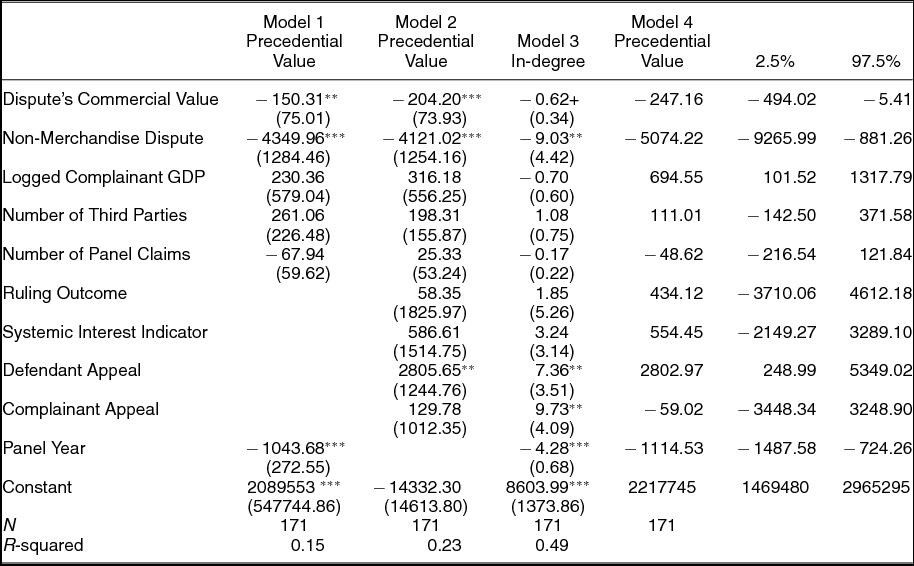
The variables above make up my base estimation, shown in the first column of Table 1. Here, as in models 2 and 3, I rely on a standard OLS estimation. Robust standard errors are clustered on the dispute combined throughout. Indeed, some disputes have multiple complainants in the same dispute (under the same DS number), while others count as two separate disputes (with separate DS numbers) that result in common litigation and a single panel and AB report. To account for this, I code all such disputes as belonging to a single Dispute Combined number, and cluster errors on that identifier.
Do Countries Strategically Shape WTO Precedent?

Notes: OLS estimations in Models 1–3. Robust standard errors clustered on Dispute Combined in parentheses. + p < 0.10, **p < 0.05, ***p < 0.01. Model 3 includes cubic spline for time trend. Model 4 shows Bayesian estimates of draws from the posterior distribution, and top and bottom quantiles of marginal posterior distribution, implemented through Zelig using a Gibbs sampler.
In Model 2, I control for a number of additional possibly confounding variables. Systemic Interest Indicator is a dummy coded as 1 if any of the third parties in the dispute joined by invoking “systemic,” rather than “material” interests, and 0 otherwise. The invocation of systemic interests tends to be indicative of issues of law that have a far-reaching impact on WTO jurisprudence. We might thus expect it to be positively related to a dispute’s precedential value.
Additionally, I include Ruling Outcome, a measure of what proportion of the claims ruled on were decided in favor of the complainant. This measure thus varies from 0 to 1, with a sample average of 75.1%. Along these lines, I also account for whether a case has been appealed. Appealed cases potentially contain more material apt to be cited. I disaggregate this measure into two variables: an Indicator of Complainant Appeal, and an Indicator of Defendant Appeal, both relating to appeals of the panel findings. These also serve as useful ways of getting at the degree of satisfaction of each party with the panel ruling, which may indicate how close to the desired precedent the judges’ reasoning was.
Model 2 also changes the way time is included, by replacing the simple Panel Year variable with a cubic spline with four knots, as per the line drawn in Figure 4, where the nonlinearity of the relationship between time and citations comes across. Though less efficient, the inclusion of the cubic spline serves as a potentially better control of such nonlinearity.
Model 3 in Table 1 includes the same right-hand side variables as model 2. The difference here is the dependent variable, which is now a simple measure of in-degree—that is, the number of direct citations to the dispute under evaluation. I include this third model as a means of comparing the weighted, complainant-specific measure of Precedential Value to a simpler, unweighted, system-wide measure of direct citations. The time parameter in Model 3 returns to the simple Panel Year measure.
Finally, Model 4 features estimates from a Bayesian model. Including network measures into regression equations generates a number of potential challenges that political scientists are only starting to recognize. Fortunately, the application in this article—which amounts to placing a centrality measure on the left-hand side of the equation—is simple enough that there is little concern about bias. However, it is worth running an additional test of the relationship using an equivalent Bayesian model, which is more flexible in terms of its underlying assumptions, and which also fares better with small samples. The mean of random draws from the posterior distribution is shown in the 4th column, and columns 5 and 6 show bottom and top quintiles.
The findings are consistent across all estimations. In all four models, disputes’ commercial value is negatively related to their subsequent precedential value, offering support for the article’s main hypothesis: countries appear to strategically file low commercial value disputes which go on to build favorable precedent for subsequent cases. And the effect is substantively significant: looking at Model 2, increasing the commercial value of the average dispute by one standard deviation reduces the subsequent precedential value of that case (from the complainant’s standpoint) by nearly 48%.Footnote 37 Though it is difficult to compare coefficients across the two dependent variables, it is apparent that the Dispute’s Commercial Value has a more significant impact on the complainant-specific precedential value than on disputes’ in-degree. This accords with intuition, and provides support for the view that complainants are strategically pursuing precedential value for their own benefit, in a way that has limited spillovers on the membership as a whole. By comparison, nonmerchandise disputes are associated with significantly lower precedential value. This, too, accords with intuition: these politically sensitive disputes tend to be one-offs, filed to challenge specific legislation. As a result, they are seldom invoked subsequently, either by the initial complainant or by others.
By contrast, the effect of market size is ambiguous. While positive in all the estimations of precedential value, it is only significantly positive in the Bayesian model. It has an insignificantly negative effect on the simple in-degree dependent variable, in Model 3. It is worth pointing out, however, that the reference category in this case is not made up of the entire membership, but of the set of 43 countries that have initiated a WTO dispute that ended with a ruling. These countries constitute a subset of members with high average legal capacity. To assess this relationship further, I replace the Logged Complainant GDP with indicator variables for the two superpowers, the United States and the European Union. When I do so for Models 1–3 (not shown to save space), both superpowers are associated with higher precedential value, but only the dummy for the United States is statistically significant at the 5% level. Overall, while there is some indication that wealth may play a role, the effect thus remains tenuous, and seems limited to the case of the United States.
There are interesting comparisons to be drawn between Models 1, 2, and 4, which use the precedential value dependent variable, and Model 3, which uses the in-degree as the dependent variable. Recall that one of the main distinctions between the two dependent variables is that the precedential value only considers citations in subsequent cases filed by the same complainant. By contrast, the in-degree measure treats invocations of a dispute by all countries alike. This distinction is reflected in the results over appeals. When considering precedential value from the complainant’s standpoint, an appeal by the complainant indicates a complainant’s dissatisfaction with the ruling, suggesting the dispute may be of limited value in setting the ground for subsequent filings. Accordingly, complainant appeals have an insignificant effect in Model 2 and a negative effect in the Bayesian estimation in Model 4. By contrast, even complainant appeals should increase the amount of legal reasoning to be drawn on by the membership as a whole. This is what Model 3 shows: complainant appeals have a positive effect on a dispute’s in-degree. Defendant appeals, in turn, should have a similar positive effect both on precedential value from a complainant’s perspective and on a dispute’s in-degree, since they indicate both a finding favorable to the complainant, and increase the amount of reasoning apt to be cited. So they do: all coefficients for Defendant Appeal are significantly positive.
Finally, and as expected, the year of the panel ruling is statistically and substantively significant. The earlier a case is filed, the more time it has to acquire precedential value by being cited by other commercially significant cases.
Evidence of Contestation?
One may ask, what about other countries? Are those states strategically filing test cases uniquely capable of anticipating the implications of the precedent they seek to set? In other words, if the European Union is strategic enough to file against Korean powdered milk to reify its preferred interpretation of the Agreement on Safeguards, it stands to reason that others might be both able to take the long-term view and willing to invest in countering the European Union’s efforts. Korea may have little at stake in the matter—that is why the European Union targets it—but why would those countries with more at stake not take Korea’s side and oppose the European Union’s claims?
Theory offers support for these questions. Insights from the legal interpretivist literature teach us that interpretations can be contested, and that political actors will invest resources in doing so (Johnstone Reference Johnstone2003; Venzke Reference Venzke2009). The precise legal status of precedent notwithstanding, once an interpretation has been laid down, it becomes more difficult to dislodge it. As Venzke (Reference Venzke2012, 58) has it, “if an actor manages to implement new reference points in legal argument that are aligned with its interest, others face an uphill battle.” If some countries invest in precedent, others should invest in contesting their efforts. Do we see signs of such contestation?
In the case of the WTO, contestation can come from only one place. While countries may join a complainant’s side in a dispute by becoming a co-complainant and thus bolster the case against the defendant, there exists no equivalent means of formally supporting the defendant’s case—with the exception of third party submissions. Third parties are countries other than the litigants that join a dispute from its start, and that seek to influence the outcome by submitting their views alongside the litigants (Johns and Pelc Reference Johns and Pelc2014). The average WTO dispute counts just under four third parties, and their submissions make up an integral part of the final panel report. Third parties’ submissions matter, not least because judges may be swayed by their arguments (Busch and Reinhardt Reference Busch and Reinhardt2006). The question becomes, do we see activity among third parties hinting at systematic contestation of precedent?
The case of the European Union and safeguards certainly suggests so. The United States joins as the only third party in Korea—Dairy. The majority of the US submission, recorded in the panel report, is spent denying the importance of the “unforeseen developments” requirement. In doing so, the United States clearly takes Korea’s side, refuting every EU argument in turn.Footnote 38 The United States then takes the very same stance in Argentina—Footwear, which it also joins, this time as one of five third parties. Here too, the United States takes the defendant’s side, refuting all the European Union’s arguments.Footnote 39
The United States is also a vocal third party during the appeal stage in both disputes. Interestingly, after restating its legal arguments, the United States shifts tactics during the appeal process, looking for support in state practice: “State practice has also treated the question of “unforeseen developments” as marginal, legally non-binding or subsumed by other aspects of the safeguards process.”Footnote 40 The United States argues that the criterion should not be a requirement, since most countries do not treat it as such. By relying on state practice, the United States is actively seeking to delegitimize a particular interpretation of the text, were its legal argument to fall short.
In this instance, the United States interpretation loses out to the European Union’s. Yet the very fact that we observe the United States vehemently contesting the European Union’s efforts in these two minor disputes gives additional credence to the notion that countries are able to see far enough into the future to both invest in precedent and oppose attempts by others to do so if the resulting precedent is unfavorable to them. All this, while precedent has strictly no formal legal authority.
The question, once again, is whether this happens on average. If it does, then we should expect states to challenge complainants disproportionately more in the test cases that go on to acquire greater precedential value. To find out, I examine the partisanship of all third party submissions in every WTO dispute. I then verify whether prodefendant submissions are associated with greater subsequent invocations. To start, I use data from Busch and Reinhardt (Reference Busch and Reinhardt2006), which code all third party submissions as procomplainant, prodefendant, or mixed. I update the data for the disputes that took place between 2005 and 2012 following their methodology.
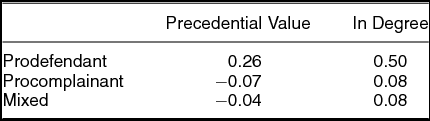
As in Busch and Reinhardt, most (71%) third parties are procomplainant; a minority (22%) are prodefendant; and an even smaller share (7%) are mixed submissions. The bivariate correlations between the partisanship of submissions and disputes’ precedential values, shown in Table 2, speak for themselves. What these correlations suggest is that contestation in the Korea—Dairy case is representative of the average among precedentially important disputes, which attract a disproportionate number of prodefendant submissions. By comparison, precedential influence is not positively correlated with either procomplainant or mixed submissions. The same split is apparent in correlations between partisanship and the simpler in-degree measure of precedential impact, shown in the second column of Table 2.
Correlations Between Precedential Value and Partisanship of Third Party Submissions

To be sure, the same relationship emerges in regression analysis. A poisson count model reveals a statistically significant positive relationship with prodefendant submissions, and a negative relationship with procomplainant submissions (not shown to save space). This holds once we add the other third party count (procomplainant and prodefendant, respectively) on the right-hand side, to control for the systemic interest of the dispute. Nonetheless, because the right-hand-side variable (precedential value) corresponds to events that took place later in time than the dependent variable (third party submissions), I choose not rely on these estimations too strongly. The assumption would need to be that the precedential values are subsequently realized proxies of a latent precedential value that is observable by third parties. While this assumption does in fact correspond to the theory, I nonetheless prefer to rely on the simpler bivariate correlations shown in Table 2, which are less prone to misinterpretation.
In this respect, it is unlikely that the causality runs in the opposite direction, i.e., that pro-defendant submissions are themselves producing greater subsequent citations. Prodefendant submissions represent a disagreement with the complainant’s claims. Since legal citations invariably serve to approve rather than to negate, prodefendant submissions should themselves lead to fewer, rather than more, citations. We can thus be confident that countries’ expectations over potential precedent-setting cases is what produces contestation, as evidenced in the number of prodefendant submissions. These cases then stand out through their high invocation in subsequent disputes. In sum, efforts by countries to shape precedent are observed by other strategic actors, who systematically seek to contest these interpretations when they appear unfavorable.
Distributional Consequences: Who Gains?
The empirical findings not only suggest that countries’ behavior reflects a shared view of precedent as binding, but also that certain countries, such as the United States, may be better able to exploit the implications of this view than others. It is worth thinking through these distributional consequences. Who gains more?
The question of distributional effects is especially interesting given how the judicialization of international politics, as a general phenomenon, is usually taken as a gain for small countries. The added “stability and predictability”—an explicit goal of the WTO’s legal systemFootnote 41 —that comes from the delegation of decision-making to courts is usually thought to benefit poor countries. Legalization is by construction a move away from power politics, and thus a reduction of the returns to power. Yet as I discuss, a commitment to predictability also means that the interpretations proffered by judges become “definitive.” In a decentralized regime such as the WTO, this forward-looking aspect of precedent presents major powers with opportunities to affect the meaning of the rules to their advantage.
Indeed, the meaning of the rules does not evolve in a random fashion. This shared meaning is less a function of the court itself than of far-sighted countries strategically initiating cases. In this respect, the concerns of observers warning against judicial rule-making seem overblown. Indeed, states are likely to retain the final trump card.Footnote 42 Were a court to regularly impose interpretations of the rules at odds with states’ interests, it would quickly be subject to political correction (Steinberg Reference Steinberg2004). The normative concern lies elsewhere. Insofar as some countries are better able to initiate multiple disputes than others, they will also have a greater say over the meaning of the rules, as seen through the prism of precedent. In this respect, differences in countries’ legal capacity, and thus their ability to file strings of related disputes, may hold even more significant implications than previously imagined (Busch, Reinhardt, and Shaffer Reference Busch, Reinhardt and Shaffer2009). At stake is not only the enforcement of one’s rights under the treaty; it is also about shaping that treaty’s meaning to one’s favor. The final irony, then, as highlighted by Ginsburg (Reference Ginsburg2005), is that those powerful countries best able to exploit precedent are also the ones to oppose it most often. The United States, in particular, stands out as opposing the authority of precedent more than any other WTO member, even as the analysis suggests that it is especially good at exploiting the precedents it sets. Consider a recent statement in US—Civil Aircraft: “The United States requests that the first sentence of paragraph 7.248 of the Interim Report be modified to remove any suggestion that reports of the Appellate Body are binding except with respect to resolving the particular dispute between the parties to that dispute.”Footnote 43 Such explicit challenges, however, remain rare: WTO members, including the major powers, have tacitly accepted the growing authority of precedent.
Of course, this is no zero-sum game. Even if countries with high legal capacity have the greatest ability to initiate cases and thus shape case law, in so doing they also clarify the rules to everyone’s benefit. Political actors will often delegate decision-making to courts in politically sensitive areas. Any agreement may be preferable to no agreement, yet sometimes no single outcome is politically ratifiable by all parties. Courts provide a partial solution. This, after all, is the case made by students of European integration (Burley and Mattli Reference Burley and Mattli1993). Studies have shown that faced with legislative deadlock, countries grew more tolerant of the rising authority of precedent in European courts (Bouwen and McCown Reference Bouwen and McCown2007; McCown Reference McCown2003). This had similar distributional consequences to the ones identified in this article, whereby private actors endowed with high legal capacity (the ECJ allows private standing) grew “able and likely to pursue long planned litigation strategies in an attempt to reshape rules in a direction beneficial to them” (McCown Reference McCown2003). Despite the fact that this represented considerable delegation of power to the courts, European member states did not act to block precedential reasoning in the ECJ. Then as now, governments may realize that courts have the ability to converge expectations on politically fraught issues in a manner that benefits all members.
As is often the case, this public benefit—clarification of the rules—conceals a distributional conflict: some gain more than others. This is a familiar story. The existence of rules favors everyone, and the weak most of all. Yet in exchange for binding themselves, powerful states often seek to extract rents. They influence the shape of the rules to their advantage. Precedent in international law is one more instance of such travel along the Pareto frontier (Krasner Reference Krasner1991).
CONCLUSION
International law explicitly disavows the constraining effect of precedent. This is consistent with governments’ traditional reluctance to delegate power to international institutions. Indeed, because precedent-following entails precedent-making, having courts bound to past verdicts necessarily comes at a risk of judicial rule-making. As a number of legal scholars point out, international courts are not subject to legislative oversight in the way that domestic courts are—the implication is that if courts’ interpretations are “definitive,” they could construct obligations where countries had created none (Ragosta, Joneja and Zeldovich Reference Ragosta, Joneja and Zeldovich2003).
States need to be able to push back against such judicial rule-making, but they also seek the predictability that comes with consistent rulings. As is often the case, the compromise solution is an informal one (Stone Reference Stone2011). Governments insist that precedent is not formally binding, but they behave as if it were. Even as precedent in the trade regime remains, legally speaking, a fiction, political and legal actors tacitly agree to be bound by its logic.
The article provides evidence for such effectively binding precedent by relying on tools borrowed from social network analysis. I demonstrate that governments behave as if precedent were binding by examining the disputes they choose to file. By looking at which disputes go on to acquire precedential value, it is possible to show that states initiate cases not only to resolve disagreements, but also as a means of setting a precedent that changes the interpretation of rules in their favor. Such seminal cases tend to go after smaller markets, allowing complainants greater latitude to target their legal arguments. Once a precedent is set, countries turn around and exploit it in high stakes disputes.
In sum, despite the singular degree of delegation that binding precedent in international law entails, instead of obstructing it, countries accept that precedent will modify the meaning of the rules. They seek to affect these changes, by filing disputes that aim primarily at a “rule gain.” But not all countries are equally able to engage in this exercise. WTO members with high legal capacity such as the United States appear significantly more likely to invest in precedent and build on it in subsequent filings. As a result, they end up with greater influence over the evolving interpretation of rules long after these have been ratified. Such distributional consequences should be of concern to those who view legalization as an unambiguous step away from power politics.



Comments
No Comments have been published for this article.