1. Introduction
A number of recent studies on the phonetics–phonology interface argue that many phonological patterns refer to psychoacoustic similarity – perceived similarity between sounds based on detailed acoustic information. Expanding on the general notion of faithfulness constraints in Optimality Theory (Prince & Smolensky Reference Prince and Smolensky1993/Reference Prince and Smolensky2004, McCarthy & Prince Reference McCarthy, Prince, Beckman, Walsh Dickey and Urbanczyk1995), several authors have proposed that speakers attempt to maximize the psychoacoustic similarity between inputs and outputs (Boersma Reference Boersma1998; Steriade Reference Steriade, Hume and Johnson2001a, Reference Steriadeb, Reference Steriade2003; Côté Reference Côté2004; Jun Reference Jun, Hayes, Kirchner and Steriade2004; Fleischhacker Reference Fleischhacker2005; Kawahara Reference Kawahara2006; Wilson Reference Wilson2006; Zuraw Reference Zuraw2007). For example, several researchers have observed that nasals are more likely to undergo place assimilation than oral consonants (Cho Reference Cho1990, Mohanan Reference Mohanan and Goldsmith1993, Boersma Reference Boersma1998, Jun Reference Jun, Hayes, Kirchner and Steriade2004). Steriade (Reference Steriade1994, Reference Steriade, Hume and Johnson2001a), Boersma (Reference Boersma1998), and Jun (Reference Jun, Hayes, Kirchner and Steriade2004) have proposed that this asymmetry arises because a place contrast is harder to perceive in nasals than in oral consonants, and therefore speakers can tolerate a change of articulation in nasal consonants but not in oral consonants: nasal pairs differing in [place] are ‘psychoacoustically similar enough’, whereas pairs of oral consonants differing in [place] are ‘psychoacoustically too different’ (see also Malécot Reference Malécot1956, Mohr & Wang Reference Mohr and Wang1968, Pols Reference Pols1983, Hura, Lindblom & Diehl Reference Hura, Lindblom and Diehl1992, Kurowski & Blumstein Reference Kurowski, Blumstein, Huffman and Krakow1993, Ohala & Ohala Reference Ohala, Ohala, Huffman and Krakow1993, Davis & MacNeilage Reference Davis and MacNeilage2000 for the low perceptibility of [place] in nasals; see Kohler Reference Kohler, Hardcastle and Marchal1990, Hura et al. Reference Hura, Lindblom and Diehl1992, Huang Reference Huang, Hume and Johnson2001, Johnson Reference Johnson2003, Kawahara Reference Kawahara2006 for the notion of ‘perceptually tolerated articulatory simplification’).
Another example of the role of psychoacoustic similarity in phonology comes from the observation that a voicing contrast is more likely to be neutralized than other manner contrasts. Steriade (Reference Steriade2001b) points out that underlying voiced obstruents readily undergo devoicing in coda positions in many languages such as German, Polish, Russian and Turkish, but coda voiced obstruents never become nasalized in any languages. To explain this observation, drawing on previous psycholinguistic studies (Peters Reference Peters1963, Greenberg & Jenkins Reference Greenberg and Jenkins1964, Walden & Montgomery Reference Walden and Montgomery1975, van den Broecke Reference van den Broecke1976), she proposes that a voicing contrast is less perceptible than other manner contrasts, and that speakers tolerate a change in voicing because the change is psychoacoustically the least salient. These proposals have led to – and have expanded on – the general idea of the P-map (for ‘Perceptual’-map) (Steriade Reference Steriade, Hume and Johnson2001a, Reference Steriadeb, Reference Steriade2003), which states that speakers know the perceptual distances between two phonological elements, and that based on this knowledge, they attempt to minimize the perceptual disparity between two corresponding elements in phonology (most commonly inputs and outputs).Footnote 2
This paper contributes to the body of literature which argues for the importance of psychoacoustic similarity, but from a slightly different angle, namely from the perspective of verbal art. A sizable amount of work has shown that psychoacoustic similarity plays an important role in shaping phonological patterns, including verbal art patterns. Previous studies have revealed that speakers require psychoacoustic similarity between two rhyming or alliterating segments, and this claim has been demonstrated in Middle English alliteration (Minkova Reference Minkova2003), English imperfect puns (Fleischhacker Reference Fleischhacker2005), Japanese rap rhymes (Kawahara Reference Kawahara2007), and Romanian half-rhymes (Steriade Reference Steriade2003). Building on this body of work, our corpus-based analysis demonstrates that Japanese speakers require two corresponding elements in puns to be as similar as possible, and the measure of similarity rests on psychoacoustic information. Our results show that both phonological patterns and verbal art patterns are governed by the same principle: the maximization of psychoacoustic similarity between two corresponding elements.
To make the case that speakers use psychoacoustic similarity in composing verbal art patterns, this paper analyzes dajare, which is a linguistic word game – more specifically, the creation of imperfect puns – in Japanese. In constructing dajare, speakers make a sentence out of two words or phrases that are identical or near-identical. An illustrative example is huton-ga huttonda ‘the futon was blown away’, which involves the juxtaposition of two similar words: huton and huttonda. An analogous English example would be something like ‘Titanic in panic’. In many languages, similar sounds tend to form sound pairs in a range of verbal art patterns, including rhymes, alliterations, and imperfect puns (see Kawahara Reference Kawahara2007 for a recent overview). The role of similarity in imperfect puns has been explored in English (Lagerquist Reference Lagerquist1980, Zwicky & Zwicky Reference Zwicky and Zwicky1986, Sobkowiak Reference Sobkowiak1991, Hempelmann Reference Hempelmann2003, Fleischhacker Reference Fleischhacker2005) as well as in Japanese (Otake & Cutler Reference Otake and Cutler2001, Cutler & Otake Reference Cutler and Otake2002, Shinohara Reference Shinohara2004). All of these studies agree that some kind of similarity plays a role in the formation of imperfect puns. We argue that it is specifically the psychoacoustic similarity that underlies imperfect pun parings.
Before closing this introductory section, a remark on our methodology is in order. In addition to lending further support to the role of psychoacoustic similarity in verbal art, our methodology is also innovative; that is, we undertake a statistical approach to the analysis of Japanese imperfect puns. The statistical approach allows us to uncover phonological patterns that could easily be obscured by non-phonological factors and therefore missed in an impressionistic survey. That is, speakers' focus on syntactic coherence and semantic humor may well obscure the purely phonetic and phonological aspects of two corresponding words (Hempelmann Reference Hempelmann2003). Here we draw on a large amount of data to verify whether discovered phonetic and phonological patterns are convincingly real.
The rest of this paper proceeds as follows. In section 2 we provide an overview of Japanese imperfect puns, and describe how we collected and analyzed the data. In section 3, as a preliminary, we statistically establish the role of similarity in the formation of Japanese imperfect puns. In section 4 we make the case that speakers deploy psychoacoustic similarity, rather than featural similarity, when they compose imperfect puns.
2. Method
2.1 An overview of Japanese imperfect puns
Puns are very common in Japanese, and some speakers create new puns on a daily basis (Mukai Reference Mukai1996, Takizawa Reference Takizawa1996). In composing puns or dajare, speakers deliberately juxtapose a pair of ‘similar-sounding’ words or phrases – we argue in section 4 that this notion of ‘similarity’ is based on psychoacoustic information. The two corresponding parts can include identical sound sequences as in buta-ga butareta ‘a pig was hit’, an example of a perfect pun; or the two corresponding words can include similar but non-identical sounds. In (1) we provide an example of an imperfect pun, which includes corresponding pairs of non-identical sounds (indicated in bold letters: [m–t], [h–b]). In this paper we focus on imperfect puns that include mismatched consonant pairs.Footnote 3
(1) manhattan-de sutanbattanManhattan-loc stand-by ‘I stood by in Manhattan.’
In (1), manhattan and sutanbattan are a pair of similar phrases that form an imperfect pun.Footnote 4 This paper uses the following notations. We mark corresponding domains in imperfect puns by underlining: we define corresponding domains as sequences of syllables in which corresponding vowels are identical.Footnote 5 We use bold letters to indicate non-identical pairs of corresponding consonants, which is the focus of our analysis.
The pun in (1) is an imperfect pun in that it does not involve perfectly identical sequences of sounds. Though Japanese puns can involve non-identical pairs of consonants, previous studies have noted that imperfect pun pairs tend to involve ‘similar’ consonants (Otake & Cutler Reference Otake and Cutler2001, Cutler & Otake Reference Cutler and Otake2002, Shinohara Reference Shinohara2004). Deferring detailed discussion of the precise definition of ‘similarity’, the importance of similarity in imperfect puns can be informally illustrated by examples like: Aizusan-no ai su ‘ice cream from Aizu’ ([z] and [s] are minimally different in voicing) and okosama-o okosa na ide ‘please do not wake up the child’ ([m] and [n] are minimally different in place). Drawing on this observation, this paper statistically assesses what kind of similarity plays a role in imperfect puns, and demonstrates that speakers deploy their knowledge about psychoacoustic similarity based on detailed acoustic information. Our findings show that speakers possess a rich knowledge of psychoacoustic similarity and make use of that knowledge to form verbal art patterns (Steriade Reference Steriade2001b, Reference Steriade2003; Minkova Reference Minkova2003; Fleischhacker Reference Fleischhacker2005; Kawahara Reference Kawahara2007).
2.2 Data collection
This subsection describes how we compiled the database for this study. In order to investigate how similarity influences the formation of Japanese imperfect puns, we collected examples of imperfect puns from three websites.Footnote 6 We also elicited data from native Japanese speakers by asking them to create puns of their own ‘out of the blue’, from which we selected imperfect puns.Footnote 7 In total, we collected 2371 examples of Japanese imperfect puns.
Recall that we define ‘corresponding domains’ in imperfect puns as sequences of syllables in which corresponding vowels are identical. For example, in okosama-o okosa na ide ‘please do not wake up the child’, the corresponding domains include the first four syllables. In the domains defined as such, we counted pairs of corresponding consonants between the two words. We ignored identical pairs of consonants, because we are interested in similarity, not identity. Therefore, in the example okosa ma-o okosa na ide, for instance, we extracted just the pair [m–n].
A few remarks on our coding convention are in order. We counted only onset consonants, and ignored coda consonants because they assimilate in [place] to the following consonant in Japanese (Itô Reference Itô1986). We also ignored singleton–geminate distinctions because our interest lies in segmental similarity. We coded the data based on surface forms, following a recent body of work which argues that similarity is based on surface forms rather than phonemic forms (Steriade Reference Steriade2001b; Kang Reference Kang2003; Kenstowicz Reference Kenstowicz2003; Minkova Reference Minkova2003; Kawahara Reference Kawahara2006, Reference Kawahara2007; Kawahara, Ono & Sudo Reference Kawahara, Ono, Sudo, Vance and Jones2006; though see Jakobson Reference Jakobson1960; Kiparsky Reference Kiparsky and Freeman1970, Reference Kiparsky and Brame1972, Reference Kiparsky and Freeman1981; Malone Reference Malone1987 for a different view). For instance, the onset of the syllable [ʃi] is arguably derived from an underlying /s/, but it was counted as [ʃ]. Finally, we excluded pairs which are underlyingly different but are neutralized at the surface because of independent phonological processes (even when such neutralization is optional). For example, the second consonant [dd] in be ddo ‘bed’ can optionally devoice in the presence of another voiced obstruent (Nishimura Reference Nishimura2003, Kawahara Reference Kawahara2006). Thus given an example like beddo-dai-wa be tto itadakimasu ‘please pay for the bed separately’, we did not consider the [dd–tt] pair as a pair of non-identical consonants, since the pun-composer could have pronounced /beddo/ as [betto] when s/he composed the pun. Similarly, many puns included examples of [y] corresponding with Ø in the context of [i _ a], as in kanariØa-o kauno-wa kanari i ya ‘I don't like having a canary’. We did not count these cases since /ia/ can surface as [iya] (Katayama Reference Katayama1998, Kawahara Reference Kawahara2003).
2.3 Data analysis: O/E ratios
This paper investigates what kind of measure of similarity speakers use when they compose imperfect puns. For this purpose, we need a measure of combinability between two segments. We use O(bserved)/E(xpected) ratios as a measure of how well two elements combine. O/E ratios are ratios between how often a pair is actually observed (O-values) and how often it would be expected to occur if two elements were combined at random (E-values). Mathematically, the O-value of a sound [A] is how many times [A] occurs in the corpus, and the E-value of a pair [A–B] is P(A)×P(B)×N (where P(X)=the probability of the sound [X] occurring in the corpus; N=the total number of consonants). O/E ratios greater than 1 indicate that the given consonant pairs are combined as pun pairs more frequently than expected (overrepresentation), while O/E ratios less than 1 indicate that the given consonant pairs are combined less frequently than expected (underrepresentation) (see Trubetzkoy Reference Trubetzkoy1969, Frisch, Pierrehumbert & Broe Reference Frisch, Pierrehumbert and Broe2004, Kawahara Reference Kawahara2007 for the notion of relativized frequencies).
In our O/E analysis, we excluded consonants whose O-values are less than 20 because including them resulted in extraordinarily high O/E ratios: combining two rare consonants yields a very low E-value, so that even a single observed pair of that type would yield an artificially high O/E ratio (e.g. the O/E ratio of the [pj–bj] pair is 1121.7). For this reason, we excluded [ts], [dʒ], [y], [nj], [rj], and all non-coronal palatalized consonants. The exclusions left 535 pairs of consonants for the subsequent analysis.
Before completing the method section, a remark on our statistical analysis is in order. We did not test whether each individual O/E ratio was significantly larger than 1, for two reasons. First, applying the same test on multiple O/E ratios requires a drastic post-hoc α-level adjustment, and it is unlikely to find statistically significant overrepresentations – i.e. potential inflation of Type 2 errors (Klockars & Sax Reference Klockars and Sax1986, Myers & Well Reference Myers and Well2003: 84–86, 241–245). Second, since each O/E ratio is dependent on other O/E ratios, applying the same test on multiple O/E ratios violates the assumption of independence, which usually results in an increase in Type 1 errors (Seco, Menéndez de la Fuente & Escudero Reference Seco, Menéndez de la Fuente and Escudero2001). We thus instead applied a statistical test for general patterning of O/E ratios to test specific null hypotheses.
3. The correlation between similarity and combinability: a statistical preliminary
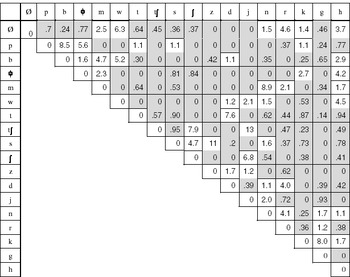
Table 1 shows the result of the O/E analysis, where shading indicates underrepresentation.
O/E ratio (shading indicates underrepresentation).

To statistically verify the correlation between combinability in puns on the one hand and similarity on the other, as a first approximation, we estimated the similarity of consonant pairs in terms of how many feature specifications they share (Klatt Reference Klatt1968, Fay & Cutler Reference Fay and Cutler1977, Shattuck-Hufnagel & Klatt Reference Shattuck-Hufnagel and Klatt1977, Stemberger Reference Stemberger1991, Bailey & Hahn Reference Bailey and Hahn2005). We will later discuss the importance of psychoacoustic similarity in section 4 and argue that featural similarity ultimately fails to account for the detailed aspects of the pun pairing patterns. We nevertheless start with this simple version involving featural similarity in order to first statistically establish the correlation between similarity and combinability.
To estimate the numbers of shared feature specifications among the set of distinctive consonants in Japanese, we used eight features: [sonorant], [consonantal], [continuant], [nasal], [strident], [voice], [palatalized], and [place]. [Palatalized] is a secondary place feature which distinguishes plain consonants from palatalized consonants (yoo-on, in the traditional Japanese terminology). According to this featural similarity system, a [p–b] pair, for example, shares seven feature specifications, and hence is treated as highly similar. On the other hand, a pair like [ʃ–m] agrees only in [cons], and is thus considered as a highly non-similar pair.
We made the following assumptions when assigning feature specifications to Japanese sounds. Affricates are specified both as [+cont] and [−cont] (Sagey Reference Sagey1986, Lombardi Reference Lombardi1990). We treated [h] as a voiceless fricative, not as an approximant (Lass Reference Lass1976: 64–68, Jaeger & Ohala Reference Jaeger and Ohala1984, Sagey Reference Sagey1986, Parker Reference Parker2002). We also assumed that sonorants are specified as [+voice] and thus agree with voiced obstruents in terms of [voice], although phonologically, voicing in sonorants behaves differently from voicing in obstruents in Japanese phonology (see section 4.3 for further discussion). The appendix gives the complete feature matrix used in this analysis.
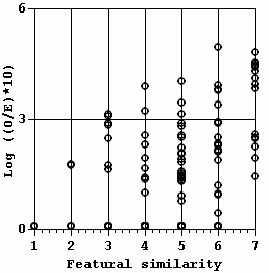
The scatter plot in figure 1 illustrates the general correlation between similarity and combinability of consonant pairs. For each consonant pair, it plots the number of shared feature specifications on the x-axis and plots the natural log-transformed O/E ratios multiplied by 10 (Loge((O/E)∗10)) on the y-axis. We use log-transformed values on the y-axis because it allows us to fit all the data points in a reasonably small-sized graph. Loge(zero) is undefined, so we replaced Loge(zero) with zero. However, the log of O/E ratios smaller than 1 is negative, and hence would be incorrectly treated as a value smaller than zero (e.g. 0.5>0, but Loge(0.5)<0). Therefore, we multiplied O/E ratios by 10 before log-transformation. The plot excludes all pairs in which one member is Ø (null), since it is difficult if not impossible to define Ø in terms of distinctive features; we discuss such pairs in section 4.4.
Correlation between the number of shared feature specifications and the likelihood of two consonants being paired in imperfect puns.
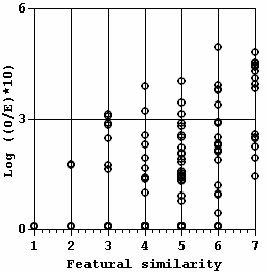
We observe in figure 1 an upward trend in which the combinability correlates with featural similarity: the more feature specifications a pair shares, the higher the corresponding O/E ratio is. To statistically assess the linear relationship in figure 1, we calculated a Spearman's rank correlation coefficient ρ, a non-parametric measure of linear correlation. We used a non-parametric measure because we cannot assume a bivariate normal distribution. The result is that ρ is .497 (t(134)=6.63; p<.001), a statistically significant correlation.
Another measure of featural similarity can be calculated based on the number of shared natural classes divided by the number of shared and unshared natural classes  Frisch et al. 2004). Based on this formula, we calculated the similarity matrix among the Japanese consonants using a similarity calculator developed by Adam Albright (Albright n.d.). We then calculated the correlation between combinability and this similarity matrix, yielding a ρ value of .488 (t(134)=6.47, p<.001), a value similar to the ρ value in the analysis above.
These two analyses establish statistically that a general correlation exists between combinability and some kind of similarity. Having established the statistical correlation, we now turn to some inadequacies of featural similarity in capturing imperfect pun patterns and argue for the importance of psychoacoustic similarity.
4. Beyond featural similarity: the role of psychoacoustic similarity
In section 3, we used distinctive features to estimate similarity. We argue in this section that, although featural similarity accounts for some broad patterns, it ultimately fails to capture some of the detailed aspects of pun pairings. We propose that Japanese speakers instead use psychoacoustic similarity. By psychoacoustic similarity, we mean perceived similarity between sounds based on acoustic details.
One example that supports the role of psychoacoustic similarity is the [r–d] pair, whose O/E ratio is 3.99. According to the distinctive feature system, this pair agrees in six features (all but [son] and [cont]); but the average O/E ratio of other consonant pairs agreeing in six distinctive feature is 1.49. The 95% confidence interval of the O/E ratios of such pairs is 0.39∼2.59, and 3.99 lies outside this interval. Thus the high O/E ratio of the [r–d] pair is unexpected from the standpoint of featural similarity, but makes sense from a psychoacoustic perspective. Japanese [r] is a flap which involves a ballistic – or instantaneous – constriction (Nakamura Reference Nakamura2002): [r] and [d] are similar to each other in that they are both voiced consonants with relatively short closures (Price Reference Price1981, Steriade Reference Steriade, Broe and Pierrehumbert2000).Footnote 8
Below we present four more kinds of arguments that pun composers exploit psychoacoustic similarity rather than featural similarity. First, speakers are sensitive to the different perceptual salience of the same feature in different contexts (section 4.1.). Second, composers take into consideration the different perceptual salience of different features (section 4.2.). Third, composers are sensitive to similarity contributed by a phonologically inert feature (section 4.3.). Finally, pun-makers are willing to pair Ø with consonants that are psychoacoustically similar to Ø (section 4.4.).
4.1 Sensitivity to context-dependent salience of the same feature
The first piece of evidence that pun composers make use of psychoacoustic similarity is the fact that composers are sensitive to different degrees of salience of the same feature in different contexts. Here, we focus on the perceptual salience of [place]. In (2), we list the O/E ratios of minimal pairs of consonants differing in place (the Japanese moraic nasal [N] appears only in codas, and was therefore excluded from this study).
(2) O/E ratios of minimal pairs differing in place
[m–n]: 8.85 [b–d]: 1.09 [p–t]: 1.11
[b–g]: 0.65 [p–k]: 1.08
[d–g]: 0.39 [t–k]: 0.87
We observe that the O/E ratio of the [m–n] pair is higher than that of any other minimal pair in (2) (by a binomial test, p<.05).Footnote 9 Thus the data in (2) indicate that composers treat the [m–n] pair as more similar than any minimal pairs of oral consonants: they treat the place distinction in nasal consonants as less salient than in oral consonants.
Evidence from previous phonetic and psycholinguistic studies supports the lower perceptibility of [place] in nasals than in oral consonants. First, a similarity judgment experiment by Mohr and Wang (Reference Mohr and Wang1968) shows that nasal minimal pairs are considered perceptually more similar to each other than oral consonant minimal pairs. Second, Pols (Reference Pols1983) demonstrated with Dutch speakers that [place] in nasals is less accurately perceived than [place] in oral consonants in noisy environments.Footnote 10 Place cues are less salient in nasal consonants than in oral consonants for two reasons: (i) formant transitions into and out of the neighboring vowels are obscured by coarticulatory nasalization, and (ii) burst spectra play an important role in distinguishing different places of articulation (Jakobson, Fant & Halle Reference Jakobson, Fant and Halle1952, Stevens & Blumstein Reference Stevens and Blumstein1978, Blumstein & Stevens Reference Blumstein and Stevens1979), but nasals have weak or no bursts (see Malécot Reference Malécot1956, Pols Reference Pols1983, Hura et al. Reference Hura, Lindblom and Diehl1992, Kurowski & Blumstein Reference Kurowski, Blumstein, Huffman and Krakow1993, Ohala & Ohala Reference Ohala, Ohala, Huffman and Krakow1993, Steriade Reference Steriade1994, Boersma Reference Boersma1998, Davis & MacNeilage Reference Davis and MacNeilage2000, Steriade Reference Steriade, Hume and Johnson2001a, Jun Reference Jun, Hayes, Kirchner and Steriade2004 for further discussion of the low perceptibility of nasals' [place] and its phonological consequences). To summarize, in measuring similarity due to [place], Japanese speakers take into account the lower perceptibility of [place] in nasal consonants. The lower perceptibility of [place] in nasals has a psychoacoustic basis: the blurring of formant transitions caused by coarticulatory nasalization and weak bursts. The data in (2) therefore show that speakers use psychoacoustic similarity in composing puns.
By contrast, if speakers were using featural similarity, then the higher combinability of the nasal pair would remain unexplained. One could postulate that featural similarity is affected less when two nasal segments disagree in [place] than when two oral segments disagree in [place]. However, introducing such weighting is post-hoc: it simply restates the observation and has no explanatory power.
An anonymous reviewer points out that feature weighting would not be ad-hoc ‘if it is derived from an independently motivated model of feature relationship’. However, no previously established models of distinctive features distinguish [place] in oral consonants and [place] in nasal consonants. Feature geometry is one well-elaborated theory of feature relationships, which postulates that features are organized in a hierarchical structure (Clements Reference Clements1985, Sagey Reference Sagey1986, McCarthy Reference McCarthy1988, Halle Reference Halle and Bright1992, Clements & Hume Reference Clements, Hume and Goldsmith1995). However, no versions of feature geometry postulate a structural difference between [place] in nasal consonants and [place] in oral consonants.
Another elaboration of feature relationships is the theory of underspecification. This theory postulates that non-contrastive or unmarked specifications are underlyingly unspecified (Kiparsky Reference Kiparsky and Yang1982, Itô & Mester Reference Itô and Mester1986, Archangeli Reference Archangeli1988, Mester & Itô Reference Mester and Itô1989, Paradis & Prunet Reference Paradis and Prunet1991, Itô, Mester & Padgett Reference Itô, Mester and Padgett1995; see also Lahiri & Reetz Reference Lahiri, Reetz, Gussenhoven and Warner2002 for a model of word recognition using underspecification). Underspecification theory cannot explain the difference between [place] in nasal consonant and [place] in oral consonants either, because [place] is distinctive both in nasal and in oral consonants, and therefore [place] must be specified in both of these environments.
As a last alternative analysis, it has been claimed that when two sounds alternate with each other in phonology, their phonological relation may enhance similarity between them (Zwicky Reference Zwicky1976; Malone Reference Malone1987, Reference Malone1988a, Reference Maloneb; Hume & Johnson Reference Hume and Johnson2003; Shinohara Reference Shinohara2004; Kawahara Reference Kawahara2007; cf. Steriade Reference Steriade2003, who doubts this claim). However, it is impossible to derive the high O/E ratio of the [m–n] pair from their phonological alternating status. In Japanese phonology, [place] in nasals and [place] in oral consonants do not behave differently. In onset position, neither nasal nor oral consonants change their place specifications. In codas, both nasal and oral consonants place-assimilate to the following consonant (Itô Reference Itô1986), as exemplified in (3).
(3)
(a) Nasal place assimilationhoN ‘book’hom-bako ‘book-box’hon-dana ‘book-shelf’hoŋ-ga ‘book-NOM’
(b) Place assimilation of oral consonantsbut(u) ‘to hit’ hik(u) ‘to pull’bup-panasu ‘to fire a bullet’ hip-paru ‘to pull off’but-toosu ‘to permeate’ hit-toraeru ‘to arrest’buk-korosu ‘to kill’ hik-kaku ‘to scratch’
To summarize, no independent mechanisms of distinctive features derive the difference between [place] in nasals and [place] in oral consonants.
4.2 Sensitivity to different salience of different features
The second argument that pun composers deploy psychoacoustic rather than featural similarity rests on the fact that they treat some features as perceptually more salient than other features. A large body of psycholinguistic work has demonstrated the non-equivalence of perceptibility of different features (Miller & Nicely Reference Miller and Nicely1955, Peters Reference Peters1963, Singh & Black Reference Singh and Black1966, Mohr & Wang Reference Mohr and Wang1968, Ahmed & Agrawal Reference Ahmed and Agrawal1969, Singh, Woods & Becker Reference Singh, Woods and Becker1972, Wang & Bilger Reference Wang and Bilger1973, Walden & Montgomery Reference Walden and Montgomery1975, van den Broecke Reference van den Broecke1976, Benkí Reference Benkí2003, Bailey & Hahn Reference Bailey and Hahn2005). Therefore, if speakers are using psychoacoustic similarity, it is predicted that we would observe that different features contribute to pun pairing frequencies to different degrees. We now show that this prediction is correct.
Here we discuss the perceptibility of [voice]. Some scholars have proposed that among manner features that determine spectral continuity ([cont, nasal, voice]), the [voice] feature contributes only weakly to consonant distinctions. The weaker perceptibility of [voice] obtains support from previous psycholinguistic findings, such as Multi-Dimensional Scaling (Peters Reference Peters1963, Walden & Montgomery Reference Walden and Montgomery1975; see also Singh et al. Reference Singh, Woods and Becker1972), a similarity judgment task (Greenberg & Jenkins Reference Greenberg and Jenkins1964, van den Broecke Reference van den Broecke1976, Bailey & Hahn Reference Bailey and Hahn2005: 352), and an identification experiment in noise (Wang & Bilger Reference Wang and Bilger1973; see also Singh & Black Reference Singh and Black1966).Footnote 11 See also Kenstowicz (Reference Kenstowicz2003) and Steriade (Reference Steriade2001b), who argue that [voice] is phonologically more likely to neutralize than other manner features because [voice] is less perceptible.
Given the relatively low perceptibility of [voice], if pun composers are sensitive to psychoacoustic similarity, we expect that pairs of consonants that are minimally different in [voice] should combine more frequently than minimal pairs that disagree in other manner features. To compare the effect of [cont], [nasal], and [voice], we compare the O/E ratios for the minimal pairs defined by these features, as in (4).
(4) [cont] [nasal] [voice][p–Φ]: 5.58 [b–m]: 4.68 [p–b]: 8.51[t–s]: 0.90 [d–n]: 1.12 [t–d]: 7.64[d–z]: 1.68 [k–g]: 8.03[s–z]: 11.3[ʃ–ʒ]: 6.81
A non-parametric Mann-Whitney test reveals that the O/E ratios of the minimal pairs that differ in [voice] are significantly larger than those of the minimal pairs that differ in [cont] or [nasal] (Wilcoxon W=15, z=2.61, p<.01).Footnote 12
Japanese pun-makers treat minimal pairs that differ only in [voice] as very similar, which indicates that composers know that a disagreement in [voice] does not disrupt perceptual similarity as much as other manner features would. In other words, Japanese speakers have an awareness of the varying perceptual salience of different features.Footnote 13
A theory that relies on featural similarity cannot explain why a [voice] difference does not reduce pun pairing likelihood as much as differences in other manner features do. To salvage the featural similarity view, one could augment the theory by postulating that [voice] contributes less to featural similarity; but this analysis is ad-hoc. This augmentation simply restates the observation and misses the insight that [voice]'s lesser contribution to the combinability of pun pairs has its basis in its lower perceptibility. Relatedly, Frisch et al. (Reference Frisch, Pierrehumbert and Broe2004: 204) consider augmenting their model of similarity by introducing weighting. However, weighting does not automatically follow from their model, but is rather ‘perceptually and cognitively plausible’ (p. 204) – Frisch et al. too, assume that weighting has a psychoacoustic basis.Footnote 14
There are no independent mechanisms in feature theories that derive the observation that [voice] contributes to featural similarity less than other manner features. One might attempt to derive the low contribution of [voice] from its hierarchical position in feature geometry. McCarthy (Reference McCarthy1988) places [voice] under a Laryngeal node and places [nasal] and [cont] directly under a root node. One could argue that the fact that [voice] is dominated by a higher node – other than a root node – may make the contribution of [voice] smaller than that of [nasal] and [cont] (Golston Reference Golston1994, cited in Holtman Reference Holtman1996: 252). However, it is not clear why being dominated by some higher node should result in a lower contribution to featural similarity. Nor, to our knowledge, have the proponents of feature geometry proposed to derive different degrees of contribution to featural similarity from hierarchical organization. Moreover, in other models of feature geometry, [nasal] and [cont] are dominated by some higher node as well; both of these features are dominated by a Manner node in Clements (Reference Clements1985) ; [nasal] is dominated by a Soft Palate and Supralaryngeal node in Sagey (Reference Sagey1986) and Halle (Reference Halle and Bright1992) (although Sagey notes that the evidence for the Supralaryngeal node is not so strong); [cont] is dominated by an Oral Cavity node in Clements and Hume (Reference Clements, Hume and Goldsmith1995) and by a Place node in Padgett (Reference Padgett1991). Underspecification is of no help either, because all the features in (4) are contrastive in Japanese phonology.
Nor can [voice]'s weak contribution to featural similarity be derived from an alternating status of minimal pairs that differ in voicing. We do find a change in [voice] in Japanese phonology, namely Rendaku, which voices the initial consonant of the second member of compounds (Itô & Mester Reference Itô and Mester1986), as in (5a) (see also Nishimura Reference Nishimura2003, Kawahara Reference Kawahara2006 for another phonological alternation that changes consonantal voicing). However, [Φ] and [p] also alternate allophonically with each other in Japanese phonology, where [Φ] appears before [u] but [p] appears when geminated (Itô & Mester Reference Itô, Mester and Tsujimura1999), as in (5b). Moreover, voiced obstruents, when geminated, are realized as nasal–obstruent clusters, as in (5c) (Kuroda Reference Kuroda1965; Itô & Mester Reference Itô and Mester1986, Reference Itô, Mester and Tsujimura1999; Kawahara Reference Kawahara2006).
(5)
(a) Rendaku
tako ‘octopus’ oo-dako ‘big octopus’kai ‘shell’ hotate-gai ‘scallop’
(b) [ɸ]∼[p] alternation
Φuro ‘bath’ hitop-puro ‘one bath’Φun ‘minute’ rop-pun ‘six minutes’
(c) Coda nasalization/zabu+μ+ri/ → [zamburi] ‘splashing’(cf. /tapu+μ+ri/→ [tappuri] ‘a lot’)/o+μ+deru/→ [onderu] ‘get out’(cf. /o+μ+kakeru/→okkakeru ‘chase’)(‘μ’ represents a floating mora that causes gemination)
Since Japanese phonology shows evidence for changes in all of [voice], [cont] and [nasal], it is difficult to derive the asymmetry in (4) from alternating statuses in phonology.
4.3 Sensitivity to similarity contributed by voicing in sonorants
The third piece of evidence that speakers resort to psychoacoustic similarity is that speakers are sensitive to similarity contributed by a phonologically inert feature – voicing in sonorants. Table 2 shows how often Japanese speakers combine sonorants with voiced obstruents and voiceless obstruents in imperfect puns in our database.
Probabilities of sonorants being paired with voiced obstruents and voiceless obstruents.

Out of 346 tokens of voiced obstruents, 63 of them are paired with sonorants, whereas out of 497 tokens of voiceless obstruents, only 30 are paired with sonorants. In other words, the probability of voiced obstruents corresponding with sonorants (0.18; s.e. (standard error)=0.02) is higher than the probability of voiceless obstruents corresponding with sonorants (0.06; s.e.=0.01). The difference between these ratios is statistically significant (by approximation to a Gaussian distribution, z=5.22, p<.001). The pattern in table 2 suggests that pun composers treat sonorants as being more similar to voiced obstruents than to voiceless obstruents (see Stemberger Reference Stemberger1991, Walker Reference Walker2003, Côté Reference Côté2004, Frisch et al. Reference Frisch, Pierrehumbert and Broe2004, Rose & Walker Reference Rose and Walker2004, Coetzee & Pater Reference Coetzee and Pater2005 for evidence from other languages that obstruent voicing promotes similarity with sonorants; see Kawahara Reference Kawahara2007 for the same pattern in Japanese rhymes).
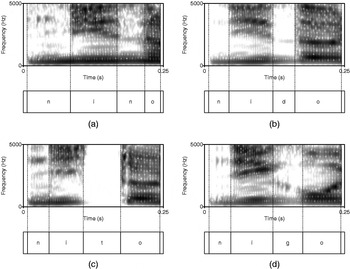
The thesis that speakers use psychoacoustic similarity when forming puns correctly predicts the effect of sonorant voicing on their similarity with voiced obstruents. First, low frequency energy is present during the consonantal constriction in both sonorants and voiced obstruents (figure 2a, b), but not in voiceless obstruents (figure 2c). Second, Japanese voiced stops, especially [g], are often lenited intervocalically, resulting in formant continuity (figure 2d), as with sonorants. Voiceless stops do not spirantize, resulting in complete formant discontinuity, and thus differ from sonorants. For these reasons, voiced obstruents are acoustically more similar to sonorants than voiceless obstruents are.
Illustrative spectrograms of Japanese [n, d, t, g] in the environment of [ni _ o]. Read by a female native speaker of Japanese. Pictures generated by Praat (Boersma & Weenink Reference Boersma and Weenink2007).

By contrast, if speakers were deploying featural rather than psychoacoustic similarity, the pattern in table 2 would not be predicted, given the behavior of [+voice] in Japanese sonorants. Phonologically, voicing in Japanese sonorants behaves differently from voicing in obstruents. A well-known phonological restriction in Japanese requires that there be no more than one ‘voiced segment’ within a stem; but only voiced obstruents, not voiced sonorants, count as ‘voiced segments’. Consequently, previous studies have proposed that [+voice] in sonorants is underspecified (Itô & Mester Reference Itô and Mester1986, Itô et al. Reference Itô, Mester and Padgett1995), or that sonorants do not bear the [voice] feature at all (Mester & Itô Reference Mester and Itô1989), or that sonorants and obstruents bear different [voice] features (Rice Reference Rice1993). Regardless of how we featurally differentiate voicing in sonorants and voicing in obstruents, sonorants and voiced obstruents do not share the same phonological feature for voicing. Therefore, if speakers were deploying phonological featural similarity, the pattern in table 2 would not be predicted. The featural similarity view – augmented with underspecification or structural differences between sonorant voicing and obstruent voicing – in fact makes the incorrect prediction that voicing in sonorants and voicing in obstruents should not interact with each other.
4.4 Sensitivity to consonants' similarity to Ø
As a final piece of evidence for the importance of psychoacoustic similarity, we discuss consonants' similarity to Ø: consonants that correspond with Ø are those that are psychoacoustically similar to Ø. In some imperfect puns, consonants in one phrase do not have a corresponding consonant in the other phrase, as in hayama tte Øayama tta ‘I apologized without thinking too much’ and Øakagaeru-ga wakagaeru ‘A brown frog will become young’. In (6) we list the set of consonants whose O/E ratios with Ø are larger than 1 – these are consonants which are paired with Ø more frequently than expected.Footnote 15
(6) [w]: 6.25, [r]: 4.59, [h]: 3.72, [m]: 2.54, [n]: 1.49, [k]: 1.39
The consonants listed in (6) are in fact those that are likely to be psychoacoustically similar to Ø, which supports the claim that speakers use psychoacoustic information when they create imperfect puns.
First, since [w] is a glide, the transition between [w] and the following vowel is blurry, which can make the presence of [w] hard to detect.Footnote 16Myers and Hanssen (Reference Myers and Hanssen2005) demonstrate that given a sequence of two vocoids, listeners misattribute the transitional portion to the second vocoid, effectively lengthening the percept of the second vocoid and shortening the percept of the first vocoid.Footnote 17 Thus, due to [w]'s blurry boundaries and consequent misparsing, the presence of [w] is perceptually hard to detect.
Next, Japanese [r] is a flap, which involves a brief and ballistic constriction in Japanese (Nakamura Reference Nakamura2002). The shortness of the constriction makes [r] sound similar to Ø. Third, the propensity of [h] to correspond with Ø accords with the observation that [h] lacks a superlaryngeal constriction and hence its spectral property assimilates to that of neighboring vowels (Keating Reference Keating1988, Pierrehumbert & Talkin Reference Pierrehumbert, Talkin, Docherty and Ladd1992), making the presence of [h] difficult to detect; [h] is a perceptually weak consonant (see Mielke Reference Mielke2003 for the perceptibility of [h] in various phonetic contexts).
Fourth, for [m] and [n], we speculate that the edges of these consonants with flanking vowels are blurry due to coarticulatory nasalization, causing them to be interpreted as belonging to the neighboring vowels. Downing (Reference Downing, van Oostendorp and van der Weijer2005) argues that the transitions between vowels and nasals can be misparsed due to this blurriness, and that the misparsing effectively lengthens the percept of the vowel. As a result of misparsing, the perceived duration of nasals may become shortened.
Finally, [k] extensively coarticulates with adjacent vowels in terms of tongue backness (Sussman, McCaffrey & Matthews Reference Sussman, McCaffrey and Matthews1991, Keating & Lahiri Reference Keating and Lahiri1993, Keating Reference Keating1996). As a result of this extensive coarticulation, [k] can fade into its environment and become perceptually similar to Ø (de Lacy & Kingston Reference de Lacy and Kingston2006).Footnote 18
To summarize, speakers pair Ø with segments that are psychoacoustically similar to Ø – especially those that fade into their environments – but not with consonants whose presence is highly perceptible. Stridents, for example, are not likely to correspond with Ø because of their salient long duration and great intensity of the noise spectra (Wright Reference Wright1996, Steriade Reference Steriade, Hume and Johnson2001a). Additionally, coronal stops coarticulate least with surrounding vowels (Sussman et al. Reference Sussman, McCaffrey and Matthews1991, de Lacy & Kingston Reference de Lacy and Kingston2006) and hence they stand out perceptually from their environments. As a result, they are unlikely to correspond with Ø.
By contrast, phonological similarity does not offer a straightforward explanation for the set of consonants in (6). The list of consonants in (6) does not alternate systematically with Ø in Japanese phonology. We observe that (6) includes sonorant consonants, with the exception of [h] and [k];Footnote 19 but as Kirchner (Reference Kirchner1998: 17–18) notes, there is no sense in which sonorous consonants are similar to Ø phonologically. We should in fact not consider Ø as being sonorous: while languages prefer to have sonorous segments in syllable nuclei (Dell & Elmedlaoui Reference Dell and Elmedlaoui1985, Prince & Smolensky Reference Prince and Smolensky1993/Reference Prince and Smolensky2004), no languages prefer to have Ø nuclei. Sonority thus fails to explain why speakers prefer to pair Ø with the set of consonants in (6).
Rather, the list of consonants in (6) includes sonorants because their phonetic properties make them akin to Ø: their edges with flanking vowels are blurry, fading into their environments. This view is supported by the fact that [k] and [h], which like sonorants blend into their environment, are treated as similar to Ø.
As another alternative, one could try to characterize Ø in terms of distinctive features, making use of the theory of underspecification. Recall that this theory postulates that non-contrastive or unmarked feature specifications are underlyingly unspecified (Kiparsky Reference Kiparsky and Yang1982, Itô & Mester Reference Itô and Mester1986, Archangeli Reference Archangeli1988, Mester & Itô Reference Mester and Itô1989, Paradis & Prunet Reference Paradis and Prunet1991, Itô et al. Reference Itô, Mester and Padgett1995). Based on this view, we could postulate that the segment which has the sparsest underlying specification is closest to Ø. This analysis, however, does not predict that the list of consonants in (6) would be close to Ø. For example, nasal consonants are marked while oral consonants are not, and sonorants are marked while obstruents are not (Chomsky & Halle Reference Chomsky and Halle1968); therefore, [−nasal] and [−son] should be underspecified. As a result, oral obstruents are predicted to be closest to Ø because they lack underlying specifications for [±nasal] and [±son]. However, the list in (6) includes nasal and sonorant consonants. Moreover, no version of underspecification postulates that [k] is more sparsely specified than [t]: in fact, the proponents of Radical Underspecification argue for the opposite (Archangeli Reference Archangeli1988, Paradis & Prunet Reference Paradis and Prunet1991, Lahiri & Reetz Reference Lahiri, Reetz, Gussenhoven and Warner2002).Footnote 20 For these reasons, the theory of underspecification does not account for why the consonants in (6) are treated as close to Ø in Japanese imperfect puns.
4.5 Summary: psychoacoustic similarity vs. featural similarity
Japanese speakers perceive similarity between sounds based on acoustic information, and use that knowledge of psychoacoustic similarity to compose imperfect puns. Featural similarity fails to capture the bases of similarity judgments that speakers make in composing pun pairs. We have presented four kinds of arguments: (i) context-dependent salience of the same feature, (ii) relative salience of different features, (iii) similarity contributed by a phonologically inert feature, and (iv) similarity between consonants and Ø. We have also argued throughout that these shortcomings of the featural similarity model cannot be salvaged by existing elaboration of feature theories, such as feature geometry or underspecification theory. Recall also that there are pairs like the [r–d] pair, whose high degree of overrepresentation cannot be explained in terms of featural similarity (see also footnote 8 for other potential examples of this kind).
Rather, Japanese speakers use psychoacoustic similarity when they make imperfect puns. A future investigation should construct a complete psychoacoustic similarity matrix for Japanese sounds through psycholinguistic experiments (e.g. identification experiments in noise and similarity judgment tasks) and apply it to a further analysis of the imperfect pun patterns. Since this task will require a completely new set of experiments, we leave it for future research.
Conclusion
5.1 Parallels between verbal art and phonological patterns
In closing this paper, we discuss non-trivial parallels which we found between the imperfect pun patterns and phonological patterns. For example, in Japanese imperfect puns, [m] and [n] are more likely to correspond with each other than [p] and [t] are, just as in other languages' phonology in which [m] and [n] alternate with each other (i.e. nasal place assimilation) while [p] and [t] do not (Cho Reference Cho1990, Mohanan Reference Mohanan and Goldsmith1993, Jun Reference Jun, Hayes, Kirchner and Steriade2004). In both verbal art and phonology, nasal pairs are more likely to correspond with each other than oral consonant pairs.
Similarly, in the pun pairing patterns, minimal pairs that differ in voicing are more likely to correspond with each other than other types of minimal pairs that differ in nasality and continuency. This patterning parallels the cross-linguistic observation that a voicing contrast is more easily neutralized than other manner features (Steriade Reference Steriade2001b, Kenstowicz Reference Kenstowicz2003). In both cases, a voicing mismatch between two corresponding elements is tolerated, more so than a mismatch in other features.
Third, in section 4.3 we observed that voicing in sonorants enhances similarity with voiced obstruents, and this finds its parallel in linguistic similarity avoidance patterns. In some languages, pairs of sonorants and voiced obstruents are disfavored, as in Arabic (Frisch et al. Reference Frisch, Pierrehumbert and Broe2004: 195) and Muna (Coetzee & Pater Reference Coetzee and Pater2005). Finally, we demonstrated in section 4.4 that when consonants correspond with Ø, speakers tend to choose those consonants that fade into their environment. Again, this pattern finds a parallel in phonology: when speakers epenthesize a segment, they typically choose segments that are the least intrusive (usually glottal consonants for consonants and schwa or high vowels for vowels: Dupoux et al. Reference Dupoux, Kakehi, Hirose, Pallier and Mehler1999, Steriade Reference Steriade2001b, Kenstowicz Reference Kenstowicz2003, Howe & Pulleyblank Reference Howe and Pulleyblank2004, Walter Reference Walter and Kenstowicz2004, Kwon Reference Kwon2005, though see de Lacy & Kingston Reference de Lacy and Kingston2006 for the observation that [k] is never epenthetic in natural languages, presumably for a markedness reason).
With these results we conclude that there exist non-trivial parallels between verbal art patterns and phonological patterns.Footnote 21 As we have argued throughout this paper, the parallels exist because speakers use psychoacoustic similarity in shaping both phonological and verbal art patterns. Given the parallels, moreover, we further conclude that it can be fruitful to investigate speakers' grammatical knowledge by examining para-linguistic patterns (Ohala Reference Ohala1986, Itô et al. Reference Itô, Kitagawa and Mester1996, Fabb Reference Fabb1997, Yip Reference Yip1999, Minkova Reference Minkova2003, Steriade Reference Steriade2003, Kawahara Reference Kawahara2007 as well as references cited above). Our strategy has been inspired by a growing interest in using verbal art as a source of information about our linguistic knowledge. We hope our studies have shown the fruitifulness of investigating phonological hypotheses using external evidence (Churma Reference Churma1979).
5.2 Overall summary
The combinability of two consonants in imperfect puns in Japanese correlates positively with their perceptual similarity. The analysis of imperfect puns has shown that speakers possess a rich knowledge of psychoacoustic similarity and deploy it in composing imperfect puns, supporting the tenets of the P-map hypothesis (Steriade Reference Steriade, Hume and Johnson2001a, Reference Steriadeb, Reference Steriade2003; Fleischhacker Reference Fleischhacker2005; Kawahara Reference Kawahara2006, Reference Kawahara2007; Zuraw Reference Zuraw2007). Featural similarity, on the other hand, fails to capture the bases of the similarity decisions that speakers evidently make.
6. APPENDIX
6.1 Feature matrix used for the analysis in section 3