INTRODUCTION
Most historic buildings in Japan are primarily made of wood. Because these historic buildings were often erected by emperors and nobles, many historical records concerning the buildings survive. When such records are absent, historians may estimate a building’s age by consideration of its architectonic style.
The architectural styles employed in the Japanese middle ages and early modern ages developed and progressed in diverse ways based on locality. This diversity makes it difficult to estimate the age of ancient structures based on architectural style alone. For many structures that were not ceremonial or government buildings, such as farmhouses and dwellings, no construction records exist, which further complicates efforts to establish the building age.
In Japan, dendrochronology is commonly used for establishing the age of ancient buildings. Japanese cypress was often used in the construction of ancient Japanese buildings, and this tree is well suited to dating by dendrochronology. Dr. Takumi Mitsutani succeeded in producing a master curve for annual ring generation of the Japanese cypress in 1985. Thereafter dendrochronology came into common use for investigations of ancient buildings and architecture (Mitsutani Reference Mitsutani1990). In Japan, dendrochronology master curves have been published for Japanese cypress, Japanese cedar, sciadopitys verticillata, dolabrata, and hemlock spruce, and have been applied to dendrochronology studies of structures made with these species.
Since builders utilized local forest resources in construction, medieval and early modern buildings were built with a variety of tree species. Moreover, buildings constructed in the Middle Ages and the early modern period were typically composed of thin wood pieces. Such wood pieces have only a small number of tree rings. Therefore local buildings of the Middle Ages and early modern times are often outside the scope of dendrochronology methods. These considerations suggest the use of 14C dating for studying buildings of the Middle Ages and early modern period.
Dendrochronology and 14C dating methods can be used to determine the age of the outermost rings of a wood piece, but these methods cannot derive the age of the building itself, since the outermost wood layer and the age of structural pieces may not match, and the ages of the pieces and the building may not be identical. However, application of both techniques should reduce overall uncertainty of the age determination.
14C Dating and Protection of Old Japanese Buildings
When the present 14C dating survey of old buildings began in Japan in 2004, it was not known whether it is possible to apply 14C dating techniques to structures from the 13th to the 19th century. First we carried out the 14C dating survey on Seki House, a structure of cultural importance (Imamura Reference Imamura2005). The tree species used in the pillars of Seki House were pseudotsuga japonica and pine, which are both outside the application of dendrochronology in Japan. The method of 14C wiggle matching was applied to the wood of this pillar. The results suggest that the ages of the pieces are consistent with the early 17th century, which agrees with the estimate based on the architectural style of Seki House (Imamura Reference Imamura2005). Also, the age of another pillar was found to be consistent with that of the drawing room, which according to legend was built as a place for the third Tokugawa Shogun to eat lunch.
The success in the dating of Seki House using the 14C wiggle-matching method suggested that 14C dating investigation could be applied to other buildings of the 13th century or later, therefore we tried 14C dating surveys on other medieval and modern buildings. Previous work (Nakao et al. Reference Nakao, Sakamoto and Imamura2014, Reference Nakao, Sakamoto, Imamura, Nagai, Nishijima, Martin and Maruyama2015) had researched whether 14C dating is possible in various types of construction, including temples, shrines, castles, houses of the upper classes, and common people’s dwellings.
Using the method of three-point wiggle-matching of short tree rings, we were able to contribute to the preservation of an old townhouse that was about to be destroyed (Fujita Reference Fujita2015). In addition, because the research helped to establish the value of a temple main hall as an important cultural property, the hall has been designated a national treasure (Nakao Reference Nakao2011; Ueno and Nakao Reference Ueno and Nakao2012). In this way, we have been able to establish that 14C dating of old buildings is reliable in Japan, and 14C dating now provides chronological information for the protection of cultural properties.
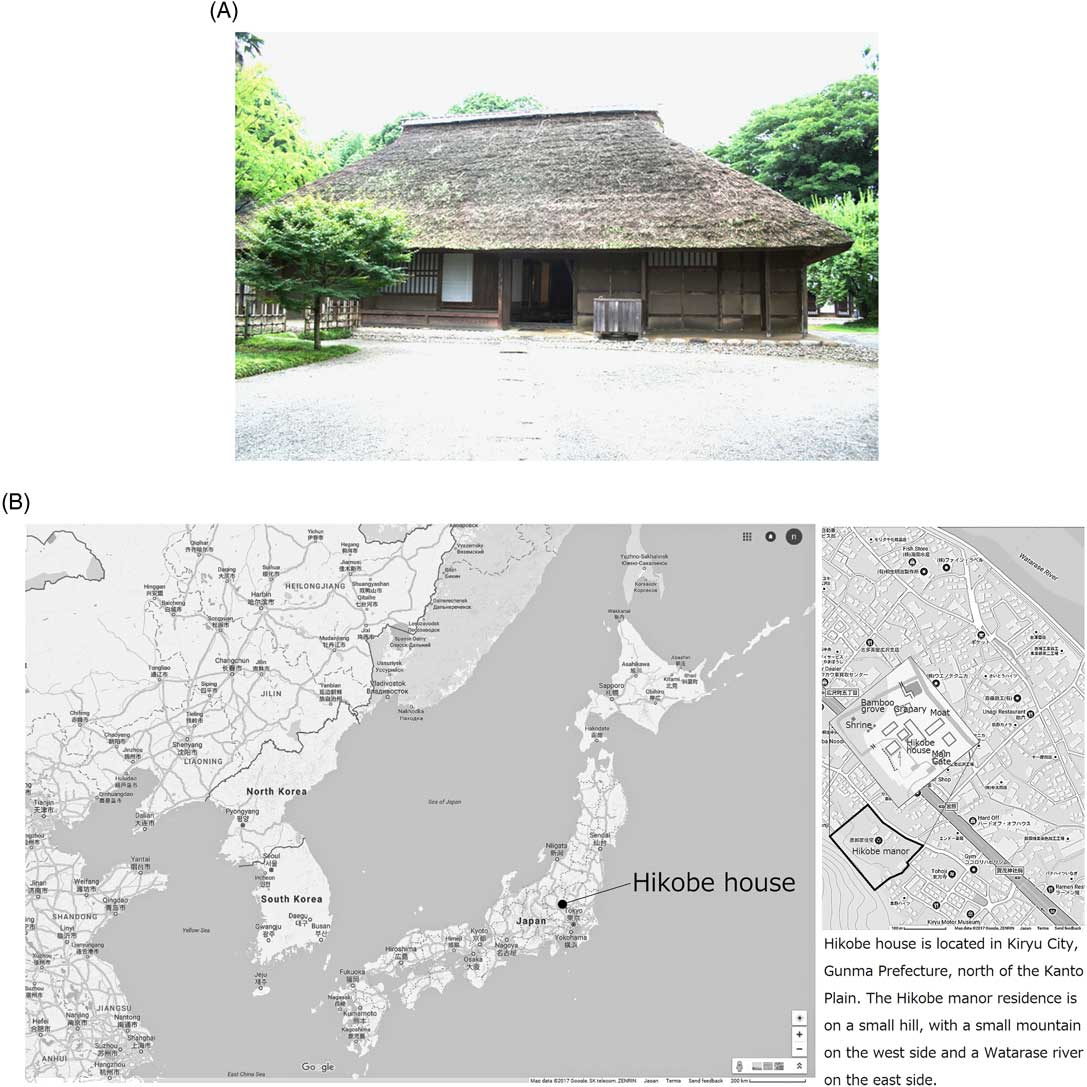
To illustrate further the value of this wiggle-matching method, we introduce the case of the important cultural property Hikobe House (Figure 1). In the Hikobe House survey, we successfully derived piece ages by the wiggle-match method of short annual rings. By comparing the results of the archaeological survey, the construction survey, and the 14C dating survey, the building’s age and aspects of its history were revealed.
(A) Front of Hikobe House and (B) map of Japan showing the house’s location.

About Hikobe House
Hikobe House is an important cultural property located in Gunma prefecture and is one of the oldest such properties in the Kanto region of Japan. Hikobe House has a high historical value in both the main house and the estate, and received the important cultural property designation by the national government in 1992. No written records of the house construction exist, so Hikobe’s main building age was unknown. According to lore, the Hikobe estate was developed in its current location in the mid-16th century.
Hikobe House was dismantled and underwent extensive repair and reconstruction for the preservation of cultural assets between 1995 and 1998. During the dismantling and repair work, excavations were carried out under the main house, which yielded samples of pottery from the layer of the early 17th century. As a result of this excavation, the Hikobe main house was estimated to date back to the first half of the 17th century (Akiyama et al Reference Akiyama, Inaba and Sonoda1999).
On the other hand, the guest room of the Hikobe main house seemed to be of a previous design, which may have predated the early 17th century. At the same time, it seems the structure of the Hikobe main house may have been developed in the late 17th century. Given this conflicting age information, the 14C dating investigation was carried out to better elucidate the true age of the Hikobe House structures.
METHOD
Survey Research Organization
In general, 14C age investigations of old buildings are carried out as a part of repair work, maintenance, preservation activities, and academic research, so the specialists of the various sectors involved in the building perform a joint survey. It is necessary for the architectural experts to look at the entire building, summarize and compare reports, and collate the survey results of each expert.
Selection
14C dating was applied to measure the ages of wood parts of building structures that had been in storage and were not reused in the building repair works. The wood parts of building structures were selected to be suitable for the architectural chronological survey among the large amount of material stored in the attic of Hikobe House.
For successful dating of the building by a 14C dating survey, the selection of suitable wood pieces is the most important step. From among the hundreds of timber pieces constituting the old building, the original wood that was cut down and used during initial construction must be selected. Hereinafter, we describe the conditions of the pieces suitable for the architectural chronological survey.
Old Japanese buildings have been repaired and altered in many places and parts up to the present day. During repair or remodeling, newer wood pieces are usually added. The oldest fragments of wooden structures show the building’s age. On the other hand, the pieces added later can provide the dates of subsequent repairs and/or remodeling. The older first pieces are of two types. One is the material cut down at the time of first construction. The other type is reused or recycled older material that had previously been cut down. If wooden materials were scavenged from a predecessor building that had been demolished, or if the builders used driftwood and/or wood that had died long before the time of construction, the old material would exhibit an age much older than that of the building. While the ages of the old materials are not at all related to the building or remodeling ages, the old materials may be useful for establishing the ages of the predecessor buildings.
Restoration architects have the experience and technology to distinguish between wood components added at the time of repair and the original pieces. Based on the observation of processing traces and the surface of the piece joints, architectural historians and restoration architects can trace the process of remodeling of the building. Such trace restoration methods can play a very useful role in the 14C dating survey.
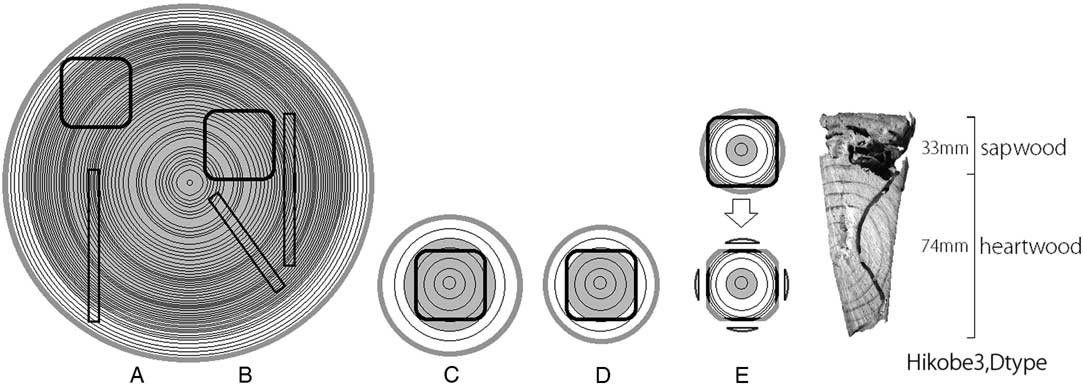
The next problem is the presence or absence of sapwood. If any sapwood remains, the age of the pieces suggested by the outermost annual ring can be associated with the building age (Figure 2A). If a wood piece has thin annual rings and has had the sapwood shaved, there is no way to determine the actual number of annual rings in the piece. Therefore, it is impossible to associate the building age with the ages of the outermost annual rings of the pieces, making these pieces unsuitable for the 14C dating survey (Figure 2B).
Examples of different lumber-working methods used to create the wood members.

Even if there is no sapwood, wooden material with wide annual rings and a core can be associated with the building age using the age of the outermost annual ring of the piece (Figure 2C). Many wooden pieces with a core have sapwood (Figure 2D). Menkawa pillars with wood skin are suitable for 14C dating methods (Figure 2E). Such pillars were used in Sukiya (the interior style of a tea ceremony house, a Japanese guest house, and so on).
The No. 3 “tie beam” of the Hikobe House (a cross-section of which is shown in Figure 2E) is a red pine material having 33 mm of sapwood. It is estimated that about a few years of sapwood was shaved from No. 3 at the time of construction (Figure 2C). Piece No. 3 has a small number of tree rings, and so was deemed unsuitable to apply the 14C wiggle-match method. Instead, the required age was obtained via the two-point measurement method (Figure 4).
In addition, building materials may have been contaminated. Over the years, building pieces may have been coated with paints or impregnated with resin-based materials. Such contaminated material was avoided in this study.
Sampling and Sample Preparation
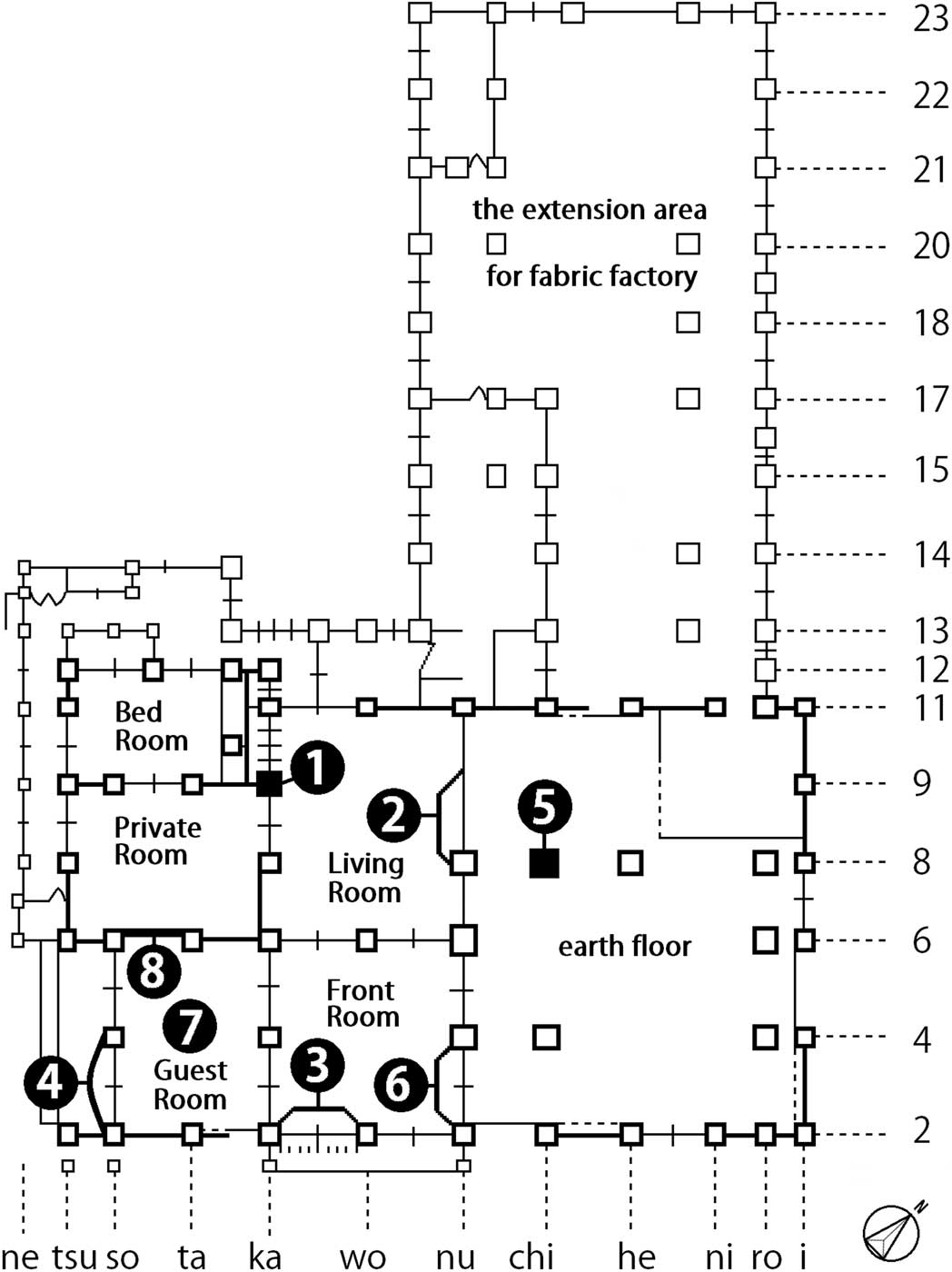
In the first survey, in 2009, we collected samples from 7 pieces of the Hikobe House. In the second survey, in 2012, we collected samples of a wall panel from the guest room. In the third survey, in 2016, we resampled the No. 6 sample (Figure 3).
Position on the site plan of the wooden members examined in this study.

Paleo Labo carried out sample preparation chemistry for AAA processing (using 1.2 M of HCl solution, 1 M NaOH solution, and 1.2 M HCl solution), graphitization of carbon dioxide, and 14C accelerator mass spectrometry (14C-AMS) on pieces No. 1, No. 2, No. 3, No. 4, No. 5, No. 7 and 3 samples of No. 6 (Kobayashi et al. Reference Kobayashi, Niu, Itoh, Yamagata, Zaur, Ineza, Nakamura and Fujine2007). Sakamoto carried out ultrasonic cleanings using acetone and a solvent consisting of a 2:1 mixture (by volume) of chloroform and methanol, respectively. For piece No. 8, AAA pretreatment was carried out (1 hr × 2 times in 1.2 M of HCl solution, 1 hr × 5 times in 1 M NaOH solution, and 1 hr × 3 times in 1.2 M HCl at 80°C) (Nakao et al. Reference Ueno and Nakao2012; Sakamoto et al. Reference Nakao, Sakamoto, Imamura, Nagai, Nishijima, Martin and Maruyama2015).
Cellulose extraction from another No. 6 piece was performed as follows. Wood was cut into a 1-mm-thick plate using a low-speed precision circular saw with a boron nitride blade. After ultrasonic cleaning using a mixture of acetone and the 2:1 chloroform-methanol mixture, the tree-ring plate was placed between PTFE perforated sheets and stitched up by cotton string. The sample was put into a testing tube, and chlorine bleaching was performed using sodium chlorite solution and concentrated HCl (1 hr × 4 times at 70°C). Hemicellulose was removed using a 17.5 wt% NaOH solution (1 hr × 3 times at 80°C). After neutralization, the sample was vacuum-freeze dried. Bleached tree rings were separated into 3-yr time spans and stored in separate glass tubes. The Center for AMS at Yamagata University performed the graphitization and 14C-AMS measurement.
RESULTS AND DISCUSSION
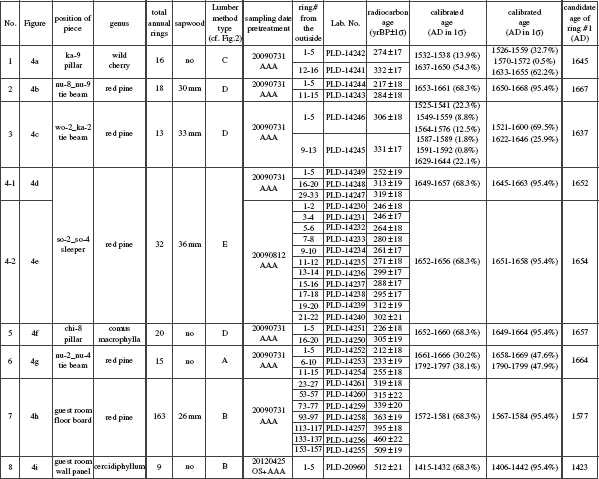
Table 1 shows the results of the 14C dating. 14C-wiggle matching was carried out using RHC calibration program (Imamura Reference Imamura2007; Sakamoto Reference Sakamoto2012). Age considerations help to establish the relationship between the 14C data of the piece of wood and the building age. First, we determine whether the piece of wood of the survey was all cut down at the same time. For building age determination, it is necessary to match the estimated ages obtained in other ways. Finally, we conducted a comparative study of the piece of wood ages given by the 14C dating survey and the building age suggested by its architectural style. We also compared these data with building excavation data and with information derived from literature records and local lore. If the age obtained by 14C survey is a true building age, it should be consistent with the ages indicated by the architectural style, excavation data, and literature records. If these ages do not match, it is necessary to clarify the reasons for the mismatch and to check the reliability of all of these data. The following is a brief discussion of the findings for each of the eight pieces of wood considered in this study.
Data list of survey materials.

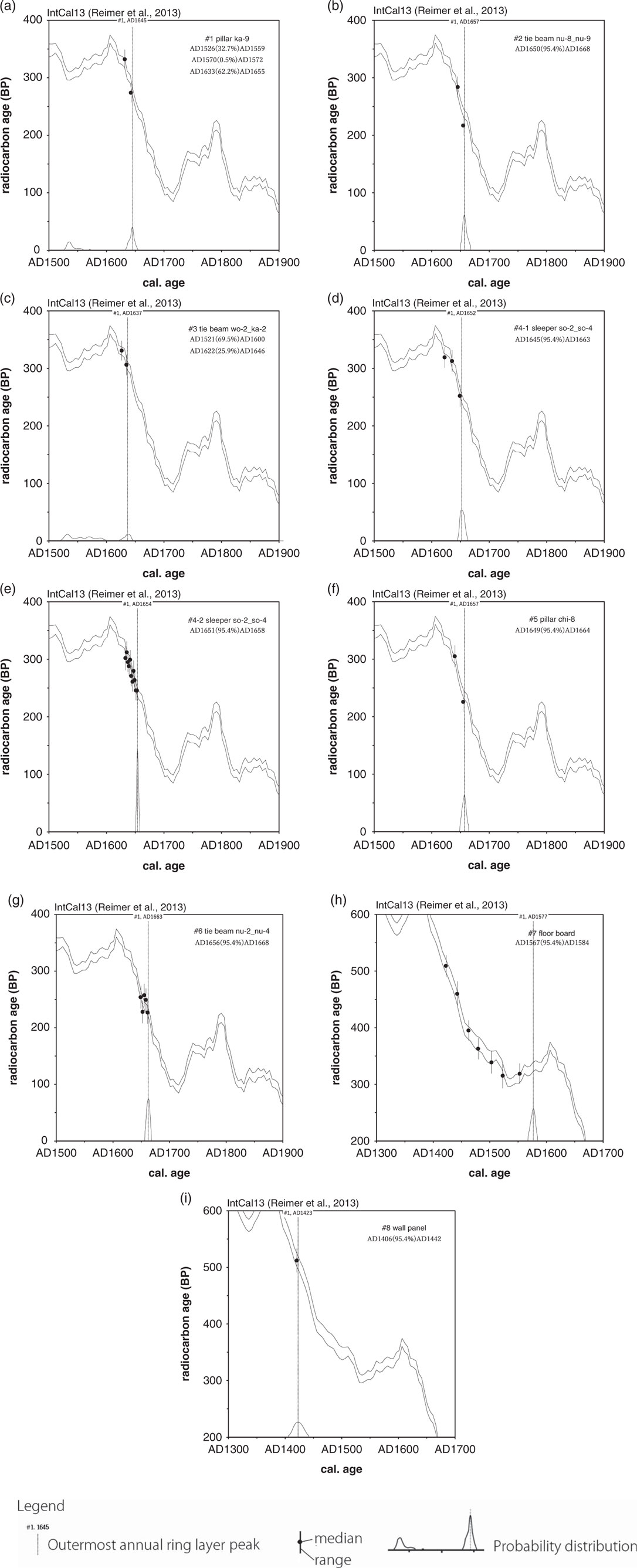
No. 1 (Figure 4a #1), the “ka-9” pillar, is a material with a core of wild cherry. This piece of wood has no sapwood and its average annual ring width is about 5 mm (Figure 2C type). No. 1 was considered to be less shaved at the time of lumber harvesting. From the two point analysis, this piece of wood probably dates from sometime from the mid-16th century to the 17th century. Because pottery of the early 17th century was excavated at the site, the possibility of the earlier 16th century date can be eliminated.
Radiocarbon dating analysis of each wooden member used in the study. 14C wiggle-matching was carried out using RHC calibration program (Imamura Reference Imamura2007; Sakamoto Reference Sakamoto2012). Using RHC, only tree ring numbers are required. Their gaps are calculated automatically.

No. 2 (Figure 4b #2), the “nu-8 _ nu-9” tie beam, is composed of red pine with 30 mm of sapwood. The average annual ring width of the No. 2 piece is 3.9 mm, and is of the type shown in Figure 2C. We considered that piece of wood No. 2 was cut down in the late 17th century.
No. 3 (Figure 4c #3), the “wo-2–ka-2“ tie beam, consists of red pine with 33 mm of sapwood. The average annual ring width of the No. 3 piece is 5.8 mm (Figure 2 C type). Because of the small annual rings, possible ages of the piece of wood may date from the 16th century to the 17th century. Similar to piece of wood No. 1, the possibility of the 16th century can be eliminated.
No. 4, the “so-2–so-4” sleeper, is red pine with 36 mm of sapwood. The average annual ring width of the No. 4 piece of wood is 2.6 mm (Figure 2C type). Wiggle matching was carried out for different sample sets, namely three samples of five rings (Figure 4d #4-1) and 11 biennial samples (Figure 4e #4-2), in the same manner. The calibrated ages of the outermost rings coincided almost exactly, and indicated that No. 4 was cut down in the late 17th century in conclusion.
No. 5 (Figure 4f #5), the “chi-8” pillar, is composed of cornus macrophylla with a core and no sapwood. The average annual ring width of the No. 5 piece of wood is 4.5 mm (Figure 2C type). Our 14C survey indicated that No. 5 was cut down in the late 17th century.
No. 6 (Figure 4g #6), the “nu-2–nu-4” tie beam, is red pine with no sapwood. The average annual ring width of the No. 6 piece of wood is 5 mm (Figure 2C type). Since this piece of wood has only 15 tree rings, the bleached butt end of the piece of wood was sampled in three rings each and dated. Our survey results suggest that No. 6 was cut down in the late 17th century.
No. 7 (Figure 4h #7), one of the floorboards, consists of red pine material with 26 mm of sapwood. Results from the present study suggest that No. 7 was cut down in the 16th century.
No. 8 (Figure 4i #8), the wall panel, is a cercidiphyllum material with no sapwood. The outermost annual rings of No. 8 appear to date from the 15th century. The surface of the No. 8 wall panel were finished using a narrow planer tool. On the other hand, the back of the panel was apparently finished using an adz with a roundish edge. The No. 8 wall panel is spliced using a technique typical of the Middle Ages. It is apparent that the wood surface and back treatment splice of piece No. 8 were worked with early 16th-century tools and methods. The medieval techniques apparent in No. 8 are consistent with the age obtained in the 14C dating survey.
CONCLUSIONS
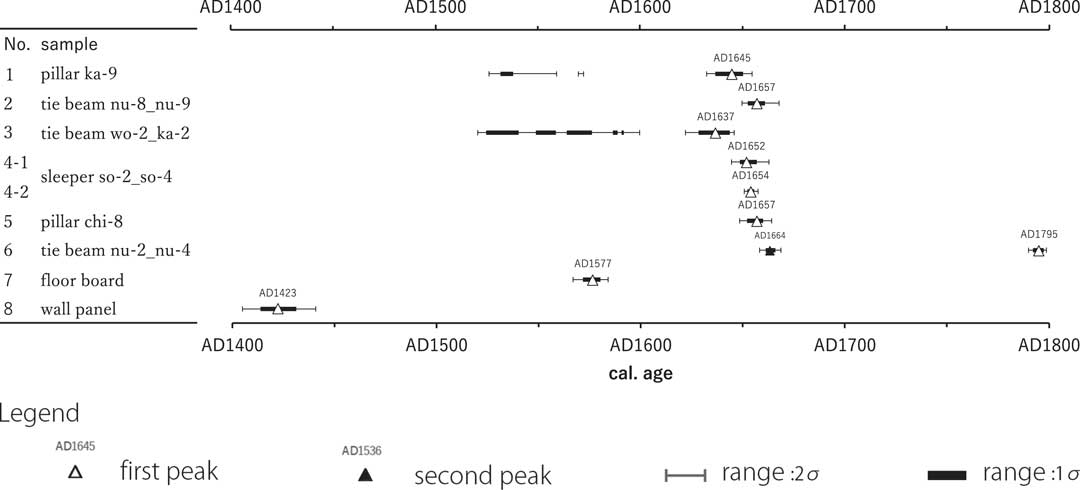
The results of the 14C dating survey indicate that the 8 wooden pieces surveyed can be divided into two age groups, one from the late 17th century and the other from before the 17th century (Figure 5). Pieces No. 1, No. 2, No. 4, No. 5, and No. 6 all show ages dating to the middle and late 17th century. When the portions of the wood that were removed at the time of harvesting (such as the sapwood) are considered, these trees are judged to have been cut down in the late 17th century.
Multi-plot of derived age of the eight pieces examined in this study.

The study suggested two ages for wooden structure No. 3. However, the trace restoration method found that the No. 2 and No. 3 pieces of wood were made in the same period, so we can select the age of the 17th century.
No. 7 and No. 8 both indicate a prior origin, in the 16th century or earlier. It is possible that both these pieces of wood were part of the pieces from the manor house built in the 16th century. Because of the reuse of wood from the predecessor building, the processing techniques used on No. 7 and No. 8 are older than those used throughout the rest of the building, and the room design is also of an earlier era.
Since 6 of the 8 buildings’ pieces of wood could reliably be dated to the late 17th century, the authors place the construction date of the current Hikobe House to be the late 17th century. Mr. Hikobe ascended to the role of village chief in 1661, and seems to have built the house soon after assuming the post. The derived age of No. 4, 1654 (peak) + a few years, is well consistent with the date 1661.
In the Hikobe House dating survey, we have obtained good results using 14C dating of wood material that had been out of the structure until now. For the survey we targeted pieces of wood that had short tree-ring samples of about 20 annual rings. We measured the 14C ages of three points per sample, and analyzed these points by the wiggle-match method. By obtaining ages for several building pieces of wood, we were able to determine the likely age of the overall building.
ACKNOWLEDGMENTS
This work was supported by Paleo Labo Co. Ltd. with the research fund, “High-Precision Chronology for Research on Historical and Archaeological Materials,” Collaborative Research of National Museum of Japan History, and JSPS KAKENHI “Radiocarbon dating of the cultural asset building,” Grant Number 23300325, and “Research on application of historical construction of radiocarbon dating,” Grant Number 15H02949. The authors thank Mr. HIKOBE Atsuo and his family, the Japanese Association for the conservation of Architectural Monuments, Mr. SONODA Seiji, Paleo Labo Co. Ltd., and the Center for Accelerator Mass Spectrometry of Yamagata University.
Authors’ Contributions
In the Hikobe House dating survey, Nakao managed the survey and selected the wood pieces for analysis. Samples were collected by Nakao, Sakamoto, Imamura, and Kobayashi. The Paleo Labo group carried out the chemical preparation on the samples for AMS measurements to apply the 14C wiggle matching method, and the results were analyzed by Imamura, Sakamoto, and Ozaki. Sakamoto and Nakao determined the likely age of the pieces analyzed. Nakao assembled the information to arrive at an estimate of the age and transition history of Hikobe House.
Nakao was advised on the piece selection by Mr. Seiji Sonoda. Mr. Sonoda belongs to the Japanese Association for the Conservation of Architectural Monuments, and he is the cultural property repair architect who carried out the deconstruction and repair work at Hikobe House in 1998. Paleo Labo Co., Ltd. performed the 14C dating survey of Hikobe House as a local contribution. Their work was carried out just prior to the 12th Japanese AMS Symposium, which was convened by Paleo Labo Co., Ltd. in Gunma prefecture (Imamura et al. Reference Imamura, Niu, Itoh, Ozaki, Fujine and Kobayashi2010; Nakao et al. Reference Nakao, Sakamoto and Imamura2010; Ozaki et al. Reference Ozaki, Niu, Itoh, Hirota, Zaur, Ineza, Yamagata, Kobayashi, Fujine, Sakamoto, Imamura and Nakao2010).