How does the legacy of an ethnic civil war affect the political preferences of ordinary citizens? Does experience with wartime violence that is driven by ethnic tensions lead communities to reject the politicization of identity or does it instead radicalize the population even more along ethnic lines? These are important questions for better understanding not only the social and political consequences of ethnic civil wars but also the roots of identity-based political competition. While numerous studies have addressed how conflict affects social behavior and interaction between individuals, how that translates into political preferences and vote choice requires more attention.
Expectations about the effect of violence on voting are not obvious. On the one hand, recent work suggests that ethnic aversions may not endure beyond the war, especially in the Balkans due to pre-war norms of co-operation.Footnote 1 On the other hand, literature on voting and electoral strategies would predict that violence increases the salience and polarization of ethnic identities, which in turn heightens ethnically based mobilization and voting.Footnote 2 Violence exposure may also increase ascriptive identification while reducing general trust and interpersonal exchange between members of the formerly warring groups.Footnote 3 However, we still know relatively little about the impact of war on social capitalFootnote 4 and whether or how the inter-group aversions that are potentially engendered by conflict translate to vote choice. Equally important, while emerging research has looked at the individual-level consequences of exposure to wartime violence,Footnote 5 the communal effects of wartime violence remain relatively unknown.Footnote 6 Yet, these effects better reflect the broader social and political legacies of the war.
Our study focuses on community-level ethnic voting to explore the consequences of wartime violence on the political salience of ethnicity. The empirical analysis relies on data from the civil war in Bosnia in 1992–5. We employ difference-in-differences (DID) regression and data on wartime casualties and pre- as well as post-war national election results at the municipal level to estimate the effect of exposure to violence on post-war party competition. We find that increased exposure to violence induces higher levels of post-war ethnic voting. The difference in the post-war ethnic vote share between the least violent and most violent municipality is about 16 percentage points – a substantively large effect that holds across a variety of robustness checks.
We argue that this effect occurs because wartime ethnic violence highlights ethnic differences, forces individuals to adopt and solidify ethnic identity, and induces a retreat into ethnic communities for protection and coping. This, in turn, results in high levels of cohesion among co-ethnics and intense distrust of non-co-ethnics. The combination of in-group cohesion and out-group distrust polarizes voters’ political preferences along ethnic lines and makes ethnic parties the most attractive channels of representation. Using post-war survey data, we find suggestive evidence for this causal mechanism.
The rest of the article is organized as follows. In the next section, we provide our theoretical argument on how community-level exposure to wartime violence affects post-war ethnic voting. We then describe the Bosnian case and its generalizability. This is followed by a discussion of the data and measures. After presenting our main results along with various robustness checks, we delve into the potential causal mechanism. The final section concludes.
THEORY
Individuals have many identities – some ethnic, some non-ethnic – with which they can identify politically.Footnote 7 In the absence of strong group-based identities, such as ethnicity, vote choice and party competition tend to be dominated by socio-economic interests.Footnote 8 However, as ethnic identification increases, individual political preferences become more polarized along ethnic lines, which in turn encourages voting based on ethnicity rather than more programmatic or ideological issues.Footnote 9 We argue that communal experience with wartime ethnic violence constitutes a major change in social conditions and environment, triggering heightened levels of ethnic identification, and increasing the political salience of ethnicity as reflected in support for ethnic parties. The causal mechanism underlying our argument runs as follows.
Ethnically based violence forces even neutral individuals to take sides in order to gain advantage, seek protection or simply express moral outrage over the violence.Footnote 10 This process of retreating into ethnic communities begins during the conflict itself, but even after violence ends, each side of the conflict continues to band together as a collective coping mechanism.Footnote 11 Furthermore, previous research suggests that the effects of wartime violence transcend individual experiences with communities forming collective memories of the violence.Footnote 12 Such collective memory can foster ethnic cohesion and sustain the effects of violence on ethnic identification long after the war.
The adoption of ethnic identity and closer connection with co-ethnics make the distinctions between them and others more prominent. The desire to maintain a positive image of one’s ethnic identity leads to negative out-group evaluations and perceptions of non-co-ethnics as a threat.Footnote 13 This, in turn, breeds parochialism toward out-groups and undermines trust and co-operation with members of those groups, generating an us vs. them mentality along ethnic lines.Footnote 14
Under this context of greater in-group cohesion and increased distrust of out-groups, we argue, the ethnic community assumes a significant role in the individual’s life and ethnicity becomes a defining feature of the individual’s identity. People’s perception of personal well-being will be more intimately tied together with the fortunes of their ethnic community. Because of this, individuals in communities that have suffered from ethnic violence are more likely to have ethnically exclusionary policy preferences.Footnote 15
Naturally, parties that espouse a particular ethnic identity can more credibly claim to members of that ethnicity that, once in office, they intend to benefit the group. Non-ethnic parties, on the other hand, will often have leaders and candidates from different ethnic groups. Due to their multi-ethnic composition and programmatic rather than explicitly group-based policies, non-ethnic parties will struggle to make credible claims that they have the best interests of a particular ethnic group in mind. We argue that it is precisely this dynamic that produces higher levels of support for ethnic parties among high exposure communities.Footnote 16
Note that our theory does not necessarily require that individuals personally experience violence. Adopting and solidifying identities and showing solidarity toward the ethnic in-group can also result from witnessing violenceFootnote 17 or living in fear of violence,Footnote 18 both of which are significantly more likely in communities where more wartime violence took place. In turn, our theory suggests that violence experienced by the majority of a population will also have an effect on the underlying culture of that locale. If a given population in the aggregate has high levels of distrust of other ethnic groups, this will have a lasting impact on the local community, regardless of a particular individual’s level of exposure.
In sum, we argue that communal exposure to wartime violence increases the salience of ethnicity and makes it important for vote choice. On the flip-side, absent experience with violence, ethnic identity remains only one of the possible identities that can affect vote choice. In low-violence communities, we are therefore less likely to see a post-war surge in ethnic party support.
THE CASE OF BOSNIA
Our argument applies to ethnic civil wars that are followed by competitive elections where ethnic parties are allowed to participate. Bosnia represents such a case. The violence in the Bosnian Civil War was overwhelmingly inter-ethnic. At various times during the war (April 1992–December 1995), significant fighting occurred between Bosniaks and Serbs, Serbs and Croats, as well as Croats and Bosniaks.Footnote 19 The outbreak of the war is best understood in the context of Yugoslavia’s rather rapid disintegration in the late 1980s and early 1990s. The first democratic, multi-party elections produced non-communist, ethnically minded governments in Slovenia and Croatia that soon declared independence from greater Yugoslavia. The country’s most ethnically diverse republic, Bosnia-Herzegovina, held its own multi-party elections in November of 1990. The Bosniak and Croat members of the subsequent government, motivated by Slovenia’s and Croatia’s declarations and frightened by the increasingly chauvinist posture of Serbia’s Slobodan Milošević, orchestrated a referendum on independence in February 1992 which was approved overwhelmingly by voters but boycotted by the country’s ethnic Serb population. Shortly thereafter, in April 1992, hostilities broke out between Bosnia’s constituent peoples. The violence was both intense and varied, including high numbers of military casualties, indiscriminate targeting of civilians, systematic sexual violence and the frequent use of torture in the numerous concentration camps that were set up throughout the country. The war continued until NATO forces intervened in mid-1995 and finally brought an end to open hostilities later that year. Post-war, there have been several democratic elections with ethnic and non-ethnic parties competing for votes.
GENERALIZABILITY
Bosnia constitutes a difficult case – which enhances the generalizability of our findings – because its history of ethnic relations and recent research suggest that it is an inherently co-operative society where war-effects may be muted or absent altogether. Specifically, several authors point out that Bosnia was one of the most ethnically tolerant societies in the former Yugoslavia and that ethnic hatred was not the leading cause of war.Footnote 20 These co-operative norms may be resilient to the effects of war. Indeed, post-war research shows strong evidence of fairness toward non-co-ethnics,Footnote 21 absence of polarizing ethnic hatredFootnote 22 and weak war effects on negative evaluations of out-groups.Footnote 23 This poses an uphill battle for us to find significant effects of wartime violence. If we do uncover such effects, however, we can be more confident in their reliability and generalizability.
Furthermore, the country adopted a system of ethnic quotas after the war. These quotas may have increased the overall level of ethnic voting by priming voters to think of political life in ethnic terms and by incentivizing parties to ground their appeals in ethnic identity (increasing the supply of ethnic parties). However, since these changes occurred at the national level, their effect is likely to be uniform across all municipalities. Furthermore, any increase in ethnic voting as a result of quotas is likely to suppress potential variation in ethnic voting. If we do find the hypothesized violence effect on voting in this context, such an effect is even more likely to be present in contexts where ethnic quotas are absent.
It is important to keep in mind, however, that the conflict in Bosnia concluded with outside intervention, which according to some research may lead to the ‘freezing’ of the conflict and the underlying issues that led to tensions in the first place.Footnote 24 This is in contrast to decisive military outcomes or negotiated settlements undertaken by domestic actors, where a final resolution to the issues that induced conflict is more likely. Therefore, the case of Bosnia is particularly relevant to instances where the issues that produced conflict continue to remain salient in the post-war period. However, outside intervention and peacekeeping have become increasingly common in the post-World War II period: for example, Regan finds that an outside power intervened in 101 out of 150 intrastate conflicts that occurred between 1945 and 1999.Footnote 25 In this regard, Bosnia is representative of a large share of post-conflict societies. We discuss the Bosnian case in greater detail in Supplementary Information (SI) section SI1.
DATA, MEASURES AND METHOD
Estimating the effect of wartime violence on ethnic voting is a difficult task. Communities that experienced more violence are not likely to be similar to those that experienced little to none. Moreover, communities with higher levels of pre-war ethnic voting may be the ones that suffered more wartime violence. To address these problems, we rely on panel data from pre- and post-war elections with a difference-in-differences regression design. Our unit of analysis is a pre-war municipality (n=109). The data for pre-war elections and for our measure of the level of violence are available at this level. We matched this level of analysis also for post-war elections.Footnote 26 Descriptive statistics for all the variables are provided in Table SI2.2.1.
Our dependent variable, Ethnic vote share, measures the share of the municipal-level vote obtained by ethnic parties in national legislative (House of Representatives) elections.Footnote 27 We obtained municipal-level election returns for the 2006, 2010 and 2014 legislative elections from the Central Election Commission of Bosnia and Herzegovina, and for 1990 from Sambró i Melero.Footnote 28 While legislative elections were also held in 1996, 1998, 2000 and 2002, municipal-level results with significant coverage were not available for elections prior to 2006.Footnote 29 Nevertheless, we believe that using the country’s three most recent national elections poses the most difficult test of our theory. The effects of wartime violence on ethnic voting should be especially pronounced in elections immediately following the war. Focusing on elections that were held over a decade after the war, we are able to observe whether the violence effect endures for an extended period of time.Footnote 30
Following Chandra, we define an ethnic party as ‘a party that overtly represents itself as a champion of the cause of one particular ethnic category or set of categories to the exclusion of others, and that makes such a representation central to its strategy of mobilizing voters’.Footnote 31 Parties that do not engage in such rhetoric were coded as multi/non-ethnic.Footnote 32 The dependent variable ranges from 19.33 to 99.49, with a mean of 80.99.
Our independent variable of interest, Casualty, is intended to capture the extent to which a given municipality experienced wartime violence. This measure is based on information reported in the Bosnian Book of the Dead (BBD),Footnote 33 the most authoritative database on Bosnian wartime casualties yet assembled.Footnote 34 The BBD provides data on the number of confirmed dead and missing disaggregated to the pre-war municipal-level.Footnote 35 Our independent variable measures the total number of confirmed dead and missing as a percentage of the pre-war municipality population. The measure ranges from 0.12 to 20.86, with a mean of 2.32. In the analysis below, we log the casualty data due to right skewness.
Method of Analysis
In order to estimate the effect of wartime violence on ethnic voting, we use a difference-in-differences (DID) model. This is an appropriate technique for identifying the effect of exposure to violence (Casualty), by comparing how Ethnic vote share differs between pre-war (1990) and post-war (2006, 2010 and 2014) elections across municipalities exposed to different levels of violence. Our primary quantity of interest measures the difference in differences from the pre- and post-periods in municipalities that experienced varying degrees of violence, had the municipality not experienced any violence. It is a counter-factual (an unobservable quantity) and relies on the admittedly strong assumption that the trends in ethnic voting in the municipalities were and would have continued to be parallel absent the violence. To address this, the modeling strategy accounts for municipal (baseline) heterogeneity and municipal-independent time trends. Specifically, we estimate the effect through the use of the following model:
 $$\eqalignno{ {\rm (Ethnic\,vote\,share)}_{{it}}\!=\,& \gamma _{i} {\plus}\lambda _{t} {\plus}\delta _{1} D_{{2006}} {\times}{\rm log}({\rm Casualty})_{i} {\plus}\delta _{2} D_{{2010}} {\times}{\rm log}({\rm Casualty})_{i} \cr &{\plus} \delta _{3} D_{{2014}} {\times}{\rm log}({\rm Casualty})_{i} {\plus} {\rm \varepsilon}_{{it}} , $$
where the i’s represent the municipality, the λ t represents intercepts for each time period, the D’s represent dummy variables for post-war years, and the δ’s the effect of violence at each time period, our primary quantity of interest. The ε it is the stochastic error term. We utilize clustered robust standard errors, on municipality and time, to account for heteroskedasticity and the inherent correlation between observed outcomes within a given municipality over time and between municipalities at a given time. By including fixed effects for municipality and time and by clustering the standard errors in this way, the variation ‘picked up’ by the explanatory variable is in theory independent of time trends or municipality. Nevertheless, to further address concerns regarding the lack of randomness associated with treatment assignment (that is, violence), we dichotomize the municipalities at the mean value of Casualty into relatively high- and low-violence municipalities and find no large imbalances in most theoretically relevant covariates across these two types of municipalities (see SI2.2 and Figure SI2.2.2). In short, there is little evidence that the modeling strategy we employ would lead to overestimation of the effect size.Footnote 36 Further diagnostic tests we provide in SI3 also suggest that the robust linear specification is appropriate.
Alternative Measures of Violence
While we believe the casualty figures that we use provide the most appropriate measure of violence, we also collected data on three alternative violence measures. We use these to further test the robustness of the results we present. The first of these measures is Refugees, representing the number of refugee voters in the 1998 national election as a percentage of the pre-war population. This measure should partly capture the considerable physical displacement that resulted as a consequence of the war. These data are available for all 107 municipalities from Tabeau and co-authors.Footnote 37
We also use data on the number of prison camps that were administered during the war, found in the Final Report of the United Nations Commission of Experts – Annex VIII.Footnote 38 This variable, Prison Camps, is the number of wartime prison camps per 1,000 pre-war residents. It is important to note that these data were released in mid-1994, and therefore, do not capture the last 1.5 years of the war. Also, the Sarajevo area is not disaggregated to the municipal level, which leads to the omission of ten municipalities from the analysis.
The third measure, Claims, captures the amount of property destruction incurred during the war as reported by Nenadić and co-authors.Footnote 39 It measures the number of legal claims made for return of property lost during the war (or monetary compensation in lieu of return), as a percentage of the number of pre-war residents. The measure covers ninety-nine municipalities.
RESULTS
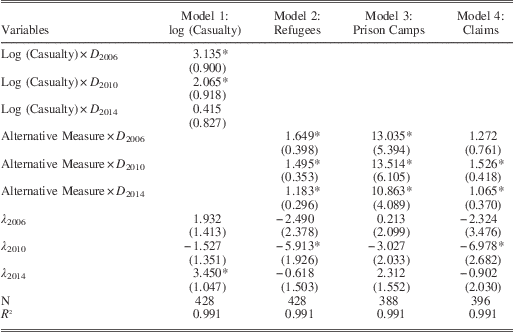
Our main results are presented in model 1 of Table 1.Footnote 40 In general, the higher the casualty rate, the higher the level of post-war ethnic voting. The estimated effect of the logged casualty rate on ethnic vote share is highly reliable and fairly large in magnitude (3.1) for the 2006 election, decreases slightly in magnitude (to 2.1) but maintains reliability at the 95 per cent level for the 2010 election and loses reliability while decreasing substantially in magnitude (to 0.4) in the 2014 election. The decrease both in the magnitude and reliability of the effect is interesting.Footnote 41 We take this as an indication that the impact of wartime violence is declining. But perhaps the more striking finding is that the effect persisted for over a decade after the war.
The Effect of Wartime Violence on Ethnic Vote Share

Note: Cell entries represent unstandardized coefficient estimates with clustered (on municipality and year) robust standard errors in parentheses. The independent variable is listed in the column heading. The dependent variable is Ethnic vote share (on 0–100 scale). The intercept term is dropped to allow fixed effects for municipality and year (not shown). *p<0.05
In terms of substantive interpretation, from the lowest exposure of violence to the highest, ethnic vote share is expected to differ by 16.3 percentage points in 2006, 10.7 in 2010 and 2.2 in 2014. Because Casualty is highly skewed, a look at the differences in the effect from the 25 per cent quantile (1.1) and the 75 per cent quantile (2.3) might also be informative. In 2006, the estimated effect differs between the two quantiles by 2.3 percentage points, in 2010 the difference is 1.5 and in 2014 the difference is 0.3. While these differences may seem modest, considering the potentially dampened estimated effects we have noted (in n. 36), the differences may be considerably larger.
The results for the alternative measures are presented in models 2 through 4, also in Table 1. The hypothesized relationship is statistically reliable at the 95 per cent level for all three years for Refugees and Prison Camps, but again the magnitude is decreasing over time.Footnote 42 Substantively, as Refugees increases from the 25 per cent quantile (1.6) to the 75 per cent quantile (5.2), the estimated effect differs by 5.8 in 2006, 5.3 in 2010 and 4.2 in 2014. Similarly, as Prison Camps increases from the 25 per cent quantile (0.06) to the 75 per cent quantile (0.24), the estimated effect differs by 2.4 in 2006, 2.5 in 2010 and 2.0 in 2014.
The estimated effect for Claims is also reliable at the 95 per cent level for 2010 and 2014, and while less reliable for 2006 (p=0.09), is always in the expected direction. Repeating the earlier exercise, as Claims increases from the 25 per cent quantile (2.1) to the 75 per cent quantile (5.8), the estimated effect differs by 4.7 in 2006, 5.7 in 2010 and 4.0 in 2014.
In sum, when employing these alternative measures of violence, we generally continue to detect a reliable relationship between exposure to violence and ethnic vote share. These measures are intended to capture a number of the different dimensions of violence: fatalities, physical displacement, imprisonment and property damage. Overall, the general consistency of these findings is reassuring and strongly suggests that exposure to wartime violence increases post-war ethnic voting.
Robustness Checks
We perform a number of robustness tests, reported in SI4, to further substantiate our findings. As we note earlier, due to severe right skewness we log the treatment, Casualty, but the results continue to hold with the raw variable (Table SI4.3). The results also hold when we use the civilian casualty rate (Table SI4.4).Footnote 43 Our results are also robust to the exclusion of outliers (see Table SI4.1). To further test for data irregularities, we dichotomize exposure to violence with a binary indicator as to whether the municipality experienced a casualty rate above the mean of all municipalities (see Table SI4.6.). The estimate of the effect of violence maintains reliability and is of a high magnitude for 2006. It is also of high magnitude in 2010, but only reliable at p=0.07. We also find no evidence that our estimated effects of wartime violence on ethnic voting are conditional on any of the variables described in SI2.2: a Wald test of all of the models with interaction terms between Casualty and the different variables demonstrates that none of these models significantly outperform the model without interactions. Finally, SI5 presents qualitative narratives of most similar municipalities identified via matching methods to further illustrate the hypothesized effect of violence on voting.
Demographic Change
The civil war uprooted much of the Bosnian population from their place of residence, displacing about two million of the country’s pre-war population.Footnote 44 According to some sources, by 2004 (the time of the first post-war election included in our analysis) about half of the refugees and internally displaced persons had returned to their pre-war homes,Footnote 45 a trend that continued but at a decelerated rate.Footnote 46 Survey-based research similarly claims that a majority of Bosnians reclaimed their pre-war property and returned to their homes.Footnote 47 Still, some sources suggest that the war ‘created more or less mono-ethnic communities’.Footnote 48 Theoretically, it is not clear whether and how such an increase should bias our estimates. On the one hand, recent research on ethnic identities argues that it is hard to infer anything meaningful about ethnic voting from simply looking at the ethnic makeup of a community. This is because the political relevance of ethnic (and other) cleavages depends on the extent to which they have been activated.Footnote 49 Other research suggests that, if anything, homogeneity decreases rather than increases ethnic voting.Footnote 50 Research on party politics in Bosnia also suggests that in areas where one ethnic group has a majority status, parties need to diversify their appeals beyond ethnicity to remain competitive.Footnote 51 If these studies are correct, then the fact that municipal-level ethnic homogeneity increased after the war is not likely to confound but rather make it harder for us to uncover the effects of wartime violence.
On the other hand, Swee shows that, in Bosnia, ethnically homogeneous municipalities spend more on ethnic schools because such homogeneity leads to convergent preferences among the electorate.Footnote 52 The members of ethnic majority groups then turn to ethnic parties because these parties can most credibly commit to spending more on ethnically particularistic goods.Footnote 53
We address the concern that demographic change may bias our estimates in the following ways. First, we replicate our main analysis with the subset of municipalities that were not partitioned following the war. As Swee finds, partition in Bosnia tended to increase ethnic homogeneity through the separation of ethnic populations and the self-sorting that followed between the various parts of partitioned municipalities.Footnote 54 If ethnic homogeneity increases ethnic voting and partitioned municipalities experienced more violence, then our results may be driven by a partition effect. The results in Table SI4.7, however, indicate that this is not the case. Even with a reduced sample containing only unpartitioned municipalities, the results are very similar to those in the main analysis.
Second, in order to address concerns about post-war ethnic homogeneity more generally, we capitalize on the 2013 census data released recently to measure post-war demographic composition. We run a direct-effect analysis as outlined by Acharya, Blackwell and SenFootnote 55 and present the results in Table SI4.8. The analysis is a technique to estimate the direct effect of a treatment (wartime violence) that is not mediated by a post-treatment variable (ethnic homogeneity). This is an unbiased approach, as opposed to simply controlling for a post-treatment variable. The census data and the casualty data do not change within a municipality over time, which is why we opt for random effects (rather than fixed effects) at the municipality level. Because this causes concern for municipality heterogeneity, we also include as controls the variables discussed in SI2.2. Our estimates strongly support the conclusions drawn from the original modeling.
Third, we further explore the role of demographic change by using over-time estimates (for each election year) of ethnic composition for eighty-seven municipalities.Footnote 56 Because ethnic composition now varies over time, we are able to use our earlier modeling strategy with fixed effects for time and municipality. The results (see Table SI4.9) are nearly identical to our main findings, and are reliable for the first two election years. Although this is a potentially biased sample of municipalities, it is a large sample, and because the estimates are very similar to the main analysis, we do not believe this potential bias is leading to dramatic changes in the estimates. The results of these two mediation analyses, taken together, help alleviate some of the concern that our observed correlations are being driven by the alternative causal pathway of increased post-war ethnic homogeneity.
Fourth, another potential issue with war-induced displacement concerns the types of voters who were displaced. If pre-war voters who supported multi-ethnic parties were more likely to out-migrate than were ethnic hardliners then our results may be an artifact of voters who supported multi-ethnic parties dropping out of the electorate, rather than violence inducing the kinds of attitudinal changes we argue it does.
In order the explore this possibility, we use electoral data from the 1997 municipal and 1998 national Bosnian elections, the first two elections for which electoral data disaggregated by ‘in-municipality’ and ‘out-of-municipality’ votes are available. In-municipality voters are primarily non-displaced persons, while out-of-municipality voters are overwhelmingly either refugees or internally displaced persons.Footnote 57 These data allow us to explore whether preferences were significantly different between displaced and non-displaced persons. In 1997, the three major wartime ethnic parties (the Bosniak SDA, Croat HDZ BiH and Serb SDS) received a combined 59 per cent of in-municipality votes and 83 per cent of out-of-municipality votes. Similarly, in 1998, these three parties received 51 per cent of in-municipality votes and 69 per cent of out-of-municipality votes. In other words, displaced voters appeared to exhibit substantially higher levels of support for ethnic parties than did the non-displaced. Given that (a) violence severity is positively correlated with displacement,Footnote 58 (b) the displaced exhibit higher support for ethnic politics than the non-displaced and (c) many of these displaced voters (specifically refugees) had by the time of the 2006 election stopped participating in Bosnian politics, the fact that we still find reliable results speaks to how important wartime violence is in shaping post-war politics.Footnote 59
Finally, in order to further address the concern that displacement may contaminate our results, we obtained data on the number of persons who were still internally displaced circa 2005.Footnote 60 Using these data we calculated Net displacement, which captures the number of persons who were displaced into the municipality minus the number that were displaced out of the municipality, as a percentage of the municipality’s population in a given post-war year (0 for pre-war). Using Net displacement as the mediator, we conducted another mediation analysis and the estimates continue to be very similar to those in the main analysis (see Model 1 in Table SI4.10).Footnote 61 While we certainly do not deny that displacement can affect post-war politics in important ways, the robustness checks we conduct in this section provide some additional assurance that our main results are not simply explained by the post-war demographic landscape that was created through wartime violence.
Exploring the Causal Mechanism
As the last part of our empirical analysis, we provide a preliminary exploration into the causal mechanism that we proposed in the theory section. We argue that violence increases ethnic voting by inducing retreat into ethnic community and engendering inter-ethnic distrust. In this vein, we employ the post-war survey data from late 2005 used by Bakke and co-authors as well as Ward and co-authors to test this mechanism.Footnote 62 The tests remain preliminary because of the nature of the data, which only capture the post-war situation and do not allow us to benchmark the outcome by pre-war levels. The results in this part of the analysis should therefore be treated with caution. Nevertheless, these are the most comprehensive data available that permit us to explore the individual-level effects of our community-level predictor (the municipality casualty rate). They can provide us with some valuable, although suggestive, insights concerning the causal mechanism that translates exposure to violence into ethnic party support.
The survey data include unambiguous municipality identifiers for some, but not all respondents. Due to this and some missing data, our final dataset includes roughly 1,400 respondents across twenty-seven municipalities. As described below, we use a number of dependent variables capturing retreat into ethnic community and inter-ethnic distrust. The independent variable of interest is the log of Casualty.Footnote 63
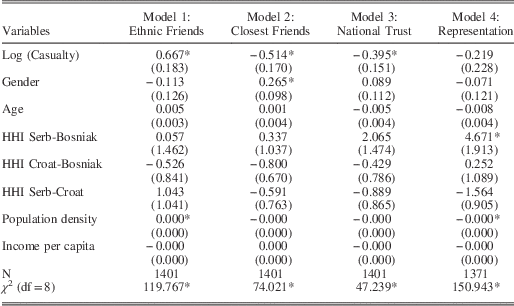
We control for a host of municipal-level, pre-war variables, detailed in SI2.2.Footnote 64 We also control for two respondent-level variables that are indications of pre-war (pre-treatment) conditions: Gender and Age.Footnote 65 Because the dependent variable is always ordered and categorical (a 5-point scale that ranges from ‘strongly agree’ (1) to ‘strongly disagree’ (5)), the modeling strategy we employ is an ordered logit regression with clustered robust standard errors by municipality.Footnote 66 The results are presented in Table 2.
Individual-Level Effects of Wartime Violence

Note: Cell entries represent unstandardized coefficient estimates with clustered robust standard errors in parentheses. The dependent variable is listed in the column heading and is on a 1–5 scale. Threshold coefficients are not presented. *p<0.05
Model 1 uses Ethnic Friends as the dependent variable, capturing the extent to which a respondent agrees with the statement that he or she desires more friends of different ethnicities. Because we argue that greater exposure to violence induces retreat into ethnic community, we expected a respondent from a high-exposure municipality to provide an answer that is higher on the scale, reflected by a positive estimate for the log of Casualty. This is indeed what we find.
The dependent variable in Model 2 is Closest Friends, which is also intended to capture retreat into ethnic community. However, unlike the previous measure, this one reflects the actual rather than desired ethnic makeup of the respondent’s personal network. It ranges from all of the respondent’s closest friends being of the same ethnicity (1) to all of respondent’s closest friends being of different ethnicities (5). We expected communal violence to reduce the number of friends of different ethnicities, which is what we find.
Turning to the effect of violence on inter-ethnic distrust, the dependent variable in model 3 is National Trust. This measure captures the extent to which a respondent agrees with the statement that he or she can only trust people of his or her own ethnicity. Higher values for this variable correspond to greater disagreement with the statement, indicating higher levels of inter-ethnic trust. In line with our expectations, the estimate for the effect of communal violence is negative and reliable.
Finally, Non-ethnic representation measures the extent to which a respondent feels that ethnic parties are necessary to protect ethnic group interests, with lower values indicating greater affinity for ethnic parties. Model 4, though the results are unreliable at conventional levels, suggests that the higher the communal exposure to violence, the lower the respondent’s preference for non-ethnic representation and the higher their affinity for ethnic group-based representation.Footnote 67
These results support our hypothesized causal mechanism that communal exposure to violence induces retreat into ethnic community and engenders inter-ethnic distrust. Respondents from municipalities that experienced greater exposure to violence consistently answered the survey questions in a manner that suggests that their personal networks are dominated by co-ethnics. These respondents also exhibited systematically lower levels of inter-ethnic trust than did those from low-violence municipalities. Although these data only reflect the post-war situation, these findings are consistent with expectations, and therefore provide at least suggestive evidence of the plausibility of our causal mechanism.
CONCLUSION
This article began by asking whether exposure to violence during ethnic warfare breeds higher levels of ethnic voting in post-war elections. We have argued that violence induces individuals to retreat into their ethnic communities and develop greater distrust of out-groups, thereby making ethnicity more salient in these communities than it would be absent the ethnically motivated violence. Furthermore, we expected the behavior and outlook that such exposure engenders to extend to vote choice, with high exposure communities displaying greater support for political parties with ethnic appeals than do otherwise comparable low exposure communities.
Using municipal-level wartime casualty, and pre- and post-war national election data from Bosnia, we find evidence in support of our hypothesized relationship between exposure to violence and levels of ethnic voting. The effect we uncover is both reliable and substantively significant. It remains robust in various alternative specifications of the model. Using individual-level survey data, we also find suggestive evidence that is consistent with our proposed causal mechanism.
Our findings make an important contribution to our understanding of post-war societies and the development of party competition in new democracies. Whereas much of the conflict literature has focused on elite behavior and interaction, relatively little attention has been paid to how a legacy of widespread and often indiscriminate violence affects the political preferences of ordinary individuals who have borne the brunt of such violence. We show that wartime violence directly affects voting behavior and that these effects persist over a lengthy period of time. Ethnic war can, therefore, have a lasting impact on the nature of post-war party competition. This is an important addition to the literature on party system development, which often neglects to account for contextual factors affecting the politicization of cleavages. Furthermore, our findings point to interesting new avenues for research, such as whether and how communities’ experiences with wartime ethnic violence affect party strategies in those communities post-war.
Additionally, this article has important implications for the literature on conflict, social capital and economic performance. As Blattman and Miguel have noted, we know relatively little about how conflict affects social capital and cohesion, both of which are important to economic performance and development.Footnote 68 Studies in this literature have often focused on how conflict may deplete general trust and, in turn, reduce the impersonal economic transactions needed for sustained, long-term development. However, one implication of our findings is that conflict may also potentially harm development by increasing support for non-programmatic (ethnic) parties. Such parties ground their electoral appeals in ethnic exclusivism and therefore are not bound to the same sorts of programmatic and ideological promises that non-ethnic parties make. This provides ethnic parties with little incentive to deliver the kinds of universal policies and publicly shared goods essential to long-term development.
Finally, our findings also have important implications for domestic and international policy makers. In post-war societies riddled with ethnic divisions and inter-ethnic distrust, parties that espouse a non-ethnic brand of politics may contribute to much needed social reconciliation. Ordinary individuals witnessing political leaders from across a country’s different ethnic groups campaign under the same party umbrella would likely generate greater co-operation and inter-ethnic trust among those ‘on the ground’. Our findings, however, suggest that given the geographic variation in exposure to violence that accompanies any ethnic civil war, some communities will require greater attention than others from policy makers. A better understanding of the relationship between exposure to violence and ethnic party support can, therefore, help inform policy intended to foster such reconciliation.