Implications
Reduction of ruminal degradation of high-quality proteins is of interest to increase the efficiency of both microbial synthesis and protein utilization as well as to reduce nitrogen emissions to the environment. To achieve this goal, several studies protected the protein through the use of acids with or without a posterior heat treatment. However, none of them developed a systematic study on the diverse factors involved in their efficiency. Optimal levels of these factors should be fixed considering the relation between protective effects and economic costs.
Introduction
Highly productive ruminants have a low efficiency in protein utilization because of high ruminal losses, mainly as ammonia, due to excessive protein degradation by ruminal microorganisms. Most protein concentrates are extensively degraded. Consequently, developing protection methods against ruminal protein degradation is of great interest. Protein denaturation can slow the actions of ruminal microorganisms and is a traditional protection method. Denaturation normally is achieved by heat treatment (Schroeder et al., Reference Schroeder, Erasmus and Meissner1996). Moreover, treatments with acid solutions, with or without a posterior heat treatment, can decrease ruminal protein degradation of feedstuffs (Atwal et al., Reference Atwal, Milligan and Young1974; Vicini et al., Reference Vicini, Clark and Crooker1983; Waltz and Loerch, Reference Waltz and Loerch1986). Ouarti et al. (Reference Ouarti, González, Fernandez, Alvir and Rodríguez2006) indicated that a combination of acid with heat treatments may act synergistically and reduce disadvantages of either method. Less intense heat treatment decreases both the cost of energy and the generation of irreversible Maillard reactions associated with overprotecting protein; and use of less acid for treatment will reduce its impact on microbial activity and effects on the rumen environment.
Currently, knowledge is limited concerning the protection efficiency of combined acid-heat treatments with regard to the acid type and strength, acid dilution and dosage, and intensity and length of the subsequent heat treatment. Most studies utilizing acids to decrease ruminal degradation of protein have used soybean meal (Vicini et al., Reference Vicini, Clark and Crooker1983; Waltz and Loerch, Reference Waltz and Loerch1986; Szokoly and Schmidt, Reference Szokoly and Schmidt2005; Ouarti et al., Reference Ouarti, González, Fernandez, Alvir and Rodríguez2006) or canola meal (Khorasani et al., Reference Khorasani, Robinson and Kennelly1989). Sunflower meal has not been tested previously despite its high ruminal crude protein (CP) degradability, commonly above 0.80 (González et al., Reference González, Sanchez and Alvir1999; Woods et al., Reference Woods, Moloney and O'Mara2003; Rotger et al., Reference Rotger, Ferret, Calsamiglia and Manteca2006) that should allow for the protective response to be large.
The objectives of this study were to determine the effect of different factors affecting the protection efficiency of sunflower meal using two acid types: inorganic (orthophosphoric acid) and organic (malic acid). Orthophosphoric acid was chosen for its high acidity, its absence of specific antimicrobial effects and as a source of phosphorus. Malic acid (or malate) has been indicated as a promise additive to improve ruminal fermentation efficiency through a reduction of the acetic acid : propionic acid ratio (Martin and Streeter, Reference Martin and Streeter1995; Callaway and Martin, Reference Callaway and Martin1996; Carro et al., Reference Carro, López, Valdés and Ovejero1999), which, together with the providing ruminally fermented energy, should prove useful. In addition, in vivo studies with malic acid-heat treatments of Ouarti et al. (Reference Ouarti, González, Fernandez, Alvir and Rodríguez2006) showed both a protein protective effect and a reduction of the above cited ratio without negative effects on ruminal and intestinal digestion.
Material and methods
Experimental design
A sample of semi-dehulled, solvent-extracted sunflower meal with a nutrient composition (g/kg dry matter (DM)) of 933 organic matter (OM), 9.3 ether extract, 371 CP, 449 neutral detergent fibre (NDF), 297 acid-detergent fibre (ADF) and 84.3 lignin was used in four separate trials.
Trial 1
The optimal volume of acid solution to be added was determined using only orthophosphoric acid (orthophosphoric acid, 85% PA-ACS-ISO, CAS [7664-38-2], PANREAC QUIMICA S.A.U., E-08211 Castellar del Vallés, Barcelona, Spain) considering that acid type would not have a remarkable effect over the diffusion of the acid solution into the feed particles. Five volumes of liquid (80, 160, 240, 320 and 400 ml/kg) and two concentrations (0.4 and 1.2 eq/kg of feed; air dry basis) were used. These doses were selected to assure a moderate cost of the acid treatments; thus, they are equivalent to 13.1 and 39.2 g of orthophosphoric acid/kg of feed, respectively. After the application of the acid solutions, all samples were dried at 60°C in an air-forced oven (Memmert ULE 400, Schwabach, Germany) for 1 h, the minimum time required to dry the wettest sample. In the following trials, and to improve homogeneity in distribution of added acid in the feed, the liquid volume applied was 400 ml/kg.
Trial 2
To determine the effect of the acid type and the marginal response to increased concentrations, four dose levels: 1.2, 2.4, 3.6 and 4.8 eq/kg of feed of each acid were used. For orthophosphoric acid resulting in the use of 1, 2, 3 and 4 M solutions which were applied at 400 ml/kg of feed. For malic acid (dl-malic acid, E-296, CAS [617-48-1], PANREAC QUIMICA S.A.U., E-08211 Castellar del Vallés, Barcelona, Spain) these concentrations were 1.5, 3, 4.5 and 6 M. The temperature and time of drying were the same as for Trial 1.
Trial 3
On the basis of the responses of Trial 2 and considering the additional protective effects of heat treatments of the four doses: 0.6, 1.2, 1.8 and 2.4 eq/kg of feed (equivalent to the use of 0.75, 1.5, 2.25 and 3 M solutions of malic acid and of 0.5, 1, 1.5 and 2 M of orthophosphoric acid) and three temperatures 100°C, 150°C and 200°C were used in this trial. Drying times were 30, 20 and 10 min, respectively, the time required to dry these samples.
Trial 4
To control overprotection of protein and to test possible mechanisms of protein protection with these treatments, the sunflower meal was treated either with water or with orthophosphoric or malic acid solutions at a dose of 0.8 eq/kg of feed, which was considered as recommended dose from the results of Trial 3. This dose was equivalent to 0.67 or 1 M solutions of orthophosphoric or malic acid, respectively. Finally samples were dried at 100°C and 150°C for times equal to those used in Trial 3.
Experimental procedures
Samples of 20 g of sunflower meal (ground to pass a 2 mm screen) were placed in Petri dishes; dishes were placed on a balance and sprayed with each acid solution until added weight matched the desired dose. Densities of each acid solution was measured previously and considered. Samples were homogenized manually with a spatula and oven-dried for the specified time period. Controls of DM were then performed to assure that this content was close to 90%. In each trial, samples of the control (untreated) and acid-treated samples each weighing 0.55 g were placed into ANKOM F57 filter bags and heat sealed. One replicate of each acid-treated sample, two replicates of the control treatment and two empty bags (used to correct the contamination of bags with ruminal components during the incubation) were placed in each of the four jars of an ANKOM Daisy II incubator (ANKOM Technology, Macedon, NY, USA). Each jar contained 2 l of an incubation medium saturated with CO2 and maintained at 39°C. Before closing the jars, the free space was saturated with CO2 to ensure anaerobiosis. The incubation medium consisted of a mixture (4 : 1) of McDougall solution (McDougall, Reference McDougall1948) and ruminal fluid; ruminal fluid was obtained from two rumen cannulated wethers fed a 0.6 : 0.4 lucerne hay to commercial concentrate diet. This diet contained (per kg DM) 930 g OM, 160 g CP and 302 g NDF. Wethers were fed six equal meals daily (every 4 h, starting at 0900 h) at an intake level of 80 g DM/kg BW0.75 (body weight). Ruminal fluid always was collected (by manual rumen emptying) 2 h after the first morning feeding to ensure a high-microbial density. Ruminal contents were squeezed through two layers of nylon cloth (200 μm pore size) into an insulated vessel to maintain a constant temperature. In order to test diversity among sources of microbial inoculum, the ruminal fluid obtained from each wether was used alone or mixed in a 3 : 1 ratio with that of the other wether. Each jar of the Daisy II incubator (ANKOM Technology) was inoculated with one of these four different sources of ruminal inocula.
After 20 h of digestion at 39°C, the bags were removed, washed with tap water and immediately stored at −20°C. After thawing, bags were washed three times for 5 min in a turbine washing machine, oven-dried (48 h at 80°C) and digested intact to N-Kjeldahl determination. Incubated empty bags of known weight were used to correct for the nitrogen content of the bag material. In vitro undegraded CP (IVUCP) was calculated as the proportion of initial CP placed into the bags remained in the bags after in vitro incubation.
In addition to IVUCP, CP solubility and available lysine were determined in Trial 4. Solubility of CP was determined by incubating the control and treated samples in McDougall buffer at 39°C. Samples weighing 0.55 g were added to 40 ml of buffer in quadruplicate and incubated for 1 h in a shaking water bath. Then, samples were filtered through paper circles (Filter Lab no. 1242; 7 to 9 μm pore size; Filtros Anoia, S.A. Barcelona, Spain) and solid residues were dried (80°C for 48 h) and analyzed for CP to determine CP solubility as proportion of the initial CP content.
Chemical analysis
Sunflower meal (ground to pass a 1 mm screen) was analyzed according to the Association of Official Analytical Chemists (2000) for DM, ash, ether extract and CP (Kjeldahl N × 6.25) by methods 930.01, 942.05, 920.39 and 954.01, respectively.
The NDF was assayed without sodium sulphite and using α-amylase (Van Soest et al., Reference Van Soest, Robertson and Lewis1991). Values of direct ADF and ADL were determined in accordance with Robertson and Van Soest (Reference Robertson and Van Soest1981). Both NDF and ADF were expressed with residual ash. Fibres were analyzed using the Ankom F57 filter bags in an Ankom 200 fibre analyzer (Ankom Technology, Macedon, NY, USA).
The concentration of available lysine in control and treated samples were estimated in triplicate using the o-phthaldialdehyde assay performed as described by Goodno et al. (Reference Goodno, Swaisgood and Catignani1981). The extracted proteins of treated and untreated sunflower meal samples were obtained by adding 0.1 M borate buffer pH 9.5, stirring for 90 min and centrifuging at 10 200 × g at room temperature for 5 min.
Statistical methods
The effects of acid treatments on IVUCP were compared by variance analysis with a split-plot arrangement of treatments in all trials. These designs always included the control and were analyzed using the mixed-model procedure of SAS (Proc Mixed; SAS). CONTRAST and ESTIMATE statement of SAS were used to calculate and test treatment means. Orthogonal polynomials were used to test the linear and quadratic effects of the quantitative factors.
In Trial 1, the acid dose was considered as whole-plot and the dilution of the acid dose and the interaction of both main factors were the sub-plot treatments. All variables were considered as fixed effects, except jars and the interaction jars × acid dose, which were considered as random effects.
In Trial 2, the type of acid and the acid dose were considered as whole-plot and sub-plot treatments, respectively. As in Trial 1, all effects were considered fixed, except jars and the interaction jars × acid type, which were considered as random effects.
In Trial 3, the combination acid type and drying temperature was the whole-plot treatment and acid dose the sub-plot. All treatments and the interaction between main factors were considered as fixed effects. Random effects were jars and the interaction jars × acid type × temperature.
In Trial 4, the drying temperature and the type of treatment (water and acids) were the whole-plot and sub-plot treatments, respectively, to study IVUCP and CP solubility. All treatments and the interaction between main factors were considered as fixed effects. Random effects were jars and the interaction jars × temperature. The results of available lysine were studied using the mean values of the laboratory analyses in a two × three factorial no replicated design. Differences between the control and treatments for this parameter were tested through contrasts between its value and the mean of treatments.
Results
Trial 1
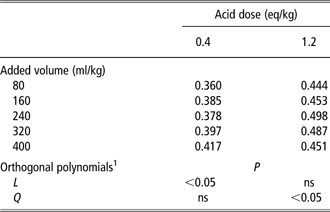
The protective effect of the ortophosphoric acid treatment (Table 1) was clear comparing the IVUCP values of the control and the mean of all treatments (0.287 v. 0.427; P < 0.001). Increasing the acid dose from 0.4 to 1.2 eq/kg of feed increased the IVUCP of sunflower meal (0.387 v. 0.467; s.e.d. = 0.0155; P < 0.001). As a tendency for the interaction acid dose × acid dilution was observed (P = 0.087) each dose was analyzed separately. In contrast, changes in IVUCP associated with the liquid volume in which these acid doses were applied only approached significance (0.402, 0.419, 0.438, 0.442 and 0.434 as means of both doses for added volumes of 80, 160, 240, 320 and 400 ml/kg of feed, respectively; s.e. = 0.0218; P = 0.063). Orthogonal polynomials showed a linear increase with the lowest dose (P < 0.05) and a quadratic increase (P < 0.05) with the highest dose. To determine marginal responses due to the use of higher doses, 1.2 meq/g was chosen as the lowest dose for Trial 2. Considering the greater response with higher volumes of solution, a dilution of 400 ml/kg was used in subsequent trials.
Effects of orthophosphoric acid dose and added volume of acid solutions on IVUCP of sunflower meal after 20 h of incubation (Trial 1)

IVUCP = in vitro undegraded crude protein.
1Established for each acid. L = lineal effect; Q = quadratic effect.
Differences were observed between control (0.287) and rest of treatments (0.427): s.e.d. = 0.0187; P < 0.001.
Effects were shown for acid dose (s.e. = 0.0213; P < 0.01) and as tendency (P < 0.1) for acid dilution (s.e. = 0.0218) and the interaction acid dose × dilution (s.e. = 0.0249; P = 0.0868).
Trial 2
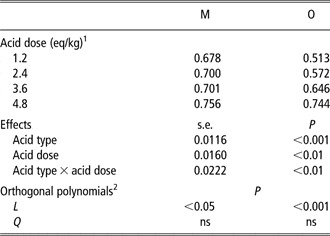
Treatments of sunflower meal with malic or orthophosphoric acids (Table 2) have a clear protective effect as shown by the comparison between the mean IVUCP of control and treated samples (0.367, 0.619 and 0.709 for control, orthophosphoric acid and malic acid, respectively; P < 0.001). A higher protective effect of malic acid than orthophosphoric acid (IVUCP: 0.709 v. 0.619 as means; s.e.d. = 0.0155; P < 0.001) was also shown. However, an interaction acid × dose (P < 0.01) was also shown, because the difference in IVUCP response between both acids was reduced with the increase of acidity. Thus, at the highest acidity level, CP protection was similar with both acids (0.756 and 0.744 IVUCP for malic and orthophosphoric acids, respectively). Values of IVUCP increased linearly with the concentration of the orthophosphoric acid through all doses (P < 0.001). A linear evolution was also shown for malic acid (P < 0.05), but the marginal response of IVUCP was low from the 1.2 meq/g dose.
Effects of concentrations of M or O solutions (sprayed at 400 g/kg of feed) on IVUCP of sunflower meal after 20 h of incubation (Trial 2)

M = malic acid; O = orthophosphoric acid; IVUCP = in vitro undegraded crude protein.
1Equivalent to the use of 1.5, 3, 4.5 and 6 M solutions of M, respectively; and 1, 2, 3 and 4 M solutions of O, respectively.
2Established for each acid. L = lineal effect; Q = quadratic effect.
Differences were shown between control (0.367) and M (0.709) or O (0.619). s.e.d. = 0.0189; P < 0.001.
Trial 3
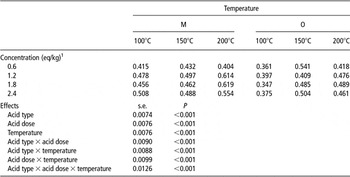
An interaction acid type × temperature × acid dose was shown (Table 3) in this trial (P < 0.001). This interaction means that the interaction acid dose × temperature is different for each acid and, besides, that the interaction acid dose × temperature exists for each acid. Therefore, a better result interpretation may be attained considering results of each acid separately. A higher protective power of malic acid than orthophosphoric acid was also observed (P < 0.001). Treatments with malic acid at different concentrations and heat temperatures increased more than twice the IVUCP value of the control (0.237 v. 0.494 as average of all treatments, P < 0.001). The interaction concentration × temperature for this acid is due to the lack of differences between heat treatments for the 0.6 meq/g dose, whereas marginal responses were recorded only up to 1.2 meq/g, but these responses were low for 100°C and 150°C treatments and high for 200°C.
Effects of temperature and concentration of M and O solutions (sprayed at 400 ml/kg of feed) on IVUCP of sunflower meal after 20 h of incubation

M = malic acid; O = orthophosphoric acid; IVUCP = in vitro undegraded crude protein.
1Equivalent to the use of 0.75, 1.5, 2.25 and 3 M solutions, respectively for M; and 0.5, 1, 1.5 and 2 M solutions, respectively for O.
Differences were shown between control (0.237) and M (0.494) or O (0.439): s.e.d. = 0.0085; P < 0.001.
Treatments with orthophosphoric acid (Table 3) increased in 75% as average the control IVUCP value (0.237 v. 0.439; P < 0.001). Main effects for this analysis were affected by the erratic behaviour showed for the heat treatment for 150°C. Thus, there was not a significant effect for acid dose. The interaction concentration × temperature in this acid may be explained in a similar way that for malic acid, because marginal responses for 100°C and 200°C were nulls or very low for doses >1.2 meq/g, but even at 200°C the reached protection is low.
Trial 4
The results for available lysine (g/100 g of CP), soluble CP and IVUCP are shown in Table 4. No interactions were shown for any parameter. No significant treatment responses were detected in the concentration of available lysine either between treatments or between treated and untreated sunflower meals. For soluble CP, there were no differences between control and water plus heat-treated meals. In contrast, acid treatments resulted in a large reduction (P < 0.05) of soluble CP v. the control (s.e.d. = 0.0176; P < 0.001) and water treatment (s.e.d. = 0.0143; P < 0.001). No difference in CP solubility was shown between both acids, but soluble CP was numerically lower when treated with malic acid than with orthophosphoric acid. In addition, no significant effects of drying temperature on soluble CP were detected. For IVUCP, differences were observed between the control and all treatments (s.e.d. = 0.0139; P < 0.01). Differences between water and acid treatments as well as between orthophosphoric and malic acids were shown (s.e.d = 0.0129; P < 0.001). No differences between both drying temperatures were observed for this parameter.
Effect of temperature and of treatments with W, M or O solutions (sprayed at 400 ml/kg of feed) on available Lys (g/100 of CP), CPS and IVUCP1 of sunflower meal

W = water; M = malic acid; O = orthophosphoric acid; Lys = lysine; CPS = crude protein solubility; IVUCP = in vitro undegraded CP.
1After 20 h of incubation.
2Interactions temperature × treatment were not significant (P > 0.1) for all variables.
3No differences (P > 0.1) were observed between control (4.54) and W (s.e.d. = 0.113), M (s.e.d. = 0.1136) and O (s.e.d. = 0.1133).
4No differences (P > 0.1) were observed between control (0.451) and W (s.e.d. = 0.0176). Differences (P < 0.001) were observed between control and M (s.e.d. = 0.0176) or O (s.e.d. = 0.0176).
5Differences (P < 0.001) were observed between control (0.376) and W (s.e.d. = 0.0157), M (s.e.d. = 0.0157) and O (s.e.d. = 0.0157).
a,b,cValues with different superscript for treatments are different at P < 0.05.
Discussion
The protective effects of acids shown in Trials 1 and 2, carried out at a drying temperature in which there is not a predictable heat effect, are in accordance with those observed treating soybean meal with acetic or propionic acids (Waltz and Loerch, Reference Waltz and Loerch1986) or hydrochloric acid (Szokoly and Schmidt, Reference Szokoly and Schmidt2005) without a subsequent heat treatment. In contrast, McKinnon et al. (Reference McKinnon, Olubobokun, Christensen and Cohen1991) treated canola meal with undiluted formic or acetic acids and did not observe increased values of in situ ruminal undegraded CP. However, when acids were combined with intense heat treatments, as in Trials 3 and 4, protective effects were commonly observed (Waltz and Loerch, Reference Waltz and Loerch1986; Khorasani et al., Reference Khorasani, Robinson and Kennelly1989; Szokoly and Schmidt, Reference Szokoly and Schmidt2005).
We have not found in the literature any systematic study considering the effect of the dilution of the applied acid dose on CP protection, in spite that this factor conditioned the diffusion space of the acid within the feed particles and as a consequence the proportion of protein molecules attained by the treatment. Previous researches have investigated from the use of little doses of acids without dilution (McKinnon et al., Reference McKinnon, Olubobokun, Christensen and Cohen1991) to soaking the feed in acid solutions (Waltz and Loerch, Reference Waltz and Loerch1986). However, the wide range of acid types and concentrations do not allow us to extract firm conclusions. The results from Trial 1 with orthophosphoric acid show that CP protection depends mostly on the acid dose rather than the volume in which this dose is applied. However, CP protection increases with the volume of acid addition. For the lowest acid dose of orthophosphoric acid (13.1 g/kg of feed), this increase was linear through all the tested range, whereas, at the highest acidity level (39.2 g/kg of feed), the protection effect did not seem to have an additional increase for volumes >240 ml/kg of feed. The selection of the 400 ml/kg to be applied in further trials pursued a maximum diffusion space, a better homogeneity in the distribution of the acid solution in the feed as well as a greater effect combined with heat (Van Soest, Reference Van Soest1994). Nevertheless, high-water content has also the disadvantage to increase the economic cost of drying.
Results from this study show increased protection of CP for increased acid doses. Previous studies also showed this effect (Atwal et al., Reference Atwal, Milligan and Young1974; Waltz and Loerch, Reference Waltz and Loerch1986; Khorasani et al., Reference Khorasani, Robinson and Kennelly1989), although in most studies, the attained protection was lower than in these assays. These previous studies mainly employed volatile fatty acids, which suffer noticeable losses after their application (Atwal et al., Reference Atwal, Milligan and Young1974). It is probable that the actual acid doses tested were smaller than those previously stated. On the other hand, our results seem to indicate that this effect shows an asymptotic response, with maximum protection levels conditioned also by the acid type and the intensity of the heat treatment subsequently applied. In relation to this point, results of Trial 3 show the lack of interest to use acid doses >0.8 eq/kg of feed (equivalent to the addition of 400 ml/kg of a 0.67 M solution for orthophosphoric acid and a 1 M solution of malic acid), because higher doses had very low additional responses and make the treatment more expensive. Although the maximum CP protection was attained with the 200°C heat treatment, the efficacy of those of 100°C to 150°C seem to be good. In situ assays of Arroyo and González (Reference Arroyo and González2009) using this dose and 150°C showed a large protective effect with each acid. The use of 200°C should be studied in these same conditions to test a possible overprotection as well as the economical interest to increased costs.
The lack of effect of acid treatments on the available lysine content does not show that condensation reactions between the free amino group of lysine and carbohydrate acid groups had taken place, and therefore, that there was not heat damage of CP in the drying conditions applied (until 150°C through 30 min). In this manner, the protective effect of acid treatments should be mainly determined by protein denaturation through the reduction of its solubility (as shown in Trial 4) and fermentation rate. The reduction of this rate with acid treatments has been shown in previous in situ studies (Vicini et al., Reference Vicini, Clark and Crooker1983; Waltz and Loerch, Reference Waltz and Loerch1986; Ouarti et al., Reference Ouarti, González, Fernandez, Alvir and Rodríguez2006). The lack of effect of the treatment with water on CP solubility and its lower effect than acids on IVUCP (Table 4) also show the effectiveness of the acid treatments. In addition, the acid diffusion from particles can inhibit microbial attraction and also microbial attachment and activity. The influence of this fact should be related to the acid dose.
The lower protection provided by treatments with orthophosphoric acid than with malic acid in Trials 2 to 4 is not in relation with the pH solutions, which is slightly lower with orthophosphoric acid (i.e. solutions needed to provide 0.8 eq/kg of feed had pH values of 0.95 and 1.45, for orthophosphoric acid (0.67 M solution) and malic acid (1 M solution), respectively. A possible specific antimicrobial effect of malic acid should be also discarded because the McDougall solution ensures a pH range during the incubation in which this acid is entirely in its dissociated form. The similar content of available lysine of both acid-treated meals does not show that a possible irreversible reaction between malic acid and free amino groups has taken place. Differences for protein protection between both acids may be related with the differences for their pKa. Thus, these constants are 3.4 and 5.1 for malic acid and 2.1, 7.2 and 12.7 for orthophosphoric acid. In this way, at the predictable pH of the incubation media (between 6 and 7), malic acid is totally dissociated. As a consequence, it could be more reactive with the protein than orthophosphoric acid, which only has been liberated as a H+. In addition, the higher viscosity of the malic acid solution may allow a wider distribution of this acid on feed particles and, as a consequence, lead to a larger quantity of protected proteins. Nevertheless, the reasons of the greater protection attained with malic acid remain unclear and, therefore, it would be of interest for further research on this subject.
Previous studies investigating the combined effects of acids and heat are limited. Szokoly and Schmidt (Reference Szokoly and Schmidt2005) show that a subsequent heat treatment to the application of hydrochloric acid (100°C for 30 min) reduced the in situ CP degradability of soybean meal by 61%. The studies of Waltz and Loerch (Reference Waltz and Loerch1986) and Khorasani et al. (Reference Khorasani, Robinson and Kennelly1989) also combined acid and heat treatments as well, but regrettably, they only used a single drying temperature, which prevents deriving conclusions about the effects of this combination. On the other hand, there are some studies with regard to heat treatment of sunflower seed. Mustafa et al. (Reference Mustafa, Chouinard, Ouellet and Soita2003) reported that autoclaving sunflower seed at 127°C and steam pressure at 117 kPa for 10, 20 and 30 min reduced in situ rumen degradability of CP from 0.910 for the untreated sample to 0.740 for the 30 min treatment. In another study, Schroeder et al. (Reference Schroeder, Erasmus and Meissner1996) processed sunflower meal in a drum roaster applying different temperatures and drying times. Between these different treatments, the closest to our study (150°C and 60 min) showed a reduction of the in situ rumen degradability of CP from 0.910 for the untreated sunflower meal to 0.390 for the heat-treated sunflower meal.
These studies, together with additional studies carried out on other feedstuffs, agree with the effect of heat treatments shown in Trial 3. The final results are determined by the treatment length and methods of applying the heat. On the other hand, the use of intense heat treatments may decrease the CP digestibility in the small intestine. Additional studies are needed to determine the effects of these treatments on intestinal digestion. In situ results on sunflower meal treated with 400 ml/kg of solutions of orthophosphoric acid (0.67 M) or malic acid (1 M) and then heated in an oven at 150°C for 6 h showed a reduction of a little bit more than 50% of the ruminal degradability using either acid associated with an increase (between 10% and 16%) of the intestinal digestibility (Arroyo and González, Reference Arroyo and González2009). In this way, the treatment with any of both acids doubled the protein value estimates for this meal, measured as the total (microbial and dietary) supply of intestinal digestible amino acids. Another benefit of these last treatments was to multiply by three times the intestinal digestible supply from this meal of lysine and methionine and by 3.7 that of cysteine (González et al., Reference González, Arroyo and Ouarti Mand Centeno2009). Similarly, Ouarti et al. (Reference Ouarti, González, Fernandez, Alvir and Rodríguez2006) protecting soybean meal with malic acid at 0.9 and 1.8 eq/kg and drying temperatures of 117°C for 6 h did not find negative effects on the intestinal digestibility of the undegraded protein, which was nearly complete. Besides, the inclusion at 5% of these treated meals in an alfalfa hay-concentrate diet did not alter the pH, the concentration of volatile fatty acids or the fibrolytic ability of the rumen, but reduced the excessive ammonia concentration resulting from the diet fermentation as well as the acetic acid/propionic acid ratio, attributing this latest effect to the incorporation of malate to the diet.
Conclusion
The combined acid-heat treatments have a high effectiveness to protect the proteins of sunflower meal from ruminal degradation. The protection levels attained are dependent on the acid type, the acid dose and its dilution, and the temperature of drying. Except for its higher cost, malic acid was more convenient due to its higher efficacy. As these results come from in vitro experiments, further research is necessary to confirm these results with in vivo and long-term trials to discard other additional effects.
Acknowledgements
This study has been supported by the CICYT funded project AGL 2001-3662. The authors thank Ana Isabel Jimenez for her support in all the experimental procedures, Kenneth Kalscheur for his revision of this manuscripts and valuables comments and suggestions, Juan Manuel González for his advices in the statistical analyses and Regina Bardaji for her linguistic revision of this manuscript.