Introduction
Haemonchus contortus is a blood-sucking parasitic nematode with economic importance worldwide. After ingestion as the infective larvae (L3) from the environment, L3 develop into further larval stages and eventually develop into adults in the abomasums of ruminants following exsheathment and moulting (Taylor et al., Reference Taylor, Coop and Wall2007). Anthelmintics are commonly used to control gastrointestinal nematodes. However, the development of anthelmintic resistance in various parasites, including H. contortus, has been reported worldwide (Coles et al., Reference Coles, Jackson, Pomroy, Prichard, von Samson-Himmelstjerna, Silvestre, Taylor and Vercruysse2006).
Investigation of DNase in H. contortus was initiated after the observation of DNA fragmentation (DF) of intestinal cell nuclei in H. contortus by treatment with fenbendazole (FBZ) which inhibits microtubule polymerization (Borgers et al., Reference Borgers, De Nollin, De Brabander and Thienpont1975; Jasmer et al., Reference Jasmer, Yao, Rehman and Johnson2000). While the connection between FBZ activity and DF is ill defined, microtubule depolymerization is associated with the inhibition of apical secretory vesicle transport in the intestine, the dispersal of the apical secretory vesicle contents throughout the body, and the accumulation of the blood meal in the intestinal lumen (Jasmer et al., Reference Jasmer, Yao, Rehman and Johnson2000). Since the contents of the intestinal vesicles are expected to contain multiple digestive enzymes, including proteases and DNases (Borgers et al., Reference Borgers, De Nollin, De Brabander and Thienpont1975), the vesicle contents are likely to be involved in mediating DF either directly or indirectly. Thus, worm DNases in the excretory/secretory products (ESPs) of H. contortus were of interest as cellular mediators to induce DF (Kwak & Jasmer, Reference Kwak and Jasmer2003, Reference Kwak and Jasmer2004).
During the developmental cycle, metazoan parasites release a variety of ESPs into the host or in vitro culture environment. Excretory/secretory products are produced by the oesophageal glands, the excretory system, the epithelial cells of intestine or rectal and vaginal cells, and the secretion of some molecules has been linked in time to the transition of free-living stages to parasitism (Yatsuda et al., Reference Yatsuda, Krijgsveld, Cornelissen, Heck and de Vries2003). The biological function of ESPs has been involved in developmental processes, penetration of host tissues and moulting or evasion of host immune responses (Liu et al., Reference Liu, Wu, Wang, Yu, Wang, Chen, Boireau and Liu2008). Excretory/secretory products in the free-living stage of parasites are important especially in the tissue invasion and parasitism of the host. The involvement of parasite ESPs in the invasion and destruction of host tissue has been described in Fasciola hepatica and Schistosoma mansoni (Dalton et al., Reference Dalton, Neill, Stack, Collins, Walshe, Sekiya, Doyle, Mulcahy, Hoyle, Khaznadji, Moiré, Brennan, Mousley, Kreshchenko, Maule and Donnelly2003; Morales et al., Reference Morales, Rinald, Gobert, Kines, Tort and Brindley2008). The functional roles of DNases in the larval stages are of interest, especially for tissue invasion.
Our previous research identified multiple DNase activities with relative molecular masses (M rs) of 34, 36, 37 and 38.5 kDa upon zymographic analysis of ESPs from adult H. contortus (Kwak & Jasmer, Reference Kwak and Jasmer2003). To date there is no description of DNase activities in ESPs of H. contortus L3, while those in ESPs of Trichinella spiralis muscle larvae have been described previously (Mak & Ko, Reference Mak and Ko1999). Impedance by host DNA could be an important barrier to the invasion and internal migration of the parasite. Hence, in the current study, we investigated the DNase activities expressed by ESPs of H. contortus L3 and compared them to those of adults, to determine if the DNase activities are specific to the developmental stage.
Materials and methods
Parasitological procedures
Third-stage larvae of H. contortus (Beltsville isolate, USA) were kindly gifted from Professor Douglas P. Jasmer at Washington State University, Pullman, Washington, USA. Lambs were infected with L3 as described by Jasmer & McGuire (Reference Jasmer and McGuire1991). The use of experimental animals was approved by the Kyungpook National University Institutional Animal Care and Use Committee (Approval #200800804). Approximately 10,000 L3/ml or 300 adult worms isolated from lambs were cultured in 20 ml Dulbecco's modified Eagle's medium (pH 6.6; Life Technologies, Rockville, Maryland, USA) for up to 96 h and 24 h, respectively, at 37°C, and ESPs were obtained from the supernatant of the culture media by ultrafiltration (Centriprep-10, Amicon, Bedford, Massachusetts, USA) at 2000 g for 90 min at 4°C (Karanu et al., Reference Karanu, Rurangirwa, McGuire and Jasmer1993). Culture media without worms were processed similarly to the worm ESPs as a control. The protein concentration was determined by bicinchoninic acid assay (Pierce, Rockford, Illinois, USA).
Zymogram
For the determination of M rs and biochemical characteristics of DNase activities in worm ESPs, zymographic assays were assessed as described (Kwak & Jasmer, Reference Kwak and Jasmer2003). Worm ESPs (10 μg) were separated on sodium dodecyl sulphate/polyacrylamide gel electrophoresis (SDS/PAGE) (10%), which contained salmon sperm DNA (200 μg/ml, Sigma, St. Louis, Missouri, USA) as a substrate for the DNases. Gel locations with DNase activities remained unstained following incubation with ethidium bromide (1 μg/ml) and UV illumination. The M rs of DNase activities were estimated by Rainbow molecular mass standards (Amersham, Pittsburgh, Pennsylvania, USA).
Plasmid digestion
DNase activities in each sample were evaluated using a Bluescript plasmid DNA as described previously (Kwak & Jasmer, Reference Kwak and Jasmer2003). Briefly, each sample (400 ng protein) was incubated with plasmid DNA (400 ng) in a 20 μl reaction under the conditions of pH 5.0 or 7.0 in the presence of 2 mm CaCl2/MgCl2, 10 mm EDTA or 100 μm aurintricarboxylic acid (ATA), a general DNase inhibitor. Incubation was at 37°C for 4 h. The degradation of plasmid DNA was determined by electrophoretic separation on agarose gels (0.8%) and ethidium bromide (500 ng/ml) staining.
Results and discussion
Two DNase activities with M rs of 34 and 36 kDa in ESPs of H. contortus L3 were detected at pH 5.0 and 7.0 in the presence of 2 mm CaCl2/MgCl2 after incubation for 48 or 96 h (fig. 1). However, no activity was detected up to 24 h of incubation. The viability of the L3 during culture is a concern for the specificity of the activities detected. When the viability of H. contortus L3 was determined by motility, approximately 93% of the L3 were motile following coproculture, and 91% of the L3 were kept motile following 96 h of culture. There were no significant differences in motility at each time point (data not shown). In agreement with this finding, the L3 of Ancylostoma caninum had 92.7% motility after coproculture and more than 85% of the L3 were motile after 1 month of culturing at room temperature (Kopp et al., Reference Kopp, Kotze, McCarthy, Morton and Coleman2008). There is little information on the DNase activity in ESPs of nematode larvae, except for the ESPs of T. spiralis muscle larvae, whose activities were detected when incubated for 48 h at 37°C (Mak & Ko, Reference Mak and Ko1999). Based on these observations, incubation of larvae over 48 h seems to be required to detect DNase activities and the culturing of H. contortus L3 for 96 h at 37°C had no significant effect on viability.
The determination of M rs of DNase activities in excretory/secretory products (ESPs) of Haemonchus contortus infective larvae (L3) by zymogram. Excretory/secretory products were obtained from L3 culture media after incubation for 0 (lane 2), 24 (lane 3), 48 (lane 4) and 96 h (lane 5). Each sample (10 μg) was separated by SDS/PAGE (10% gel containing 200 μg/ml salmon sperm DNA) and incubated in buffers (pH 5.0 or 7.0) containing 2 mm CaCl2/MgCl2. M rs of DNase activities were determined by ethidium bromide staining and UV illumination. Culture media without worm sample (same volume as ESPs; lane 1) were used as a negative control. M rs of molecular markers or DNase activities detected are indicated in kDa on the left or right, respectively.

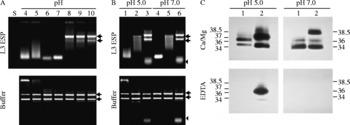
The characteristics of the DNase activities were determined by plasmid digestion assay (fig. 2A and B) based on optimal conditions of pH and metal ions which are characteristic of classic mammalian acidic or neutral DNases. Acidic DNases (e.g. DNase II) require an acidic pH but no divalent cations, while neutral DNases (e.g. DNase I) require a neutral pH and divalent cations (Kwak & Jasmer, Reference Kwak and Jasmer2003). In this assay, a Bluescript plasmid was used as a substrate for the DNases and DNA fragments produced were visualized by agarose gel (0.8%) electrophoresis and ethidium bromide (500 ng/ml) staining. The ESP activities of H. contortus L3 were detected mainly under pH conditions of 4.0 to 7.0 (fig. 2A) and were partially inhibited by the metal ion chelator EDTA (10 mM) at both pH 5.0 and 7.0, while the general DNase inhibitor ATA (100 (μm) inhibited all the DNase activities (fig. 2B). While the exact mechanism of ATA on DNase activity is ill defined, it has been proposed that ATA inhibits enzymatic activity of DNase through the alteration of the three-dimensional conformation of the enzyme (Ghosh et al., Reference Ghosh, Giri and Bhattacharyya2009).
The characteristics of DNase activities in excretory/secretory products (ESPs) of Haemonchus contortus infective larvae (L3) and comparison to those of adults. (A) Plasmid digestion assays of DNase activities in ESPs of H. contortus L3. Samples (400 ng protein) were incubated with plasmid DNA (400 ng) at 37°C for 4 h in buffers at pH 4.0–10.0 containing 2 mm CaCl2/MgCl2. Buffer without sample was incubated for 4 h as a control. The DNA fragments produced were analysed on agarose gel (0.8%) and visualized by ethidium bromide staining and UV illumination. Arrows on the right refer to estimated sizes of two forms of uncut plasmid DNA at 4 (upper) and 2.5 kb (lower), respectively. S, ESP without plasmid. (B) Effects of EDTA and aurintricarboxylic acid (ATA) on DNase activity. ESPs (400 ng) of H. contortus L3 were incubated with plasmid DNA (400 ng) at 37°C for 4 h in buffers at pH 5.0 (lanes 1–3) or 7.0 (lanes 4–6) containing 2 mm CaCl2/MgCl2 (lanes 1 and 4), 10 mm EDTA (lanes 2 and 5) or 100 μm ATA with 2 mm CaCl2/MgCl2 (lanes 3 and 6). Buffer without sample was incubated for 4 h as a control. The degradation of plasmid DNA was determined as described in (A). The arrowheads point to background staining caused by ATA. (C) Comparison of DNase activities in ESPs of H. contortus L3 to those of adults by zymogram. Excretory/secretory products (10 μg) of L3 (lane 1) or adult (lane 2) H. contortus were separated by SDS/PAGE (see fig. 1) and incubated in buffers (pH 5.0 or 7.0) containing 2 mm CaCl2/MgCl2 (Ca/Mg) or 10 mm EDTA (EDTA). Ethidium bromide stained gels are shown. Molecular masses are indicated in kDa on left- and right-hand sides.

To determine if the DNase activities were developmentally stage-specific, the DNase activities in L3 and adult H. contortus ESPs were compared by zymogram (fig. 2C). Among the four DNase activities with M rs of 34, 36, 37 and 38.5 kDa detected in the adult ESPs, the 34 and 36 kDa DNases also occurred in the L3 ESPs, with a similar preference for pH 5.0 and 7.0 as well as inhibition by EDTA. However, the 37 and 38.5 kDa activities occurred predominantly in the adult ESPs, which indicates specificity to the adult stage in the host.
The gel elution of DNase was assessed to further characterize the individual DNase activities in H. contortus L3 ESPs, according to the method of Kwak & Jasmer (Reference Kwak and Jasmer2004). However, the method was not successful in detecting the individual activities of L3, suggesting instability of the L3 DNase. In addition, the DNase activities of L3 and adults were compared quantitatively by using densitometry for the activities on the zymogram gel (fig. 2C, data not shown). The DNase activities of L3 varied from one to eight times lower than those of adults according to values of pH and molecular mass of DNase. Nevertheless, zymographic analysis showed that the 34 and 36 kDa DNase activites of H. contortus L3 ESPs occur at both pH 5.0 and 7.0 with sensitivity to EDTA, which are characteristics similar to those of adults.
Two significant findings described here are: (1) the presence of DNase activities in ESPs of L3; and (2) the developmental stage specificity of some DNase activities in ESPs of H. contortus L3 and adults. During the developmental cycle, parasites release a variety of ESPs, including proteases and DNases, into the host or culture environment. Excretory/secretory products of parasites may be involved in the developmental processes, penetration of host tissues and moulting or evasion of host immune responses (Liu et al., Reference Liu, Wu, Wang, Yu, Wang, Chen, Boireau and Liu2008). The presence of DNase activities in ESPs of H. contortus L3 could indicate a function of these extrasomatic DNases in the lumen of the gastrointestinal tract. The same rationale could hold for T. spiralis muscle larvae. Since ESPs of T. spiralis muscle larvae contain DNase activities (Mak & Ko, Reference Mak and Ko1999), impedance by host DNA could be an important barrier to tissue invasion. This is worth mentioning because the developmental part is of interest, but the potential practical application of the finding is of greatest interest.
As a practical application of DNase, viscous and elastic secretions in cystic fibrosis patients cause impaired mucus clearance and persistence of bacteria within the lungs. Recombinant human DNase has been used to treat pulmonary disease in cystic fibrosis by breaking up accumulated high molecular mass DNA (Shah et al., Reference Shah, Scott, Knight, Marriott, Ranasinha and Hodson1996).
Enzyme activities present in L3 of parasitic nematodes have been shown to be developmentally regulated (Zhan et al., Reference Zhan, Hotez, Wang and Hawdon2002; Maruyama et al., Reference Maruyama, Nishimaki, Takuma, Kurimoto, Suzuki, Sakatoku, Ishikawa and Ohta2006). A metalloprotease secreted by Ancylostoma caninum L3 is developmentally regulated (Zhan et al., Reference Zhan, Hotez, Wang and Hawdon2002). In addition, Strongyloides venezuelensis L3 quickly lose the ability of skin penetration once inside the host, which is associated with the disappearance of L3-specific protease expression (Maruyama et al., Reference Maruyama, Nishimaki, Takuma, Kurimoto, Suzuki, Sakatoku, Ishikawa and Ohta2006). Strict regulation of enzyme activities is required to minimize inadequate superfluous damage to the parasite and host. The presence of DNase activities in ESPs of L3 raises a question of the importance of this activity during invasion of the mucosa by L3. An in vivo test using a DNase inhibitor during the invasion process could be interesting to determine if DNases are a requisite for tissue penetration. While the difference in DNase activities of L3 and adults remains obscure, it is expected that DNases expressed with a stage-specific manner play important roles in the settling down of the parasite within the host. Thus, the role of DNase in larval development should be further clarified and the identification of stage-specific developmental markers will lead to the discovery of specific factors that stimulate larval development.
Acknowledgements
The authors thank Professor Douglas P. Jasmer at Washington State University, Pullman, Washington, USA, for the donation of H. contortus L3 and for critically reviewing the manuscript. This research was supported by the Basic Science Research Programme through the National Research Foundation of Korea (NRF) funded by the Ministry of Education, Science and Technology (KRF-2008-331- E00373).