





Eating disorders are common mental health disorders with median age at onset at 18 years and approximately 80% of onsets by age 25. Reference Solmi, Radua, Olivola, Croce, Soardo and de Pablo1 Thus, eating disorders primarily affect young people at a developmentally sensitive time, with potential disruption to life transitions. Reference Potterton, Austin, Allen, Lawrence and Schmidt2 As in other psychiatric disorders, intervening during early-stage first-episode illness is important for promoting full recovery. Reference Allen, Mountford, Elwyn, Flynn, Fursland and Obeid3 However, the average time between eating disorder onset and first evidence-based treatment (Duration of Untreated Eating Disorder; DUED) is lengthy, 29.9 to 67.4 months depending on diagnosis. Reference Austin, Flynn, Richards, Hodsoll, Duarte and Robinson4 Although service-related factors contribute to these delays, patient-related factors are substantial. A UK survey of people with eating disorders found that it took on average 21 months from onset to realising they had a problem, and another 13 months before they consulted their general practitioner (GP). 5 Even once referred for specialist assessment, 10–32% of eating disorder patients don’t take this up Reference Jenkins6–Reference Waller, Schmidt, Treasure, Murray, Aleyna and Emanuelli8 and a further 27% attend assessment but don’t take up treatment. Reference Waller, Schmidt, Treasure, Murray, Aleyna and Emanuelli8,Reference Gunnarsdottir, Palsson and Thorsteinsdottir9
We have previously developed and scaled an evidence-based early intervention model for 16- to 25-year-olds with an eating disorder of up to 3 years’ duration, called First Episode Rapid Early Intervention for Eating Disorders (FREED). Reference Allen, Mountford, Elwyn, Flynn, Fursland and Obeid3 FREED involves pro-active outreach and engagement after referral, treatment adaptations to increase motivation and early change and a developmentally sensitive approach for emerging adults. Reference Allen, Mountford, Elwyn, Flynn, Fursland and Obeid3 FREED reduces DUED and improves clinical outcomes. Reference Brown, McClelland, Boysen, Mountford, Glennon and Schmidt10–Reference McClelland, Hodsoll, Brown, Lang, Boysen and Flynn12 However, FREED only supports patients after they have been referred for eating disorder treatment.
Developing FREED-Mobile to support help-seeking for eating disorders
Theory-based interventions to improve knowledge, beliefs and motivation may improve help-seeking in eating disorders. We developed FREED-Mobile (FREED-M) based on the framework and intervention functions suggested by the Behaviour Change Wheel. Reference Atkins and Michie13 According to this framework, ‘psychological capability’ can be improved through increased knowledge/understanding or via emotional, cognitive and/or behavioural skills. Motivation can be improved through increasing knowledge/understanding and altering feelings about a behavioural target. Reference Atkins and Michie13,Reference Michie, van Stralen and West14 FREED-M aims to improve knowledge about eating disorders, along with motivation and readiness to seek treatment, via psychoeducation focused on the malleability of brain, body and behavioural symptoms in the early stages of an eating disorder, as well as personalised feedback on symptoms. Reference Grycuk, Monssen, Davies, Sharpe, Allen and Prasad15 The 4-week multimedia intervention is smartphone-friendly but can be accessed via phone or computer. FREED-M operates as a decision-making tool, in that it provides information to help users consider the possible outcomes, benefits and harms of different management options for eating disorder symptoms. 16 To the best of our knowledge, there are no other comparable interventions. Further information on the development and content of FREED-M is available in the protocol paper Reference Grycuk, Monssen, Davies, Sharpe, Allen and Prasad15 and the Methods section.
Here we present data from a randomised controlled feasibility trial which aimed to compare the FREED-M intervention with a minimally active control intervention. The objectives were to establish/estimate:
-
(a) attrition rates at follow-up (primary feasibility outcome)
-
(b) participant recruitment from different sources (secondary feasibility outcome)
-
(c) the intervention’s acceptability, uptake and completion rates (secondary feasibility outcome)
-
(d) intervention effect sizes and s.d. for eating disorder outcomes (clinical outcome: to inform the sample size calculation for a large-scale randomised controlled trial (RCT))
-
(e) intervention effect sizes and standard deviations for depression and anxiety, disclosure expectations, social media beliefs, motivation and social impairment and functioning (additional clinical outcomes).
These data will help indicate whether a larger RCT is warranted.
Method
Design, participants and setting
This was a parallel group, two-arm, randomised controlled design, in which participants were allocated to receive either the FREED-M intervention or were signposted to the website of the charity Beat (active control). There were no alterations to the published protocol, Reference Grycuk, Monssen, Davies, Sharpe, Allen and Prasad15 other than a decision to increase recruitment to account for higher than predicted attrition (see ‘Sample size’, below).
Outcomes were measured at baseline (week 0), post-intervention (4 weeks post randomisation) and follow-up (12 weeks post randomisation). Participants were eligible for inclusion if they were aged 16–25 years and had a suspected eating disorder (defined by a score ≥2 on the SCOFF (‘sick, control, one stone (14 lbs/6.3 kg), fat, food’) questionnaire). Reference Hill, Reid, Morgan and Lacey17 People with current or past specialist treatment for their eating disorder, low English comprehension, or who did not have access to the internet, were excluded. People who had been referred for specialist eating disorder treatment, but had not yet received this, were eligible. This decision was informed by research showing that up to 30% of patients referred for specialist assessment/treatment don’t take this up. Reference Jenkins6–Reference Gunnarsdottir, Palsson and Thorsteinsdottir9 Participants were recruited from primary care, schools, universities and from referrals to specialist eating disorder services in England. Patients were offered a £20 voucher at 12 weeks if they completed study assessments.
Randomisation and blinding
Randomisation was completed by researchers using the King’s Clinical Trials Unit web-based service in accordance with a standard operating procedure and held on a secure server. The randomisation allocation utilised minimisation with a random component. Minimisation factors were: (a) likely diagnosis of anorexia nervosa versus other eating disorder as assessed by the Eating Disorder Diagnostic Scale (EDDS); Reference Stice, Fisher and Martinez18 and (b) specialist referral for treatment for an eating disorder in process (yes/no) as self-reported by participants.
Neither participants nor the research team were blinded to participant condition assignment. However, care was taken to present interventions in both trial arms as active interventions to reduce participant expectancy biases. Participants were not told that FREED-M was a novel treatment or that signposting to the Beat website was the control intervention. Both groups were presented with their condition as an active intervention and told they would be given access to the alternative condition after the study. The statistical advisor to the study remained blinded to participant allocation until a first draft of the analyses were completed.
Sample size
The original target sample size was n = 35 per arm, Reference Teare, Dimairo, Shephard, Hayman, Whitehead and Walters19 assuming an attrition to follow-up rate of a = 0.4 (based on Vollert et al Reference Vollert, Yim, Görlich, Beintner, Gordon and Musiat20 ). Applying an attrition correction factor of 1/(1-a), the estimated required N = 116, i.e. 58 participants/arm. Assuming 116 eligible participants enrolled, we would be able to estimate a 40% attrition rate within a 95% CI of ±9%.
During initial data collection (December 2022–March 2023), attrition was higher than expected at ∼60%. In April 2023, we therefore decided to increase our sample size to account for 60% attrition and accordingly set a target sample size of N = 176, i.e. 88 participants/arm.
Interventions
Study interventions and assessments were delivered on a purpose-built smartphone-friendly website, designed with the company Fruitful (fruitful.studio).
FREED-M intervention
The four FREED-M intervention modules combine psychoeducation with personalised feedback. Psychoeducation consisted of a series of four short, animated films focusing on key themes: (a) encouraging early help-seeking, (b) the impact of an eating disorder on the body (highlighting gut health), (c) the impact and malleability of eating disorder-related changes to the brain and (d) effects of and strategies for managing unhelpful social media use. Each animation was 2–3 min in length. Participants were able to view one animation per week and were then invited to reflect on the content and the personal relevance of the materials. They were also able to access weekly downloadable resources associated with the animation theme.
The intervention content was developed with young people with lived experience of an eating disorder, experts in the field and prior qualitative research. Reference Potterton, Austin, Allen, Lawrence and Schmidt2 This process was informed by guidance on the development of electronic and mobile-health tools. Reference Michie, Yardley, West, Patrick and Greaves21,22
Weekly personalised symptom feedback was given to participants in the FREED-M arm, based on information obtained during the baseline assessment and in line with the theme of the week. Such feedback is thought to increase the likelihood or depth of processing information and has a significant positive effect on the psychotherapy outcome, including in eating disorder interventions (see Grycuk et al Reference Grycuk, Monssen, Davies, Sharpe, Allen and Prasad15 ). Feedback was provided based on programmed algorithms within the FREED-M intervention and made use of available scoring guidance for each questionnaire (i.e. informing participants of their pattern of scores and what these may mean).
The FREED-M animated films can be seen at https://www.wovenink.co.uk/freed-m-series.
Control intervention
Participants allocated to the control intervention were signposted to the website of ‘Beat’ (beateatingdisorders.org.uk), the UK eating disorder charity, which provides information and support for eating disorders. While intended to be a minimally active intervention, Beat provides a range of support options and resources including web-based chat rooms and a telephone support line.
Outcomes
Feasibility outcomes
The primary feasibility outcome was the 12-week post-randomisation study attrition rate (i.e. the proportion of randomised participants who did not complete the follow-up assessment). Secondary feasibility outcomes were: participant recruitment (proportions of randomised participants recruited from different sources; number of participants recruited per month); completion rates (proportion of randomised participants who completed all assessments); intervention uptake (proportion of participants randomised to FREED-M who accessed at least a part of the first intervention module); intervention completion rates (proportion of participants randomised to FREED-M who accessed each intervention module) and adherence (proportion of participants randomised to FREED-M who provided a rating for the animated film, completed symptom assessments and made free-text reflections on the module content); and intervention acceptability (proportion of participants randomised to FREED-M with a rating of ≥ 4 on each feedback question, scored on a five-point Likert scale from 1 = ‘did not like it at all/not at all useful’ to 5 = ‘best thing ever/extremely useful’).
Clinical outcomes
At baseline only, participants completed a questionnaire on eating disorder symptom onset and reported their height. At all assessment points (baseline, weeks 4 and 12) they completed the EDDS Reference Stice, Fisher and Martinez18 and self-reported weight, as well as questions on motivation and readiness to change and to seek help. These questions were based on published guidance Reference Rollnick, Mason and Butler23 and used a 10-point visual analogue scale, i.e. asking participants to rate out of 10 their motivation to change eating disorder symptoms, readiness to change eating disorder symptoms and likelihood of seeking help for eating disorder symptoms over the next month. Additionally, participants were asked a categorical (yes/no) question on whether they had already sought help for their eating disorder.
A short version of the EDDS and the questions on motivation and readiness to change were additionally completed at weeks 1–3.
Other clinical outcomes were questionnaires assessing depression and anxiety (Patient Health Questionnaire; PHQ-4 Reference Kroenke, Spitzer, Williams and Löwe24 ), beliefs about the risks and benefits of disclosing eating difficulties (Disclosure Expectations Scale; DES Reference Vogel and Wester25 ), social media behaviours Reference McLean, Paxton, Wertheim and Masters26 and motivation for use (Motivations for Social Media Use Scale; MSMU Reference Rodgers, Mclean, Gordon, Slater, Marques and Jarman27 ) and social impairment and functioning (Work And Social Adjustment Scale-Youth; WSAS-Y Reference Jassi, Lenhard, Krebs, Gumpert, Jolstedt and Andrén28 ). These were completed at baseline and weeks 4 and 12. Reference Grycuk, Monssen, Davies, Sharpe, Allen and Prasad15
Economic measures
The adult, five-level version of the EuroQol measure of health-related quality of life (EQ-5D-5L (29)), suitable for the calculation of quality adjusted life years, was completed at baseline and 12-week follow-up. It is recommended for participants aged 16 and older. 29 We assessed the acceptability of this measure for our young adult eating disorder participants. In addition, a modified, self-report version of the Adult Service Use Schedule (AD-SUS) was developed and tested for acceptability and comprehensiveness at baseline (covering the previous 3 months) and week 12 (covering the period since baseline). The measure, based on a previous version developed for adolescents and young adults, Reference Perez, Jin, Russo, Stochl, Painter and Shelley30 was adapted based on existing evidence of service use in eating disorders. Reference Gowers, Clark, Roberts, Byford, Barrett and Griffiths31,Reference Schmidt, Sharpe, Bartholdy, Bonin, Davies and Easter32 Service use was collected from the National Health Service (NHS) and social services perspective preferred by the National Institute for Health and Care Excellence (NICE).
Harms
Adverse events were defined as: a drop in 2+ BMI points between time points (0–4 weeks, 4–12 weeks); or any admission, accident and emergency (A&E) department visits, or treatment by ambulance crews for any reason (assessed at 12 weeks).
Procedure
The trial was registered (ISRCTN15662055). The authors assert that all procedures contributing to this work comply with the ethical standards of the relevant national and institutional committees on human experimentation and with the Helsinki Declaration of 1975, as revised in 2013. Ethical approval was obtained from the London – Camden & Kings Cross Research Ethics Committee (REC Ref: 22/LO/0655; 11.10.2022). Potential participants first completed an online consent form and screening procedures. Once eligibility had been determined, they were directed to complete the baseline assessment and then randomised.
Managing fraudulent participants
As detailed below (participant recruitment), during the trial period we became aware of a number of likely fraudulent participants, some of whom were only identified after randomisation. We have reported elsewhere the protocol we developed for managing these. Reference Davies, Monssen, Sharpe, Allen, Simms and Goldsmith33
Data analysis
Feasibility outcomes were summarised using counts or proportions and associated Poisson confidence intervals, overall and separately by arm, as appropriate. Clinical and economic measures were summarised using means and s.d. or proportions and Poisson confidence intervals as appropriate by time point and arm.
Mean differences between the arms for most outcomes were estimated using linear mixed effects models and maximum likelihood estimation with all post-randomisation measures of the outcome as dependent variables, and random intercepts for participants to account for the repeated measures. FREED-M versus active control odds ratios for binary outcomes were estimated using mixed effects logistic regression models with random intercepts. All models used to compare clinical outcomes between FREED-M and the active control included an allocation variable, and the minimisation covariates as independent variables.
Effect sizes for continuous outcomes were calculated as the mean difference between arms at week 4 and week 12 divided by the s.d. pooled across both arms of the outcome measure at baseline. Effect sizes for binary outcomes were calculated as the odds ratio, i.e. odds of experiencing each outcome in the intervention arm compared with the control arm at week 4 and week 12.
There were planned subgroup analyses by eating disorder diagnosis (anorexia nervosa (restrictive and binge/purge sub-types) versus non-underweight eating disorders) for motivation to change and readiness to change at week 4 and week 12. To do this, the linear mixed effects models described above were re-run, replacing the trial arm by time interaction term with a trial arm by time by eating disorder diagnosis interaction term. Effect sizes are presented separately by eating disorder diagnosis arm (see Supplementary Materials).
There were no planned economic analyses. The economic component of the study was limited to testing the economic measures (the EQ-5D-5L and the adapted version of the AD-SUS) for use in a future definitive RCT, so no formal statistical analyses were carried out, and data are presented descriptively. Testing focused on acceptability (via completion rates and qualitative feedback), comprehensiveness (via open-ended questions in the AD-SUS asking participants to report ‘other’ services) and redundancy (service-use items included in the AD-SUS but not reported as being used by any participant).
Results
Participant recruitment and flow
Participant flow is shown in Fig. 1. Recruitment took place from 1 December 2022 to 30 June 2023. Four hundred and sixty-two people were assessed for eligibility, of which 112 were identified as being suspected fraudulent participants and were withdrawn. Of the 350 true participants who were assessed for eligibility, 133 did not pass screening (for reasons, see Fig. 1). Of 329 people offered baseline assessment, 296 completed this. Of these, 92 were withdrawn prior to randomisation due to suspected fraud or invalid baseline responses. Reference Davies, Monssen, Sharpe, Allen, Simms and Goldsmith33 Two hundred and four people were randomised, with 102 allocated to each study arm. A further 20 participants were withdrawn post randomisation due to suspected fraud, leaving 91 true participants in the FREED-M and 93 in the control arm. There was one post-randomisation participant-initiated withdrawal in the FREED-M arm (no reason given). Analyses were conducted with the 184 randomised participants who were deemed genuine.
CONSORT diagram of participant flow through the trial. ED, eating disorder. SCOFF, sick, control, one stone (14 lbs/6.3 kg), fat, food.

Fig. 1 Long description
The flowchart details the participant flow through the FREED-Mobile trial. It starts with 462 participants screened for eligibility, with 350 genuine participants and 112 later identified as fraudulent. 133 participants were excluded for various reasons, leaving 329 invited for baseline assessments. Of these, 217 were genuine and 112 were fraudulent. 125 participants were excluded for not completing baseline or being fraudulent, resulting in 204 participants randomized. 20 further fraudulent participants were excluded, leaving 184 participants allocated to two groups: 91 to FREED-Mobile and 93 to control. Post-intervention assessments at week 4 and follow-up assessments at week 12 show the number of participants who completed or missed assessments. Finally, all participants were analyzed for feasibility outcomes and lower participant numbers for effect size estimates.
The average recruitment rate of true participants into the trial was 26.3 participants/month (95% CI 22.6, 30.4). The most common recruitment source was school, college or university (n = 62, 33.7% (95% CI 26.9%, 41.0%)), followed by GP (n = 53, 28.8% 95% CI 22.4%, 35.9%)), ‘other’ sources (n = 39, 21.2% [95% CI 15.5%, 27.8%)), the internet (n = 22, 12.0% (95% CI 7.6%, 17.5%)) and family or friends (n = 8, 4.3% (95% CI 1.9%, 8.4%)).
Baseline characteristics
The mean age of participants was 21.0 (s.d. = 2.4) years, 89.1% (n = 164) identified as female and 63.6% (n = 117) as White. Mean BMI was 23.1 (s.d. = 6.3) kg/m2. Based on EDDS scores, 83 (45.1%) participants had an anorexia nervosa-spectrum eating disorder, 67 (36.4%) had a non-underweight binge-spectrum eating disorder, 33 (17.9%) had subclinical eating disorder symptoms and 1 person screened positively on the SCOFF but then did not report any eating disorder symptoms at baseline. Demographic and clinical characteristics were balanced between the arms, and approximately 15% of each group had started the help-seeking process with a specialist eating disorder referral underway (see Supplementary Materials). Descriptive statistics for all outcomes and all time points are shown in the Supplementary Materials.
Assessment completion/attrition
The overall assessment completion rate was n = 184 at baseline (100.0% (95% CI 98.0%–100.0%)), n = 85 at week 4 (post-intervention, 46.2% (95% CI 38.8%–53.7%)) and n = 72 at week 12 (follow-up, 39.1% (32.0%–46.6%)). Thus, attrition rate at week 12 (primary feasibility outcome) was n = 112 (60.9%, (95% CI 53.4%–68.0%)). Assessment completion rates were similar across trial arms.
Intervention engagement and acceptability
The proportion of participants engaging with the different module elements ranged between 45.1 and 75.8%, and in general declined slightly across the 4 weeks (Table 1). Twenty-two participants in the FREED-M arm (24.2%) did not engage in any module elements throughout the 4 weeks. There was no difference in baseline characteristics between participants who engaged in none versus those who engaged in at least one element (age: t(89) = 1.85, p = 0.07; gender: X 2(2) = 1.74, p = 0.42; ethnicity; X 2(4) = 2.93, p = 0.57; eating disorder diagnosis group: X 2(2) = 0.08, p = 0.96). Of those who engaged in at least one module element (n = 69), over half accessed the content exclusively on their mobile phone (n = 38, 55.1% (42.6%, 67.1%)), a quarter via computer (n = 17, 24.6% (15.1%, 36.5%)) and around 20% via both devices (n = 14, 20.3% (11.6%, 31.7%)).
Estimates of intervention adherence to different components of FREED-Mobile (n = 91)

Table 1 Long description
A table showing intervention adherence to different components of FREED-Mobile over four weeks. The table has four rows and three columns. Column headers are Symptom assessment completed, Film rating completed, and Open-text reflection completed. Each column has two sub-columns: % (95% CI) and n. Row labels are Week 1, Week 2, Week 3, and Week 4. Row 1: Symptom assessment completed: 75.8 (65.7–84.2), 69; Film rating completed: 62.6 (51.9–72.6), 57; Open-text reflection completed: 53.8 (43.1–64.4), 49. Row 2: Symptom assessment completed: 59.3 (48.5–69.5), 54; Film rating completed: 56.0 (45.2–66.5), 51; Open-text reflection completed: 49.5 (38.8–60.1), 45. Row 3: Symptom assessment completed: 52.7 (42.0–63.3), 48; Film rating completed: 52.7 (42.0–63.3), 48; Open-text reflection completed: 45.1 (34.6–55.8), 41. Row 4: Symptom assessment completed: 46.2 (35.6–56.9), 42; Film rating completed: 48.3 (37.8–59.1), 44; Open-text reflection completed: 56.0 (45.2–66.4), 51.
Measures of intervention acceptability were provided by 42/91 (46.2%) participants in the FREED-M arm. Of these, 78.5% (n = 33, [(95% CI 63.2%, 89.7%)) liked the intervention ‘moderately’ or ‘a lot’, and 66.7% (n = 28, (95% CI 50.5%, 80.4%)) found it ‘moderately’, ‘very’ or ‘extremely’ useful. Participants in the FREED-M arm also provided separate ratings of the four animated films (see Table 2). The films were rated very favourably overall. At least four of a possible five stars were given by 70.8 to 79.5% of participants across the films. A majority of participants endorsed that the content felt relevant to them, with positive ratings ranging from 54.5 to 72.7% across the films, although positive ratings for helpfulness ranged between 39.2 and 58.1%.
Acceptability ratings for FREED-Mobile short animations by week

Table 2 Long description
The table presents ratings for four animated films on three criteria: overall rating, film relevance, and film helpfulness. It has four rows and three columns. The columns are labeled ‘Film overall rated 4/5 stars’, ‘Film relevance rated 4/5 stars’, and ‘Film helpfulness rated 4/5 stars’. Each column is further divided into percentage (with 95% CI) and n/total. The rows are labeled with the names of the films: Film 1 – Help-seeking, Film 2 – Social media, Film 3 – Gut health, and Film 4 – Eating disorders and the brain. Each row provides the percentage and n/total for the three criteria. Notable trends include high overall ratings for all films, with Film 4 receiving the highest overall rating at 79.5%. Film relevance ratings are also high, with Film 4 again leading at 72.7%. Film helpfulness ratings are lower compared to overall and relevance ratings, with the highest being 58.1% for Film 4.
Intervention effect sizes on clinical outcomes
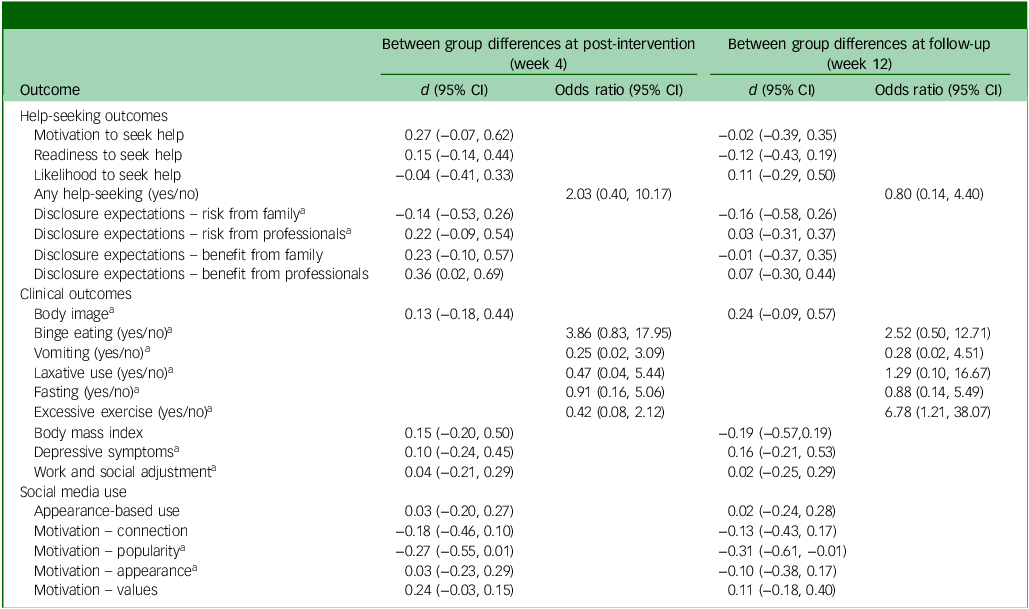
Between-group FREED-M versus control Cohen’s d-type effect sizes for motivation and readiness to seek help were small to medium at post-intervention (4 weeks, d = 0.27 and d = 0.15, respectively) favouring FREED-M, but differences were not sustained/reversed at follow-up (12 weeks, d = −0.02 and d = −0.12, respectively). Effect sizes for other help-seeking outcomes, clinical outcomes and social media use were small, with confidence intervals for between-group mean differences and odds ratios across outcomes generally not excluding the null value (see Table 3). Small effect sizes (d > 0.20, odds ratio > 1.5) favouring FREED-M were seen for reports of any help-seeking (4 weeks), vomiting (4 weeks, 12 weeks), laxative use (4 weeks), excessive exercise (4 weeks), perceived benefit of disclosing eating disorder to family (4 weeks) and professionals (4 weeks), use of social media for popularity purposes (4 weeks, 12 weeks) and for pursuing values (4 weeks). There were also some small effect sizes favouring control: perceived risk of disclosure expectation from professionals (4 weeks), binge eating (4 weeks, 12 weeks) and excessive exercise (12 weeks).
Between-group differences in outcomes at post-intervention (week 4) and follow-up (week 12)

Table 3 Long description
A table comparing between-group differences in outcomes at post-intervention (week 4) and follow-up (week 12). The table has 18 rows and 4 columns. Column headers are: Outcome, d (95% CI) Between group differences at post intervention (week 4), Odds ratio (95% CI), and d (95% CI) Between group differences at follow up (week 12). Row labels include Help-seeking outcomes, Clinical outcomes, and Social media use. Each row provides specific outcomes and their corresponding values for d (95% CI) and Odds ratio (95% CI) at post-intervention and follow-up. Notable trends include small effect sizes favoring FREED-M for certain outcomes at post-intervention, which are not sustained at follow-up.
a. Negative values favour intervention.
Subgroup analyses by eating disorder diagnosis
Effect sizes for motivation to change and readiness to change at week 4 and week 12 are presented separately by eating disorder diagnosis arm (anorexia nervosa-type versus other eating disorder) in Supplementary Materials. There were no significant time × group × eating disorder diagnosis interactions. As with the main analyses, 95% CI for effect sizes were broad.
Economic measures
Completion rates were high for both the AD-SUS and EQ-5D-5L (100% of participants at baseline and 100% of those followed up at 12 weeks). Qualitative feedback suggested improvements to ease completion of the AD-SUS and supported the EQ-5D-5L as a relevant and clear measure. A few redundant AD-SUS items, with little reported use, were identified (educational psychologists; special educational needs coordinators; social services; medications, including for attention-deficit hyperactivity disorder and tics/Tourette’s), but no missing items were identified.
Service use was generally low and relatively consistent between baseline and follow-up. Services most commonly reported included GPs (57% of participants in the 3 months before baseline; 56% over the 12-week follow-up period); non-mental health outpatient services (34% baseline; 32% follow-up); dentist (25% baseline; 28% follow-up); mental health worker (21% baseline; 21% follow-up); and talking therapy (20% baseline; 24% follow-up). Prescribed medications were common for depression/anxiety (22% baseline; 22% follow-up) and sleep disorder (14% baseline; 10% follow-up). Services used rarely included in-patient stays (≤5% of participants) and eating disorder services (eating disorder out-patient services ≤ 11%; community specialist eating disorder consultant ≤ 7%; eating disorder in-patient stays ≤ 3%).
Mean EQ-5D-5L scores at baseline were approximately 0.65, which is low for a non-clinical sample and far lower than population norms, typically reported to be over 0.95 for young adults aged 18–24 years. Reference Janssen, Pickard and Shaw34 Scores were highly variable, with participants reporting the full range of responses at baseline, from states worse than death (−0.124) to perfect health (1.000), and a wide range of responses at follow-up (0.075 to 1.000). Mean scores at baseline were similar between groups (mean 0.647 FREED-M; 0.661 control), with both groups showing improvement between baseline and follow-up (mean 0.700 FREED-M; 0.741 control).
Harms
In the FREED-M arm, 7 people reported any adverse event (10 events total (2 hospitalisations; 3 A&E visits; 1 treatment by ambulance crew; 4 drop in BMI of 2+ points)) versus 12 in the control arm (12 events total (9 A&E visits; 3 drop in BMI of 2+ points)).
Discussion
We present findings from a feasibility study of a novel, smartphone-friendly online decision tool, FREED-M, compared with an active control condition. Feasibility outcomes show that young people were very willing to take part in the study and be randomised. This helped to mitigate the power of the study against higher-than-expected drop-out. Our study attrition was higher than originally estimated, but is in keeping with other low-intensity online interventions. Reference Torous, Linardon, Goldberg, Sun, Bell and Nicholas35
Our FREED-M intervention use data are encouraging, with approximately three-quarters of participants in this arm engaging with at least some of the FREED-M module content and with use of different intervention components ranging from 45 to 76% across the 4-week study. These usage rates are consistent with a meta-analysis of digital interventions for eating disorders, which found approximately one-quarter of people drop out of digital interventions entirely but only one-third access all programme components. Reference Linardon, Shatte, Messer, Firth and Fuller-Tyszkiewicz36 Our ability to steadily recruit young people with eating disorders speaks to the desire from this group for interventions in a digital format.
We received positive feedback on the acceptability of the FREED-M animated films. Overall ratings for the 4 films were at least 4 out of 5 stars in between 71 and 80% of cases. Interestingly, ratings of relevance and helpfulness were lower, suggesting that some participants may have enjoyed the films without necessarily finding them applicable to their circumstances. The social media animation received the greatest endorsement from participants for relevance and helpfulness, highlighting the particular importance of this topic for emerging adults with a recent onset eating disorder.
For motivational variables, there were small- to medium-sized effects for motivation and readiness to seek help at 4 weeks, which favoured FREED-M. There was also a small effect size favouring FREED-M for help-seeking behaviours at 4 weeks. This suggests that in the short term, our minimal intervention was effective in increasing motivation and readiness to seek help for eating disorder symptoms. However, these effects were not maintained to 12 weeks. Clinical outcomes were difficult to interpret, possibly due to the heterogeneity of our patient population (developmentally, in terms of referral route and in terms of eating disorder diagnoses), the short time frame of the study and small numbers due to attrition. Importantly, our control intervention was also an active intervention, by combining regular self-monitoring online with signposting to the Beat website (which includes options for online web chats and a telephone helpline).
Taking our findings together, we believe the results support progression to a large-scale trial of the FREED-M intervention. In a larger trial, careful thought would need to be given to the most appropriate form of control condition; whether the FREED-M intervention could be adapted to increase engagement and motivational effects; and to the target participant group. Adaptations might include extending the duration of intervention, to give more time for it to support change; adding guidance, which typically increases the effectiveness of digital interventions; Reference Werntz, Amado, Jasman, Ervin and Rhodes37 allowing for personalisation of content (e.g. through self-selection of modules and variable module order); Reference Cheung, Thomas, Brvar and Rowe38 and considering strategies to increase overall intervention use, such as rewards for module completion. These factors may minimise attrition while also increasing intervention adherence and effects. It may also be helpful to restrict recruitment to individuals who do not yet have a specialist referral underway. This would allow for clearer evaluation of how FREED-M has an impact on help-seeking behaviour.
Strengths and limitations
This study has a number of strengths. To our knowledge, FREED-M is the first decision-making tool designed to support help-seeking and early change for young people with a recent-onset eating disorder. We provide compelling evidence for the appeal of such a tool, with over-recruitment relative to initial targets. As noted, ratings of acceptability were also high. An additional strength is the systematic recording of adverse events, which is important given the potentially serious effects of deterioration. Reference Linardon, Fuller-Tyszkiewicz, Firth, Goldberg, Anderson and McClure39 Limitations include substantial attrition from follow-up questionnaire assessments, which raises questions about the representativeness of those participants who were retained, and the lack of sustained effects from 4 to 12 weeks. Recruitment was via the SCOFF which has limitations in detecting eating disorders, particularly for recent-onset presentations and males. Reference Kutz, Marsh, Gunderson, Maguen and Masheb40 In addition, we are only able to estimate engagement with FREED-M from completion of weekly symptom assessments and the provision of film ratings and text reflections. Some participants may have used FREED-M without providing this information and, conversely, some participants may have completed symptom assessments without fully engaging with the FREED-M resources. We did not assess the acceptability and use of our control condition (Beat website). These limitations should be considered and addressed in a future full RCT.
Next steps
Although the trial’s attrition rate was higher than expected, recruitment exceeded expectations and acceptability of the FREED-M intervention was high. Motivation and readiness to change, and/or help-seeking behaviour, are candidates as potential primary outcomes for a future RCT.
Supplementary material
The supplementary material is available online at https://doi.org/10.1192/bjo.2026.12113
Data availability
The data that support the findings of this study are available from the corresponding author (U.S.) upon reasonable request.
Acknowledgements
We would like to thank the participants of this trial and the individuals with lived experience of an eating disorder, clinicians and researchers who helped shape content for the FREED-M intervention. An earlier version of this manuscript has been published as a pre-print and can be accessed at https://doi.org/10.31234/osf.io/4xrgb_v1.Reference Sharpe, Allen, Goldsmith, Lawrence, Byford and Monssen41
Author contributions
The study design was conceived by U.S., K.L.A., H.S., K.A.G., S.B., V.L., V.A.M., D.G., N.G. and V.P. and funding was obtained by these authors. Study coordination, site management and data collection were coordinated by D.M., M.R.D., L.G., R.P., P.P., S.M. and A.B. The analyses were carried out by H.S., K.A.G. and S.B. The first draft of the paper was written by H.S., K.A. and U.S. All authors provided critical feedback and shaped the final version of the manuscript.
Funding
This work was supported by the National Institute of Health Research (NIHR) under its Research for Patient Benefit (RfPB) Scheme (grant number NIHR201175). U.S., H.S. and K.L.A. receive support via the Medical Research Council/Arts and Humanities Research Council/Economic and Social Research Council Adolescence, Mental Health and the Developing Mind initiative as part of the EDIFY programme (grant number MR/W002418/1). K.L.A. and U.S. are additionally supported by the Medical Research Council grant no. MR/X030539/1 and H.S. is additionally supported by UK Research and Innovation (MRC, ESRC, AHRC), the NIHR and the Medical Research Foundation as part of the EDAC network (grant number: MR/X03058X/1). K.A.G. is supported by the NIHR Applied Research Collaboration South London (NIHR ARC South London) at King’s College Hospital NHS Foundation Trust. During the course of this work V.P. received salary funding via King’s College London from the NIHR academic clinical lecturer scheme; University of Nottingham as Associate Professor, via the NIHR senior clinical and practitioner research award (SCPRA) and NIHR Mental Health Translational Research Collaboration Mission (hosted by the NIHR Oxford Health Biomedical Research Centre); and the NIHR East Midlands scholarship scheme (hosted by NHS Nottingham and Nottinghamshire and the University of Nottingham). This study has been delivered through the NIHR Maudsley Biomedical Research Centre (BRC). Additionally, this study was supported by the UK Clinical Research Collaboration-registered King’s Clinical Trials Unit at King’s Health Partners, which is part-funded by the NIHR BRC hosted by South London and Maudsley NHS Foundation Trust in partnership with King’s College London. The views expressed herein are those of the authors and not necessarily those of the National Health Service, NIHR or Department of Health and Social Care.
Declaration of interest
None.





 Open access


eLetters
No eLetters have been published for this article.