Introduction
During the last decade, a growing body of literature documented the existence of geographic areas characterized by higher prevalence of exceptional agers, namely the Blue Zones (Poulain et al., Reference Poulain, Herm and Pes2013). There is evidence that one of the five Blue Zones is in the central–eastern region of Sardinia, an Italian island located in the Mediterranean Sea, where the number of male centenarians is very similar to that of women (Poulain et al., Reference Poulain2004).
A recent line of research examining the psychological markers of optimal aging in the Sardinian Blue Zone documented that community-dwelling and cognitively healthy agers living in that geographical spot self-reported less depressive signs and better psychological well-being than peers living in a similar agro-pastoral area located in Northern Italy (Fastame and Penna, Reference Fastame and Penna2014; Fastame et al., Reference Fastame, Penna and Rossetti2014b). This pattern of results was also replicated when perceived mental health measures of older people of the Sardinian Blue Zone were compared with those of peers living in a Sardinian urban area (Fastame et al., Reference Fastame, Penna and Hitchcott2015). Overall, compared to the national cut-off scores, older people from the Sardinian Blue Zone showed higher levels of psychological well-being and lower levels of depressive symptoms, which, in turn, were associated to more preserved working memory efficiency and better capacity to self-rate and reflect on one’s cognitive resources (Fastame et al., Reference Fastame, Penna, Rossetti and Agus2014a). Following this, a recent investigation conducted with cognitively intact Sardinian centenarians and octogenarians and nonagenarians recruited in the Blue Zone showed preserved mental health and very few depressive symptoms in all the age groups, even in the oldest successful agers (Fastame et al., Reference Fastame, Penna and Hitchcott2020). However, it must be noticed that this evidence stands in contrast to the findings of the Georgia Centenarian Study, according to which depressive symptoms were more evident in centenarians than in sexagenarians and octogenarians (Martin et al., Reference Martin, Rott, Kerns, Poon, Johnson, Martin, Rott, Hagberg and Morgan2000).
A further study conducted with members of Sardinian families (i.e. grandparents, parents, and children) being born and living in the Blue Zone for at least two previous generations documented that personal satisfaction about friendships and satisfaction about family ties predicted self-reported psychological well-being and depressive symptomatology among the participants, which, reported well-preserved mental health indexes (Hitchcott et al., Reference Hitchcott, Fastame, Ferrai and Penna2017). These outcomes reinforce the idea that aging is a complex phenomenon where the development of its psychological dimensions (i.e. affective, cognitive, and metacognitive) contributes with social factors (e.g. social engagement and satisfaction about family and non-family relationships) to the promotion of mental health in late adulthood (e.g. Baltes et al., Reference Baltes, Lindenberger, Staudinger and Lerner1998; Fuller-Iglesias et al., Reference Fuller-Iglesias, Webster and Antonucci2015). In particular, as suggested elsewhere (e.g. Carpiniello et al., Reference Carpiniello, Carta and Rudas1989; Diener et al., Reference Diener, Seligman, Choi and Oishi2018), if the social network represents a supportive resource for the older people treating them with respect and it considers the agers a resource to be engaged by the active social participation (e.g. being helpful for the others and being depository of the local knowledge), this attitude can boost both self-efficacy and perceived mental health (e.g. life satisfaction) even in extreme adult span (Fastame et al., Reference Fastame, Penna and Hitchcott2020).
There is also evidence that resilience represents a protective factor for the mental health of elders living in the Sardinian Blue Zone, favoring a better adaptation to adverse conditions (Fastame et al., Reference Fastame, Hitchcott, Mulas, Ruiu and Penna2018). Besides, it has been documented that older adults of the Sardinian Blue Zone having a lifestyle more oriented to perform outdoor socially oriented leisure activities and hobbies and engaging a more intense physical activity (e.g. gardening) showed reduced risk of depression and better perceived psychological well-being than older people living in the same area but being more sedentary (Fastame et al., Reference Fastame, Hitchcott and Penna2018). In line with this trend of research, Pes et al. (Reference Pes2013) argue that successful agers of the Sardinian Blue Zone live in the inner mountainous areas of the island where the slope of the environment contributes massively to increase the physical and cardiovascular activities of the older inhabitants which, in turn, do have the habit to walk for long distances and to maintain a more healthy lifestyle.
Concerning the motor functioning of older people, a trend of research shows that the ability to effectively perform simple tasks like those associated with postural control, gait, and basic activities of daily living is associated with well-being, quality of life, and cognitive decline. In particular, gait speed has been found significantly correlated with life expectancy (Hardy et al., Reference Hardy, Perera, Roumani, Chandler and Studenski2007), cognitive decline (Peel et al., Reference Peel, Alapatt, Jones and Hubbard2019), and self-perception of aging (Levy et al., Reference Levy, Slade and Kasl2002; Sargent-Cox et al., Reference Sargent-Cox, Anstey and Luszcz2012). It is also noticeable that early disturbances in cognitive process such as attention, executive functions, and working memory often coexist with slower gait speed and greater instability (Amboni et al., Reference Amboni, Barone and Hausdorff2013; Montero-Odasso et al., Reference Montero-Odasso, Verghese, Beauchet and Hausdorff2012). Physical functions have been also specifically investigated in exceptional survivors living in the Blue Zones and identified as important factor to characterize phenotypes that reflect healthy aging (Willcox et al., Reference Willcox, Willcox and Ferrucci2008).
However, so far, no studies have longitudinally examined the impact of age-related factors on the efficiency of psychological and motor competences of older adults living in the Blue Zones. Despite this, several investigations have been conducted elsewhere to explore whether significant functional and psychological changes occur in later life span (i.e. oldest old individuals and centenarians) and what the impact of motor and psychological changes on life quality of older adults is. In this regard, converging evidence suggests that survivors into the extreme adult span are characterized by a meaningful loss of basic functional capacities (e.g. bathing and dressing) and motor efficiency (e.g. reduced handgrip strength, reduced walking speed, and greater use of walking aids) limiting their independence and social life (e.g. Nybo et al., Reference Nybo, Gaist, Jeune, McGue, Vaupel and Christensen2001). In contrast, there is controversial evidence about the development of perceived mental health in very late adulthood, since according to some authors psychological well-being is stable over the last decades (e.g. Smith et al., Reference Smith, Fleeson, Geiselmann, Settersten, Kunzmann, Baltes and Mayer1999), especially among older participants engaged in recreational activities (Michèle et al., Reference Michèle, Guillaume, Alain, Nathalie, Claude and Kamel2019), whereas further longitudinal studies documented the prevalence of adverse mental health outcomes (i.e. increase of depressive symptoms and deterioration of psychological well-being) in late adulthood (Browning et al., Reference Browning, Enticott, Thomas and Kendig2018) and in extreme late life span (Martin et al., Reference Martin, Rott, Kerns, Poon, Johnson, Martin, Rott, Hagberg and Morgan2000). According to Kahana et al. (Reference Kahana, Kelley-Moore and Kahana2012), the changes in the mental health outcomes of the oldest old individuals are influenced by different stressors, such as the occurrence of acute illnesses and social (i.e. family members and friends) losses.
A further trend of research suggests that there is an interplay between motor functioning and psychological well-being in late adulthood. Specifically, on the one hand, preserved psychological well-being (i.e. greater hedonic or eudaimonic wellness and fewer depressive symptoms) in the older people represents a protective factor against the successive occurrence (e.g. over a four-year period) of motor decline (Boyle et al., Reference Boyle, Buchman and Bennett2010; Gale et al., Reference Gale, Cooper, Deary and Sayer2014; Hybels et al., Reference Hybels, Pieper and Blazer2009; Kiyoshige et al., Reference Kiyoshige2019) and the future onset (e.g. over a 10-year period) of chronic conditions and mortality (Zaninotto and Steptoe, Reference Zaninotto and Steptoe2019). On the other hand, it has also been showed that the onset of motor deficits in the older population is associated with the successive occurrence of mental health problems. Concerning this, a longitudinal Australian study conducted by Kendig et al. (Reference Kendig, Browning, Thomas and Wells2014) documented that physical activity represented a protective factor for ageing well (i.e. community-dwelling people being alive and living independently with good physical and psychological health) by the end of a 12-year period, that is, people less sedentary reported better psychological well-being. Moreover, Jónsdóttir and Ruthig (Reference Jónsdóttir and Ruthig2020) recently showed that older people with diminished functional mobility who fell within the past year, a few years later reported poorer perceived physical health and greater depressive symptoms.
The main purpose of this study was to examine longitudinally the impact of age-related factors on several motor parameters, psychological well-being, and metacognitive measures in a sample of community-dwelling older adults living in the Sardinian Blue Zone, while controlling for the gender effect. Furthermore, this investigation intended to explore the relationship between motor functioning indexes and self-reported mental health and metacognitive scores, respectively. Specifically, we were interested in examining whether possible objective changes in the motor efficiency over a period of 2 years were related to significant changes in self-reported mental health and cognitive and motor errors (i.e. cognitive failures; Broadbent et al., Reference Broadbent, Cooper, FitzGerald and Parkes1982) being experienced by the participants in their everyday life. To our knowledge, no studies have been carried out to explore the relationships of motor abilities and motor and cognitive slips in late adulthood. However, we are aware of an investigation conducted with a sample of professional drivers documenting significant associations between motor efficiency and cognitive failures (Allahyari et al., Reference Allahyari, Saraji, Adi, Hosseini, Iravani, Younesian and Kass2008).
For the best of our knowledge, this is the first study in which the developmental trajectories of objective motor, psychological well-being, and cognitive failures measures were treated as repeated measures nested within older participants living in the Sardinian Blue Zone. For the aims of this study, the respondents were tested twice, with a 24-month interval between test administrations.
Following previous evidence, at follow-up: (1) psychological well-being was hypothesized to be stable (Smith et al., Reference Smith, Fleeson, Geiselmann, Settersten, Kunzmann, Baltes and Mayer1999) or reduced (Browning et al., Reference Browning, Enticott, Thomas and Kendig2018); (2) depressive symptoms were expected to increase (e.g. Browning et al., Reference Browning, Enticott, Thomas and Kendig2018; Fastame, Penna et al., Reference Fastame, Penna and Hitchcott2015) or to remain stable (e.g. Fastame, Hitchcott et al., Reference Fastame, Hitchcott and Penna2015; Snowdon and Lane, Reference Snowdon and Lane1995); (3) cognitive failures could be expected to increase (e.g. Zlatar et al., Reference Zlatar, Moore, Palmer, Thompson and Jeste2014), decrease (e.g. Mecacci and Righi, Reference Mecacci and Righi2006), or to be stable (Mahoney et al., Reference Mahoney, Dalby and King1998); (4) mobility performances (assessed through instrumented gait analysis) were expected to worsening (Ferrucci et al., Reference Ferrucci, Cooper, Shardell, Simonsick, Schrack and Kuh2016; Ko et al., Reference Ko, Hausdorff and Ferrucci2010), (5) motor efficiency and cognitive failures were expected to be significantly correlated (Allahyari et al., Reference Allahyari, Saraji, Adi, Hosseini, Iravani, Younesian and Kass2008); (6) higher distress and lower psychological well-being in older people were expected to be correlated with worse motor performance (Kendig et al., Reference Kendig, Browning, Thomas and Wells2014; Strawbridge et al., Reference Strawbridge, Deleger, Roberts and Kaplan2002); (7) females were expected to report more depressive symptoms and less psychological well-being than males (e.g. Borden and Berlin, Reference Borden and Berlin1990; Fastame et al., Reference Fastame, Penna and Rossetti2014b; Pinquart and Sörensen, Reference Pinquart and Sörensen2001); and (8) gender effects are present in mobility parameters due to intrinsic anthropometric differences between men and women.
Methods
Participants
A sample of 91 community-based 68- to 92-year-old older individuals (mean age = 78.7 years, SD = 5.6), 51 females, and 40 males was recruited at Urzulei, a mountainous village of approximately 1200 inhabitants (i.e. ~300 people were over 65 years old) located in the Sardinian Blue Zone. The recruitment has been conducted by the second author through personal contacts with the local social agencies and through the word-of-mouth into the community.
At baseline, 37 single/widowed and 54 married respondents were tested, whereas further woman decline the invitation to take part in the study (i.e. 98.9% of acceptance rate).
In order to take part in the study, participants had to satisfy the following criteria: (1) to be born in the Sardinian Blue Zone; (2) to be a descendant of families living in those areas for at least two previous generations; (3) to be community-dwelling (i.e. non-institutionalized); (4) to be free from neurologic disorders able to interfere with mobility (e.g. Parkinson’s disease, multiple sclerosis, and stroke), severe symptomatic orthopedic conditions and, in general, inability to walk independently. In this regard, individuals who needed aids to ambulate (i.e. canes, walking frames, and crutches) had to be excluded owing to the reduced reliability of instrumental measures of mobility for the specific setup employed herein (Zijlstra, Reference Zijlstra2004); (5) to be cognitively intact, that is, participants had to obtain a score ≥ 24/30 using the Mini-Mental State Examination test (MMSE, Folstein et al., Reference Folstein, Folstein and McHugh1975) or eventually they had to report a score included between 23 and 20, suggesting suspected cognitive decline;
Overall, at baseline, the mean score in the MMSE condition of the participants was 26.04 (SD = 2.4).
Following the previous research conducted in the Sardinian rural areas (e.g. Hitchcott et al., Reference Hitchcott, Fastame, Ferrai and Penna2017), educational attainment (i.e. low: ≤8 years versus high: >8 years) was not counterbalanced across the participants (χ 2 = 52.32, df = 1, p < .0005). In contrast, gender (χ 2 = 1.33, df = 1, p = .25) and marital status (χ 2 = 3.18, df = 1, p = .07) were counterbalanced across the respondents.
After approximately 24 months from the first assessment, 69 participants, 41 females and 28 males, 27 single/widowed and 42 married accepted to be tested again, whereas 22 further individuals (10 females and 12 males, 10 single and 12 married participants) mainly conducting an active lifestyle (i.e. only three people at baseline stated that they were not engaged in gardening or any further leisure activity) and being cognitively intact at baseline (i.e. only three people reported an MMSE < 24 at baseline), refused to take part in the study for unknown reasons or because they stated to be looking after some relatives.
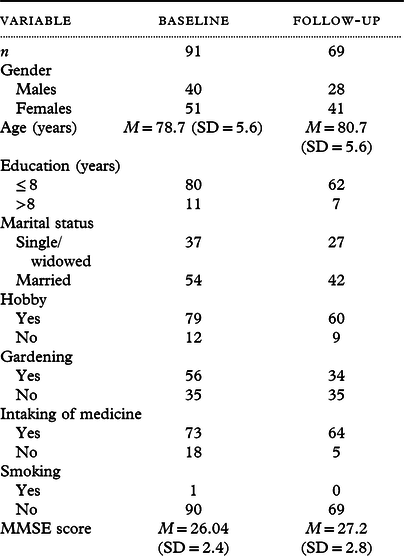
At follow-up, both gender (χ 2 = 1.33, df = 1, p = .25) and marital status (χ 2 = 3, df = 1, p = .08) were counterbalanced across the participants. Furthermore, the respondents reported a mean MMSE score above 24 (M = 27.16, SD = 2.8) suggesting the maintenance of cognitive efficiency concerning the assessment of the general cognitive efficiency of the participants. Overall, significant differences were found between the MMSE scores rated at baseline and at follow-up (t(158) = −2.7, p = .008), suggesting an improvement of the general cognitive efficiency of the sample in the latter. However, this outcome must not be misinterpreted, because the apparent improvement of the general cognitive efficiency at follow-up is an artifact, due to a score correction for age and educational attainment (see the Materials section). Table 1 summarizes the socio-demographic characteristics and MMSE scores of the participants at baseline and follow-up.
Lifestyle, socio-demographic information, and general cognitive efficiency (i.e. MMSE) scores collected from all the participants of the study at baseline (i.e. November–December 2018) and at follow-up (i.e. after 24 months)

Ethics statement
The research was conducted in accordance with the ethical standards of the institutional research committee and with the 1964 Helsinki Declaration and its later amendments. Written informed consent was given by all participants prior to participation.
Materials
Participants completed the following battery of tools:
The interview by Fastame and Penna (Reference Fastame and Penna2012) was proposed to record information about socio-demographic information (e.g. gender, age, marital status, and education) and lifestyle (e.g. smoking, time spent for gardening, or for outdoor leisure activities) of the participants.
The MMSE (Folstein et al., Reference Folstein, Folstein and McHugh1975) was administered to test the general cognitive efficiency of the respondents. Specifically, this test serves to screen several cognitive functions such as attention, short, and long-term memory. Scores were adjusted for age and years of education (Magni et al., Reference Magni, Binetti, Bianchetti, Rozzini and Trabucchi1996). The maximum score was 30.
The Psychological Well-Being and Ageing Questionnaire (PWBQ, De Beni et al., Reference De Beni, Borella, Carretti, Marigo and Nava2007) is a self-report questionnaire composed of 37 items assessing different facets of psychological well-being (e.g. coping and personal satisfaction) in over 60-year-old individuals. For each item, the participant had to assess the frequency of that situation (e.g. when I wake up, I feel happy about myself and my life) in his/her daily life on a Likert scale ranging from 1 (Never) to 4 (Always). Thus, the total score ranges from 37 to 148. According to the authors, a score ≥ 115 indicates greater level of psychological well-being.
The Center of Epidemiological Studies-Depression Scale (CES-D, Radloff, Reference Radloff1977; Italian version, Fava, Reference Fava1983) is a 20-item self-report inventory that was used to assess negative affect. For each of mental health statement, the participant was invited to assess his/her level of distress during the past week using a four-point Likert scale ranging from 0 (Rarely or Never) to 3 (Most days or Every day). The total score ranges from 0 to 60. A score ≥ 16 indicates the occurrence of significant depressive symptoms, whereas a score of 23 or higher is used as the Italian cut-off to diagnose suspected major depression.
The Cognitive Failures Questionnaire (CFQ; Broadbent et al., Reference Broadbent, Cooper, FitzGerald and Parkes1982; Italian validation, De Beni et al., Reference De Beni, Borella, Carretti, Marigo and Nava2007) is a 25-item questionnaire that was used as metacognitive measure to assess a person’s awareness of his/her cognitive and motor slips in the daily life during the past 6 months. For each item, the respondent had to rate the frequency of that situation (e.g. Do you drop things?) using a five-point Likert scale ranging from 0 (Never) to 4 (Very often). The maximum total score is 100. De Beni et al. (Reference De Beni, Borella, Carretti, Marigo and Nava2007) claimed that a score ≤ 22.25 indicates a normal performance.
Physical functions were assessed through instrumented gait analysis performed by means of a wearable inertial measurement unit, previously employed in studies involving older adults (Pau et al., Reference Pau2018). In short, a miniaturized lightweight inertial sensor was attached to the individual’s low back (approximately at S1 vertebrae location) using a semi-elastic belt, and then she/he was required to walk, at self-selected speed in the most natural manner possible, along a 20-m hallway, following a straight trajectory. During the trial the device recorded, at 100-Hz frequency, the accelerations along three orthogonal axes: antero-posterior (which corresponds to the walking direction), medio-lateral, and supero-inferior. Data were transmitted in real time via Bluetooth to a personal computer, where they were later processed using a custom MATLAB® routine to calculate the following parameters:
-
gait speed: the mean velocity of progression, expressed in m s−1;
-
stride length: the longitudinal distance between two successive ground contacts of the same foot, expressed in m;
-
cadence: the rate at which a person walks, expressed in steps min−1.
Procedure
After that written informed consent was provided by each participant, he/she was individually tested in a quiet room of his/her home. First, the MMSE was used to test the general cognitive efficiency of each respondent, if signs of cognitive impairment were absent or a few (i.e. MMSE score ranging between 23 and 20), the socio-demographic interview was presented. Thereafter, the presentation order of the remaining psychological measures was counterbalanced across the participants according to the Latin square procedure. To reduce the fatigue effect, the examiner read aloud each statement of the questionnaires and recorded the responses given by the participant. Then, the gait analysis was carried out in a successive session conducted within a one-week interval. Overall, the testing phase lasted approximately 60 minutes.
Results
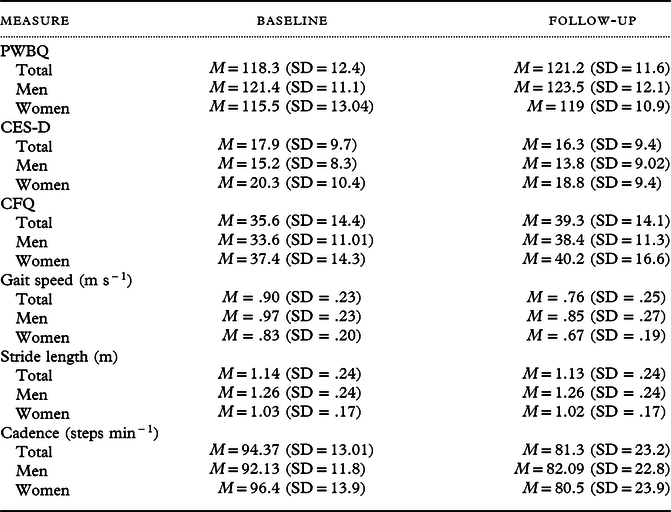
First, response distributions in each psychological and motor condition were analyzed to examine whether normality was achieved. Once it was ascertained, the means and standard deviations of each psychological and motor measure rated at baseline and follow-up were calculated. Table 2 summarizes these findings.
Psychological well-being (i.e. PWBQ), depression (i.e. CES-D), cognitive failures (i.e. CFQ), gait speed, stride length, and cadence mean indexes recorded across the participants of the study at baseline and at follow-up

Standard deviations are illustrated in parentheses.
Next, intraclass correlation coefficients (ICC), using the methods suggested by Heck et al. (Reference Heck, Thomas and Tabata2014), were computed for each psychological and motor measure to examine whether the data presented a clustered structure that could justify the use of a mixed linear model analysis approach. Once that intercept-only models with no exploratory variables were fitted (unconditional random-effects model), the ICCs were calculated for each self-reported mental health (i.e. PWBQ and CES-D, respectively), cognitive failures (i.e. CFQ), and gait parameters (i.e. gait speed, stride length, and cadence), respectively. Overall, the computation of the ICCs (i.e. PWBQ: ρ = .62; CES-D: ρ = .46; CFQ: ρ = .60; gait speed: ρ = .46; stride length: ρ = .98; and cadence: ρ = .22) suggested that there is evidence of substantial clustering and supported the decision to model the data using a multilevel modeling approach.
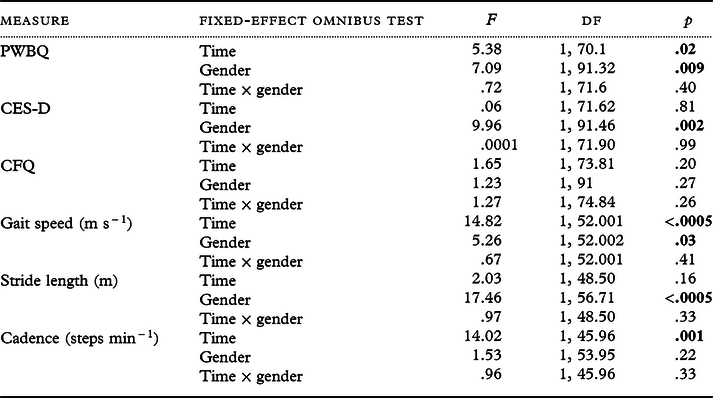
Then, a multilevel modeling approach was adopted to examine whether time (i.e. 0 = baseline versus 1 = follow-up) predicted self-reported mental health (i.e. PWBQ and CES-D, respectively), cognitive failures (i.e. CFQ), and gait parameters (i.e. gait speed, stride length, and cadence), respectively, while controlling for the effect of gender (0 = female versus 1 = male). A random intercept was included; therefore, it was assumed that intercepts for the relationships between time and each psychological or motor measure vary across people, when controlling for gender. The linear model also included random slopes, because it was hypothesized that the change in mental health scores, cognitive failures, and motor efficiency indexes over the time could vary significantly across participants too. Maximum likelihood was the method used to produce the parameter estimates. The outcomes of these analyses are summarized in Table 3.
Fixed effects of time (i.e. follow-up v. baseline), gender (i.e. males vs. females), and time × gender in the prediction of psychological well-being (i.e. PWBQ), depression (i.e. CES-D), cognitive failures (i.e. CFQ), gait speed, stride length, and cadence indexes assessed across the participants of the study

Significant effects are highlighted in bold.
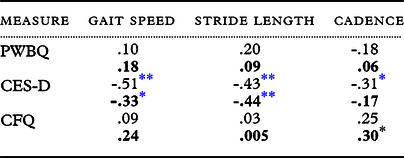
Finally, a series of Pearson product moment correlations were computed to examine the relationship between psychological well-being (i.e. PWBQ), depressive symptoms (i.e. CES-D), and cognitive failures (i.e. CFQ) scores with the gait parameters assessed at baseline and follow-up. Table 4 illustrates these findings.
Pearson product moment correlations calculated between gait speed, stride length, cadence indexes, and psychological well-being (i.e. PWBQ), depression (i.e. CES-D), and cognitive failures (i.e. CFQ) scores, respectively

Coefficients values at follow-up are shown in bold.
* p < .05.
** p < .01.
Discussion
The current study was mainly aimed at exploring whether several psychological measures of mental health, metacognitive efficiency, and motor efficiency assessed in a sample of older people living in an extraordinary area of longevity varied across a period of approximately two years.
A further goal was to examine the associations between motor and psychological indexes at baseline and after 24 months (i.e. follow-up).
Current outcomes let us point out different conclusions. First, self-reported psychological well-being of older people living in the Sardinian Blue Zone significantly improved at follow-up. Thus, extending previous studies conducted in the Sardinian Blue Zone (e.g. Fastame et al., Reference Fastame, Hitchcott, Mulas, Ruiu and Penna2018; Fastame and Penna, Reference Fastame and Penna2014), in comparison with the national cut-off indexes, our participants reported very high level of perceived psychological well-being both at baseline and follow-up. Furthermore, as expected (e.g. Borden and Berlin, Reference Borden and Berlin1990), males reported better psychological well-being and less depressive signs than the female group, that is, following previous evidence (e.g. Fastame et al., Reference Fastame, Penna and Rossetti2014b; Fastame, Penna et al., Reference Fastame, Penna and Hitchcott2015), both at baseline and follow-up, perceived depressive signs of our male participants were lower than the CES-D critical Italian cut-off measure (i.e. ≥16) indicating the occurrence of significant depressive signs. Besides, in line with Mahoney et al. (Reference Mahoney, Dalby and King1998), perceived cognitive failures remained stable across a period of approximately 2 years. Overall, following an investigation pointing out the positive effect of gardening and leisure activities on mental health of older people of the Sardinian Blue Zone (Fastame, Hitchcott et al., Reference Fastame, Hitchcott, Mulas, Ruiu and Penna2018) and consistently with a further study highlighting the high levels of physical activity (i.e. due to the slope of the territory) of the successful agers living in the Sardinian Blue Zone (Pes et al., Reference Pes2013), one can speculate that the maintenance of a very active lifestyle reported by our participants could, at least partially, justifies their high level of psychological well-being and the occurrence of few depressive symptoms. Indeed, during the socio-demographic interview the respondents reported that if they were not involved with family meetings, they were mainly engaged in individually oriented and unstructured (i.e. not planned and organized by an organization promoting educational programs in aging) daily leisure activities (e.g. needle works, handcrafting, and crosswords) and gardening. Moreover, it must be bore in mind that this study was conducted in a socio-cultural context characterized by an intense social connectivity (Heatherington, Reference Heatherington1999) and where older individuals are considered an important social resource for their community (Fastame et al., Reference Fastame, Penna, Rossetti and Agus2013). Additionally, it must be noticed that the low occurrence of self-reported depressive symptoms cannot be justified by the assumption of antidepressants, since none of our participants declared to use them. Indeed, during the socio-demographic interview we could record only the intake of medications for age-related (e.g. hypercholesterolemia, hypertension, and diabetes) pathologies and in some cases for the occurrence of some carcinogenic (i.e. prostate-related) ones. Besides, when preliminarily, we analyzed the results relative to the emotional well-being subscale of the PWBQ questionnaire (De Beni et al., Reference De Beni, Borella, Carretti, Marigo and Nava2007), we found that our participants did not report any difficulty to identify, express, and share their emotional status with the others and rather their scores indicated a very good/excellent emotional competence (i.e. mean score in the emotional well-being subscale ≥ 33 at baseline and follow-up). Therefore, since in community-based older individuals less depression and greater well-being have been found to be associated with low alexithymia (Henry et al., Reference Henry, Phillips, Maylor, Hosie, Milne and Meyer2006; Ziadni et al., Reference Ziadni, Jasinski, Labouvie-Vief and Lumley2017), it seems unlikely that the high mental health scores being self-reported by our participants can be related to the occurrence of some forms, even mild, of alexithymia. In contrast, in line with Charles and Carstensen (Reference Charles and Carstensen2008), one might argue that agers of the Sardinian Blue Zone are less affected by negative emotions and exhibit preserved emotional regulation mechanisms which, in turn, positively impact their perceived mental health. This is also consistent with a line of research highlighting the link between physically and socially oriented leisure activities and emotion regulation and well-being (Dupuis and Alzheimer, Reference Dupuis and Alzheimer2008). Nonetheless, as suggested by previous studies conducted in the Sardinian rural areas (e.g. Fastame & Penna, Reference Fastame and Penna2012; Fastame et al., Reference Fastame, Hitchcott and Penna2015), we cannot exclude that the respondents attempted to present themselves happier and less depressed to impress the interviewer and to preserve their social image, since the effect of social desirability was not controlled for. Thus, at present, it cannot be excluded that a marginal but significant percentage of variance related to the self-reported mental health measures was impacted by the socially desirable responding style of the participants.
Relatively to the gait patterns, our findings substantially confirm the large existing body of literature which reports a generalized decrease in most spatio-temporal parameters with increasing age. In particular, we observed, consistently with previous studies, a significant decrease in speed (Aboutorabi et al., Reference Aboutorabi, Arazpour, Bahramizadeh, Hutchins and Fadayevatan2016; Ferrucci et al., Reference Ferrucci, Cooper, Shardell, Simonsick, Schrack and Kuh2016; Ko et al., Reference Ko, Hausdorff and Ferrucci2010, Reference Ko, Tolea, Hausdorff and Ferrucci2011) of similar magnitude in men and women. Walking speed is the product of the stride length and cadence (Prince et al., Reference Prince, Corriveau, Hébert and Winter1997), and it has been suggested that reductions of speed with aging are usually resulting from a concurrent reduction in stride length and cadence (Aboutorabi et al., Reference Aboutorabi, Arazpour, Bahramizadeh, Hutchins and Fadayevatan2016; Frimenko et al., Reference Frimenko, Goodyear and Bruening2015; Prince et al., Reference Prince, Corriveau, Hébert and Winter1997) even though few studies failed to detect statistically significant changes of stride length in older individuals with respect to younger ones (Blanke and Hageman, Reference Blanke and Hageman1989; Silder et al., Reference Silder, Heiderscheit and Thelen2008). However, as in our case, stride length remained practically constant from baseline to follow-up, speed changes are likely due mainly to lower cadence at the follow-up. Speed reduction in elderly is considered as adaptation to increased risk of falls (Espy et al., Reference Espy, Yang, Bhatt and Pai2010) due to deterioration of sensory, vestibular, and proprioceptive inputs (Iosa et al., Reference Iosa, Fusco, Morone and Paolucci2014; Rantakokko et al., Reference Rantakokko, Mänty and Rantanen2013), while shorter stride lengths are mainly originated by weakness of the ankle plantaflexors muscles (JudgeRoy et al., Reference JudgeRoy, Davis and Õunpuu1996). Given that the individuals tested in the present study belong to a rural community and are often engaged in sustained physical activity related both to higher terrain slope and to gardening and animal husbandry (Pes et al., Reference Pes2013), it is reasonable to hypothesize that even in the presence of adequate muscular strength, they unconsciously accommodate their gait to lower speed mainly reducing cadence, as a protective measure against the risk of instability and fall. It is also noticeable that the significant differences found between men and women (i.e. men walk faster and with longer strides) are fully consistent with previous studies (see the review of Frimenko et al., Reference Frimenko, Goodyear and Bruening2015 for details) and mainly attributable to anthropometric features, rather than actual gender effects.
Additionally, extending previous research (e.g. Boyle et al., Reference Boyle, Buchman and Bennett2010; Gale et al., Reference Gale, Cooper, Deary and Sayer2014; Hybels et al., Reference Hybels, Pieper and Blazer2009; Kendig et al., Reference Kendig, Browning, Thomas and Wells2014), higher depressive symptoms were associated with worse motor performance (e.g. lower speed during the walk). Moreover, as expected (Allahyari et al., Reference Allahyari, Saraji, Adi, Hosseini, Iravani, Younesian and Kass2008) at follow-up participants reporting more cognitive and motor mistakes also reported more signs of motor decline, whereas no significant associations were found at baseline. This could suggest that after the eight decade, significant changes in motor functioning are associated with a greater awareness about one’s own cognitive and motor slips.
Altogether, from an applied viewpoint, current outcomes suggest that the implementation of specific interventions promoting the maintenance of an active lifestyle in late adulthood is crucial to boost mental health and motor efficiency in the third and fourth ages.
However, some limitations of this study need to be pointed out. First, to our knowledge, this is the first follow-up study conducted to examine the impact of age-related factors on motor and psychological efficiency measures of community-dwelling and cognitively intact older people living in an area of exceptional longevity characterized by an agro-pastoral lifestyle. Therefore, these outcomes cannot be generalized to longevous people living in further Blue Zones or elders residing in urban areas or to older individuals living in nursing homes. Furthermore, the sample size, the paucity of tools administered to study mental health, and physical functions suggest caution in generalizing these findings. Also, we did not perform any specific analysis on our sample to detect the existence of frailty, and thus such condition is not included in the analysis. However, it should be noted that the participants were preliminarily tested for handgrip strength (which is considered a reliable marker of frailty, Syddall et al., Reference Syddall, Cooper, Martin, Briggs and Aihie Sayer2003) and in all of them the obtained values were aligned with those considered normal for their age range (Lauretani et al., Reference Lauretani2003). Thus, it is likely that frailty was not a relevant factor for the results here presented. Finally, future research is needed to test longitudinally the impact of social desirability and alexithymia on the self-assessment of mental health in successful agers.
Nonetheless these limitations, this is the first study examining longitudinally the association of motor functioning and perceived mental health in a sample of community-based older individuals living in an area of exceptional longevity like the Sardinian Blue Zone. In conclusion, current investigation adds to the literature, primarily pointing out that over a period of approximately 2 years, agers living in an area of exceptional longevity and optimal aging maintain high levels of mental and functional health being associated with an active lifestyle characterized mainly by a regular engagement in leisure activities.
Conflict of interest
The authors have declared that no conflict of interest exists.
Statement of authorship
I. M. recruited the participants, collected the data and was responsible for the scoring and the preparation of the input databases. M. C. F. and M. P. conceived the study, M. C. F. and M. P. were in charge of overall direction and planning. M. C. F. took the lead in conducting the data analyses. M. C. F. and M. P. wrote the manuscript and revised it. All authors discussed the results, commented on the manuscript and approved the final version of it.
Supplementary material
To view supplementary material for this article, please visit https://doi.org/10.1017/S1041610220001659