How do campaign finance regulations influence party competition? Although this question has received fairly substantial attention in the American context, it has largely been ignored in comparative studies of electoral dynamics. An increasingly lengthy roster of comparative scholars of elections has called for more rigorous examinations of the role that campaign finance laws play in determining the extent and degree of party competition.Footnote 1 Samuels, for example, notes the ‘enormous potential policy and normative implications’ of studying party financing cross-nationally,Footnote 2 while Hooghe, Maddens and Noppe argue that party financing may well be an ‘intervening and increasingly important variable’ in cross-national studies that link electoral institutions to the effective number of parties.Footnote 3 A recent summary of the literature on campaign finance similarly notes that while the dearth of cross-national data that plagued an earlier generation of campaign finance scholars has begun to be filled,Footnote 4 our theoretical understanding of the relationship between party finance and party competition still lags seriously behind.Footnote 5
Addressing this question is all the more important given the increasing amount of attention that party funding rules are receiving cross-nationally in policy debates about electoral fairness, leveling the playing field for political competitors and even corruption. Campaign finance regulation – and its effects on party competition – have frequently been at the center of political discussions in Canada, France, Spain and the United Kingdom (to name just a few examples from advanced democracies) and in many newly democratized countries as well. The current legal and political debates in the United States further illustrate the dire need for an answer to this question. There has been an increasing outcry from politicians, pundits and voters about the adverse effects of certain types of campaign finance laws on the quality of representation. The scholastic literature on this point would seem to support their indignation, as less restrictive campaign finance regulations have been linked to decreased voter turnoutFootnote 6 and adverse perceptions of political efficacy.Footnote 7
In this article, we set aside these normative concerns and focus on studying the empirical relationship between campaign finance and electoral outcomes. We argue that the variation in campaign finance laws around the world affects party competition on a much more fundamental level. Specifically, we argue that various campaign finance laws can combine to exert a strong influence on the nature of the party system – more specifically, the number of parties competing in a system and their relative sizes. We take as our point of departure the long-established argument in the study of campaign finance that larger parties disproportionately benefit from laws that, for example, establish higher ceilings on campaign donations or allocate free campaign media time based on previous electoral performance or a party's current seat share in the legislature. Such laws can combine to make money not only more vital to winning an election, but also to make the accumulation of vast campaign war chests considerably easier for larger and better established parties.Footnote 8
This article focuses on four types of regulations: (1) limits to individual donors’ contributions to political parties, (2) limits to the amount that parties can spend in a given electoral cycle, (3) the criteria for allocating free campaign media time, where applicable and (4) the criteria for allocating direct public funding to political parties, where applicable. Just as institutional variables such as district magnitude and seat allocation formulas create variously permissive or restrictive environments in which parties compete for legislative seats, we argue that, even controlling for such well-established institutional effects, campaign finance laws will similarly exert their own permissive or restrictive influence. Likewise, just as the presence of ethnolinguistic or regional cleavages can result in a more or less complex policy space in which parties can assume distinct party platforms, we argue that the presence or absence of certain campaign finance regulations will make it impossible for newer or smaller parties to differentiate themselves from one another in the eyes of the voters. Indeed, in the absence of the necessary funding to circulate the particulars of one's policy platform, what good is staking out an ideological position in the first place?
We define a concept called fund parity that indicates the extent to which smaller or larger parties can be expected to have relatively similar access to campaign resources. Where fund parity is high, larger parties face limits on the maximum amount of money they can raise and spend. Additionally, the allocation of free media time and direct public subsidization of parties are predicated less on previous levels of performance and more simply on participation (at whatever level) in the current election. These factors combine to downplay the advantages that larger parties have over smaller or newer parties in terms of their infrastructure and notoriety. We argue that increasing fund parity inherently levels the electoral playing field by allowing parties without large resource endowments to compete on a more equal footing with those that do. As we will demonstrate in the course of this article, we find that fund parity has a marked and substantial impact on the effective number of parties (ENP) even when we control for the standard battery of covariates (such as district magnitude, ethnolinguistic fractionalization, federalism, etc.) that studies of electoral politics typically rely upon.
None of this should be understood, however, as our advancing a normative argument in support of greater fund parity between smaller and larger parties. As a long line of comparative scholarship in electoral politics has demonstrated, increasing the size of the party system comes with its fair share of both pros and cons. While having more parties represented in the legislature serves to better represent voters’ preferencesFootnote 9 and allows for the formation of governments with ideological positions closer to the median voter,Footnote 10 larger party systems can also result in the low prospective identifiability of potential government members,Footnote 11 increased public deficitsFootnote 12 and stagnation in the policy-making process.Footnote 13 So just as previous scholars have established that increasing a district's magnitude will increase proportionality (and thereby increase the level of ‘parity’ in the translation of votes into seats between smaller and larger parties), we demonstrate that certain constellations of campaign finance laws will also affect the level of ‘parity’ in funding between smaller and larger parties. The implication in either case is an enlarged party system, which comes with its own battery of (normatively) desirable and undesirable traits.
The article proceeds as follows. We first develop in greater detail the theory that underlies our hypothesized relationship between fund parity and the size of the party system. We next test this proposition on a diverse set of the world's democracies in a cross-national regression analysis. We find evident and substantial support for the idea that as fund parity between smaller and larger parties increases, the size of the party system will increase markedly. We are conscious of potential endogeneity criticisms of this approach. After all, it may well be the case that countries with more (effective) parties also adopt higher levels of fund parity, rather than the other way around. We address this potential endogeneity problem in three ways. First, we repeat the regression analysis only on recently democratized countries. We argue that these countries faced greater international pressures from democracy-promoting organizations and – regardless of the nature of party competition at the time of democratization – would have faced a constrained choice set in their selection of campaign finance laws. This constraint on party strategies leaves our positive relationship between fund parity and size of the party systems intact, thereby suggesting that it is the funding rules that affect the number of parties rather than vice versa. Secondly, where possible, we demonstrate that the size of the party system in the previous election has no bearing on the level of fund parity in the current election. Thirdly, as we have two periods of measurement for many countries,Footnote 14 we explore cases in which the level of fund parity changed between measurement years. We demonstrate that the size of the party system in place during this interval is an abysmal predictor of the direction of the change (whether toward more or less parity). At several points in the article, we illustrate our hypothesized relationship substantively with country-specific examples, and we conclude with a prolonged focus on recent changes in fund parity in Canadian elections.
Campaign Finance and Party Competition
The extant theoretical work on the determinants of the size of the party system as indicated by the effective number of parties can best be framed as a discussion of a country's institutional, sociological and legal attributes that structure an environment of political competition. In particular, scholars have demonstrated time and again that these competitive contexts can either be permissive – indicating that many (particularly smaller) parties have a legitimate probability of winning a seat in the legislature – or restrictive – indicating that few (particularly larger) parties have a legitimate probability of winning. Permissive electoral contexts include situations in which districts are of a larger magnitude,Footnote 15 electoral thresholds are lower,Footnote 16 seat allocation formulas advantage smaller parties,Footnote 17 numerous ethnic or regional political cleavages allow many parties to adopt differentiable policy positions,Footnote 18 or the costs of registering a new party for the ballot are low.Footnote 19 By contrast, the opposite constellation of institutional, social and legal factors creates an electoral context that is restrictive: lower district magnitudes, higher thresholds, fewer salient political divisions in a society and higher costs (such as requiring more signatures) of standing on a ballot.
But the organizational and financial characteristics of party systems should similarly exert such restrictive or permissive influences. This idea was central to earlier studies of the development of cartel parties, especially as they began to co-opt state institutions for the purpose of subsidizing their electoral campaigns.Footnote 20 The argument was simple: allowing larger, electorally successful parties to draw directly from state coffers to support their campaign activities increases the gulf between these parties and newer and smaller parties. In short, the cartelization of political competition was argued to exert downward pressure on the effective number of parties by increasing the disparity in available resources between older and newer parties.Footnote 21 As Scarrow has argued, however, and as various cross-country and single-country studies have illustrated, this theoretical relationship between state subsidization of political campaigns and lower effective number of parties does not bear out empirically.Footnote 22 In some cases, direct public funding of political parties might even increase the number of parties entering electoral competition, as Casas-Zamora illustrates.Footnote 23
We argue that this divergence in findings might best be explained by insufficient attention paid to the nuances of direct public funding and other attributes of campaign finance regimes. The eligibility criteria for state subsidization of political parties, for example, differ from country to country, as do the eligibility requirements for other campaign perks such as free advertising time on major media outlets. Important factors such as whether or not there are limits on the amount that donors can give to parties – and the amount that parties can spend in a given election cycle – should also shape the competitiveness of the campaign environment. We outline two hypothetical examples to help shape our theoretical discussion about how these various legal provisions combine to structure the nature of party competition.
First, consider a country that has no limits on donations to political parties and no limits on the amount of money parties can spend during an election. Let us also say that the state offers free media time and direct public subsidization to parties (as is often the case) and that the criteria for allocating this time is a given party's performance in the last election. In this scenario, money and success are likely to go hand in hand. As a party's financial endowments increase toward infinity, it is able to win an election with near certainty. Indeed, the name of the game in this situation is gathering more funds than the opponents, because these funds can be used to crowd out any of the opponents’ messages. This situation is especially detrimental to the efforts of smaller and newer parties without equal funds or access to wealthy donors or external organizations (for example, unions) to sponsor their campaigns. Such donors, rather than spreading their wealth widely, are likely to channel their financial contributions to parties with governing potential. The same is true for organizational ties, which are likely to be exclusive to only certain parties. In an environment with no limits on spending, parties’ pre-existing organizational ties, higher profiles and notoriety will bring them disparate advantages over their smaller and newer competitors. Without an equally large pulpit from which to broadcast their messages, smaller and newer parties are left without good alternatives to reach voters as effectively, and therefore may decide not to compete at all (or resign themselves to the fact that they simply will not gain many votes if they do). The end result – for better or worse – is a system dominated by a few large parties.
Now consider the opposite scenario: an electoral environment in which donors are rather limited in what they can give to parties, the parties are severely circumscribed in the amount they can spend campaigning, and free media access and direct public subsidization are distributed equitably to all parties that field candidates or party lists in the election (regardless of their size or past electoral performance). Given that every party must now speak through a same-sized megaphone, competition is characterized less by the volume of the message. While governing parties may enjoy higher profiles and notoriety, no party can claim a material advantage. With a lower limit on the overall amount that can be spent on campaigning, parties very quickly expend their resources. Voters now receive roughly the same volume of cues from all parties, regardless of past performance or resource endowment, and the size of the choice set for these voters expands. Whereas before smaller and newer parties would have been unable to reach the masses, now their policy platforms at least receive a fair vetting in the competition. As noted by Jacobson, a prominent scholar of campaign spending in the American context, if all parties ‘spend beyond the point needed to become thoroughly familiar with voters, then the substance of the campaigns, the contents of campaign messages, become the dominant factors’.Footnote 24 In this case, if smaller parties lose the election, it is for reasons other than simply having insufficient assets. This is likely to encourage more parties to remain in competition and more new parties to enter, thus driving up the size of the party system.
Table 1 summarizes the four attributes mentioned above and their expected contribution to more-or-less permissive environments of party competition. The first two attributes – limits on donations and spending – can be understood as ‘power-curbing’ provisions that tie the hands of larger parties and their influential donors. The latter two attributes – equitable allocations of media time and public subsidies for all parties contesting the election – can be understood as ‘playing-field leveling’ provisions that spread state resources more evenly across all parties rather than just a few. As each variable assumes a more ‘permissive’ value, we argue that the overall permissiveness of party competition increases. By itself, an equitable distribution of free media time across all parties will certainly create more incentives for more parties to enter electoral competition. But combining this provision with another permissive decision (such as severely limiting the amount of money a party can spend on campaigning) should create even greater inducements for additional parties to contest the election.
Campaign Finance Provisions and the Permissiveness of Party Competition

In general, then, while we hypothesize that each individual legal provision should by itself be positively associated with greater levels of party competition, we go one step further to argue that these four attributes work together to tap into a more interesting latent concept.Footnote 25 Indeed, the two motivating examples discussed above anchor the extreme ends of such a latent concept, which we will refer to as fund parity. We define fund parity as an additive metric of: (1) limits on the amount of money donors can contribute to parties, (2) limits on party expenditure, (3) equitable allocation of free media time and (4) equitable allocation of direct public funding. As more of these criteria are fulfilled, the level of fund parity between parties increases. That is to say, in the presence of more of these attributes, the electoral environment is increasingly characterized by a more-or-less financially equitable playing field. Where fund parity is high, we should see more fractionalized party systems with a higher effective number of parties than where fund parity is low. This is because more parties can cross the (comparatively lower) financial barriers to successful entry and because voters can more readily pick out these newer and smaller parties’ campaign messages in an environment where all parties are speaking through same-sized megaphones. This should be the case even if we control for the various institutional and sociological explanations typically advanced by scholars of electoral politics.
This idea builds on the work of Heidenheimer, but has never been studied cross-nationally.Footnote 26 His supposition then – as ours is now – is that sociological and institutional variables by themselves cannot explain the full extent of variation we see in party systems around the world. He highlighted the potential relevance of a metric of campaign expense (an ‘index of expenditure’) that would be comparable across countries. For the observations in the dataset that we employ in this article, this is certainly the case. Across our national-level observations in single-member districts, for example, the effective number of parties ranges from 1.9 to 7.6 with a mean of 3.3. The distribution of values across our multi-member districts is disturbingly similar: a minimum at 1.7 and a maximum at 9.3 with a mean of 4.5. If we similarly subset the data into federalized or unitary countries, presidential or parliamentary systems, or highly sociologically fragmented and barely fragmented, we see a similarly disappointing lack of trends in the data. By contrast, we can demonstrate that fund parity explains some of the variation in ENP across countries.
A reasonable challenge to our theory of fund parity emerges from the American literature on campaign spending, which argues that campaign spending by incumbent politicians is generally ineffective, while spending by challenger candidates can, in some cases, improve the challenger's vote share.Footnote 27 Although extending this logic to multiparty democracies is tenuous, parallels can be drawn between ‘incumbent’ candidates in America and ‘larger’ parties in other countries as well as between ‘challenger’ candidates in America and ‘smaller’ parties elsewhere. If Jacobson's empirical findings are correct, they pose a problem for our argument: when increased spending benefits smaller parties (but not larger, perhaps incumbent, parties), then increasing fund parity will hurt smaller parties. Increasing fund parity, in this respect, would decrease ENP, contrary to our hypothesis.
However we argue against the applicability of this logic in our cross-national test for two reasons. First, Jacobson's empirical findings in the American case are rather controversial and have been countered by a number of subsequent studies.Footnote 28 Green and Krasno, for example, argue that the marginal effect of incumbent spending is roughly similar to the effect of challenger spending, and Abramowitz and Green and Krasno (in a subsequent study) find that – at least under certain circumstances – incumbent spending matters for electoral outcomes, even if the impact of challenger spending might be more substantial.Footnote 29 In a more recent study, Gerber finds additional evidence that the marginal effects of spending by incumbents and challengers are roughly equal, leading him to conclude that ‘equalizing spending levels may significantly increase incumbent defeat rates, and caps on candidate spending may improve the chances of challengers’.Footnote 30 Scarrow summarized the state of the American literature on this point, arguing that ‘mounting evidence suggested that candidates would be foolish to abstain from spending as much as they could raise’.Footnote 31
Thus despite some evidence to the contrary, the empirical findings of the American literature on balance supports our idea that reducing the spending advantages of larger parties would substantially increase the electoral prospects of smaller parties and, therefore, drive up ENP. This logic squares well with findings from studies of Canada and the United Kingdom – which have similar electoral rules to the United States – that both incumbent and challenger spending matter for electoral outcomes.Footnote 32
Secondly, we have a more theoretical objection to applying the findings of the American literature too literally in cross-national research: the conceptual labels of ‘incumbent’ politician and ‘challenger’ candidate are only tenuously analogous to ‘larger’ and ‘smaller’ parties, respectively, in multiparty systems, especially those in which party lists are used and more than one candidate appears on a single party's list. In this case, a party will usually have ‘incumbent’ politicians and ‘challenger’ candidates running side by side in the same district. Where this happens, even larger, more well-known parties can gain an electoral advantage by spending large amounts of money to acquaint voters with lesser-known candidates who are ranked further down the list. Indeed, in single-country studies of spending effects in multiparty systems such as Japan, Brazil, Ireland and Belgium, scholars have repeatedly found a strong positive correlation between spending levels and electoral success.Footnote 33
Data and Analyses
We measure our outcome variable – the effective number of parties in votes – using the standard formula developed by Laakso and Taagepera and, subsequently, by Taagepera and ShugartFootnote 34 with data provided by Gallagher and Mitchell.Footnote 35 Where possible, we supplemented their figures with raw data reported in the online databases of Adam Carr and the European Elections Database. As noted above, there is substantial variation in this variable across our observations in general and, in particular, within theoretically relevant subsets, such as within countries that have a single-member district electoral rule.
In order to measure our main explanatory variable – fund parity – we begin with the Funding of Political Parties and Election Campaigns installment of the International Institute for Democracy and Electoral Assistance (International IDEA) handbook series.Footnote 36 This project constitutes an unprecedentedly large and thorough survey of experts, electoral commissions and written laws pertaining to campaign finance regulations in scores of countries around the world. The first iteration of the data collection was completed and released in 2003, and the database was recently updated with another installment in 2012, giving us two points of measurement for many countries. We are particularly interested in a series of questions pertaining to the nature of campaign finance in each country: (1) whether there is a limit on the amount of money an individual can donate to a political party, (2) whether there is a limit on the amount of money a political party can expend in contesting an election, (3) whether parties are entitled to free media access and (4) whether parties are entitled to direct public subsidization.Footnote 37
In an effort to construct a measure of the internal consistency of these four attributes (thereby ensuring that we are correctly combining the variables into a useful single metric), we turned to the field of psychometric testing, which has pioneered several measures of internal reliability. One such metric for assessing questions that have continuous values as answers is the widely utilized Crombach's α Footnote 38 and, in the specific case of variables with dichotomous outcomes, its derivative – the Kuder-Richardson Formula 20, or KR20.Footnote 39 These measures of internal consistency have been recently applied in various subfields of political scienceFootnote 40 and can be calculated in general form by:
 $$ { {\rm{KR20}}\, &= \frac{K}{{K\,{\rm{ - }}\,1}}\left( {1\,{\rm{ - }}\,\frac{{\sum _{{i\, = \,1}}^{K} {{p}_i}{{q}_i}}}{{\sigma _{X}^{2} }}} \right) \cr {\rm{\sigma }}_{X}^{{\rm{2}}} \, & = \frac{{\sum _{{i\, = \,1}}^{N} {{{({{X}_i}\,{\rm{ - }}\,\bar{X})}}^2} }}{N} \cr} $$
where K is the length of the ‘test’ (K = 4 questions), N is the number of ‘test takers’ (countries), pi
is the proportion of ‘yes’ responses to our four questions, qi
is the proportion of ‘no’ responses and
 $$$ {\rm{\sigma }}_{X}^{{\rm{2}}} $$$
is the variance across specific question responses Xi
. In this way, KR20 gives us an estimate of the internal consistency of a battery of questions that is bounded by 0 and 1. Studies of political science have typically relied on consistency values between 0.6 and 0.8.Footnote
41
Across our countries and for these four particular questions, the internal consistency of our fund parity metric is 0.64, indicating statistically that all four items are similarly tapping into an underlying latent concept.Footnote
42
As argued above, however, there are important differences across countries in how free media access and direct public funding are allocated – either based on a party's past performance (previous vote share or presence in the legislature) or equitably across all participants in an election. Supplementary questions in the International IDEA survey shed light on whether allocations are based on performance or a norm of equity. From these questions, we construct a metric of fund parity that takes the values in the set {−2, −1, 0, 1, 2, 3, 4} depending on each country's responses. The metric is coded as follows:
-
• Limits on donation amount (1) or no limits (0)
-
• Limits on party expenditures (1) or no limits (0)
-
• Media access allocated based on previous performance (−1), allocated equally (1) or no free media access (0)
-
• Direct public funding allocated based on previous performance (−1), allocated equally (1) or no direct public funding (0)
Our hypothesis is that as the values of this additive metric increase, the effective number of parties at the national level should increase as well. In our dataset, we observe values across the full range of fund parity scores with the interquartile ranging from 0 to 1 (mean = 0.29).Footnote 43
We control for the standard battery of variables employed in a study of this nature. The number of democratic years a country has experienced is included as the age of democracy, which has been demonstrated to have a reductive effect on ENP, due to voters’ increasing familiarity with the strategic incentives generated by electoral institutions.Footnote 44 Our measure of democratic age comes from the dataset constructed by Golder.Footnote 45 We control for whether or not a country is federal (which has been argued to exert a positive influence on the number of parties)Footnote 46 as well as for whether or not a country is presidential (which has been argued to negatively influence the effective number of parties, as parties coalesce or ‘link’ across districts in an effort to win national office).Footnote 47
We follow many previous scholars and use as our measure of national-level district magnitude the weighted average figure presented in the Database of Political Institutions.Footnote 48 This measure of average district magnitude is weighted by district size, which conveniently provides an approximately correct summary statistic in the event that a country employs a mixed-member electoral system. This variable enters our model in logged form to account for its non-normal distribution across our cases. Following Clark and Golder, we interact district magnitude with a national-level measure of ethnolinguistic fractionalization as reported by Fearon.Footnote 49 Larger values of both district magnitude and ethnolinguistic fractionalization are expected to positively impact ENP, and the logic behind including their interaction has been discussed at length by Amorim, Neto and Cox as well as Singer and Stephenson.Footnote 50
The results of our first regression model can be seen in Table 2. The number of observations for which we have complete data comes to 93. However, regression diagnostics clearly indicate that three of these observations were extreme statistical outliers. To account for this, we (a) deleted these observations before re-estimating the same model and also (b) left these observations intact and estimated a robust regression model. The size of the coefficients and their standard errors were only slightly different across these two modeling strategies, and the statistical significance of fund parity was unaffected.Footnote 51 The first column in Table 2 reports the results for the first approach.
OLS Model Estimating the Effect of Fund Parity on ENP

Note: the first model includes all observations for which we have complete data. The second model includes observations only for those countries that democratized in 1974 and later. *p ≤ 0.1, **p ≤ 0.05, ***p ≤ 0.01.
The results demonstrate that fund parity exerts a strong and statistically significant influence on ENP. In fact, fund parity returns the strongest statistically significant coefficient in the first model. Furthermore, this coefficient is substantively sized. We used Clarify to simulate 1,000 draws of the model's parameters and calculated the expected value of ENP at different levels of fund parity.Footnote 52 Holding the values of the other variables at their means, moving from the lowest to highest observed value of fund parity is predicted to increase ENP by more than 2.6 parties. Restricting ourselves to increases across the interquartile range of fund parity values, we still observe an increase of about half a party.Footnote 53 This effect is anything but trivial given that, at the national level, the addition of even 0.5 effective parties can make a substantial difference in not only who gets represented, but also in the balance of power in parliament and, consequently, in the process of policy making as well as government formation and duration.Footnote 54
Specific examples may help further illustrate the significance of our finding. Consider the case of Switzerland, a country with rather large district magnitudes (generally ranging from 7.9 to nearly 9.0, on average). The national-level ENP is persistently far below the M+1 ceiling of electoral institutional scholars.Footnote 55 During the seventeen elections that have taken place since 1945, Switzerland's ENP has never risen above 7.4 and has, on average, fallen well below the Duvergerian M+1 ceiling by more than three parties. This is especially surprising, given the marked ethnolinguistic fractionalization in this country. As scholars of electoral politics have long argued, M+1 provides an upper bound to the ENP that should only be reached when there is a sufficiently large number of cleavages in society to allow M+1 parties to assume as many differentiable platforms as possible.Footnote 56 Switzerland seems to be a prime candidate to hit the M+1 upper bound, given its high level of heterogeneity, yet this is not the case.
Switzerland's extremely low fund parity may account for this striking deviation from institutional predictions. It is one of the very few countries in Europe that election monitors have claimed provides ‘no federal regulation on party or campaign financing’.Footnote 57 Indeed, political parties in Switzerland can receive unlimited campaign contributions and there are no spending caps.Footnote 58 However access to media is currently regulated, in that parties with current representation in the parliament are entitled to free media access.Footnote 59 Therefore fund parity, as defined here, is virtually non-existent. In light of our argument, the discrepancy between the actual ENP and the one predicted by institutional theory is no longer surprising. Furthermore, taking a longitudinal view reveals that Switzerland has experienced a decrease in fund parity over time: the provisions about allocating free media time only to parliamentary parties and banning campaigning in electronic media (other than through this free allocation of time) were instated before the 1999 elections.Footnote 60 In accord with our theory, the average ENP dropped from 6.76 in the pre-1999 period to 5.82 in the post-reform period. A simple t-test indicates that this reduction of 0.94 parties is statistically discernible from 0 at the 95 per cent significance level. That is, the further reduction of already low fund parity since the late 1990s was followed by a systematic decrease of nearly one effective party each election.
However a number of countries have surprisingly high levels of ENP (given their average district magnitudes). Above-average levels of fund parity can again help us explain this seeming failure of the institutional explanation's ability to predict. These countries range across all of the main families of electoral rules, including single-member districts (Liberia and Zambia), proportional representation (Peru, Hungary and Greece) and mixed-member systems (Lithuania, Italy and Bolivia). A number of these countries (such as Hungary, Italy, Lithuania and Greece) also have comparatively low levels of ethnolinguistic fractionalization, making their large ENP figures especially surprising if we fail to take into account the fact that each country employs an above-average level of fund parity. Even in the case of highly fragmented countries such as Liberia and Zambia, the M+1 rule in the presence of high ethnolinguistic fractionalization would predict an ENP of around 2. In 2011, however, each of these countries had a much higher ENP: 13.0 in Liberia and 3.5 in Zambia.Footnote 61
Assessing Potential Endogeneity
There is a legitimate endogeneity objection to the results presented in the first model. It might be the case that the ENP drives the choice of campaign finance laws, rather than the other way around. After all, one might expect parties to be strategic about the kind of funding rules and regulations they adopt, making sure that they benefit from these rules. Countries with fewer parties might therefore adopt rules to restrict fund parity in order to secure their current electoral advantage, while countries with more parties may be more supportive of increased parity, from which more parties could benefit. We find the potential for reverse causation here compelling, and undertake a number of tests below to determine whether there is indeed a clear causal direction that would support our hypothesized relationship.Footnote 62
One way to verify the direction of this relationship is to focus the analysis on comparatively newer (post-1974) democracies. Our argument in doing so is twofold. First, the so-called third wave democracies adopted their campaign finance rules at the time of democratization or soon thereafter – when party systems were non-existent or very weak and fluid.Footnote 63 One can therefore argue that, at least in some cases, funding regulations were in place before the party systems. Secondly, these newer democracies, even those with stable party systems, faced mounting pressure from the international community to adopt ‘normatively desirable’ institutions. Scholars such as van Biezen and Kopecký, for example, argue that adopting party finance regulation ‘is a standard requirement of many international organizations and institutions that support democratization’.Footnote 64 We argue that, in this subset of cases, individual countries would have had much less agency in selecting their own campaign finance laws. Since in these new democracies the rules were more likely to have been exogenously introduced, confirming the original result would more strongly suggest that the direction of causality runs from fund parity to ENP. The results for this post-1974 subsample are presented in the last column of Table 2. They confirm that our fund parity variable has a similarly sized, positive and statistically significant impact on ENP in these countries as well.
We think this is an appropriate test of endogeneity, because it seems to be the case that the initial choice of fund parity levels was increasingly decided exogenously in countries that democratized later in the twentieth century. A possible objection to this argument is that – even if the rules were exogenously imposed – at the same time that the levels of fund parity were being set at a higher level for these new democracies, the instability of these newer party systems resulted in a higher ENP, as voters had yet to grow accustomed to democratic electoral institutions. Put differently, a positive correlation could exist between fund parity and ENP, but the reasoning behind the correlation would be different from that articulated by our theory. If our measurements of fund parity were taken during this time period (around 1974), then this would certainly be a potential problem. However, our measurements took place in 2003 and 2012. We think this allows sufficient time between the adoption of democratic rules (the mean year of democratization in the 1974-and-later subset is 1988) and the measurement of fund parity levels to argue that any ‘artificial’ inflation in ENP resulting from poor voter coordination would have sufficiently declined before the study periods.
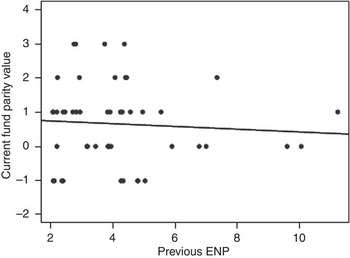
A second attempt at allaying concerns about endogeneity might be to consider the ENP that were previously in place in the lead-up to the years for which we have measurements for fund parity. This might constitute a proxy (however rough) for the type of party system that structured the current set of campaign finance rules. If we see a clear relationship (presumably positive) between the previous ENP and the current fund parity score, then this might be cause for concern about a potentially endogenous relationship. Figure 1 plots these two variables against one another and includes the bivariate regression line that estimates their relationship. As demonstrated by the nondescript scattering of points across the plot and the effectively flat regression line, there appears to be no relationship between the ENP in the previous election and the current level of fund parity that governs the current election.
Plot of ‘current’ level of fund parity against ‘previous’ effective number of parties Note: ordinary least squares regression line included to demonstrate that there is no relationship between the two variables (r = −0.04).

Still, a legitimate argument could be made that the government in place immediately prior to our points of measurement on fund parity was not necessarily the administration that would have set the funding rules for the subsequent electoral contest. After all, many campaign finance regulations persist across changes in government. Thus we consider a similar test to the one above, but this time in a slightly more dynamic setting. We identify cases in our dataset that (1) have two observations of fund parity and (2) changed their position on the fund parity metric between 2003 and 2012. In these cases, we can look at the ENP in a given country between 2003 and 2012 and determine to what extent these figures are driving the types of changes in fund parity we see across the two iterations of the International IDEA dataset.Footnote 65 If the selection of campaign finance regulations is truly endogenous to the ENP, then we would expect countries with higher ENP values to adopt increasingly permissive regulations (that is, more fund parity). Therefore in a correlation between these two variables, we would expect a positive and strong coefficient. Yet this correlation coefficient across the twenty-nine instances of change in our dataset is exceedingly weak (r = 0.11).Footnote 66 Overall, the cumulative evidence from the three different endogeneity tests all point in the same direction: not only are fund parity and ENP positively related, but the former is likely to influence – rather than follow from – the latter.
It may seem surprising that even though campaign finance regulation has such a profound effect on the size of the party system, the existing parties do not appear to be using these rules strategically. Why aren't systems with fewer parties restricting fund parity to fight off competitors? We argue that there are at least two reasons why we do not find that ENP affects fund parity. First, parties are likely to have multiple goals and operate under constraints. They may not want to manipulate fund parity in a strategic manner, because doing so may conflict with their other goals. Or they may want to strategize, but find themselves constrained by public opinion, the media or even the international community. For example, parties in any type of system may find it electorally advantageous to be responsive to public opinion that may favor (or even pressure for) more fund parity. Parties can use measures that increase parity to improve their image as responsive and accountable, and dispel concerns that they are tied to corporate interests.
Secondly, individual parties that advocate higher parity in low-ENP systems may be acting strategically. The reverse causality argument presumes that parties in a system act in a coordinated manner to protect the interests of the system. However it is unlikely that all parties will have sufficiently similar interests to underscore such coordination. A major party in a low-ENP system may advocate higher fund parity, for example, in hopes of fragmenting its main rival party. It may calculate that leveling the playing field will increase the number of parties in the system, but that this is more at the opposition's expense than its own. By a similar token, main parties in high-ENP systems may want to restrict fund parity in hopes of increasing their own advantage over their competitors. It is not obvious why they should care about the overall impact on the party system rather than on their own party. Given that policy is generally made not by all parties in the system but by a subset, it is more appropriate to consider the interests of the individual parties than those of the entire system in order to understand policy outcomes such as the level of fund parity. In sum, we believe there are two convincing reasons for why ENP may not affect fund parity: (1) parties can have multiple goals and (2) party interests may differ from system interests.
A Detailed Look at Fund Parity in Canada
A closer look at the Canadian case further illustrates the plausibility of our proposed causal order and mechanism about the relationship between fund parity and the size of the party system. Canada experienced a significant change to its campaign finance laws that resulted in an increase in fund parity after 2000. This allows us to explore whether any expected changes to the party system followed from (rather than preceded) this increase. We can further investigate to what extent the increase in fund parity was brought about because existing parties wanted to restrict or broaden their competitors’ access to the electoral market in order to shed light on the mechanism of the reverse causality argument. Note also that Canada is a long-running, fully consolidated Western democracy, with a parliamentary federal system that exhibits high levels of ethnolinguistic fractionalization and employs a single-member district electoral system. All of these institutional and structural variables remained unchanged during the time period under consideration. Therefore, any longitudinal variation in ENP cannot be attributed to these usual explanations of party system size that are typically advanced in the literature on electoral competition.
Beginning in 1963, Canada legally formalized its ‘modern system’ of campaign finance, which was not necessarily oriented toward norms of equality and fair play.Footnote 67 In 2000 it dramatically departed from these rules with the federal adoption of The Elections Canada Act and subsequent legislation adopted in 2004 and 2007.Footnote 68 This series of reforms ‘sought to increase transparency, enhance fairness, and promote participation’Footnote 69 and included, among other things, provisions for limiting the amount of money a donor could contribute to political parties, more restrictive spending limits, and guaranteed free access to a designated amount of broadcast time (as well as price controls for any additional time).Footnote 70 These changes produced a significant increase in fund parity from the 1963 system.
The literature analyzing these reforms and their causes has generally agreed that the reforms were primarily driven not by politicians’ self-interest or hopes of partisan gain, but by concerns over increasing the quality of government.Footnote 71 The main actors behind these reform initiatives were not political parties but Elections Canada, the Auditor General and the Supreme Court, while the political motivation to follow through with the reforms was provided not by partisan strategizing, but by the need to regain public trust after a number of prominent scandals involving party funding.Footnote 72 Underlining the non-strategic and non-self-interested goals of political parties, Boatright notes that ‘many politicians put the public interest (or what they thought to be the public interest) ahead of their own self-interest, voting for legislation that would harm their ability, and their party's ability, to raise money’.Footnote 73
Our expectations about the resulting ENP in Canada is straightforward: for elections in the 1963–97 time period (eleven total) the ENP should be lower than in the subsequent 2000–11 time period (five elections). This is because, as Canada gradually moved toward greater funding parity in its campaign finance regulations, we should expect more parties to gain footholds in the electorate. In fact, this is exactly what the data bears out. In 1963–97, the average ENP was 3.23, whereas in the latter period, the average ENP was 3.72. Furthermore, this difference of 0.5 parties is statistically discernible from 0: in an unpaired t-test that accounts for unequal variance across the two samples, the 95 per cent confidence interval surrounding this difference is [0.18, 0.81].
This increase of 0.5 parties at the system level impacted specific parties in differing capacities. The Green party, for example, benefited from the increased fund parity most visibly. Its vote share increased from less than 1 per cent prior to the reforms to an average of 5 per cent in the 2000s. The reforms directly contributed to this success by making it possible for the party to start running nationwide campaigns.Footnote 74 The decline of the Liberal Party – previously one of the major competitors – and the rise of the smaller National Democratic Party further signify the effect of the reforms on generating more equal competition among parties. In general, Boatright notes that the campaign finance reforms significantly changed the partisan balance of power in Canada.Footnote 75
Overall, the Canadian example illustrates that the rise in fund parity increased the ENP by creating more equal conditions for party competition. In this case, campaign finance rules could not simply be interpreted as reflections of the existing party system. Rather, these rules had a significant independent effect on the size of the system. Furthermore, the narrative also suggests that increases in fund parity were not caused by partisan strategizing, but were brought about by forces exogenous to the party system. While this is only one example, and does not by itself invalidate the possibility that in other cases parties may want to manipulate these rules to their advantage, it does illustrate that reforms are not necessarily brought about only by partisan strategizing. Therefore the existing party system has to influence the rules rather than vice versa.
Discussion and Conclusion
We began this study by posing the question: how do campaign finance regulations influence party competition? There are, perhaps, two intuitive answers to this question. The first answer is largely grounded in well-known concerns articulated by politicians, citizens and scholars around the world who are worried that lax campaign finance regulations will make parties more beholden to wealthy interests at the expense of high-quality representation of the less well-endowed citizenry at large. But in this study, we have focused on a second – much more fundamental – answer to this question: aside from any institutional and social predictions about the ‘natural’ number of parties we would expect in a polity's elections, the level of resource parity between parties will either drive down or inflate the number of choices voters have when they go to the polls. Put differently, given the electoral rules and the number of politically salient social divisions in a country, a country's level of fund parity has the potential to dramatically perturb (either upwards or downwards) the menu of party offerings that voters would expect in equilibrium.
We find considerable support for this argument across a broad set of tests, and account as best we can for a potentially endogenous relationship between ENP and the level of fund parity. This is an intuitive yet novel finding, given that no comparative studies on party systems has heretofore empirically explored or theorized about this relationship. In a field marred by insufficient theoretical development,Footnote 76 our argument about the role of fund parity in determining the number of parties constitutes a productive first step in comparative theorizing on campaign finance regulation around the world. We have also demonstrated that – even controlling for the variables that electoral scholars typically expect to influence ENP – our measure of fund parity is a powerful predictor of the size and scope of party competition in its own right. We think this is an important contribution to the literature on party systems. It allows us to account for the unexplained variance in ENP at the national level across countries. It also provides policy makers with valuable information about the potential consequences of campaign finance regulation and how to influence the size of the party system.
By way of conclusion, we would like to more clearly articulate some of the potentially interesting implications of our results. An interesting dynamic implicit in our causal story – one that future research might explore in more detail – is a potential trade-off that parties face between amassing resources on the one hand and pitching their policy prescriptions to the public on the other. When fund parity is low and limits are non-existent, the name of the game is money, pure and simple. Parties are more likely to depend on wealthy donors, external organizations and other types of activists for financial support.Footnote 77 This financial dependence also means that parties are (at least to an extent) obligated to pursue the policy interests of these activists. Some of the existing literature in both two-party and multiparty contexts has argued that activists’ views may be more extreme than those of party supporters and the general electorate.Footnote 78 If this is the case, then rather than responding to the broader electorate, parties operating under pressures from financiers may be forced to support more extreme policy positions: which would increase the polarization of the party system (without the corresponding polarization of public preferences). As fund parity increases, however, parties have the option to choose to be more vote oriented and adopt more moderate positions to increase their support.Footnote 79 The end result would be a more moderate party system, one that may more accurately reflect the preferences of the electorate at large rather than extreme partisan activists.
This line of reasoning suggests that fund parity may influence not only the size of the party system but also the level of polarization and extremism present in that system. If true, this argument may well have important ramifications for the literature on party position takingFootnote 80 as well as on the causes of polarization and the resulting potential for conflict, adverse policy consequencesFootnote 81 and the decreased quality (or even breakdown) of democracy.Footnote 82 Even if one believes that activists (and donors) are not more extreme in their policy views,Footnote 83 financial dependence may still motivate parties to be more policy than vote oriented,Footnote 84 which is likely to affect their positions. Further research could, therefore, productively explore the effect of campaign finance laws on party policy positions. This could prove to be profoundly interesting for our understanding of parties’ responsiveness to shifts in public opinion as well as the quality of democratic representation more broadly.Footnote 85