Introduction
The ability of insecticides to eliminate huge numbers of mosquitoes (Diptera: Culicidae) interrupts disease transmission, but on the other hand, imposes immense selection for resistance (Shetty Reference Shetty1997; Glunt et al. Reference Glunt, Thomas and Read2011; Insecticide Resistance Action Committee 2011; Centers for Disease Control and Prevention 2015; Liu Reference Liu2015; World Health Organization 2015). Malaria control now is largely dependent on insecticides belonging to synthetic pyrethroids (World Health Organization 2013) but their efficacy is now under threat due to the development of resistance in mosquito vectors worldwide (Ranson et al. Reference Ranson, Abdallah, Badolo, Guelbeogo, Kerah-Hinzoumbé and Yangalbé-Kalnoné2009). Resistant mosquitoes can spread into different geographic regions and reduce the effectiveness of mosquito control programmes (Zaim and Guillet Reference Zaim and Guillet2002; Ranson et al. Reference Ranson, N’Guessan, Lines, Moiroux, Nkuni and Corbel2011).
Treatment of a target species with an insecticide may be uneven as the insecticide deposit is a result of complicated and dynamic interactions between biotic and abiotic factors, such as vegetation, wind speed and direction, rainfall, etc., and therefore the insects may receive sublethal concentrations of the toxin and the insecticide performance may be often greatly reduced (Rust Reference Rust1995; Ali et al. Reference Ali, Xue and Barnard2006). Sublethal effects are the biological, physiological, and behavioural changes of surviving insects following contact with a sublethal amount of the insecticide (Lee Reference Lee2000; Desneux et al. Reference Desneux, Decourtye and Delpuech2007; Biondi et al. Reference Biondi, Desneux, Siscaro and Zappalà2012a). The sublethal effects are particular to each insecticide, which depends on the mode of action, life stage of the insect exposed, duration of exposure, concentration, and environmental factors such as temperature and food (Perez et al. Reference Perez, Marina, Bond, Rojas, Valle and Williams2007).
The older mosquitoes are more susceptible to insecticides and the risk of mortality increases after blood feeding (Rowland and Hemingway Reference Rowland and Hemingway1987), therefore low concentrations of the insecticide could remove the older females substantially (Glunt et al. Reference Glunt, Thomas and Read2011). In addition, females harbouring parasites are less tolerant to insecticide exposure as the parasites impose an additional metabolic stress on them (Molina-Cruz et al. Reference Molina-Cruz, DeJong, Charles, Gupta, Kumar, Jaramillo-Gutierrez and Barillas-Mury2008). Apparent reduction in the infectivity of insecticide treated Anopheles stephensi Liston (Diptera: Culicidae) with rodent malaria, Plasmodium yoelii yoelii Landau, Michel, and Adam (Protista: Plasmodiidae) was described (Carle et al. Reference Carle, Coz, Elissa, Gasquet, Sannier, Richard and Timon-David1986) suggesting that the reduction could be due to the direct toxicity of the insecticide on the parasite.
Studies on sublethal effects of insecticides have been carried out to discover the negative and non-lethal impacts of insecticides on life history traits that might affect population dynamics (Stark and Banks Reference Stark and Banks2003). Accurate assessment of sublethal effects is crucial in controlling insect pest populations and understanding their selectivity towards non-target organisms (Desneux et al. Reference Desneux, Decourtye and Delpuech2007; Tan et al. Reference Tan, Biondi, Desneux and Gao2012; Biondi et al. Reference Biondi, Mommaerts, Smagghe, Viñuela, Zappalà and Desneux2012b).
Anopheles stephensi is an urban malaria vector in the Indian subcontinent and accounts for about 15% of the annual malaria incidence (Shetty Reference Shetty2002). In southeastern Asia, India has the highest burden of malaria (World Health Organization 2012). Under the auspices of World Health Organization Pesticide Evaluation Scheme, alphamethrin (=alphacypermethrin) is recommended for malaria prevention and control (World Health Organization 2009).
The purpose of this paper is to describe the sublethal effects of alphamethrin on life history traits like fecundity, hatchability, sex ratio, and longevity for the exposed parental generation, as well as subsequent generations without insecticide exposure (F1 and F2). This paper also describes the sublethal effects of alphamethrin on genital morphology, rhythms of pupation, and adult emergence (eclosion) in A. stephensi.
Material and methods
Anopheles stephensi strain and maintenance
Anopheles stephensi strain of Goraguntepalya (GGP), Bangalore, India was used in the present investigation. The said strain was collected as larvae from cement tank in a construction area. Larvae were reared in white enamel pans in the insectary. The pupae formed from these larvae were transferred into wide-mouth bottles and the emerging adults were released into cages made of iron frames covered with nylon mosquito net. The adults were fed with sucrose solution (10%) soaked in sterilised cotton. Upon maturation the females were provided blood meal from restrained mice. Plastic vials (7.62 cm diameter) lined by filter paper and filled with water were placed inside the cage for oviposition. The laid eggs were kept for 72 hours to ensure complete hatching. The hatched larvae were transferred to enamel pans containing filtered tap water and were fed with powdered yeast tablets throughout the larval period. These stocks were maintained at a temperature of 25±1 °C with relative humidity of 75±5% and 10 hours of photoperiod throughout the course of investigations (Shetty Reference Shetty1983). The said colony was maintained for 10 generations in the insectary without any insecticide exposure.
Insecticide and larval bioassay
Alphamethrin (96.7% technical concentration), a synthetic pyrethroid (supplied by Tata Rallies India Limited, Mumbai, India), acts as nerve poison with very low doses and is effective against a range of pests in agriculture, public health, and animal husbandry. Alphamethrin (Type II pyrethroid) is a racemic mixture of (S)-α-cyano-3-phenoxybenzyl-(1R,3R)-3-(2,2-dichlorovinyl)-2,2-dimethylcyclopropane-carboxylate and (R)-α-cyano-3-phenoxybenzyl-(1S,3S)-3-(2,2-dichlorovinyl)-2,2 dimethylcyclopropane-carboxylate having the molecular formula, C22H19Cl2NO3. Type II pyrethroids cause prolonged opening of sodium channel resulting in the influx of sodium ions into the cell. This causes membrane depolarisation accompanied by suppression of the action potential (Gammon et al. Reference Gammon, Brown and Casida1981; Lund and Narahashi, Reference Lund and Narahashi1981).
Larval bioassay (in four replicates) was carried out for series of concentrations ranging from 0.00001 to 0.1 mg/L of alphamethrin (World Health Organization 2005). Mortality was recorded 24 hours post exposure and the mortality data was subjected to probit analysis. LC10, LC30, and LC50 were calculated following regression line method (Finney Reference Finney1971). LC10, LC30, and LC50 were found to be 0.00006, 0.0004, and 0.0014 mg/L, respectively.
Sublethal and test concentrations of alphamethrin
Stock concentration of insecticide was prepared by dissolving alphamethrin in denatured alcohol (98 mL of absolute alcohol+2 mL ethyl methyl ketone). From the known stock concentration, the three sublethal concentrations (LC10, LC30, and LC50) were prepared by serial dilution using denatured alcohol.
Test concentrations were prepared by adding 1 mL of the sublethal concentration in 249 mL of water. Triplicates of 25 late third instars were introduced to the test solutions. Parallel controls were setup by adding 25 larvae and 1 mL denatured alcohol in 249 mL water. Mortality was observed 24 hours after exposure (World Health Organization 2005). The survivors were washed with tap water and reared in separate enamel pans and fed on powdered yeast tablets. The adults emerged from the exposed larvae was the parental generation. F1 and F2 generations were subsequently obtained by selfing males and females of respective generations. Parental, F1and F2 generations were obtained for each sublethal concentration. Observations on changes in life history parameters were done as described by Aguilera et al. (Reference Aguilera, Marquetti, Navarro and Bisset1995) and Zin and Shetty (Reference Zin and Shetty2008).
Fecundity
Each blood fed female from the above treatments was separated and introduced into a 35-mL vial lined with filter paper and 10 mL of water for oviposition. The filter paper on which the eggs were laid was collected and eggs were counted under the dissection microscope at 20× magnification.
Hatchability
The eggs of each female were allowed to hatch and the larvae hatched were counted. The per cent hatchability for each iso-female was calculated using the formula:
 $${\rm \,\%\,}\,{\rm Hatchability{\equals}}{{{\rm Number}\,{\rm of}\,{\rm larvae}} \over {{\rm Number}\,{\rm of}\,{\rm eggs}}}{\rm {\times}100}$$
Sex ratio
The larvae of each female were reared as a separate iso-family. Precautions were taken to avoid selective mortality as a source of bias in collection of data for sex ratio distortion. If mortality of larvae exceeded 10%, the entire family was discarded. The number of freshly emerged males and females were scored at each generation for each female and the male to female ratio was recorded.
Longevity
The adults emerged from larvae exposed to sublethal concentrations were reared as separate stock. The number of days they survived from the day of emergence was taken as longevity of the adult flies and was recorded.
Morphology of gonads
Five-day-old adult male and female mosquitoes, whose larval stage was treated for LC10, LC30, and LC50, were used for studying morphological variations in the gonads. Males and females were separated into two test tubes and were incapacitated by tapping the lower end of the test tube against the palm. Once disabled, each adult was placed in a drop of insect saline on a slide and its reproductive system was removed using needles under a dissecting microscope (×40). In the males, their penultimate abdominal segment was pulled out using a needle to get the intact reproductive system including testes, accessory glands, and ejaculatory duct. The female reproductive system was dissected by placing one needle on the anterior part of the abdomen and by pulling out the last two abdominal segments using another needle. The reproductive systems were separated from debris on each slide and examined for structural abnormalities under the dissection microscope. A total of 50 males and females for each concentration were dissected. Control (untreated) males and females were also dissected for comparison.
Rhythms of pupation and eclosion
The late third instars were exposed to the three sublethal concentrations of alphamethrin and their effects on pupation and eclosion were studied following the method of Nayar and Sauerman (Reference Nayar and Sauerman1970). The patterns of larval development leading to pupation and pupal development leading to eclosion were recorded. Four batches of 25 larvae, recovered after being exposed to sublethal concentration for 24 hours were reared in separate trays. The time taken for the recovered larvae to pupate (pupation) was recorded. Pupae thus formed were collected in a wide-mouth bottle. The time taken for the pupae to emerge (eclosion) was recorded. The number of pupae formed and adults emerged were recorded every two hours. Parallel to this, controls were set up with 25 larvae each. Pupation and eclosion patterns of all the exposed groups were compared with that of the control.
Statistical analysis
Mortality data recorded after 24 hours of treatment of the larvae were subjected to probit analysis (Finney Reference Finney1971) for calculating LC10, LC30, and LC50. Data from fecundity hatchability and pupation were analysed by analysis of variance (ANOVA) with post-hoc Tukey’s honest significant difference test, sex ratio was analysed by ANOVA with Tukey’s test as well as by t-test, longevity data was analysed by t-test and Kaplan–Meier survival analysis with Wilcoxon χ2 test, and eclosion data was analysed by Mann–Whitney test using SPSS software package version 15.0 for Windows (SPSS, Chicago, Illinois, United States of America). For all the above tests, probability level, P<0.05 was determined as significant. All data were checked for homogeneity of variance and normality (transformation).
Results
Sublethal concentrations
The three sublethal concentrations (LC10, LC30, and LC50) with 95% fiducial limits obtained for the strain GGP from the regression equation (y=1.96+0.959x) were LC10 : 0.00006 (0.000033–0.000081), LC30: 0.0004 (0.00019–0.00060), and LC50 : 0.0014 (0.0011–0.0016).
Direct and transgenerational effects of sublethal concentrations of alphamethrin on fecundity, egg hatchability, sex ratio, and morphology of gonads
Fecundity
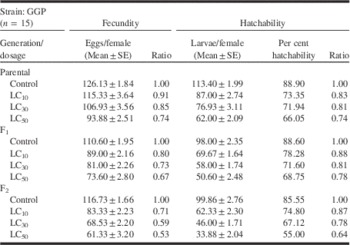
Reduction in the fecundity was observed in the exposed groups. A gradual reduction was also found with increase in concentrations (Table 1). The sublethal concentrations significantly reduced fecundity among concentrations in parental (F(3,56)=21.8, P<0.0001), F1 (F(3,56)=49.3, P<0.0001), and F2 (F(3,56)=97.332 , P<0.0001) generations.
Sublethal effects of alphamethrin on fecundity and hatchability of Anopheles stephensi.

Notes: n=number of females.
GGP, Goraguntepalya.
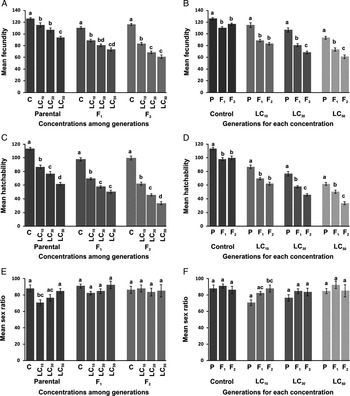
Tukey’s post-hoc test showed that fecundity of the parental generation was reduced at LC10 (P=0.05), LC30 (P<0.0001), and LC50 (P<0.0001) when compared with its control. Fecundity was also greatly reduced when compared between LC10 and LC50, LC30, and LC50 however the reduction was not significant between LC10 and LC30 (P=0.188). A similar trend was observed in F1 generation, where the fecundity between LC10 and LC30, LC30 and LC50 were not so different. Fecundity in F2 generation was also reduced compared with control and among other groups, however the reduction was not so significant between LC30 and LC50 (Fig. 1A).
Mean (±standard error) fecundity (A, B), hatchability (C, D), and sex ratio (E, F) in Anopheles stephensi exposed to sublethal concentrations of alphamethrin. A, C, E: among concentrations; B, D, F: across generations. C: control; LC10, LC30, LC50: sublethal concentrations. P, F1, F2: parental and filial generations. Mean bars with identical letters indicate non-significance.

A significant reduction in fecundity was observed across generations (parental, F1 and F2) at LC10 (F(2,42)=35.62, P<0.0001), LC30 (F(2,42)=52.164, P<0.0001), and LC50 (F(2,42)=34.296, P<0.0001)). Tukey’s post-hoc test showed that fecundity at LC10 was reduced in parental generation when compared with F1 and F2 (P<0.0001). However there was no significant reduction between F1 and F2 (P=0.350). Fecundity at LC30 and LC50 was found to be reduced when compared among all groups (P=0.01) (Fig. 1B).
Egg hatchability
Reduction in the egg hatchability was observed in the exposed groups. Similar to fecundity, gradual reduction was found with increase in concentrations (Table 1). The sublethal concentrations significantly reduced egg hatchability among concentrations in parental (F(3,56)=73.419, P<0.0001), F1 (F(3,56)=99.75, P<0.0001) and F2 (F(3,56)=164.82 , P<0.0001) generations.
Tukey’s post-hoc test showed that egg hatchability of parental generation was reduced at LC10, LC30, and LC50 (P<0.001) when compared with its control. Egg hatchability was also greatly reduced when compared between all groups, i.e., LC10 and LC30, LC10 and LC50, as well as LC30 and LC50 (P<0.05). A similar trend was observed in F1 where hatchability was significantly reduced among all the groups (P=0.001) except between LC30 and LC50 (P>0.05). Egg hatchability in the F2 generation was reduced compared with control, and among all the groups (P=0.01) (Fig. 1C).
The significant reduction in egg hatchability was observed across parental, F1 and F2 generations, at LC10 (F(2,42)=31.084, P<0.0001), LC30 (F(2,42)=46.692, P<0.0001), and LC50 (F(2,42)=40.88, P<0.0001).
Tukey’s post-hoc test showed that egg hatchability at LC10 was reduced in parental generation when compared with F1 and F2 (P<0.001), however there was no significant difference in hatchability between F1 and F2 (P>0.05). Egg hatchability showed reduction at LC30 and LC50 among all the groups (P<0.01) (Fig. 1D).
Sex ratio
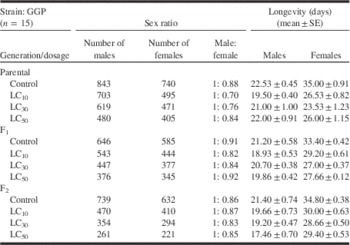
The sex ratio was tilted towards the males, i.e., the number of males were more than the females in treated and as well as in control (Table 2). Sublethal concentrations reduced the male to female ratio among concentrations in parental generation (F(3,56)=4.828, P=0.005), however there were no differences in F1 (F(3,56)=2.265, P=0.091) and F2 (F(3,56)=0.113, P=0.952) generations.
Sublethal effects of alphamethrin on sex ratio and longevity of Anopheles stephensi.

Notes: n=number of females.
GGP, Goraguntepalya.
In the parental generation the decrease in the sex ratio was detected at LC10 (P=0.006) when compared with control. The difference was also significant between LC10 and LC50 (P=0.037). There were no differences among the other groups in this generation. There were also no differences in sex ratios in F1 or F2 (Fig. 1E).
Significant reduction in sex ratio was observed across parental, F1 and F2 generations at LC10 (F(2,42)=6.470, P=0.004), however there were no differences at LC30 (F(2,42)=1.283, P=0.288) and LC50 (F(2,42)=0.626, P=0.539).
Reduction in sex ratio at LC10 was detected only between parental and F2 generations (P=0.003). There were no differences between other groups at LC10 and also no differences among all the groups at LC30 and LC50 (Fig. 1F).
Longevity
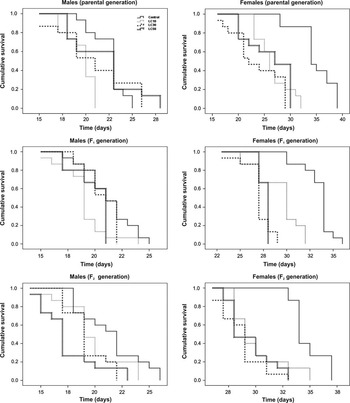
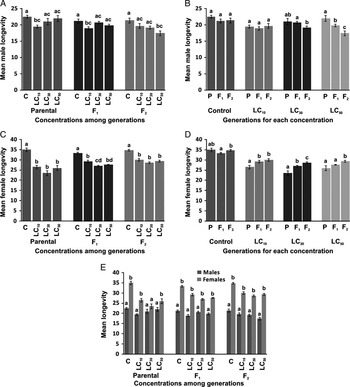
The life span of females was longer than males in control and sublethal concentrations. Overall reduction in lifespan of exposed groups was recorded in comparison with the control (Table 2). Kaplan–Meier survival analysis showed significant reduction in male longevity in parental (χ2=9.85, df=3, P=0.02), F1(χ2=12.801, df=3, P=0.005), and F2 (χ2=16.554, df=3, P=0.001) generations. Similarly female longevity was also significantly reduced in parental (χ2=28.409, df=3, P<0.0001), F1 (χ2=38.232, df=3, P<0.0001), and F2 (χ2=29.243, df=3, P<0.0001) generations (Fig. 2).
Kaplan–Meier survival graphs for sublethal exposure of alphamethrin on males and females of Anopheles stephensi in parental, F1 and F2 generations.

Post-hoc test showed that male longevity in parental generation was reduced at LC10 (P=0.030) when compared with control, however there were no differences among other groups. A similar trend was observed in the F1 generation where longevity was reduced at LC10 (P=0.010) in comparison with control. Longevity in the F2 generation was only reduced at LC50 (P=0.001) when compared with controls (Fig. 3A).
Mean (±standard error) male (A, B), female (C, D), and comparative (E) longevity in Anopheles stephensi exposed to sublethal concentrations of alphamethrin. A, C, E: among concentrations; B, D: across generations. C: control; LC10, LC30, LC50: sublethal concentrations. P, F1, F2: parental and filial generations. Mean bars with identical letters indicate non-significance.

Male longevity showed no differences among generations at LC10. Longevity was reduced at LC50 only between F1 and F2 (P=0.023). Longevity at LC50 was reduced among all the groups (P<0.05) (Fig. 3B).
Female longevity in parental generation was reduced at LC10, LC30, and LC50 (P<0.0001) when compared with control, however no differences were found between groups. A similar trend was observed in F1 as well as F2 generations (P<0.0001) (Fig. 3C). Female longevity at LC10 was reduced between parental and F1 (P=0.015) and F2 (P=0.002) generations. Longevity at LC30 was reduced among all the generations. Longevity at LC50 was reduced between parental and F2 (P=0.014) as well as F1 and F2 (P=0.006) (Fig. 3D).
Independent t-tests showed that the longevity of the females in the parental generation was longer when compared with that of the males in LC10 (P<0.0001) and LC50 (P=0.011). Longevity of females was also longer among all the groups in F1 and F2 generations (P<0.0001) (Fig. 3E).
Morphology of gonads
No morphological abnormalities were observed on sublethal exposures of alphamethrin in reproductive systems of males and females. No structural abnormalities were observed in testicular lobules, vas deferens, accessory glands, or ovaries among exposed groups as compared with control.
Direct effects of sublethal concentrations of alphamethrin on rhythms of pupation and rhythms of eclosion
Rhythms of pupation
Pupation in control larvae began at 48 hours post recovery from sublethal exposure. Mean pupation time was found to be 59±1.91 (mean±standard error) hours. Maximum pupation peak occurred at 52–58 hours and was completed by 70 hours. Similarly, LC10 exposed larvae began pupation at 60 hours post recovery. The mean pupation was found to be 73±2.08 hours. Maximum peak occurred at 62–66 hours and continued as smaller peaks up to 86 hours. Among LC30 exposed larvae pupation also began at 60 hours post recovery. Mean pupation time was found to be 77±2.38 hours. Maximum pupation peak occurred at 62–66 hours and continued as smaller peaks up to at 94 hours. Larvae pupated were fewer than control and LC10. Similarly LC50 exposed larvae also began pupation at 60 hours but the number of larvae pupated were fewer than control and other exposed groups. Mean pupation time was 80±2.58 hours. Maximum peak occurred at 62 hours and continued as very small peaks up to 98 hours. Pupation was found to be delayed by 14, 18, and 21 hours post recovery for LC10, LC30, and LC50, respectively (Fig. 4). The results indicate toxicological effects of sublethal concentrations on the rhythms of pupation.
Rhythms of pupation on exposure to sublethal concentrations of alphamethrin in Anopheles stephensi.

Sublethal concentrations significantly delayed pupation among concentrations (F(3,53)=12.019, P<0.0001). Tukey’s post-hoc comparisons showed that the delay in pupation was significant at LC10 (P=0.005), LC30 (P<0.0001), as well as LC50 (P<0.0001) when compared with control. However there were no differences among the other groups.
Rhythms of eclosion
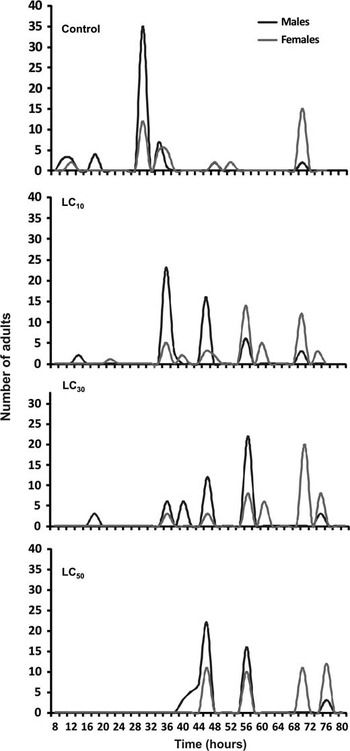
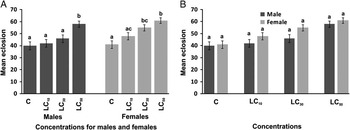
The adults emerged from larvae exposed to sublethal concentrations were released into their respective cages and scored for sex. The pupal duration was prolonged and eclosion delayed in exposed groups. It was observed that the males emerged much earlier than females among the treated groups and also in the control. In the control group, maximum eclosion occurred at 28–32 hours (males) and 68–72 hours (females) post pupation. The mean (±standard error) eclosion times were 40±3.26 and 41±3.21 hours, respectively. The mean eclosion time of LC10 exposed males was also 42±3.16 and females was 48±3.05 hours. Male emergence showed two major peaks at 34–38 hours and 44–48 hours while the females showed two major peaks at 54–58 hours and 68–72 hours indicating delay in eclosion. LC30 exposed larvae showed a maximum male emergence at 54–58 hours and female emergence at 68–72 hours. The mean emergence times were 46±3.16 and 55±2.64 hours, respectively. Similarly LC50 exposed larvae showed two male emergence peaks at 46–48 and 54–58 hours and two female emergence peaks at 68–72 and 74–78 hours. The mean emergence times were 58±2.58 and 61±2.38 hours, respectively. The delay of eclosion was clearly evident when the larvae were treated to the sublethal concentrations (Fig. 5).
Rhythms of adult eclosion on exposure to sublethal concentrations of alphamethrin in Anopheles stephensi.

Mann–Whitney comparisons showed delay in male emergence at LC50 (P=0.001) while no significant delay at LC10 and LC30 when compared with control. Also the delay was not significant between LC10 and LC30 (Fig. 6A). Comparison showed delay in female emergence at LC30 (P=0.006) and LC50 (P=0.0001) when compared with control and no significant delay at LC10 (P=0.139) (Fig. 6A). Mann–Whitney comparisons showed no significant delay in male to female eclosion among all the groups (Fig. 6B).
Mean (±standard error) males and females (A), comparative (B) eclosion in Anopheles stephensi exposed to sublethal concentrations of alphamethrin. C: control; LC10, LC30, LC50: sublethal concentrations. Mean bars with identical letters indicate non-significance.

Discussion
As insecticides are one of the reliable control methods, refining the insecticidal control measures could provide effective malaria control while considerably reducing selection for resistance (Gourley et al. Reference Gourley, Liu and Wu2011). The life history traits studied were reduced significantly in the exposed groups, which indicates that alphamethrin caused reproductive disadvantages in the exposed groups.
In this study, fecundity and egg hatchability were significantly reduced. Fecundity could be reduced due to physiological and behavioural effects caused by insecticides (Desneux et al. Reference Desneux, Decourtye and Delpuech2007) and also could be due to the penetration of the chemical into the egg (Broadbent and Pree Reference Broadbent and Pree1984). Insecticides can disrupt the metabolic process in insects, which affect behaviour and physiology that do not lead to direct mortality. Therefore, insecticides decrease the production of offspring because of behavioural modifications in mate location, courtship, and oviposition, or due to physiological effects on egg fertilisation, oogenesis, ovulation, spermatogenesis, sperm motility, and overall affecting population structure (Haynes Reference Haynes1988; Ali et al. Reference Ali, Xue and Barnard2006).
The effects of insecticides on various reproductive parameters such as fecundity, hatchability, and sex ratio were reported in A. stephensi for neem and bifenthrin (Zin and Shetty Reference Zin and Shetty2008); fenitrothion, cypermethrin, and deltamethrin (Priyalakshmi et al. Reference Priyalakshmi, Rajashree, Ghosh and Shetty1999); and propoxur and temephos (Sanil and Shetty Reference Sanil and Shetty2012). Pyriproxyfen (2%) showed no effects on fecundity but the fertility of eggs showed significant reduction in A. stephensi (Aiku et al. Reference Aiku, Yates and Rowland2006). Decrease in fecundity was also observed in Aedes aegypti (Linnaeus) (Diptera: Culicidae) to alphamethrin and malathion (Minn and Shetty Reference Minn and Shetty2008).
No sex ratio distortion was observed in this study suggesting that alphamethrin may be indiscriminative towards the developing larvae. Cytological observations indicated that sex ratio bias towards male in Aedes Meigen is associated with preferential breakage of the X chromosome during male meiosis (Newton et al. Reference Newton, Wood and Southern1976). Molecular mechanisms for sex ratio distortion was attributed to highly specific homing endonuclease I-PpoI7, which cuts a conserved sequence on the mosquito’s (Anopheles gambiae Giles) X chromosome and experiments indicated that the majority of developmentally arrested embryos in A. gambiae had been fertilised by Y-bearing spermatozoa (Windbichler et al. Reference Windbichler, Papathanos, Catteruccia, Ranson, Burt and Crisanti2007, Reference Windbichler, Papathanos and Crisanti2008).
Longevity is an essential component of reproductive fitness, which can potentially increase the magnitude of disease transmission. Longevity of insects treated with sublethal concentrations of insecticides may increase, decrease, or remain unchanged (Lee Reference Lee2000). In the present study, the longevity of males and females was decreased in the exposed groups as compared with control. Longevity of females is usually longer, as also in this study. The reduction in male longevity can reduce the number of matings and reduction in female longevity can reduce the number of ovipositions, which would also lead to reduced fecundity. Importantly, the female mosquito might die before the end of the incubation period of the parasite.
A sharp decrease in life span was observed in adults whose larval stages were exposed to sublethal concentrations of hexaflumuron in Culex quinqefasciatus Say, A. stephensi, and A. aegypti (Vasuki Reference Vasuki1992). Sublethal exposures of propoxur and temephos were found to prolong the lifespan of A. stephensi (Sanil and Shetty Reference Sanil and Shetty2012) and temephos treated larval stages in A. aegypti (Reyes-Villanueva et al. Reference Reyes-Villanueva, Juarez-Eguia and Flores-Leal1990).
This study showed irregular rhythms of pupation and eclosion of larvae exposed to sublethal concentrations of alphamethrin as compared with control. The pupation and eclosion rhythms were found to be disturbed on exposure to sublethal concentrations of temephos and propoxur in A. stephensi (Sanil and Shetty Reference Sanil and Shetty2012). Sublethal concentrations of malathion, methoprene, and resmethrin resulted in significantly lengthened time to pupation. The time needed for adults of insecticide-exposed mosquito populations to emerge was greater than controls for the malathion, methoprene, and resmethrin (Robert and Olson Reference Robert and Olson1989). Pyriproxyfen (Sumilar®0.5G) inhibited over 80% of the total adult emergence in A. gambiae (Mbare et al. Reference Mbare, Lindsay and Fillinger2013).
The male and female gonads of treated groups were dissected out and observed for structural abnormalities. No structural abnormalities were observed. On the contrary, temephos and propoxur treated males showed atrophied and rudimentary testes, reduced accessory, glands and short, disintegrated, thin vas deferens, etc. (Sanil and Shetty Reference Sanil and Shetty2012).
Even though there are no structural abnormalities, the sublethal effects show reduction in fecundity, which may be due to neurotoxic action of alphamethrin that would disrupt neurohormonal balance. Insecticides that act on the central nervous system disrupt normal reproductive physiology as reproduction is neurohormone regulated, neurohormonal imbalance from insecticide poisonings may affect normal function (Maddrell and Reynolds Reference Maddrell and Reynolds1972; Robert and Olson Reference Robert and Olson1989; Reyes-Villanueva et al. Reference Reyes-Villanueva, Juarez-Eguia and Flores-Leal1990; Lee Reference Lee2000).
Knowledge of these sublethal effects of insecticides could be important in the decision-making process in integrated pest management programmes (Robert and Olson Reference Robert and Olson1989). Direct sublethal effects not only negatively affect the various life traits but also can show transgenerational affects. Such affects drastically impact key demographic parameters (Guo et al. Reference Guo, Desneux, Sonoda, Liang, Han and Gao2013).
Sublethal concentrations can play a vital role in control of insect vectors of disease. Reducing the vector population by altering its reproductive fitness would be effective without imparting a strong selection pressure for resistance. In the present study sublethal effects of alphamethrin showed reduced fecundity, hatchability, longevity, and delay in pupation and eclosion in the exposed generation and also subsequent generations in A. stephensi.
Acknowledgements
This work was supported by financial assistance from University Grants Commission (UGC) and Department of Science and Technology (DST), New Delhi to Professor N. J. Shetty.