Dairy products have an important role in human healthy life because of the abundant nutrients and active substances. Milk protein and milk fat are important components of milk that affect dairy industry competitiveness (Tian et al. Reference Tian, Wu, Zhao, Xu, He and Wang2017). Mastitis is the most frequent and important disease in dairy cattle worldwide causing great economic losses to the dairy industry. The strategy of indirect selection for mastitis resistance based on Somatic Cell Count (SCC) is effective because of the strong positive genetic correlation between SCC and clinical mastitis (Rupp & Boichard, Reference Rupp and Boichard1999).
Toll-like receptor 4 (TLR4) is an important member of the Toll-like receptor family that is involved in pathogen recognition, as well as recognition of host danger signals (alarmins) that are released during tissue damage (Miyake, Reference Miyake2007). It has been reported that TLR4 gene expression is increased significantly in the mammary gland during mastitis, which suggests that TLR4 may be associated with mastitis in dairy cow (Beecher et al. Reference Beecher, Daly, Ross, Flynn, McCarthy and Giblin2012). Wang et al. (Reference Wang, Xu, Gao, Li, Ren and Zhuo-ma2008) found that dairy cows with the CC genotype for TLR4 c.2021 C > T had lower SCC than cows with the TT genotype in three Chinese commercial dairy cattle populations, including the Chinese Holstein (104), Sanhe cattle (197), and Chinese Simmental (96). Wang et al. (Reference Wang, Luoreng, Gao, Guo, Li, Gao, Xu, Li, Chen and Wang2014) later found associations between TLR4 SNPs and their haplotypes and SCC in the same populations, and found that Hap2, Hap4 and Hap12 had negative effects on milk SCC, whereas Hap13 had positive effects on milk SCC. It was previously reported that the 5′ upstream region of TLR4 is polymorphic, and polymorphisms were associated with total lactation milk yield in Vrindavani cattle (Mishra et al. Reference Mishra, Kumar, Yathish, Choudhary and Kumar2016). Earlier, Beecher et al. (Reference Beecher, Daly, Childs, Berry, Magee, McCarthy and Giblin2010) found that the non-synonymous SNP TLR4-2021 in the Ireland Holstein cow population was associated with both milk protein and fat percentage in late lactation (P < 0·05). Zhou et al. (Reference Zhou, Cheng, Gong, Byun, Edwards and Hickford2017) later reported that variant C of TLR4 c.2021 was associated with higher milk yields in New Zealand Holstein-Friesian × Jersey cross dairy cows , but lower milk fat percentages.
We hypothesized that SNPs in TLR4 may contribute to individual variation in health-related and production traits in dairy cattle. The objective of this study was to validate the associations of the promoter SNP at −226 G > C and a non-synonymous SNP (rs 8193069, c.2021 C > T) in exon 3 of TLR4 with milk SCC and milking traits in larger and different Holstein population residing in the southeast of China.
Materials and methods
Animal and milk production records
All of the procedures involving animals received approval from the Institutional Animal Care and Use Committee of Yangzhou University. A total of 866 cows were sampled from a large Holstein dairy farm located in the district of Yancheng City, P.R. China. This farm was well organized by utilizing the free stall bar raising technique, feeding the TMR diet, milking in central milking hall three times every day. The DC-305 (Dairy Comp 305) software was used for dairy cow management. The phenotypic data were comprised of 25 162 test-day records from a total of 2198 lactations (lactations 1 to 3) of 866 cows. For analyses, 20 556 records were retained and utilized in this study after selecting.
DNA extraction
Blood (10 ml) from 866 Holstein cows was collected from the tail vein by caudal venipuncture, using tubes containing potassium EDTA (EDTA K3E 15%, 0·12 ml; BD Vacutainer Systems). A standard phenol–chloroform procedure was used to extract DNA from blood, with a slight modification in centrifugation speed and time (Winfrey et al. Reference Winfrey, Rott and Wortman1997).
SNP genotyping and transcription-factor binding sites analysis
SNP genotyping was performed by using the MassARRAY system (Sequenom Inc., San Diego, CA) based on means of the matrix-assisted laser desorption ionisation-time using the flight mass spectrometry method (MALDI-TOF). The 1 kb 5′ putative promoter region of TLR4 gene was analyzed for potential transcription-factor binding sites using the software MatInspector (Cartharius et al. Reference Cartharius, Frech, Grote, Klocke, Haltmeier, Klingenhoff, Frisch, Bayerlein and Werner2005).
Statistical analyses
Genotype and allele frequencies
The genotype frequencies were tested for deviations from proportions of Hardy-Weinberg equilibrium (HWE) by chi-squared test applications. The pairwise level of linkage disequilibrium was measured using the squared correlation (r 2) of the alleles at 2 loci (Hill & Robertson, Reference Hill and Robertson1968). Genotype frequencies, allele frequencies, linkage disequilibrium and haplotype analyses for this population were performed using the SHEsis software (Shi & He, Reference Shi and He2005).
SNP and haplotype associations
The haplotypes were assigned for each individual using the PHASE software (Stephens et al. Reference Stephens, Smith and Donnelly2001). The associations between single SNP (or haplotype) and milk production traits were analyzed by the linear mixed model as implemented in the generalized linear model (GLM) procedure of Statistics Analysis System software (SAS) (SAS Institute Inc, Cary, NC, USA). The following linear statistical model was applied:
 $$\eqalign{ Y_{ijklmnop} =&\; {\rm \mu} + \hbox{Sir}\hbox{e}_i + \hbox{Yea}\hbox{r}_j + \hbox{T}\hbox{S}_k \cr & + \hbox{Parit}\hbox{y}_l + \hbox{C}\hbox{S}_m + \hbox{DI}\hbox{M}_n + \hbox{Genotyp}\hbox{e}_o + e_{ijk\ln mop}} $$
where Y ijklmnop = dependent variable (observed milk production traits and SCC); μ = overall mean; Sirei = fixed effect of the ith sire (1,…., 43); Yearj = fixed effect of the jth year (2010, 2011, 2012, 2013 and 2014); TSk = fixed effect of the kth test season (spring, summer, autumn and winter); Parityl = fixed effect of the lth parity (1 to 3); CSm = fixed effect of the mth calving season (March to May = spring, June to August = summer, September to November = autumn, and December to February of next year = winter); DIMm = fixed effect of the mth DIM class (<100, 100 to 200, >200 d); Genotypeo = fixed effect of the oth SNPs or haplotypes; and e ijklnmop = random residual effect. Because of the skewed distribution of somatic cell count (SCC), we transformed the SCC to somatic cell count (SCC) using the following formula: SCC = log2(SCC/100 000) + 3 (Wiggans & Shook, Reference Wiggans and Shook1987).
Detailed materials and methods are given in the online Supplementary File.
Results
Polymorphisms of TLR4 gene
The frequency of G was 0·553 for c.−226 G > C, and the frequency of C was 0·865 for c.2021 C > T. The individual frequencies of the genotypes were deviated from HWE for SNP c.−226 G > C and SNP c.2021 C > T. Linkage disequilibrium, evaluated as r 2, was 0·192 between c.−226 G > C and c.2021 C > T. Three haplotypes and their frequencies were reconstructed for the SNPs: CC (0·312), CT (0·135), GC (0·553).
The analysis of the TLR4 promoter region revealed that SNP c.−226 G > C is positioned within 6 potential transcription factor binding sites: Myc associated zinc-finger protein, transcription factor AP-2, insulator protein CTCF, E-box binding factors, MEF3 binding sites and Krueppel-like C2H2 zinc-finger factors hypermethylated in cancer. According to the comparison to the bovine TLR4 gene (DQ839567) sequence, the SNP c.2021 C > T of TLR4 gene leads to the transformation of a protein coding amino acid from threonine (Thr) to isoleucine (Ile), which changes the protein conformation of TLR4 (Zhou et al. Reference Zhou, Cheng, Gong, Byun, Edwards and Hickford2017).
Associations of SNPs and haplotypes with milking traits and SCC
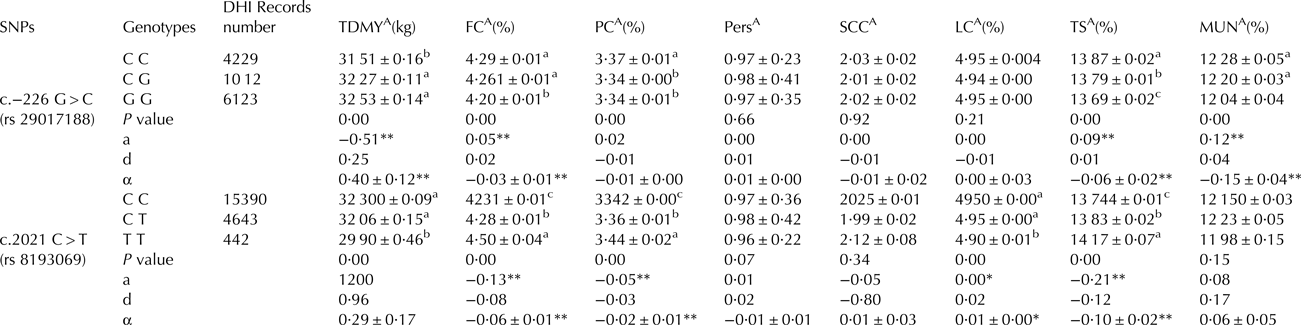
The estimated effects of TLR4 c.−226 G > C on the milk production traits and SCC are presented in Table 1. Significant effects (P < 0·05) of SNP −226 G > C were detected on test day milk yield (TDMY), fat content (FC), protein content (PC), total solids (TS) and milk urea nitrogen (MUN). Individuals with genotype GG had lower FC, PC, TS and MUN compared to genotypes CG and CC, but higher TDMY. The SCC showed no significant differences between the three genotypes of TLR4 c.−226 G > C. Correspondingly, a significant additive effect and allele substitution effect was observed for TDMY, FC, TS and MUN (P < 0·01). The allele substitution effect from C to G resulted in a significant decrease on FC (0·032), TS (0·061 kg), MUN content (0·145), and a significant increase on TDMY (0·397 kg).
Effects of SNPs of TLR4 c.−226 G > C and TLR4 c.2021 C > T on SCC and milk production traits

TDMY, test-day milk yield; FC, fat content; PC, protein content; Pers, Persistency; SCC, somatic cell count; LC, lactose content; TS, total solid; MUN, milk urea nitrogen
*Significant association at the significance level of 0·05; **Significant association at the significance level of 0·01. a,b within the same column with different superscripts indicate P < 0·05
The estimated effects of TLR4 c.2021 C > T on milk production traits and SCC are presented in Table 1. Significant effects (P < 0·05) of TLR4 c.2021 C > T polymorphisms were detected on TDMY, FC, PC, lactose content (LC) and TS. Individuals with genotype TT had higher FC, PC and TS than that of genotype CT and CC, but lower TDMY and LC. No significant differences between three genotypes of TLR4 c.2021 C > T were found for SCC. Correspondingly, a significant additive effect and allele substitution effect was observed for FC, PC LC, and TS (P < 0·05). The allele substitution effect from C to T resulted in a significant increase on FC (0·058), PC (0·024), TS content (0·091 kg), and a significant decrease on LC content (0·009).
Estimated effects of TLR4 haplotypes on milk production traits and SCC are presented in Table 2. The haplotypes of TLR4 had a significant effect on 5 milk production traits (P < 0·01), including TDMY, FC, PC, LC, and TS content. The individuals with haplotype CT had higher values for FC, PC and TS content than either haplotypes CC or GC, but lower TDMY (P < 0·05). The haplotypes of TLR4 had no significant effects on SCC (P > 0·05).
Effects of haplotypes of TLR4 c.−226 G > C and TLR4 c.2021 C > Ton SCC and milk production traits

TDMY, test-day milk yield; FC, fat content; PC, protein content; Pers, Persistency; SCC, somatic cell count; LC, lactose content; TS, total solid; MUN, milk urea nitrogen
a, b within the same column with different superscripts indicate P < 0·05
Discussion
Previously, Sharma et al. (Reference Sharma, Mount and Karrow2008) found that animals with the CC genotype for promoter of c.−226 G > C had higher SCC than other genotypes in Canadian Holstein bulls, and confirmed the biological significance of this locus by reporter gene assay. In that study, TLR4 gene expression was found to be highest 6 h post LPS challenge, and cows with the GG genotype exhibited significantly higher expression compared to CG and CC genotypes. Ruiz-Larrañaga et al. (Reference Ruiz-Larrañaga, Manzano, Iriondo, Garrido, Molina, Vazquez, Juste and Estonba2011) and Sharma et al. (Reference Sharma, Abo-Ismail, Schenkel, You, Verschoor, Pant and Karrow2015) later reported that SNP (c.−226 G > C) may contribute to the bovine immune response to Mycobacterium avium ssp. Paratuberculosis (MAP). The software MatInspector revealed that SNP c.−226 G > C is positioned within 6 potential transcription factor binding sites, one of which is activating protein 2 (AP-2), a family of closely related transcription factors that plays a critical role in regulating gene expression (Hilger-Eversheim et al. Reference Hilger-Eversheim, Moser, Schorle and Buettner2000). The SNP c.−226 G > C appears to be biologically meaningful for disease resistance and host immunity, but we found no such association between this SNP and SCC. The discrepancy between different studies may be a function of different genetic backgrounds and/or different mammary pathogens affecting SCC. However, this SNP had significant effects on TDMY, FC, PC, TS and MUN. The mutation of SNP c.−226 G > C may influence the expression of related genes by altering a transcription factor binding site, and functional studies are warranted to investigate this further.
In this study, significant associations were also observed between SNP c.2021 C > T and TDMY, FC, PC, LC, and TS, but no significant effect on SCC was found. Beecher et al. (Reference Beecher, Daly, Childs, Berry, Magee, McCarthy and Giblin2010) found TLR4-2021 to be associated with both milk protein and fat percentage in late lactation (P < 0·05) within the Holstein cow population in Ireland, and the CC genotype was associated with a decrease in milk protein and fat percentage, and this is similar to our results. However, Wang et al. (Reference Wang, Xu, Gao, Li, Ren and Zhuo-ma2008) found an association between SNP c.2021 C > T and SCC, in that individuals with CC genotype had significantly lower SCC than those with the TT genotype in the Chinese Holstein, Sanhe and Chinese Simmental populations. They speculated that the C allele may be a favorable allele for mastitis resistance; however, this is different from our results. The discrepancy among different studies may be a function of differences in the parity of the cow or period during which the phenotype was measured, the different genetic background and breed of the animals in the study, and/or different mammary pathogens affecting SCC.
In conclusion, c.−226 G > C in the promoter region and c.2021 C > T in the coding region of TLR4 in Chinese Holstein cows showed slight linkage disequilibrium. These SNPs did not associate with SCC significantly, but had significant effects on TDMY, FC, PC and TS. The individuals with TLR4 haplotype CT had higher values for FC, PC and TS content than either haplotypes, but lower TDMY. Therefore, these SNPs could be used for molecular marker-assisted selection of milk productions for Chinese Holstein. However, these associations will require further investigation with respect to their impact on immune function and practical relevance because of the potential of these SNPs to alter gene expression.
Conflicts of interest
The authors declare that they have no conflicts of interest.
Supplementary material
The supplementary material for this article can be found at https://doi.org/10.1017/S0022029918000535
The research was financially supported by the National Natural Science Foundation of China (31372286, 31472067), the Priority Academic Program Development of Jiangsu Higher Education Institutions (PAPD), the Open Project Program of Jiangsu Key Laboratory of Zoonosis (No. R1404), and the Jiangsu Agricultural Science and Technology Innovation Fund (CX(17)1005).