1 Introduction
1.1 The problem: Enigmatic tonal alternation of Tlapanec verbs
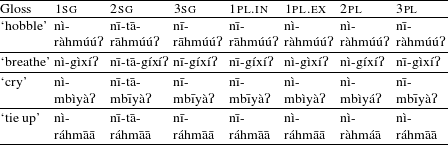
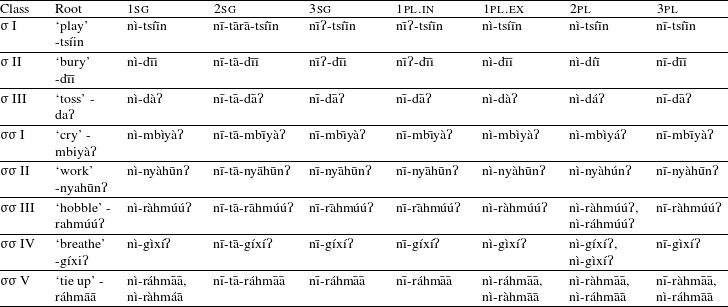
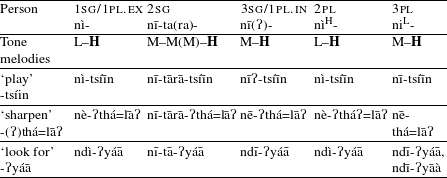
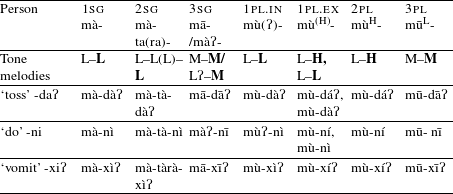
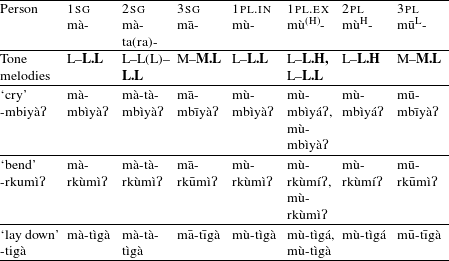
Tlapanec (Mè’phàà), an Otomanguean language spoken in the state of Guerrero, Mexico, is known for its enigmatic tonal alternation in verb forms according to person and aspect-mode categories, in addition to suppletion and other segmental alternations (Suárez Reference Suárez1983, Wichmann Reference Wichmann, Engberg-Pedersen, Fortescue, Harder, Heltoft and Jakobsen1996, Navarro Solano Reference Navarro Solano2012, Duncan Reference Duncan2017, Tiburcio Cano Reference Tiburcio Cano2017). An illustration of this phenomenon is in Table 1, showing some sample paradigms of ‘regular’ (that is, not suppletive) verbs which encode agents and differentiate seven person categories exclusively by means of tonal alternation (with the exception of the 2sg forms which have an agentive prefix ta-/tara-) in the Zilacayotitlán variety of Tlapanec. The prefix which encodes the completive aspect ni- (where the tone varies), the 2sg agentive prefix tara-/ta- and the stems are segmented by a hyphen. The three tones in Tlapanec are represented as follows: low (à), mid (ā), and high (á).
Illustration of Zilacayotitlán Tlapanec verb conjugation.

At first glance, the paradigms in Table 1 resist generalizations. First, examining the cells horizontally, we observe that the tonal exponents of the stems are not consistent; that is, the tones of the stem show variation throughout the paradigm. For instance, ‘hobble’ has a low–high melody on the stem for the 1sg, 1pl.ex, 2pl and 3pl but mid–high for the 2sg, 3sg and 1pl.in. This makes it challenging to postulate underlying tones for the stems. The same holds true for the prefixes; the prefix in the 3pl has a mid tone in ‘hobble’, ‘breathe’ and ‘cry’ but has a low tone in ‘tie up’. Secondly, examining the cells vertically, we observe that the tone melodies for each person are not consistent either. For instance, the first two verbs (‘hobble’ and ‘breathe’) have the same tone melody, low–low–high, in the 1sg forms, but other two verbs have different tone melodies. On the other hand, the tone melody for the 2pl form is low–low–high for ‘hobble’, ‘cry’ and ‘tie up’ as opposed to ‘breathe’, which has a low–high–high pattern. This makes it unlikely to assume that the agent is encoded by some kind of non-concatenative, templatic morphemes which purely consist of tone melodies (McCarthy & Prince Reference McCarthy and Prince1986). Lastly, the patterns of syncretism, that is, identical forms realizing different cells of the paradigm (Baerman, Brown & Corbett Reference Baerman, Brown and Corbett2005, Albright & Fuss Reference Albright, Fuss and Trommer2012), are also unsystematic: for all the verbs, the tone melodies for the 3sg and the 1pl.in forms and that of the 1sg and the 1pl.ex forms are the same. On the other hand, the tone melody for the 2pl form is the same as the 1sg/1pl.ex form for ‘hobble’ but it is distinct for the other three verbs; the tone melody for the 3pl is the same as the one for the 3sg form for ‘cry’ but they are distinct for other three verbs. Thus, the apparatus commonly used to describe syncretism, blocking or extension (Baerman Reference Baerman2012), cannot consistently account for these tonal alternation patterns in Tlapanec.
1.2 Theoretical background
Non-canonical patterns, or form and function mismatches in morphology, where signifiers deviate from a canonical linear ideal, such as fusion, suppletion, defectivness, syncretism, subtractive morphology, multiple exponence, or non-concatenative morphology, are often handled within the Word and Paradigm model (Matthews Reference Matthews1965; Blevins Reference Blevins2006, Reference Blevins2016), where inflectional classes are established to see how much is predictable from other parts within the paradigm (Carstairs-McCarthy Reference Carstairs-McCarthy1983, Reference Carstairs-McCarthy1994; Stump Reference Stump2001, Reference Stump2016; Finkel & Stump Reference Finkel and Stump2007; Corbett Reference Corbett, Montermini, Boyé and Tseng2009; Ackerman & Malouf Reference Ackerman and Malouf2013). This is because they show that an inflected word’s content and form fail to exhibit the kind of isomorphism that the morpheme concept predicts, and thus a holistic approach makes more sense (Stump Reference Stump2016: 17, 22; Booij Reference Booij2018a: 5, 18; Good Reference Good2018). Such an approach has been applied to various Otomanguean languages which exhibit complex inflectional paradigms, such as Mazatec (Léonard & Kihm Reference Léonard, Kihm and Müller2010, Ackerman & Malouf Reference Ackerman and Malouf2013, Baerman Reference Baerman, Hathout, Montermini and Tseng2013, Corbett Reference Corbett2015), Otomí (Palancar Reference Palancar2012), Chinantec (Baerman Reference Baerman, Hathout, Montermini and Tseng2013, Baerman & Palancar Reference Baerman and Palancar2015), and Amuzgo (Palancar & Feist Reference Palancar and Feist2015). A similar analysis has been proposed for Tlapanec, where tonal alternations as observed in Table 1 are assumed to be morphological (Suárez Reference Suárez1983, Tiburcio Cano Reference Tiburcio Cano2017); that is, the tone melodies of verbs cannot be derived or predicted from the underlying representations of the stems and affixes, but rather the exponents of the agents are assumed to be non-concatenative tonal templates and different patterns of tonal alternations constitute different inflectional (or tone) classes. Such an approach can be labelled as a word-based approach, which treats word forms as basic units and their recurrent parts as abstractions over full forms (Matthews Reference Matthews1965; Anderson Reference Anderson1992; Aronoff Reference Aronoff1994; Stump Reference Stump2001, Reference Stump2016; Blevins Reference Blevins2006, Reference Blevins2016; O’Neil Reference O’Neil2014; Pirrelli, Ferro & Marzi Reference Pirrelli, Ferro, Marzi, Baerman, Brown and Corbett2015).
In this paper, we argue that the tonal alternations observed in Tlapanec regular agentive verbs can be straightforwardly accounted for by phonology, without resorting to any extremely abstract representations or morpheme-specific ad hoc rules: the lexical tones of the prefixes and the verb stems, with underspecification and floating tones, and cross-linguistically common tone processes such as tone spreading and floating tone docking. In fact, Cline (Reference Cline2013) independently applied such an approach to Acatepec Tlapanec to account for the distribution of lexical tones and tonal alternations which occur with suffixation. The data can be accounted for under Autosegmental Phonology (Goldsmith Reference Goldsmith1976, Reference Goldsmith1990), with some restrictions on the application of the rules, and further, these restrictions fall out naturally using Optimality Theory (Prince & Smolensky Reference Prince and Smolensky2008). We call such an analysis a phonological (or a morpheme-based) approach.
A phonological approach often yields to ‘phonological reductionism’, the idea that virtually any alternation can be analyzed with single underlying representations of extreme abstractness and phonological operations; for instance, see analyses couched within an SPE-style analysis (Chomsky & Halle Reference Chomsky and Halle1968), Government Phonology (Kaye, Lowenstamm & Vergnaud Reference Kaye, Lowenstamm and Vergnaud1990) or Element Theory (Backley Reference Backley2011), such as Lampitelli (Reference Lampitelli2017) on Italian velar insertion. Our analysis differs substantially from such approaches in that we assume a surface-true view of phonology, where only productive and automatic processes are considered phonological.
The issue discussed in this paper is relevant to the ongoing debates on the division of labor between storage and computation, or phonology and morphology (Bermúdez-Otero Reference Bermúdez-Otero and Trommer2012): which facts and generalizations are primary versus epiphenomenal, and where in the grammar or lexicon they originate from, and what kind of predictions they make. Morpheme-based approaches and word-based approaches fundamentally differ in this respect. For a word-based approach, whether constructive, as in A-morphous Morphology (Anderson Reference Anderson1992), Aronoff’s (Reference Aronoff1994) model, or Paradigm Function Morphology (Stump Reference Stump2001, Reference Stump2016), or abstractive, as in Blevins (Reference Blevins2006, Reference Blevins2016), O’Neil (Reference O’Neil2014), and Pirrelli et al. (Reference Pirrelli, Ferro, Marzi, Baerman, Brown and Corbett2015), inflectional paradigms are primary, while morphological categories such as root, stem and affix are epiphenomenal (O’Neil Reference O’Neil2014: 34). For a morpheme-based approach, morphemes and their underlying representations are primary but inflectional paradigms are epiphenomenal (Stump Reference Stump2016: 13). Within a word-based approach, especially within the abstractive approach, the minimal meaningful unit is the word and thus, words are stored in their entirety in the lexicon, and the speakers make generalizations abstracted from the relationship between these full forms (O’Neil Reference O’Neil2014: 33). In this sense, the need for morphological segmentation is excluded (Stump Reference Stump2016: 259). Within a morpheme-based approach, on the other hand, what is stored in the lexicon are the morphemes – that is, prefixes and stems with lexical tones, and phonological processes which apply when they are concatenated.
In general, a word-based approach, especially an abstractive approach (or, implicative, in Stump’s (Reference Stump2016) terminology), is better at expressing generalizations that are not tied to any specific exponent but involve paradigm-based patterns that may be instantiated with different morphology in the inflection of different lexemes (Stump Reference Stump2016: 261), such as grade-alternating noun declension in Saami and Estonian discussed in Blevins (Reference Blevins2006: Section 3.2), or conjugational patterns in Georgian where root and stem formatives of a verb need to be identified by comparing whole word forms (Blevins Reference Blevins2006: Section 4). An abstractive approach is also useful for describing analogical phenomena in language learning and language change (Stump Reference Stump2016: 261). On the other hand, a constructive (or exponence-based, in Stump’s (Reference Stump2016) terminology) approach, whether morpheme-based or word-based, is better at capturing generalizations tied to specific exponents (Stump Reference Stump2016: 261), including automatic phonological processes. A constructive approach also makes it possible to distinguish very general patterns from restricted patterns (Stump Reference Stump2016: 263). Finally, a constructive approach does not force one to make arbitrary choices in lexical representations, which an abstractive approach is forced to, either by means of a set of principal parts or by means of an inflection-class label together with a citation form (Stump Reference Stump2016: 264).
According to a word-based approach, the tonal alternations in the Tlapanec paradigms in Table 1 would represent a case of family resemblance encoded by distributed associative memory where each form is listed nonanalytically. On the other hand, according to a morpheme-based approach, they represent a productive pattern encoded by standard rules, where outputs can be listed or unlisted (Bermúdez-Otero Reference Bermúdez-Otero and Trommer2012). In this paper, it will be shown that the tonal alternations in Tlapanec verbal paradigms fall out neatly and correct predictions can be made if we assume a constructive, morpheme-based approach (or a phonological analysis) which makes concepts such as underlying representations and morphemes possible: overabundance in certain, but not other, cells (Section 6.2.1); patterns of formal identity of cells (Section 6.2.2); and the ability to make predictions about the number of tonal patterns and about which tonal patterns are possible and which are not (Section 6.2.3).
As should be evident by now, the difference between a word-based approach and a morpheme-based (or phonological) approach is not always binary. Even though there are some radical (such as abstractive) word-based models that claim that all morphologically significant realizations are about whole word forms and their content (Blevins Reference Blevins2006, Reference Blevins2016; O’Neil Reference O’Neil2014; or Pirrelli et al. Reference Pirrelli, Ferro, Marzi, Baerman, Brown and Corbett2015), constructive word-based models such as Paradigm Function Morphology only state that there are some (but not all) morphologically significant generalizations that are irreducibly about whole word forms and their content (Stump Reference Stump2016: 27 and Section 14.2). What we try to show in this paper is not that the whole Tlapanec verbal paradigms can be accounted for by a morpheme-based, phonological approach, but rather that the tonal alternations of Tlapanec agentive verbs can be accounted for mostly by phonology, while other alternations, including suppletion, are motivated by paradigmatic relations with full word forms in other cells.
1.3 Organization of the paper
The paper is structured as follows. In Section 2 we review basic information on phonology and morphology of Tlapanec that is relevant for the topic of this paper. Section 3 presents the attested patterns of tonal alternations in the regular completive forms of one class (so-called agentive) of verbs, which encode agents by tonal alternations. Section 4 introduces phonological preliminaries, lexical representations of prefixes and stems, as well as tonal processes and tonal constraints, before providing analyses of each of the attested patterns of tonal alternations. With these phonological apparatuses in hand, in Section 5 we propose phonological analyses of each pattern of tonal alternations. In Section 6 we compare the phonological (or morpheme-based) approach proposed in this paper with a word-based approach, and conclude that a phonological (morpheme-based) approach is more adequate, since such an analysis is more restrictive and has more explanatory and predictive power.
2 Tlapanec/Mè’phàà
Tlapanec is spoken in the eastern part of the state of Guerrero, Mexico. Tlapanec constitutes a language family with the now extinct Subtiaba language, once spoken further south in Nicaragua. This language family belongs to the western branch of the Otomanguean phylum. INALI (2008: 169–171) recognizes nine varieties of Tlapanec (ISO 639-3 codes: tcf, tpc, tpl and tpx). In this paper we focus on the variety spoken in the community of Zilacayotitlán, with additional information from the varieties spoken in Malinaltepec and Zapotitlán Tablas. The data on Zilacayotitlán comes from the second author, a male native speaker of this variety in his 30s, and from Tiburcio Cano (Reference Tiburcio Cano2017); we assume that these data are representative of this variety. The data on Malinaltepec come from sources published by a Malinaltepec native speaker and linguist Abad Carrasco Zúñiga (especially Carrasco Zúñiga Reference Carrasco Zúñiga2006).
Generally, Tlapanec has the following consonants (Tiburcio Cano Reference Tiburcio Cano2017: 41), with some variations depending on the variety and analysis (such as whether the nasal + plosive combinations are sequences or singletons): six plosives, p, b, t, d, k and g; three affricates, ts, tx [ʧ], and dx [ʤ]; two fricatives, s and x [ʃ]; two nasals, m and n; two liquids, l and r; and two semivowels, v [w] and y [j]. In this paper we adopt the view that the glottal stop [ʔ] as well as h are consonants rather than vowel features (see discussions in Carrasco Zúñiga Reference Carrasco Zúñiga2006; Marlett & Weathers Reference Marlett and Weathers2012; Navarro Solano Reference Navarro Solano2012; Tiburcio Cano Reference Tiburcio Cano2017: 47ff.; Marlett Reference Marlett2019). Tlapanec varieties have five vowel qualities, a, e, i, o, and u. Vowel duration (represented by vowel doubling) and nasalization of vowels (represented by n after a vowel) are contrastive on prominent (or stressed) syllables, the last syllable of the root (Marlett & Weathers Reference Marlett and Weathers2012). Roots are typically monosyllabic or disyllabic. The examples in (1) are a minimal pair of vowel duration, while those in (2) are a minimal pair of vowel nasalization:

Tlapanec has three surface levels of tones, low (abbreviated as L, represented as à), mid (M, ā) and high (H, á), illustrated by the following minimal triplet:

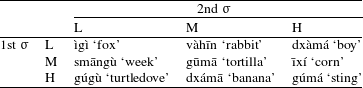
The tone-bearing unit (TBU) is the mora. All of the possible combinations of these three tones (tone melodies) are attested: L.L, L.M, L.H, M.L, M.M, M.H, H.L, H.M, and H.H, as illustrated in Table 2.
Tone melodies in Zilacayotitlán Tlapanec.

Among these tone melodies, L.H is rare and H.L is almost absent in some varieties, including Zilacayotitlán. In Zilacayotitlán, lexical tautosyllabic contours (on long vowels) are limited to LH, HM and ML but LM and HL contours also occur as a result of morpheme concatenation (Tiburcio Cano Reference Tiburcio Cano2017: 60). The TBU is the mora, and thus contour tones can only occur on long vowels. In addition to these three level tones, an underspecified tone has been proposed by Cline (Reference Cline2013). The underspecified tone is realized as a mid tone due to a rule called Default Mid Tone Insertion (Cline Reference Cline2013: 17), as in (4), unless other tone processes are applied. In (4) (and in the remainder of the paper), the form left of the arrow is the underlying form (here, a TBU with an underspecified tone, represented with no symbol on the tonal tier) and the form right of the arrow is the surface form; the dashed line connects a newly associated tone to the TBU (the mora) due to phonological processes.

The phonological behavior of an underlying mid tone and an underspecified tone are distinct, as we will see throughout this paper. In the underlying representations, the underspecified tone is unmarked while the mid tone is represented by a macron, as in ā.
A few works have been published on Tlapanec tonology, including Oropeza Bruno (Reference Oropeza Bruno2014) who looks at the phonetics and the phonology of Tlapanec tones, while Coto Solano (Reference Coto Solano2017) focuses on the perception of tone in Tlapanec. More specifically on tonal morphophonology, Black (Reference Black, de Azcona and Paster2005) offers an autosegmental account on the tonal changes that accompany noun inflection; Wichmann (Reference Wichmann and Ciscomani2006) describes tonal changes on verbs, more especially tonal changes that accompany the aspect-mode prefixes; and Cline (Reference Cline2013) is a more thorough account of tonal phonology and morphophonology (especially the tonal alternations that accompany suffixation). None of the studies listed above delves into the tonal alternations that accompany agent person marking discussed in this paper.
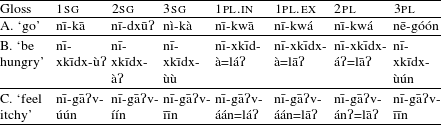
Tlapanec verbs obligatorily encode tense-aspect-mode (TAM) categories by a prefix, such as incompletive (na-/nu-), completive (ni-), potential (ma-/mu-), for example. Tlapanec verbs manifest semantically-based alignment (Suárez Reference Suárez1983; Wichmann Reference Wichmann, Engberg-Pedersen, Fortescue, Harder, Heltoft and Jakobsen1996, Reference Wichmann, de Azcona and Paster2005, Reference Wichmann, Malchukov and Spencer2009; Navarro Solano Reference Navarro Solano2012; Duncan Reference Duncan2017). The first class of verbs are agentive verbs, which we refer to as Class A verbs. They encode the agent (the sole agentive argument of an intransitive verb or the more agent-like argument of a transitive verb) with stem alternation (suppletion) and tonal alternation; they correspond to transitive verbs and ‘unergative’ verbs in Duncan (Reference Duncan2017). The second class includes non-agentive intransitive verbs (Class B), which encode their sole argument with a set of pronominal suffixes and enclitics that are also employed as the dative marker of a verb and the possessive marker on nouns; they correspond to the ‘dative’ verbs in Duncan (Reference Duncan2017). Lastly, Class C verbs are intransitive verbs which encode their sole argument with a set of pronominal suffixes which are also employed to encode the patient argument of a transitive verb or the subject of an adjective; they correspond to ‘unaccusative’ verbs in Duncan (Reference Duncan2017). There are also verbs which encode the subject with a combination of a Class A marker and a set of suffixes (‘pegative’ case in Wichmann Reference Wichmann, Engberg-Pedersen, Fortescue, Harder, Heltoft and Jakobsen1996). There is an ongoing discussion regarding whether or not the system is semantically based (Tiburcio Cano Reference Tiburcio Cano2017), but this issue is orthogonal to the topic of this paper.
The three classes of verbs are exemplified in Table 3. The verb ‘go’, a Class A verb, undergoes stem alternation according to person, as well as the change in the prefix tone. The verb ‘be hungry’, a Class B verb, encodes its sole argument via a set of suffixes and enclitics, while the prefix only encodes the TAM categories and this prefix is invariable. The verb ‘feel itchy’, on the other hand, has another set of suffixes and enclitics while the prefix only encodes the completive aspect, as in Class B.
Alignment classes in Tlapanec.

In this paper, we focus our discussion on Class A verbs, which encode their sole argument or the more agent-like argument with prefixes or stem alternation. We do not take into consideration Class B or Class C verbs for the following two reasons, even though some tonal alternations are observed in these classes of verbs too. First, the tonal alternations observed in Class B and C verbs are between the stem and the suffixes, while in this paper we are discussing the tonal alternations between the prefixes and the stems. Secondly, the tonal alternations for these classes of verbs were already discussed in detail in Black (Reference Black, de Azcona and Paster2005) and Cline (Reference Cline2013), who argue that the tonal alternations can be accounted for by underlying tones of the stems and suffixes, underspecification and tone spreading.
3 Tlapanec verb tonal alternations: A paradigmatic chaos
For regular Class A verbs, the majority of the verbs encode their agents purely by tonal alternations (with the sole exception of the 2sg prefix if the verb is not suppletive) in the completive aspect, as we saw in Table 1 above. In other TAM categories, segmental differences (such as vowel quality of the prefixes) also accompany tonal alternations. There are several patterns of tonal alternations, both for monosyllabic and disyllabic stems. In order to see how many and which patterns of tonal alternations are observed, we collected verb stems of the Class A which encode their agents purely by tones. In our database,Footnote [2] we found 86 Class A verbs which encode the agent by tonal alternation or stem alternation.Footnote [3] Among these, 15 verbs are (strongly) suppletive according to person (such as ‘go’ in Table 3). By suppletion we refer to cases where the semantic distinction between two forms is regular, while the formal distinction between them is not regular (Mel’čuk Reference Mel’čuk1976: 52) and specifically by strong suppletion where the forms in a suppletive relationship share no phonological material (Dressler Reference Dressler and Fisiak1985). Such suppletive verbs were excluded, since such verbs are mostly likely to be tonally suppletive (that is, they do not share the same lexical representation) too. Our preliminary analysis suggests that the tonal alternations of some suppletive verbs can also be accounted for by lexical tones of prefixes and stems as well as tone processes, by postulating a different set of lexical tones of prefixes for suppletive verbs and different lexical representations of stems within the paradigm, depending on the agent person; similar facts are reported for another Otomaguean language, Amuzgo (Kim Reference Kim, Palancar and Léo Léonard2016: 212).
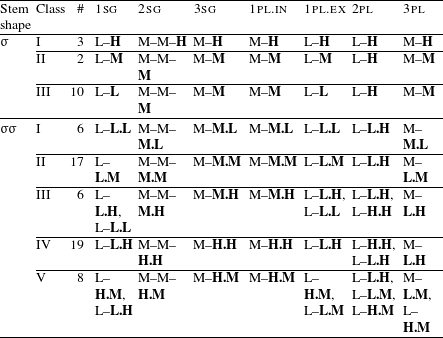
Table 4 summarizes the patterns of tonal alternations in the completive aspect forms of regular Class A verbs in Zilacayotitlán Tlapanec, obtained from our database. The labels under the column ‘Class’ are tentative and they will be given concrete phonological representations in Section 5. For monosyllabic stems, we found three patterns of tonal alternations, while for disyllabic verbs we found five patterns of tonal alternations. In Table 4, the stem tones are in boldface so that they are easily identifiable.
Tonal alternation patterns in completive in Zilacayotitlán Tlapanec.

In most cases, the 1sg, 1pl.ex and 2pl prefixes have a low tone, while other prefixes have a mid tone, except for the 3pl of the disyllabic Class V, which has a variant with a low tone. Monosyllabic Class I has a high tone on the stem consistently. Class II has a mid tone on the stem throughout, except for the 2pl where the stem has a high tone. Class III has a low tone in the 1sg and 1pl.ex, a high tone in the 2pl, and a mid tone in the other forms.
For disyllabic stems, Class I has a L.L melody in the 1sg and 1pl.ex, L.H in the 2pl and M.L in the other forms. Class II has a L.M melody in the 1sg, 1pl.ex and 3pl, L.H in the 2pl and M.M in the other forms. Class III has a L.H melody (L.L when there is a foot-medial glottal stop) in the 1sg, 1pl.ex, and 3pl on the one hand, and the 2pl has free variation between L.H and H.H melodies on the other; other forms have an M.H melody on the stem. Disyllabic Class IV has a L.H melody in the 1sg, 1pl.ex and 3pl, while the others have a H.H melody throughout, except that the 2pl has free variation between the H.H and L.H melodies. Class V manifests the greatest amount of variation: the 2sg, 3sg and 1pl.in forms have a H.M melody consistently, but the 1sg has free variation between H.M and L.H; the 1pl.ex has free variation between H.M and L.M; the 2pl has variation between L.H, L.M and H.M; and the 3pl has variation between L.M and H.M.
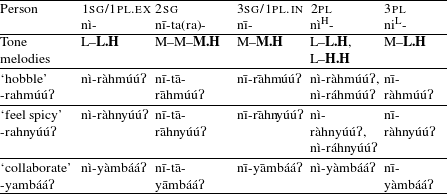
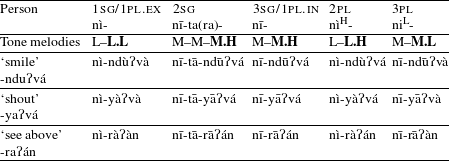
Table 5 exemplifies each class of tonal alternations in Table 4 with actual verb stems in the completive aspect.
Examples of each tonal alternation pattern.

A comparison of Tables 4 and 5 reveals some generalizations. First, the 1pl.ex always has the same tone melodies as the 1sg (except for ‘tie up’, which has variants that can distinguish between the two persons), and the same holds true for the 1pl.in and the 3sg. Footnote [4] Thus, in the following discussion, the cells for the 1sg and 1pl.ex on the one hand and those for the 3sg and 1pl.in on the other are collapsed, except for the cases where they do contrast. We further note that the tone melodies of the 2sg are the same as those of the 3sg, except that the 2sg has the 2sg agent prefix.
Besides these cases of systematic syncretism, the generalizations that hold between cells appear to be hard to achieve. First, the tones on the stems or the prefixes are not consistent, which makes it challenging to postulate underlying tones of stems and prefixes. Secondly, the tone melodies for each person are not consistent either, which makes an analysis with a templatic, non-concatenative morpheme for agent persons unlikely. Thirdly, some cells have free variation (or overabundance, the availability of more than one realization for the same content cell – see Thornton Reference Thornton2012), such as the 2pl form of Classes III, IV and V of disyllabic stems. Lastly, the patterns of syncretism are unsystematic. For instance, the 3sg (as well as 1pl.in) and the 3pl forms are identical for monosyllabic stems and for the Class I disyllabic stems, while the 1pl.ex and the 2pl forms are identical for the Class I monosyllabic stems and some Class IV and V disyllabic stems; in addition, the 1pl.ex and/or 2pl and the 3pl forms can be identical for some Class V disyllabic stems.
On the other hand, the number of the patterns of tonal alternations is quite restricted, and irregularity (i.e. verbs that are not suppletive but whose tones do not fit into any of the patterns in Table 4) is scarce: three for monosyllabic stems and five for disyllabic stems, which is fewer than the number of level tones (low, mid, high and underspecified) and possible combinations of these four tones (
 $4\times 4=16$
combinations). This suggests that the system is rule-based, rather than a random collection of allomorphs (or, allotones).
At this point, a question arises whether we are dealing with inflectional classes, where the agent persons are encoded by templatic tonal patterns which vary according to the inflectional class, or whether these tonal alternation patterns can be accounted for by the underlying tones of prefixes and stems. In this paper, we argue that the latter is the case. Before elaborating on such an analysis in Section 5, let us first introduce some phonological prerequisites in Section 4.
4 Phonological prerequisites
In this section, we first present the lexical representations of the TAM prefixes and stems (Section 4.1). We then present tone processes which apply between them when TAM prefixes are attached to verb stems (Section 4.2), as well as the tonal constraints at work in Tlapanec tonal alternations (Section 4.3).
4.1 Lexical representations of prefixes and stems
4.1.1 Lexical representations of prefixes
We propose that the TAM prefixes have lexical tones as shown in Table 6.
TAM prefixes of Zilacayotitlán Tlapanec.

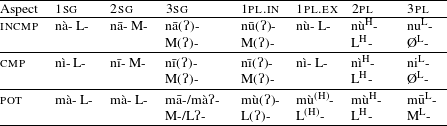
The incompletive and completive prefixes (as well as the simultaneous, progressive, exhortative and desiderative prefixes) share the same pattern of tonal alternations, while the potential prefix has another pattern. In the incompletive and completive, the 1sg, 1pl.ex and 2pl have a low tone, 2sg, 3sg and 1pl.in have a mid tone, while the 3pl is toneless (see Cline (Reference Cline2013: 22, 117) for a different proposal). The 2pl and 3pl forms are associated with floating tones, which will be explained in detail in Section 4.2.2.Footnote [5] In the potential mood, the 3sg and 3pl forms have a mid tone but others have a low tone, except that the 3sg has a low tone when the prefix is accompanied by a glottal stop. The 1pl.ex, 2pl and 3pl forms are associated with a floating tone. The floating high tone of the potential 1pl.ex is optional in many cases as we will see below, thus in parenthesis.
In many cases, a toneless syllable is realized with a mid tone due to Default Mid Tone Insertion in (4) above, and thus it is often unclear whether the underlying tone is toneless or mid. We tentatively postulate a mid tone where evidence is lacking. For the incompletive/completive 3pl, we postulate an underspecified tone, since the floating low tone (Section 4.2.2.1) associated with this prefix can dock to this vowel regressively. This contrasts with the potential 3pl, where the floating low tone cannot dock regressively (since it is specified for a mid tone).
In addition to the prefixes in Table 6, 2sg is further encoded by a prefix t (a)ra-/r (a)- ∼~t (a)-,Footnote [6] which comes between the TAM prefix and the stem (Suárez Reference Suárez1983: 124ff.). The TAM prefixes further undergo phonologically conditioned allomorphy. First, the high vowels of the prefixes (i and u) alternate with a mid vowel (e and o) in certain contexts, including when the stem begins with a non-high vowel (Tiburcio Cano Reference Tiburcio Cano2017: 72). Secondly, the nasal (n-, m-) of the prefixes alternates with prenasalized plosives (nd-, mb-) when the stem begins with a semivowel (Suárez Reference Suárez1983: 194). Lastly, a glottal stop is found after the TAM prefixes in 3sg and 1pl.in when the stem is monosyllabic and there is no other glottal stop in the stem, but this glottal stop is deleted when the stem is disyllabic or has a glottal stop (see Suárez Reference Suárez1983: 197ff.; Navarro Solano Reference Navarro Solano2012: 102–107; Cline Reference Cline2013: 115).
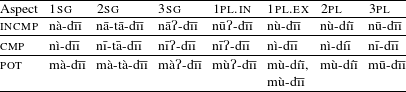
The following paradigm of a verb -dı̄ı̄ ‘bury’ in Table 7 illustrates the conjugation of the incompletive, completive and potential forms. Note that a glottal stop is inserted in the 3sg and 1pl.in forms between the prefix and the stem since the stem is monosyllabic and does not have a glottal stop. Furthermore, the potential form of the 1pl.ex shows a variation between the two tonal melodies.
Conjugation of -dı̄ı̄ ‘bury’.

4.1.2 Lexical representations of stems
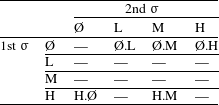
In Zilacayotitlán Tlapanec, verb stems can have Ø, M or H tones for monosyllabic stems.Footnote [7] Disyllabic Class A stems in Zilacayotitlán Tlapanec can have the following tone melodies: Ø.L, Ø.M, Ø.H, H.Ø and H.M.Footnote [8] This is shown in Table 8.
Tone melodies of Class A verb stems in Zilacayotitlán Tlapanec.

4.2 Tone processes
In this subsection, we will introduce some tone processes which apply when the TAM prefixes and stems are combined. As we will see, many of the tone processes were already independently proposed by Cline (Reference Cline2013) to account for the distribution of the tone of noun stems and the interaction of the stem tone and suffix tones for Class B and C verbs in Acatepec Tlapanec. In this section, we reassess Cline’s proposal and modify them where necessary to account for the Zilacayotitlán Tlapanec data.
4.2.1 Tone Spreading
4.2.1.1 Low Tone Spreading
The low tone spreads progressively to the following toneless syllables until it is blocked by a syllable specified with a tone. In (5) and throughout this paper, the solid line associates the lexical tone to the TBU, and the dashed line connects a newly associated tone to the TBU (the mora) due to phonological processes.

The following pair illustrates Low Tone Spreading. The 2sg agent prefix tara-/ta- is toneless, and its tone is always the same as the prefix that precedes it. Thus, in (6a) the low tone of the potential 2sg prefix mà- spreads to both syllables of the prefix. (6b) justifies the lexical underspecified tone of this prefix, which is realized as a mid tone, due to Default Mid Tone Insertion in (4).Footnote [9] Throughout this paper, glossed examples appear with the surface form in the first line, the underlying (lexical) representation with segmentation in the second, followed by the autosegmental representation as well as glosses and translation.

Low Tone Spreading can only apply when the low tone is lexically linked to a syllable; a floating low tone docked to a syllable due to Floating Low Tone Docking (Section 4.3.1.1) cannot spread.
4.2.1.2 High Tone Spreading
A high tone spreads to the following low-toned or toneless syllable (Cline Reference Cline2013: 26):

High Tone Spreading is illustrated by the following examples (the analysis here follows Cline Reference Cline2013). The tones of both (8a) and (9a) are realized as a sequence of H.H, but they show a contrast when possessor suffixes are attached; the tone contours on the second syllable is LM in (9b) and HM in (9b). This difference is accounted for by considering that (8a) has an underlying /H.L/ melody while (9a) has /H.Ø/ and that the underlying tone surfaces in (8a) when this suffix is attached. In both cases the final mora of the suffix has a mid tone due to Default Mid Tone Insertion in (4).Footnote [10]


High Tone Spreading is only progressive and cannot be regressive;Footnote [11] a high tone does not spread to the preceding syllable, even if it is a toneless syllable. This can be confirmed by examples such as (10), where a high tone on the first syllable of the stem is preceded by a prefix with a toneless syllable, yet the high tone does not spread.

4.2.2 Floating tone docking
The 2pl prefix in incompletive/completive and potential and the 1pl.ex prefix in the potential are associated with a floating high tone, while the 3pl prefix is associated with a floating low tone, as we saw in Section 4.1.1. This subsection describes how these floating tones dock to the TBU.
4.2.2.1 Floating Low Docking
The 3pl prefix has a floating low tone. The floating low tone associated with the 3pl prefix can dock only to a disyllabic stem; this is a language-specific stipulation for which we have not been able to determine the motivation. The Floating Low Docking can either be progressive or regressive. The floating low tone docks to the following first syllable of the stem when this syllable is lexically toneless or has a high tone, and not followed by a low tone (11a).Footnote [12] When the second syllable of the stem has a low tone, the Floating Low Docking applies vacuously; that is, this floating low tone docks to this syllable, deleting its lexical low tone (11b), instead of docking to the first syllable of the stem; this is possibly due to the Obligatory Contour Principle (OCP; e.g. Leben 1973, Myers Reference Myers1997), which bans sequences of identical tones (in this case, low tones).Footnote [13] See Section 4.3 for this constraint. In some cases (with H.M stems) in the completive, as we discuss in Section 5.4.2, the verbs can have a free variant in (11c) where this floating low tone docks to the prefix itself (which is toneless) when the first syllable of the root has a high tone, in addition to the form in (a).

The following examples illustrate Floating Low Docking. In (12a), the floating low tone of the prefix docks to the first syllable of the stem which is lexically toneless. (12b) justifies the underlying tone melody of this verb stem; the mid tone on the prefix vowel in (12a) and on the first syllable of the stem in (12b) is due to Default Mid Tone Insertion in (4).

The structures in (13a) illustrates Floating Low Docking on a stem with a low tone in the last syllable. Low Tone Docking vacuously applies and the floating low tone docks to this last syllable, deleting its lexical low tone. The 3sg form in (13b) happens to be homophonous with the 3pl form in (13a) but their underlying structures are different. In both cases the middle syllable acquires the mid tone by Default Mid Tone Insertion in (4), which applies after Low Tone Docking and thus does not incur crossing of association lines.

The examples in (14) and (15) illustrate Low Tone Docking with the stems that lexically have a high tone on their first syllable.


In (14a), the floating low tone docks to this first syllable of the stem, displacing the lexical high tone to the following syllable. In (15a), on the other hand, the floating low tone of the prefix docks to the prefix vowel, which is toneless, while in (15b), a free variant of the same form, the floating low tone docks to the first syllable of the stem, replacing its lexical high tone. Again, (14b) and (15c) confirm the underlying tone melodies of the verb stems.
4.2.2.2 Floating High Docking
The floating high tone associated with the 2pl prefix (both in incompletive/completive and in potential) and the 1pl.ex prefix (in potential) docks to a following syllable, unless a lexical high tone is already present; thus, it would only apply to Ø, M, Ø.L, or Ø.M stems. This is again possibly due to a constraint motivated by the OCP that prohibits a sequence of two high tones associated with different nodes. Unlike Floating Low Docking, the floating high tone can dock to monosyllabic stems, and Floating High Docking can only be progressive.

The example in (17a) illustrates Floating High Docking.

Here, the first mora of the stem is specified for a mid tone and the low tone of the prefix cannot spread, and the floating high tone of the prefix docks onto this mora, forming a HM contour. The (b) form confirms the underlying tone melodies of the verb stems.
4.3 Tonal constraints
When a prefix and a verb stem are concatenated, their underlying tones do not surface as they are, due to the tone processes discussed in Section 4.2. Furthermore, the applicability of these tone processes is subject to certain tonal constraints (Yip Reference Yip2002). In this section we list the tonal constraints that are operative in Zilacayotitlán Tlapanec. First, we introduce three faithfulness constraints:

The two Max-T constraints ban deletion of the lexical tone, the one on the last syllable of the stem, the other on non-final syllables; this splitting of a constraint by position is supported by the crosslinguistic tendency that word-final syllables are susceptible to changes (e.g. Iverson & Salmons Reference Iverson and Salmons2011). *Shift in (18c) bans shifting of tones to another syllable; this constraint combines *Associate, which prohibits a new association line, and *Disassociate, which penalizes removal of an association line (Yip Reference Yip2002: 83).
The following are the markedness constraints necessary to account for the tone alternations in Zilacayotitlán Tlapanec:

The constraint in (19a), OCP, was already introduced in Section 4.2. The two *Float constraints, (19b) and (19c), require that floating tones be realized. (19d) SpecifyT requires that a TBU must be specified; in Zilacayotitlán Zapotec, we interpret this constraint to penalize an underlying toneless syllable realizing as a mid tone due to Default Mid Tone Insertion in (4) when preceded by a low or high tone.Footnote [14] NoTautomorphemicDocking in (19e) penalizes regressive docking of a floating tone to the morpheme that introduced it (McPherson Reference McPherson2016: e52); this could be related to the crosslinguistic tendency that tonal processes are generally progressive rather than anticipatory (Hyman & Schuh Reference Hyman and Schuh1974: 97). Constraint (19f) *LʔH disprefers a L.H melody with a glottal stop in the middle; a dispreference for such a sequence can be observed in the conjugations of Ø.H stems (Section 5.3.4 below) and H.M stems (Section 5.4.2) as well as the fact that the allomorph of the 3sg potential, màʔ-, has a mid tone when followed by a stem-initial high tone (māʔ-tsíı̄n [pot.3sg-play], not * màʔ-tsíı̄n; see Section 5.1 below). Lastly, (19g) is a language-specific constraint that penalizes a word with three or more syllables and with an initial singly-linked low tone (e.g. L.M.M, L.H.H):

These constraints are ranked consistently as presented in (21).

The justification for this ranking will be provided throughout the next section.
5 A phonological analysis of Tlapanec tonal alternations
In this section, we analyze each tonal alternation pattern presented in Section 3 with the phonological apparatus presented in Section 4. We first show data for the tonal alternations in the completive aspect; the same tonal alternation patterns are observed for the incompletive aspect. We then present the potential forms, which have different patterns of tonal alternation due to the different lexical tones of the prefixes. We begin with verb stems which do not undergo tonal alternations, H stems (Section 5.1). We then look at the verb stems which only undergo floating tone docking, but not tone spreading: M stems (Section 5.2). In Section 5.3 we look at verb stems which undergo both tone spreading and floating tone docking: Ø, Ø.M, Ø.L, and Ø.H stems. Finally, in Section 5.4, we discuss stems which undergo both tone spreading and floating tone docking, as well as chain of tone displacement: H.Ø and H.M stems.
5.1 No tone process applied: H stems
For monosyllabic verb stems with the tone melody H, the lexical tones presented in Section 4.1 are realized faithfully; this is because (i) a low tone on the prefixes cannot spread to a syllable with a high tone, (ii) the Floating Low Docking does not apply since the root is monosyllabic (recall that Floating Low Docking only applies to polysyllabic stems), and (iii) the Floating High Docking does not apply since the root already has a high tone.
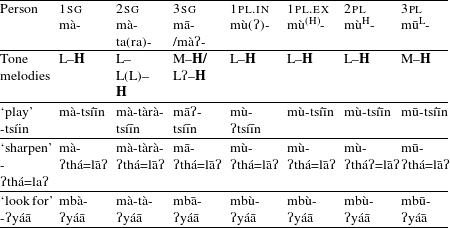
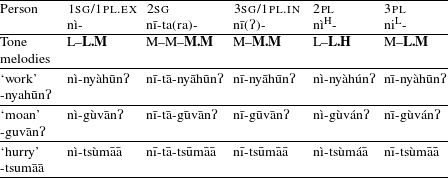
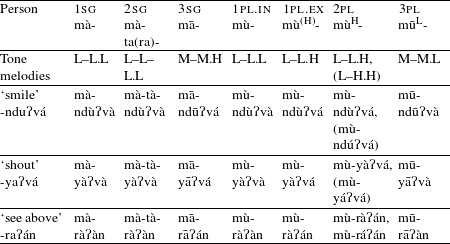
The paradigms in Table 9 show conjugations of the completive forms of the H stems. Three verb stems from our database follow this pattern, without any exceptional cells. The verbs ‘play’ and ‘look for’ have the HM contour tone on the stem, but we consider them to be a subclass of the H stems, since their behaviors are the same; this is because in monosyllabic stems only the first tone of the syllable is relevant. The verb ‘sharpen’ has an enclitic =lāʔ which is an iterative marker (Wichmann Reference Wichmann1992).Footnote [15] The verb ‘look for’ has two variant forms in 3pl; one of these variants, ndı̄ʔyáā, is the expected regular form, while the other variant, ndı̄ʔyāà is irregular (although the low tone on the last mora could be due to the floating low tone associated with the 3pl prefix). The stem tones are in boldface.
H stems (completive).

H stems (potential).

In the potential forms, the prefix tones for the 2sg, 1pl.in, 1pl.ex and 3pl are different (in addition to the difference in vowel quality), as we saw in Section 4.1.1: 2sg
mà-, 1pl.in
mù-, 1pl.ex
mù
 $^{(H)}$
- and 3pl
mū
 $^{L}$
-. However, none of the tonal processes apply here either, and the stem tone is consistently high as in the completive forms, as can be seen in Table 10.
5.2 Floating Tone Docking: M stems
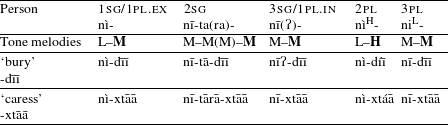
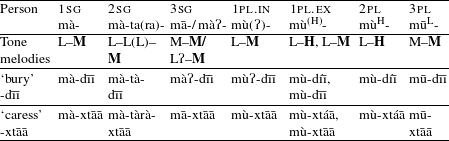
Monosyllabic verb stems with the tone melody M undergo Floating High Docking in the 2pl (both in the completive and the potential) and optionally in the potential 1pl.ex form. In this case, the floating high tone associated with these prefixes docks to the only syllable of the stem. Otherwise these verbs do not undergo any tonal alternations in the stem. Low Tone Docking does not apply in the 3pl since the stems are monosyllabic. None of the tone spreading processes apply either, because the first syllable of the root is specified for tones (and thus the Low Tone Spreading cannot apply), and the High Tone Spreading cannot apply since there is no high tone either on the prefix nor on the stem. We have found two such stems in our database, without any exceptional cells. Conjugations of these verbs in the completive is presented in Table 11.
M stems (completive).

M stems (potential).

See (17) above for the derivation of the 2pl form of ‘caress’. For this form, the L–H melody is more optimal than the L–M melody due to the ranking *Float(H) » Max-T(final) as was proposed in Section 4.3; that is, an unassociated floating high tone (symbolized by  ) would be costlier than deletion of the tone on the final syllable of the stem. This is illustrated in the following tableau. Throughout this paper, tone symbols in a circle (such as
 ) represent a floating tone that does not find a docking site and remains floating.

The tonal melodies of the potential forms also follow from the simple concatenation of the prefix tones and stem tones (Table 12). Here again, the only difference in the tonal melody is in the 2sg and 1pl.in forms, which have low tone on the prefixes, and 1pl.ex, which has a low tone with a floating high tone, as in 2pl. Again, the stem tones are consistent, except for the 1pl.ex and 2pl forms where Floating High Docking is applied: in the case of 1pl.ex, Floating High Docking is optional while, in the case of 2pl, it is obligatory; this difference in optionality is because the 1pl.ex prefix has two allomorphs in free variation, with and without the floating high tone (mù- or mù H -).
5.3 Floating Tone Docking and Low Tone Spreading: Ø, Ø.M, Ø.L and Ø.H stems
Stems which begin with a toneless syllable, namely the tone melodies Ø, Ø.M, Ø.L and Ø.H, undergo Low Tone Spreading as well as Floating Tone Docking.
5.3.1 Ø stems
Toneless monosyllabic stems undergo Low Tone Spreading when the prefix has a low tone (i.e. the 1sg and the 1pl.ex in the completive and the 1sg, 2sg, 1pl.in, 1pl.ex and 2pl in the potential). Furthermore, Floating High Docking is applied in the 2pl (both completive and potential) and in the potential 1pl.ex forms. Floating Low Docking in the 3pl does not apply since the stem is monosyllabic. We have found ten such stems, with only one exceptional cell, the completive 2sg of ‘dance’, -sya, which is nı̄tārāsyá, instead of the expected *nı̄tārāsyā. We show below a sample conjugation of the completive forms of three verbs which belong to this class in Table 13. Other verb stems which belong to this class are: -baàn ‘move (it)’, -sya ‘dance’, -tha=lā’ ‘defecate (it)’,Footnote [16] -thaa ‘defecate’, -tsi ‘buy’, -xkaa ‘crawl’, and -ya (with mina’ refl) ‘observe oneself’.
Ø stems (completive).

The following examples show derivation of the 1sg and the 2pl forms of ‘do’. In (23a), the low tone of the prefix spreads to the only syllable of the stem while, in (23b), the floating high tone associated with the prefix docks to the stem syllable.

Table 14 shows the potential forms of the verbs in Table 13. The differences with the completive forms in terms of tones are the 2sg and 1pl.in forms which have a low tone on the prefixes, and the 1pl.ex which has a low tone with a floating high tone as in the 2pl. As can be predicted, the low tone of the 2sg and 1pl.in prefixes spreads to the stem syllable, and the floating high tone of the 1pl.ex optionally docks to the stem syllable (in the case of ‘vomit’, it is obligatory). The 3sg of ‘do’ also has a low tone on the prefix (since the allomorph with a glottal stop has a low tone; recall Section 4.1.1 above) but this low tone does not spread to the stem.
Ø stems (potential).

5.3.2 Ø.M stems
The Ø.M stems undergo Low Tone Spreading when the prefix has a low tone (i.e. the 1sg and 1pl.ex in the completive, on the one hand, and 1sg, 2sg, 1pl.in, 1pl.ex and 2pl in the potential on the other), as well as Floating High Docking in the 2pl (both completive and potential) and 1pl.ex in the potential, and Floating Low Docking in the 3pl forms. There are seventeen such stems, with only one irregular cell: the completive 1sg of ‘dream’, -gundāā, is nı̄gúndāā, instead of the expected *nìgùndāā. Table 15 shows the sample paradigms of the completive forms of three verbs which manifest this pattern of tonal alternation. Other verb stems belonging to this class are: -gavı̄ı̄ ‘try’, -gongōō ‘fetch’, -gundāā ‘dream’, -kwatūūn ‘take possession of’, -mahān ‘get wet’, -rganı̄ı̄ ‘make stagger’, -rgunı̄ʔ ‘smoke’, -smahāānʔ ‘make wet’, -tuvı̄ı̄n ‘grasp’, -xkathū ‘scratch’, -xkaxı̄ì ‘wake (someone) up’, -yamāā ‘observe, spy’, -rruthū ‘cut’, and -rrubū ‘pull’.
Ø.M stems (completive).

The following examples illustrate the derivation of the 1sg (Low Tone Spreading), the 2pl (Floating High Docking) and the 3pl (Floating Low Docking) forms of the verb ‘work’:

In (24a), the low tone of the prefix spreads to the first toneless syllable of the stem. In (24b), the same tone spreading applies, in addition to the docking of the floating high tone of the 2pl prefix to the final syllable of the stem which is lexically mid. In (24c), the floating low tone docks to the first syllable of the stem which is toneless.
In (24b), the floating high tone docks to the final syllable of the stem rather than the first toneless syllable; this is due to the ranking *#LXX » Max-T(final); that is, having an initial singly-linked low tone is costlier than deleting the final tone of the stem. This is illustrated in tableau (25):

In the 3pl form in (24c), the floating low tone docks to the toneless first syllable of the stem, rather than docking regressively to the prefix vowel or progressively to the last syllable of the stem overwriting its lexical mid tone. This is because docking the floating low tone regressively would incur violation of NoTauMorDoc in (26b) below on the one hand (in addition to SpecifyT, since a mid tone is inserted on the toneless syllable due to Default Mid Tone Insertion in (4) even though it is preceded by a low tone), and docking it to the last syllable of the stem would induce violation of Max-T(final) in (26c) on the other. The attested form in (26a) does not violate any tonal constraints listed in Section 4.3. Recall that a floating low tone docked to a syllable cannot spread, thus (26b) cannot have the L–L.M melody.

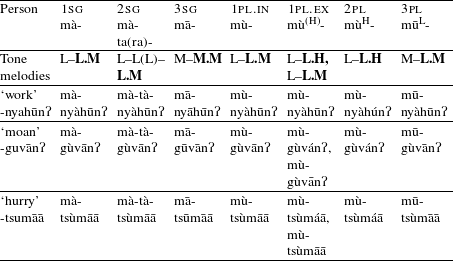
Table 16 illustrates the potential forms of the verbs in Table 15. Again, the differences in the tone melodies from the completive forms can be accounted for by the differences in the lexical tones of the prefix. Unlike completive forms, the 2sg and 1pl.in prefixes have a low tone, which spreads up to the first toneless syllable of the stem, as expected. The 1pl.ex form has a floating high tone, which optionally docks to the final syllable of the stem (except for ‘work’, where this floating high tone cannot dock for some reason). High Tone Docking is obligatory for the 2pl forms.
Ø.M stems (potential).

5.3.3 Ø.L stems
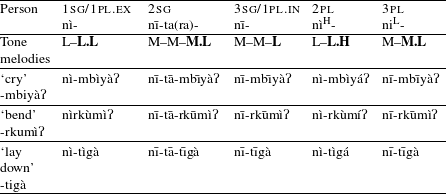
The Ø.L stems undergo Low Tone Spreading when the prefix has a low tone (i.e. the 1sg and the 1pl.ex forms in the completive, and the 1sg, 2sg, 1pl.in, 1pl.ex and 2pl in the potential), and Floating High Docking in the 2pl forms and optionally in the 1pl.ex forms of the potential. We found six such stems in our database, with only the completive 2pl of ‘harvest’ -nuhùn being irregular: nìnúhún, not the expected *nìnùhún.Footnote [17] The conjugations of three such verbs are exemplified in Table 17. Other verbs which have the same tonal patterns as these verbs are: -nuhùn ‘harvest’, -raxùù ‘ask (a question), greet’, and -xkrigàà ‘trap’.
Ø.L stems (completive).

The following examples illustrate the derivation of the 1sg and 2pl forms of ‘lay down’:

In (27a), the low tone of the prefix spreads to the first syllable of the stem which is toneless. In (27b), the same Low Tone Spreading applies and, in addition, the floating high tone of the 2pl prefix docks to the final syllable of the stem, overwriting the lexical L.
In (27a), the low tone spreads to the following toneless syllable despite the presence of the lexical low tone in the final syllable, violating OCP; however, this is the optimal form since no spreading of the low tone would result in a L–M.L sequence which would incur violation of *SpecifyT (which penalizes a toneless syllable to be realized as a mid tone when preceded by a high or low tone), as well as *#LXX (no initial singly-linked low tone), both of which dominate OCP; this is illustrated in (28).

Furthermore, we observe that in cases such as (27b) the low tone of the prefix spreads to the first syllable of the stem and then the floating high tone docks to the last syllable of the stem, rather than the first syllable which is toneless. This is due to *#LXX, which disprefers the initial singly-linked low tone in a word with three or more syllables, introduced above in Section 4.3. Examples such as (27b) demonstrate that this markedness constraint is ranked higher than the faithfulness constraint against deletion of an underlying tone on the final syllable, namely Max-T(final).
The tableau in (29) illustrates the interaction of Low Tone Spreading and Max-T(final) in the example of nìtìgá ‘y’all laid him down’.

The candidates (a) and (c) incur violation of *#LXX and thus are less optimal than the candidate (b). The candidate (d) is eliminated since it has a toneless syllable being realized with a mid tone even though it is preceded by a low tone, violating SpecifyT.
The 3pl forms are homophonous with the 3sg forms, but here we consider that in fact floating low tone docking vacuously applies: the floating low tone docks to the last syllable, overwriting its lexical low tone, as in (30a).

The tableau in (31) illustrates this.

The candidate in (a) violates only low-ranked Max-T(final), thus optimal. The candidate in (b) induces violation of OCP, since two low tones are adjacent that are associated to different nodes. The candidate in (c) incurs violation of SpecifyT since the toneless syllable is realized as a mid tone even though preceded by a low tone, as well as NoTauMorDoc and *#LXX. Note that a floating low tone docking to a syllable cannot spread, thus (c) cannot have a L–L.L melody. Candidate (d) has the same surface realization as candidate (a), but violates *Float(L), which is highly ranked.
Table 18 shows the potential forms of the verbs in Table 17. Again, the differences in the tonal melodies can be attributed to the differences in the lexical tones of the prefixes. The 1sg, 2sg and 1pl.in forms have a low tone in the prefix, which spreads to the first toneless syllable of the stem, as is predicted. The 1pl.ex forms have two variants since Floating High Docking is optional here, while it is obligatory in 2pl.
Ø.L stems (potential).

5.3.4 Ø.H stems
The Ø.H stems undergo Low Tone Spreading when the prefix has a low tone (i.e. the 1sg and 2pl in the completive on the one hand, and 1sg, 2sg, 1pl.in and 2pl in the potential on the other) and Floating Low Docking in the 3pl. There are six such stems in our database. The Ø.H stems are divided into two subclasses, according to the presence or absence of a foot-medial glottal stop in the stem. First, when there is no foot-medial glottal stop, the surface tone melodies are as predicted from the interactions of the lexical tones and tonal processes. Table 19 shows tonal melodies of such verbs in the completive.
Ø.H stems I (completive).

The following examples illustrate the derivation of the 1sg and 3pl forms of ‘hobble’:

In (32a), the low tone spreads from the prefix to the first syllable of the stem which is toneless. In (32b), the floating low tone docks onto the first syllable of the stem which is toneless.
In the 2pl forms for ‘hobble’ and ‘feel spicy’ (but not ‘collaborate’), we note free variation between the L–L.H and L–H.H melodies. This is possibly due to the equal ranking of the constraints *#LXX and *Float(H), as can be seen in (33): the candidate (a) violates *Float(H), since the floating high tone of the 2pl prefix remains floating, while the candidate (b) violates *#LXX because it has an initial singly-linked low tone. The candidate (b) further violates OCP but survives possibly because the L–H.H melody can disambiguate itself from 1sg/1pl.ex.

The second subclass of the Ø.H stems has a glottal stop in the foot-medial position (Table 20). In such a case, the 1sg/1pl.ex and the 3pl forms have the tone melodies L–L.L and M–M.L in the completive, instead of the expected L–L.H and M–L.H, respectively (while the 2pl has the expected L–L.H melody).
Ø.H stems II (completive).

The following examples illustrate the derivation of the 1sg and the 3pl forms of ‘shout’:

In (34a) the low tone of the prefix spreads all the way up to the last syllable of the stem. In (34b) the floating low tone docks onto the last syllable and the first syllable of the stem is assigned a mid tone by default.
The L–L.L and M–M.L melodies are found for the 1sg and 3pl forms, instead of the expected L–L.H and M–L.H; this is because the sequence low–glottal–high (LʔH) is dispreferred. The LʔH melody does occur in the 2pl form of these verbs as well as in the 1sg, 2pl and 3pl of the H.Ø stems (Section 5.4.1) and in the 1sg and 2pl forms of the H.M stems (Section 5.4.2). However, these facts can be accounted for by the relative ranking as proposed in Section 4.3: *Float(H) »*LʔH » Max-T(final).
The tableau in (35) illustrates the selection of the 1sg form of ‘shout’.

Here, the candidate (b), with the low tone spreading all the way to the last syllable, is the most optimal, since the candidate (a) violates *LʔH that is ranked higher.
In the 2PL form of ‘shout’ in (36), on the other hand, candidate (a) is the optimal one since (b) violates *Float(H) which is ranked higher.

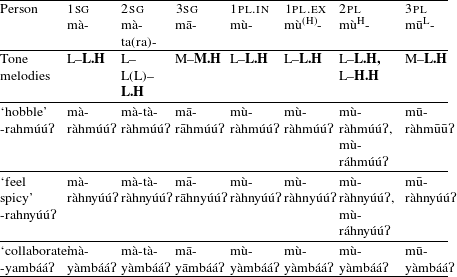
Tables 21 and 22 show the potential forms of the verbs in Tables 19 and 20 above. Again, the tonal melodies are split according to the presence or absence of a glottal stop in the foot-medial position. Table 21 shows the potential forms of the verbs in Table 19. The differences in the tonal melodies of some completive forms are due to differences in the lexical tones of the prefixes. The 1sg, 2sg and 1pl.in forms have a low tone on the prefix, which spreads predictably to the first toneless syllable of the stem. The 1pl.ex prefix has a floating high tone, and this floating high tone vacuously docks to the final syllable of the stem. As in the completive, the 2pl forms show variation between the L–L.H and L–H.H melodies.
Ø.H stems I (potential).

Ø.H stems II (potential).

Table 22 shows the potential forms of the verbs in Table 20, which have a glottal stop in the foot-medial position. Prefixes with a low tone (1sg, 2sg and 1pl.in) spread this low tone all the way up to the final syllable of the stem, as in the completive. The 3sg and 3pl forms have the same tonal melodies as in the completive. In the 1pl.ex, the floating high tone vacuously docks to the final syllable. The 2pl form shows variation between the L–L.H and L–H.H melodies but the latter is uncommon for ‘smile’ and ‘shout’.
5.4 Chain of tone displacement: H.Ø and H.M stems
The most complex tonal alternations are observed with the disyllabic lexical tone melodies beginning with a high tone, namely H.Ø and H.M. For these tone melodies, a tone on one syllable replaces the tone on the next syllable, and the tone on this syllable gets further pushed forward to the following syllable (chain of tone displacement, as is reported for languages such as Kikuyu in Clements Reference Clements, Clements and Goldsmith1984).
5.4.1 H.Ø stems
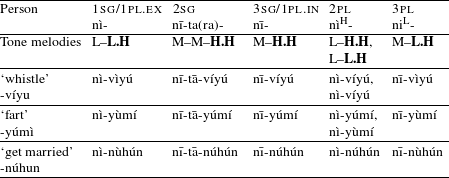
The H.Ø stems (such as -víyu ‘whistle’) are never realized as the H.M sequence and thus the analysis presented here is somewhat abstract. First, High Tone Spreading applies when the prefix has a mid tone (i.e. 2sg, 3sg and 1pl.in in the completive and 3sg in the potential), and thus the underlying /H.Ø/ is realized as the H.H melody (nı̄-víyú [cmp.3sg-whistle]). Secondly, the low tone of the prefix spreads to the first syllable of the stem when the prefix has a low tone (i.e. the 1sg and 1pl.ex in the completive and the 1sg, 2sg, 1pl.in, 1pl.ex and 2pl in the potential) and pushes forward this high tone to the following syllable, surfacing with the tone melody L.H (nì-vìyú [cmp.1sg-whistle]). Furthermore, the floating low tone of the 3pl prefix docks to this first syllable of the stem, and this also causes the displacement of the high tone to the following syllable, resulting in the L.H melody (nı̄-vìyú [cmp.3pl-whistle]).
However, we saw in Section 4.2.1.1 that the surface H.H sequence results from the underlying /H.Ø/ sequence by High Tone Spreading, and we postulate this underlying tone melody for these stems. Both the underlying /H.L/ and /H.Ø/ melodies surface as a H.H melody, but postulating an underlying /H.Ø/ melody is justified, since their suffixed forms have a HM contour on the 3sg suffix, rather than the LM contour which occurs with the /H.L/ melody:

In our database, we found nineteen verb stems which can be analyzed to have a lexical /H.Ø/ melody. There are no exceptional cells, but the completive 2pl forms of most of the verbs have free variation between the tone melodies L–H.H and L–L.H, which will be discussed below. Three of these verbs are listed in Table 23; other verbs which belong to this class are: -gíxiʔ ‘breathe’, -ndóthaaʔ ‘spit’, -rámi ‘whistle’, -ráʔtsinʔ ‘sneeze’, -hrígu ‘lower’, -rtígu ‘reduce’, -tá’aā ‘hang’, -tsína ‘whine’, -txíʔnaʔ ‘stumble’, -txípa ‘make tortillas, crush’, -xkúxi ‘lift’, -xpáʔan ‘bury’, -xpíʔtha=lāʔ Footnote [18] ‘divide’, -xpríguū ‘appease’, -xúʔmbiı̄ ‘grill’, -yáxi ‘gather’.
H.Ø stems (completive).

The following examples illustrate the derivation of the 1sg, 3sg and 3pl of ‘whistle’:

In (38a), the low tone of the prefix spreads to the first syllable of the stem, replacing its lexical high tone, and this high tone is further pushed to the last toneless syllable. In (38b), the high tone of the first syllable of the stem regularly spreads to the following syllable due to High Tone Spreading. In (38c), the floating low tone docks onto the first syllable of the stem, pushing forward its underlying high tone to the last syllable. Note that the constraint *#LXX only disprefers an initial singly-linked low tone, thus (38c) does not violate this constraint.
The tableau in (39) illustrates the 1sg form of ‘whistle’.

Candidate (a) incurs violation of *Shift since the high tone on the first syllable of the stem is displaced to the following toneless syllable. Here Max-T(non-final) is not violated since the high tone on the first syllable of the stem is simply displaced to the following toneless syllable, and not deleted. Candidate (b) has an initial singly-linked low tone and thus violates *#LXX. This constraint is ranked higher than *Shift, and thus is eliminated. It could also be the case that candidate (b) is avoided because this form would be homophonous with the 2pl form. Candidate (c) violates SpecifyT since the last syllable has a mid tone due to Default Mid Tone Insertion in (4) even though it is preceded by a high tone.
The tableau in (40) illustrates the 3pl of ‘whistle’.

Candidate (b) incurs violation of NoTauMorDoc by docking its floating low tone to the prefix, as well as *#LXX. Recall that docked floating tone cannot spread, thus candidate (b) cannot have a L–L.H melody.
The following examples of ‘whistle’ illustrate free variation in the 2pl forms between the L–L.H and L–H.H melodies:

In (41a), floating high tone docking applies vacuously: the floating high tone docks onto the first syllable of the stem, replacing its underlying high tone. We could alternatively consider that the lexical high tone of the first syllable of the stem spreads to its second syllable and the floating high tone is not realized. In (41b), the low tone of the prefix spreads to the first syllable of the stem due to Low Tone Spreading, pushing forward its underlying high tone to the final syllable. The floating high tone in this form remains unassociated.
Free variation in the 2pl forms between the L–H.H and the L–L.H melodies reflects the conflict between the two equally ranked constraints, *#LXX and *Float(H). Here we assume the Partially Ordered Constraints model of variation (Reynolds Reference Reynolds1994, Coetzee Reference Coetzee2004, Antilla Reference Antilla and de Lacy2007, Coetzee & Pater Reference Coetzee, Pater, Goldsmith, Riggle and Yu2011, Guy Reference Guy2011), where the grammar states a partial, rather than a total, order on the constraint set; each time the grammar is used to evaluate a candidate set, one of the total orders consistent with the partial order is randomly chosen. In such a theory, variation or overabundance results when some of these total orders pick different candidates as optimal.
The tableau in (42) illustrates this variation.

In (42), candidate (c) violates the undominated SpecifyT, since the final toneless syllable is assigned a mid tone due to Default Mid Tone Insertion in (4) even though it is preceded by a high tone. Candidate (a) nìvìyú incurs violation of *Float(H), since the floating high tone of the prefix is not realized, while candidate (b) nìvíyú incurs violation of *#LXX since it has an initial singly-linked low tone. Candidate (b) further induces violation of OCP, since two high tones are associated to different adjacent nodes. We assume that candidate (b) still survives since the tonal melody L–H.H can be disambiguated from 1sg/1pl.ex forms, which have the L–L.H melody.
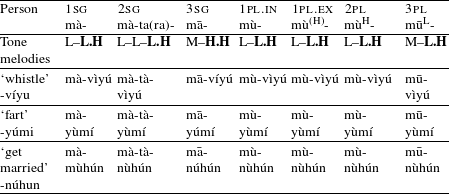
Tonal melodies in the potential forms can also be accounted for by the underlying tones of the prefixes and their interactions with the stem tones as in the completive forms (Table 24): when the prefix tone is low (1sg, 2sg and 1pl.in), this low tone spreads to the first syllable of the stem, pushing forward a high tone on this syllable to the following syllable. The 3sg and 3pl forms have the same tonal melodies as in the completive, since their prefix tones are the same (except that the 3pl form has a mid tone, rather than being toneless, but it makes no difference here). The 1pl.ex and 2pl forms are associated with a floating high tone; this high tone vacuously docks to the final syllable of the stem. Unlike in the completive, there is no free variation in the 2pl form with the L–H.H melody.Footnote [19]
H.Ø stems (potential).

5.4.2 H.M stems
The other tone melody which begins with a high tone, H.M stems, has the following patterns of tonal alternations. These verbs have a consistent H.M melody in the stem, both in the completive and the potential, but the forms in 1sg, 1pl.ex, 2pl and 3pl can have free variation with other tonal melodies. We have identified eight such verbs, all of which are shown in Table 25 in their completive forms. These stems show the greatest amount of variation. These verbs can have distinct forms for 1sg and 1pl.ex inflection and thus they are listed in separate columns in Table 25.
H.M stems (completive).

Free variation of certain cells found in these verbs is due to the conflict among equally-ranked constraints, Max-T(non-final), NoTauMorDoc, *#LXX and *Float(H). First, some H.M stems manifest free variation in the completive 1sg and 1pl.ex forms between the L–H.M melody and L–L.H (1sg) and L–L.M (1pl.ex) melodies. Note also that these are the only verbs which can differentiate 1sg and 1pl.ex forms in the completive aspect (in the incompletive and potential, the prefix vowels are distinct). The following examples illustrate the derivation of the two variants of the 1sg form of -xpáthū ‘hit’:

In (43a), the lexical tones of the prefix and the stem are simply realized, while in (43b) the low tone of the prefix spreads to the first syllable of the stem with a lexical high tone, which is displaced to the final syllable replacing its lexical mid tone.
The tableau in (44) illustrates the 1sg form (and the 1pl.ex, which has the same underlying representation) of -xpáthū ‘hit’.

All the candidates incur violation of some highly ranked constraints and in the absence of the optimal candidate, all can survive as variants (L–H.M for both 1sg and 1pl.ex, L–L.H for 1sg, and L–L.M for 1pl.ex). Candidate (a) violates *Shift and Max-T(final) since the mid tone of the last syllable is deleted. Candidate (b) incurs violation of *#LXX because the form has an initial singly-linked low tone. Candidate (c) violates Max-T(non-final) and Max-T(final) because both of the tones of the stem are replaced.
Secondly, all except for the first three verbs (which only have the M–L.M melodies) in Table 17 above show free variation in the 3pl forms between the M–L.M and L–H.M melodies. The following examples illustrate the derivation of the two variants of the 3pl form of -xpáthū ‘hit’:

In (45a), the floating low tone of the prefix docks to the first syllable of the stem, deleting its lexical high tone, while in (45b), this floating low tone docks regressively to the prefix vowel, which is toneless.
The tableau in (46) illustrates the 3pl forms.

Candidate (a) is the most optimal, since it only violates Max-T(non-final). Candidate (b) violates two constraints, NoTauMorDoc and *#LXX, and is thus the second most optimal. Candidate (c) violates a highly-ranked *Float(L) and is eliminated. Recall that a docked floating low tone cannot spread, so Candidate (b) cannot have a L–L.X melody.
Lastly, the 2pl forms of these verbs manifest the greatest variation, with some verbs allowing up to three variants, such as -xpígāā ‘break’. The variation could be because any of the three options can be homophonous with other persons: the L–L.H melody would be homophonous with 1sg, L–L.M with 1pl.ex, and L–H.M with 1sg, 1pl.ex and 3pl. The following examples illustrate the derivation of the three variants of the 2pl form of this verb:

The tableau in (48) illustrates the 2pl forms of ‘break’.

The optimal candidate is (a), since it only incurs violation of *Float(H) among the three equally-ranked constraints, while others violate two of the three equally-ranked constraints, Max-T(non-final), *#LXX and *Float(H). Candidate (d) further violates other constraints and thus candidates (b) and (c) survive as variants.
Table 26 shows the conjugations of the verbs in this class in the potential forms. The potential forms also show variation when the prefix has a low tone (i.e. the 1sg, 2sg. 1pl.in, 1pl.ex and 2pl) or a floating tone (high tone in the 1pl.ex and 2pl, low tone in 3pl). The verbs ‘kick’ and ‘place on’ do not show variation and have a consistent H.M melody in the stem. In the case of ‘kick’, this could be due to the dispreference against a *LʔH sequence, as discussed in Section 5.3.4. The 3pl forms show greatest variation, but what is noteworthy is the fact that the L–H.M melody with regressive docking of the floating low tone is impossible. This is because the potential 3pl is specified for a mid tone (mū
 $^{L}$
-), while the completive/incompletive 3pl is toneless (mu
 $^{L}$
-), as seen in Section 4.1.1.
H.M stems (potential).

5.5 Summary
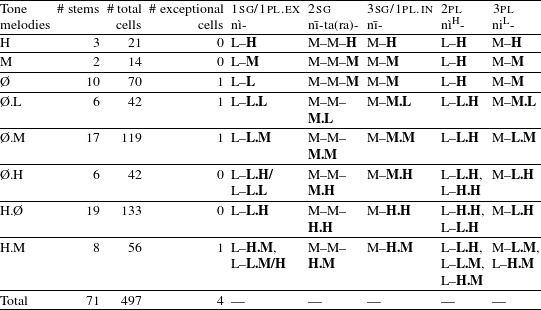
In this section we have presented a phonological analysis of the tonal alternations of Class A verbs in Zilacayotitlán Tlapanec. We have shown that most of the tonal alternation patterns can be straightforwardly accounted for by the lexical tones of prefixes and stems, as well as tone processes and tonal constraints. Table 27 summarizes the analysis of the completive forms. In Table 27, ‘# total cells’ is calculated by multiplying the number of stems by seven (person categories), and ‘# exceptional cells’ refers to the number of verb forms not predicted by the application of the lexical representations and tone processes discussed in Section 4. The 1sg and 1pl.ex forms on the one hand, and the 3sg and 1pl.in forms on the other, have the same tone melodies (except for some cases in H.M stems, where the 1sg and the 1pl.ex forms can be distinguished), and thus these cells are collapsed. The phonologically conditioned (by glottal stop) allotony in the 1sg/1pl.ex of the Ø.H stems is divided by ‘/’, while the free variation in the 2pl form of the H.Ø and H.M stems and that of the 1sg/1pl.ex and the 3pl forms of the H.M stems are separated by a comma.
Summary of the tone alternation patterns in the completive.

As can be observed, the majority of the cells can be accounted for by the simple concatenation of the lexical tones of the prefix and the stem, as well as the tone processes which apply when they are combined; out of 497 total cells of 71 verb stems, only four cells (1%) are unpredictable from the lexical representations and tone processes; in other words, 99% of the cells can be straightforwardly accounted for by phonology. Furthermore, the cells with overabundance (2pl of H.Ø stems and 1sg/1pl.ex, 2pl and 3pl of H.M stems) are precisely where equally-ranked constraints interact with each other.
6 Comparison and evaluation of phonological and word-based approaches
In the preceding sections, a phonological analysis of Tlapanec verb tone alternations has been proposed. We showed that the lexical representations of the prefixes and the stems, as well as the tone processes such as tone spreading and tone docking, and tonal constraints, can sufficiently account for the majority of the tonal alternation patterns. Another competing alternative account for these tonal alternations is a word-based (especially abstractive) analysis, where the prefixes and stems are not analyzed into separate morphemes carrying their own lexical tones, but rather each pattern of tonal alternations is treated as an inflectional (tonal) class. How, then, would the phonological account presented in this paper fare in comparison to such a word-based model? This section first explores such an alternative (Section 6.1) and then evaluates these two approaches, comparing the consequences of each analysis, and argues that a phonological (or morpheme-based) approach is superior in the case of Tlapanec tonal alternations (Section 6.2).
6.1 An alternative analysis: A word-based approach
In paradigm-based morphological theories such as Paradigm Functional Morphology (Stump Reference Stump2001, Reference Stump2016; Stump & Finkel 2013), Network Morphology (Corbett & Fraser Reference Corbett and Fraser1993, Brown & Hippisley Reference Brown and Hippisley2012), Construction Morphology (Booij Reference Booij2017, Reference Booij2018b; Caballero Reference Caballero2018) or more radically holistic models (Matthews Reference Matthews1965; Bybee Reference Bybee2001; Skousen, Lonsdale & Parkinson Reference Skousen, Lonsdale and Parkinson2002; Blevins Reference Blevins2006, Reference Blevins2016; O’Neil Reference O’Neil2014; Pirrelli et al. Reference Pirrelli, Ferro, Marzi, Baerman, Brown and Corbett2015), the morphosyntactic content of each form is determined not by the representation of the verb form itself, but by the cell that this representation occupies. In Paradigm Functional Morphology, for instance, a cell pairing the lexical content of a lexeme L and the morphosyntactic content of the property set
 $\unicode[STIX]{x03C3}$
with the word form w is represented as ‹L,
 $\unicode[STIX]{x03C3}$
: w› (Stump Reference Stump2016: 10). For instance, the paradigm of French national can be represented with the set of cells in (49). In such a representation, the grammatical category annotations are conventionally in lower case, rather than small caps.

Applying this type of representation to Tlapanec, the paradigm of the verb ‘hobble’ in the completive, for instance, would be as in (50). The abbreviation ‘cmp’ stands for the completive aspect.

In such a model, especially an abstractive version of word-based morphology (Blevins Reference Blevins2006, Reference Blevins2016; O’Neil Reference O’Neil2014; Pirrelli et al. Reference Pirrelli, Ferro, Marzi, Baerman, Brown and Corbett2015), principal parts are first identified as lexical stipulations; the principal parts are cells in a lexeme’s realized paradigm from which all of the other cells in that paradigm can be logically deduced, given a language’s patterns of inflection (Stump Reference Stump2016: 257). Then, implicative rulesFootnote [20] derive forms of other cells (Stump Reference Stump2016: 260). For instance, consider the hypothetical system of six two-celled realized paradigms in (51), taken from Stump (Reference Stump2016). Here, P, Q, R, S, T and U refer to a given stem, g, h, i, j and k are exponents of each morphosyntactic property set a and b. Thus, for instance, ‹Pg, {a}› , means that the stem P takes the form g as the exponent of the morphosyntactic property set a (such as tense, person, number).

Such a system can be analyzed as in (52) according to an abstractive word-based analysis. Here, we only present an abstractive word-based analysis, and not a constructive word-based analysis (e.g. Aronoff’s (Reference Aronoff1994) model, A-morphous Morphology (Anderson Reference Anderson1992) or Paradigm Function Morphology (Stump Reference Stump2001, Reference Stump2016)), but the implications of such analyses are the same with regard to the phenomenon we are interested in. The forms with the property set {b} are assumed to be principal parts from which the form with the property set {a} can be deduced, and thus lexically stipulated. The implicative rules in (b) state that when a stem has the form i in a morphosyntactic category {b}, then the stem has the form g in a morphosyntactic category {a}; otherwise the stem has the form h in the morphosyntactic category {a}:

To apply such a representation to Tlapanec tonal alternations, we could first hypothesize that agents are encoded by non-concatenative, templatic morphemes (McCarthy & Prince Reference McCarthy and Prince1986); for instance, the morpheme for the 1sg agent is the tone melody L–L.L for disyllabic Class I verbs (of Class A verbs) while L–L.H for Class III verbs. Next, the principal parts would be identified; in the case of Zilacayotitlán Tlapanec, it would be the 3sg and 1sg forms in the completive: the 3sg form alone cannot determine the rest of the paradigm since the difference between the Ø vs. M stems is neutralized in the 3sg form. The 1sg forms alone are not sufficient either, since the difference between the Ø.H and H.Ø stems is neutralized in the 1sg.Footnote [21]

The tone melodies of the 2sg (with the addition of the 2sg agent prefix) and 1pl.in forms are the same as the 3sg and those of the 1pl.ex are the same as the 1sg, thus no further information is necessary. The 2pl and 3pl forms are deducible from these principal parts, with the implicative rules. Such implicative rules can be formulated as follows. For instance, (54a) says that if the completive 1sg has the L–H melody and the 3sg M–H melody, then the 2pl has the L–H melody and the 3pl the M–H melody.

In fact, such an abstractive word-based analysis has been proposed (informally) by Suárez (Reference Suárez1983: 171ff.) and more recently by Tiburcio Cano (Reference Tiburcio Cano2017). Such an analysis can derive the same surface tonal patterns, but in the next section, we indicate some problems that such a word-based approach would face.
6.2 Comparison of phonological and word-based analyses
In this section, we will examine three problems which a word-based approach would face, and where a phonological account is superior to such an approach: the explanatory adequacy of the cells with overabundance (Section 6.2.1), patterns of syncretism (Section 6.2.2) and predictive power of the number of patterns and the possible and impossible patterns (Section 6.2.3). We conclude that a phonological analysis such as one presented in this paper is superior since it has explanatory and predictive power, and since it is more restrictive.
6.2.1 Explanatory adequacy for the cells with overabundance
A phonological analysis, such as the one proposed in this paper, can predict and explain where and why free variation (or overabundance) would be found: overabundance is found precisely where multiple equally ranked constraints compete and no candidate is singled out as the most optimal. For instance, in Section 5.4.1 we saw that variation in tone melodies is found for the completive 2pl forms of the H.Ø stems, where the constraints *Float(H) and *#LXX compete; in Section 5.4.2 we observed that the completive 1sg/1pl.ex, 2pl and 3pl forms of the H.M stems manifest overabundance where the constraints Max-T(non-final), NoTauMorDoc, *#LXX and *Float(H) compete.
For a word-based approach, such cases of overabundance are merely arbitrary and thus, we find no explanations. That is, variation in the 2pl or 3pl forms cannot be predicted from the principal parts, the 1sg and 3sg forms. For instance, for the Ø.H and H.Ø stems, the 1sg or 3sg forms do not show variation in completive, while the 2pl does. One might wonder if the overabundance in these cells is motivated so that homonymy between cells be avoided. Thus, the L–H.H melody, along with the optimal L–L.H tone melody (Section 5.4.1), is employed for the completive 2pl of the H.Ø stems, because the L–L.H melody would result in homonymy with the 1sg forms. However, this is not always the case. For instance, 3sg (as well as 1pl.in) and 3pl forms are identical for the H, M, Ø and Ø.L stems in completive but there is no variation in either 3sg or 3pl forms to avoid homonymy.
In general, Tlapanec speakers do not seem to even intend to avoid homonymy within the paradigm;Footnote [22] thus, 1sg and 1pl.ex on the one hand, and 3sg and 1pl.in on the other, are always identical in the completive aspect. The glottal stop found after the 3sg and 1pl.in prefixes before monosyllabic stems without a glottal stop, does not serve to disambiguate any homophonous cells.Footnote [23]
6.2.2 Patterns of syncretism
Patterns of syncretism in Tlapanec verbs also pose problems for an abstractive word-based approach. Syncretism in inflectional paradigms (Stump Reference Stump2001: Chapter 7, Reference Stump2016: Chapter 10; Baerman Reference Baerman2005; Baerman et al. Reference Baerman, Brown and Corbett2005; Albright & Fuss Reference Albright, Fuss and Trommer2012) is generally observed when the cells share certain morphological features (such as the dative and ablative plural in Latin) or as a result of underspecification (such as the null person/number suffix in the verbal inflection of English that occurs in all but 3sg present indicative forms). Alternatively, syncretism can also constitute a system-wide morphomic class, which does not constitute any natural class; for instance, the 1sg present indicative always has the same stem as the present subjunctive in Spanish, regardless of the conjugation class, except for exceptional verbs.
This holds true for the systematic formal identity of the 1sg and the 1pl.ex on the one hand, and the 3sg and the 1pl.in on the other, in completive; they represent a case of system-wide meta-syncretism, since they are syncretic for all verbs, except for irregular verbs. However, other patterns of formal identity in Tlapanec verb paradigms are unsystematic and grammatically incoherent. Thus, the 3sg (as well as the 1pl.in) and the 3pl forms are identical for H, M, Ø and Ø.L stems in completive, while the 1pl.ex and 2pl forms are identical for Ø stems, some H.Ø stems and H.M stems in completive; in addition, 1pl.ex and/or 2pl and 3pl forms can be identical for some H.M stems in completive. The formal identity is not system-wide, nor is there any grammatical or semantic coherency between these cells. The mechanisms commonly used to describe syncretism, blocking or extension (Baerman Reference Baerman2012), cannot consistently account for such patterns of tonal alternations.
Under a phonological (or morpheme-based) approach, these cases of form identity of cells in the paradigm can be simply understood as cases of accidental homophony, which results from the concatenation of lexical tones of prefixes and stems and various phonological processes (see Albright & Fuss Reference Albright, Fuss and Trommer2012 for more on distinguishing true syncretism and accidental homophony). This is a natural consequence of a phonological approach: a limited number of possible tonal specifications means that many forms will have the same interaction with the same result. The speakers simply concatenate the prefixes and stems and apply phonological processes, without worrying if the resulting form would be homophonous with other forms in the paradigm. Under a word-based approach, on the other hand, the homophony just is, with no explanation.
6.2.3 Predictive power of the number of patterns and possible and impossible patterns
A further advantage of a phonological analysis is that it can make predictions about the number of tonal alternation patterns and about what is a possible tonal paradigm and what must be considered as irregular, independently of the number of verbs that display each pattern. A word-based approach fails to make such predictions.
In terms of the number of patterns of tonal alternations, a phonological approach such as the one proposed in this paper predicts that the number of patterns should not exceed the number of underlying tonal categories: four (low, mid, high and Ø) for monosyllabic stems, and 4 × 4 = 16 for disyllabic stems. This is indeed the case; with 71 Class A verbs that are not suppletive, we found three patterns for monosyllabic stems and five patterns for disyllabic stems. A word-based approach, on the other hand, would predict a far larger number of tonal alternation patterns. A possible number of the patterns of tonal alternations, according to a word-based approach, can be calculated as follows. First, a possible number of tonal melodies of a word can be calculated by exponentiating the four tonal categories (low, mid, high and Ø) by the number of the syllables in the word (ignoring the final tone of a long final syllable, which does not play a role): two with the monosyllabic stems (thus, 42 = 16) and three with the disyllabic stems (thus, 43 = 64). As we have seen in Section 6.1 above, we can conclude that Tlapanec regular Class A verbs have two principal parts. Thus, the number of the possible patterns of tonal alternations will be the square of the possible numbers of the tonal patterns in a word: 162 = 256 for monosyllabic stems and 642 = 4096 for disyllabic stems. Even if we consider that the principal parts are dynamic and that the principal part is the 1sg form for monosyllabic stems and the 3sg form for the disyllabic stems (see footnote 21), there would be 16 patterns of tonal alternations for monosyllabic stems and 64 patterns for disyllabic stems. These numbers are far larger than what is actually observed.
A phonological analysis also predicts that any further classes which emerge with more data can also be accounted for with appropriate representations and the same phonological processes. For instance, according to a phonological approach, forms such as regular Class A verbs with the completive 1sg form with a mid tone or a high tone on the prefix are excluded, since the 1sg prefix has a low tone in the completive (Section 4.1.1). A word-based analysis would fail to make such predictions; no mechanism guarantees that the 1sg cannot have a mid or high tone on the prefix; since the 1sg form is one of the principal parts, the tonal melody of the 1sg forms are simply lexically stipulated.
7 Conclusions
In this paper, we have argued that the tonal alternations of Class A verbs in Tlapanec can mostly be accounted for by the lexical tones of the prefixes and stems, as well as phonological processes such as tone spreading and floating tone docking, without resorting to any extremely abstract phonological representations or morpheme-specific ad hoc rules. These tonal processes are independently motivated in the language. A phonological (or morpheme-based) analysis within Optimality Theory has explanatory and predictive power since such an approach can further predict and explain in which cells and why overabundance is found in some cells, that is where equally ranked constraints compete. In comparison, a word-based approach, where the morphosyntactic content of each form is determined not by the representation of the verb form itself, but by the cell that this representation occupies, would not provide any accounts as to where and why overabundance is found in certain cells, and patterns of syncretism would be troubling for such an approach. Furthermore, a phonological approach such as the one proposed in this paper is more restrictive in the sense that it can predict the number of patterns of tonal alternations and possible patterns of tonal alternations, while a word-based analysis cannot.
In studying a language’s inflectional paradigms, it is important to separate phonological processes and phonologically motivated alternations from morphologically motivated alternations (Baerman Reference Baerman2014, Reference Baerman2015; Corbett Reference Corbett2015: 147–148). However, this is not always an easy task especially in the case of Otomanguean languages, particularly due to the complex interactions of phonology and morphology. The contention of this paper is not that all the alternations found in the verbal paradigm are due to phonological processes; for instance, weak and strong suppletion according to agent person is clearly morphological. The alternation of the 2sg agent prefix tara-/ta- (see footnote 6) is phonologically motivated, yet not due to a productive phonological process, since this alternation is morpheme-specific. In this sense, our approach differs from what is called ‘phonological reductionism’. Some phenomena are clearly motivated to avoid homophony with the forms in other cells, such as the 2sg prefix ta (ra)-, since without this prefix, the 2sg form would be homophonous with the 3sg in the completive/Present or with the 1sg in the potential (see footnote 23). Tone alternations according to the agent of regular verbs in Tlapanec, on the other hand, are due to the simple concatenation of the underlying tones of the prefixes and stems, as well as synchronically productive tone processes.