Introduction
Cultivating plant mixtures is expected to generally provide a higher overall productivity (Hooper et al., Reference Hooper, Chapin Iii, Ewel, Hector, Inchausti, Lavorel, Lawton, Lodge, Loreau, Naeem, Schmid, Setälä, Symstad, Vandermeer and Wardle2005), a better control of pests and diseases (Ratnadass et al., Reference Ratnadass, Fernandes, Avelino and Habib2012), and enhanced ecological services (Vandermeer, Reference Vandermeer1989; Gurr et al., Reference Gurr, Wratten and Luna2003; Malézieux et al., Reference Malézieux, Crozat, Dupraz, Laurans, Makowski, Ozier-Lafontaine, Rapidel, De Tourdonnet and Valantin-Morison2009). Mixed-cropping systems are often seen as a strategy to reduce the risk of pest incidence through barrier, dilution, and trophic effects (Ratnadass et al., Reference Ratnadass, Fernandes, Avelino and Habib2012). Increasing natural regulation constitutes an important component of more sustainable cropping systems. The management of animal and plant communities in agroecosystems represents one of most important levers to improve these regulations (Macfadyen et al., Reference Macfadyen, Davies and Zalucki2015). Understanding trophic and non-trophic interactions between different species in agroecosystems is essential to develop more efficient pest control strategies based on natural regulation processes.
Crop diversification at different scales, from field scales to diversified landscape scales, is often presented as a means to alter pest regulation processes by increasing the incidence of natural enemies, reducing pest pressure and enhancing crop production (Andow, Reference Andow1991; Poveda et al., Reference Poveda, Gómez and Martínez2008). However, the effect of plant diversity is not always positive for the control of pests. For instance, increasing plant diversity may support alternative prey that diverts generalist predators from the pest. Furthermore, systems more rich in plants mays support a richer community of predators in which intraguild predation may dampen the potential of pest control. Therefore, understanding what type of cropping system is more suitable to reduce pest damage is of major importance to ultimately improve agricultural productivity and avoid pesticides applications. The type of plants embedded in agroecosystems strongly influences habitats for arthropods altering the refuges or shelters available for generalist predators (Bianchi et al., Reference Bianchi, Booij and Tscharntke2006; Dassou et al., Reference Dassou, Tixier, Dépigny and Carval2017). These mixed-cropping systems may also shelter alternate hosts and prey for parasitoids and predators (Bianchi et al., Reference Bianchi, Booij and Tscharntke2006). The development of alternative prey may increase the abundance of generalist predators and improve pest regulation (Landis et al., Reference Landis, Wratten and Gurr2000; Chailleux et al., Reference Chailleux, Mohl, Teixeira Alves, Messelink and Desneux2014). In addition, according to the resource concentration hypothesis (Root, Reference Root1973), mixed-cropping systems may benefit from resource dilution of a particular pest.
In Benin, tomatoes are grown in cropping systems ranging from monoculture to intercropping with diverse food crops including maize, roots, tubers, and vegetables. These un-mechanized cropping systems rely on family labor and receive very little chemical inputs. The local cultivation of tomato contributes to the nutrition security of populations through diet quality (Simeni et al., Reference Simeni, Adeoti, Abiassi, Kodjo and Coulibaly2009). Indeed, the tomato fruit is involved in several daily dishes and is a source of minerals and vitamins that can help reduce micronutrient and vitamin deficiencies (Beecher, Reference Beecher1998).
Pests and diseases greatly reduce the yield and the market value of the tomato fruits. In Benin, the main tomato insect pest is Helicoverpa armigera (Hübner) (Elégbédé et al., Reference Elégbédé, Glitho, Dannon, Douro, Kpindou and Tamň2014) which feeds on tomato fruits. This polyphagous pest (Cunningham et al., Reference Cunningham, Zalucki and West1999) causes massive damage to the tomato fruit, thus greatly reducing tomato yield. A broad range of families of predators have been listed as potential predators for the Helicoverpa spp., especially in cotton plots (Mensah et al., Reference Mensah, Harris and Beattie1995). Predatory beetles, bugs, lacewings, and spiders are mentioned as predators of H. armigera (Mensah et al., Reference Mensah, Harris and Beattie1995; Cherry et al., Reference Cherry, Cock, Berg, van den Kfir, Neuenschwander, Borgemeister and Langewald2003). Anthocorids and ants of the genera Pheidole and Myrmicaria have been identified as potential generalist predators of H. armigera in smallholders’ fields in Kenya (Van Den Berg & Cock, Reference Van Den Berg and Cock1995).
We hypothesize that the cultivated plants associated with tomatoes are expected to change the structure of arthropod trophic groups in tomato-based agroecosystems and in fine may modify the control of H. armigera by generalist predators. Here, we assessed the effect of the cropping system type (tomato mono-cropping vs. mixed-cropping) on (i) the diversity and abundance of arthropods from three trophic groups (herbivores, omnivores, predators) and (ii) the abundance of H. armigera. We also investigated whether the abundance of H. armigera was correlated to the abundance of higher trophic groups (omnivore and predators).
Materials and methods
Study sites
The study was carried out at the southern part of Benin in the departments of Atlantic, Mono and Couffo. The tomato fields were located in the small villages of Southern Benin in areas where tomato is the major production. These villages are in the districts of Abomey-Calavi: Latitude 6°26′54O Longitude 2°21′20N; Ouidah: Latitude 6°21′47O Longitude 2°5′6N; Comè: Latitude 6°24′27O Longitude 1°52′55N; Dogbo: Latitude 6°49′0O Longitude 1°46′59N; Lokossa: Latitude 6°38′19O Longitude 1°43′0N; Allada: Latitude 6°39′55N Longitude 2°9′4O. The climate is humid tropical with an average temperature of 28 °C and rainfall up to 1400 mm per year. The soil is sandy clay. Four fields were monocultures of tomato and 26 fields were tomato crops associated to a diverse array of other annual (e.g. maize, groundnut, and vegetable crops) and perennial crops (e.g. palms and pineapples), covering a gradient of situations ranging from one to ten associated crops. We studied farmer's fields that were set up since decades. Farmers make a mix of all crops in the fields without a particular spatial organization. No chemical fertilizers or insecticides were used for the field management. Soil fertilization was made with composts, and biopesticides based on neem seeds were used for pest control.
Measurements of plant diversity and arthropod communities in tomato cropping systems
The effect of the diversity of cultivated plants in tomato fields on the food web structure of arthropods was measured in the 30 fields. We characterized the cultivated species composition at the field scale. In the center of each tomato field, an experimental plot (20 × 20 m) was delimited. Each experimental plot was subdivided into 25 (4 m by 4 m) quadrats in which all cropped plants were identified and counted. In the center of each quadrat, one pitfall trap (12 cm of diameter, half-filled with soapy water) was placed and removed after 72 h to capture the soil and litter arthropods. In total, 25 pitfall traps were used per field in order to maximize the trapping. Additionally, in each experimental plot, flying insects were (i) captured with an entomological net during 5 min and (ii) collected directly on ten entire tomato plants using a mouth aspirator. On each of the ten tomato plants, all the damaged tomato fruits were cut in order to collect the larvae of H. armigera. We also visually inspected all tomato plants in each experimental plot to search for the different stages of development of H. armigera. The 30 studied fields covered evenly a broad gradient of plant diversity (Table S1). The same measurements were achieved between 8 and 12 am in two periods: 3 months in the long rainy season (May, June, and July) and 3 months in the short rainy season (August, September, and October). The identification of arthropod taxa collected in the fields was completed at Entomological Museum of IITA – Benin. All arthropod individuals collected with the traps, nets, and aspirator were identified up to the genus or to the species and counted. When an individual was not identified at the species level, a morphospecies was attributed to each individual based on morphological specificities, allowing further calculation of richness (Barratt et al., Reference Barratt, Derraik, Rufaut, Goodman and Dickinson2003). Finally, each taxon was associated to a trophic group (herbivore, omnivore, and predator) according to the literature (Table S2).
Data analysis
The abundance of both taxa and trophic groups was calculated by summing abundance of individuals of the same species or trophic group. Poisson Generalized Linear Models (GLMs) were used to analyze the effect of the type of system (tomato mono-cropping vs. mixed-cropping) on the abundance of arthropod taxa or trophic groups. The effect of the crop type on the overall diversity, richness, and evenness was tested with a linear model. In the case of the herbivore trophic group and of H. armigera, we also tested the effect of the combined abundance of omnivore and predator trophic group (log and log quadratic values) as predictors of their abundance. The maximum likelihood of parameters of GLMs was approximated by the Laplace method (Bolker et al., Reference Bolker, Brooks, Clark, Geange, Poulsen, Stevens and White2009). Statistical analyses were performed with R 3.4.2 (R Development Core Team, 2018) at a significant level of 1%.
Results
Abundance of the arthropod species in tomato agroecosystems
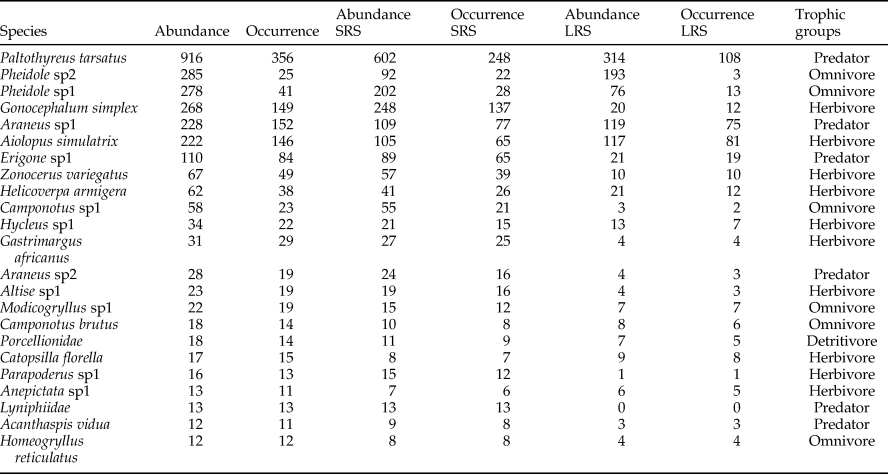
As a whole, 3351 individual arthropods from 12 orders were collected in the overall tomatoes fields. The most abundant orders were Hymenoptera with 1937 individuals followed by Orthoptera with 391 individuals, Araneae with 384 individuals, Coleoptera with 353 individuals. Based on the literature, five arthropod trophic groups were constituted as follows: omnivores (1905 individuals), herbivores (940 individuals), generalist predators (467 individuals), detritivores (30 individuals), and parasitoids (seven individuals). We retained for further analyses the arthropods for which the trophic group abundances were >400 individuals. The arthropod species or genus that are the most abundant and for which the occurrence was >50 in tomato agroecosystems were from omnivore-predator trophic group including the ants taxa (Pheidole spp. and Camponotus sp.), spiders (Araneus sp. and Erigone sp.), and from herbivores trophic group including the false wireworm (Gonocephalus simplex (F.) (Coleoptera: Tenebrionidae)), two grasshoppers (Aiolopus simulatrix (Walker) (Orthoptera: Acrididae) and Zonocerus varigatus (Orthoptera: Pyrgomorphidae)), and H. armigera (table 1).
Abundance and occurrence of the arthropod species (with occurrence >10), on the whole experiment and for the two studied seasons.

SRS, short rainy season; LRS, long rainy season.
Difference of abundance and diversity of arthropod trophic groups between mono-crops and mixed-crops in tomato agro-ecosystems
The abundance of H. armigera was significantly lower in the mixed-crop fields than in mono-crop. Inversely, the abundance of herbivores was not correlated with the crop type but there was a trend for more abundant herbivores in mono-crop fields. The abundance of the predators and omnivores was significantly higher in the mixed-crop fields than in mono-crop fields (fig. 1).
Distributions of the field-scale abundance of Helicoverpa armigera and of the three trophic groups according to the type of cropping system. The P values are corresponding to the test of the effect of the crop type on the abundance, tested in a Poisson GLM.

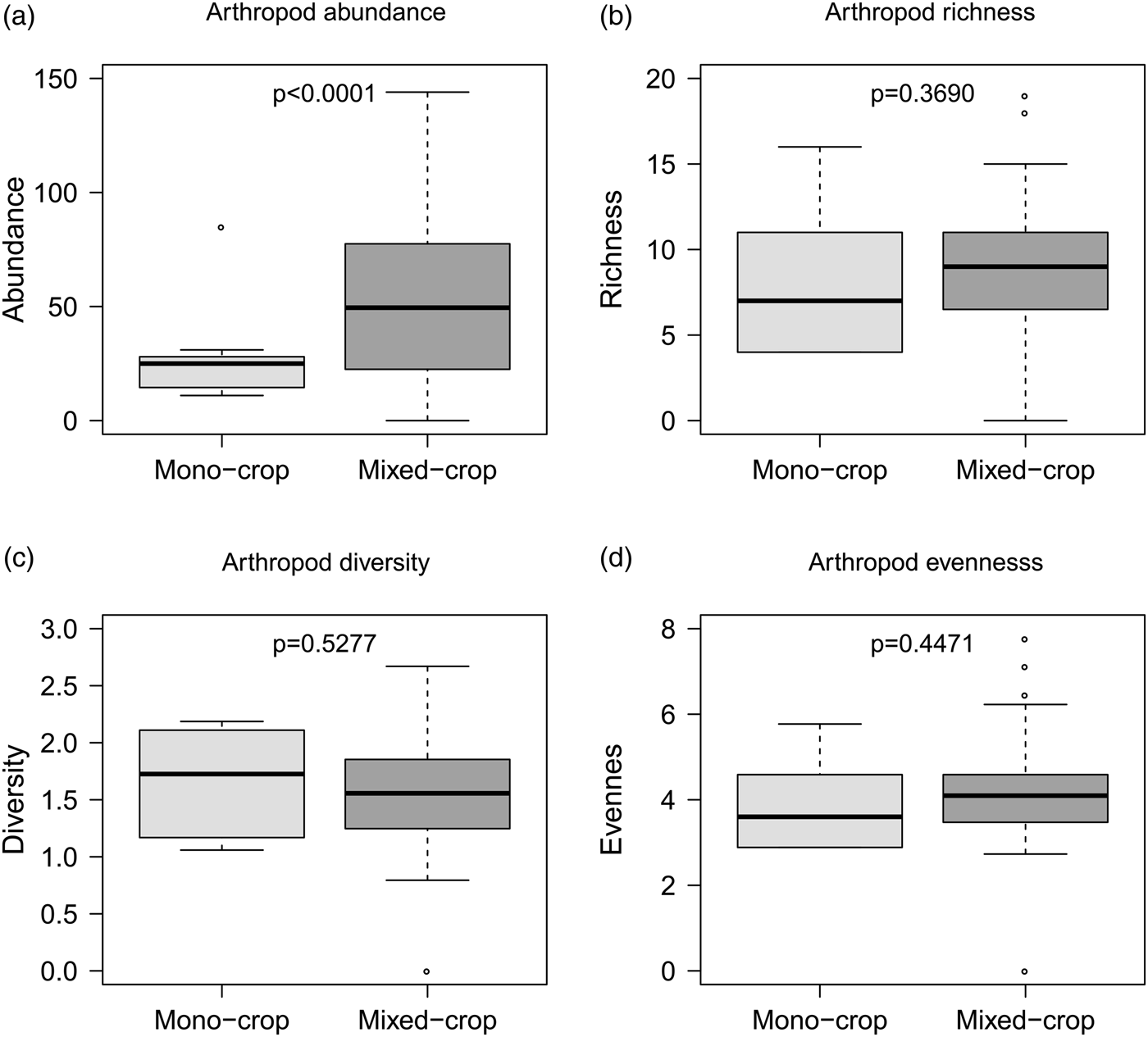
The abundance of all arthropods was significantly higher in mixed-cropping systems compared with mono-cropping systems (fig. 2a). The crop type did not alter significantly the arthropod diversity, evenness, and richness (fig. 2b–d). At the level of taxa, the abundances of Pheidole spp., Paltothyreus tarsatus, and spiders (including Araneus spp. and Erigone sp.) were significantly higher in mixed fields than in mono-crop fields (fig. 3). In total, the abundance of 14 out of 63 taxa was significantly affected by the crop type (Table S3). Among these taxa that significantly responded to crop type, there were the five taxa of ants P. tarsatus, Monomorium bicolor, Monomorium sp., Crematogaster sp., Pheidole spp.
Distributions of the field-scale arthropod community metrics according to the type of cropping system. The P values are corresponding to the test of the effect of the crop type on the metrics, tested in a Poisson GLM for the total arthropod abundance and in a LM for other metrics.

Distributions at the field-scale of the abundances of Pheidole spp., spiders and Paltothyreus tarsatus according to the type of cropping system. The P values are corresponding to the test of the effect of the crop type on the abundance, tested in a Poisson GLM.

Relationship between the abundance of herbivores and H. armigera with the abundance of the omnivore-predator trophic group
The abundance of the omnivore-predator trophic groups had a positive (but plateauing) significant effect on the herbivores abundance (fig. 4a, table 2). Inversely, this omnivore-predator abundance had a negative significant effect on the H. armigera abundance (fig. 4b, table 2).
Relationship between the field-scale (one point per season) abundance of the herbivore trophic group (A) and Helicoverpa armigera (B) with the abundance of the omnivore-predator trophic group. The curves show the prediction of the GLM (Poisson distribution) when significant (see table 2 for the description of the models).

Effect of the abundance of the omnivore-predator trophic groups on the abundance of the herbivore trophic group and of the Helicoverpa armigera abundance.

Discussion
Difference of abundance and diversity of the three arthropod trophic groups between mono-crop and mixed-crops systems
In this study, the abundances of the predators were significantly higher in the mixed-crop fields than in mono-crop fields. This result corroborates previous studies from biodiversity experiment or meta-analyses (Letourneau et al., Reference Letourneau, Armbrecht, Rivera, Lerma, Carmona, Daza, Escobar, Galindo, Gutiérrez and López2011). This could be explained by an increase in predator abundance due to the diversification of the plant resources as suggested by other studies (Mollot et al., Reference Mollot, Tixier, Lescourret, Quilici and Duyck2012; Dassou et al., Reference Dassou, Carval, Dépigny, Fansi and Tixier2015). Plant diversity often modifies the structure of arthropod communities, increases the abundance of generalist predators (Song et al., Reference Song, Wu, Kong, Zhang, Du, Hu and Yao2010), and reduces the abundance of pests (Baliddawa, Reference Baliddawa1985). This case, found also in this study, could also be explained by the fact that tomato is a seasonal crop in which the intercropped plants provide a favorable habitats and plant resources to the predators.
This finding could be the result of two complementary processes in diversified cropping systems: (i) more provision of favorable habitats for predators and (ii) increased availability of alternative resources for predators (Vasconcelos et al., Reference Vasconcelos, Leite, Vilhena, Lima and Magnusson2008; Dassou & Tixier, Reference Dassou and Tixier2016). Interestingly, in our experiment, the crop type affected the omnivore and the predator trophic groups but not the herbivore trophic group (fig. 1). The positive effects of mixing plants on the abundance of the omnivore and of the predator trophic groups, but not of the herbivore group, suggest that the abundance of higher trophic groups was driven by habitat diversification rather than by an increase of their resources (herbivores). The positive and plateauing trend between herbivore and omnivore-predator trophic groups (fig. 4a) suggests (i) that at low abundances of both trophic groups, habitat effect is positive for both, and (ii) that at higher abundances of the omnivore-predator trophic group, the predation of herbivores progressively increases with their abundance. The absence of effect of associated cultivated plants on the abundance of the herbivore trophic group may be the result of the resource concentration effect (Root, Reference Root1973). Indeed, the herbivore trophic group was dominated by specialist species (Tetranhychus sp., Altise sp., Dacus ciliatus, and Lyriomyza sativae) that are likely to respond to a dilution of their resources. Tetranychus sp. is a mite reported on tomato and can be responsible for important damages with leaves chlorotic spots on and under the limb of the tomato leaves thus reducing the photosynthesis of the tomato. Adults of the fruit fly D. ciliatus bite early to deposit their eggs. After hatching, their larvae sink into the healthy pulp to feed. The leafminer Liriomyza sativae such as Tetranychus sp. attacks the leaves and is responsible for the sinuous galleries on the leaves reducing photosynthesis. The association of other crop inside tomato fields had probably reduced the ability of herbivores to locate their host plants. Furthermore, non-host plants could obstruct the movement of the insect pest within the fields (Poveda et al., Reference Poveda, Gómez and Martínez2008) as described by the barrier crop hypothesis.
In our study, the effect of the crop type was positively significant on both omnivore and predator abundances and not significant on herbivores abundances. This finding shows how mixed-crop systems favor omnivore and predator communities that consume majority herbivores. Surprisingly, mixed systems increased overall arthropod abundance but not diversity (fig. 2) as predicted by the resource concentration hypothesis and mentioned by Ebeling et al. (Reference Ebeling, Hines, Hertzog, Lange, Meyer, Simons and Weisser2018), the diversity of communities is not always positively correlated to plant diversity. We can hypothesize that in our case, higher abundance in more diversified systems led to more connection between species, which is a key factor associated with community stability (Hooper et al., Reference Hooper, Chapin Iii, Ewel, Hector, Inchausti, Lavorel, Lawton, Lodge, Loreau, Naeem, Schmid, Setälä, Symstad, Vandermeer and Wardle2005) and also probably to pest control. This absence of effect on arthropod diversity could also be attributed to the fact that even in mixed systems the habitat remains a highly perturbed cultivated area; it is perhaps even more perturbed in mixed-crops since there were more diverse cultural practices applied to each crop of the field.
Difference of H. armigera abundance between mono-crops and mixed-crops in tomato agro-ecosystems
Our results show that H. armigera abundance was greater in mono-cropping than in mixed-cropping systems. The cultivated plant diversity increased the predator abundance and in-turn probably increased the control of lower trophic levels including H. armigera, through predator-mediated interactions (Chailleux et al., Reference Chailleux, Mohl, Teixeira Alves, Messelink and Desneux2014). This agrees with the findings of Dassou e t al. (Reference Dassou, Dépigny, Canard, Vinatier, Carval and Tixier2016) and Haddad et al. (Reference Haddad, Crutsinger, Gross, Haarstad, Knops and Tilman2009) who reported that plant diversity increases the abundance of arthropods at higher trophic levels and reduces the abundance of lower trophic levels. Ants are potential predators of H. armigera as showed by Mansfield et al. (Reference Mansfield, Elias and Lytton-Hitchins2003) on H. armigera eggs. In our study, ants such as Pheidole spp. and P. tarsatus and other arthropods such as beetles Gonocephalum simplex and spiders Araneus sp. and Erigone sp. were more abundant in tomato mixed-cropping systems than in tomato mono-cropping systems. These arthropods are generalist predators of many pests. Liu et al. (Reference Liu, Wan, Zhang, Meng and Wang2000) have enumerated many of these predators including ants and spiders as potential predators of H. armigera. Other studies have shown the suppression of H. armigera by a large complex of predators including Pheidole spp. and Camponotus spp. (Van Den Berg & Cock, Reference Van Den Berg and Cock1995). In addition to ants, spiders were among the most abundant predators recorded in our tomato cropping systems. Some families including Lycosidae, Clubionidae, Oxyopidae, Salticidae, and Thomsidae could be integrated in biological control programs since they were shown to consume 2.5–5 Helicoverpa spp. eggs per day and per spider (Pfannenstiel, Reference Pfannenstiel2008). The generalist predator G. simplex is abundant in these systems and feeds on several species of plants. The dilution of resources is favorable to their proliferation.
Our study gives element to increase the ecological regulation of H. armigera in tomato cropping systems. First we showed that mixed-cropping systems create suitable ecological structures for omnivores and predators that in-turn are likely to control H. armigera. Interestingly higher abundance of omnivores and predators did not dampen the abundance of other herbivore (except H. armigera). The habitat effect is probably the main effect that explains higher abundance of the omnivores and predators, e.g. by providing shelter from adverse conditions (Landis et al., Reference Landis, Wratten and Gurr2000). Our results suggest that a good way to improve this control would be to go further in the magnitude of the field plant diversity. For instance, we could recommend to farmers to not only increase the richness of plants inside tomato fields, but also to maximize the type of plants that create more diverse habitats for the omnivore-predator trophic group. Including more perennial plants would also be an interesting mean to structure the community of natural enemies especially ants (Dassou et al., Reference Dassou, Tixier, Dépigny and Carval2017).
Ants occurred frequently at relatively high abundance and we suggest that future research should focus on ant species, such as the predaceous ant P. tarsatus, and investigate its potential role in biological control of H. armigera. In future experiments, it will be valuable to go deeper in the assessment of the process of control, for example, in carrying out experiments with the exclusion of predators.
This study is representative of traditional African agricultural systems that are less chemically intensive than most tomato cropping systems across the world, and also cover a broad range in crops mixing. This makes it a particularly rich case to better understand how favorable habitats and refuges may be managed to enhance pest control.
Supplementary material
The supplementary material for this article can be found at https://doi.org/10.1017/S0007485319000117
Acknowledgements
We thank the tomato farmers of south of Benin for allowing us to work in their fields. We also thank the UR GECO of CIRAD for English edition through the STRADIV project (grant n° 1504-003) funded by Agropolis Foundation. This work was funded by Ecological Organic Agriculture (EOA).