Nutrition is the major environmental factor regulating mammary lipogenesis and milk fatty acid composition in ruminants (Palmquist et al. Reference Palmquist, Beaulieu and Barbano1993). Inclusion of plant oils, oilseeds or marine lipids in the diet represent nutritional strategies for altering milk fat composition (Chilliard et al. Reference Chilliard, Glasser, Ferlay, Bernard, Rouel and Doreau2007). Fatty acids secreted in milk are derived from de-novo synthesis in the mammary gland or extracted from circulating non-esterified fatty acid (NEFA) and triacylglycerides (TAG) in arterial blood. Metabolic pathways involved in mammary lipid synthesis are regulated, at least in part, in response to the supply of long-chain fatty acids that originate from lipid in the diet, intermediates or end-products of ruminal biohydrogenation of dietary unsaturated fatty acids or mobilization of adipose tissue.
The role of altered mammary lipogenic gene expression in the regulation of milk fat synthesis has been examined in the bovine during milk fat depression on diets containing marine lipids (Ahnadi et al. Reference Ahnadi, Beswick, Delbecchi, Kennelly and Lacasse2002) or low proportions of forage and plant oils (Piperova et al. Reference Piperova, Teter, Bruckental, Sampugna, Mills, Yurawecz, Fritsche, Ku and Erdman2000; Peterson et al. Reference Peterson, Matitashvili and Bauman2003; Harvatine & Bauman, Reference Harvatine and Bauman2006). Data on the nutritional regulation of mammary expression of lipogenic enzymes in the goat are limited (Bernard et al. Reference Bernard, Leroux, Bonnet, Rouel, Martin and Chilliard2005a, Reference Bernard, Rouel, Leroux, Ferlay, Faulconnier, Legrand and Chilliardb). Furthermore, milk fat synthesis and to a lesser extent fatty acid composition responses to lipid supplements are known to differ between ruminant species (Chilliard et al. Reference Chilliard, Glasser, Ferlay, Bernard, Rouel and Doreau2007; Bernard et al. Reference Bernard, Leroux and Chilliard2008, Reference Bernard, Shingfield, Rouel, Ferlay and Chilliard2009). Plant oils in the diet result in systematic increases in milk fat secretion in the goat (Chilliard et al. Reference Chilliard, Ferlay, Rouel and Lamberet2003), whilst variable responses have been reported in the cow (Palmquist et al. Reference Palmquist, Beaulieu and Barbano1993; Chilliard et al. Reference Chilliard, Glasser, Ferlay, Bernard, Rouel and Doreau2007). The role of specific intermediates arising from ruminal metabolism of dietary unsaturated fatty acids on the regulation of lipid metabolism as well as the mechanisms responsible for differences in milk fat responses between ruminant species are not well established.
Previous studies in goats have evaluated the effects of supplementing grass hay based diets with cis-9 18:1 enriched sunflower-seed oil (Bernard et al. Reference Bernard, Rouel, Leroux, Ferlay, Faulconnier, Legrand and Chilliard2005b), soybeans predominating in 18:2n-6 (Bernard et al. Reference Bernard, Leroux, Bonnet, Rouel, Martin and Chilliard2005a) or formaldehyde-treated linseed as a source of rumen-protected 18:3n-3 (Bernard et al. Reference Bernard, Rouel, Leroux, Ferlay, Faulconnier, Legrand and Chilliard2005b), on lipogenic gene expression in adipose and mammary tissues in goats. However, metabolism of polyunsaturated fatty acids in the rumen results in the formation of a diverse range of biohydrogenation intermediates with evidence that the profile of metabolites produced differs between oils and oilseeds (Shingfield et al. Reference Shingfield, Chilliard, Toivonen, Kairenius and Givens2008b).
The present study examined the effect of sunflower-seed oil or linseed oil in the diet on lipogenic gene transcript abundance in mammary, adipose and liver tissue of goats during established lactation. Determination of tissue responses to plant oil supplements in combination with a comprehensive analysis of milk fatty acid composition (Bernard et al. Reference Bernard, Shingfield, Rouel, Ferlay and Chilliard2009) was used to provide a novel insight into the possible role of specific biohydrogenation intermediates formed during ruminal 18:2n-6 or 18:3n-3 metabolism on the regulation of lipogenic gene expression, lipogenic enzyme activity and milk fat secretion. Furthermore, characterization of lipogenic gene expression in adipose tissue and liver allowed the possible contribution of peripheral tissues to changes in mammary lipogenesis to be evaluated.
Materials and Methods
Animals and diets
Thirteen multiparous [mean 3·2 (sd 1·3)] Alpine goats of mean 77 (sd 7) days in lactation were offered three experimental diets according to a replicated 3×3 Latin square design with 28-d experimental periods with 4 or 5 animals per group. Treatments comprised natural grassland hay offered ad libitum and a concentrate mixture supplemented with no additional lipid (H), 130 g/d linseed oil (HLO; SA Vandeputte, Mouscron, B-7700, Belgium) or 130 g/d sunflower-seed oil (HSO; Auvergne Trituration, Lezoux, F-63190, France) offered as two equal meals at 8.30 and 16.30. Oils were stored in the dark at 4°C until incorporated into daily rations. Mean forage:concentrate ratio of the diet [on a dry matter (DM) basis] was 44:56, 49:51 and 49:51 for H, HSO and HLO, respectively. Concentrates contained rolled barley (197, 112 and 111 g/kg DM for H and HSO and HLO, respectively), dehydrated sugarbeet pulp (227, 179 and 178 g/kg DM for H and HSO and HLO, respectively), pelleted dehydrated lucerne (65, 54 and 54 g/kg DM for H and HSO and HLO, respectively) and soybean meal (67, 116 and 116 g/kg DM for H and HSO and HLO, respectively). Chemical composition of the experimental diets and plant oils have been reported previously (Bernard et al. Reference Bernard, Shingfield, Rouel, Ferlay and Chilliard2009). Goats were milked at 8.00 and 16.00. Procedures used to select and recruit animals to the experiment have been described previously (Bernard et al. Reference Bernard, Shingfield, Rouel, Ferlay and Chilliard2009). All experimental procedures were approved by the Animal Care Committee of INRA in accordance with the Use of Vertebrates for Scientific Purposes Act 1985.
Measurements and sampling
Feed intakes, chemical composition of experimental diets, milk yield, milk constituents and fatty acid composition were determined during each experimental period according to sampling protocols and analytical procedures outlined elsewhere (Bernard et al. Reference Bernard, Shingfield, Rouel, Ferlay and Chilliard2009). Milk lipolysis was determined as the increase in free fatty acid content (expressed as g of free oleic acid equivalent/100 g fat) measured after storage at 4°C for 34 h post milking, using the copper soap method (Jellema, Reference Jellema1991).
On days 24–25 of periods 1 and 2, mammary biopsies were obtained after morning milking for tissue RNA extraction using sterile Trucut needles (CE Sherwood Medical, Northern Ireland, UK) according to the manufacturer's instructions. Approximately 20–25 mg of tissue was collected, rinsed in sterile 0·9% saline solution, inspected to verify tissue homogeneity and snap frozen in liquid nitrogen. Samples were stored at −80°C until RNA extraction. At the end of the experiment, goats were slaughtered after morning milking. Immediately prior to slaughter, animals were milked to remove most of the milk in the mammary glands. Immediately after death, samples of mammary, liver and perirenal adipose tissues were collected under sterile conditions, frozen in liquid nitrogen and maintained at −80°C until RNA extraction and/or enzyme assays. Samples of mammary tissue were assayed immediately for stearoyl-CoA desaturase (SCD) activity. A perirenal adipose tissue sample collected immediately after slaughter was stored at 37°C for adipocyte volume determination (Chilliard et al. Reference Chilliard, Gagliostro, Flechet, Lefaivre and Sebastian1991).
Blood samples were collected on day 23 of each experimental period at 7.30. Samples obtained from the jugular vein were collected into evacuated collection tubes (Venoject, C.M.L., Nemours, F-77792, France) containing potassium EDTA. Once collected, blood samples were centrifuged at 1500 g at 4°C for 15 min and plasma was analysed for insulin, glucose, NEFA, total cholesterol, phospholipids, triacylglyceride, acetate, 3-hydroxy-butyrate and urea concentrations according to reference procedures (Loor et al. Reference Loor, Ferlay, Ollier, Doreau and Chilliard2005).
Enzyme assays
Lipoprotein lipase (LPL; EC 3.1.1.34) activity was measured in samples of milk, mammary and perirenal adipose tissues (Faulconnier et al. Reference Faulconnier, Thevenet, Flechet and Chilliard1994). Activity of fatty acid synthase (FAS; EC 2.3.1.85), glycerol-3-phosphate dehydrogenase (EC 1.1.1.8, G3PDH), glucose-6-phosphate dehydrogenase (EC 1.1.1.49, G6PDH), and malic enzyme (EC 1.1.1.40, ME) was determined in perirenal adipose and mammary tissues (Chilliard et al. Reference Chilliard, Gagliostro, Flechet, Lefaivre and Sebastian1991). Samples of mammary tissue were also analysed for acetyl-CoA carboxylase (ACC; EC 6.4.1.2) and SCD (EC 1.14.99.5) activity (Bernard et al. Reference Bernard, Rouel, Leroux, Ferlay, Faulconnier, Legrand and Chilliard2005b).
RNA isolation and real-time reverse-transcription PCR
Total RNA was isolated from samples of mammary tissue using the RNeasy mini kit (QIAGEN Inc.) while total RNA in liver was extracted using the NucleoSpin RNA II (Macherey Nagel, Inc.) kit. For adipose tissue, total RNA was extracted according to Bonnet et al. (Reference Bonnet, Leroux, Faulconnier, Hocquette, Bocquier, Martin and Chilliard2000). DNA contamination was removed by DNase I treatment (Amplification grade, Invitrogen) prior to cDNA synthesis. Integrity and concentration of RNA, and RT-PCR were realized according to Bernard et al. (Reference Bernard, Rouel, Leroux, Ferlay, Faulconnier, Legrand and Chilliard2005b). Abundance of targeted gene (LPL, ACC, FAS, SCD) transcripts were expressed as the mRNA copy number relative to the cyclophilin A (housekeeping gene) to account for variations in RNA integrity, RNA quantification and cDNA synthesis.
Statistical analysis
DM intake, milk production, milk composition, fatty acid secretion in milk, plasma metabolite concentration and mammary mRNA abundance data collected during the three experimental periods were subjected to Analysis of Variance using the General Linear Models Procedure of SAS (SAS Institute, Cary NC, USA) for a 3×3 Latin square design with a model that included the fixed effects of treatment and period and random effects of goat. Treatment means were compared using the least square means procedure (SAS Institute) with differences declared significant at P<0·05. Determinations of enzyme activity in mammary and adipose tissue and measurements of mRNA abundance in hepatic and adipose tissue of samples collected after slaughter were statistically evaluated using the nonparametric Wilcoxon U-test. Treatment effects were considered significant at P<0·05.
Results
Intake and animal performance
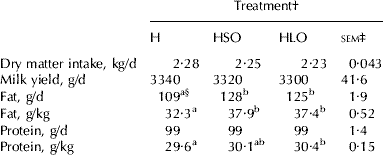
Plant oils had no effect (P>0·05) on DM intake (Table 1). Inclusion of sunflower-seed oil enhanced (P<0·05) 18:2n-6 intake (5·1, 41·4 and 13·2 g/d for H, HSO and HLO, respectively) while linseed oil in the diet increased (P<0·05) 18:3n-3 intake (6·0, 6·4 and 37·7 g/d for H, HSO and HLO, respectively). Treatments H, HSO and HLO supplied 29·9, 142·6 and 141·8 g/d of total C18 fatty acids, respectively. Plant oils had no effect (P>0·05) on milk yield and protein output (Table 1). Relative to the control treatment, inclusion of plant oils enhanced (P<0·05) milk fat content (mean response +5·6 and +5·1 g/kg for HSO and HLO, respectively) and fat yield (corresponding values +19 and +16 g/d).
Effect of sunflower-seed oil or linseed oil in the diet on dry matter intake, milk yield and milk composition in goats
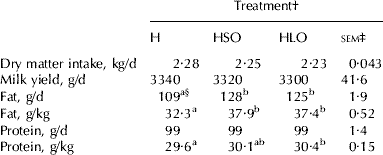
† Refers to natural grassland hay-based diets containing no additional oil (H), or 55 g/kg diet DM of sunflower-seed oil (HSO) or linseed oil (HLO)
‡ For n=39; error degrees of freedom, 22
§ Means within a row with unlike superscripts differ (P<0·05)
Milk fatty acid secretion
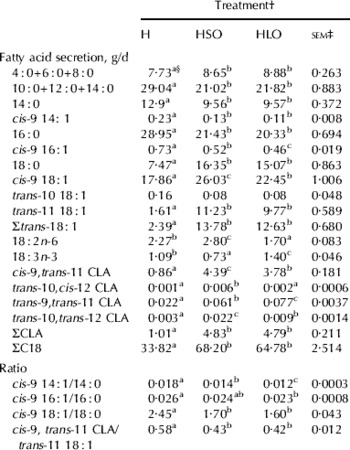
Plant oils in the diet decreased (P<0·05) secretion of 10:0–14:0, 16:0 and cis-9 16:1 and enhanced (P<0·05) the output of 4:0–8:0, 18:0, cis-9 18:1, trans-11 18:1, Σtrans-18:1, cis-9, trans-11 CLA and ΣCLA in milk (Table 2). Both sunflower-seed and linseed oil reduced (P<0·05) milk fat cis-9 14:1/14:0, cis-9 18:1/18:0 and trans-11 18:1/cis-9, trans-11 18:2 concentration ratios (Table 2). Compared with the control, treatment HLO decreased (P<0·05) the concentration ratio of cis-9 16:1/16:0 in milk fat (Table 2).
Effect of sunflower-seed oil or linseed oil in the diet on the secretion of major fatty acids in milk, including specific isomers of conjugated linoleic acid (CLA) in goats
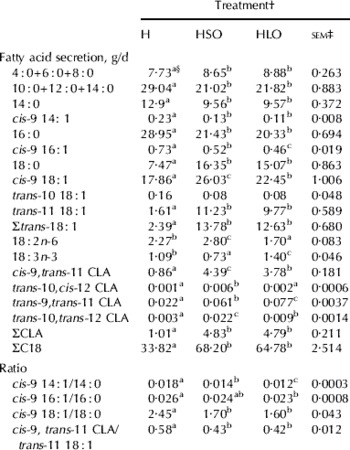
† Refers to natural grassland hay based diets containing no additional oil (H), or 55 g/kg diet DM of sunflower-seed oil (HSO) or linseed oil (HLO)
‡ For n=39; error degrees of freedom, 22
§ Means within a row with unlike superscripts differ (P<0·05)
Plasma metabolites and milk lipoprotein lipase activity
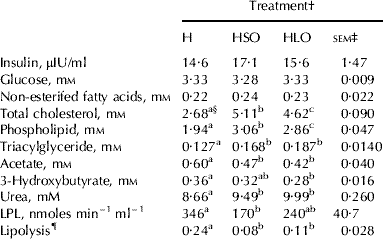
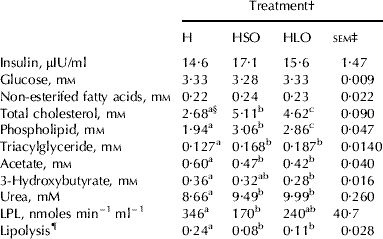
Plasma glucose, insulin and NEFA concentrations were similar amongst treatments (Table 3). Relative to the control, HSO and HLO increased (P<0·05) plasma total cholesterol, phospholipid, TAG and urea content (Table 3). Both HSO and HLO decreased (P<0·05) acetate concentrations in plasma, whilst β-hydroxybutyrate was reduced (P<0·05) for HLO relative to treatment H. Activity of LPL in milk was decreased (P<0·05) in response to sunflower-seed oil in the diet, whereas both plant oils supplements decreased (P<0·05) lipolysis in milk during storage after milking (Table 3).
Effect of sunflower-seed oil or linseed oil in the diet on milk lipoprotein lipase (LPL) activity and plasma insulin and metabolite concentrations in goats
† Refers to natural grassland hay based diets containing no additional oil (H), or 55 g/kg diet DM of sunflower-seed oil (HSO) or linseed oil (HLO)
‡ For n=39; error degrees of freedom, 22
§ Means within a row without a common superscript differ (P<0·05)
¶ Lipolysis determined as milk fat cis-9 18:1 equivalents (g/100 g fat) after storage at 4°C for 34 h post milking
Mammary, adipose and hepatic tissue lipid metabolism
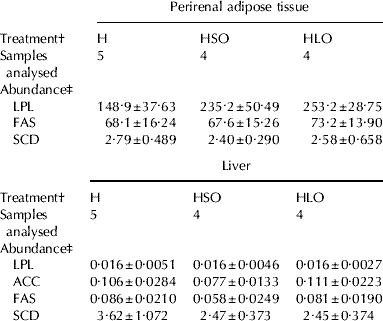
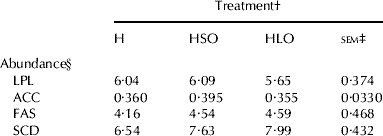
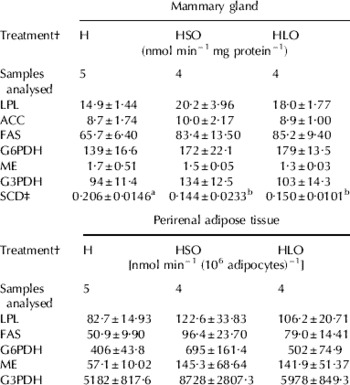
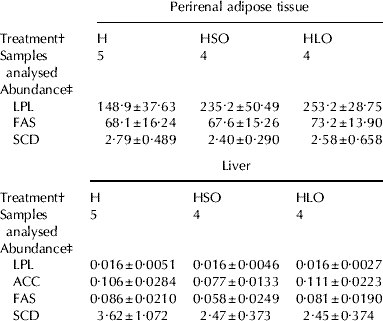
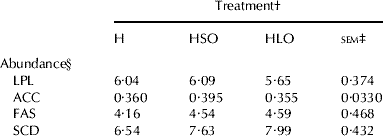
Treatments had no effect (P>0·05) on the abundance of mRNA encoding for LPL, ACC and/or FAS and SCD in mammary, liver or perirenal adipose tissues (Tables 4 and 5). Furthermore, treatments had no effect (P>0·05) on LPL, FAS, G6PDH, ME and G3PDH activity in the mammary gland and perirenal adipose tissue, or ACC activity in mammary gland (Table 6). However, inclusion of both plant oils in the diet was associated with a reduction (P<0·05) in mammary SCD activity.
Effect of sunflower-seed oil or linseed oil in the diet on mRNA abundance encoding for lipoprotein lipase (LPL), acetyl-CoA carboxylase (ACC), fatty acid synthase (FAS), and stearoyl-CoA desaturase (SCD) in perirenal adipose tissue and liver of goats
† Refers to natural grassland hay based diets containing no additional oil (H), or 55 g/kg diet DM of sunflower-seed oil (HSO) or linseed oil (HLO)
‡ mRNA levels expressed in arbitrary units (AU) determined as abundance relative to cycophilin A mRNA multiplied by 100. Values are means±se
Effect of sunflower-seed oil or linseed oil in the diet on mRNA abundance encoding for lipoprotein lipase (LPL), acetyl-CoA carboxylase (ACC), fatty acid synthase (FAS), and stearoyl-CoA desaturase (SCD) in mammary tissue of goats
† Refers to natural grassland hay based diets containing no additional oil (H), or 55 g/kg diet DM of sunflower-seed oil (HSO) or linseed oil (HLO)
‡ For n=39; error degrees of freedom, 22
§ mRNA levels expressed in arbitrary units (AU) determined as abundance relative to cycophilin A mRNA multiplied by 100
Effect of sunflower-seed oil or linseed oil in the diet on lipoprotein lipase (LPL), acetyl-CoA carboxylase (ACC), fatty acid synthase (FAS), glucose-6-phosphate dehydrogenase (G6PDH), malic enzyme (ME), glycerol-3-phosphate dehydrogenase (G3PDH) and stearoyl-CoA desaturase (SCD) activity in mammary and perirenal adipose tissue of goats

† Refers to natural grassland hay based diets containing no additional oil (H), or 55 g/kg diet DM of sunflower-seed oil (HSO) or linseed oil (HLO)
‡ Determinations based on the analysis of (n=4) samples
Values are means±se. Means within a row with unlike superscripts differ (P<0·05)
Discussion
Inclusion of plant oils in the diet had no effect on milk yield but enhanced milk fat secretion consistent with previous studies in the goat (Chilliard et al. Reference Chilliard, Ferlay, Rouel and Lamberet2003; Bernard et al. Reference Bernard, Leroux, Bonnet, Rouel, Martin and Chilliard2005a, Reference Bernard, Rouel, Leroux, Ferlay, Faulconnier, Legrand and Chilliardb). In contrast, supplementing high-forage diets with sunflower-seed oil (Rego et al. Reference Rego, Rosa, Portugal, Franco, Vouzela, Borba and Bessa2005; Shingfield et al. Reference Shingfield, Ahvenjarvi, Toivonen, Vanhatalo, Huhtanen and Griinari2008a) or linseed oil (Roy et al. Reference Roy, Ferlay, Shingfield and Chilliard2006) have been shown to have no effect or decrease milk fat secretion in the bovine, highlighting fundamental differences in the regulation of mammary lipogenesis and fatty acid secretion in response to dietary lipids between ruminant species.
Supplementing the diet with plant lipids decreased milk fat secretion of medium chain fatty acids (10:0–16:0) synthesized de novo in agreement with responses to plant oils or oilseeds reported in goats (Bernard et al. Reference Bernard, Rouel, Leroux, Ferlay, Faulconnier, Legrand and Chilliard2005b; Chilliard et al. Reference Chilliard, Glasser, Ferlay, Bernard, Rouel and Doreau2007) and cows (Chilliard et al. Reference Chilliard, Glasser, Ferlay, Bernard, Rouel and Doreau2007; Shingfield et al. Reference Shingfield, Chilliard, Toivonen, Kairenius and Givens2008b). Indirect comparisons indicate that reductions in milk 10:0–16:0 secretion of 27% in goats on treatment HLO were lower than the decrease of 46% reported for cows fed diets of comparable composition (Roy et al. Reference Roy, Ferlay, Shingfield and Chilliard2006). Reductions in the secretion of fatty acids synthesized de novo to plant oils in this experiment were found to be independent of mammary expression or activity of ACC and FAS. Lipid supplements had no effect on mammary G6PDH, ME or G3PDH activity consistent with responses to formaldehyde-treated linseed, oleic rich sunflower-seed oil or soybeans in lactating goats (Bernard et al. Reference Bernard, Leroux, Bonnet, Rouel, Martin and Chilliard2005a, Reference Bernard, Rouel, Leroux, Ferlay, Faulconnier, Legrand and Chilliardb). These findings are in direct contrast to studies in cows fed diets causing milk fat depression containing high proportions of concentrates rich in starch and soybean oil (Piperova et al. Reference Piperova, Teter, Bruckental, Sampugna, Mills, Yurawecz, Fritsche, Ku and Erdman2000) or sunflower-seed oil (Peterson et al. Reference Peterson, Matitashvili and Bauman2003), supplemented with fish oil (Ahnadi et al. Reference Ahnadi, Beswick, Delbecchi, Kennelly and Lacasse2002) or a mixture of fish oil and soybean oil (Harvatine & Bauman, Reference Harvatine and Bauman2006), or in response to post-ruminal or intravenous infusions of trans-10,cis-12 CLA (Baumgard et al. Reference Baumgard, Corl, Dwyer, Sæbø and Bauman2000; Harvatine & Bauman, Reference Harvatine and Bauman2006), which have established that 30–59% reductions in milk C4–16 secretion was associated with decreases in mammary ACC and FAS mRNA abundance and/or activity. Current and previous studies (Bernard et al. Reference Bernard, Rouel, Leroux, Ferlay, Faulconnier, Legrand and Chilliard2005b) indicate that decreases in secretion of fatty acids synthesized de novo of between 18 and 27% in the goat are not associated with significant changes in mammary expression or activity of ACC and FAS. Differences in the magnitude of ACC and FAS mRNA responses to dietary polyunsaturated fatty acids are probably related to inherent differences in mammary lipogenesis between ruminant species. Several studies have established that specific biohydrogenation intermediates (trans-10,cis-12 CLA, cis-10,trans-12 CLA and trans-9,cis-11 CLA) exert anti-lipogenic effects in the bovine (Shingfield & Griinari, Reference Shingfield and Griinari2007). In this experiment, the concentration of these fatty acids in milk was below 0·01 g/100 g fatty acids (Bernard et al. Reference Bernard, Shingfield, Rouel, Ferlay and Chilliard2009) with the implication that ruminal formation and mammary uptake of these intermediates is extremely limited in the goat. Furthermore, milk fat responses to post-ruminal infusions (Andrade & Schmidely, Reference Andrade and Schmidely2006) or rumen-protected supplements (Shingfield et al. 2008c) provide evidence that the mammary gland in the caprine is much less responsive to the anti-lipogenic effects of trans-10,cis-12 CLA compared with the bovine.
Increases in the secretion of long-chain fatty acids to plant oils was not accompanied by changes in the expression or activity of LPL in the mammary gland confirming earlier studies in goats (Bernard et al. Reference Bernard, Leroux, Bonnet, Rouel, Martin and Chilliard2005a, Reference Bernard, Rouel, Leroux, Ferlay, Faulconnier, Legrand and Chilliardb). Previous experiments in lactating cows have shown that, with the exception of fish oil (Ahnadi et al. Reference Ahnadi, Beswick, Delbecchi, Kennelly and Lacasse2002) high-concentrate diets containing plant oils which induce milk-fat depression result in limited variations in mammary LPL mRNA abundance (Piperova et al. Reference Piperova, Teter, Bruckental, Sampugna, Mills, Yurawecz, Fritsche, Ku and Erdman2000; Peterson et al. Reference Peterson, Matitashvili and Bauman2003; Harvatine & Bauman, Reference Harvatine and Bauman2006). These findings tend to suggest that mammary mRNA and potential activity of LPL (determined in vitro) are not rate-limiting for mammary uptake of long-chain fatty acids in ruminants in vivo, with the implication that other factors including substrate (circulating TAG) availability and/or mammary LPL partitioning play a more important role. Inclusion of sunflower-seed oil, and to a lesser extent, linseed oil decreased LPL activity in milk (Table 3). The activity of LPL in caprine milk is known to be reduced in response to dietary lipid supplements, changes that may be explained by a repartitioning of the LPL protein towards the basal membrane at the expense of the intracellular space of secretory epithelial cells (Chilliard et al. Reference Chilliard, Ferlay, Rouel and Lamberet2003; Bernard et al. Reference Bernard, Leroux and Chilliard2008). Plant oil-mediated inhibition of lipolysis in milk may result from the decrease in milk LPL activity, with LPL in caprine milk being bound to the cream fraction and may, at least in part, account for the positive association between LPL activity in milk and post-milking lipolysis in the goat (Chilliard et al. Reference Chilliard, Ferlay, Rouel and Lamberet2003).
Apparent transfer of total C18 from the diet into milk (calculated as the ratio between secretion in milk (g/d) and amount supplied by the diet (g/d)) of 112, 48 and 45% for H, HSO and HLO diets, respectively, suggests that a proportion of C18 secreted in milk on control diet was derived from lipogenesis in non-lactating mammary tissues, whilst long-chain fatty acids derived from plant oils were also utilized by tissues other than the mammary gland. Previous studies in goats during mid lactation (Bernard et al. Reference Bernard, Rouel, Leroux, Ferlay, Faulconnier, Legrand and Chilliard2005b) or late lactation (Bernard et al. Reference Bernard, Leroux, Bonnet, Rouel, Martin and Chilliard2005a) offer no support for lipid supplements inducing changes in lipogenic gene expression or enzyme activity in perirenal adipose tissue consistent with current findings (Tables 4 and 6), and the lack of significant effects on plasma insulin, glucose and NEFA concentrations in response to plant oils (Bernard et al. Reference Bernard, Rouel, Leroux, Ferlay, Faulconnier, Legrand and Chilliard2005b; Table 3). Furthermore, treatments had no effect on LPL, ACC, FAS and SCD mRNA abundance in the liver (Table 4). Overall, the results suggest that lipogenic gene expression or potential enzyme activity (as measured in vitro) in hepatic or perirenal adipose tissue does not play a key role in the regulation of milk fat secretion and long-chain fatty acid metabolism responses to plant oils in the goat. Differences in mRNA abundance of lipogenic genes among tissues (Tables 4 and 5) are consistent with minimal synthesis of fatty acids de novo and uptake of plasma VLDL in ruminant liver (Zelewski & Swierczynski, Reference Zelewski and Swierczynski1990) that occur preferentially in adipose tissue and the lactating mammary gland (Bauman, Reference Bauman and Cronjé2000) but suggest a significant contribution of hepatic tissue to the desaturation of absorbed fatty acids, in agreement with previous studies (Chang et al. Reference Chang, Lunt and Smith1992).
Secretion of 18:2n-6 or 18:3n-3 in milk were enhanced on HSO and HLO treatments, respectively, but relative to the control the increases were marginal (Table 2) confirming that these fatty acids are extensively metabolized in the rumen and result in the formation of 18:2 and 18:1 intermediates and 18:0 as the final end-product as reflected by the secretion of these fatty acids in milk (Table 2).
Concentration ratios of product and substrate in milk fat, cis-9 14:1/14:0, in particular, have been used as a proxy of SCD activity (Bauman & Griinari, Reference Bauman and Griinari2003; Bernard et al. Reference Bernard, Leroux and Chilliard2008). Plant oils in the diet decreased milk fat cis-9 18:1/18:0, cis-9,trans-11 CLA/trans-11 18:1 and cis-9 14:1/14:0 concentration ratios (Table 2) consistent with the measured decrease in mammary SCD activity in the present study, as well as in goats fed supplements of cis-9 18:1 enriched sunflower-seed oil (Bernard et al. Reference Bernard, Rouel, Leroux, Ferlay, Faulconnier, Legrand and Chilliard2005b) or during incubations of caprine mammary tissue with cis-9 18:1, 18:2n-6 and 18:3n-3 in vitro (Bickerstaffe & Annison, Reference Bickerstaffe and Annison1970). In contrast, plant oils had no effect on mammary SCD mRNA abundance (Table 5) in agreement with earlier observations in cows (Delbecchi et al. Reference Delbecchi, Ahnadi, Kennelly and Lacasse2001; Peterson et al. Reference Peterson, Matitashvili and Bauman2003; Harvatine & Bauman, Reference Harvatine and Bauman2006) and goats (Bernard et al. Reference Bernard, Leroux, Bonnet, Rouel, Martin and Chilliard2005a). However, mammary SCD mRNA abundance has been shown to be reduced in response to supplements of rumen-protected fish oil in the cow (Ahnadi et al. Reference Ahnadi, Beswick, Delbecchi, Kennelly and Lacasse2002) and formaldehyde-treated linseeds in the goat (Bernard et al. Reference Bernard, Rouel, Leroux, Ferlay, Faulconnier, Legrand and Chilliard2005b). Current data implicate polyunsaturated fatty acids at the mammary gland exerting negative regulatory effects on mammary SCD activity, which is in broad agreement with an extensive body of evidence on SCD gene expression and activity in the liver and adipose in rodents (Ntambi, Reference Ntambi1999). An absence of altered mammary SCD mRNA abundance on the HLO treatment, may be related to the relatively low secretion of 18:3n-3 in milk in this experiment (1·4 g/d) compared with a higher output in the milk (2 g/d) of goats in previous studies (Bernard et al. Reference Bernard, Rouel, Leroux, Ferlay, Faulconnier, Legrand and Chilliard2005b).
Post-ruminal infusion studies have established that several metabolites formed during ruminal 18:2n-6 metabolism (Shingfield & Griinari, Reference Shingfield and Griinari2007) including trans-10,cis-12 CLA (Baumgard et al. Reference Baumgard, Corl, Dwyer, Sæbø and Bauman2000), trans-10,trans-12 CLA (Sæbø et al. Reference Sæbø, Sæbø, Griinari and Shingfield2005) and trans-9,trans-11 CLA (Perfield et al. Reference Perfield, Lock, Griinari, Sæbø, Delmonte, Dwyer and Bauman2007) decrease product substrate concentration ratios for SCD in milk in the bovine. Trans-10,cis-12 CLA is also known to elicit a decrease in the fatty acid concentration ratios that serve as a proxy for SCD in the goat (Andrade & Schmidely, Reference Andrade and Schmidely2006). Milk fat concentrations of trans-10,trans-12 CLA and trans-9,trans-11 CLA were enhanced on HSO and HLO treatments (Table 2) which may explain, at least in part, the reduction of mammary SCD activity to plant oils in the goat. However, the possible contribution of other polyunsaturated fatty acids or ruminal biohydrogenation intermediate products on the regulation of mammary SCD activity cannot be excluded (Bernard et al. Reference Bernard, Shingfield, Rouel, Ferlay and Chilliard2009). Indirect comparisons indicate a larger reduction in milk fat cis-9 14:1/14:0 concentration ratio to linseed oil in the caprine of 33% compared with reductions of 13% in the lactating cow receiving diets of comparable composition (Roy et al. Reference Roy, Ferlay, Shingfield and Chilliard2006). Furthermore, small or relatively minor changes in the ratio of cis-9 18:1/18:0 in milk were reported in response to plant oils in the cow fed hay-based diets (Roy et al. Reference Roy, Ferlay, Shingfield and Chilliard2006; Chilliard et al. Reference Chilliard, Glasser, Ferlay, Bernard, Rouel and Doreau2007) while current and earlier studies (Bernard et al. Reference Bernard, Rouel, Leroux, Ferlay, Faulconnier, Legrand and Chilliard2005b) indicate that this ratio is substantially decreased in goats. Collectively these observations point towards a higher sensitivity of the SCD enzyme system to the inhibitory effects of polyunsaturated fatty acids or ruminal biohydrogenation intermediates in the caprine mammary gland compared with the bovine.
In conclusion, changes in milk fatty acid secretion to plant oil supplements do not appear to be mediated via alterations in mammary ACC, FAS and LPL mRNA abundance or lipogenic enzyme activity. Even though lipid supplements decreased goat mammary SCD activity and substantially altered milk fat concentration ratios that serve as a proxy for SCD activity, these changes were not associated with a reduction in mammary SCD mRNA abundance. Further studies are required to elucidate the mode of action of mammary lipogenic and fatty acid secretion responses to plant oils in the caprine, and identify causes for differences in the regulatory mechanisms between ruminant species.
This research was supported by the French Ministry of Research and regional funding (Project: Poitou-Charentes; Effect of the diet and its fat composition on the quality of goat milk and dairy products, and on yield of fatty acids shown to exert positive effects on human health) within the ‘Aliment Qualité Sécurité’ (N° 2000/F16) research programme. The authors acknowledge and appreciate the contribution of A Ollier, A Combeau for diligent care of experimental animals, R Jailler and his team for assisting in the slaughter of experimental animals, P Gaydier for the collection of mammary biopsies and P Capitan, C Labonne, M Tourret and D Bany for assistance with sample analysis.