INTRODUCTION
The false scad Caranx rhonchus (Geoffory Saint-Hiliaire, 1817) is a common semi-pelagic carangid fish, which inhabits seas around islands of the eastern Atlantic, in moderate subtropical waters of the west Atlantic, South Africa, Japan, Australia and New Zealand. It is very common in the Mediterranean Sea, especially the Tunisian waters above muddy and sandy bottoms down to depths ranging from 30 to 200 m (Fischer et al., Reference Fischer, Bauchot and Schneider1987). There are no reliable statistics on C. rhonchus landings on the Tunisian coasts. The entire genus Caranx is mixed in one statistical category. Currently, this species is still abundant in the Gulf of Gabes (south of Tunisia), it is an economically important pelagic species and it is considered as being overfished. However, despite its abundance, very little is known about the trophic ecology of this species in the Gulf of Gabes.
In the north-east Atlantic, Boely et al. (Reference Boely, Wysokinski and Elwertowski1973) studied the diet of C. rhonchus. Severin (Reference Severin1983) reported that juvenile C. rhonchus from Arguin Bay of the Mauritanian coastal area was zooplanktophagous but becomes ichthyphagous when adult. In the Mediterranean waters and mainly along the Tunisian coasts, Ould Mohamed (Reference Ould Mohamed1999) and Ben Salem & Ktari (1980) provided qualitative descriptions of the diet of C. rhonchus. The purpose of the present study was to investigate the diet and feeding habits of C. rhonchus in the Gulf of Gabes, including the effects of predator size and season on the stomach contents.
MATERIALS AND METHODS
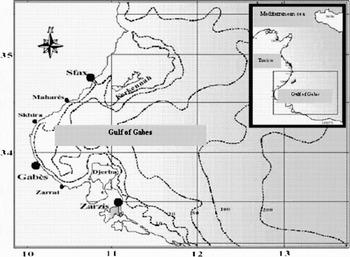
In the Gulf of Gabes, from the parallel 35°N to the Tunisian–Libyan border (Figure 1), Caranx rhonchus is caught by seine nets; 1040 specimens were collected monthly between June 2004 and May 2006 ranging in size from 6.5 to 30.6 cm and were examined fresh. Immediately after landing, the total length (TL) of each fish was measured to the nearest 0.1 cm and weighed to the nearest 0.1 g.
Map of the study area (Bradai, Reference Bradai2000).

Preys were identified to the possible lowest taxon and weighed to the nearest 0.001 g. Numerous indices have been calculated to quantify the importance of different prey items in the diet of fish. Dietary descriptions of this fish the species and other aquatic vertebrates are greatly influenced by the choice of method used to quantify the relative importance or contribution of each prey type to the diet. This is because the most commonly used methods (frequency of occurrence (%O), numerical abundance (%N) and volume or weight estimations (%W)) convey different types of information on feeding habits (MacDonald & Green, Reference MacDonald and Green1983; Bigg & Perez, Reference Bigg, Perez and Beddington1985; Cortés, Reference Cortés1997). This limitation of single indices led Pinkas et al. (Reference Pinkas, Oliphant and Iverson1971) to propose the index of relative importance (IRI) — a compound index that describes the relative contribution of stomach contents to the diet. Cortés (Reference Cortés1997) proposed to include the IRI standardized to 100% (%IRI), in addition to reporting the three single measures (%O, %N and %W), to facilitate comparisons between dietary studies. The per cent index of relative importance puts results into a common metric, more amenable for use in diet comparisons and calculation of other trophic indices. In the present study, the following indices were used:
vacuity index (%VI) = number of empty stomachs *100/total number of examined stomachs;
percentage frequency of occurrence (%O) = number of stomachs in which a food item was found * 100/divided by total number of full stomachs;
percentage numerical abundance (%N) = number of each prey item * 100/the total number of prey in all stomachs;
percentage gravimetric composition (%W) = wet weight of each prey item * 100/the total weight of stomach contents.
The main food items were determined using the index of relative importance (IRI):
IRI = %O (%N + %W).
The index was expressed in percentage as follows: %IRI = (IRI/∑ IRI) ×100.
Prey species were sorted in decreasing order according to IRI and the cumulative %IRI was calculated and recorded for the major forage categories (Hyslop, Reference Hyslop1980) and compared among different groups according to size, season and sex. This index was examined for three size-groups that corresponded roughly to juveniles (≤16 cm TL), sub-adults (16.1–22 cm) and adults (>22 cm TL) of Caranx rhonchus.
Statistical differences (P < 0.05) in diet composition with respect to length-class and season were assessed by the Chi-square test of the frequencies of a given prey (Sokal & Rohlf, Reference Sokal and Rohlf1981). The variation in vacuity index (%VI) was also tested using the Chi-square test over a contingency table of the number of empty stomachs.
RESULTS
Feeding intensity
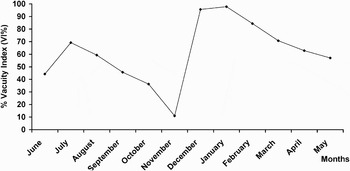
Among the 1040 stomachs of Caranx rhonchus examined, 595 were empty (VI% = 57.2). The proportion of empty stomachs varied significantly over the year (χ2 = 216.16, P < 0.05).
The highest number of empty stomachs was found in December (95.6%) and January (97.7%), while the lowest was observed in November (11%) (Figure 2). The proportion of empty stomachs was also significantly different among the three size-classes (χ2 = 10.2, P < 0.05), and corresponded respectively to juveniles (VI% = 53.9%), sub-adults (VI% = 61.9%) and adults (VI% = 50.9%).
Variation in percentage of empty stomachs of Caranx rhonchus throughout the year.

Diet composition
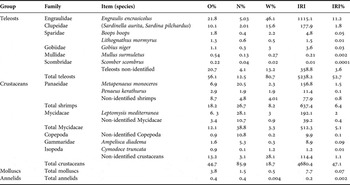
Four major prey groups: teleosts, crustaceans, molluscs and annelids were identified in the stomach contents of Caranx rhonchus. A total of 13 species representing 12 different families were identified.
Teleosts constitute the most frequently observed group, with 52.7% of the total %IRI, followed by crustaceans (%IRI = 47.1), while the other taxa, i.e. molluscs and annelids were scarcely found (%IRI < 0.1) (Table 1) and for that they are not indicated in all figures. At the family level, Engraulidae (Engraulis encrasicolus) was the major prey consumed by C. rhonchus (%IRI = 12.9), followed by two crustaceans: Panaeidae (%IRI = 6.4) and Mycidacae (%IRI = 5.1) (Table 1).
Diet composition of Caranx rhonchus of the Gulf of Gabes (Tunisia).

Diet composition in relation to the sex
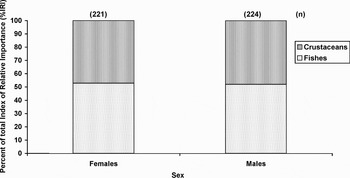
Overall, teleosts had a slightly higher percentage of IRI than crustaceans. Female teleosts had an IRI of 52.8% and crustaceans 47.1%, while males had 51.9% and 47.9% of teleosts and crustaceans respectively. There were no appreciable dietary differences between males and females in any prey category (teleosts: χ2 = 0.1, P > 0.05; crustaceans: χ2 = 0.1, P > 0.05) (Figure 3).
Diet compostion of Caranx rhonchus among sex, based on the percentage index of relative importance values of the major prey groups: n = number of non-empty stomachs analysed in each sex.

Diet composition in relation to fish size
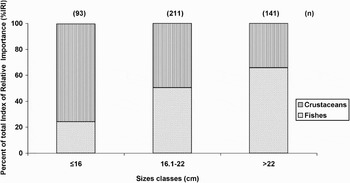
Teleosts and crustaceans were the only prey groups present in the diet of all size-classes (Figure 4). Crustaceans were the most important prey group in the small size-class (≤16 cm TL) (%IRI = 75.4), while the contribution of teleosts was comparatively low (%IRI = 24.1). The frequency of crustaceans significantly decreased with increasing size (χ2 = 14.7, P < 0.05), whereas the frequency of teleosts significantly increased (χ2 = 20.7, P < 0.05). In the large size-class (adults, >22 cm TL) teleosts represented more than 65% of the total IRI.
Diet compostion of Caranx rhonchus among size-classes, based on the percentage index of the relative importance values of the major prey groups: n = number of non-empty stomachs analysed in each size-class.

Diet composition in relation to the seasons
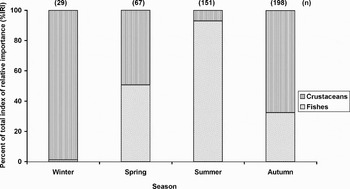
There were some seasonal variations in food habits of C. rhonchus (Figure 5). Crustaceans were the dominant prey group during autumn and winter. Teleosts were also present in the stomachs throughout the year, with a peak value recorded in summer (%IRI = 92.8). Teleosts and crustaceans were present in equal proportions in spring. In addition, molluscs were found in winter, autumn and summer, while annelids were found only in summer. Significant differences among seasons were found for crustaceans (χ2 = 84.4, P < 0.05) and teleosts (χ2 = 78.3, P < 0.05).
Diet composition of Caranx rhonchus throughout the year based on the percentage index of relative importance values of the major prey group: n = number of non-expty stomachs analysed in each season.

DISCUSSION
Dietary studies of Caranx rhonchus in the Gulf of Gabes, central Mediterranean, show a high proportion of empty stomachs and few prey items per stomach, most of them in advanced stages of digestion. Ould Mohamed (Reference Ould Mohamed1999) reported that the percentage was higher than 65% on the Tunisian coasts, but it was more than 70% in the region of Cape Blanc (north-western Africa) (Kompowski, Reference Kompowski1976). However, the proportion of empty stomachs is often variable in commercial Caranx catches. In view of the lack of evidence of stomach reversion at capture, the high percentage of empty stomachs may reflect short periods of feeding followed by periods of rapid digestion. Rapid digestion can complicate dietary analysis, because of the possibility of a reduction in the number of prey species that may be positively identified.
Our study indicates that Caranx rhonchus is an opportunistic predator that consumes a wide range of prey items. It is mainly a carnivorous fish, as are all species of the genus Caranx (Overko, Reference Overko1978; Maigret & Ly, Reference Maigret and Ly1986; Chavance et al., Reference Chavance, Ba and Krivospitchenko1991; Marchal, Reference Marchal1991). Its most common prey were teleosts and to a lesser degree, crustaceans. These prey groups, which represent 45% or more of the total IRI, can be considered as the main food. The other prey groups (i.e. molluscs and annelids) were of minor importance and may be considered as occasional food.
The anchovy Engraulis encrasicolus had the highest frequency of occurrence in the diet of C. rhonchus. Penaeidae (i.e. Metapenaeus monoceros and Penaeus kerathurus), Mycidacae (i.e. Leptomysis mediterranea) and Clupeidae (Sardinella aurita and Sardina pilchardus) were of secondary importance. In the north-east Atlantic, C. rhonchus is a predator species and feeds also primarily on teleosts, especially the anchovy Engraulis encrasicolus (Boely et al., Reference Boely, Wysokinski and Elwertowski1973).
The feeding patterns of Caranx rhonchus observed in the present study agree well with the field distribution patterns of several fish species. For example, the anchovy Engraulis encrasicolis, commonly present in the Tunisian waters (Gaamour, Reference Gaamour1999), especially in the Gulf of Gabes was frequently found in the stomachs of this species, whereas, the other teleosts: Boops boops, Lithognathus mormyrus, Gobius niger, Mullus surmuletus and Scomber scombrus were less frequently encountered. The annual landings of the false scad Caranx rhonchus were always important in the Gulf of Gabes due to the encouragement of the state to exploit this commercial species with appropriate fishing gears (gill-nets and purse seines).
Diet often changes with the geographical area and this was observed for C. rhonchus as well. In the Gulf of Gabes, C. rhonchus seems to have a diet similar to that of other areas, with few exceptions. In the Mediterranean Sea, the main food of this species was small fish, while crustaceans were the second most important group (Fischer et al., Reference Fischer, Bauchot and Schneider1987). Ben Salem & Ktari (Reference Ben Salem and Ktari1980), also reported that teleosts, crustaceans and algae were present in the stomach contents in the same area. Taken together, the results of these studies confirm the importance of teleosts in the diet of C. rhonchus. In contrast, Severin (Reference Severin1983), reported that C. rhonchus from the Arguin Bay of the Mauritanian coastal area, is mainly a planktophagous fish. The observed variations suggest that the diet composition of C. rhonchus may be greatly modified in response to the availability of prey.
In comparison to other Carangidae, the diet of Caranx rhonchus in the Gulf of Gabes most closely resembles that of amberjack Seriola dumerili (Andaloro & Pipetone, Reference Andaloro and Pipetone1997), both species feeding primarily on teleosts. However, the diet of the horse mackerel, Trachurus trachurus, from the Tunisian coasts (Fezzani, Reference Fezzani2006) and the central Adriatic Sea (Santic et al., Reference Santic, Jardas and Pallaoro2004) were mainly zooplanktonic crustaceans, while teleosts were of minor importance. Ben-Salem (Reference Ben-Salem1988) reported that mysids, along with copepods and euphausiids, were the main food items of horse mackerel from Lion Bay and the Tunisian coastal area.
In this study, the obtained results show that food habits considerably change as fish grow. Small and medium size-classes are mostly zooplanktophagous fish, while large specimens (>22 cm TL) are mainly ichthyophagous.
Juveniles tended to consume a less diverse range of prey species, comprising mostly zooplanktonic crustaceans (larvae of shrimps, Mycidacae and Gammaridae) and small pelagic fish and fish larvae. Larger specimens appear to become more piscivorous and therefore capable of capturing large teleosts that have a high percentage of stomach content weight. These differences could be attributed to the size of the specimens. Sub-adults of C. rhonchus have diets comprising mostly teleosts and crustaceans.
In our study, the stomach food content of C. rhonchus showed seasonal variations. Crustaceans dominated in the diet during autumn and winter. Teleosts were frequently encountered in the stomachs in summer. Teleosts, beside the crustaceans, constituted a significant part of the diet in spring.
Feeding intensity is negatively related to the percentage of empty stomachs (Bowman & Bowman, Reference Bowman and Bowman1980). In our study, vacuity index (%VI) values are increased in June–July and August. This period coincides with the spawning season of Caranx rhonchus in the Gulf of Gabes (Ould Mohamed, Reference Ould Mohamed1999). Feeding intensity decreased during the winter months, as can be deduced from the high number of empty stomachs (>80%). This can be explained either by the unavailability of the prey or by the temperature dependent physiological process. The need for this species to take in enough energy for the breeding period has probably resulted in an increase in their feeding intensities from March to May and this may also explain the decrease in the %VI values. The greater feeding intensity of C. rhonchus coincides with the autumn season, which may reflect that the fish require more energy to palliate the deficit due to the spawning event.
In conclusion, C. rhonchus is mainly a carnivorous fish. The diet in the Gulf of Gabes as well as in the north-east Atlantic waters comprises mainly teleosts. The importance of fish and crustaceans differed significantly with seasons as well as in small and medium size-classes. In addition, teleosts constituted the main food in larger specimens. Feeding activity of this species throughout the year probably depended on fish abundance and seawater temperature. Our results show that C. rhonchus has a high feeding opportunism.
Future monitoring of the Gulf of Gabes feeding ecology of Caranx rhonchus could help us better understand the inter- and intra-specific interactions that occur in this region, and how climate change affects these interactions.