INTRODUCTION: THE STRATEGIC PEASANT
Peasant households in early twentieth-century China seemed to contemporary observers to face a perpetual crisis of subsistence survival.Footnote 1 Informed by agricultural specialists on China including L. Buck, the leading European economic historian R. H. Tawney described the situation of Chinese peasants as “a man permanently standing up to the neck in the water”.Footnote 2 Later J. C. Scott used this metaphor in introducing the idea of The Moral Economy of the Peasant.Footnote 3 Observers thought that the poverty of peasants went in tandem with marginally self-sufficient conditions in which there was little room for accumulating a surplus. In particular, the small size of land plots worked by peasants seemed to prevent them from increasing productivity through economies of scale and from escaping the trap of involution. However, observers also witnessed thousands of peasants selling products in local marketplaces. In order to reconcile this activity with the perception of unstable agricultural production which left peasants with little surplus to sell, contemporary scholars came up with the explanation that peasants were forced to make sacrifice sell-offs in times of famine. Heavy taxes and/or rent in addition to their debts to merchants forced them to sell off their products even at the expense of basic survival. The image of selling not surplus but essential goods encouraged moral economists to insist that villagers needed to establish systems of mutual support, or maintain reciprocal relationships, as a defence against the market economy. The image of Chinese peasants in subsistence crisis in combination with famine sell-offs also worked to dramatize the revolutionary narrative of peasants rising up in revolt from the bottom of society.
However, as we will see in this article, modern investigations of income and expenditure by Chinese peasant households in more detail have shown many cases where a proportion of products were neither sold nor consumed by average farmers, but held back when the price was not favourable to await the next season. Why would peasants regularly facing a subsistence crisis keep a portion of their products unused and unsold? Scholars maintaining the idea of famine sell-offs by peasants have never delved into the actual behaviours of peasants in marketplaces, even though these have already been investigated in field research.Footnote 4 The above-mentioned behaviour of peasants may seem a risky investment through individual choice in a way that S. L. Popkin characterized as a rational peasant who might under different circumstances have chosen to join a collective action to avoid risk.Footnote 5 However, the reality not only goes beyond the dichotomy of a self-sufficient economy and a market economy according to the moral economy concept, but also goes beyond another dichotomy of individual choice and communal contribution according to the rational peasant approach. In this article we shall see a duality of economic activity within the Chinese rural economy, resulting from different strategies by peasant households which made individual choices according to market conditions.
As we will see in detail in the third section below, statistical surveys of local marketplaces in rural China have revealed that the amount of exchange among peasants exceeded the amount of trade between local peasants and merchants from outside. This is the aspect that conventional conceptions of markets, such as Smithian Growth, have always overlooked. Working on the assumption that a transaction between different occupations and/or dissimilar products can increase productivity and enhance economic development, one would conclude that exchange among local peasants whose products are similar must be negligible.Footnote 6 However, the growth of the rural market in China which was not in proportion with that of distant exchange suggests that there might be another path of trade development for the rural economy that has been neglected by conventional trade theory, focusing as it does on comparative advantage in production factor endowment between distant locations.
Foreseeing fluctuating conditions both in proximate exchanges and distant trade, Chinese peasants invested resources and allotted labour in order to maximize return in the short term and avert risk in the long term, mostly by individual choice rather than collective activity. Here we will call such people “strategic peasants”. Numerous peasants’ strategic engagement in local trade affected the organization of commerce along the direction of strengthening autonomy in proximate exchanges as against distant trade. As the exchanges within local marketplaces developed autonomously, peasants had more options to maximize their return and minimize their risk. The strategic peasant household in China operated in tandem with the autonomous local market.
The multiplicity of markets has not always escaped scholars’ attention. However, just as Polanyi made a distinction between local trade as controllable and long distance trade as uncontrollable,Footnote 7 the self-organizing aspects of local marketplaces where anonymous peasants gathered were mostly ignored. Developing the field research on rural markets in China before World War II, Skinner successfully modelled market strata in rural China, but his model incorporating central place theory in geography was too concentric to highlight the gap between marketplaces accessible to peasants and those not accessible.Footnote 8
Anonymous exchanges in the marketplace needed a currency circulating among locals. As shown in the fourth section below, if a formal supply of currency was in shortage, native currencies with no official support were often created by locals to mediate local exchanges. The degree of strength of the combination between individual peasant and local marketplace differed society by society. Comparisons with contemporary Japanese peasants in the fifth section will make clear that the economic activities of Chinese peasants were far less corporative and more dependent on one-time transactions in a marketplace than the Japanese ones were. This contrast between China and Japan suggests a difference in institutions, one preventing a monopoly of trade and indirectly encouraging one-time transactions, and the other directly organizing trade and enhancing subsequent transactions between the same parties.
SEASONAL ALLOCATION AND DIVISION OF LABOUR INTRA-PEASANT HOUSEHOLD
Agriculture all over the world commonly undergoes a considerable degree of seasonality. There is no agriculture without a slack season when little labour supply is needed. Meanwhile, in the busy seasons such as cultivation and harvest, as much labour as possible is required to supply the need. How to organize both idle and busy times determines the characteristics of the peasantry differently society by society.
In busy seasons, facing a shortage of labour, Chinese peasant households typically hired day labourers. Those who wanted to be employed and who wanted to employ both gathered at a particular place such as the end of a bridge in the early morning and negotiated the conditions: the wage of the day and whether lunch would be provided. Liu Dapeng 劉大鵬, a literatus in Chiqiao 赤橋 village, Taiyuan 太原 county, Shanxi province, wrote of a typical case in his diary in which hundreds of men gathered at a bridge to look for employers during the harvest season. Liu himself was not a large-scale landowner but a farmer with a middle-level size holding in the region. However, Liu himself often hired several labourers for cultivating land and harvesting crops. He sometimes recorded the amounts of wage payments in his diary, but not the names of the day labourers.Footnote 9 His descriptions suggest that, unlike the long-term labourers called changgong 長工, day labourers and their employers made a one-time transaction that entailed no subsequent relationship.
Liu's descriptions reflect a common situation in modern China. Take another example from an investigation of a rural market, Wulibao 五里堡, Yidu 益都 county, Shandong province. The report reveals that at every harvest for wheat in May and for sorghum in July, anywhere from 30 to 500 job seekers would gather for day labour in a temple. Wages fluctuated day by day according to demand and supply.Footnote 10
In addition to the day labour markets, a custom of mutual labour exchange between peasants, called huangong 換工, also existed in order to ease the tension between labour supply and demand in the agricultural busy seasons, though this was not at all common across China overall.Footnote 11 Thus, the provision of labour through ready cash payments dominated in making up labour shortages due to agricultural seasonality. In most cases day labour wages were paid in cash on the day without deferment.
In the case of day labour markets in rural areas, most employers and employees lived in the same village, or in neighbouring villages. For example, the diary of Liu Dapeng on 15 July 1918 records that by the bridge called Yurangqiao 豫讓橋, 200 workers gathered and were employed in Xizhen 西鎮, Huada 花塔, and Yingdi 硬底 in addition to Chiqiao.Footnote 12 Mid-July is a busy season for harvesting spring wheat. Two hundred day labourers in the region of four villages in which probably around three hundred households lived was a considerable number.Footnote 13 Considering that the villages were located close to each other, we can assume that employers and employees were not complete strangers. However, importantly, there was a clear tendency for those who wanted to be employed to go to the labour matching place outside the village to seek employers. Even if eventually a job seeker was employed by an employer within the same village, they rarely looked for jobs without going to the day-labour market.Footnote 14 This tendency for Chinese peasants to avoid a subsequent relationship in seeking day labour marks a clear contrast with Japanese villagers, as we will see in a later section and the article by Tanimoto in this issue.
Interestingly, the investigations of incomes and expenditures in peasant households in the 1930s revealed that some households receiving income from being employed had expenditure for employing others as well.Footnote 15 The relationship between an employer and an employee did not always reflect inequality between the affluent and the poor, but rather showed an adjustment between households which had surplus labour and others which had labour shortages at a particular point in time. The relationship between them might be reversed at a different time. However, direct exchanges of labour without wage payments between neighbouring peasants did not often occur. Again we can confirm a strong tendency in China for peasant households to choose one-time transactions rather than establishing subsequent cooperation with a particular household.
The wages for day labour depended on demand and supply on the day as already mentioned, but there was clear seasonality in the movement of wage levels. For example, in the case of one village in Shandong, the wage for day labour in August was 80 cents, while that in January was 20 cents.Footnote 16 It is often assumed that conditions of low-opportunity cost forced peasants to add to their working hours in farming at an unfavourable return per working hour, even if below subsistence level.Footnote 17 If one considers only the wages during the season of lowest demand, the argument for farming work at sub-subsistence level return might seem persuasive. However, in the slack seasons with unfavourable conditions for agriculture, peasants quite naturally would try to find any available opportunities for income outside agriculture.
Nobody can be categorized as a peasant unless they practice agriculture on land. However, this does not mean that the income of the household comes only from agricultural work. One survey showed that, among 99 day labourers who lost agricultural employment, 91 engaged in non-agricultural work, while only 8, including gamblers and beggars, were categorized as unemployed. Interestingly the most popular vocation was small peddler, which amounted to 37 labourers among 99.Footnote 18
An investigation of 92 households in Huangling 黃陵 village, Taiyuan county, Shanxi province, revealed that the peasants had no shortage of opportunities to earn cash income from non-agricultural engagements. Among 81 peasant households, in addition to 23 engaging in agricultural labour, 74 worked as coolies, 37 made shoe soles, 10 worked as peddlers, 4 engaged in making noodles, 2 worked as village police, and so on. In particular, shoe sole-making absorbed a considerable amount of female labour from nearly half of peasant households.Footnote 19 In other villages in the same region, some produced coarse paper, some worked in local coal mines, and the like.Footnote 20 It is true that farming, especially cultivating grains, was the principal occupation for most of the villagers. However, their work on arable land was subject to a high degree of seasonality, and peasants organized their labour capacity in slack times to fulfil a variety of side businesses as often as possible.
The investigation of Huangling village showed a positive relationship between the number of male labourers in a household and the amount of cash income from employment including non-agricultural work. The coefficient between them is 0.72. This result means that the more labour a peasant household could set aside, the more cash could be brought in from employment. There was no tendency to increase the labour force to bring diminishing return per capita to the household. This contradicts the idea of involution, that increasing population forces the productivity per capita to diminish. It appears instead that ampler income outside farming one's own arable lands enabled peasants to cultivate less land, rather than a reduction of farming causing peasants to depend on cash income as the concept of famine sell-offs presumes.
The case of Liu Dapeng, mentioned above, who lived in Chiqiao village in the same county as Huangling, gives us an example.Footnote 21 Liu held the second-highest status of scholar, juren, and had cultivated land even when he had reached seventy years of age. In this sense, he fulfilled the Confucian ideal of one who cultivates land on a fine day and reads books on a rainy day. Although the land in his possession changed over time; basically Liu continued managing arable land of around 10 mu in total (approximately 0.6 ha) mainly planted with wheat. According to his description, the average harvest was 1 tan per mu. An annual harvest of 10 tan is sufficient to feed no more than three adults. In total, fifteen persons including women and infants lived in Liu Dapeng's family. Thus, though he rented land of 5 mu for a field in a different village, he was not exaggerating at all when he often wrote in his diary about the insufficiency of crops from his own lands to feed the entire family.Footnote 22 How did he cover the shortfall? Until 1911 when the Qing dynasty collapsed, he earned an honorarium from teaching the children of wealthy financiers in Taigu 太谷. However, the Shanxi financiers, called piaohao 票號, who had close connections with the Qing dynasty, collapsed and Liu suddenly lost this important source of income. Then, he endeavoured to run a small-size coal mine located in the mountainous region of the same county in cooperation with other peasant investors. The mine employed around thirty miners.Footnote 23 According to a later investigation, investors in coal mines in the district amounted to 60 persons, while the number of miners in the district was estimated to be 1,300.Footnote 24 Thus, Liu Dapeng was a peasant whose usual crop yield was below subsistence level but, depending on the situation, was also a capitalistic entrepreneur in a new business.
The vocations of side businesses by peasants differed greatly according to regional resources as well as individual conditions. Considering the whole of China, however, the most important area of activity was doubtless the hand cotton manufacturing industry. As the cultivation of raw cotton increased through the Ming–Qing period, spinning of cotton thread and weaving of cotton cloth spread across China, including regions where cotton was not cultivated. As late as the mid-eighteenth century, spinning cotton thread and weaving cotton cloth took root as the most important work absorbing female labour in many regions throughout China. In this period Wang Huizu 汪煇祖, a literatus in Zhejiang who was most famous as the author of guidebooks for local officials and secretaries, wrote in a retrospective account that, in order to earn enough to pay the honorarium to Wang's teacher in his boyhood, Wang's mother spun and wove cotton cloth to sell in exchange for copper coins of fine shapes.Footnote 25 Where did she sell the cotton cloth? Many investigations even in the 1930s revealed that, instead of purchasing machine-made cotton yarn which had already become widespread, local women were still spinning raw cotton and selling the surplus thread and cloth in the local marketplace.Footnote 26 The cloth which Wang Huizu's mother made was definitely used by clothing makers in the same region, acquired through local marketplaces. Generally speaking, raw cotton and cotton cloth were traded inter-regionally, yet inter-regional trade in cotton yarn in significant quantities was never recorded. The cotton thread trade appears only in descriptions relating to local marketplaces and was hardly ever found going beyond a single county, though it did exist.Footnote 27 We will consider this point again in the fifth section below.
In respect of Chinese peasant households, the concept of the “low-opportunity cost” in farming can be persuasive only if one ignores both the wide seasonality of labour demand in agriculture and access to non-agricultural business by peasants. Depending on similar resources in the same region, the division of labour in an intra-household way worked to generate exchanges between households without specialization household by household. We may call this the “intra-household” division of labour, through which labour is complementarily organized by gender and seasonality. This path of development is quite different from the pattern conditioning the specialization of production in an inter-household way. The concept of the division of labour depending on inter-household exchange presumes full-year employment which did not exist in most agricultural societies.
In the agricultural busy season Chinese peasants needed an exchange of labour on a scale of several villages; in selling their main harvest they needed an exchange of crops on a scale of around twenty villages; and in selling by-products for specific uses they needed an exchange of commodities on a scale of one county or larger. In the first two sizes of zone, the intra-household division of labour operated, while, in the largest-size zone, inter-household division of labour dominated. Thus, according to these multiple exchange zones, Chinese peasants combined intra-household and inter-household division of labour. In the following section we will examine the marketing places for peasants.
THE MARKETS FOR ONE-TIME TRANSACTIONS BETWEEN PEASANTS
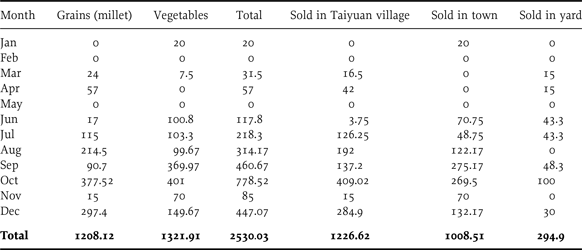
Where did Chinese peasants mostly sell their products? Who mainly purchased the products from peasants? Take a look at the case of the villagers in Huangling village mentioned above. Basically, they sold grains by themselves in the local market, which was held every other day in their village, while they sold vegetables to merchants coming from Taiyuan (the provincial capital, Yangqu 陽曲 county) to their homes, and sometimes sold vegetables in the town by themselves. Easy access to the provincial capital town was a specific advantage for the peasants in this village. As Table 1 in the Appendix shows, importantly, either type of selling had strong seasonality, though the bias in grains was slightly greater than that in vegetables.Footnote 28
As far as the main crops were concerned, peasants usually sought to bring them to the marketplace and directly negotiate prices with buyers. The majority of modern investigations of peasant households in early twentieth-century China show that peasants preferred selling products in a marketplace rather than selling to merchants in their own homes, because they believed that they could realize the appropriate prices in a market while they might be cheated by the merchants at home.Footnote 29 Importantly, when they judged that the price in the marketplace was not favourable, they often brought their products back home and waited for prices to rise.Footnote 30 Rural investigations such as the Chūgoku Nōson Kankō Chōsa 中國農村慣行調査 always show that Chinese villagers were very keen observers of price movements in the marketplaces they accessed. This observation is supported by Liu Dapeng's diary, in which he frequently recorded the price of grains in the rural marketFootnote 31 and described the movement of prices in a local town, Jinci zhen 晉祠鎮, which was located within walking distance of his village, Chiqiao.
Some cotton-growing peasants did not harvest raw cotton all at once, but batch by batch every five days in order to wait for favourable market conditions.Footnote 32 As Table 2 in the Appendix shows, peasants of the three villages in Hebei and Henan retained a quarter in value of all products neither to consume nor sell. Those villages mainly cultivated grains and raw cotton. Naturally grains occupied the majority of the reserved products. In the case of Michang 米厰 village 50 per cent of grains were neither sold nor consumed. However, of the raw cotton that had been thought to be completely sold soon after harvesting by peasants desperately seeking cash, in reality one-tenth was also left unsold or unconsumed.Footnote 33 The result proved the truth of an earlier observation that Chinese peasants held back even commercial crops like cotton, depending on the conditions in a market.Footnote 34
In the same way as day labour seekers avoided employment not arranged in the employment matching place, peasants tended to avoid selling their products within their villages, except when the marketplace was located there. It is apparent that Chinese peasants had a preference for one-time transactions that would give them greater freedom in subsequent transactions.
Depending on the situation, however, Chinese peasants sometimes received merchants in their homes in order to sell their products. As shown already, some peasants in Huangling village sold vegetables to merchants in their homes. An investigation in Licheng 歷城 county, Shandong, revealed that, in spring, peasants found an advantage in selling a large quantity of radishes if they invited merchants in to purchase them, since peasants could sell radishes only in small quantities in the marketplace, even if at a higher price. In autumn, in the same village, merchants came to purchase peanuts directly because it allowed them to acquire a large quantity even if the price was not as cheap as in the local marketplace.Footnote 35 In the case of Jiading district, Shanghai, cotton growers usually sold raw cotton in their homes under the terms offered by dealers.Footnote 36 This contrasted with peasants in Changshu 常熟 county, Jiangsu, who always brought rice to a marketplace and rarely welcomed merchants coming directly for purchase, except in one particular year when the price of rice rose sharply.Footnote 37 Located in the same Lower Yangzi delta as Changshu, peasant households in Jiading had other income sources from Shanghai besides the cotton crop. Thus, depending on the situation, Chinese peasants strategically chose where, when and to whom they sold their products. Basically, they negotiated by themselves in selling products and services and seldom accepted unfavourable prices. However, if special conditions were given, they had no hesitation in selling their products under the terms offered by dealers even if apparently less favourable.
Interestingly, the data from peasant households in Huangling village also suggests that there were two different strategies followed by peasant households. One tendency was, the more a peasant sold vegetables to the provincial capital, the more that peasant earned income outside agriculture. The coefficient is not so high, 0.43, but the probability on both sides is 0.003, which sufficiently meets the level of statistical significance at 1 per cent. Meanwhile, we find no such tendency for grains, i.e., that the more a peasant sold grains in the local marketplace, the more the peasant earned income outside agriculture. The coefficient between the quantity of grains sold in the local market and the amount of non-agricultural income among peasants who sold grains is very low, 0.02. In addition, the probability on both sides between them is 0.877, which strongly suggests almost no relationship between the two data. Thus, one type of peasant tended to increase the sale of products to the outside as they increased cash income, while another type kept selling grains within the local market regardless of the amount of cash income.Footnote 38 Apparently the former needed merchants’ connections with the outside. We may call the former broker-dependent (hence distant-trade-oriented) peasants, the latter broker-independent (hence local-trade-oriented) peasants.
Thus, depending on the situation, Chinese peasants chose their strategy differently. We need know to what extent the exchanges with merchants from town were important for peasants. Table 3 shows the value of commodities sold in eleven rural markets in the same county, Zouping 鄒平, Shandong, by the distance of each marketplace from the county town. Nearly half the value was occupied by agricultural products sold within 25 km, grains. Adding the handicrafts within 25 km – native cloth – the major local peasant products occupied nearly 60 per cent of the entire commodities traded. The balance between local products and inter-regional products was favourable for locals, except in one marketplace, Xiaodian 小店. In the largest case, Wangwuzhuang 王伍莊, two-thirds of the entire value was a “surplus” for local products. Generally speaking, petit dealers connecting rural markets with towns sold local products to towns and bought anything saleable home to return rather than keeping the cash earned.Footnote 39 We shall consider those small traders later. It might be safe to say that the “surplus” in the table reflected the amount of intra-exchange between locals gathering in the marketplace exceeding the amount of local commodities sold to the outside in exchange for commodities from outside. In short, the data suggests that peasants exchanged with proximate peasants more than with merchants engaging in distant trade.
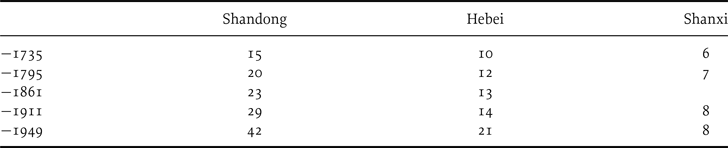
Table 4 shows the number of rural marketplaces per county in three Northern Chinese provinces, Shandong, Hebei and Shanxi. The density of marketplaces continued to increase, and particularly in the early twentieth century, they rocketed. The inclusion of peasant products in international trade stimulated commercial activity in rural China. A deeper degree of involvement in international trade in coastal areas such as Shandong accelerated the emergence of new rural marketplaces. The increasing commercialization in the peasant economy occurred through the proliferation of these new marketplaces.
As we have demonstrated, aside from the trade between one peasant and another, some portion of peasants’ products were sold to dealers in a local marketplace in villages and brought to larger towns. Who were the dealers who acquired peasants’ products and brought them to town? Some were dispatched by wholesale merchants in town, but the majority were petit traders who were also engaging in agriculture in villages, as the investigation in Shandong mentioned in the previous section revealed. Basically, the merchants in town worked as brokers mediating between petit traders collecting products from local marketplaces and inter-regional buyers. Crossing the border between the two categories of peasant strategy argued above, they must have been distant-trade-oriented peasants, but they could not have been dependent on merchants from town. That is why some peasants engaged in trade between towns and villages by themselves.
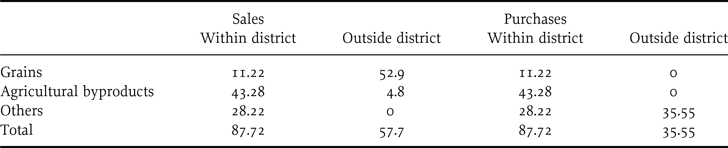
In the case of Jining 濟寧 county, among the total wheat and other grains acquired in the county town, two-thirds was sold to two larger cities, Jinan and Tianjin, while the remainder was sold locally.Footnote 40 Unlike the grain brokers in Manchuria, the grain brokers in the town made no advances to petit traders in order to acquire grains from villages. Table 5 shows the amounts of trade both for the inside zone and for the outside zone in Qingyuan 清苑 county, Hebei. Here the zone represents the area in which the town attracted sellers and buyers. The grains sold were mainly for outside the zone, 211,600 yuan, but some were for inside the zone, 44,880 yuan. However, non-grain agricultural products were sold and bought completely inside the zone. The total amount of sales inside the zone, 320,888 yuan, was larger than those outside the zone, 230,800 yuan. Considering that both Jining and Qingyuan had railway stations, a larger proportion of trade might have been made up of inside trade in the zone of usual local towns than was the case in these two towns.
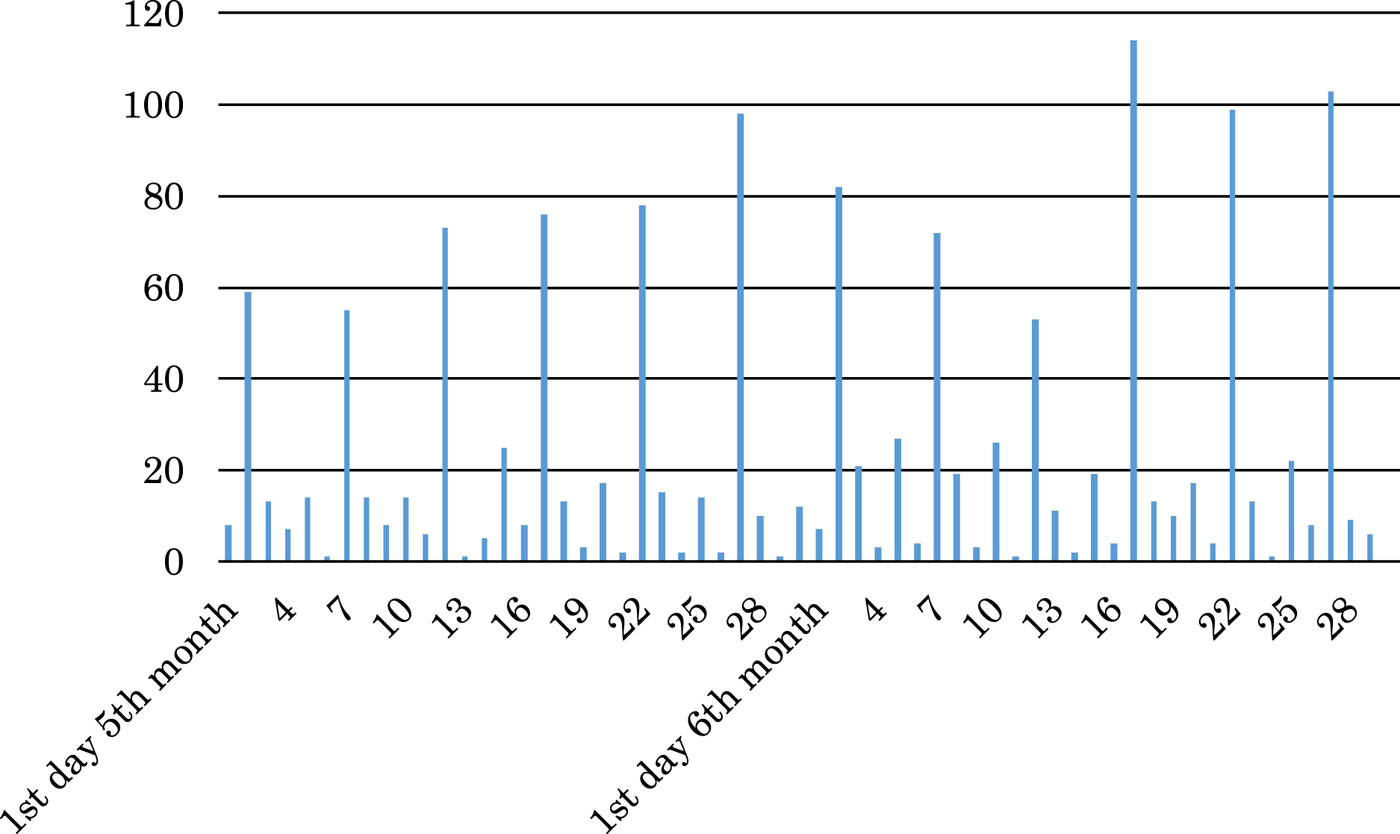
Interestingly, in a category of account book from the Tongtaihao 通泰號, a grocery merchant in Daliu zhen 大柳鎮 town, Ningjin 寧津 county, Hebei, the daily frequency of transactions periodically surged on the second day and the seventh day in every ten-day period (Figure 2 in the Appendix). The account book called Churu qian liushuizhang 出入錢流水賬 (hereafter “cash book”) appears to have been used to record all the Tongtaihao transactions, except for miscellaneous purchases for daily use, and the like. Most of the names in the entries are individual and rarely appeared twice in the same year. On days other than the second and seventh, merchants’ names in the same town made up most of those appearing in the account books.Footnote 41 The difference by day strongly suggests that the town had a five-day market held on the second and seventh days and that the market attracted a number of individual petit dealers.Footnote 42 We should remember that petit dealership was an important side-business for peasants, as shown in the last section. The individual persons appearing in the account book from the Tongtaihao must be the same as the dealers called xiaofan 小販 in the reports of later periods.Footnote 43 Apparently the Tongtaihao did not make multilateral clearance with those petit dealers as they did with the merchants in the town, as we will see in the next section.
Sometimes the Tongtaihao sold on credit and purchased on debt with the petit dealers. Even in those cases, there was a clear tendency for both sides to settle as late as the next market day, or five days later. In the case of such deferred settlements they appeared to have charged no interest.Footnote 44 Even if sales credit existed between the grocery shop and peasant-dealers, deferred payments consisted of only a very small part of the overall transactions. During the 18th day, 5th month, Daoguang 10th year (1830) and 17th day, 6th month, Daoguang 10th year, only 918,554 wen was recorded as sums sold on credit and purchased on debt with the petit dealers, while the entire transactions of the Tongtaihao amounted to 23,616, 946 wen. In addition, among fifty-seven persons who made deferred payments to the Tongtaihao during the period, only three appeared in the account book for the deferred payment in the same period of the next year, Daoguang 11th year. During the period from the 12th day, 1st month, Daoguang 10th year to the 12th day, 7th month, Daoguang 10th year, a total of seven months including an intercalary month, 420 persons appeared only once among the 483 deferred payments recorded in the account book.Footnote 45 We can see that cash transactions were so dominant that sales credit rarely repeated between the same buyer and seller. Thus, the preference for one-time transactions was particularly strong in the case of transactions through the marketplace. This finding coincides with the observations through modern rural investigations that peasants (and petit traders) made no subsequent transactions with specific merchants.Footnote 46
Interviews with villagers through rural investigations in Hebei, Shandong, Shanxi, and Jiangnan revealed four points: first, villagers seldom exchanged one commodity for another, in other words, they rarely used direct barter, but usually exchanged through transactions in cash; second, villagers avoided selling their products within their village as long as they could go to a marketplace; third, villagers showed no tendency to borrow money in the same village; fourth, villagers did not purchase necessities from the same merchants as those to whom they sold their products.Footnote 47 All these four features support the conclusion that Chinese peasant households heavily depended on one-time cash transactions through multiple and direct negotiations in anonymous settings. A marketplace accessible in half a day's travel provided an indispensable matching opportunity among local peasants.
These decentralized features in the transactions at village level were also mostly shared in the transactions at the town level between merchants residing in towns and petit dealers coming from villages. One-time transactions were dominant not only at the level of proximate exchanges among villages but also at the level of less proximate exchanges connecting villages and towns. The autonomy of dealers in lower-level markets as opposed to those of upper-level markets appears more clearly in the means of exchange, that is, money.
NATIVE CURRENCIES AND LOCAL MERCHANTS
Imagine a market system in an agricultural society stratified between upper-level markets and lower-level markets. The latter functions to collect agricultural products locally with strong seasonality, while the former distributes commodities at a relatively consistent rate inter-regionally. Depending on the size of transactions, the upper-level markets have a stronger demand for large denomination currencies, while the lower-level markets require small denomination currencies. A lower-level market might require more currency at one particular time, especially after the harvest, while an upper-level market might need to retain currency at all times. Modern China shows a case in which the lower-level markets spread very widely and densely, to the extent that exchanges inside the local zone were of greater volume than exchanges outside the zone, as we saw in the previous section. In this section, through payment systems, we are going to see a highly decentralized market system, as the activities in the lower-level market were so completely independent from those in the upper-level market.
Many historical cases show a lack of synchronization between the upper-level markets and the lower-level markets. We should not simply reduce the inconsistency between the two markets to underdevelopment of market activity, since the independence had advantages for locals, as we will see in this section. The vertical discrepancy between the upper-level markets and the lower-level markets has been ignored by those studies which view the relationship among Chinese rural markets with a concentric model, as already pointed out in the introduction above.
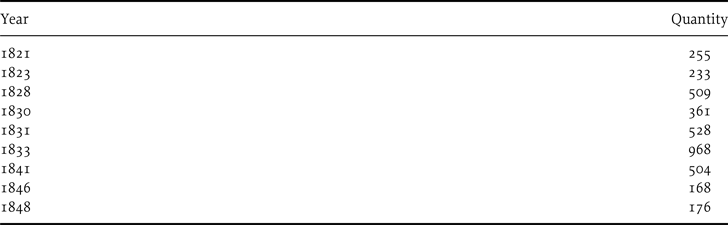
We can see one case showing the discrepancy between the two levels of markets associated with silver and copper coins respectively in mid-nineteenth-century China. From 1830 to 1850 the circulation of silver decreased, likely resulting from China's international trade deficit due to increasing opium imports. Table 6 in the Appendix shows the number of silver ingots, baoyin 寳銀 (50 liang), that entered the Tongtaihao store in nine different years. After a peak in 1833, when 968 silver ingots entered the shop, the number dropped to 168 in 1846, less than one-fifth of the 1833 peak. The merchants did not set a fixed exchange rate between silver and copper coins; the rate changed daily, and even more than once within the same day. As a result, silver appreciated substantially against copper coins. According to the account books of the Tongtaihao, one liang of silver was exchanged for 2,590 wen in the local unit of copper coins (jingqian 京錢) in 1821, 2,820 wen in 1830, 2,970 wen in 1841, 3,580 wen in 1844, and 4,800 wen in 1848.Footnote 48 The value of copper coins in terms of silver reduced by nearly half. At the time, silver was flowing out of China in significant quantities, and it is therefore safe to assume that under the contraction of silver flows, merchants depended to a greater degree on multilateral counter trade through book transfers to keep their transactions in the same town, as we will see later.
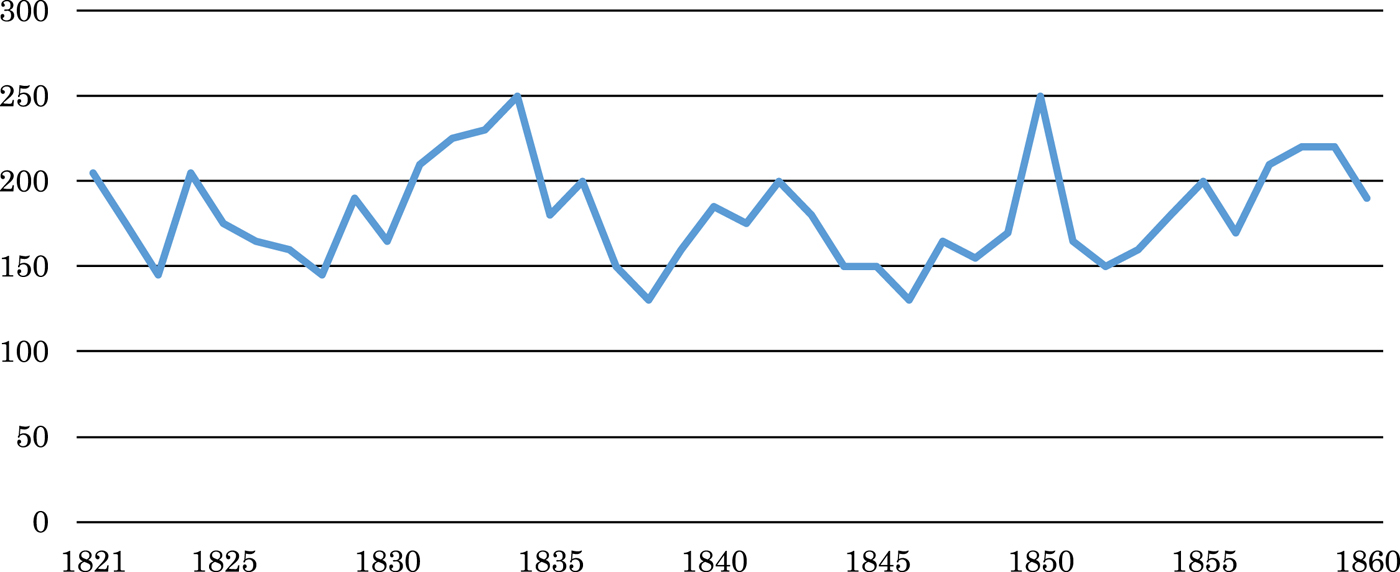
However, in spite of the serious depreciation of copper money against silver, prices in terms of copper cash remained surprisingly stable for almost half a century. Figure 1 shows the price movement of rice in one rural area, Tunxi 屯溪 county, Anhui, in China in the first half of the nineteenth century. Rice prices in copper coin at the end of the 1840s were almost the same as those at the beginning of the 1820s. In the district, many clans annually held a ritual for praying to their ancestors in early spring, at the festival known as Qingmingjie 清明節. They would record the prices of items they bought for this ritual in their account books. Importantly, in this case we can trace the movement of prices year by year without having to adjust for seasonality. Grains including rice and beans were traded in terms of copper cash, while imports from outside regions were made in terms of silver. Thus, the appreciation of silver must have hampered the purchase of products through distant trade. In addition, since tax payments were made in terms of silver, the shortage of silver caused difficulties for taxpayers. However, considering the high proportion of proximate exchanges as compared to distant exchanges for peasant households, as shown in the statistics from Qingyuan county (Table 5), keeping price movements stable within proximate exchanges must have been beneficial for ordinary peasants in rural China.
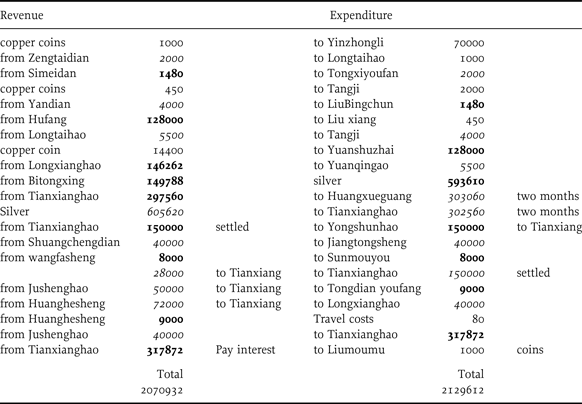
How seriously did the contraction in silver circulation affect business between local merchants? Let us take a look at a “cash book” from the Tongtaihao again. Table 7 shows all of the transactions recorded in the cash book on the 1st day of the 10th month of 1841. The total transactions that day amounted to more than 2 million wen of copper cash (or 2,000 chuan 串, a unit of coin string), which was equivalent to around 700 liang (19 kg) of silver. Though the grocery store was located in a local town, the scale of its business was quite large. The cash book included entries for both revenue (ru 入) and expenditures (chu 出). Importantly, equal amounts of wen copper cash frequently appear as entries in both the revenue and expenditure columns. We mark the different cases in italic and bold style in the table. This suggests that these transactions may have been made not through the exchange of currency, but through transfers recorded in the account books of different merchants. For example, the Tongtaihao received a commodity valued at 2,000 wen from the Zengtai 增泰 shop, and, on that same day, paid the same amount to the Tongxi 同喜 oil producer. Probably, Zengtai likewise recorded 2,000 wen in the expenditure side of their account books, while Tongxi recorded 2,000 wen in the revenue side of their books. It was not necessary to use currency as long as the amounts of the two transactions were exactly the same. We call this multilateral counter trade.
The cash book records only three pairs of revenue and expenditure for the 8th day of the 8th month of the 21st year of Daoguang (1841), as seen in Table 8. These entries allow us to confirm our interpretation of the account books. The Tongtaihao made three transactions on that day: it purchased goods whose value was 95,000 wen from the Longtaihao 隆太號 and sold goods valued at 95,000 wen to the Yishengheng 義盛恆; it purchased goods whose value was 1,400 wen from the Longtaihao and sold two pieces of cloth, lubaibu 魯白布 (probably white cloth made in Shandong), to the Tangji 堂記, and purchased goods whose value was 159,276 wen from the Longtaihao and paid 159,276 wen in silver to the Longtaihao. In most cases we cannot identify what commodities were sold and purchased, but in the case of the sale to the Tangji, the account book in fact noted two pieces of lubaibu cloth.
Most of the merchants appearing frequently in the account books presumably carried out business in the same town as the Tongtaihao. In cases where the grocery shop engaged in transactions with traders from outside the town, the place name is recorded in front of the name of the merchant shop, such as the Fashenghao 法盛號 shop in Chengli 成里. Importantly, in such business with outside merchants, silver was always used to settle the transactions.
As seen in Table 7, transactions valuing a total of 1,450 chuan (almost two-thirds of the day's total transactions, which were worth 2,070 chuan) were carried out through multilateral counter trade. Though copper coin (chuan) was used as the unit of account, only 16 chuan of copper coins – or less than one per cent of the sum of all transactions – changed hands on that day. Thus, the merchants carried out business in terms of copper coins, but they did not rely so much on physical coins. Silver ingots circulated more than copper coins, but transactions in silver occupied at most 30 per cent of the day's transactions. Through the 21st year of Daoguang (1841), silver ingots and copper coins were used in roughly the same proportion of the Tongtaihao's transactions.
Thus, we can assume that the silver outflow in this period had differing impacts on distant and proximate exchanges. Shortages of silver must have made the settlement of distant transactions more difficult, and therefore forced dealers to depend on multilateral counter trade. At the same time, by substituting multilateral book transfers for the exchange of silver ingots, merchants in the same town could to some extent continue to carry on business despite the liquidity shortage.
Interestingly, in the case of the Tongtaihao the merchant kept accounts in terms of copper coin, but the entry of actual copper coins occupied only a small portion of the entire transactions. However, in cases of one-time transactions with petit dealers, which occupied the majority of transactions in terms of frequency (not amount), copper coins must have been paid. Copper coinages whose values were small were easily distributed among peasant households, but difficult to concentrate in large quantities. In addition, demand for copper coinages was subject to much stronger seasonality than inter-regional currencies. Contemporaries thought that peasants held huge amounts of copper coins in rural areas and that this propensity caused shortages of copper cash.
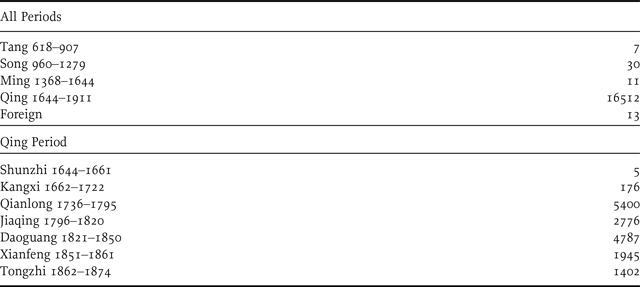
Excavations of coin hoards have proved that a proportion of copper coins did stay among end users for a long time. Table 9 shows the contents of a hoard from Aba 阿巴 district, Sichuan province, which appears to have been abandoned in the 1870s. Qianlong coins issued almost one hundred years earlier constituted one-third of the hoard. Other hoards across China reveal that, over more than five centuries, copper coins functioned in the same fashion. The physical presence of coins does not always mean that they were fully circulating. This proliferation of copper coins means rather that they were staying with a number of end users and became disarticulated from the return stream to the marketplaces.
Business in the local marketplaces seems to have been dominated by transactions in cash.Footnote 49 Shortages of copper coins caused local dealers to create devices to supplement the local monetary supply: native notes, typically called qianpiao 錢票. Native notes appear to have gained in popularity across China until even as late as the end of the nineteenth century, especially in northern China where, unlike southern China, few silver dollars circulated. As mechanical printing became prevalent in the early twentieth century, increasing numbers of native notes appeared. Some notes displayed the reason for their issuance as follows: “Copper coins have recently disappeared and silver subsidiaries were in short supply. Subsequently trade stagnated and traders have suffered losses. Thus, we issue these small notes to circulate in the market for making the supply of small change easier.”Footnote 50
Most native notes had inscriptions stating that they could be converted into metal currencies. However, observers in the early twentieth century recorded that, when a bearer actually requested the conversion, the issuer would simply exchange it for another note issued by different shop.Footnote 51 In some cases the issuers declared that they would only convert notes into coins on the day of the five-day market, the market held every five days.Footnote 52 On other days, they would only exchange one note for another at the demand of the bearer.Footnote 53 Whether the issuers observed the rule or not, the notes actually had little convertibility. However, importantly, these statements suggest a strong relationship between the activities of the local marketplace and the acceptance of native notes.
The situation in Tongshan 銅山 county in the Lower Yangzi region around 1930 shows us a more comprehensive picture of the locality of money relating to the demand for small denomination currencies and the circulation of native notes.Footnote 54 As far as currencies of one yuan were concerned, across the county the Yuan Shikai Silver Dollars issued by the central government, Mexican dollars, Bank of China notes, Bank of Communication notes and others circulated in the same way as in other counties. However, a great variety of additional smaller denomination currencies of different kinds also circulated within the county. In particular, native notes issued by local merchants, whose denominations ranged from 50, 100, 200, 300, 500, and 1,000 wen, increased the multiplicity of currency circulation. There were two kinds of native notes: one was issued by exchangers and credit-worthy shops in the county town; the other was issued by shops in rural areas. The former could circulate across the county, while the latter circulated as widely as across 40–50 square kilometres. The smallest denomination coins, 10-wen copper coins, always suffered from shortages, thus they appreciated against higher denomination copper coins (20, 50, 100, and 200 wen) and native notes by around 10 per cent. Meanwhile, the 20-cent silver coin was undervalued against the 20-cent note by around five per cent. The disparity reflected the local commercial custom of using 20-cent notes more frequently than 20-cent coins. The usage of small denomination currencies depended on local custom prevailing within a space of a few hours’ walking distance.
The appearance of currencies changed period by period. However, the distinction between a currency mediating distant exchanges and another mediating proximate exchanges never disappeared from modern China.
ANOTHER CONFIGURATION BETWEEN PEASANTS AND MERCHANTS: COMPARISON WITH EARLY MODERN JAPAN
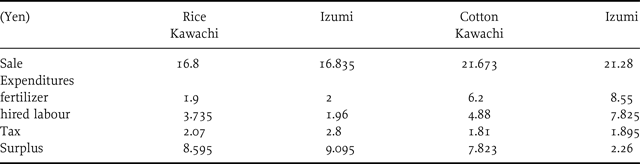
The Japanese rural economy of the mid-nineteenth century presents a situation quite unlike China during the same period. Technologically and geographically Japanese agriculture was not so different from its equivalent in southern China. Cultivation of rice and cotton brought seasonal tensions in the demand and supply of labour in both countries. Table 10 reveals that peasants in the region of present-day south Osaka used hired labour. This must have included day labour for rice planting in late spring, spreading water in cotton fields in summer, and harvesting in autumn. However, unlike rural China, as far as agricultural day labourers were concerned, the pattern of one-time employers occasionally engaging one-time employees rarely appeared in rural Japan. For example, the diary of one landowner in Yamashiro (present southern Kyoto) recorded the names of day labourers as well as the amounts of payments, as the article by Tanimoto in this issue reveals.Footnote 55 In four different years the same persons appeared and all seem to have lived nearby. No such document is known in China, but it is not entirely impossible that the same person might have been employed for day labour many times by the same employer within a Chinese village. However, there was a conspicuous difference between Japan and China: the day labourers in Yamashiro were paid later, in one extreme case, two months later. Deferred payment for day labour would have been beyond imagining in contemporary China.
The instance mentioned above suggests that in Japanese villages one villager could not easily make a one-time transaction with another. A set of institutions worked behind this feature. A village in Tokugawa Japan was a unit of taxation. Importantly, unlike under Qing China, the assessment for land taxation was readjusted so frequently that the relationship between tax collectors, domains, and villages was always in tension. It was common for leading households in a village to cover unpaid tax for destitute households. A village worked as a single entity, something much more than a collection of peasant households. It possessed common land for uses such as collecting firewood. It also had its own laws which applied only among villagers and which even the warrior rulers could not disregard. Under these circumstances, various forms of labour exchange in proximate locations such as yui 結 (labour exchange for agricultural work) dominated Japanese village life.Footnote 56 Under such a cohesive atmosphere, it is no exaggeration to say that day labour for a cash payment settled on the day between villagers of the same village would have seemed unsocial.
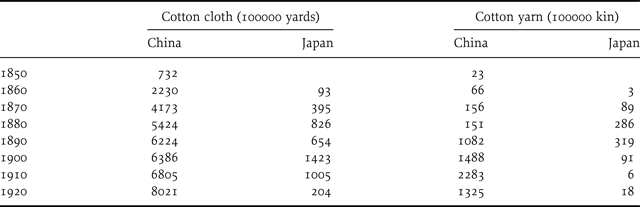
Early nineteenth-century rural Japan became less dependent on local markets. It is in striking contrast with China that rural markets, such as the every five-day markets, decreased across Japan through the seventeenth and eighteenth centuries.Footnote 57 This transformation accompanied a structural change in handicraft manufacture, which most typically appeared in the cotton industry. Until the eighteenth century the majority of cotton thread seems to have been made and used within the same region in Japan, just as in China. However, the situation changed towards the turn of the century. A typical case was merchants in Osaka who purchased raw cotton directly from cotton-growing peasants in Kawachi and transported it to Awaji or Kii where peasants could not plant cotton and had idle time in the slack season to do spinning. Manual cotton threads, kaseito 綛糸, were traded in large quantities by merchants in Osaka to distant regions like Ryukyu and Akita.Footnote 58 Manual cotton threads traded in this way were easily substituted by cheaper, imported machine-made yarns. Thus, the import of cotton yarn grew rapidly after the opening of the ports, and the loss of the manual thread trade resulted in decreasing returns from raw cotton cultivation in Japan, as Table 11 shows.
Both the Chinese and Japanese handicraft cotton industry depended on such a “division of labour” between peasant households with little specialization. The development of the inter-regional trade in manual cotton threads in Japan mentioned above seems on the surface to have been an increasing vertical disintegration of products. But even in this case, the households earning profits from cotton thread spinning in winter did not need to give up rice cultivation. Though there is a slight possibility that the shipments along the Japanese Sea coast, kitamaesen 北前船, might have stimulated inter-regional trade, the transformation in the cotton thread market did not result from any change in transportation or spinning technology, but more simply from a shortage of the cotton threads supplied to cotton weavers who were receiving increasing orders. The cotton spinning process needed eight times as long a time as the weaving process.
Wholesale merchants in early nineteenth-century Osaka often made advances to cotton-spinning households and collected the threads from them to transport to weaving districts such as western Owari. Their activities could only have been completed in association with a credit supply from financiers in Osaka. Put very simply, a financial system could induce wholesale merchants to advance money to cotton-spinning peasants in order to collect products at a fixed price; simultaneously the peasants became less dependent on accessible local markets. The popular circulation of drafts in the Japanese local economy, as the article by Tanimoto in this issue explains, depended on subsequent transaction chains among wholesale merchants, retail merchants and producers. These particular circumstances did not develop in the Chinese handicraft cotton industry.
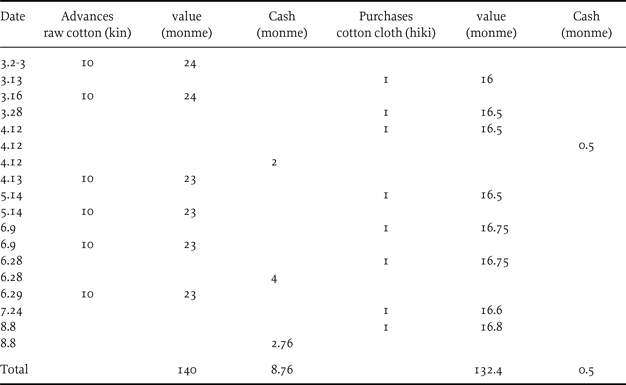
In Japan, merchants purchased products such as raw cotton in cash. However, unlike commission-oriented merchants in China at the same time, in Japan merchants from towns sometimes made advances to peasants to secure commodities. Typically, this manifested itself as a putting-out system. Table 12 shows the account book of a cotton merchant, the Yamawaki 山脇 family, showing transactions with a peasant household which wove cotton cloth in Kawachi, present-day south Osaka, then the most commercialized region in Japan. Probably this part of the account book did not cover the entire business between the merchant and the weaving peasant, but we can find a clear tendency. Repeating the advance of 10 kin of raw cotton and the purchase of 1 hiki of cotton cloth from the 3rd month to the 8th month, the value both of raw cotton and of cotton cloth was kept almost at the same level. The merchant is likely to have continued being the primary customer of cloth which the peasant wove.
It is probable that the peasants also cultivated raw cotton on their land, but their weaving capacity exceeded the amount of their own crop, thus the merchants provided raw cotton collected from other districts. The merchants might have made advances to the peasants from whom raw cotton was purchased after the harvest. As Table 10 shows, cotton-growing farmers needed more cash for fertiliser than rice farmers. For merchants to advance fertiliser, mostly from sardines, to peasants before cultivation and receive raw cotton after the harvest from the peasants was a typical pattern. To complete the transactions little cash was used between merchants and peasants. A comparison between the account books of the Yamawaki family in 1850 and 1858 suggests that the proportion of putting out and advances increased while that of purchasing cloth in cash from petit traders or peasants decreased.Footnote 59 The prospect of subsequent contracts between sellers and buyers lessened the necessity of cash and enabled drafts to circulate, as is shown in the article in this issue by Tanimoto.
Here we see a substantial difference between China and Japan, both of which developed rural commercialization dependent on a handicraft cotton industry. It is quite similar in both countries that merchants brought materials to rural regions and peasants manually produced goods in agricultural slack seasons. However, as the case of Gaoyang 高陽 (a district representative of the handicraft cotton industry in China) vividly shows, besides directly selling cloth to merchants, peasant weavers always sold their products in local marketplaces as well. Materials were also mainly purchased by peasants through local marketplaces where merchants brought them.Footnote 60 Thus, the businesses were far more negotiable in Chinese villages than in Japanese ones.
Table 13 shows the purchases of cotton thread by the Tongtaihao from the Hongtaihao. Within one period of less than ten days, they traded three times. The quantities and prices varied. We should not make a casual comparison depending on such a limited case, but the variation over a short time in the case of the Tongtaihao was quite in contrast with the case of the Yamawaki family, where the quantities and prices did not vary. At least we can find a significant difference between one-time transactions and subsequent transactions in the same industry.
Table 11 shows a contrast: after opening their ports, China soon increased the import of cotton cloth while Japan increased the import of cotton yarn. Unlike China, machine-made yarns substituted for manually-spun threads soon after the Japanese opened their ports. In this way, machine-made yarns deprived Japanese peasant households of their longest and most valuable side business. As Table 10 shows, raw cotton cultivation had already become less profitable than rice cultivation in 1880s Japan. Raw cotton cultivation that had thrived for three centuries was soon to disappear entirely from the Japanese archipelago.
By contrast, Chinese cotton cultivation continued while the Chinese cotton mill industry developed. Chinese as well as Japanese investigators in the Lower Yangzi delta observed in the 1930s that raw cotton growers still manually spun thread in spite of the fact that a cotton mill stood nearby.Footnote 61 Some written materials and investigations suggest that local women would have been expected to spin cotton thread to sell in the local market, but only a very small amount of cotton thread was sold beyond a county. In short, cotton spinning, the most time-consuming and the most profit-making side-business for peasant households, had in China not been exposed to competition from machine-made thread traded along distant trade circuits. The survival of manual spinning in rural China reflects the autonomy of local marketplaces and the discrepancy between proximate exchange and distant trade.
Less autonomous features of proximate exchange in Japan appeared in the usage of money as well. Private notes, called shisatsu 私札, circulating locally appeared only at the very beginning of the seventeenth century and again in the middle of the nineteenth century in Japan. In other words, only in the transitional periods at the start of the Tokugawa regime and in the Meiji reformation did endogenous local paper monies circulate in a similar way to native notes in China, while domain paper monies, hansatsu 藩札, dominated within each feudal territory across Japan. Most domain paper monies were issued in cooperation with the merchants who dealt in special products by the domain in trade centres such as Osaka. Thus, domain paper monies circulated regionally, but inter-regional trades backed them up. The sharp contrast between the popular circulation of native notes in China and the dominance of domain notes in Japan reflects the profound difference in local trade and proximate exchange among peasants between the two countries.
CONCLUSION: INDIRECT AND DIRECT INSTITUTIONS
As far as the allocation of labour within a single peasant household is concerned, China and Japan shared some features. The extent to which women were involved in agricultural field work differed not only between China and Japan but also among regions within China,Footnote 62 but domestic manufacture commonly depended on women's labour in both countries. It was common for a variety of non-agricultural work to absorb idle labour in slack seasons.Footnote 63
However, unlike the division of labour within the household, the division of labour between peasant households was quite different in China and Japan. In the agricultural busy season when labour was in shortage, one-time transactions in supplying labour were dominant in China, while continuing transactions were most common in Japan even when the labour supply was secured through wage payments.
The relationship between peasants and merchants was also different. In selling major crops, one-time transactions were dominant in China, while continuing transactions became common in Japan. Generally speaking, Chinese peasants kept a high degree of freedom in deciding the disposal of their products. In manufacturing and selling by-products during the slack season, the difference between China and Japan manifested itself in the same way, but less clearly than in the cases of labour and major crops.
In China the boundary between peasants and merchants was not a distinct one. Many peasants engaged in small-size transactions as merchants in the slack season. No monopoly of trade by professional merchants prevented peasants from becoming a price taker in negotiation with merchants. Meanwhile, in Japan, vocational merchants dwelling in the towns largely dominated trade under the Tokugawa regime.
Why did the difference between a society orientated towards one-time transactions and another towards continuing subsequent transactions develop? The former represents the desire for freedom and the latter the desire for certainty. Each society in a certain period associated the two ambivalent basic desires according to the situation. In particular, the binary option between one-time and subsequent transactions determined the way local trade operated. For example, proximate exchanges created the conditions for multilateral direct negotiation among locals such as occurred in the rural market. This attribute differs from that of distant trade in which bilateral negotiations through a broker were dominant. That is why a local marketplace worked independently from distant trade.
The popular concept of Smithian growth does not consider the variety of exchanges which exist, such as the difference between one-time transactions and subsequent transactions, and also overlooks the importance of exchanges among peasants whose products are similar. The Smithian concept suggests that as “the extent of a market” increases, a division of labour spreads horizontally beyond villages, municipalities and nations.Footnote 64 The concept presumes a framework in which exchanges occur according to differences of vocation and/or product, and ignores the exchanges between households whose products are akin. But in fact it was commonly observed that a peasant who mainly produced a particular gain might still purchase that same grain from another peasant.Footnote 65 Ignoring cases of exchanges between one party with a surplus of an item and another with a shortage of the item, the Smithian concept caused scholars to neglect actual exchanges between neighbouring peasants and underestimate the scale of economic activity in rural regions. Peasants with no other item to give could offer their labour to another peasant in exchange for grain.
In particularly, the Smithian framework cannot explain why some societies dominated by small-size peasant households responded differently to increasing foreign trade after the nineteenth century, such as the contrast between China and Japan shown in the previous section.Footnote 66 A perceived dichotomy between a market economy and a self-sufficient economy, including Smithian Growth, has blinded scholars to vertical multiplicity in market activities. The non-proportional development between proximate and distant exchanges shown in this article has simply not occurred to them.
The difference in exchanges worked in association with a variety of rules that traders observed, implicitly or explicitly. Subsequent transactions were stabilized through codes directly encouraging the favourable consequences of exchanges. Typically the codes contained punishments for violators. Meanwhile, one-time transactions were maintained not through any codes directly enhancing anonymous exchanges but through more general institutions which indirectly discouraged an oligarchy from monopolizing exchanges. Under the Chinese imperial regime, a range of regulations such as the equal division of inherited properties, open bidding in adopting local measures, the ban on appointing locals as governor, and others, incidentally also indirectly guaranteed an open market system in which nobody could establish a monopoly over transactions in the marketplace. Each individual regulation was not specially directed towards commercial activities, but the whole range of indirect regulation created a foundation in society which served to maintain open access to markets.
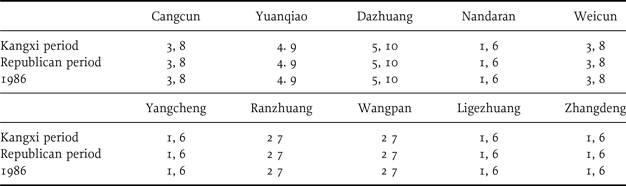
Table 14 shows that the rural market system was so deeply embedded in Chinese society that the cycle of opening days in every ten-day period had no change through the Kangxi period (1662–1722), the Republican period, and even in 1986 soon after the revival of the “free markets”, ziyoushichang 自由市场, in rural areas. The introduction of railroad services in the early twentieth century and the prohibition on commercial activities during the Cultural Revolution did not eradicate the system through which ordinary peasants made local exchanges. We can find that the preference for one-time transactions among peasants remained so strong precisely to sustain opportunities to exchange anonymously in person. The Qing dynasty, the Nationalist government, and the reformist regime after Mao had no specific policies to promote rural markets. However, even without explicit support, the establishment of wider institutions indirectly worked to encourage peasants to exchange through marketplaces.
The differences between China and Japan shown in the previous section did not result from relative progress or backwardness. Superficially, in both countries it appears that the development of the market caused wholesale merchants to dominate and discouraged periodic rural markets. However, it is pure teleology to explain such differences according to a general narrative of evolution or devolution. Such an argument overlooks the fact that the degree of freedom of choice for the majority of ordinary people had diminished substantially as economic transformations took place. The difference between the two countries, where the economy depended on peasant households of small size in both, suggests that trades involving ordinary peasants progressed along different paths.
APPENDIX
Monthly sales of peasant products, Huangling village, Taiyuan, Shanxi, 1940

Breakdown of peasant products in three villages, Northern China, 1939–1940

Commodities by distance in 11 marketplaces, Zouping, Shandong, 1932

Average number of rural markets per county in Northern Chinese Provinces

Annual sales and purchases per households in Qingyuan county, Hebei, China 1930 (yuan)

Annual quantities of silver ingots, baoyin, entered in the Tongtaihao account books

Revenue and expenditure in wen on 1st day, 10th month, Daoguang 21st year (1841) in the grocery store Tongtaihao, Ningjin county, Hebei, China.

Transactions on 8th day 8th month, Daoguang 21st year (1841), Tongtaihao

Distribution of era names on copper coins from the Aba Hoard, Sichuan, 1870s.

Profits with rice and cotton cultivation per 1 tan mid-1880s southern Osaka, Japan

Imports of cotton cloth and yarns after opening ports, China and Japan

Advances and purchases between the Yamawaki family and a peasant weaver in 1850

Purchases of cotton thread by the Tongtaihao from the Hongtaihao, 1841

Cycle of dates holding rural markets in Qingyuan

Annual movement of rice price at rural area, Tunxi county, Anhui, China (wen per 5 sheng)

Frequency of daily transactions, Tongtaihao, 5th and 6th months, Daoguang 10th year (1830)