Introduction
Conjugated polymers hold great promise for harvesting thermal energy at temperatures below 200°C. Their light and flexible nature and possibility of scalable processing such as roll-to-roll or inkjet printing make them ideally suited for powering wearable electronics that are impractical with rigid inorganic materials. However, the electrical conductivity and Seebeck coefficient of conjugated polymers need to be significantly enhanced to meet the requirements of such applications. Tremendous effort has been made to enhance their power factor (PF = S Reference Chen, Zhao and Liang2 σ, where S is the Seebeck coefficient and σ is the electrical conductivity) over the past two decades. Aside from adjusting the oxidation level and molecular arrangement, hybridization offers a facile approach to developing both p- and n-type flexible thermoelectric materials with enhanced performance.
In this article, we focus on recent progress in hybrid thermoelectric composites. We discuss synthesis techniques and key parameters that influence thermoelectric properties. A flexible organic-based thermoelectric module from Fujifilm is discussed along with the fabrication of high-quality carbon nanotubes (CNTs) paste. In addition, we highlight a recent breakthrough in the fabrication of inorganic–organic hybrid superlattices for the application of wearable/flexible thermoelectric devices at temperatures below 100°C.
Organic thermoelectric materials and their hybrid composites
Conjugated polymers
Typical conjugated polymers used as thermoelectric materials include poly(3,4-ethylenedioxythiophene) (PEDOT), polyanilines (PANIs), polythiophenes, polyacetylenes, polypyrrole, and polycarbazole, which have been intensively studied and reviewed.Reference Bubnova and Crispin1–Reference Culebras, Gómez and Cantarero5 Among these, p-type PEDOT:PSS (polystyrene sulfonate) and PEDOT-Tos (Tosylate) exhibit encouraging thermoelectric performance through careful chemical control of the oxidation level where the optimal power factor (PF) can reach 460 and 450 μW/mK2,Reference Kim, Shao, Zhang and Pipe6,Reference Bubnova, Khan, Wang, Braun, Evans, Fabretto, Hojati-Talemi, Dagnelund, Arlin, Geerts, Desbief, Breiby, Andreasen, Lazzaroni, Chen, Zozoulenko, Fahlman, Murphy, Berggren and Crispin7 and the values are among the highest PF values that the organic-based thermoelectric materials can achieve. However, air-stable n-type organic conductors are rare as most of them have relatively small electron affinity and are likely to react with water and oxygen.Reference Anthopoulos, Anyfantis, Papavassiliou and de Leeuw8–Reference Nicolai, Kuik, Wetzelaer, De Boer, Campbell, Risko, Brédas and Blom10 Recently, it was found that electrochemical polymerization can be used to synthesize high-performance n-type conjugated polymers by controlling the oxidation (and thus the carrier concentration) at the anode. For instance, Sun et al. fabricated an n-type poly(Ni-ethylenetetrathiolate), which exhibited a large PF of 453 μW/mK2 at 300 K.Reference Sun, Qiu, Tang, Geng, Wang, Zhang, Huang, Xu, Yue and Guan11
Hybrid thermoelectric composites
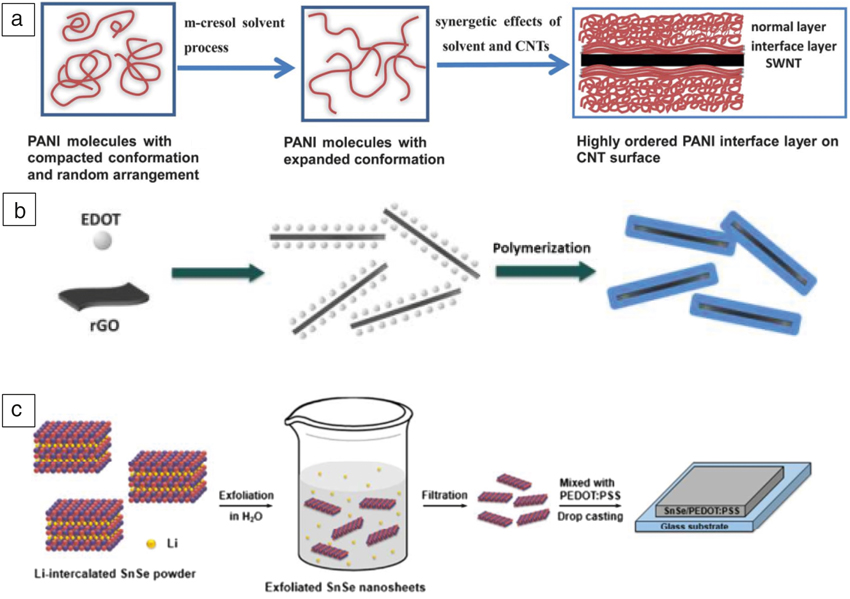
In addition to optimizing the oxidation level, conductive polymers can be blended with other components to improve the overall thermoelectric performance, including with highly conductive materials such as CNTs and graphene as well as inorganic materials with large Seebeck coefficients. These hybrid composites can be fabricated by either solution processing or in situ polymerization.Reference Kim, Kim, Choi, Grunlan and Yu12–Reference Ju and Kim16 The typical synthesis methods are shown in Figure 1. Thermoelectric performance can be tailored by tuning the morphology and distribution of the polymer in the composites. For instance, PANI can grow along the wall of a CNT to form a cable-like structure by either solution processing or in situ polymerization, which results in stronger π–π interaction between PANI and CNT, leading to enhanced carrier mobility that improves both the electrical conductivity and Seebeck coefficient.Reference Yao, Chen, Zhang, Liufu and Chen17–Reference Wang, Yao, Chang and Chen20 In some cases, segregated CNT bundles can be coated with polymer particles, such as PEDOT:PSS or poly(3-hexylthiophene) (P3HT) by solution processing, which helps bridge neighboring nanotubes and allows charge carriers to transfer at the junctions.Reference Kim, Kim, Choi, Grunlan and Yu12,Reference Yu, Choi, Yin and Grunlan21–Reference Bounioux, Díaz-Chao, Campoy-Quiles, Martín-González, Goni, Yerushalmi-Rozen and Müller23 Distinct from CNT-based composites, conducting polymers such as PANI and PEDOT can be intercalated into stacked graphene or simply grow on the surface of graphene nanosheets during in situ polymerization, which will promote intramolecular conjugation and facilitate the hopping transport of charge carriers at the interface.Reference Xu, Chen and Qiu14,Reference Wang, Yao, Bi, Huang, Wang and Chen15
Schematics of various synthesis methods for organic-based thermoelectric composites. (a) (Left to right) The random coil-like polyaniline (PANI) molecules become extended chains when treated with m-cresol solvent. After subsequent treatment with a solvent containing dispersed single-walled carbon nanotubes (CNTs), a highly ordered cable-like PANI/CNT composite forms due to synergetic effects and intramolecular conjugation;Reference Yao, Wang, Wang and Chen13 (b) (Left to right) EDOT monomers are dispersed in a reduced graphene oxide (rGO) aqueous solution to form a pie-like PEDOT/rGO composite during in situ polymerization;Reference Xu, Chen and Qiu14 (c) (Left to right) Li-intercalated SnSe powder was exfoliated into nanosheets in water, and then mixed with aqueous PEDOT:PSS. The obtained SnSe/PEDOT:PSS composite was deposited onto a glass substrate by drop casting.16 Note: PEDOT, poly(3,4-ethylenedioxythiophene); PSS, poly(styrene sulfonate); SWNT, single-walled nanotube; EDOT, 3,4-ethylenedioxythiophene.

For inorganic–organic hybrid composites, the size, morphology, and distribution of inorganic nanomaterials in the polymer matrix as well as the adhesion at the interfaces are crucial for improving the thermoelectric performance. In addition, special attention has been paid to inorganic nanoparticles, which can be easily oxidized during synthesis. To minimize such oxidation, processing methods such as ball milling should be conducted in an inert atmosphere. Alternatively, an acid treatment has proven to be an effective and low-cost method to reduce the oxidized surface of the alloy-based nanoparticles.Reference Zhang, Sun, Katz, Fang and Opila24
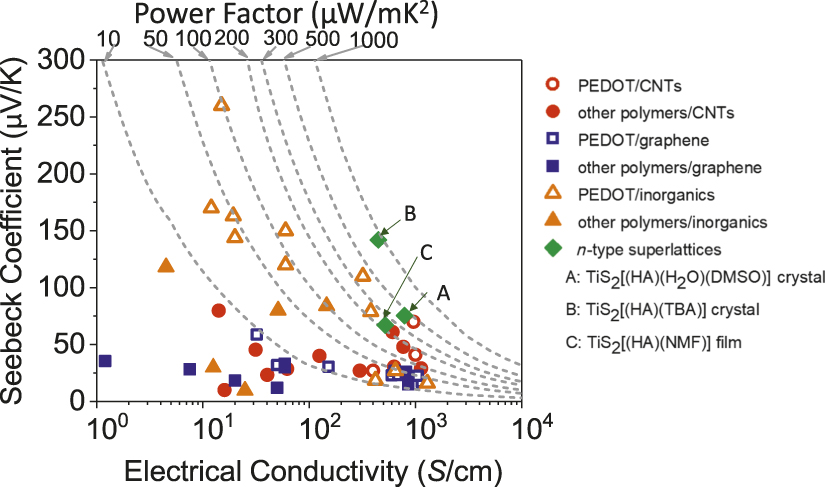
Figure 2 summarizes the thermoelectric properties of organic-based hybrid composites reported in the literature, including polymer/CNTs,Reference Kim, Kim, Choi, Grunlan and Yu12,Reference Yao, Wang, Wang and Chen13,Reference Yao, Chen, Zhang, Liufu and Chen17–Reference Bounioux, Díaz-Chao, Campoy-Quiles, Martín-González, Goni, Yerushalmi-Rozen and Müller23,Reference Yu, Kim, Kim and Grunlan25–Reference Wang, Yi, Pu and Yu31 polymer/graphene,Reference Xu, Chen and Qiu14,Reference Wang, Yao, Bi, Huang, Wang and Chen15,Reference Kim, Hwang and Woo32–Reference Yoo, Kim, Lee, Cho, Choi, Kim and Kim44 and polymer/inorganic composites.Reference Ju and Kim16,Reference Zhang, Sun, Katz, Fang and Opila24,Reference Song, Liu, Zhu, Kong, Lu, Xu, Wang and Zhao45–Reference Zhou, Dun, Wang, Wang, Shi, Carroll, Liu and Qiao60 In addition, the thermoelectric PFs of some inorganic–organic superlattice materialsReference Wan, Gu, Dang, Itoh, Wang, Sasaki, Kondo, Koga, Yabuki, Snyder, Yang and Koumoto61–Reference Wan, Tian, Azizi, Huang, Wei, Sasai, Wasusate, Ishida and Koumoto63 have been included in Figure 2 for comparison, and this will be discussed hereafter in detail. Compared to the CNT or graphene composites (circles), the polymer/inorganic composites (triangles), particularly PEDOT:PSS/Te (nanowires or nanorods) composites, possess a relatively large S (>160 μV/K).Reference See, Feser, Chen, Majumdar, Urban and Segalman50–Reference Yee, Coates, Majumdar, Urban and Segalman52 However, their σ needs to be significantly enhanced to achieve PF > 100 μW/mK2. Among the polymer–inorganic composites (triangles), the highest PFs were achieved for p-type PEDOT:PSS/SnSe composite (380 μW/mK2),Reference Ju and Kim16 and n-type PVDF [poly(vinylidene fluoride)]/Cu0.1Bi1.9Se3 composite (103 μW/mK2).Reference Dun, Hewitt, Huang, Xu, Zhou, Huang, Cui, Zhou, Jiang and Carroll59 On the other hand, PF of polymer/graphene composites (squares) is generally below 50 μW/mK2, due to the low S (<50 μV/K in most cases). For the CNT-based composites, particularly the PEDOT/CNTs composites, the high σ outweighs the drawback of the low S. Among them, the maximum PF reaches 500 μW/mKReference Chen, Zhao and Liang2 by p-type PEDOT:PSS mixed with 40 wt% double-wall CNTs.Reference Moriarty, Briggs, Stevens, Yu and Grunlan22
Thermoelectric properties of a wide range of organic-based composites compiled from data reported in the literature. The plot includes polymer/CNT (carbon nanotube) composites (circle symbols),Reference Kim, Kim, Choi, Grunlan and Yu12,Reference Yao, Wang, Wang and Chen13,Reference Yao, Chen, Zhang, Liufu and Chen17–Reference Bounioux, Díaz-Chao, Campoy-Quiles, Martín-González, Goni, Yerushalmi-Rozen and Müller23,Reference Yu, Kim, Kim and Grunlan25–Reference Wang, Yi, Pu and Yu31 polymer/graphene composites (square symbols),Reference Xu, Chen and Qiu14,Reference Wang, Yao, Bi, Huang, Wang and Chen15,Reference Kim, Hwang and Woo32–Reference Yoo, Kim, Lee, Cho, Choi, Kim and Kim44 and polymer/inorganic composites (triangle symbols).Reference Ju and Kim16,Reference Zhang, Sun, Katz, Fang and Opila24,Reference Song, Liu, Zhu, Kong, Lu, Xu, Wang and Zhao45–Reference Zhou, Dun, Wang, Wang, Shi, Carroll, Liu and Qiao60 Among these, composites containing poly(3,4-ethylenedioxythiophene) (PEDOT) are shown with hollow symbols, and other polymer materials, including polyaniline, polypyrrole, PVDF, and P3HT, are shown with solid symbols. Power factor (PF) values of organic–inorganic superlattices (A–C)Reference Wan, Gu, Dang, Itoh, Wang, Sasaki, Kondo, Koga, Yabuki, Snyder, Yang and Koumoto61–Reference Wan, Tian, Azizi, Huang, Wei, Sasai, Wasusate, Ishida and Koumoto63 are also presented (solid diamond) for comparison. The plot shows that the polymer/inorganic composites possess relatively large S as compared to polymer blended with CNTs or graphene. However, their σ (electrical conductivities) need to be significantly enhanced to achieve a large PF. Note: HA, hexylammonium; DMSO, dimethylsulfoxide; NMF, n-methylformamide; TBA, tetrabutyl ammonium; P3HT, poly(3-hexylthiophene); PVDF, poly(vinylidene fluoride); A, electrochemically intercalated TiS2[(HA)(H2O)(DMSO)] superlattice crystal; B, optimized TiS2[(HA)(TBA)] superlattice crystal through heat treatment; C, solution-processed TiS2[(HA)(NMF)] superlattice film.
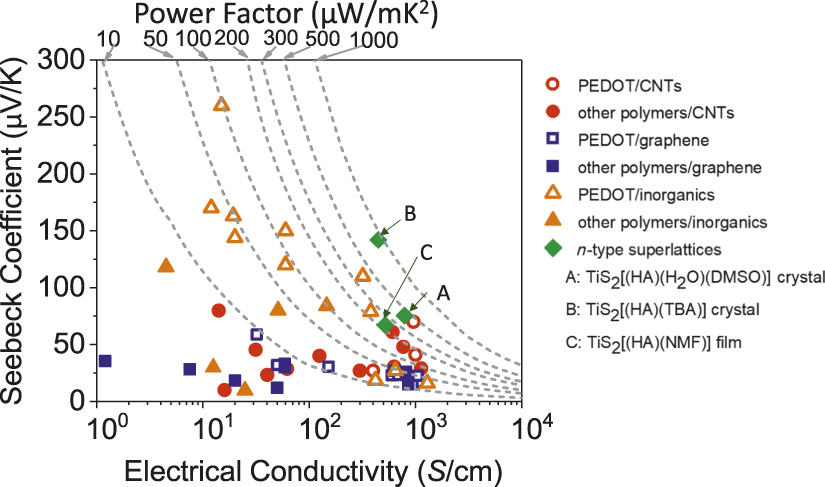
It should be noted that the vast majority of composites presented in Figure 2 are p-type materials, and the development of air-stable n-type organic materials/composites is highly desired to make efficient p–n coupled thermoelectric devices. In addition to incorporating n-type nanomaterials into polymers, single-wall CNTs treated with alkali salts or hydroxides (such as NaCl, NaOH, and KOH) and crown ether could be negatively charged and exhibited excellent stability in air up to 150°C, with the optimized PF reaching ∼230 μW/mK2 at 310 K.Reference Nonoguchi, Nakano, Murayama, Hagino, Hama, Miyazaki, Matsubara, Nakamura and Kawai64
Flexible thermoelectric module from Fujifilm Corporation
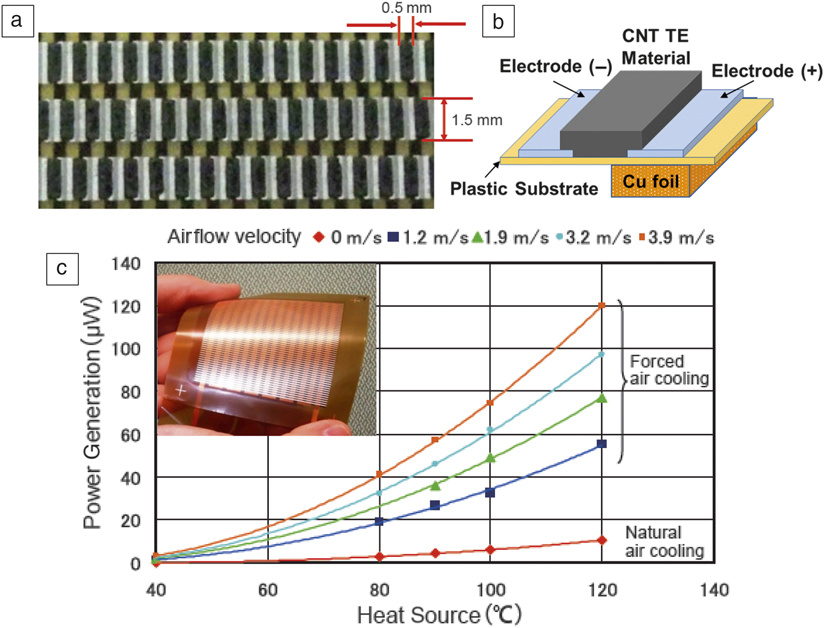
The flexibility of organic materials and advanced processing techniques offer great opportunities to fabricate novel thermoelectric modules that are beyond traditional designs. Fujifilm has developed various organic-based thermoelectric modules using printing techniques since 2010. Recently, a high-quality p-type CNT composite paste was successfully produced using a dispersion method. Parameters such as viscosity, viscoelasticity, and permeability of the paste were carefully adjusted for stencil printing. Based on this, a flexible single-leg type thermoelectric module (10 cm × 10 cm) featuring an in-plane configuration was fabricated (Figure 3).Reference Hayashi, Sugiura, Nomura and Aoai65
The configuration and power output of a carbon nanotube (CNT)-based thermoelectric (TE) module fabricated by Fujifilm Corporation.Reference Hayashi, Sugiura, Nomura and Aoai65 (a) Photograph of a CNT-based TE pattern fabricated by stencil printing, and (b) a schematic illustration of a single leg in the pattern. (c) The generated power output at different airflow rates. The inset shows a photograph of the TE module consisting of p-type CNT-based composite material. The TE module can achieve a maximum power output of 120 μW when the hot side is 120°C and the flow rate of the cool air is 3.9 m/s.Reference Hayashi, Sugiura, Nomura and Aoai65
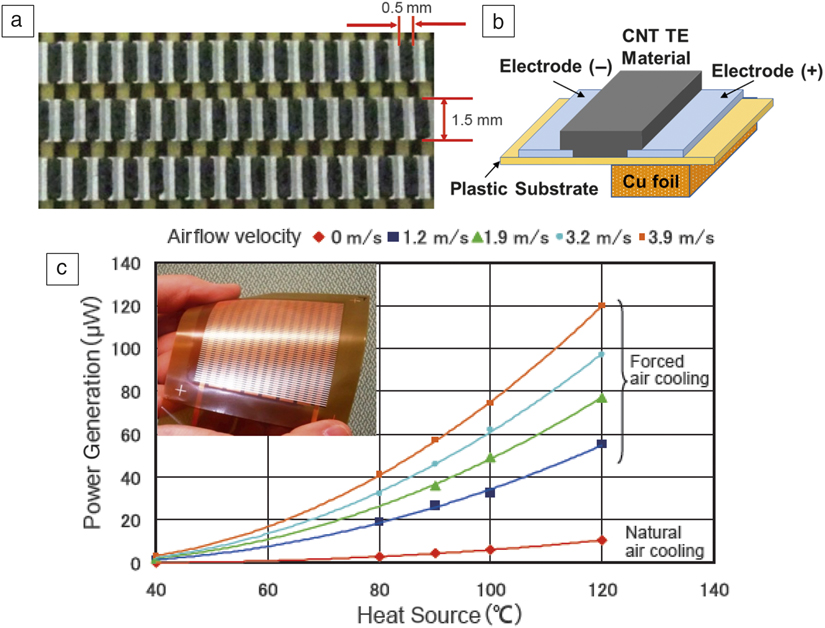
To evaluate the power generation of the device, the thermoelectric module was mounted onto an aluminum fin with flowing air for cooling, and heat was extracted from a hot pipe with a diameter of 80 mm. The power output was measured at different airflow rates in the range of 0–3.9 m/s (Figure 3). The results demonstrate that the module can generate a power output of 10 μW by natural air cooling when the hot side temperature is 120°C, and the value can remarkably increase to 50 and 120 μW when the airflow rate was 1.2 and 3.9 m/s, respectively.Reference Hayashi, Sugiura, Nomura and Aoai65
Inorganic–organic hybrid superlattices
In contrast to hybrid thermoelectric composites, inorganic–organic superlattices offer a greater chance to inherently tailor the hybrid interface, which can promote charge transfer while hindering phonon transport. Mingo et al. first investigated the thermoelectric properties of SiGe/thiophene superlattices by computer simulationReference Carrete, Mingo, Tian, Ågren, Baev and Prasad66 and found that the interplay between alloy and molecular layers could result in low thermal conductivity κ below 1 W/mK and ZT ∼ 0.25 at 300 K, suggesting that such a hybrid superlattice holds great promise for thermoelectric applications.
Karppinen et al.Reference Tynell, Terasaki, Yamauchi and Karppinen67–Reference Tynell, Giri, Gaskins, Hopkins, Mele, Miyazaki and Karppinen69 successfully synthesized n-type ZnO/hydroquinone (HQ) hybrid superlattice film using advanced atomic- (ALD) and molecular-layer (MLD) deposition techniques. The MLD technique follows the same sequential deposition routine as in ALD, and a molecular fragment is deposited in one of the cycles. The cross-plane κ could be suppressed by one order of magnitude (i.e., 43 W/mK for pristine ZnO to 4.15 W/mK for ZnO:HQ superlattice) through strong phonon scattering at the ZnO/HQ interfaces, while PF is almost unaffected. However, the anisotropy in the ZnO:HQ superlattice may cause the in-plane and out-of-plane properties to differ significantly. Furthermore, although the σ of the ZnO:HQ superlattice film can be further enhanced by doping ZnO with Al2O3,Reference Niemelä, Karttunen and Karppinen68 PF still needs to be significantly improved to achieve higher ZT, which requires the rational design of inorganic–organic components and properly engineered interfaces.
Aside from ALD/MLD techniques, organic intercalationReference Lévy70,Reference Dresselhaus71 offers a facile approach to fabricating inorganic–organic superlattices. Recently, the Koumoto group developed a novel n-type superlattice material, namely TiS2[(HA)(H2O)(DMSO)] (HA: hexylammonium; DMSO: dimethyl sulfoxide) by electrochemical intercalation and solvent exchange (Figure 4a).Reference Wan, Gu, Dang, Itoh, Wang, Sasaki, Kondo, Koga, Yabuki, Snyder, Yang and Koumoto61 The organic molecules intercalated into the van der Waals gap of layered TiS2 could accommodate deformation and ensure flexibility. The material exhibits superior thermoelectric performance (i.e., PF ∼ 450 μW/mK2, κ ∼ 0.69 W/mK, and ZT ∼ 0.21 along the in-plane direction at 300 K) that can be attributed to various factors such as quantum confinement of carriers and phonons within the TiS2 layers, carrier mobility tuning through dielectric charge-screening, and long-range interactions between phonons and the dipole moment of polar molecules.Reference Wan, Kodama, Kondo, Sasai, Qian, Gu, Koga, Yabuki, Yang and Koumoto72
The synthesis of organic-intercalated superlattice materials and thermoelectric performance of the flexible thermoelectric (TE) module. (a) A TiS2[(HA)(DMSO)] superlattice crystal was fabricated by electrochemical intercalation, where the TiS2 crystal and a Pt foil were used as cathode and anode, respectively. Next, the resulting organic-intercalated TiS2 crystal was soaked in water overnight to obtain a TiS2[(HA)(H2O)(DMSO)] superlattice crystal through solvent exchange.Reference Wan, Gu, Dang, Itoh, Wang, Sasaki, Kondo, Koga, Yabuki, Snyder, Yang and Koumoto61 (b) Synthesis of TiS2/organic superlattice film by the liquid-exfoliation and self-assembly approaches. Specifically, TiS2 powder was mixed with hexylamine and dispersed into a polar solvent (NMF). Then, the mixture was exfoliated into nanosheets by mild sonication. After centrifugation, the obtained supernatant was collected for further film deposition.Reference Tian, Wan, Wang, Wei, Ishida, Yamamoto, Tsuruta, Shin, Li and Koumoto73 (c) The (top) generated power output and (bottom) power density of (inset) a flexible TE device consisting of p-type poly(3,4-ethylenedioxythiophene):polystyrene sulfonate and n-type TiS2/organic superlattice film.Reference Tian, Wan, Wang, Wei, Ishida, Yamamoto, Tsuruta, Shin, Li and Koumoto73 The module can generate a maximum voltage output of 33 mV and power density of 250 µW/cm2 at a temperature gradient of 70 K.Reference Tian, Wan, Wang, Wei, Ishida, Yamamoto, Tsuruta, Shin, Li and Koumoto73 Note: HA, hexylammonium; DMSO, dimethyl sulfoxide; NMF, n-methylformamide; T, temperature. δ+ and δ– in (a) indicate the dipole moments of the polarized polar molecule DMSO. The blue, white, and gray atoms in (b) represent N, H, and C, respectively.

The carrier concentration in the TiS2/organic superlattices can be optimized by partially removing organic donors through vacuum annealing. Wan et al. strategically intercalated two types of organic donors with different boiling points. The partial de-intercalation by annealing at a temperature between the two boiling points led to a large PF ∼ 900 μW/mK2 at 300 K.Reference Wan, Tian, Kondo, Yang, Zong and Koumoto62
However, the electrochemical intercalation technique is unsuitable for large-scale production. Koumoto’s group has recently developed a liquid-exfoliation and self-assembly process to fabricate TiS2/organic superlattice films near room temperature (Figure 4b), where these films can be either freestandingReference Wan, Tian, Azizi, Huang, Wei, Sasai, Wasusate, Ishida and Koumoto63 or deposited onto substrates.Reference Tian, Wan, Wang, Wei, Ishida, Yamamoto, Tsuruta, Shin, Li and Koumoto73 This versatile approach greatly facilitates the scale-up synthesis toward practical applications.
In addition, theyReference Tian, Wan, Wang, Wei, Ishida, Yamamoto, Tsuruta, Shin, Li and Koumoto73 have fabricated a prototype thermoelectric module consisting of 5 p–n pairs of thermoelectric legs. The p- and n-type materials are PEDOT:PSS film and TiS2/organic superlattice films, respectively. Both materials were deposited onto a poly(ethylene terephthalate) substrate to ensure flexibility of the module, which can be freely bent or twisted (Figure 4c). The device can generate a voltage output of 33 mV with a maximum power density of 250 μW/cm2 at a temperature gradient of 70 K, which represents a new record among organic-based thermoelectric devices,Reference Bubnova, Khan, Malti, Braun, Fahlman, Berggren and Crispin74–Reference Sun, Sheng, Di, Jiao, Xu, Qiu and Zhu77 suggesting that it has great potential for powering wearable biosensors and electronics.
Summary and outlook
Organic materials have been envisioned as promising candidates for next-generation thermoelectric devices to power wearable sensors and devices. Despite the exciting progress in p-type conjugated polymers and the associated composites, substantial challenges remain in the development of air-stable n-type organic thermoelectric materials. The construction of inorganic–organic superlattices provides critical insights into the development of new flexible thermoelectric materials with unprecedented performance. Advanced printing techniques would allow the fabrication of thermoelectric modules with novel geometrical architectures beyond the traditional rigid designs.
Acknowledgments
R.T., N.H., and K.K. acknowledge financial support from NEDO-TherMat. C.W. acknowledges financial support from the 1000 Plan Program for Young Talents of China.

Ruoming Tian joined the Toyota Physical and Chemical Research Institute, Japan, in 2015. She completed postdoctoral research at the University of New South Wales (UNSW), Australia. She received her PhD degree in materials science from UNSW in 2014. Her research focuses on the development of complex oxides and flexible 2D inorganic–organic superlattices for thermoelectric energy conversion. She has published two book chapters and 18 peer-reviewed papers. Tian can be reached by email at r.tian@unswalumni.com.

Chunlei Wan is an assistant professor in the School of Materials Science and Engineering at Tsinghua University, China. He received his PhD degree from Tsinghua University in 2008. His research interests focus on both phonon- and electron-transport phenomena in solid-state materials, including thermal-barrier coating materials and thermoelectric materials. He has co-authored more than 50 peer-reviewed publications and two book chapters. Wan can be reached by phone at +86-10-62788328 or by email at wancl@mail.tsinghua.edu.cn.

Naoyuki Hayashi has been a research engineer at Fujifilm Corporation, Japan, since 2005. He studied information and imaging science and received his BE and ME degrees from Chiba University, Japan, in 1996 and 1998, respectively. He served as a research engineer at Fujitsu Laboratories from 1998 to 2005. His current research interests include carbon nanotube-based thermoelectric materials and thermoelectric modules. Hayashi can be reached by email at naoyuki.hayashi@fujifilm.com.

Toshiaki Aoai is a professor at Chiba University, Japan. He received his BS and MS degrees in hydrocarbon chemistry from Kyoto University, Japan, in 1978 and 1980, respectively. He received his PhD degree in photopolymer materials from Chiba University in 2004. He worked at Fujifilm Corporation from 1980 to 2016. His research interests focused on the design and development of photopolymer and organic electronics materials. Through his research career at Fujifilm, he has applied for more than 300 patents in these areas. Aoai can be reached by email at t.aoai@chiba-u.jp.

Kunihito Koumoto joined the faculty of Nagoya University, Japan, as a full professor in 1992. He has been a Fellow of the Toyota Physical and Chemical Research Institute, Japan, since 2015. He received his BS, MS, and PhD (1979) degrees in applied chemistry from The University of Tokyo (UT), Japan. He served as assistant professor, lecturer, and associate professor at UT. His current research focuses on inorganic–organic nanohybrid thermoelectrics for energy harvesting. He has published more than 480 papers and reviews, and 58 book chapters in inorganic materials chemistry. He was awarded the Medal with Purple Ribbon by the Emperor of Japan in 2013. He is currently the president of the Thermoelectrics Society of Japan. Koumoto can be reached by email at koumoto@apchem.nagoya-u.ac.jp.