There is a broad consensus that banks in developing countries engage in related lending. They commonly extend credit to firms owned by close business associates of the directors, members of the directors' own families or clans, or businesses owned by the banks themselves. It is also common for bank directors to have significant nonfinancial interests, and to use their banks as mechanisms to finance those interests.
There are two contrasting views about the effect of related lending on the functioning of the financial system. The first view holds that related lending has negative effects. This view argues that related lending provides a mechanism for bankers to loot their own banks—a process known as “tunneling”—at the expense of outside shareholders, depositors, and (when there is deposit insurance) taxpayers. This view receives considerable support from the literature on financial crises in LDCs, which highlights the incentives of inside investors to expropriate cash and tangible assets from outside investors in order to prop up their other firms.1
See Rajan and Zingales, “Financial Dependence”; Johnson, Boone, Breach, and Friedman, “Corporate Governance”; Johnson, La Porta, López-de-Silanes, and Shleifer, “Tunnelling”; La Porta, López-de-Silanes, Shleifer, and Vishny, “Legal Determinants” and “Law and Finance”; Laeven, “Insider Lending”; Bae, Kang, and Kim, “Tunneling or Value Added”; Mitton, “Cross-Firm Analysis”; Habyarimana, “Benefits”; and La Porta, López-de-Silanes, and Zamarripa, “Related Lending.”
See Gerschenkron Economic Backwardness; Lamoreaux Insider Lending; Calomiris “Costs”; Fohlin “Relationship Banking”; Khanna and Fisman “Facilitating Development”; and Khanna and Palepu, “Emerging Market Business Groups” and “Is Group Affiliation Profitable?”
Kroszner and Strahan, “Bankers.”
One might be tempted to reconcile these views by arguing that related lending is only pernicious when the rule of law is weak. When judicial systems are noncorrupt and property rights are clearly specified and strongly enforced, bankers cannot expropriate depositors and minority shareholders without facing legal sanctions. In countries with weak rule of law, however, depositors and minority shareholders are not protected by legal institutions—insiders can expropriate their wealth with impunity. This view, that legal context determines the effects of related lending, receives empirical support from recent work by Robert Cull, Haber, and Masami Imai.4
Cull, Haber, and Imai, “Related Lending.”
We wonder, however, whether there are other institutions that protect bank outsiders from tunneling by insiders even when the rule of law is weak. In particular, we advance the hypothesis that when there are strong institutions of corporate governance—by which we mean institutions that give outsiders the ability to police insiders, and that give insiders incentives to police each other—bankers cannot use related loans to loot their own banks. Related lending, under these circumstances may further financial development and economic growth.
We test this hypothesis by examining the performance of a banking system that, according to the extant literature on LDC financial crises, should have produced tunneling via related lending: Mexico during the 35-year dictatorship of Porfirio Díaz (1876–1911). Mexico, under Díaz, unambiguously lacked the rule of law, an impartial judicial system, and well-enforced property rights. In addition, related lending was widespread, and the economy was hit with a large external shock in 1908 that produced a financial crisis and prompted a government-organized rescue of the banking system.5
Díaz was overthrown in 1911. We continue our analysis until the end of 1913, when a civil war broke out among the factions that had earlier deposed Díaz. That civil war prompted the nationalization of the banking system.
The historical literature would also lead one to expect that bankers in Porfirian Mexico should have looted their own banks or used them to transfer resources to firms under their control. At the very least, they should have allocated credit inefficiently, overinvesting in relatively inefficient firms that they controlled. Contemporary observers believed that Porfirian banks were used as mechanisms to steal from their depositors and outside shareholders. One critic accused the banks of the following: “Loans … were primarily granted to their own shareholders … without much considering … the real chances of collecting the loan.” A second critic, Antonio Manero, wrote, “Scarcely after opening their doors, the banks' capital would disappear into loans for their own functionaries.”6
Cited in José Antonio Bátiz Vázquez and Enrique Canudos Sandoval, “Aspectos Financieros,” p. 433.
Boletín Financiero y Minero, 21 April 1921.
We find, however, that none of these outcomes obtained. Mexico's bankers did lend to enterprises owned by their own board members (or enterprises owned by the families of board members). They did so, however, because information was costly and contract rights were extremely difficult to enforce through the legal system.8
For a discussion of the importance of the legal system for financial development and economic growth, see Levine “Legal Environment” and “Law, Finance, and Economic Growth”; and La Porta, Lopez-de-Silanes, Shleifer, and Vishny, “Law and Finance.” For more discussion of the advantages that accrue to creditors from long-term relationships in the credit market see Greenbaum, Kanatas and Venezia, “Equilibrium Loan Pricing”; Sharpe, “Asymmetric Information”; Rajan, “Insiders and Outsiders”; and Petersen and Rajan “Benefits” and “Effect.”
We do find that related lending gave rise to more concentration in downstream industries. That outcome, however, was not a necessary consequence of related lending: it obtained because related lending in Mexico took place in the context of a concentrated banking system. That is, bankers allocated credit to entrepreneurs on the basis of relational ties, and the number of such ties was small, because there were few banks.
Our findings have implications beyond related lending. In recent years, a large literature has emerged on the effects of institutions on economic growth.9
See North and Weingast, “Constitutions”; Barro “Economic Growth” and Determinants; Engerman and Sokoloff, “Factor Endowments”; Rajan and Zingales, “Financial Dependence”; Przeworski et al., Democracy; Bates, Prosperity; Keefer, “What Does Political Economy”; and Acemoglu, Johnson, and Robinson “Colonial Origins” and “Reversal of Fortune.”
Przeworski et al., Democracy, p. 177.
SOURCES AND METHODS
The analysis that we carry out on the causes and consequences of related lending in Mexico draws on three bodies of evidence that we have developed. The first body of evidence consists of bank financial reports. These reports were published in the financial press, and allow us to estimate bank rates of return, share prices, dividend payments, and capital-asset ratios.
The second body of evidence focuses on bank lending strategies. For two of Mexico's largest banks, the Banco Nacional de México and the Banco Mercantil de Veracruz, we retrieved internal bank records that allowed us to estimate the extent of related lending over long time periods: 1884–1911 and 1898–1906, respectively. These records were located in the Archivo Histórico Banamex and the Archivo General de la Nación, both in Mexico City. For four other large banks, we developed a data set for a cross-section of the loans they made in 1908. These records were also retrieved from the Archivo General de la Nación.11
We retrieved records of these loans by examining interbank loan sales to the state-owned Caja de Préstamos para Obras de Irrigación. Archivo General de la Nación [hereafter AGN], Galería 2, Sesiones Administrativas de la Caja de Préstamos, Box 1. Data for the total size of the loan portfolios of these banks were retrieved from their end-of-year balance sheets published in the Economista Mexicano.
The third body of evidence focuses on a downstream industry that received related loans from the banks—cotton textiles. We note that the cotton textile industry is an ideal natural laboratory with which to study the impact of related lending on the real economy. First, cotton textiles were Mexico's largest manufacturing industry. Second, the industry was finance-dependent, but at the same time it approximated the requirements of perfect competition to an unusual degree. There were not barriers to entry produced by patents, proprietary technology, control of raw materials, advertising, branding, or control of wholesale or retail distribution. The capital equipment was easily divisible and scale economies were exhausted at small firm sizes, compared to such industries as steel, cement, paper, and chemicals. The industry was also characterized by a high degree of entry and exit. Third, Mexico's cotton textile industry was protected from foreign competition by a high level of tariff protection.
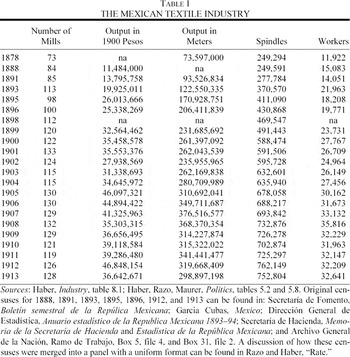
We study the effect of related lending on this industry by employing the Razo-Haber textile data set. We draw seven censuses from their data set: 1888, 1891, 1893, 1895, 1896, 1912, and 1913. These censuses are enumerated at the mill level and contain information on inputs, outputs, firm location, and ownership. We also draw state and national data on textile inputs and outputs from their data set for every year from 1891 to 1913.12
This data set links mills and firms across manufacturing censuses and excise tax records over the period 1850–1932. For a discussion of the sources and methods used to build the panel, see Razo and Haber, “Rate.” The census records employed in this study can be found in García Cubas, Mexico; Dirección General de Estadística, Anuario estadístico; Secretaría de Fomento, Boletín semestral; Secretaría de Hacienda, Memoria de la Secretaría de Hacienda; Secretaría de Hacienda, Estadística; AGN, Ramo de Trabajo, Box 5, file 4; and AGN, Ramo de Trabajo, Box 31, file 2. We have recoded their data set to more effectively follow firms during the 1888–1913 period. We have also recalculated the real value of output by substituting the Gómez-Galvarriato and Musacchio price index for the INEGI cotton textile price index employed by Razo and Haber. In addition, we have culled stamping and knitting mills from the data set, and checked the data set against original manuscripts to verify observations with inordinately high or low values.

We coded the data set in order to capture relationships between bankers and textile mill owners. Specifically, we coded for bank board members who were the sole proprietors of a textile mill, a partner in a firm that owned a textile mill, or served on the board of directors of a joint stock corporation that owned a textile mill. We denote such mills as “bank-related.”13
We note that our definition of bank connection is restrictive. Entrepreneurs who were connected to a bank in some way other than overlap between their membership on a bank board and ownership of a textile firm (for example, overlapping board memberships in a third, unobserved firm in a different industry, or marriage to a relative of a member of a bank board) are coded as “nonrelated” firms. We note that the assumption that overlap between mill ownership and a bank directorship is a good proxy for bank credit is consistent with three fundamental facts about Mexican banking. First, we know from case studies by historians that some banks were founded by textile entrepreneurs for the purpose of financing their existing manufacturing ventures. (See Gamboa Ojeda, Los empresarios; Gamboa Ojeda and Estrada, Empresas and empresarios; and Rodríguez López, “La banca porfiriana.”) Second, in the case of Banamex (Mexico's largest bank), some of its board members were textile industrialists and the bank itself was a major stockholder in one of the country's largest textile companies. We know from the minutes of the bank's board meetings that it lent heavily to these enterprises. (Maurer, Power, p. 98). Third, evidence from other large banks (reviewed below) makes it clear that they lent primarily to their own board members, members of their families, and their business associates. We also know that the directors of many of these banks also owned textile mills. The list of banks related to textile entrepreneurs or joint stock textile companies consists of Banamex, the Banco de Londres y Mexico, the Banco Oriental, the Banco de Nuevo León, the Banco de Durango, the Banco de Coahuila, the Banco Mercantil de Veracruz, the Banco de Guanajuato, the Banco de Estado de México, and the Banco de Zacatecas.
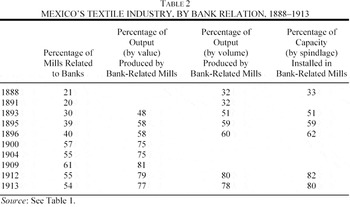
Table 2 presents aggregate data on the relationships between mill owners and bankers. In 1888, 21 percent of textile mills were owned by bank directors or their close relatives. By 1913 the proportion had grown to 54 percent. The percentage of installed capacity controlled by related mills increased from 33 percent in 1888 to 80 percent in 1913.14
Following Kane, Textiles, we measure installed capacity by spindles, which constitute the most important capital input for the production of cotton textile goods.

RELATED LENDING AND THE MEXICAN BANKING SYSTEM
In the late 1870s Mexico's banking system was so small as to be practically nonexistent. Only two chartered banks existed in the entire country. One was a branch of a British bank that operated in Mexico City and focused primarily on financing foreign trade. The other was a small American-founded operation chartered by the government of the border state of Chihuahua. The reason for the tiny banking system is not hard to divine: Mexico's nineteenth-century governments, fighting for their survival against numerous rebellions, coups, secessions, and foreign invasions, preyed upon private wealth. Bankers feared that as soon as they made their capital visible, by obtaining a charter, the government would confiscate it via forced lending.15
Until the growth of the chartered banking system in the decades after 1884, most financial intermediation took place in merchant houses, which issued bills of exchange and advanced credits to entrepreneurs in their social networks. These institutions did not, however, have any of the advantages of banks: they did not sell equity to outside investors, they did not have limited liability, they did not take deposits, and their bills of exchange had to be 100 percent backed by specie reserves. In short, they were different from modern banks in a fundamental sense: they made money by speculating with the funds of their proprietor, rather than with funds that belonged to people other than the proprietor. For an examination of how such a merchant house operated, see Walker, Business.
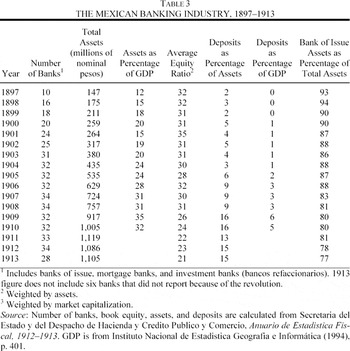
Spurred on by legislation enacted by Porfirio Díaz, who ruled from 1876 to 1911, Mexico's banking system expanded rapidly. The key to Díaz's banking policies was that he provided bankers with a series of segmented monopolies and oligopolies that raised rates of return high enough to compensate them for the risk of expropriation. In 1897, when Díaz's regulatory system was first codified, the entire banking system was comprised of just ten banks with total assets equal to only 12 percent of GDP. (See Table 3). By 1910, (Díaz's last full year in office before he was overthrown), there were 32 banks with total assets equal to 32 percent of GDP. Not only was this a sizable banking system by the standards of developing countries at the turn of the century, it was large by Mexico's current standards: the ratio of total commercial bank assets to GDP in Mexico in 2004 was only 33 percent.

The Banking Act of 1897 divided the banking system into three sectors: banks of issue, which emitted bank notes, discounted bills, and made commercial loans; mortgage banks, which lent long term on agricultural and urban properties; and investment banks (bancos refaccionarios), which were supposed to make long-term loans to agricultural and industrial enterprises. Only one of these sectors, the banks of issue, prospered. As Paolo Riguzzi has shown, limitations on the number of charters the government was willing to grant to mortgage banks, along with difficulties in enforcing contract rights on real property, meant that there were never more than three mortgage banks in the entire country.16
Riguzzi, “Legal System.”
Maurer, Power, p. 95.
Mexico's banking system had three salient features. First, the federal government tightly regulated the number of banks competing in any market. Second, the institutions governing banking gave bank directors strong incentives to monitor one another: there was no deposit insurance; banks were extremely well capitalized; significant amounts of this capital were owned by banks' own directors; and minority shareholders had mechanisms to monitor bank directors. Third, the vast majority of lending was related lending.
Mexico's banking regulations created binding constraints on entry and competition. Only the federal government could grant a bank charter. It allowed only two banks to branch nationally: the Banco de Londres y México (BLM) and the Banco Nacional de México (Banamex). All other banks were prohibited from branching outside their concession territories, generally contiguous with state lines. With very few exceptions, the government chartered only one bank in any territory, meaning that there were typically only three banks operating in any state: Banamex, BLM, and the federally chartered local bank for that state. Special tax concessions and high minimum capital requirements safeguarded these charters.18
The government levied a 2 percent tax on bank capital—but exempted the first bank of issue in each state to receive a federal charter. The government also established a minimum capital requirement for a bank of issue equivalent to 250,000 dollars—five times the minimum capital needed to found a national bank in the United States.
Maurer, Power, chap. 2; and Haber, Razo, and Maurer, Politics, chap. 4.
Bank directors had strong incentives to monitor one another, because the banks were very highly capitalized—and the directors owned much of that capital. One of the most striking characteristics of Mexico's banks during this period was their high capital-adequacy ratios, which is to say that their stockholders had significant amounts of capital at risk. From 1897 to 1910 the ratio of equity to total assets never fell below 24 percent. (See Table 3). Even the banks of issue, which had lower capital-asset ratios because of their ability to create bank notes, had extremely high capital-asset ratios: from 1897 to 1910, the average ratio of equity to total assets never fell below 21 percent. In part, these capital ratios were driven by the legal requirement that note issues not exceed two (sometimes three) times a bank's cash on hand, or three times its paid-in capital.20
Maurer, Power, pp. 43 and 111.
Independent directors appointed by outside shareholders also monitored bank directors. The 1884 Commercial Code, required the recipients of a bank charter (who became the directors) to subscribe to the first tranche of the bank's capital. Banks could later sell additional tranches to outsiders. In addition, the founding directors of a bank could (and often did) sell parts of their original stakes, often to other banks. These outside shareholders (who owned a majority of bank stock) then insisted on the appointment of independent directors who monitored the founding board members.21
Ludlow, “La construccion,” pp. 299–346; Gamboa Ojeda, “El Banco Oriental,” pp. 106, 111, 116, 129, and 132; Ludlow, “El Banco Mercantil,” pp. 147–49 and 152; Cerutti, “Empresario,” pp. 196 and 211–213; Romero y Barra, “El Banco del Estado,” p. 229; Rodríguez Lopez, “La banca porfiriana,” pp. 271–72; and Maurer, Power, pp. 74–80, 94–95, and 111–13.
Razo, “Social Networks”; and Musacchio, “Corporate Governance.”
Boletín Financiero y Minero, 20 March 1908.
Mexico's bankers started out by making arm's length loans, but quickly shifted to related lending. Banamex, the largest bank in the country, received one of the first federal charters in 1884. It began by making arm's length loans. The problem was that it could not easily assess the quality of borrowers or the collateral they offered. It therefore responded by placing onerous requirements on borrowers, but the requirement led to problems of adverse selection. The history of its largest early manufacturing loans is instructive in this regard. In 1884 Banamex opened a 200,000 peso credit line (roughly US$200,000) to the Hercules textile factory for the purpose of purchasing new plant and equipment. It charged an interest rate of 8 percent and required that the loan be collateralized with 250,000 pesos worth of the factory's inventory, with the warehousing costs to be borne by the factory. Given that the factory had to finance the cost of the inventory, this implied an effective interest rate of 18 percent. Terms like these, of course, tend to attract low-quality borrowers—and this case was not an exception to that general rule. The Hercules mill was unable to make its payments. Eventually, Banamex sold a portion of the loan to a New York trading house (for only 65 percent of its face value) and recouped the rest by converting the loan into an equity interest in the mill.
In the wake of the Hercules fiasco, Banamex attempted to create mechanisms that would allow it to monitor outside borrowers directly. For example, Banamex lent 79,000 pesos to a cashmere factory in Guanajuato on the condition that it accept one of its own correspondents as manager.24
Archivo General del Banco Nacional de México (henceforth AHBNM), Actas de Consejo, Ordinary session, vol. 1, 30 September 1884.
AHBNM, Actas de Consejo, Ordinary session, vol. 2, 13 October 1885.
AHBNM, Actas de Consejo, Ordinary session, vol. 2, 20 April 1886.
Banamex's experiences with these loans induced it to shift strategy: from 1886 to 1901 all of Banamex's private (nongovernment) loans went to its own directors. After 1901 Banamex extended credit to nonrelated borrowers, but only if they satisfied one of two criteria: the borrower had a loan guarantee from the federal government (as with some railroad companies); or was either the Banco Oriental or one of that bank's directors. The reason the Banamex board gave here is instructive: most of the loans made by the Banco Oriental went to its own directors, all well-known textile magnates. Loans to them, and to their bank, were a means of investing in their manufacturing enterprises. Thus Banco Oriental loans were deemed low risk precisely because the Banco Oriental itself practiced related lending.27
Maurer, Power, pp. 95–103 and 108–10; and Maurer and Sharma, “Enforcing Property Rights,” pp. 953–56. The case of the Banco Oriental, and its relationship to the Puebla textile industry, is detailed in Gamboa Ojeda, Los empresarios; and Gamboa Ojeda and Estrada, Empresas and empresarios.
Related lending, in fact, appears to have been standard business practice for Mexico's banks. Data we have retrieved on the loan portfolio of the Banco Mercantil de Veracruz indicate that 86 percent of its loans to individuals from 1898 to 1906 went to the bank's own directors.28
The data for this estimate come from a random sample of 50 entries found in AGN, Galería 2, Libro de Responsibilidades de la Banco Mercantil de Veracruz.
Maurer, Power, p. 103.
AGN, Galería 2, Sesiones Administrativas de la Caja de Préstamos, Box 1. Data for the total size of the loan portfolios of these banks were retrieved from their end-of-year balance sheets published in the Economista Mexicano.
Aguilar Aguilar, “El sistema bancario,” p. 74; Rodriguez López, “La banca porfiriana,” pp. 272 and 278–79; and Cerutti, “Empresario y banca,” pp. 169–70, 196, and 204.
Precisely because bank insiders had much at stake, the loans that they granted to one another tended to be made on fairly conservative terms. First, they often lent to directors as individuals, rather than to their enterprises. Second, they typically required that credit lines be secured by liquid assets, such as cash, government securities, or corporate securities, which were physically held by the bank. When lines of credit were secured by a cash deposit, they were obviously not 100 percent secured. Nevertheless, the existence of a security deposit substantially raised the cost of defaulting and lowered the cost of collateral repossession: the bank simply kept the security that it already held in its vault.32
Maurer, “Banks and Entrepreneurs,” p. 345.
The way in which downstream firms established a relational tie to a bank demonstrates that related lending resulted from the bankers' inability to enforce arm's-length contracts. Mexico's bankers did not choose to lend to a particular textile company, and then demand a seat on that company's board of directors. Rather, the textile mill owner would obtain a bank charter, sell shares in the bank to outside investors, issue bank notes, and then lend the notes to textile mills that he already owned (or, in some cases, found an entirely new mill). Of the 34 textile mills that switched from being nonrelated to being bank related between 1888 and 1912, 33 were owned by textile entrepreneurs who later became bankers. In short, bankers did not look at their banks as independent credit intermediaries in the textbook sense of the term. Instead, they looked at them as the investment arms of their widespread commercial and industrial interests.
RELATED LENDING AND THE PERFORMANCE OF THE BANKING SYSTEM
Did Mexican bankers use related loans to loot their own banks? One would imagine that they had strong incentives to do so. Mexico was hit by an external shock in 1908 that drove down the prices of its major export commodities between 14 and 56 percent (depending on the product). The decline in prices caused mineral and agricultural producers to drastically curtail production by between 20 and 64 percent (depending on the product), which in turn caused the demand for manufactured goods to fall by 9 to 20 percent (depending on the product). The decline in Mexico's export and manufacturing sectors soon threatened the banking system. Interest rates on commercial paper rose from 8 percent to 10 percent, net new lending dropped to zero, and bank rates of return fell considerably as borrowers began to default.33
Bank balances and the interest rate on commercial paper from Economista Mexicano. Bond price data from Escalona Salazar, “La entrada.”
In response to the crisis, the government quickly organized a rescue. In September 1908 the federal government chartered the Caja de Préstamos para Obras de Irrigación y Fomento de la Agricultura, or “Lending Institution for Irrigation Works and Agricultural Development.” Despite its name, the Caja made no direct loans to farmers or irrigation companies; nor did its creators within the government intend it to. Rather, the Caja purchased existing agricultural loans and bank-issued mortgage bonds from the banks, with the explicit intention of injecting liquidity into the banking system.34
Maurer, Power, p. 67.
Mexican Herald, 3 September 1908 and 4 September 1908.
The banking crisis, in conjunction with a government-led bailout, gave bank directors incentives to loot their own banks. First, the crisis gave the directors of weak banks incentives to tunnel as much as they could before the banks failed anyway. Second, the bailout gave the directors of stronger banks incentives to tunnel, as they would be protected from some of the consequences of their malfeasance.
Widespread tunneling would have three testable implications for the banking system. First, tunneling would cause bank failures resulting in losses for depositors and noteholders, not just for shareholders. Second, tunneling directors would divert profits into loans for themselves and their other enterprises, reducing the value of bank profits paid to shareholders. Third, shareholders would judge that bank stock was risky and discount its value accordingly.
The evidence does not indicate that any of these outcomes obtained. Mexico had, in fact, a remarkably stable banking system. As shown in Table 3, the number of reporting banks and total bank assets increased steadily throughout the period under study. The only downturn was in 1909, when, as a result of the crisis of 1908, seven small banks of issue failed (two were later rechartered as investment banks, and the others were purchased by larger, more solvent banks). Nevertheless, depositors do not seem to have believed that their wealth was not at risk: bank deposits grew in both absolute and relative terms from 1908 to 1909. (See Table 3). In fact, in 1897, deposits (exclusive of those securing credit lines) accounted for only 2 percent of total bank assets. By 1910 they accounted for 16 percent.
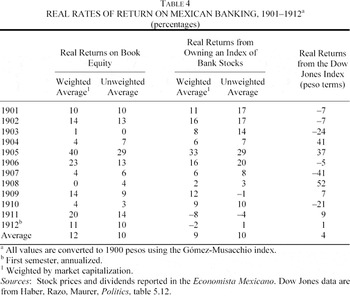
One might argue that although the banking system was stable, the directors were still able to extract resources from outside shareholders. That hypothesis, however, is not consistent with the fact that Mexican banks were extremely profitable enterprises for their shareholders, contrary to what we would expect to see in the presence of tunneling. The real return on the book value of equity in 1901–1912 for the entire banking system was 12 percent. These returns were not driven by the profits earned by a few large banks: the unweighted average real return-on-equity for all banks was 10 percent per year. Moreover, the evidence does not indicate that the 1908 financial crisis had a long-term impact. The rate of return on equity fell in 1908, but it returned to pre-1908 levels in 1909.
Mexican banks returned these high profits to shareholders by paying out high and regular dividends. In fact, over the 1901–1910 decade, the banks paid out almost all of their profits to shareholders in the form of dividends.36
In fact, banks paid dividends worth 106 percent of their profits over the 1901–1910 period. We estimated this figure from balance sheets published in the Economista Mexicano. Profits were calculated as changes in real net worth (adjusted for issues of new stock) plus dividends in 1900 pesos. Real net worth was calculated by revaluing assets and liabilities in 1900 pesos and subtracting the value of new stock issues, if any.
Musacchio, “Law.”

Were large dividends (and hence high returns) a sign that directors were in fact tunneling? It is possible that directors tunneled by paying out all of the bank's cash flow to themselves as dividends. This interpretation is not, however, consistent with the evidence about the identity of bank shareholders. Banks did not grow by taking deposits (as Table 3 shows, deposits never accounted for more than 16 percent of total assets), but rather by issuing additional shares. Lists of the purchasers of these additional shares, which we have for the Banco de Jalisco, the Banco Mercantil de Veracruz, and the Banco del Estado de México, indicate that the majority of these additional shares (57, 85, and 93 percent, respectively) were bought by outsiders.38
Ludlow, “El Banco Mercantil”; Oveda, “Bancos y banqueros”; and Romero Ibarra, “El Banco del Estado.”
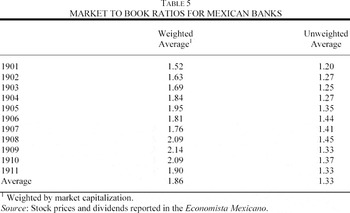
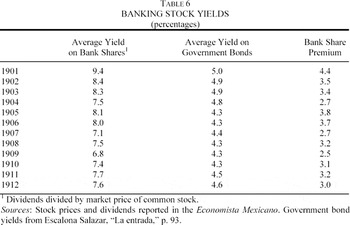
Did bankers tunnel through some other mechanism? It might be that high dividends paid to outsiders were simply compensation for the risk of tunneling. This argument is not, however, consistent with the evidence regarding the price of bank shares. If stockholders feared that the directors were tunneling, they would have discounted the price of shares. We therefore estimated two measures of the degree to which investors discounted shares: market-to-book ratios and the average yield on banking stock. Neither measure is consistent with the hypotheses that banking stocks were heavily discounted.
Table 5 shows the average (weighted and unweighted) market-value-to-book-value ratio for Mexican banks in 1900–1911. Bank stock traded at an average premium of 33 percent over its book value. Moreover, the crisis of 1908 does not appear to have had a major effect on how investors valued their assets. In fact, only one bank, the Banco de Michoacán, was valued at less than its book value in the years 1909 and 1910.39
The Banco de Michoacán was hard-hit by the financial panic in 1909. Banamex agreed to accept responsibility for redeeming the Banco de Michoacán's banknotes if the Banco de Michoacán would agree to abandon its right to issue further notes in the future. There were no losses to depositors or noteholders. Maurer, Power, p. 80.

The data on banking yields are also inconsistent with the hypothesis that investors heavily discounted banking stock. As Table 6 shows, between 1901 and 1912 the difference between the yield on Mexican banking stock and Mexican government bonds dropped from 4.4 percentage points to 3.0 percentage points. Moreover, the 1908 financial crisis does not appear to have had a major effect on this overall trend.

The evidence, in sum, does not indicate that Mexican bankers tunneled either before or after the crisis of 1908. In fact, there is evidence that during the crisis, bankers propped up banks with which they shared interlocking directorates. For example, the Banco de Jalisco rescued the Banco de Aguascalientes, and the Banco Oriental purchased and merged with the troubled Banco de Oaxaca and the Banco de Chiapas. Banamex assumed responsibility for the note issues of the Banco de Michoacán and Banco de Campeche when they faced runs and could no longer support their note issues. Banamex also aided two troubled banks on the Yucatán peninsula in merging.40
Maurer, Power, pp. 58 and 68.
Did the banks succeed in weathering the crisis through the expedient of passing off their bad related loans to the Caja de Préstamos? The evidence indicates that in 1908 the banks did transfer related loans to the Caja, but these loans were chosen by the government precisely because they were high-quality loans. In point of fact, the Caja de Préstamos may be the only banking bailout in world history to have made money. The assets held by the Caja (loans and mortgage bonds transferred from banks) consistently generated a positive cash flow, allowing the Caja to not only pay the interest due on its bonds, but to pay a 10 percent annual dividend on its outstanding share issues. We calculate that the Caja generated a nominal return to all claimants of its assets (bondholders and shareholders) of 4 percent in 1909, 7 percent in 1910, and 8 percent in both 1911 and 1912.41
Calculated from the balance sheets of the Caja de Préstamos, published in Economista Mexicano.
DID RELATED LENDING MISALLOCATE CAPITAL?
One might argue that even though bankers did not do enough looting to jeopardize the health of the banking system, they may nonetheless have diverted resources to their own, relatively inefficient, enterprises. In order to test this hypothesis we turn to our panel of textile mills. If bankers were using their textile mills to channel resources from the banks to themselves, then we would not expect bank-related mills to grow. Textile mills would simply be mechanisms to extract the wealth of the bank.
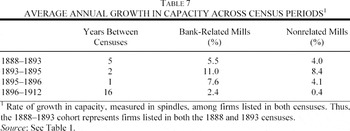
When we look at the growth in the size of mills, however, we find precisely the opposite: not only did bank-related mills grow, they grew faster than their nonrelated competitors. In Table 7 we calculate the growth rates of mills that existed (and did not switch between the bank-related and nonrelated categories) across various census periods. In each period, we find that mills that were bank-related outgrew mills that were not bank-related.

A somewhat weaker hypothesis about tunneling would suggest that bankers may have used their banks to support their own, relatively inefficient firms. In this view, bank-related mills may have been productive enterprises (rather than zombie firms whose purpose was to extract bank resources), but they would be less productive than their competitors. If this hypothesis holds, it implies that related lending misallocated capital.
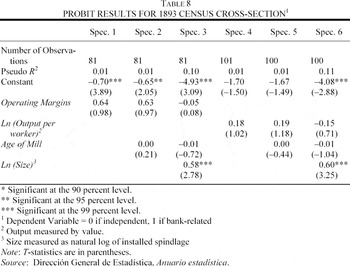
As a first step in testing this hypothesis, we estimate a series of probit regressions, where the dependent variable is whether a mill was bank-related, and the independent variables are the characteristics of mills. If credit was misallocated, then we should be able to predict which firms were bank-related based on their performance characteristics. We measure these characteristics as profitability and technical efficiency. We begin our analysis with the 1893 manufacturing census, because it provides extremely detailed data on the costs and volumes of all inputs and outputs. We employ two measures of mill performance: operating margins, and labor productivity. We add controls for mill size and age.
Regardless of the specification, our qualitative results are the same: there were no statistically significant differences between bank-related and nonrelated mills. (See Table 8.) We estimate similar probits—whose results are not reported here—for 1888, 1891, 1895, 1896, 1912, and 1913. The only difference is that these probits do not include a variable for operating margins because of data constraints. Not a single one of these probits, regardless of the specification employed, found any relationship between technical efficiency and bank relation. The probits imply, in short, that there was a dead-heat between bank-related and nonrelated mills in terms of their technical efficiency.42
These probit results are available from the authors.

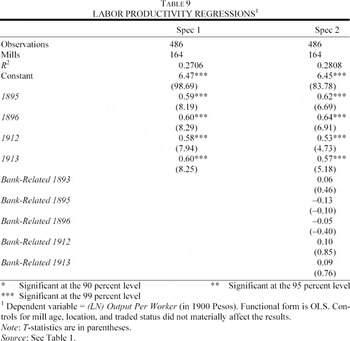
It is conceivable that the probit results on individual cross sections are too blunt an instrument to pick up small, but consistent, differences in productivity across censuses and mill types. We therefore estimate a time series, cross-sectional regression on labor productivity, and report the results in Table 9.43
We measure output as the real value of production. Following Atack and Sokoloff on productivity in the United States, and Bernard and Jones on international productivity comparisons, we took the number of workers as the measure of the labor input. We adjusted, however, for changes in the legal length of the workday. Atack, Estimation; Bernard and Jones, Productivity”; and Sokoloff, “Was the Transition?”
We do not report the results on mill age, location, and traded status because none of the coefficients were large or significant, and because the addition of these variables had no material impact on our cross-sectional dummies or the interaction of the cross-sectional dummies with the dummy for bank-relation.

Does the dead heat in labor productivity between bank-related and nonrelated firms mask capital misallocation? Bank-related firms could have used more capital per worker, and thus similar output per worker even though their output per unit of capital was lower. We therefore re-estimated our regressions on labor productivity, controlling for capital intensity and mill size. That regression produced the same qualitative results as our earlier regression: none of the coefficients on bank-relation come up significant.45
We also tested two additional counter-hypotheses. First, in order to eliminate the possibility that small firms might be driving the results, we broke the sample into two sectors, nonrelated and bank related, and calculated the labor productivity of each sector in the aggregate for individual census years. There were no significant differences in productivity between the bank-related mills, as a whole, and their nonrelated competitors. Second, in order to test the hypothesis that the owners of more efficient mills were more likely to found banks, we estimated a Cox-proportional hazard model with a mill switch from nonrelated to bank-related as the dependent variable. Only mill size had a significant effect on the probability of switching.
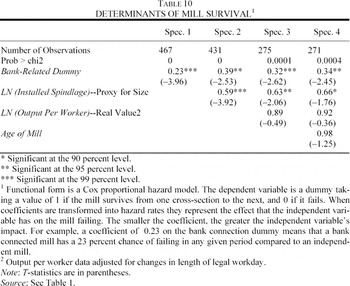
One may worry that technical efficiency is the wrong metric by which to judge the productivity of bank-related and nonrelated textile mills. What matters is economic efficiency: efficient mills thrive and grow; inefficient mills go out of business. If so, and if bank-related mills were less efficient, then bank-related mills would fail more frequently than nonrelated mills. In order to test this hypothesis, we employ a Cox maximum-likelihood proportional hazards model to estimate the effect of bank-relation on the probability of mill failure. Mills are defined as “failed” when they disappear from the subsequent census and never reappear. All coefficients (and standard errors) are transformed into hazard rates.
Our findings, presented in Table 10, are not consistent with the hypothesis that bank related mills were less economically efficient. In fact, we find exactly the opposite: bank-related mills were only 23 percent as likely to fail as their nonrelated competitors. This result is robust to the addition of conditioning variables for mill size, labor productivity, and age.

The Cox hazard model also suggests that being big was endogenous to being bank related. Bank-related firms lived longer, and therefore grew larger. This is consistent with our finding that bank-related mills grew much faster than their competitors, reported in Table 7.
MARKET STRUCTURE
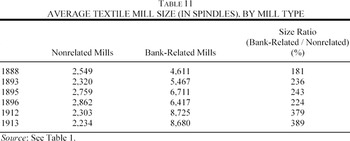
If bank-related firms grew at a much faster rate than their nonrelated competitors, then it follows that there should have been big size differences between bank related and nonrelated mills. Table 11 is unambiguous on this point: in 1888, bank related mills were, on average, almost twice the size of unrelated mills; by 1913, they were nearly four times as large.

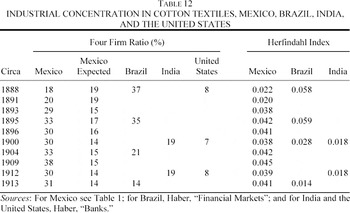
It also follows that the market structure of the textile industry should become more concentrated as the proportion of bank-related mills grew. In order to measure concentration we aggregate mills into firms, and estimate four-firm concentration ratios and the Herfindahl index.
In order to determine how low concentration would have been in the absence of related lending, we specify three counterfactuals. The first compares Mexico to itself over time. Cotton textile manufacturing was an industry characterized by constant returns to scale technologies and the absence of entry barriers. We should expect that, in the absence of related lending, as the industry grew, concentration should have fallen. The second compares Mexico to other countries that had large textile industries, but which did not have Mexico's banking system. We focus on three countries: the United States, Brazil, and India.46
Haber “Industrial Concentration”; “Financial Markets”; and “Banks.”
The method assumes that all firms in a market have an identical chance of gaining or losing market share over time. Even under perfect competition, therefore, firms will have unequal market shares in equilibrium, but the market share of the largest firms will solely be a function of the number of firms in the industry and a stochastic growth process. See Sutton, Technology.
The results of all three experiments, reported in Table 12, indicate that the Mexican cotton textile industry was “too concentrated.” First, concentration in Mexico actually increased over time, even though the industry was growing quickly. (In the United States, Brazil, and India, concentration fell or remained stable as the textile industry grew.) Second, the Mexican cotton textile industry was much more concentrated than the U.S., Brazilian, or Indian cotton textile industry. Third, the Mexican cotton textile industry showed much higher four-firm ratios compared to the ratio that would be expected in a perfectly competitive market, given the number of firms in the industry.

CONCLUSION
In recent years, policy-makers and academics have become interested in the nexus between finance and growth. Researchers in this field have noted that poor countries tend to have small banking systems. Some have also noted that banks in poor countries engage in related lending. The consensus view that has emerged from the related-lending literature is that causality runs from related lending to a small and inefficient banking system, and from a small banking system to slow growth. The posited mechanism behind the relationship between related lending and a small banking system is that bankers loot their own banks or systematically misallocate capital.
We argue, based on a study of a banking system characterized by widespread related lending, that the posited mechanism that connects related lending to small banking systems did not function in Porfirian Mexico. Widespread related lending was a response to poor legal institutions that made it very difficult to repossess collateral or obtain accurate information about the credit-worthiness of impersonal creditors. Our analysis of the performance of the textile industry indicates that Mexican bankers did not choose to lend to firms that were systematically less productive than their competitors.
Why did not Porfirian bankers take advantage of the opportunities presented them to loot their own banks or divert capital to less productive enterprises? Three conditions appear to have been crucial. First, Mexican law mandated extremely high capital-asset ratios. In Porfirian Mexico, capital-asset ratios were three times the levels recommended by the Basel Committee on Banking Supervision in 2004. Second, bank directors owned substantial equity shares in their banks. This provided bank directors strong incentives to monitor one another. Third, depositors and outside shareholders had their own money at risk. Porfirian Mexico enjoyed no deposit insurance schemes. This provided depositors and outside shareholders strong incentives to monitor the directors.48
See Huybens, Jordan, and Pratap, “Financial Market Discipline,” for evidence that Porfirian depositors disciplined bank directors by withdrawing their deposits from risky banks.
Khanna and Fisman, “Facilitating Development”; and Khanna and Palepu, “Emerging Market Business Groups” and “Is Group Affiliation.”
Calomiris, “Costs”; and Lamoreaux, Insider Lending.
This is not to say that there were no costs to Mexico's reliance on related lending. Firms that received related loans grew substantially faster than firms that did not. A more open banking system might have led to more lending and more economic growth. Mexico would have industrialized faster with more liberal bank incorporation laws. There would have been more textile firms, because a larger number of entrepreneurs could have used the banking system to finance their expansion. Businesspeople with a comparative advantage in managing manufacturing concerns would have been able to obtain bank financing, and bank credit would not have been limited to entrepreneurs who had enough political connections to obtain a bank charter. Mexico would have had a larger and less concentrated textile industry. The banking system would have been more competitive, and capital mobility between regions would have been greater. There were costs to widespread related lending, therefore, but they were not as high as is usually assumed.51
For a detailed analysis of the economic costs of the Porfirian banking system, see Maurer, Power, chap. 5.
Related lending was a second-best solution, but it was the best available in Mexico. Given the insecurity of property rights and the high cost of information, bankers had two options. The first was to make no loans at all. The second was to engage in related lending. Far from being pernicious or fraudulent, related lending allowed banks to overcome the scarcity of good financial information about outside credit risks that characterized the Porfiriato. It was no secret that banks in Porfirian Mexico engaged in widespread related lending. Lack of competition may have prevented new entrepreneurs from gathering the resources they needed, keeping the economy from achieving the industrial vitality found in countries with more decentralized capital markets, but related lending did not in-and-of-itself retard Mexico's economic growth or industrialization.
Earlier versions of this article were presented at the National Bureau of Economic Research Corporate Finance Group, the World Bank, the Brown University Department of Economics, and the Stanford Center for International Development. The authors would like to thank Nicola Cetorelli, Robert Cull, Alex Galevotic, Simon Johnson, David Kaplan, Todd Keister, Tarun Khanna, Randall Kroszner, Luc Laeven, Naomi Lamoreaux, Ross Levine, Ethan Ligon, César Martinelli, Aldo Musacchio, Roger Noll, Krishna Palepu, Sangeeta Pratap, Armando Razo, James Robinson, Tridib Sharma, Jordan Siegel, Paul Sniderman, Kenneth Sokoloff, Rafael Di Tella, Michael Tomz, and Paul Wilson for their comments on earlier drafts. We would also like to thank Philip Hoffman and two anonymous referees for their suggestions. Financial support was provided by a grant from the U.S.-Latin American Relations Program of the William and Flora Hewlett Foundation to Stanford's Social Science History Institute. Any and all errors remain wholly our own.