


INTRODUCTION
After war, a common question is what to do with poor, unemployed, high-risk men such as ex-fighters. Poor job opportunities could mean they are easier to rerecruit into violence, increasing the risk that war recurs.Footnote 1 They pose other risks as well. One is election violence. In Sierra Leone, for instance, parties paid ex-fighters to intimidate voters.Footnote 2 Another is crime. Former paramilitaries in Colombia, for example, have been recruited by criminal bands.Footnote 3 And, as this article describes, ex-fighters in Liberia were drawn into illegal work and interest in mercenary fighting.
To prevent this, nearly every fragile state funds some form of public works scheme, training, or other employment intervention for young men.Footnote 4 It is also the reason most demobilization, disarmament, and reintegration (DDR) programs have a heavy employment component. But can job programs turn swords into ploughshares?
These programs are rooted in three assumptions: first, that states can stimulate lawful employment by supplying training or capital; second, that lawful employment will decrease incentives for illegal work and rebellion; and third, that jobs and higher incomes will socially and politically integrate men into society.
The first assumption is plausible. Economic theory and evidence suggest that the average poor person has high returns to capital inputs and sometimes to skills, in large part because they are able but credit constrained.Footnote 5 High-risk men in fragile states are not average, however. They have a comparative advantage in violence, and they often lack the human, social, and physical capital to succeed in peacetime labor markets.
Yet the evidence on such high-risk men is limited and inconclusive. Observational studies of DDR programs report low or indeterminate effects on economic and political reintegration.Footnote 6 By their own admission, however, most DDR programs are poorly executed.Footnote 7 Also, often the primary goal of DDR is to get a peace agreement signed, not sustained economic reintegration.
The second assumption is rooted in the idea that fighters are rational and that crime and rebellion respond to changes in the opportunity cost of participation (Becker Reference Becker1968; Popkin Reference Popkin1979). While persuasive, there is little rigorous, individual-level evidence outside the United States. In developing countries, it comes mainly from country- and district-level analysis of income shocks.Footnote 8 Similarly, in developed countries, studies also suggest that city-level crime rates fall as wages rise.Footnote 9 There are limits to testing theories of individual behavior with meso-level data, however, especially because income shocks also affect the incentives of rebel groups, states, and civilian populations.Footnote 10
Some scholars also doubt that employment meaningfully deters crime and violence. Not all criminal activities crowd out work hours, and insurgent groups might not be labor constrained (Berman et al. Reference Berman, Felter, Shapiro and Callen2011). While fighting is risky, sometimes being a civilian is riskier, and so many men join armed groups for the security they provide, especially in Liberia’s wars (Bøås and Hatløy Reference Bøås and Hatløy2008). Moreover, studies of gangs and revolutions suggest that the key motivator might not be wages but demand drivers such as status, ideology, outrage, or a desire for justice. For example, Levitt and Venkatesh (Reference Levitt and Venkatesh2000) argue for the symbolic value attached to seniority in U.S. drug gangs. Scholars of revolution argue that injustices and other grievances generate outrage and with it an intrinsic satisfaction from violent action (e.g., Gurr Reference Gurr1971; Merton Reference Merton1938; Wood Reference Wood2003).
Finally, the third assumption, from employment and incomes to sociopolitical integration, is intuitively plausible but has no firm basis in theory or evidence. In principle, poverty could drive grievances or anomie that dissociate young men from mainstream society. Job programs could mend the damage. But evidence is limited.Footnote 11
This article evaluates a program that provided agricultural training and capital inputs to high-risk men in postwar Liberia. Liberia’s war ended in 2003, but in 2009 thousands of ex-fighters still occupied rubber plantations, illicitly mined precious minerals, or illegally logged. They clustered in “hotspots” where the state had little control. The state considered them a major security risk.
To shift men away from illegal activities and mitigate mercenary recruitment, the nonprofit Action on Armed Violence (AoAV) designed a program including several months of residential agricultural training, counseling and “life skills” classes, and farm inputs worth $125. AoAV recruited over 1100 high-risk men in 138 communities. Roughly half were randomly offered the program, and three-quarters complied.
Fourteen months after training, we observed several impacts. First, contrary to the conventional wisdom in DDR circles, even the highest risk men were overwhelmingly interested in farming. Second, treated men shifted their hours of work away from illicit resource extraction towards farming by roughly 20%. Almost none exited illicit work completely, however. Rather they simply shifted their portfolio of occupations. Their incomes increased about $12 a month as a result. Third, the program had little effect on peer networks, hierarchical military relationships, aggression, social integration, or attitudes toward violence or democracy.
Fourth, when an election crisis in Côte d’ Ivoire led to a short war, between 3 and 10% of men in the control group reported actions such as attending secret meetings with recruiters or being willing to fight at the going recruitment fees. Many also reported talking to an ex-commander recently. We have several proxies for recruitment interest, most imperfect. None of our sample actually went to fight, since the war ended abruptly. Nonetheless, treated men were about a quarter less likely to report these mercenary recruitment proxies.
Finally, future economic incentives seem to have been crucial in deterring both illicit and mercenary interest. Roughly a third of treated men did not receive their package of farm inputs because of unexpected supply issues. At the time of the survey, AoAV had told these men to expect to receive a cash equivalent in the near future. Men would miss the transfer if they left their villages to fight abroad or mine, meaning the cash transfer was de facto conditional. We use arguably exogenous variation in the receipt of inputs (and the expectation of a future transfer) to show this incentive explains a large portion of the reduction in illicit mining and proxies for mercenary interest.
These results have several implications for the rehabilitation of high-risk men. For example, we see that high-risk men had positive returns to a supply-side intervention of agricultural capital and skills. This success contrasts with the spotty record of non-farm skills training, and suggests that agricultural DDR and jobs programs may be more effective in fragile agrarian states.
This increase in employment and incomes did not affect social and political integration, however, at least after 18 months. Thus economic assistance alone may be insufficient to fully reintegrate high-risk men. To our surprise, an intensive and well-executed attempt to socialize men through counseling had little tangible effect in this case. We argue that some features of the program—its residential approach, concentrating ex-combatants with each other and with ex-commanders—interfered with effective resocialization.
Nonetheless, the higher returns to farming significantly changed incentives for crime and mercenary work. This is notable for several reasons: because rigorous individual-level evidence that crime and rebellion respond to legal wages is almost nonexistent; because so many other reintegration models and programs have failed; and finally because the specific labor response is insightful. A modest change in income (40 cents a day) led to a sizable shift in illicit employment, implying that the labor supply between illegal and legal sectors is highly responsive to small changes in relative wages. Also note, however, that people do not exit illicit work entirely. Employment in both legal and criminal sectors is a rational response to risk, and so men optimally keep at least some of that alternative income stream in their portfolio of work. Grogger (Reference Grogger1998) finds the same response among U.S. criminals. This evidence suggests jobs programs are more likely to affect criminal activity on the intensive than extensive margin.
Finally, the importance of future payouts in deterring undesirable behavior implies that ongoing and conditional incentives may be an important element of peacebuilding. This implies that programs such as sustained cash-for-work could help deter crime or armed recruitment.
One caveat to these results is that all our outcomes are self-reported, and if the treated underreport crime or mercenary interest, we will overstate treatment effects. We argue that this is unlikely given the pattern of outcomes we see, such as no treatment effect on the antisocial behaviors that were targeted by the program, and large effects on behaviors ignored in the curriculum (such as illicit mining). Also, we discuss evidence from urban Liberia that high risk men in the control group may underreport crime. But systematic misreporting is a risk, most of all with our proxies for mercenary interest and activity.
A second caveat is that it is difficult to say why the program made men less likely to commit crimes or rebel. This is a recurring limitation of quantitative studies of rebellion: we cannot measure motivations.
Nonetheless, the patterns of results suggest that this particular program deterred mercenary interest in a large part because of its effects on material incentives. Not only does the effect of the intervention on mercenary interest resemble the effect on illegal work, but both are especially influenced by future cash incentives. We also did not see an effect on armed social networks, attitudes to violence, or nonmaterial forms of aggression, suggesting the program didn’t work by breaking recruitment networks or socializing men against violence.Footnote 12 We cannot exclude a role for nonmaterial incentives in recruitment. For example, training and farming may have strengthened the social standing of treated men and made agrarian life more attractive. While undoubtedly true to some extent, this interpretation is hard to square with the deterrence effect of future cash transfers, or with the fact that most of our measures of community integration were unaffected by the program. In any case, our interpretation is merely that material incentives do matter to ex-fighters, at least on the margin.
The remainder of this article outlines the program and experimental protocols, the data we collected, a theoretical framework for understanding program components, the impacts of the program, and a discussion of how we can interpret the impacts to speak to theoretical and policy debates on recidivism and violence prevention.
INTERVENTION AND EXPERIMENT
From 1989 to 1996 and 1999 to 2003 two civil wars wracked Liberia. They killed nearly 10% of Liberia’s 3.5 million people, displaced a majority, and recruited tens of thousands of young men into combat (Republic of Liberia 2008). Since 2003, however, Liberia has been at peace and growing economically.
By 2008, the government and a United Nations (UN) peacekeeping force estimated that 9,000 ex-fighters were living in remote “hotspots” and were engaged in illegal resource extraction, including alluvial gold and diamond mining, logging, and rubber tapping (Republic of Liberia 2008). The government was eager to curb resource theft so that the concessions could be licensed and taxed, typically to foreign firms. These were crucial sectors for the Liberian economy, and ending illegal exploitation was one of the government’s core economic recovery strategies.
Peacekeepers also viewed these hotspot men as threats to regional peace. For decades, regional conflicts have been fueled by cross-border mercenary recruitment of men like these. A 2008 coup in neighboring Guinea fueled rumors of recruitment of Liberians as mercenaries, and there were regular violent clashes between the state and plantation squatters.
The Program
As a result, one of the highest priorities was to create stable jobs for high-risk men. To do so, AoAV rebuilt and operated two training centers, one in central Bong County and one in eastern Sinoe County. They designed a program with four main components:
-
1. Residential coursework and practical training in rice and vegetable farming, animal husbandry, rubber and palm cultivation (three months in Sinoe and four months in Bong). In residence, AoAV also provided meals, lodging, clothing, literacy classes, and basic medical care and personal items.
-
2. Counseling and a “life skills” class that aimed to socialize men to peacetime life. During the residential program it met three times a week in groups of 20. The locally developed approach used semiscripted lectures and group discussion, and was led by facilitators who were ex-combatants themselves. It focused on reframing and understanding wartime actions, dealing with symptoms of traumatic stress, managing anger, and resolving disputes peacefully. Facilitators also conducted informal out-of-classroom mentoring.
-
3. After graduation, transport to a community of their choice, coordinating with the community for access to farmland.
-
4. A two-stage package of tools/supplies tailored to the trainee’s interests, such as vegetable farming or animal husbandry, that cost $125. Men received the first half upon graduation and the second half several weeks later, if AoAV could locate them and confirm they had initiated farming or animal raising. In addition, Sinoe graduates were given $50 cash. This was not part of the program plan but was negotiated after a miscommunication during recruitment.
AoAV estimated the cost (excluding fixed costs such as training site construction and head office expenses) to be roughly $1,275 per person in 2009.Footnote 13
The government and UN peacekeeping force used the exit of ex-combatants from the enclaves to increase state control of the area, which typically meant a civilian administrator, periodic UN peacekeeper patrols, and the preparations to sell mining or rubber tapping licenses to small and medium firms. With virtually no police or staff, however, the state’s reach was limited. The main change on the ground was likely the slow transfer of the concessions to private companies.
Target Sites
For the Sinoe site, AoAV recruited in 35 communities on and around the Sinoe Rubber Plantation. A few months before, it had reverted to state control after the expulsion of a former rebel general. Hundreds of squatters, mainly nonranking ex-fighters and their families, still remained.
For the Bong program, AoAV recruited in 103 communities in three regions. First, several dozen remote villages and mining camps in Gbarpolu County—one of the most isolated counties, known for illicit logging and mining. The camps were magnets for opportunistic youth and ex-fighters, some led by ex-commanders. Second, they recruited in 12 villages and towns in and around Ganta, a border city, where at the time there were reports of mercenary recruitment after a Guinean coup. Third, they recruited ex-combatants from villages near the training site.
Recruitment
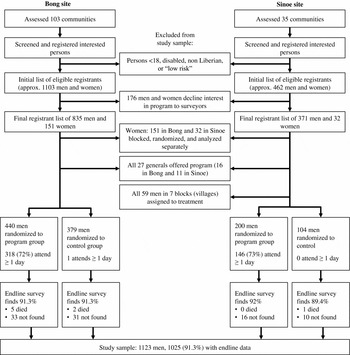
The Bong training site accommodated 350 men and 50 women, while the Sinoe site accommodated 175 men and 25 women. We worked with AoAV to assign offers to the program randomly among screened, registered men. Figure 1 illustrates sample recruitment, selection, randomization, and data.
Sample Recruitment, Selection, Randomization, and Data Collection

From May to October 2009 AoAV advertised the program in community meetings, and screened and registered interested and eligible people. There was overwhelming interest in the program among the hotspot population, high-risk or not. AoAV collected extensive data on war experiences and current economic activities and attempted to register those they deemed to be the highest-risk men, especially those least served by previous postwar programs. They excluded people deemed physically incapable of agriculture, and non-Liberians.
We have no data on the men screened out, but we observed the process first-hand and observed mainly low-risk men being turned away (e.g., noncombatants, or well integrated ex-fighters). Undoubtedly some high-risk men were not interested in the program, so did not register.
AoAV registered 1,565 men and women and passed them to a baseline survey team. 176 people withdrew their interest or could not be found, resulting in 1,206 registered men and 183 women. Our experimental analysis excludes 27 high-ranking “generals” who were automatically offered the program, as the UN considered it too risky to exclude them. We also exclude women who participated in the program, who were few in number and have very different characteristics and risks.
This screening and self-selection has implications for the interpretation of treatment effects: they apply to the subset of nonranking, high-risk men who have some minimum interest in a training intervention. This is probably the main quantity of academic and policy interest, however.
Randomization
To randomize men, we blocked by training site, rank, and community and, within blocks, assigned each person a uniform random variable and sorted in ascending order. Men were randomly assigned to an offer to enter the program in this order within blocks until a target number per block was reached. If a person refused or could not be located, they were still assigned to the treatment group (an offer) and the offer went to the next person on the list.Footnote 14 Of 1,123 men, 57% were assigned to treatment.
DATA
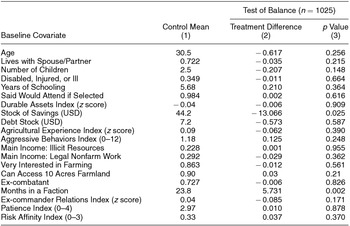
Table 1 describes men at baseline.Footnote 15 On average, the men were aged 30, had 5.9 years of schooling, with 27% literate. They reported cash earnings of $47 in the past month, savings of $46, and debts of $7. Seventy-four percent were in a wartime faction, though only 17% reported being on the front lines. 13% reported close relations with a former commander.
Baseline Summary Statistics and Test of Randomization Balance

Notes: Columns (2) and (3) report results of an OLS regression of each covariate on the treatment indicator and block fixed effects. Standard errors are clustered by village. USD variables are censored at the 99th percentile.
Most men were already subsistence farming, as markets were distant and food expensive. On average they had 4.8 years of farm experience. Thirty-two percent said farming was their main source of income, and 29% reported it was nonfarm labor or business. Forty-seven percent reported some work in illicit activities in the past week, but only 23% said that this was their main source of income. Eighty-seven percent said they were “very interested” in being a farmer. Ninety percent said they could easily access 10 acres of land.
The sample was broadly balanced along covariates. Columns 2 and 3 of Table 1 report the treatment and control group difference in select baseline covariates. Just 7% of all covariates have an imbalance with p < 0.1. The treatment group, however, had lower savings and spent more time in armed factions.Footnote 16 All treatment estimates control for all covariates.
Endline surveys and attrition. We conducted endline surveys from February to June 2011, 18 months after baseline and 14 months after training. The sample was mobile and difficult to track, but we nonetheless surveyed 1025 (91.3%) of 1,123 men.Footnote 17 Many had multiple aliases. Roughly 45% moved between surveys, many changing locations every few months. Few had mobile phones. We invested heavily in tracking out of concern that the hardest to find would be the most prone to violence. We made at least four attempts to locate each person. To mitigate excess attrition among the untreated, they received a phone worth $15 for completing the endline.
Attrition is not significantly correlated with treatment, and all baseline covariates explain just 11 percent of the variation. Some covariates are significantly related, and imply unfound men could be those with a higher propensity for illicit activities and violence—they are slightly more likely to be ex-combatants, have slightly higher baseline aggression, and have been illicit rubber tappers.Footnote 18
Qualitative data. We also conducted eight weeks of unstructured interviews before, during, and after the program with participants, community leaders, UN and government personnel, and nonstudy residents. Furthermore, under our supervision, one American and two Liberian research assistants followed 26 treated men over two years, typically interviewing them four times (before, during, and twice after training).Footnote 19 To understand recruitment activities we also conducted informal interviews with ex-fighters and ex-commanders outside our sample, as well as government and UN personnel, during the crisis in Côte d’ Ivoire.
CONCEPTUAL FRAMEWORK
AoAV designed their intervention to affect occupational choice in three ways. First, they used training to raise the returns to labor and capital in agriculture. Second, the input package aimed to relieve a constraint on available capital, with inputs that were difficult to sell or use in other sectors. Like many DDR and correctional programs, the goal was to provide material incentives for lawful rather than unlawful work.
A third aspect of the intervention, the counseling and life skills, aimed at something less conventional: socialization. The idea was that some actions or professions have direct utility benefits or penalties—that people have preferences over how their income is earned (e.g., Akerlof and Kranton Reference Akerlof and Kranton2000). These preferences are thought to be partly rooted in one’s self-image, social category, and experiences. By providing education, a new profession, and relocation, AoAV’s intervention tried to affect occupational choice by changing self-image and peers, and thus affecting penalties from oneself or peers for deviant behavior.
This section tries to capture these aims in a simple model of occupational choice between legal and illegal occupations. We outline the framework and key insights here, with full details in the Online Appendix.
Setup
We assume people allocate their labor between leisure l, legal activities La (such as agriculture), and illicit activities Lm (such as unlicensed mining or mercenary work). Legal work (“agriculture,” for simplicity) is a function of one’s labor, productivity θ (driven by locally available technologies and techniques), and capital inputs X t − 1 (such as seeds), which are decided in the previous period. Agricultural output is thus F(θ, La t , X t − 1), and AoAV’s intervention provides inputs and aims to increase productivity.
Meanwhile, we assume mining and mercenary work pays an hourly wage that varies over time, wt .Footnote 20 It also comes with a risk of future punishment. For simplicity, we assume this cost is a linear function of last periods’ hours in mining and mercenary work: ρ fLm t − 1, where ρ is the probability of apprehension and f is the punishment. Punishment includes imprisonment and foregone wages, but it could also include the withholding of a “peace dividend” such as a cash transfer.Footnote 21
Total earnings from all activities are thus yt ≡ ptF(θ, La t , X t − 1) + wtLm t − ρ fLm t − 1, where p is the price for output. In addition to investing in agricultural inputs, the person can also invest or borrow through a riskless asset with constant returns 1 + r.Footnote 22 We can consider the case where there is no production risk, and also the case where agricultural productivity and the illicit wage are subject to stochastic shocks.
Finally, we assume people have the utility function U(c, l, σLm
). This includes the standard preferences over consumption c and leisure, but it also includes the possibility of direct utility benefits or penalties from the type of work through the term σLm
.Footnote
23
If people are socialized to penalize themselves for illicit work, then σ < 0 and
 $U_{\sigma L^{m}}^{\prime}\le 0$
. We could also interpret σ < 0 as external social sanctions or disapproval. In principle, however, there is no reason σ has to be negative. To the extent that a personal experience or identity-related injustice creates a grievance or a sense of anomie, then σ > 0 and
 $U_{\sigma L^{m}} {\prime}>0$
. This corresponds to the case where rebellious or illicit activity delivers positive utility benefits, perhaps because it is rewarded with esteem and respect, or because it satisfies some preference for justice or revenge.Footnote
24
In either case, the program’s aim to socialize and normalize high-risk men can be captured crudely in this framework as a decrease in σ.
The setup resembles a classic occupational choice of crime model, except with home production and the potential for (dis)utility over illicit labor. People choose their labor allocations, consumption, and inputs for next period’s production in order to maximize the present value of expected utility, subject to a simple budget constraint (see Online Appendix).
Insights from the Model
Solving out the model provides a number of insights. First, for AoAV’s training or inputs to affect production decisions (and deter illicit work) specific market failures must exist. In particular, the provision of training and capital will only shift employment patterns if credit markets function poorly or agricultural knowledge is imperfect, and hence the men are below their efficient scale of agriculture. Otherwise the men would be able to access the needed technology and borrow to finance any training and inputs until they reach an efficient scale, and new in-kind inputs would be liquidated or divested.
These assumptions seem reasonable in rural Liberia where credit and insurance are almost nonexistent and agricultural technology is rudimentary. But success also requires that men have high returns to these skills and capital once the program relieves these constraints. In particular, men cannot be bound by some other constraint, such as inadequate insurance or insecure property rights.
Second, the model illustrates why men are unlikely to exit illicit activities entirely. If there are high but diminishing returns to agriculture, then people will optimally engage in both agriculture and illicit activities, allocating their time so that the net marginal product of labor in agriculture equals that in illicit work. This is even more the case when there is risk aversion and uncertainty, since men have additional an incentive to perform both activities to reduce risk. Thus the model predicts that increasing agricultural productivity alone will reduce the proportion of hours that are illicit, but not necessarily the incidence of any illicit work.
Punishments, however, can encourage exit. Increasing the risk of being caught, or the penalties once caught, are one way to do so (and may not be subject to the same diminishing returns). This is the common rationale for policing and punishment. There are other ways to penalize crime, such as withdrawing a benefit. For instance, a capital transfer program conditional on no arrests, or living away from lootable resources, could have similar effects. As we discuss below, at endline a subset of the men were awaiting a cash transfer from AoAV, and we will argue that this punishment lens is a useful way to consider their incentives.
Finally, the model suggests who ought to be targeted by an agriculture-oriented reintegration program, in terms of who is more likely to engage in illicit activities but potential to be influenced by policy: people with low initial productivity but interest in learning (in agriculture, in this case, though the same argument could be made for other peaceful activities); and who have little capital and are credit constrained.
Also, the model points out that it will be more difficult to persuade men to pick up agriculture when their disutility of illicit work is low, when the returns to illicit work are high (such as rising gold prices), and when agricultural input prices are relatively high.
EMPIRICAL STRATEGY
We estimate the simple intent to treat (ITT) effect via an ordinary least squares (OLS) regression of the outcome on an indicator for receiving an offer to enter the program, controlling for all baseline covariates.Footnote 25 Because we are testing multiple outcomes, we also test whether an additive standardized treatment effect of measures in “families” of outcomes is different from zero.Footnote 26 We cluster standard errors by baseline village.
We report every outcome measured in the endline survey, except for a small number of secondary outcomes that we report in the Appendix.Footnote 27 The main outcomes of interest were defined by the stated aims of the intervention and our theoretical framework, and are fairly commonsensical: agricultural skills acquired and used; employment in legal and illicit activities; income; antisocial behaviors and other participation in/attitudes toward violence; risk of rerecruitment into armed groups and other violent organizations; and social and community integration.Footnote 28
Accounting for imperfect compliance. Seventy-four percent of those assigned to treatment complied, in that they attended at least a day. Ninety-four percent of those who attended a day graduated. The rest quit early or were dismissed for infractions. To estimate the effect of the program on compliers, we also estimate the effect of treatment on the treated (TOT) using assignment to an offer as an instrument for attending at least a day.
Noncompliance was fairly unsystematic. Qualitatively, people said they did not attend largely because a few days was inadequate notice. Others mentioned family obligations, debts, illness, or jobs that would not permit them to return if absent. In an OLS regression of compliance on baseline covariates, the R 2 statistic is just 0.06 and most covariates are unrelated to compliance.Footnote 29
Identifying the marginal impact of capital inputs. Graduates mainly selected packages for vegetable farming (60%) and pig and poultry husbandry (29%). Roughly half of graduates, however, report that they did not receive the full package. This includes all who chose pigs and poultry, because of external supply problems. Chicks and piglets were not available in Liberia and AoAV had to transport them in from Guinea. Despite repeated attempts, the animals did not survive the journey and were never distributed. This meant that some program graduates returned to their communities and received seeds and other farm inputs, but others in the same communities received materials to build a pig sty or chicken coop but not the animals.
Some months before the endline survey, AoAV announced that they would give a $100 cash grant to the men who chose animals, though they gave no specific date. We ran the endline survey shortly before disbursal.
We can use this supply interruption to compare the impacts of receiving training and inputs versus training and a promise of a cash transfer in the near future. While the interruption was exogenous, men’s choice of animal versus farm input packages was not. We can interpret any difference as causal if we think selection of package is exogenous conditional on observed data.
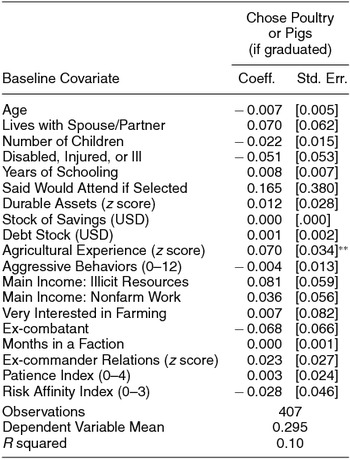
Conditional unconfoundedness is plausible. Animals have lower cash flow than vegetables, are more capital intensive, involve less labor, and are perceived to be more profitable. Thus we might expect more patient, wealthier men with other labor opportunities to choose animals. But we see no such pattern; the choice of specializations seems to be relatively uncorrelated with a rich set of baseline covariates. Table 2 reports an OLS regression of poultry/pig package choice on select baseline covariates among graduates. Only one covariate is significant: a 1 SD increase in agricultural experience is associated with a 7 percentage point increase in poultry/pig choice.
Correlates of Package Selection

Notes: Calculated via OLS regression with block fixed effects. The F test is on all covariates excluding block and region dummies. Robust standard errors are in brackets, clustered by village. *** p < 0.01, ** p < 0.05, * p < 0.1.
RESULTS
Training ran November 2009 to February 2010 in Bong, and September to December 2009 in Sinoe. Based on our observations, classroom instruction was practical and pitched at an appropriate level. Instruction involved substantial field training with animals and crops. Students learned techniques appropriate for small-scale cash cropping and animal husbandry unavailable before, such as seed germination or fertilizer, pesticide, and vaccine use.
Fights, angry protests, strikes, and the threat of violence were weekly occurrences on the training sites. While the events were disruptive, they were also opportunities for the students to learn to work out grievances peacefully and apply lessons from the life skills class.
Overall, students were enthusiastic about the life skills and counseling. In interviews a year later, they frequently brought up slogans and examples from the class, and its impact on their lives. In the endline survey, when asked what part of the program most changed their life, 23% of graduates said the life skills curriculum and 19% said counseling, compared to 44% who said skills training and 3% who said inputs.
More than half of the graduates chose to return to their baseline community, and most others chose a community in the same county. Across Liberia farmland is plentiful and arranging for a few acres of land was straightforward. Community members often said they were proud of their new or returned residents.
Graduates faced steep challenges, however. They typically returned to remote communities with sizable local markets but difficult road access and limited access to external markets and inputs. Furthermore, graduates reported serious liquidity constraints, and hence little access to tools and inputs beyond what AoAV provided. Farmland was plentiful but typically rugged, semicleared rainforest. Liberian farmers seldom have access to plows, draft animals, or tractors and perform most work by hand. Pests and rainfall are also persistent challenges. Program impacts need to be considered in light of these difficulties.
Impacts on Occupational Choice and Incomes
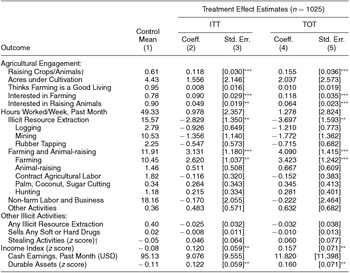
Table 3 reports control group means and treatment effects for economic outcomes. We focus on TOT estimates. Men typically had a portfolio of occupations. Illicit opportunities were often distant from village settlements, and so it was common for men to farm some weeks of the year in their base village, leave for petty trading, then move elsewhere to mine, log, or tap rubber for a period. Changes in occupation often meant spending fewer days in “the bush” illicitly mining, and more days in town farming or trading.
Program Impacts on Occupational Choice and Income

Notes: Columns (2) and (3) report the intent-to-treat (ITT) estimate, and columns (4) and (5) estimate the effect of treatment on the treated (TOT) via two-stage least squares. All regressions include block dummies and baseline covariates. Standard errors are clustered at the village level.
† See Appendix D.1 for all index components.
*** p < 0.01, ** p < 0.05, * p < 0.1.
The program led to large increases in agricultural work. Sixty-one percent of controls said they were engaged in farming or animal-raising, and this increased 15.5 percentage points among the treated—a 26% rise relative to controls. Treated men also expressed more interest in agriculture as a career. Interest in farming was high even without treatment: 95% of controls said that they could make a good living farming, 78% were interested in farming in the future, and 90% were interested in raising animals. Treated men were no more likely to think that farming is a good career (since opinion is nearly unanimous) but they were 12 percentage points more likely to express interest in farming. Hours worked in agriculture increased by 4 hours per week, or 33% relative to controls.Footnote 30
We also observed a shift on the intensive margin away from illicit resource extraction. We collected days and hours worked at 15 activities in the previous month (a time of dry season farming and crop sales). Controls reported 49 hours of work per week, and total hours were not affected by treatment. But treated men decreased hours of resource extraction by 3.7 (23%) and increased other work by 5 hours, mainly agriculture. Importantly, the treated did not exit illicit activities completely—40% of control men engaged in any illicit extraction and this was only 3.2 percentage points lower among the treated, not statistically significant.
Reports of felony crime were rare and perhaps for this reason we saw little effect of treatment. We asked about drug selling and theft (stealing, pickpocketing, and armed robbery) which we assembled into a standardized index. Only 2% of control men reported drug selling (usually marijuana) and only about 2% of men reported thievery.Footnote 31 Treated men were half as likely to report they sold drugs, not statistically significant. There was little effect of treatment on self-reported stealing.
Incomes rose as a result. We measured income by combining two measures, which together increased 0.16 standard deviations. First, we asked each respondent his net cash earnings in the past four weeks, activity by activity.Footnote 32 This earnings measure may be subject to recall and other biases, and does not capture home production. Also, agricultural incomes may not have been earned in the past month. We approximate a measure of permanent income using durable assets—a standardized index constructed by taking the first principal component of 42 measures of land, housing quality, and durable household assets.
Controls reported $95 in earnings in the month prior to the survey, and this was $11.82 higher among treated men, a 12% increase (not significant, in part because of high variance). Treated men also reported a 0.16 standard deviation increase in the durable assets index, significant at the 5% level. The family index of both is statistically significant. This durable asset increase is likely a result of previous harvests (of which there were two to three since the end of the training program), and is probably a more reliable guide to income than earnings.
In general, these results are robust to alternate treatment effects specifications and attrition bounds (see Appendix D.3).
Returns. In the simplest case, we imagine the $11.82 earnings treatment effect represents a permanent increase in monthly income—$141 annually. This is 11% of the per person program cost of $1275, and is the cost of capital at which a $141 perpetuity breaks even. This is not an especially high or rapid private return. Moderate social externalities, however, could make it a more promising social investment. In this case, the intervention allowed the government to reclaim resource concessions and, as we see next, may have reduced the risk of future rebellion.
Impact on Mercenary Recruitment Activities
We ran our endline survey at a time of escalating violence in Côte d’ Ivoire (CI). The incumbent president, Laurent Gbagbo, lost but disputed a November 2010 election to his rival Alassane Ouattara. Both sides began mobilizing armed forces in December, and there were sporadic outbreaks of violence through February 2011. Serious fighting began in February near the Liberian border. Full-scale war broke out by March. By early April, however, French and UN forces helped to capture and defeat Gbagbo, and hostilities suddenly ceased.
Both sides were accused of recruiting Liberian ex-fighters. Undetermined numbers crossed from Liberia to Côte d’ Ivoire starting in December 2010. About 10,000 Liberian mercenaries fought in Côte d’ Ivoire during 2002–07 hostilities (ICG 2011). Our qualitative work and news reports suggest that, by March 2011, no more than 500 Liberian mercenaries had crossed to Côte d’ Ivoire. These men were primarily from the capital and border towns, were some of the most experienced ex-fighters, and were offered $500–1500 to join (ICG 2011). According to one Liberian recruit, “Some of us are not working. Our government [in Liberia] disarmed us, but they have refused to take us into the new army” (Garnaglay Reference Garnaglay2011). “We have been in this business for many years,” another said. “We know how to fight well and if Gbagbo or Ouattara’s men can employ us to fight, that will be good.” Several sources—news reports, our informal conversations with peacekeepers, ethnographers, and government, and finally our qualitative interviews with high-risk men during the rising violence—generally suggest that most interest in recruitment was opportunistic.
Though they undoubtedly exist, it was difficult to find first- or second-hand accounts of Liberians driven by solidarity or ideology. With the possible exception of the Krahn group (Guère on the Ivorian side), few Liberian ethnic groups had strong ties to one side or the other. The Krahn/Guère held close ties to Gbagbo, however, and their area on the Ivorian side had especially intense violence, took the longest to calm down, and had the most credible rumors of mercenaries.
To the best of our knowledge, none of our sample went to fight in Côte d’ Ivoire. This is not surprising given the small numbers that went before the war came to a sudden end. Systematic data on who recruited, and who was recruited, does not exist. Based on our qualitative interviews, some ex-commanders recruited through their networks, and had begun to approach and make offers to ex-fighters to prepare for a longer war. In small communities across Liberia, grassroots recruitment activities also proliferated. People, often former midlevel commanders and generals, would hold secretive meetings of former fighters in the village. It’s unclear whether these local mobilizers had formal ties to armed groups in Côte d’ Ivoire. Rumors circulated widely about the sums promised to men to go, and appropriate terms might be discussed in the meetings. Ex-fighters, if interested, could seek out these meetings, mobilizers, or (in the extreme) make plans to move to one of the border towns where forces were expected to amass. Other men were more likely to be recruited by dint of their profession or location (e.g., in a mining town).
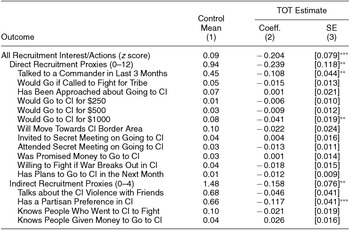
Table 4 lists control means and treatment effects for all 16 self-reported measures in the survey. Some are very indirect proxies for recruitment, and so we display them in a separate subindex and interpret them cautiously. For instance, 66% of control men expressed a partisan preference for either Gbagbo or Ouattara, and 68% said they talked about the war with friends.
Program Impacts on Mercenary Recruitment Proxies

Notes: Columns (2)–(3) report the the effect of treatment on the treated (TOT) via two-stage least squares. Regressions include block dummies and baseline covariates. Standard errors are clustered at the village level. See Appendix D.1 for ITT results.
*** p < 0.01, ** p < 0.05, * p < 0.1.
Other survey questions, however, reflect more direct demand for or supply of offers, and so are better proxies for interest in recruitment or engagement with recruiters. For instance, 8% said they had been approached to go fight, 10% said they were making plans to move to the border area, 4% said they were invited to go to a secret recruitment meeting, and 3% reported attending. Three percent also reported being offered money to go. Five percent reported they would go for $1,000, and 1% said they had concrete plans to go in the next month.Footnote 33
Forty-five percent had also talked with a commander in the past 3 months. They could talk to a commander for many reasons, of course, but the question is whether a treatment effect reflects a lower likelihood of talking to commanders for reasons of recruitment. Below we show that the program had no statistically significant effect on relationships with ex-commanders. This is one reason we include it in the direct proxies, with these caveats.
Twelve of the 16 measures (including nine of the 12 more direct measures) are lower for treated men than controls, often by large proportions. For example, those who would go for $1,000 falls 51%, attending a secret meeting falls 43%, planning to move to the border area falls 21%, talking with a commander in the last 3 months falls 24%, and having concrete plans to go drops 86%. Of these, the treatment only effects talking to commanders and willingness to go for $1,000 are individually significant. Jointly, however, these falls are significant—engagement in all 12 more direct recruitment activities fall 24%. The other indirect recruitment indicators fall 11%, and an index of all 16 recruitment measures falls by 0.2 standard deviations with treatment. In general, the results are fairly robust to excluding some of the largest and statistically significant proxies (Online Appendix).
There are only 21 Krahn in our sample, but the deterrence effect of treatment on mercenary interests is larger rather among this ethnic group, suggesting the program was no less effective when there were bonds of solidarity at stake.Footnote 34
Some results are more difficult to explain, such as the decrease in an expressed partisan preference with treatment. This could be evidence of the program offer changing political preferences or grievances. The decision to join an armed group is complex and multifaceted, and elements of glory, grievances, or other motives were surely present. Thus we cannot dismiss other, nonmaterial motives.
In-kind Inputs versus an Expected Cash Transfer
These treatment effects conceal heterogeneity in who received the in-kind capital inputs. Assuming agricultural skills and capital are complements, the model predicts that people are less likely to increase farming without capital. The effect on illicit activities is ambiguous, however. In practice, mining and mercenary work requires that men leave the village and risk missing the disbursement. This could dissuade men from illicit work even if agricultural returns are low. Missing the disbursement is akin to a punishment in our model.
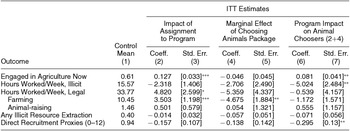
We estimate the effect of choosing animals in Table 5, which estimates the ITT with an additional indicator for whether the man chose animals. The coefficient on treatment alone reflects the effect of choosing farming (columns 1 and 2), the coefficient on the animals indicator gives the marginal effect of that choice (in columns 3 and 4), and the sum of these two coefficients is the total program impact on those who chose animals (in columns 5 and 6).
Heterogeneity of Program Impacts by Package Choice

Notes: Column (2) reports the ITT coefficient of program assignment and column (4) reports the coefficient on an interaction between program assignment and choosing poultry/pigs. Column (6) lists the sum of the coefficients in columns (2) and (4). The regression includes baseline covariates and regional dummies are used instead of block dummies. Standard errors clustered by community.
*** p < 0.01, ** p < 0.05, * p < 0.1.
We see that those who chose animals are less likely to increase their agricultural engagement or hours of work. The decrease is not statistically significant, but the decrease in hours farming is. Illicit activities fall in both groups, though they appear to fall most in the animals group (the difference is not statistically significant).
The fall in both illicit resource extraction and mercenary recruitment activities is largest, however, among those who chose to specialize in animals and were told to expect a transfer. This is consistent with men staying in villages to await the transfer.Footnote 35 These estimates are not sensitive to serious violations of the assumption of conditional unconfoundedness (Online Appendix).
Could Results be Biased by Self-reported Data?
One concern with these effects is they use self-reported data. If the treated feel pressure to report good behaviors (experimenter demand) then we overestimate impacts on them. This is a challenge in developing countries where administrative data are nonexistent.
Measurement error is a risk, but there are several reasons to think it is a modest one. First, the patterns we observe are inconsistent with the obvious incentives to misreport. The counseling and life skills components of the program stressed certain forms of behavior change: ending use of war names, lowering interpersonal aggression, and solving disputes peacefully, among other behaviors. Occupational choice, including resource extraction, was not discussed. Thus if treated men have a tendency to report “good” behavior to surveyors, we should expect treatment effects to be largest for the behaviors emphasized by their counselors. Below we will see the opposite is true.
Second, since resource extraction and mercenary actions mainly decrease among animal choosers, the incentives to misreport would have to be correlated with expecting cash specifically, not treatment in general. While feasible, it is puzzling that we do not see this pattern appear in the good behaviors explicitly emphasized by the program. Furthermore, the control group, who were eligible for future training, did not respond to a similar incentive.
Third, we attempted to measure social desirability bias in a similar sample. Logistically it was not possible to validate data for our dispersed, mobile group. Instead, we conducted a survey validation exercise in the capital among high-risk men in the slums of Monrovia, especially men engaged in petty crime. These men were part of a field experiment that tested a similar program of rehabilitation, detailed in Blattman, Jamison, and Sheridan (Reference Blattman, Jamison and Sheridan2015). Briefly, Liberian qualitative researchers shadowed and interviewed 240 men for four days within 10 days of a written survey. They used in-depth observation, interviews, open-ended questioning, and efforts at trust-building to elicit more truthful answers about theft, drug use, and gambling from a random subsample of experimental subjects. Comparing these responses to survey data, we find little evidence of measurement error. If anything, it seems the control group underreported sensitive behaviors and expenditures, meaning the true treatment effects are larger than estimated.
Sociopolitical Impacts
Finally, we see no evidence the program successfully socialized the men differently, including the aims of the counseling and life skills: peer groups, risky social networks, antisocial behaviors, community engagement and leadership, and attitudes to violence.
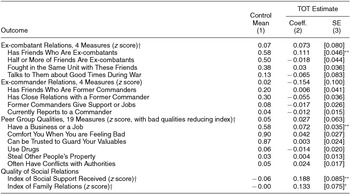
Table 6 reports control group means and TOT estimates for several family indices plus a subset of the index components as examples (Appendix D.1 lists all components). We see no evidence the program broke down military chains of command or interaction among ex-combatants, perhaps because the training intensified exposure to ex-combatants and commanders. An index of four measures of ex-combatant relationships increases 0.073 standard deviations (not significant). An index of relationships with former commanders declines 0.154 standard deviations among treated men (also not significant). Treated men do report small decreases in close relations with a commander, or receiving support or jobs from a commander.
Program Impacts on Social Relations, Networks and Peers

Notes: We estimate the effect of treatment on the treated (TOT) via two-stage least squares. All regressions include block dummies and baseline covariates. Standard errors clustered at the village level. See Appendix D.1 for ITT estimates.
† See Appendix D.1 for all index components.
*** p < 0.01, ** p < 0.05, * p < 0.1.
We also asked respondents about their closest friends and whether or not they have 19 different qualities ranging from “positive” (e.g., have a business or job, participate in community meetings) or “negative” ones (e.g., get drunk regularly, use drugs, steal, or have conflicts with the authorities). An index increasing in positive qualities and decreasing in negative ones is 0.027 standard deviations higher among the treated (not significant). Table 4 displays six such qualities. None of the negative qualities and only one of the positive qualities (having a business or job) increase with treatment.
Treated men do, however, report better support from existing networks. Table 6 reports an index of eight questions about forms of social support received in the past month (such as people who gave them advice, financial support, etc.) and seven questions about family relationships (such as frequency of interaction or whether there are serious disputes). Social support is 0.19 standard deviations higher among the treated, and the family index is 0.13 standard deviations greater (significant at the 10% level).
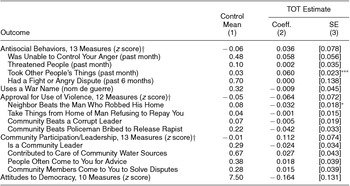
Table 7 looks at the pro- and antisocial behaviors targeted by the intervention. Again we report family indexes with examples of the components. We see no significant change in an index of 13 questions about aggressive and other antisocial behaviors in the past four weeks (such as threatening people, destroying their property, or having physical fights). Also, about a third of the control group use a nom de guerre, a practice actively discouraged by the facilitators as a symbol of personal change. Treatment has no effect on its use.
Program Impacts on Anti-social Behavior and Attitudes to Violence and Democracy

Notes: We estimate the effect of treatment on the treated (TOT) via two-stage least squares. All regressions include block dummies and baseline covariates. Standard errors clustered at the village level. See Appendix D.1 for ITT estimates.
† See Online Appendix D.1 for all index components.
*** p < 0.01, ** p < 0.05, * p < 0.1.
We also asked about 12 attitudes towards violence as a means of maintaining order or justice (such as mob justice). The index is 0.064 standard deviations lower among the treated (not significant). We asked 13 questions about community participation and leadership (such as attending community meetings, or contributing to public goods). An index of these is 0.112 standard deviations greater among the treated (not significant). Finally, we see no significant difference in 10 measures of prodemocratic attitudes, such as whether they disapprove of military coups when the president’s performance is bad.
DISCUSSION AND CONCLUSIONS
There have been few opportunities outside the U.S. to test the effects of labor market interventions on illegal and rebellious activity. This intervention shows that increasing agricultural productivity and capital led men to shift away from illicit resource extraction on the intensive but not the extensive margin. The extensive margin responded more to future and ongoing incentives—a conditional cash transfer—rather than a one-time increase in capital and productivity. These patterns resemble what a simple, standard model of occupational choice predicts.
Implications for illicit labor markets and economic rehabilitation. First, programs often assume that former fighters, gang members, or other high-risk young men are uninterested in traditional occupations like farming. This belief may come from asking young men “What do you want to be?” rather than “What do you think you will be?” But farming is the main economic opportunity in Liberia, a point both AoAV and the highest-risk men understood. Farming is not especially lucrative but it is respectable and commonplace, and indeed necessary for most households for their lifetime. Thus most of them were keen to improve their knowledge.
Second, the response to the promise of a future cash transfer is insightful. It suggests that one-time transfers of skills and capital may have limited deterrent effects on future violence. That is, the most effective peace dividends may pay out repeatedly over time. Capital transfers or cash-for-work programs could accomplish the same if they condition payment on men’s location—out of hotspots and not in mercenary work.Footnote 36
Third, our results are consistent with a growing body of evidence that suggests that employment programs should emphasize capital alongside skills. Men who received training and were waiting for their capital were unable to start their farms. This is consistent with our theoretical model: if people are poor and credit-constrained then the returns to skills alone will be low. This is also consistent with studies of business skills and vocational training, which show limited impacts on men and seldom pass a cost-benefit test (e.g., Attanasio, Kugler, and Meghir Reference Attanasio, Kugler and Meghir2011; Cho et al. Reference Cho, Kalomba, Mobarak and Orozco2013; McKenzie and Woodruff Reference McKenzie and Woodruff2014). A growing number of studies, moreover, show that the poor have high returns to capital.Footnote 37 In the AoAV program, a reasonable hypothesis is that increasing the availability of capital, or even changing the ratio of skills to capital provided, would increase cost-effectiveness. This is unknown, however, and an important question for future study.
Fourth, the elasticity of illegal labor supply suggests the returns to mining and other resource extraction were not much greater than agriculture to begin with. Given free entry into illicit resource extraction, it’s perhaps not surprising that returns are competitive with other opportunities. There are interesting parallels to studies of U.S. drug gangs that finds that the lowest positions are quite poorly paid, labor supply is elastic, but on the intensive margin only (Levitt and Venkatesh Reference Levitt and Venkatesh2000). As a result, to persuade men to exit rather than simply decrease illicit activities, a single-sector focus may be insufficient. Programs that promote both farm and nonfarm business (such as petty trading), perhaps by providing more liquid capital, could reduce risk and hence incentives for illicit work. This is another important area for research.
Economic incentives might not be enough. The model (and common sense) also imply that increasing policing and punishment could lead to criminal exit, especially combined with higher legal wages. Illicit resource extraction was an appealing alternative partly because of low enforcement. But in the aftermath of conflict, it may be easier to change labor market opportunities than strengthen police forces, at least in the short term.
Implications for theories of armed recruitment. The findings are also largely consistent with the idea that armed recruitment responds to material incentives. First, we see large impacts on returns to legal work (and the opportunity cost of illegal work), but no statistically significant evidence of impacts on the behaviors and attitudes associated to connections to commanders, peer quality, nonmaterial forms of violence, community participation, or attitudes to crime and violence. The program only affected antisocial behaviors with material incentives. Third, the decrease in both illicit activity and proxies for interest in recruitment activities is largest among men with future economic incentives not to leave the village.
This is not to say that demand drivers do not matter. Armed social networks, ethnic solidarity, and grievances undoubtedly influenced men’s interest in mercenary work. And these drivers may have played an even larger role in a less opportunistic conflict than the Ivorian one. This general variation in motives is important, but our research design only identifies the subset of the variation that is affected by the randomized treatment. Like any source of causal identification, this exogenous variation is not necessarily representative of all the variation in factors affecting the decision to join an armed group. For the reasons we outline above, the evidence points to the program affecting material incentives most of all.
One possibility, however, is that getting trained and becoming a successful farmer raised men’s community esteem and lowered men’s social marginalization. This reduced the appeal of armed groups as a source of respect and upward mobility. We do see that the program increased social support from friends and family. But there is no significant effect on broader community participation. Probably economic success and social integration are intertwined, and a pure economic opportunity cost is too narrow an interpretation of why jobs and income deter crime and armed recruitment.Footnote 38
Meanwhile, the one piece of evidence that is consistent with an effect of the program on grievances is the reduction in expression of a “partisan preference” in the war. This is difficult to square with a pure opportunity cost motive at work. Relatedly, the one group that had the closest solidarity with a fighting group were less likely to express interest in recruitment than their co-ethnics in the control group. But evidence for the opportunity cost mechanism does not crowd out demand drivers, or vice versa. As our formal model illustrated, they are likely to be complementary.
Implications for rehabilitation strategies. Failure to resocialize men in this case does not mean socialization is futile. Indeed, other programs targeting high-risk urban youth, in both the United States and Africa, have successfully changed antisocial behaviors. Successful programs have tended to target specific behaviors and “character” skills, often using the techniques of cognitive behavioral therapy, or CBT (Heckman and Kautz Reference Heckman and Kautz2013; Heller et al. Reference Heller, Pollack, Ander and Ludwig2013, Reference Heller, Shah, Guryan, Ludwig, Mullainathan and Pollack2015). In urban Liberia, one study shows that eight weeks of nonresidential CBT focused on skills of self-control and a noncriminal self-image had large and sustained impacts on violence and crime, especially when combined with cash transfers (Blattman, Jamison, and Sheridan Reference Blattman, Jamison and Sheridan2015).
In the U.S. rehabilitation literature, “best practices” discourage residential programs (since they do not help people learn to change in their normal environments), and have shown that concentrating “at-risk” men with “high-risk” men tends to increase antisocial behavior (Gendreau and Andrews Reference Gendreau and Andrews1994; Heckman and Kautz Reference Heckman and Kautz2013). They also tend to encourage focused, CBT-style curriculums over lectures or talk therapy. It is possible that a nonresidential program, cognitive-behavioral counseling approach, that treated ex-commanders and the highest risk men separately, would have led to greater social integration. This too is an important area for more research.
Overall, this article adds to a growing body of evidence that economic margins matter for crime and rebellion. As this evidence solidifies, however, it means noneconomic approaches to behavior change are arguably a more important area for future study and policy experimentation, given the paucity of evidence and uncertainty about what works.
SUPPLEMENTARY MATERIAL
To view supplementary material for this article, please visit http://dx.doi.org/10.1017/S0003055415000520.




Comments
No Comments have been published for this article.