1. Plato on the Nature of the Sudden Moment
1.1. “All of a Sudden” from the Symposium to the Seventh Letter
You probably remember how Diotima concludes her first description of the ladder of love in Plato’s Symposium (210e):
Try to pay attention to me, she said, as best you can. You see, the man who has been thus far guided in matters of Love, who has beheld beautiful things in the right order and correctly, is coming now to the goal of Loving: all of a sudden he will catch sight of something wonderfully beautiful in its nature—that, Socrates, is the reason of all his earlier labors (trans. Nehamas & Woodruff Reference Nehamas and Woodruff1989, emphasis mine).Footnote 1
In this passage the methodical and orderly succession of stages, whereby the soul, beginning with beautiful bodies and ending with the beauty of sciences, reaches an ever wider understanding of the unity of beauty, is contrasted with the unexpected manifestation of the Beautiful itself. The “vast sea of beauty” (210d) of the earlier stages now gives place to a singular entity which neither comes into being nor passes away, neither waxes nor wanes, neither disguises itself as something other nor mixes with its opposite in any respect or from any perspective: it is the absolute Beauty as distinct from all relational beauties; the universal and eternal Form as opposed to all particular and time-bound beautiful things. The word ἐξαίφνης (exaiphnês) is used to describe the sudden conversion of the soul from one order of reality to another, its passage from the immanence of perceptible bodies, ethical activities, artistic productions, and scientific truths to the transcendence of Platonic Forms. As opposed to the linear and smooth succession of the previous stages denoted by the hendiadys locution ἐφεξῆς τε καὶ ὀρθῶς (ephexês te kai orthôs) ascension to a Form is an abrupt occurrence that disrupts the smooth succession of time. Although the objects of perception are essentially different as the soul proceeds from bodies to souls to achievements to sciences, its upward movement is supposed to follow a continuous, though tortuous, line of ascent. But continuity is then broken and the soul is “all of a sudden” illuminated in the presence of the Form. Though occurring in time the event effects a rupture from temporality as ordinarily perceived: it opens up a vision of eternity.
That Plato intended what his text implies is confirmed by both internal and external evidence. In the Symposium itself the word ἐξαίφνης is used three more times after its first appearance at the culminating stage of Diotima’s ladder of love: first, when a group of drunk people noisily disturb the solemn atmosphere of Agathon’s house, Alcibiades being the most prominent among them (212c); second, when Alcibiades takes notice of Socrates, who has been sitting on the same couch with him all along (213c); and finally, when another group of drunk people unexpectedly enter Agathon’s house (223b). Since the second and fourth instances of ἐξαίφνης in the dialogue are clearly similar, it may be assumed that the author of the dialogue wanted his readers to imagine that the beneficial presence of Socrates in Alcibiades’ life would be parallel to the mentally and psychologically groundbreaking force of an encounter with Beauty. As an unexpected rupture of orderly succession the ἐξαίφνης may thus take up an upward or a downward direction and assume a positive or a negative turn: it may bring up a vision of an eternal essence in the mist of temporal agony or procure a disruptive presence in the midst of serene contemplation. The four instances of ἐξαίφνης in the dialogue compose a conceptual rhyme of the type ABAB, where A stands for peaceful rest and B for tortuous motion.
The word ἐξαίφνης is used in several other dialogues. In the Gorgias (523e) it highlights the abrupt transition of the soul from terrestrial life to the subterranean realm, i.e., death. In the Theaetetus (162c) it accompanies the passage from ignorance to knowledge. In the Republic it is used in the allegory of the Cave three times (515c, 516a, 516e), the first being the unexpected liberation of a prisoner from his chains. In the Cratylus, perhaps more significantly, it escorts the unforeseen inspiration whereby Socrates, much to his own surprise, manages to delve into the original meanings of divine names.Footnote 2 In the late Laws (678b) the Athenian Stranger makes the distinction between κατὰ σμικρόν (“little by little”) and ἐξαίφνης (“all of a sudden”)Footnote 3 in a way reminiscent of Diotima’s opposition between smooth progress (ἐφεξῆς τε καὶ ὀρθῶς) and abrupt change (ἐξαίφνης).
The evidence of the Seventh Letter is crucial at this juncture. The author, whether Plato himself or some close acquaintance who knew his thoughts well, uses the word ἐξαίφνης in order to indicate the unforeseeable time when the four levels of knowledge (i.e., name; definition; image or specimen; and finally true belief, science and understanding) merge into one, thus generating a sudden illumination in the cognising soul.Footnote 4 As the progressive knower brings together the four levels of knowledge and tries to grasp their common denominator, “all of a sudden” a light is kindled in the soul. Once kindled this internal light is said to be self-nourishing and self-sustaining (αὐτὸ ἑαυτό τρέφει). The knowledge thereby acquired is characterized as utterly ineffable (ῥητὸν γὰρ οὐδαμῶς), probably in the sense that its content, as well as the experience of perceiving it, cannot be adequately described in non-metaphorical terms. One can assume that the psychological certainty provided by the experience is of a similarly incommunicable nature. There is no doubt that the author of the letter expected the reader to understand the event described in so many words as an encounter with a Platonic Form. As in the scala amoris of the Symposium or even the allegory of the Cave of the Republic, the difficult and methodical process of acquiring partial knowledge about some object of study precedes the attainment of absolute truth about it. But since the former is a moving process whereas the latter a firm state of the soul, the two kinds of knowledge are worlds apart. In most cases, then, it is the discontinuity between a process and its end result that is indicated by the word ἐξαίφνης, which seems to have gradually acquired a quasi-technical sense in Plato’s writings.
1.2. The Sudden Moment in the Parmenides
Most of the ἐξαίφνης passages that I have presented so far speak of the unexpected and abrupt character of a mental experience that consists in one’s attuning to an order of reality higher than the sensible world. As such they show some effects which the sudden moment has on our human life. In the Parmenides, however, Plato undertakes a brief exploration of this very puzzling nature which is the ἐξαίφνης itself and which, it may be presumed, allows such mental experiences to occur.
Some terminological remarks are in order before I proceed. The Platonic ἐξαίφνης of the Parmenides is often translated as “moment” or “instant” or even “the instant of change”. Such renderings allow an all-too-quick assimilation of the Platonic ἐξαίφνης to the Aristotelian νῦν (nun), which is also translated as “the instant of change”. Moreover, “instant” and “moment” are common nouns of everyday speech. Τὸ ἐξαίφνης, by contrast, is an adverb turned into a substantive by the addition of the definite article in a highly abstract philosophical discussion. It would strike the ancient listener as a grammatical peculiarity whereas the “instant” or “moment” does not similarly strike the modern reader. Last, but not least, τὸ ἐξαίφνης, besides denoting “instantaneousness”, also connotes “unexpectedness”, a sense which is either entirely missing from “instant” and “moment” or not prominent in them. The German translation of the Platonic ἐξαίφνης as Augenblick (“the twinkling of an eye”, hence “moment”) has the drawback that it prematurely makes the Platonic ἐξαίφνης similar to, if not identical with, the Aristotelian ἐξαίφνης (Phys. IV, 13 222b14-16) which is something different. Moreover, Augenblick is a common word of everyday speech, rather than a purely technical term, and a boldly metaphorical one at that—unlike ἐξαίφνης. As such it is a perfect translation of the Pauline ἐν ῥιπῇ ὀφθαλμοῦ (1 Cor. 15.52), a locution nowhere to be found in the literature of the classical age. I shall therefore translate τὸ ἐξαίφνης as “the sudden moment” or, more simply, “the sudden” to emphasize its out-of-the-blue character—“the suddenly”, an even more literal rendering, creates unnecessary awkwardness.
The relevant passage of the Parmenides runs as follows (156c1-157b5):
—But when it [i.e., the One] comes to rest after moving, and changes to being moved after resting, it is surely impossible for it to be in one time at all.
—How so?
—It will not be possible for it to undergo being at rest before and moved afterward, or to be moved before and at rest afterward, without changing.
—Of course not.
—Yes, but there is no time in which it is possible for it at once to be neither moved nor at rest. (Χρόνος δέ γε οὐδεὶς ἔστιν, ἐν ᾧ τι οἷόν τε ἅμα μήτε κινεῖσθαι μήτε ἑστάναι.)
—No, there is not.
—Furthermore, it does not change without being in the process of changing.
—Hardly.
—Then when does it change? Not while at rest, nor while moved, nor while in time.
—No.
—So, there is this strange thing (τὸ ἄτοπον τοῦτο) in which it would be when it is changing.
—What sort of thing?
—The sudden (Τὸ ἐξαίφνης). For the sudden seems to signify something such that change proceeds from it into either state. For there is no change from rest while resting, nor from motion while moving; but the sudden, this strange nature, is something inserted between motion and rest, and it is in no time at all; but into it and from it what is moved changes to being at rest, and what is at rest to being moved. (ἀλλὰ ἡ ἐξαίφνης αὕτη φύσις ἄτοπός τις ἐγκάθηται μεταξὺ τῆς κινήσεως τε καὶ στάσεως, ἐν χρόνῳ οὐδενὶ οὖσα, καὶ εἰς ταύτην δὴ καὶ ἐκ ταύτης τό τε κινούμενον μεταβάλλει ἐπὶ τὸ ἑστάναι καὶ τὸ ἑστὸς ἐπὶ τὸ κινεῖσθαι.)
—Very likely.
—Then since the One is both at rest and in motion, it changes to each state; only so could it do both. But in changing it changes all of a sudden, and when it changes it is in no time at all, is neither moved nor at rest. (μεταβάλλον δ᾽ ἐξαίφνης μεταβάλλει, καὶ ὅτε μεταβάλλει, ἐν οὐδενὶ χρόνῳ ἂν εἴη, οὐδὲ κινοῖτ᾽ ἂν τότε, οὐδ᾽ ἂν σταίη.)
—No.
—Now, is this also true relative to other changes? When the One changes from being to ceasing to be, or from not being to coming to be, is it then between certain motions and stations, and then neither is nor is not, neither comes to be nor ceases to be?
—It seems so, at any rate.
—Then by the same account, in passing from one to many and from many to one, it is neither one nor many, neither combined not separated. And in passing from like to unlike and unlike to like, it is neither like nor unlike and becomes neither like nor unlike; and in passing from small to large and to equal, and vice versa, it is neither large nor small nor equal, neither grows nor diminishes nor becomes equal.
—It seems not.
—Then would the One undergo all these affections, if it is.
—Of course.Footnote 5
The passage is not about the process of change as such; it is about the nature of shifting (μεταβάλλειν (metaballein)) from a state to a process (such as from being-at-rest to be-moving-in-space) and vice versa or, more elliptically,Footnote 6 from one state to another (such as from being-like to being-unlike). It does not directly question the possibility of change as such; it rather focuses on the condition, which allows transition from the process of changing to its end, or from the state of rest to the beginning of motion. It is in such a context that the sudden is introduced.
The first thing the reader learns about the sudden, even prior to its name, is its strange character. The thing to be introduced is said in advance to be ἄτοπος (atopos), which literally means “in no place” and metaphorically “extremely puzzling”. Its weird and puzzling character is repeated in what may be seen as a formal description of the sudden (156d6-e2, emphasized above). There the sudden is characterized as a μεταξύ (metaxu), i.e., a go-between or intermediary across motion and rest. This is the second thing one learns about it. The third thing is that the sudden is in no time (ἐν χρόνῳ οὐδενί), and the fourth that it is at the end (εἰς ταύτην) and origin (ἐκ ταύτης) of every change. Therefore, the sudden is (i) extremely puzzling but not wholly unknown since it is said to be (ii) between change and rest, (iii) in no time, and (iv) at the origin as well as end of change.
As becomes clear from the way Parmenides proceeds after introducing τὸ ἐξαίφνης, the shift from motion to rest (and vice versa) is selected from among the various kinds of shift as the most evident case—evident at least in a pedagogical and educational sense. For after finishing with his brief analysis of the sudden moment, Parmenides extrapolates from the results reached so far to a general conclusion: the sudden moment is present not only in the interplay of motion and rest but in all kinds of shifts from process to state (and vice versa) without exception.
At the beginning of the third deduction (Parm. 155e4-6), Parmenides mentions the primary attributes of the One reached through the earlier two deductions, namely that it is one and many and neither one nor many.Footnote 7 That the One is many, and therefore not absolutely one, was the result of the second deduction (144e); that it is absolutely one, and therefore in no sense many (not even in the sense of being), was the result of the first deduction (141e). Though the third deduction is meant to be a synthesis of the earlier two, Parmenides says that the One partakes of time (155e6). He does not add that it does not partake of time either. The omission is significant. For at the end of the first deduction, it was explicitly stated that “it would not be possible for the One to be in time at all” (141a5). It is clear therefore that the third deduction works within the framework of time, and the One it starts dealing with is the temporal One of the second deduction.
The notion of time is meant to accommodate the conflicting attributes of the One reached through the first and second deductions. Parmenides makes it clear that the time when the One partakes of being is different from the time when it does not (155e10). Next he claims that there is a time when the One partakes of being or gets rid of being since there is no way in which it could partake or get rid of the same thing without taking or leaving it at some time (ποτέ; 156a3).Footnote 8 All in all, Parmenides begins with the assumption of a temporal One that undergoes all kinds of change in time and ends with a One that stands outside of time precisely when it changes. The notions of change and time, instead of implying one another, turn out to be incompatible. This is a paradoxical conclusion. Behind the paradox a serious doctrine seems to be concealed.
In a purely logical manner, and without appeal to sense-experience, Parmenides is trying to indicate the logical implications of the belief that there is change. For a thing to shift from, say, resting to moving, there must be a time when the beginning of movement occurs. Now, if, on the one hand, this time is part of the whole stretch of time in which the thing is moving, that would mean that at the beginning of movement the thing was already moving. Hence, the beginning of movement should be sought earlier on within the stretch of time in which movement occurs, and then still earlier, and so on ad infinitum. If, on the other hand, the beginning of movement is not part of the whole stretch of time in which the thing is moving, it must be a part of the whole stretch of time in which the thing was not yet moving. But if so, then the beginning of movement should be placed at a time when the thing was still at rest—which is absurd. To avoid the absurdity of the second option and the infinite regress of the first, the initial assumption that there is a time when the beginning of movement occurs must be reconsidered. Parmenides does not lead the argument to the conclusion that there can be no change since there can be no time in which the beginning of change should be placed. He rather leads the argument to the conclusion that the beginning of change—and the same obviously goes for its end as well—must be outside time. The beginning and the end of change must not be parts of time.
The pre-philosophical conception of time that allows this paradox to occur is not hard to find. Time is here understood as duration, as an extended and presumably measurable stretch of temporal sequence. The sudden moment cannot be such a stretch of time. For presumably any such stretch of time is divisible into a before and an after; and the beginning of change, if it is truly a beginning, cannot last. But if the sudden moment cannot be a portion of time as duration, this does not mean that it cannot be a duration-less point in the temporal flow. The sudden moment is not in time in the sense that it does not possess what any part of time must possess, namely duration. But it is in time in the same way that an unextended point can be said, though not literally, to be “part” of an extended line. As it is not by the addition of a number of points that a line is made, so it is not by the addition of a number of “suddens” that time is constituted. Non-extended points do not possess the single most important feature of a line, namely extension, and thus they cannot make up a line. For to add one such entity to another is to add zero to zero in terms of extension. Likewise, non-durational suddens cannot make up time since to add one such sudden to another is to add zero to zero in terms of temporal duration. It thus appears that the sudden moment is the element that connects two distinct states or a state and a process in such a way that they can immediately succeed one another. By so connecting them the sudden moment keeps them also apart since it prevents their confluence or fusion. One and the same temporal point is the end of the previous state or process and the beginning of the next. The sudden moment is a limit. The continuity of the flow of time is contrasted with an element that, through its weird presence in the temporal continuum, effects an inexplicable rupture of continuity. A preliminary conclusion may be reached: that the sudden moment is the enabling condition of all discontinuous leaps within temporal sequence.
If the account given above is substantially correct, the sudden moment without being part of time still features time. This feature of time has the special prerogative of allowing new things to come into being and old things to pass away. Without it time would be only a preserving factor in the world. With it time becomes both a creator and a destroyer.
A question that arises immediately is whether or not the sudden moment is identical with the present. For where could the sudden moment be found, one might ask, if not at the precise point where the past meets the future? The question is philosophically pressing. But it is also important to raise it in the context of the Parmenides itself. For in the second deduction (152b3-4) Parmenides spoke of the present time as what lies in-between the “was” and the “will-be”, or the past and the future. Since the concept of the now time or present time (ὁ νῦν χρόνος) was available to Plato, what prompted him, it may be asked, to introduce another word, to make it a substantive with the addition of the definite article (τὸ ἐξαίφνης), and to use it in a clearly technical sense? The very presence of τὸ ἐξαίφνης in the third deduction implies that it should not be read as identical to ὁ νῦν χρόνος or τὸ νῦν of the second deduction. But it is not clear how the two differ.
From the account of τὸ ἐξαίφνης that I have given so far, it follows that the sudden moment must be everywhere along the temporal axis without however being part of time as duration. For if someone can speak now of a shift between, say, one person being alive and his/her death that occurred three days ago, it is evident that the sudden moment when this person passed away is a past moment. In a similar way, for each of us there is an unpredictable future sudden when we shall pass away. The sudden moment is not restricted to the present. But whenever the shift actually occurs, it is always in the present. Past sudden moments were actually sudden only when they were present; now not only are they no longer unexpected but they have become necessary too. The future has a better claim to host the sudden moment than does the past because the future may be said to be unpredictable whereas the past is not. But future sudden moments are not yet actual. It follows that the actual sudden moment is always in the present. The past possesses moments that were indeed sudden but have lost that feature. The future, by contrast, possesses an infinite number of potential sudden moments.
In the second deduction Parmenides sees the present as the part of time that lies between the past and the future: κατὰ τὸν νῦν χρόνον [...] τὸν μεταξὺ τοῦ ἦν τε καὶ ἔσται (Parm. 152b3-4). He adds that nothing advancing in time can ever overstep the present: oὐ γὰρ πορευόμενόν γε ἐκ τοῦ ποτὲ εἰς τὸ ἔπειτα ὑπερβήσεται τὸ νῦν (152b4-5). But a paradox ensues: while a thing that advances in time is becoming older and, by the same token,Footnote 9 younger (as the first deduction has shown, 141a7-c4) than itself, that very thing is, rather than becomes, older when it is in the present. Parmenides claims that to be older is to stop becoming older (152b6-c2). But if this is so, then the thing that advances in time does not become older in the present. The now excludes becoming and by so doing it excludes any possibility of change. Parmenides actually summarizes his results as follows (152c6-d2): Εἰ δέ γε ἀνάγκη μὴ παρελθεῖν τὸ νῦν πᾶν τὸ γιγνόμενον, ἐπειδὰν κατὰ τοῦτο ᾖ, ἐπίσχει ἀεὶ τοῦ γίγνεσθαι καὶ ἔστι τότε τοῦτο ὅτι ἂν τύχῃ γιγνόμενον (“But if everything that comes to be must necessarily pass through the now, then when things are in it, they ever leave off becoming and they are what they happened to be becoming”).
The now cannot be the locus of becoming, i.e., of change as a process. The now can only host Being. With the introduction of the notion of the now Parmenides, and by implication Plato, wanted to indicate that in the midst of Becoming there is always a trace of Being. It is this conclusion of the second deduction, I take it, that led Parmenides to introduce, in the third deduction, a new concept which would allow the interplay of Being and Becoming to occur.Footnote 10 And this new concept is no other than the sudden moment. How the now of the second deduction and the sudden of the third are related to one another is not told in the dialogue. Presumably Plato thought that the dialectical exercise of the Parmenides, and perhaps any similar dialectic whatsoever, does not strip the readers of their duty to think for themselves. We may thus take up the challenge and make an attempt.
1.3. On the Relation of the Sudden to the Now in the Parmenides
One way to solve the problem about the relation of the sudden to the now in the Parmenides would be to think that Plato adopted an atomic conception of time, according to which time is not really a continuum but a series of indivisible moments each of which possesses a minimal duration.Footnote 11 The whole temporal sequence would, on that interpretation, consist of a parade of temporal units, presumably identical in size to one another, one of which would be the present now. Because indivisible each of those units would not have a before and an after, and could not therefore host becoming and change as processes. On that interpretation, the boundaries between indivisible units, of no temporal duration whatsoever, would be the sudden moments of the third deduction. Change always occurs in-between the flowing atomic nows, i.e., in no time at all, strictly speaking—precisely as the second and third deductions, taken together, stipulate. For if change does not occur within the now (which, on that view, is the ultimate constituent of time) but in the sudden moment (which is no proper part of time), it can reasonably be said that it occurs in no time.
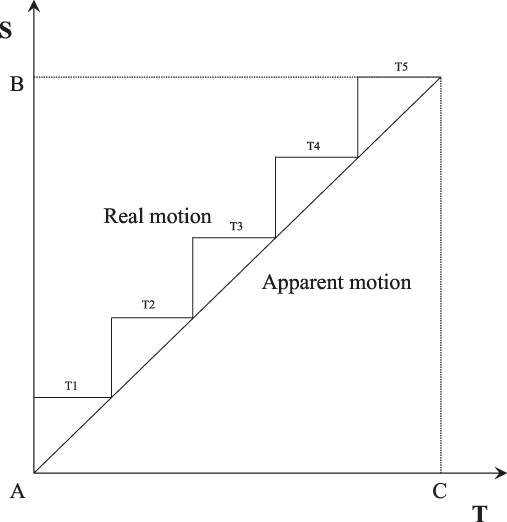
This atomic conception of time may be represented in the following table which graphically shows the difference between apparent and real locomotion in its relation to time (see Figure 1 on next page). S stands for “space” and T for “time”. The horizontal segments in the diagram stand for the atomic units of time (T1, T2, T3, T4, T5); the vertical segments for distances of space.
The relation between real and apparent motion according to an atomic conception of time

Motion appears to be continuous in space (from A to B) but is in fact a series of leaps from one position of space to another; and it appears to endure for some time (from A to C) because it takes a certain (finite) number of atomic units of time to be accomplished. From the diagram below it is clear that at any atomic now the thing is at rest; it is only in the non-extended boundaries between two such nows that the thing suddenly finds itself in the next spatial position. One would therefore be justified in saying that in any actual present, understood as an atomic unit of time, the thing is not undergoing a process of movement, hence that it is not becoming but is.
This ingenious interpretation has much to recommend itself but we are bound to face insuperable difficulties when trying to apply it in practice and to see how it works in more detail.Footnote 12 A serious difficulty is that the boundaries between the atomic units of time are regarded as indivisible points in which alone movement qua leaping takes place. But that is contrary to what Parmenides means when he declares that the sudden is “something inserted between motion and rest”. On the above reconstruction of his argument, the sudden is not between motion and rest: it is either in motion or between rest and rest. For the sudden to be really between motion and rest, it should be placed between the atomic unit and its boundary with the previous or next atomic unit. But this is to postulate another indivisible entity between an indivisible duration and an indivisible boundary of indivisible durations—and this, obviously, leads to an infinite regress.
To put the same point more graphically, suppose, for instance, that the body of the diagram above moves for the whole period denoted by T1-T3 and then comes to a standstill for the remaining T4-T5 period. When does its shift from motion to rest occur? The obvious answer seems to be: at the indivisible boundary between T3 and T4. But if so, then the body should have remained in the same position at T4 as it was at T3, and it would therefore have moved for the period T1-T2 and remained still for T3-T5, in contradiction with the movement one tries to describe. If, on the other hand, the shift from motion to rest is supposed to have occurred at the indivisible boundary between T4 and T5, then the shift would have occurred within the period of rest and not between rest and motion as Parmenides’ description of the sudden requires.
The assumption of an atomic conception of time meant to accommodate the requirements of the second and third deductions does not solve the problem. Moreover, there is no evidence that Plato espoused an atomic conception of time. Aristotle once reportsFootnote 13 that Plato postulated the existence of indivisible lines, most probably in his oral doctrines, as the origin of (divisible) lines. On Aristotle’s account, Plato claimed that talk about non-extended points is a doctrine peculiar to the mathematicians, presumably in the sense that points are mental or theoretical constructions which have no exact equivalent in the physical realm. It is possible to think that what Plato intended with the notion of indivisible lines was the Form of Line, namely the indivisible ideal object that accounts for the extended dimensionality of divisible lines.Footnote 14 But on the present state of knowledge this plausible interpretation of Plato’s intention must remain speculative. For no ancient testimony substantiates Aristotle’s claim in a satisfactory manner,Footnote 15 and, to repeat, there is no evidence whatsoever for the idea that Plato postulated indivisible units of time.
A second interpretation would take the present now of the second deduction as having a certain duration, in line with our experience of it as persisting for some time.Footnote 16 Parmenides may be taken to speak rather loosely here. On that interpretation, the sudden moment would be the real cross-section of the past with the future, i.e., the present instant in the now, as opposed to the now itself which would be allowed to have some duration extending on either side of the sudden. Damascius,Footnote 17 for instance, claimed that the now of the second deduction is such a dimension or interval (διάστημα) of time rather than the limit (πέρας) of the past with the future. He based his interpretation on Plato’s text which speaks of “the now time” (κατὰ τὸν νῦν χρόνον) at 152b3, and presumably thought that the bare “now” (τὸ νῦν), mentioned no less than 11 times immediately afterwards (152b5-e2), was meant to be an abbreviation for “present temporal duration”.
However, if the now endures, it is rather difficult to see why Parmenides claims that in it becoming is impossible. His conception of the now is such that only an indivisible present, be it an atomic unit of time or an unextended boundary, will not fail to satisfy the requirements of the argument based on it.
A third possible interpretation of the relation between the now and the sudden would be to think that the now and the sudden refer to the same entity under two different descriptions such that the focus of each description is on a different aspect of that entity. Let us see if this interpretation can be substantiated.
There are many paradoxes in the Parmenides but at least two of them relate to time. The first is the paradox of the now which cannot host becoming. The second is the paradox of the sudden which allows timeless transition from process to state and vice versa. What the two conceptions share is the fact that they are both durationless limits. In Plato’s terminology they are said to be μεταξύ. The now is intermediary between the “was” and the “will-be” (Parm. 152b4). The sudden is intermediary between motion and rest (156d7) and, more generally, between processes and states (157a1-2). But there is also a third entity that is characterized in a similar way as an intermediary. A thing that advances in time (προϊόν) is said to touch both the now and the after: it lets go of the now and grasps the after, and by so doing it is in-between (μεταξύ) the now and the after (152c2-6). There are, therefore, not two but three entities that share the feature of μεταξύ, and the next question is how they relate to each other.
Plato’s reader learns that a thing that advances in time does not get full hold of the now; it is in advance of the present, heading towards the future, always already beyond its present state towards what is to come next. In short, things advancing in time are always becoming other than themselves: they are in a process. For a thing that advances in time to get full hold of the now would be for it to stop advancing in time. But quite paradoxically, Parmenides also claims that nothing advancing in time can overstep the present (Parm. 152c6-d2; cf. 152b4-5). At any such now the thing is identical with itself: it is in a state. A thing that advances in time is, therefore, always in-between a state and a process: though identical with itself at any moment, it ever lets go of its identity and heads towards becoming other and other. Since the sudden is defined as that weird entity that lies between processes and states, a thing that advances in time may be presumed to be always in the sudden. It might follow that the sudden moment, without being part of time as duration, is still a prominent feature of advancing time: lying between the now and the after it is the atemporal, since non-extended, element that permits the flow of time. Its puzzling relation to the now, the question with which I began, is a relation of what is open to what is closed. The sudden is the present as seen from the perspective of the being of time, i.e., of temporal flow, and that means that the sudden is the now qua open to becoming.
If a thing that advances in time finds itself always in the sudden, it would follow that the sudden is an ever-present feature of advancing time. The account that I have given above implies that no matter what happens to a thing that advances in time, whether it moves, for instance, or is at rest, it always finds itself in the sudden. But Parmenides places the sudden specifically in-between processes and states, and his idea implies that whenever a thing is not shifting from process to state or vice versa, it does not find itself in the sudden. It would then follow, first, that presence or absence of the sudden is determined by what happens to each specific thing that advances in time, and, second, that, though all such suddens are temporal moments, not all temporal moments are suddens: the sudden would seem to be a subclass of the moment.
To address the questions implicitly raised by the observations of the last two paragraphs, it must be noticed that the gap between a process (or state) and its end (or beginning) is evident even to the senses: a thing that was moving suddenly comes to a standstill; a thing that was at rest all of a sudden begins to move. The discontinuity between motion and rest is infinitely greater than that between one phase of a continuous movement and another. The same predicate, moving, can be truly ascribed to the same object no matter whether it moves rapidly or slowly, cyclically or linearly, in acceleration or slowing down, in one direction or another. But the same predicate is no longer truly ascribable to the same object once it has come to rest. It follows that the sudden moment, though in principle present in any minor or major change of speed and direction, manifests itself more fully in the cardinal shift from motion to rest, and vice versa. Extrapolating from this case to a general conclusion, and since Motion and Rest are Platonic Forms, I claim that the sudden is that aspect of the present that permits transition from participation in one Form to participation in another. Whereas the now is that timeless aspect of the present that allows the presence of Being in the middle of Becoming, the sudden is that other aspect of the present that allows the presence of Becoming in the fullness of Being. The sudden is the present as principle of the temporal manifestation of Forms.
That there is a Form of Motion and a Form of Rest is explicitly stated in the first part of the Parmenides (129e1). Participation in one or the other makes things move or be at rest. But movement and rest always happen in time. An entity is in motion when it occupies different positions at different points in time; and it is at rest when it occupies the same position at different points of time. But different points of time determine a temporal interval. The notion of a thing’s being in motion or at rest necessarily involves the notion of time as extension. And the same goes for all processes and states as they become visible in sensible things. However, if there is a Form of Motion and a Form of Rest these Forms, according to the standard theory of Forms that is found in the so-called middle-period dialogues, are not in time: they are timeless. How then does what is timeless relate to time? In other words: how do timeless Forms relate to temporal things?
If the Forms are participated in by sensible things, then there must be something in the very structure of time which allows this to happen. I suggest that the now of the second deduction and the sudden of the third are those aspects of time that permit sensible things to participate in timeless Forms. But there is a noticeable difference between the two. Although both are meant to be understood as moments, in the sense that they do not possess temporal duration, the now is the moment conceived from the perspective of timeless Being and changelessness, whereas the sudden is the moment seen from the perspective of temporal Becoming and change. Both perspectives are equally needed if one is to grasp the being of time.
Both the now and the sudden are traces of eternity in time. But the sudden is also an openingFootnote 18 which allows things to switch participation from one Form to another, and thus to instantiate even contradictory Forms (such as Motion and Rest) at different times. By allowing new possibilities to realize themselves in the present, the sudden moment exhibits a generative and destructive aspect which is unthinkable of time as a flow of formally indistinguishable instants. With the introduction of the sudden moment in the discussion about the attributes of the One, Plato seems to have seen that time is not a mere quantity of temporal succession. It also has a peculiar power (or quality) hidden in its very structure, a power which becomes apparent in the paradox of shifting from a state to a process and vice versa. Notwithstanding its quantitative aspect, time, on my interpretation, possesses a structure which enables things that lie in it, i.e., temporal things, to relate to the eternity of Forms. It is this paradoxical relation of eternal Forms to temporal things, a relation that is accomplished together with the flow of time but not in time as flow, that is grasped and pronounced in the strange notion of the sudden. By ascribing to time such an unexpected moment Plato manages to see in the unintelligible occurrences of change the earthly manifestations of eternal Forms, without collapsing the fundamental distinction between Being and Becoming.
Adding now the evidence of the other Platonic dialogues, I conclude that for Plato the qualitative aspect of time manifests itself most vividly in the sudden illumination of the human mind, an event which though occurring in time neither takes time to get accomplished nor is a continuation of what is already known. Such unexpected ruptures of the temporal flow effect, all of a sudden, partial or fully-fledged manifestations of eternal realities in the temporal realm. The relation of time as flow to the sudden moment is thus similar to the relation of a process to its end, which is also its accomplishment. As full understanding in the sense of θεωρία (theôria) cannot be fully explained with recourse to the bits and pieces of cumulative knowledge that have led to it, so the shift to contemplation effected by the sudden moment cannot be fully explained with recourse to the process of discursive thinking that is causally related to it. The sudden moment is, therefore, also that atemporal aspect or feature of time that allows the overcoming of all time.
1.4. Time and the Present in the Timaeus
The interpretation just given is compatible with, but goes beyond, the account about the generation of time that can be found in the Timaeus. In the relevant passage, the Demiurge is said to have created time in order to make the world “even more similar to the paradigm”, ἔτι δὴ μᾶλλον ὅμοιον πρὸς τὸ παράδειγμα (Tim. 37c8). The statement is so surprising that Timaeus repeats it twice in the following account (38b, 39d-e). A universe without time would be more defective than a temporal world. By contrast, a temporal universe is able to imitate the intelligible world of Forms more fully. Remember that the Demiurge has first created the soul of the world and then its body, which he placed inside the soul (34b-c). Prior to the introduction of time, the world was already a living being that imitated the eternal Forms (32d-34a, 37c, 48e-49a). But the imitation could become even more accurate and the introduction of time serves precisely this purpose.
In a later passage (47a), Timaeus says that it is through the gift of eyesight and the corresponding perception of night and day, months and years, equinoxes and solstices that human beings acquired a conception of time (χρόνου ἔννοια) and began to inquire into the nature of the universe. It follows that the introduction of time in the physical universe not only made the copy more similar to its intelligible paradigm but also helped creatures such as us to make progress in knowledge and attain a vision of reality such as the “likely discourse” of the Timaeus. Rather than producing a kind of major alienation from the atemporal realm of Forms, time brings the image, including ourselves as parts of it, in closer proximity to its prototype.
By creating the regular revolutions of heaven, the Demiurge puts in order the disorderly movement of the elements, or rather traces thereof (Tim. 53b), that was going on prior to the creation of the universe (30a). Timaeus stresses the fact that time is created together with the heavens and they will perish together if ever, an unlikely option, a dissolution of the planetary system occurs (38b). It would be tempting to think that what the Demiurge creates is not time per se but a measuring system of time, i.e., the heavenly clock.Footnote 19 On that view, it would be the heavenly clock rather than time which generates in human minds a sense of cosmic order, makes them wonder and ask questions about the nature of the whole, and thus sets them on the path of philosophy.
Although this interpretation seems to be right about the assumed causal relation between the observation of the heavenly order on the part of humans and the beginnings of philosophy, it is inaccurate in one of its premises. The identity of time with the heavenly order is missing from Timaeus’ account. Cosmic clock and time are closely related to each other but they are not identical. Timaeus is sufficiently clear about this. He speaks of the creation of the moving image of eternity which we call time (χρόνος) as something distinct from the creation of the heavenly order (Tim. 37d-e, 38a, 38c), although he sees an intimate affinity between the two. And he speaks of the measuring instruments of time (ὄργανα χρόνων/χρόνου; 41e, 42d), i.e., the revolutions of the planets and the sphere of fixed stars, as something distinct from time itself. The time he has in mind is a complex but regular and rhythmic flow intimately related to the movements of the heavenly bodies but not one and the same with them. According to his famous definition (37d5-7), time is “the moving likeness (εἰκώ) of eternity” and, more precisely, “of eternity that abides in unity an image moving according to eternal number” (μένοντος αἰῶνος ἐν ἑνὶ κατ᾽ἀριθμὸν ἰοῦσαν αἰώνιον εἰκόνα).Footnote 20 Timaeus does not think that there was time in the chaotic state prior to the creation of the heavens although there was a great deal of disorderly movement going on back then (30a).Footnote 21 One might think that whenever there is change there must be time. Such, for instance, was the thought of Aristotle, who spoke of time as something intimately related to change.Footnote 22 But Timaeus’ point is that time, properly so called, is a structure of temporal succession, not temporal flow pure and simple. About the nature of this structure a few things can be learned in the account that comes immediately after the famous definition of time.
Timaeus distinguishes the “parts” (μέρη (merê)) of time from what he calls the “forms” (εἴδη (eidê)) of time, namely the “was” and the “will be” (Tim. 37e1-5). The parts of time are the natural cycles by which time is measured, i.e., days, months and years. The revolution of the fixed stars and of the sun along the straight cycle generates night and day, the revolution of the moon generates months, and the revolution of the sun along the oblique cycle (i.e., the ecliptic) generates years (39c). The parts of time are such as to include, and be included by, each other. Days and nights are included in lunar months which are included in solar years which are included in the larger planetary years (presumably those of Ares, Jupiter and Saturn) until we reach the Perfect or Great Year, the largest natural measure of time, when all revolving bodies reach the point of their common origin—only to begin anew in endless cycles of repetition (39d). “Time involves circling around to the same”23: it is a recurrence of the same, and in this sense it is a moving image of eternity, which remains always selfsame.
On the contrary, the two forms of time neither include nor are included by each other. The future is always distinct from the past, and the past from the future, and they cannot become part of each other.Footnote 24 The forms of time, unlike the cyclical parts of time, are linear and progressive. If they too are meant to imitate eternity, their imitation should be different from the imitation of eternity effected by the parts of time. The forms of time must possess their own distinctive way of imitating eternity but the Timaeus gives only a clue about how this is done. The clue is the omission of the present from the list of the forms of time.
Though past and future tenses of the verb “to be” are mentioned at Tim. 37e4, the “is” is omitted from the list of the forms of time. The omission is clearly intentional. For immediately afterwards Timaeus explains that:
We are wrong to say of eternal being that it was and is and shall be; only the “is” is appropriate for Eternity whereas the “was” and “will be” are properly used of becoming which proceeds in time (περὶ τὴν ἐν χρόνῳ γένεσιν ἰοῦσαν); for they are motions (κινήσεις γάρ ἐστον) (Tim. 37e5-38a2).
What Timaeus means to say is probably this: The “was” is or implies a process since to meaningfully say of a thing that it was F implies that it no longer is F but has shifted away from being F; and likewise, the “will be” is or implies a process since to meaningfully say of a thing that it will be F implies that it is not yet F but will shift to being F. Strictly speaking, temporal things have a past and a future but no true present. In stark contrast to those two processes, the “is” implies permanent and unalterable presence.
The fundamental difference between the present alone, on the one hand, and the past, present and future, on the other, is highlighted also at 38c where Timaeus says: “For the pattern is a thing that has being for all eternity, whereas the Heaven has been and is and shall be perpetually throughout all time”.Footnote 25 The only common term between the eternal paradigm and the perpetual heaven is the present participle of the verb “be”. The paradigm is emphatically said to be ὄν for all eternity, whereas the copy is said to be γεγονώς, ὤν and ἐσόμενος for all time. It follows from this claim that the present, which was indeed said to be a part of time in the Parmenides (151e8, 152b3-4) and is here also implicitly made a part of time, contrary to its formal exclusion from the forms of time a few lines earlier, had in Plato’s mind a very special relation to the very opposite of time, namely to timelessness or eternity.
In this passage of the Timaeus, Plato is sometimes credited with the discovery of what is now called “the timeless present”, namely the conception of an atemporal rather than everlasting eternity.Footnote 26 The timeless present refers to the “is” of the truly tenseless statements of eternal truths such as those of mathematics. Since it is nonsense to say, e.g., of the Pythagorean theorem that it is valid now as opposed to having been valid in the past or to being valid in the future, scholars have claimed that all three tenses of the verb “be” are equally foreign to eternal truths. But Plato seems to have thought that the present, which after all is always present, bears a very special relation both to perpetuity and to timeless eternity.
The present tense of the verb “to be” may be either tenseless or tensed. When tenseless, no reference to time is included in the statement that has “be” as the dominant verb, and the truth-value of the statement remains unchanged over time. “Three is an odd number”, if true, is always and necessarily true, whereas “Socrates is sitting”, if true, is only true at the time of its utterance and as long as Socrates is indeed sitting. To determine the truth-value of such a contingent statement one needs to know the precise time of its utterance. The determination of the truth-value of necessary statements, by contrast, does not require knowledge of the time of their utterance. For necessary statements are unaffected by time: they are always either true or false because they refer to essentially unchangeable states of affairs. However, besides being atemporal, all eternal truths are also sempiternal in the sense that they hold true at any time. But to be true at any time is to be true in the present without qualification, to be true in any and every present moment. Eternal truths are cast in the present tense not because the present tense can be grammatically tenseless but because the present as such is timeless. It may, therefore, be said that the tenseless function of the grammatically present tense was seen as the result, rather than the cause, of an extant feature of the now, i.e., its timelessness, once that feature was realized by human minds such as Plato’s.
In the Timaeus the present plays a dual role. Officially and formally, it is excluded from the “forms” of time since it truly belongs to eternity, which is the paradigm of time. But in a less formal or official manner, it is allowed to be a “form” of time. It is, I suggest, this dual nature of the present that is analysed into the distinct notions of the now and the sudden in the Parmenides. It is the present qua now, which excludes becoming (in the second deduction of the Parmenides) and is excluded from the “forms” of time (in their official description of the Timaeus), that is shown to be the privileged mode of being of eternal realities. And it is the present qua sudden, which allows transition from contact with one Form to contact with another, that allows eternal Being timelessly to manifest itself in the middle of temporal Becoming.
2. The Asymmetry of the Second Part of the Parmenides
2.1. The Number of Deductions According to Cornford, and Objections to His Widespread Thesis
So far I have spoken under the assumption that the place where the sudden occurs in the Parmenides constitutes an independent third deduction. Nothing in the interpretation offered above is actually based on that assumption and nothing would be lost if it were to be proven that the sudden moment occurs in what is actually a corollary, appendix or coda of the second deduction. It is now high time to defend that very old and traditional thesis which has in the 20th century been shaken by attacks made more unanimous since they had on their side the authority of F. M. Cornford.
It is now argued on all sides that the inclusion of Parm. 155e4-157b5 as an independent third deduction destroys the perfect balance of the dialectical exercise and was therefore not meant by the author to be taken as an independent deduction from the hypothesis that the One is.Footnote 27 Rather than trying to explain why the balance prescribed by Parmenides when he formally described his method earlier on in the dialogue (136a-b) is not maintained in the actual conversation he had with Aristotle, scholars desperately try to establish what the text explicitly excludes as an option in the most straightforward fashion. Let us first see the reasons Cornford adduces in order to deny that 155e4-157b5 is an independent deduction, and then look at the opening sections of all deductions one by one.
Cornford (1939: 194) writes :
Up to this point [sc. Parm. 155e3] the series of arguments, following a logical order, has corresponded closely with the series in Hyp. I, which ended here with the denial that bare Unity without being could be the object of any cognition or even be named and spoken of. But now we have arrived at the notion of a sensible thing which exists and becomes and changes in time, and there is something more to be said. There are several ways of “becoming”; and a peculiar problem is presented by any sort of becoming in time: the question when exactly becoming can take place. Accordingly an appendix or corollary is here added, which, if inserted earlier, would have marred the correspondence with Hyp. I. It is confined to two subjects: the distinction of the various sorts of becoming and change, and the time problem they all involve. It has no claim to the status, which many assign to it, of a ninth independent Hypothesis. That would destroy the symmetry of the whole set of Hypotheses. Also we are not here starting from the beginning to deduce once more all the consequences of supposing a One which is. We are starting from the result which has just been reached at the end of that deduction: a one thing which exists and becomes in time. This is clearly stated in the opening sentence (author’s emphasis).
The belief that Parm. 155e4-157b5 is an appendix to, or corollary of, the second deduction (traditionally called “hypothesis” by Cornford) is justified by two arguments: (i) if it were not an appendix or corollary, then the symmetry of the whole set of deductions would be destroyed, and (ii) that 155e4-157b5 does not begin anew with the hypothesis “the One is” but rather with the results reached at the end of the second deduction. A possible third argument involves the claim that the issue of becoming in the second deduction has led Parmenides to “the question when exactly becoming can take place”.
The third argument, if such it be, could be rather strong. For in the theoretical description of his dialectical method (Parm. 136a-c), Parmenides said that one should fully investigate all the consequences that arise from the initial hypothesis for the subject of the hypothesis as well as for things other than it in relation to themselves and to each other. It follows that if the second deduction has shown that becoming is an attribute of the One in relation to itself and to things other than itself, then the question of the possibility or otherwise of becoming should be part of the same deduction. But this is not the main reason for Cornford’s denial that 155e4-157b5 is an independent deduction. And the two arguments he explicitly adduces to support his view are weak.
As to the second argument, it is true that this section of the Parmenides begins with results so far reached, but not only with the results of the second deduction. The One that Parmenides and Aristotle are going to investigate in Parm. 155e4-157b5 is the One of the first and second deduction taken together. This is shown by the fact that Parmenides (155e4-5) proposes a third beginning (ἔτι δὴ τὸ τρίτον λέγωμεν) which will incorporate the attributes of the One reached so far (τὸ ἓν εἰ ἔστι οἷον διεληλύθαμεν). In order for this beginning to count as “third”, the attributes of the One to be discussed must be the attributes of the One reached in the earlier two deductions. If Parmenides had meant to come back to the One of the second deduction and raise some pertinent difficulties about its attributes, he should have said something like “but let’s see again (πάλιν) [or “let’s visit for a second time (τὸ δεύτερον)”] the One that we have investigated so far”.
Of the three arguments adduced by Cornford, the first is the weakest. Yet it has been the most convincing. Most commentators are willing to accept that Parm. 155e4-157b5 is not an independent third deduction primarily because of the asymmetry that this would create in the second part of the dialogue, as if it were the case that Parmenides had clearly indicated the existence of eight, and only eight deductions in the programmatic exposition of his dialectical method. What is more astonishing is that Cornford (1939: 107) himself thought that Parmenides’ programmatic exposition of the dialectical method would lead “to expect no more than four Hypotheses”. Obviously Cornford did not count the in-relation-to qualifications introduced by πρός and repeated, on five occasions, no less than 12 times in 18 lines of Burnet’s text (136a4-c5).Footnote 28 But neither does Parmenides specify the number of the required deductions nor could he do so in abstraction from the actual subject of the hypothesis. For at 136c1-2 Parmenides says that one should investigate the consequences that follow from any given hypothesis in relation to (i) the subject of the hypothesis (πρὸς αὑτό), (ii) each of the things other than the subject itself (πρὸς ἓν ἕκαστον τῶν ἄλλων), (iii) most of the things other than the subject (πρὸς πλείω), and finally (iv) all the things other than the subject in the same manner (πρὸς σύμπαντα ὡσαύτως). If taken seriously, this claim gives an indefinite, and in most cases great, plurality of deductions the actual number of which can only be determined once one knows how many things there are other than the subject of the hypothesis.Footnote 29
Having seen that Parmenides does not specify the number of the deductions of his method, it may now be said that if, and only if, things other than the subject of the hypothesis are either one or approached summarily as one group, eight deductions should unfold from the description of the method. This is actually done at Parm. 136a4-b1 where Parmenides speaks of Zeno’s hypothesis “if there are many” or “if many is” (εἰ πολλά ἐστι) and takes “the One” (τὸ ἕν), reasonably enough, to be the single contrary (or the single “other”) to the subject of Zeno’s hypothesis. Parmenides’ own hypothesis (137b2-4), “if the One is”, is the reverse of Zeno’s. It is only because of this mirror-image symmetry between Zeno’s and Parmenides’ hypotheses that one would be justified to expect eight deductions in the actual display of the method.
But even if one subordinates the section of Parm. 155e4-157b5 to the role of an appendix, the actual deductions are not so symmetrical as could be hoped. For the relative length of the first two deductions, and of the second in particular, is much greater than the length of any of the remaining six or seven. Remember that the dialectical exercise of the second part of the Parmenides is supposed to be an oral conversation in search for truth, rather than an exposition of results independently achieved. Parmenides stresses that “without this kind of detailed ranging and wandering through everything” (ἄνευ ταύτης τῆς διὰ πάντων διεξόδου τε καὶ πλάνης), despised by the many as “idle talk”—to say the least—(διὰ τῆς δοκούσης ἀχρήστου εἶναι καὶ καλουμένης ὑπὸ τῶν πολλῶν ἀδολεσχίας), “it is impossible to meet with truth and gain intelligence” (Parm. 135d4-136e3). Parmenides’ point is that the prospective philosopher must be willing and able to follow the argument wherever it leads, as one follows a path in the wilderness without having in advance established one’s proper destination. For to have established one’s final destination in advance is to presume to know what one is searching. Philosophy as a search for truth is like wandering in a forest. Whether exploration is a silent conversation of the soul with itself (Theaet. 189e-190a, Soph. 263e) or an actual discussion with a real interlocutor, the open and oral character of the enterprise should be preserved at all costs. Plato’s famous condemnation of written treatises and speeches in the Phaedrus (274e-277a) and the Seventh Letter (341b-344d) as well as his own use of the dialogue form as the only suitable literary genre for doing philosophy point in the same direction. Philosophy should be an open-ended discourse, and the dialectical method of the Parmenides offers a theoretical description and practical application of that insight with respect to the most abstract concepts used while speaking.
2.2. The Opening Sections of the Deductions
Let’s turn to the opening sections whereby the different deductions of the dialectical exercise are introduced and see what can be inferred from them:
1. 137c4: —“Very good (Εἶεν),” he said. “If it is One...”
2. 142b1: —“Do you want to return to the hypothesis from the beginning (Βούλει οὖν ἐπὶ τὴν ὑπόθεσιν πάλιν ἐξ ἀρχῆς ἐπανέλθωμεν), in the hope that another kind of result may come to light as we go back to it? (ἐάν τι ἡμῖν ἐπανιοῦσιν ἀλλοῖον φανῇ;)” —“I do indeed.” —“If One is, we are saying, aren’t we, that we must agree on the consequences for it, whatever they happen to be?” —“Yes.” —“Consider from the beginning (ἐξ ἀρχῆς).”
3. 155e4: —“Let’s speak of yet a third time (Ἔτι δὴ τὸ τρίτον λέγωμεν). If the One is as we have described it (οἷον διεληλύθαμεν)—being both one and many and neither one nor many, and partaking of time (καὶ μετέχον χρόνου)—must it not, because it is one, sometimes partake of being, and in turn because it is not, sometimes not partake of being.” —“Necessarily.”
4. 157b6: —“Must we not examine (ἆρα οὐ σκεπτέον;) what the others would undergo, if One is?” —“We must.” —“Are we to say, then, what properties things other than the One must have, if One is?” —“Let’s do.”
5. 159b2: —“Well, then, suppose we now concede those results as evident and examine again (ἐπισκοποῖμεν δὲ πάλιν), if One is: Are things other than the One also not so, or only so? (ἆρα καὶ οὐχ οὕτως ἔχει τὰ ἄλλα τοῦ ἑνὸς ἢ οὕτω μόνον;)” —“Of course.” —“Let’s say from the beginning (Λέγωμεν δὴ ἐξ ἀρχῆς), what properties things other than the One must have, if One is.” —“Let’s do.”
6. 160b5: —“Very good (Εἶεν). But must we not next examine what the consequences must be, if the One is not?” —“Yes, me must.”
7. 163b7: —“Let’s go back again to the beginning (Αὖθις δὴ ἐπὶ τὴν ἀρχὴν ἴωμεν πάλιν) to see whether things will appear the same to us as they do now, or different (εἰ ταὐτὰ ἡμῖν φαίνεται ἅπερ καὶ νῦν ἢ ἕτερα).” —“Indeed, we must.”
8. 164b5: —“Let’s go on and say (Ἔτι δὴ λέγωμεν) what properties the others must have, if One is not.” —“Yes, let’s do.”
9. 165e2: —“Let’s go back to the beginning once more (Ἔτι δὴ ἅπαξ ἐλθόντες πάλιν ἐπὶ τὴν ἀρχὴν εἴπωμεν) and say what must be the case, if One is not, but things other than the One are.” —“Yes, let’s do.” (trans. by Gill & Ryan Reference Gill and Ryan1996, slightly modified.)
Firstly, the two distinct hypotheses are introduced by εἶεν. This word marks the beginning of the dialectical exercise as a whole, and the most significant discontinuity within it, when the consequences of the negative hypothesis—that the One is not—are expounded.
Secondly, whenever Parmenides introduces a deduction meant to reach conclusions about the subject of the hypothesis that are different from, and even contrary to, those inferred in the preceding deduction, he explicitly states his purpose by using the word πάλιν coupled by either ἐξ ἀρχῆς (in the case of the first hypothesis, viz., while introducing the second and fifth deductions) or ἐπὶ τὴν ἀρχήν (in the case of the second hypothesis, viz., while introducing the seventh and ninth deductions). The in-relation-to qualifications repeatedly mentioned in the theoretical description of the method (Parm. 136a4-c5) are not taken into account in the opening sections of the actual deductions. What Parmenides does say, by contrast, is that he and Aristotle should examine the same hypothesis with respect to the same subject (i.e., the One or things other than the One, as the case may be) once again in order to find out whether or not different results can be attained.
Thirdly, the opening words of the last deduction of the entire exercise very indirectly show that this deduction will probably be the last one: the word that plays that role is ἅπαξ, itself an hapax in those introductory sections. But compare the phrase ἔτι δὴ ἅπαξ of the ninth deduction with ἔτι δὴ τὸ τρίτον of the third. The same words ἔτι δὴ are used with a different qualification in each case: “still again for once” (9) as opposed to “still again for the third time” (3). Although the last deduction leaves room for speculation about whether or not this deduction will be the last one, the third deduction is introduced in such an unambiguous way, as possessing the third place in the overall scheme, that it is strange that critics thought that it was not meant to be distinct from the previous two. Moreover, apart from this one, no other deduction is numbered. Of course, one might want to argue that “the third time” does not refer to the earlier two deductions but to some particular claim within the second deduction argued for, perhaps from a different perspective, for the third time.Footnote 30
But such an attempt can only be ad hoc. No other candidate is provided by the text for a third-time exploration than the very hypothesis that the One is. Moreover, Parmenides explicitly says that he will deal not with a “naked” One but with the One as understood previously, i.e., with the attributes of the One that he and Aristotle have reached or, more literally, “have gone through” (οἷον διεληλύθαμεν), under the assumption that the One is. He then enumerates them. What is striking in this list is the fact that the One is affirmed as well as denied its basic attributes (being one, being many, having a share in being), except one: its temporality. In the face of this minor anomaly, as well as in the face of the major anomaly caused by the introduction of a third deduction where nobody would expect it, it is unsurprising that Plato, as if to deprive future critics of their critical blade, became exceptionally unambiguous by writing that this will be a distinct third attempt. Far from suppressing the importance of this rather short deduction, as modern critics do when they make it an appendix to an earlier deduction, Plato seems to have been very eager to underline it. The third deduction stands out in the whole dialectical exercise both because of the asymmetry its presence causes across the first and the second parts of the exercise and because it is the only one in which a synthesis of contradictory conclusions reached independently in previous deductions is explicitly tried out.
2.3. The Apparent Asymmetry of the Second Part of the Parmenides
Having first established, on safe textual basis, that the section dealing with the sudden moment forms part of an independent third deduction, let’s inquire what prompted Plato to include it in the overall scheme of the deductions.
In the theoretical description of the dialectical exercise, Parmenides presents it as an indispensable method in the attainment of truth (Parm. 135d). Zeno wholeheartedly agrees (136e). Of course the many call arguments of this sort “idle talk”. But Parmenides thinks that those who truly pursue philosophy will profit from it. Earlier on, he had said to young Socrates that when he grows older and philosophy takes real hold of him, he will not despise anything, but will be convinced that there are Forms for all kinds of things (130e)—even perhaps for hair, mud and dirt. It may be assumed that one of the benefits of the prescribed method will be the realization that there are Forms of all the things we call by a common name. The exercise will deal exclusively with Forms, and Parmenides praises Socrates for not allowing the impressions of visible things to interfere with such abstract arguments as Zeno had provided at the beginning of the dialogue (135d-e). In the entire dialogue there is not the slightest hint either by Plato or by any of his characters that any kind of mental fraud or deception will intrude in the arguments. Neither in Parmenides’ preliminary description of the exercise and its method nor during its execution is there any protest either by Aristotle or any other member of the exclusive group to the effect that an argument is invalid. Moreover, Aristotle is chosen by Parmenides as a most suitable interlocutor because he is the youngest of all, younger even than Socrates, and as Parmenides says (137b), “he would give the least trouble and be most likely to say what he thinks”. The implication is that a mature person would raise unnecessary objections and obstruct the smooth flow of the arguments perhaps in order to pose as a clever man. A young person, by contrast, will be more straightforward and sincere. All in all, there is not the slightest indication that the “laborious game” (137b2) which follows is a pile of invalid arguments and sophistical deductions, and there is positive evidence that it is indispensable for the attainment of truth about Being. The dialogue ends with an emphatic ἀληθέστατα.Footnote 31 Just before Aristotle’s last word, Parmenides summarized the contradictory results that follow from either hypothesis both for the One and for the others in relation both to themselves and to each other. How can such contradictions be harmonized with one another?
One way is to think of the results as pertaining to different subjects, i.e., that the real reference of the One in each deduction changes (as all Neoplatonists, beginning with Plotinus, did); another is to believe that the One assumes a different sense in each deduction and is used somewhat homonymously. A third option would be to think that it is neither the reference nor the sense of the One that changes in each deduction but the understanding of what is implied in the predication of each hypothesis as a whole, i.e., how the One is or is not related to Being. In the first deduction “the One is” is taken to mean that the One, in order to be truly one, must be devoid of being. The second deduction understands the same claim “the One is” to mean that the One is both one and something that exists. i.e., that it possesses two distinct predicates. The shift from the first to the second deduction shows that the perspective has changed. And the perspective also changes as the reader goes, within each deduction, from the consequences about the One in relation to itself to the consequences about the One in relation to others, or from the consequences of the others in relation to themselves to the consequences of the others in relation to the One. It should be emphasized that when a hypothesis is examined in view of its consequences for the One or for things other than the One, Parmenides explicitly announces what he will do. But when he proceeds to re-examine the same hypothesis for a second time, he simply, as I have already noted, says “let’s go once again back to our initial hypothesis to find out whether we shall draw the same or some different conclusions”. This is most explicit in the second and seventh deductions but it is clearly implied also in the fifth and ninth.
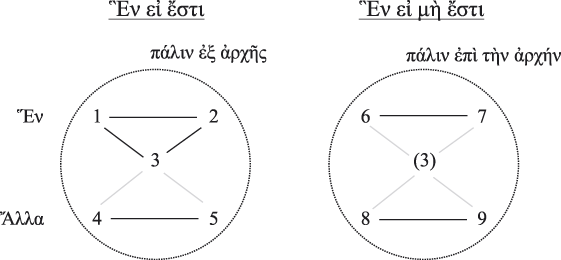
Now, if the perspective changes so imperceptibly, one might want to know how this is effected. I suggest that the very special role of the third deduction is that of providing the principle that allows for the changing of perspective, which is necessary for understanding all deductions, including itself. And the principle I have in mind is, as was to be expected, the unexpected moment which interrupts the flow of time (and of a sustained argument evolving in it) with sudden visions of contrary, and even contradictory, insights. If so, then the asymmetry of the second part of the Parmenides is more apparent than real. For if the third deduction is the point where the results of the first two deductions converge and become somewhat synthesized, it may be assumed that it retrospectively becomes the centre from which all deductions, both those resulting from the affirmative hypothesis and those resulting from the negative hypothesis, stem. The special role of the third deduction in the overall scheme of the dialectical exercise would then be similar to the centre in relation to the periphery of a circle.Footnote 32 Its results must be assumed as implicitly present, though unmentioned, also in the deductions that follow from the negative hypothesis (i.e., 6 to 9). The whole idea can be summarized in the following figure, where black lines indicate explicit, and grey lines implicit, relations:
The symmetrical asymmetry of the Parmenides’ dialectical exercise under the assumption of the central role of the third deduction

Deductions 2 and 5 consider consequences for the One and things other than the One, respectively, that are contrary, nay contradictory, to those reached in deductions 1 and 4, respectively. The same relation holds between deductions 7 and 9 vis-à-vis deductions 6 and 8, respectively. But it is not told in the dialogue what has caused those contradictions. The sole deduction that stands out in the dialectical exercise as a whole by shattering the perfect symmetry of the remaining eight deductions is the third. For, first, it does not correspond to a contradictory deduction, and, second, it synthesizes results independently reached in earlier deductions. This should be clear in the case of the five deductions that stem from the affirmative hypothesis “if the One is”, even if one would not go so far as to assume its implicit presence also in the four deductions that stem from the negative hypothesis.
2.4. Authorities
The interpretation of the symmetrical asymmetry of the second part of the Parmenides that I have put forward in the previous section is inspired by Damascius’ understanding of the pivotal role of the third deduction for the interpretation of the dialectical exercise as a whole. Proclus, before him, thought that the third deduction is central for the correct interpretation of the five deductions stemming from the affirmative hypothesis “if the One is”.Footnote 33 But Proclus considered the negative four deductions as reductiones ad absurdum. Damascius, by contrast, believed that two of those four deductions refer to extant things and only the remaining two point to the impossible; and he regarded the referent of the third deduction as implicitly present in all eight.Footnote 34 In line with common Neoplatonic tendency, Damascius thought that a different referent should be ascribed to each deduction but he disagreed with his predecessors about the precise referent of the third deduction. For him the third deduction refers to the particular human soul as it transmigrates in and out of generation (In Parm. IV, 3.8-4.19; cf. I, 32.17-22). I have not followed him in believing that a different referent should be ascribed to each deduction but I have tried to see what truth there is in his insight about the pivotal role of the third deduction for the proper understanding of the dialectical exercise as a whole.
The interpretation of the symmetrical asymmetry of the second part of the Parmenides that I have put forward in the previous section, though reached without the help of modern authorities, can still be retrospectively supported by two rather prominent figures. The first is George Grote; the second is Martin Heidegger.
In the second volume of his Plato and the Other Companions of Sokrates, Grote wrote (1865: 310-311):
The theory here laid down in the third Demonstration respecting this extra-temporal point—the Suddenly—deserves all the more attention, because it applies not merely to the first and second Demonstration which precede it, but also to the fourth and fifth, the sixth and seventh, the eighth and ninth, which follow it. I have already observed, that the first and second Demonstration form a corresponding pair, branching off from the same root or hypothetical proposition (at least the same in terms), respecting the subject Unum; and destined to prove, one the Neither, the other the Both, of several different predicates. So also the fourth and fifth form a pair, applying to the subject Cætera; and destined to prove, that from the same hypothetical root—Si Unum est—we can deduce the Neither as well as the Both, of various predicates of Cætera. When we pass on to the four last Demonstrations, we find that in all four, the hypothesis Si Unum non est is substituted for that of Si Unum est: but the parallel couples, with the corresponding purpose, are still kept up. The sixth and seventh apply to the subject Unum, and demonstrate respecting that subject (proceeding from the hypothesis Si Unum non est) first the Both, then the Neither of various predicates: the eighth and ninth arrive at the same result, respecting the subject Cætera. And a sentence at the close sums up in few words the result of all the four pairs (1-2, 4-5, 6-7, 8-9, that is, of all the Demonstrations excepting the third)—the Neither and the Both respecting all of them.
To understand these nine Demonstrations properly, therefore, we ought to consider eight among them (1-2, 4-5, 6-7, 8-9) as four Antinomies, or couples establishing dialectic contradictions; and the third as a mediator between the couples—announced as if it reconciled the contradictions of the first Antinomy, and capable of being adapted, in the same character with certain modifications, to the second, third, and fourth Antinomy. Whether it reconciles them successfully—in other words, whether the third Demonstration will itself hold good—is a different question. It will be found to involve the singular and paradoxical (Plato’s own phrase) doctrine of the extra-temporal Suddenly—conceiving Time as a Discretum and not a Continuum (author’s italics).
No comments are needed to highlight the convergence of Grote’s view to the interpretation I have provided here.
Let’s proceed to Heidegger. In the winter semester of 1930-1931 at the University of Freiburg, he gave a seminar entitled “Plato’s Parmenides”.Footnote 35 The seminar was intended for advanced students and was conducted in collaboration with the classical scholar Wolfgang Schadewaldt (who later became famous primarily for his Homeric studies). A 24-page transcript of this seminar, most probably taken by Herbert Marcuse himself, survives at the Herbert Marcuse Archive in the university library of Frankfurt am Main. Though Schadewaldt’s role in this seminar has not been clarified to satisfaction, the style and content of the surviving text leave no doubt that the author was Heidegger.
According to his interpretation of the dialogue, the second part of the Parmenides is neither an exercise in logic nor a piece of dialectic that aims to bring into high relief the deep-seated aporias concerning the one-many problem: it contains, rather, a positive doctrine or at least a profound insight towards the solution of the one-many problem that appears as the so-called third-man argument in the first part of the dialogue (131e8-132b2). For him the so-called third-man argument of the Parmenides indicates that Plato was well aware of what is for Heidegger the radical, and extremely bewildering, difference between Being (Sein) and beings (das Seiende). What is important for my much more limited purposes is the fact that Heidegger considered the dialogue as a whole to be culminating in the third deduction, which he calls the “core of the entire dialogue” and the “utmost point that Plato attained in a positive way”.Footnote 36 What prompted him to find in the third deduction the culmination of the Parmenides as a whole is the temporality of the One which is there present through the notion of the sudden (translated by Heidegger as der Augenblick). Presumably, he thought that Plato’s standard theory of Forms underwent a radical revision in the Parmenides as a result of the insight that the unity of Being cannot be absolutely unrelated to the plurality of beings which are essentially, rather than merely contingently, bound up with time. For him the Platonic ἐξαίφνης, precisely because it is not in time, manifests the essence of time. “As to the exaiphnês, we say it is time itself. Time is not eternity but rather the instant [Augenblick]”, he writes.Footnote 37
Although I, for my part, would not formulate the relationship of the sudden to time in such a straightforward way, the relevance of this view to what has been argued for in the first part of this paper must be evident. But much more relevant to the main thesis of the second part of this paper is the central role of the third deduction for the interpretation of the Parmenides as a whole, a role for which both Grote and Heidegger argued, notwithstanding their strikingly different approaches to Plato’s dialogues.
3. Conclusive Remarks
Whereas in the Symposium and the Seventh Letter the sudden moment is approached from the perspective of a subjective experience, in the Parmenides it is seen objectively from the perspective of time itself. For there must be something in the very structure of time, Plato must have thought, which allows the overcoming of time that is implied in mystical experiences of the sort Plato envisaged when, outside the Parmenides, he opposed methodical accumulation of knowledge to abrupt understanding.
According to the interpretation put forward in this paper, Plato came to see that the present must have two distinct aspects to each of which a specific technical term could be assigned: the first is the now (νῦν), the second the sudden rupture implicit in the smooth flow of time which allows things to shift from process to state and vice versa. For this last aspect Plato devised the notion of τὸ ἐξαίφνης (exaiphnês). Both aspects of the present imply, when seriously considered, timelessness. But they do not imply it in the same way. (For timelessness per se Plato introduced αἰών, and coined αἰώνιος in accordance with, and juxtaposition to, ἀίδιος.) The present qua νῦν stands in direct relation to atemporal eternity and Being; in it things can only be what they are: they do not become—they just are. The present qua ἐξαίφνης, by contrast, signifies the timeless aspect of time and the dependence of Becoming on Being. It was, therefore, the problem of methexis, i.e., the perplexing relation of eternal Forms to the ever-changing world of time, that led Plato to the introduction of the notion of the sudden.
Plato was seriously perplexed by the nature of time and its relation to eternity for reasons that lie at the very core of the theory of Forms. Though, or rather because, time was formally seen as a continuum, hence as infinitely divisible, time was for him a porous structure that could host Becoming as an image of Being. Let me substantiate the claim with an argument that is nowhere present in Plato’s dialogues but can be deduced from what is found there.
If time is a continuum it must be infinitely divisible. But a sort of extremely dense continuum that is practically indivisible is also thinkable. The notions of the continuum and of infinite divisibility are clearly distinct even though in habitual thought the latter always attends the former and the former seems to logically imply the latter. Now, imagine that time was indeed such an indivisible continuum. Such a time would be endless duration of the same. For it would not possess in its structure any feature (or fissure!) that would allow things to change. Plato’s time is not such. Though an image of eternity it is the factor par excellence of change.
There are two ways in which time is related to timelessness as a copy to its prototype: one is through perpetuity and the other through the present. The endlessness of time guarantees the instantiation of all Forms and all possible combinations of Forms in the sensible realm. The endlessness of time allows for no unrealized possibilities. Seen in this way time as a whole contains all there is to be. But can instantiation of Forms be achieved unless time itself permits instant relation to atemporal reality? The relation of intelligible Being to time, I have suggested, is effected by means of a feature of time which is not part of it qua continuum: the endlessly present possibility of a rupture of continuity. It is the presence of the present moment that distinguishes time from a line, in which no point is more prominent or more actual than any other. And it is through the present moment that time is vertically related to timeless eternity and allows temporal instantiation of Forms as well as atemporal contemplation.
I have suggested that the sudden moment spoken about in the Parmenides makes the picture of time that is found in the Timaeus more complex and varied, since the sudden moment introduces an unpredictable element in temporal flow, not explicitly anticipated by the teleological account of the Timaeus cosmogony. The statement that “time is an image of eternity”, as Timaeus claims it to be, should not be taken only in the sense that the eternal and self-same revolutions of the heavenly bodies imitate the atemporal permanence of the intelligible realm; it should also be taken in the further sense that those predictable revolutions, and the events they host or allow to occur, intermittently display important aspects of the intelligible world at unpredictable times and unexpected moments. The sudden moment, on the interpretation here advanced, is not the timeless present of eternal truths but the temporal condition which allows those truths to manifest themselves in time and to be known by temporal beings such as we are. And because for Plato the eternal truths par excellence were the Forms, the sudden moment would be what allows our temporal souls to really grasp some Form or other, either with or without the help of an earthly instantiation, in unexpected moments of abrupt illumination.
From what I have said so far it must be obvious that the Platonic ἐξαίφνης is neither identical with the Aristotelian homonym, which is an imperceptible duration,Footnote 38 nor the same as the adverb of everyday speech, though of course it is related to both. Also it is not the present now (νῦν) as commonly and naively conceived. It may reasonably be said to be the same as the Aristotelian νῦν,Footnote 39 though such an equation misses the unexpected character of the sudden moment which Plato wished to underline. The Platonic ἐξαίφνης is a technical term devised for a particular purpose by the addition of an article to a rather common adverb of everyday speech. The function it performs is highlighting the very possibility of new births and creations, new deaths and annihilations, as an indispensable, though paradoxical, feature of the structure of time. Contrary to what Aristotle later thought, when he approached time more as factor of decay than flourishing,Footnote 40 time in the Parmenides, on my interpretation, is filled with an indefinite number of unexpected possibilities. But all those possibilities stem from the always already actual fullness of Being, i.e., the realm of eternal Forms. The present is that feature of time, which allows, to paraphrase Blake, the marriage of time with eternity. In its two aspects as the now and the sudden the present is the link between two apparently incommensurable realms.
The significance of the discovery of the sudden moment as an aspect of the present that is distinct from the now moment is highlighted, I have suggested, by the very special role that the third deduction occupies in the intellectual drama of the second part of the Parmenides. Being a synthesis of results independently reached in the earlier two deductions but more intimately related to the temporal One of the second deduction than the timeless One of the first, the third deduction shows the paradoxical existence of an extra-temporal feature that must be assumed as present in the very structure of time if the antinomy created by the earlier two deductions is to be resolved. The mediating role of the sudden moment introduced therein, I have further suggested, should be thought of as implicitly present in, and applicable also to, the pairs of deductions that follow the third under both the affirmative hypothesis “if the One is” and the negative hypothesis “if the One is not”.
In sections 1.2-1.4, I have claimed that Plato thought that the very nature of time was such that, its smooth flow notwithstanding, it provided openings to the timeless realm. In section 1.1, I have also implied that for him the nature of the human soul was such that it managed, in sudden moments, to catch glimpses of the atemporal world and integrate them in its temporal life. The happy coincidence of these two factors, namely the essential opening of time and the no less essential openness of the human soul, would permit knowledge of the basic principles of reality to reach our earthly abode. It would also provide us, readers of the Parmenides, with the primary locus of that changing perspective that is so badly needed if all the deductions are to be most true, as the unsophisticated Aristotle states with the unpretentious innocence of his uncontaminated youth.
Acknowledgements: I would like to thank the participants in the conference on Plato’s Parmenides held in Chania (Crete), 26-29 September 2011, in particular Jean-Michel Charrue, Mary Louise Gill, and Constance Meinwald, as well as the audience of a seminar organized by the Research Centre for Greek Philosophy at the Academy of Athens (29 February 2012), in particular Panos Dimas, Paul Kalligas and Doukas Kapantais, for their objections and suggestions. I am also grateful to the organizers of those meetings, Sylvana Chrysakopoulou and Maria Protopappa, respectively, for their invitation and hospitality. Panos Dimas and Kyriaki Goudeli have also read, and commented upon, an earlier draft of this paper. I am particularly thankful to both. Last but not least, I would like to express my gratitude to Benoît Castelnérac, Cécile Facal and Jill Flohil for their editorial care.